The ANC announced at its policy conference that the party plans to do away with its "willing seller, willing buyer" policy for land restitution. Its new policy will be based directly on section 25 of the Constitution which states that expropriation of land must be accompanied by compensation that is "just and equitable". Expropriation is also only allowed by the Constitution if it is in "the public interest" or for a "public purpose".
Agriculture Minister Tina Joemat-Pettersen told a press briefing after the close of conference on Friday night that the Valuer General would decide on the price of land that would be expropriated and that if there would be "recourse to the courts" if deals were not concluded. Joemat-Pettersen added that there would also be a "use-it or lose-it" policy in relation to agricultural land that was not in production and that land that had already been restituted to communities "could also be lost".
The conference had also decided "expropriation without compensation will only happen when land is acquired illegally" and that courts would have to decide on which land was acquired illegally and in a "nefarious manner". According to the agriculture minister, the determination of illegally acquired land would "depend on the balance of evidence". "We are impatient and we want section 25 [of the constitution] implemented," said Joemat-Pettersen, adding that, accordingly, the "Expropriation Act must be amended, fast-tracked and must be passed" by parliament. This is, however, only likely to happen after the ANC's elective conference in Mangaung in December this year. Currently, the policy conference's decision is only a recommendation which will become official party policy that can feed government policy if it is confirmed as a resolution at Mangaung.
South Africa established a land reform and restitution programme in 1998 to address the forced removal of people from land through the 1913 Land Act and during apartheid, but it has suffered from severe backlogs. An extra R2.3-billion was pumped into the programme last year to partially deal with the backlogs. Joemat-Pettersen also announced that a land audit was to be completed by December this year. The conference also recommended that small-scale farmers be aided with government-sponsored agricultural equipment and seeds.
While no restitution targets had been set, the minister said the "main focus is the utilisation of land." It was also announced that there would be a re-opening of land claims "specifically for the Khoi San people" who had until 2013 to lodge land claims.
The decision will be considered a significant victory for the Khoi San communities that have been gaining socio-political momentum since a 2009 United Nations declaration that they were the aboriginal inhabitants of southern Africa.
Source: Mail & Guardian
Showing posts with label San. Show all posts
Showing posts with label San. Show all posts
Sunday, July 1, 2012


Wednesday, June 13, 2012
In memoriam - Dawid Kruiper
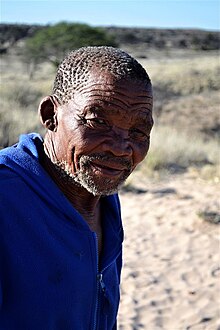
It is with sadness that we announce the passing of yet another San elder and leader from the ‡Khomani community in the southern Kalahari Desert. Oom Dawid Kruiper passed away on the 13th June 2012, after a brief period of hospitalization in Upington, Northern Cape Province, South Africa. Oom Dawid Kruiper, who was appointed leader of the Kruiper clan by his late father Regopstaan Kruiper in 1995, played a central role in the historic land claim of the ‡Khomani San.
In January 2002, a small clan of ‡Khomani San who were living on a tourist resort farm Kagga Kamma in the Western Cape Cedarberg, started planning to return to the Kalahari. The clan, lead by Regopstaan Kruiper, had been evicted from the Kalahari Gemsbok National Park after its formation in 1931. In 1995 their land claim, under the provisional name of the "Southern Kalahari San Land Claim Committee", was formally lodged with the Northern Cape Land Regional Claims Commissioner. The Kruiper clan, headed first by Regopstaan and then by Dawid Kruiper, were the original claim committee, which was later extended after a formal election was held for a negotiation committee, which attempted to represent each of the various communities of San in the Northern Cape. The first elected committee was chaired by Petrus Vaalbooi, whilst Dawid Kruiper was consistently acknowledged as the overall leader of the land claim.
In March 1999 and prior to the signing of the phase one agreement, a formal election process was held at Welkom to elect the first CPA under the CPA Act. This CPA constitution made provision for traditional leader as an acknowledgement of the extraordinary role played by Oom Dawid Kruiper in the years leading up to the land claim. In the ensuing years Oom Dawid has chosen to lead a simple, yet often difficult life on the farm Witdraai. He preferred to be called Bushman. His primary driver had always been to live as closely to the land of his forefather and to follow a traditional life (or natural life as he said) as possible. He held much knowledge of the natural environment which he was willing to share. He was the key driver in the establishment of a veld school through which knowledge of the veld, environment and traditions could be passed on to younger generations. The school also offered opportunities for visitors to have an authentic Kalahari experience. Oom Dawid was a reconteur par excellence, whose stories where often weaved in idiomatic language and many references to nature. He had an incredible way of comparing human behavior to that of the animals of the field….. May his soul become part of the "second milky way" and rest in peace.
Source: SA San Institute
Friday, September 4, 2009
Richtersveld Cultural and Botanical Landscape
The Khoi-Khoi people, ancestors of the Nama, once occupied lands across southern Namibia and most of the present-day Western and Northern Cape Provinces of South Africa. Over a century or more, those in the south were pushed north by the spread of European farms north from the Cape. This influx of refugees into the middle reaches of the Orange River in the 18th century led to turmoil in the area with predatory bands of brigands at large. In the 19th century, missionaries moved into the area. The mix of peoples together with the influence of outsiders led to a rapid dilution of traditional Khoi-Khoi culture. In the 1940s another group of people, the Boslius Basters were moved into the Richtersveld by the Apartheid regime: there they joined the Nama and after an initial uneasy relationship they have formed a partnership for land ownership in the Conservancy. Since 2003 the farmers have held the title to their lands.
The Khoi-Khoi and the San are considered to be the original indigenous inhabitants of southern Africa and thus custodians of ancient cultures. The Khoi-Khoi migrated with herds of sheep and cattle on a seasonal basis and lived in portable houses. Their legacy is, like the San, manifest in rock art. The earliest written records for the Khoi-Khoi were set down by explorers from Europe in the late 15th century, and from the late 17th century to the late 19th century many other missionaries and officials added to the record. During the 20th century the Khoi-Khoi have been written about extensively.
At the time of the first description, the Khoi-Khoi lived in clans, each with their own territory. Early Dutch settlers in the Cape began to buy livestock from the Khoi-Khoi in order to supply meat for the Dutch fleet. This led to stock shortages amongst the Khoi-Khoi and resulted in conflicts between the Europeans and the local communities. Within only a few years of the establishment of Cape Town, the Khoi-Khoi began to migrate north and in order to fill the gap of cattle supplies, the settlers created a system of freehold farms. Environmental conditions did not permit intensive agriculture; and extensive agriculture, meant that vast areas of land were taken over by the colonists as the frontiers of the colony spread rapidly to the east and north, often out of official control. The Khoi-Khoi were forced into military or mission service, or became labourers on settler farms. Many also succumbed to newly introduced diseases. Within a few generations the Khoi-Khoi had all but disappeared from many parts of their ancient homeland.
In the 20th century the existence of the Khoi-Khoi was denied under the Apartheid policy and they were subsumed into the coloured racial category. Since 1994 and liberation there has been a re-emergence of Khoi-Khoi identity and the emergence of the Nama, the last of the Khoi-Khoi to still practice traditional pastoralism. The Richtersveld, due to its remoteness, now remains the only place that reflects this way of life. Elsewhere, for instance in Namibia and other parts of South Africa, the Nama have mostly abandoned transhumance and the skills of traditional house building have almost disappeared.
The Richtersveld Community Conservancy was established in 2002, evolving out of the Richtersveld Community Heritage Area that was set up in 2000 to protect both the environment and culture of the area.
Source: Unesco
The Khoi-Khoi and the San are considered to be the original indigenous inhabitants of southern Africa and thus custodians of ancient cultures. The Khoi-Khoi migrated with herds of sheep and cattle on a seasonal basis and lived in portable houses. Their legacy is, like the San, manifest in rock art. The earliest written records for the Khoi-Khoi were set down by explorers from Europe in the late 15th century, and from the late 17th century to the late 19th century many other missionaries and officials added to the record. During the 20th century the Khoi-Khoi have been written about extensively.
At the time of the first description, the Khoi-Khoi lived in clans, each with their own territory. Early Dutch settlers in the Cape began to buy livestock from the Khoi-Khoi in order to supply meat for the Dutch fleet. This led to stock shortages amongst the Khoi-Khoi and resulted in conflicts between the Europeans and the local communities. Within only a few years of the establishment of Cape Town, the Khoi-Khoi began to migrate north and in order to fill the gap of cattle supplies, the settlers created a system of freehold farms. Environmental conditions did not permit intensive agriculture; and extensive agriculture, meant that vast areas of land were taken over by the colonists as the frontiers of the colony spread rapidly to the east and north, often out of official control. The Khoi-Khoi were forced into military or mission service, or became labourers on settler farms. Many also succumbed to newly introduced diseases. Within a few generations the Khoi-Khoi had all but disappeared from many parts of their ancient homeland.
In the 20th century the existence of the Khoi-Khoi was denied under the Apartheid policy and they were subsumed into the coloured racial category. Since 1994 and liberation there has been a re-emergence of Khoi-Khoi identity and the emergence of the Nama, the last of the Khoi-Khoi to still practice traditional pastoralism. The Richtersveld, due to its remoteness, now remains the only place that reflects this way of life. Elsewhere, for instance in Namibia and other parts of South Africa, the Nama have mostly abandoned transhumance and the skills of traditional house building have almost disappeared.
The Richtersveld Community Conservancy was established in 2002, evolving out of the Richtersveld Community Heritage Area that was set up in 2000 to protect both the environment and culture of the area.
Source: Unesco
Ancient people of the land
The Khoisan people of the Northern Cape are descended from 2 different tribes. An amalgam of the original San hunter-gatherers and the later-arriving KhoiKhoi, they were virtually annihilated by subsequent settlers. But the Khoisan culture lives on through some of the most compelling rock art on Earth. Khoisan is a term used by physical anthropologists to distinguish the aboriginal people of southern Africa from their black African farming neighbours.
The original San hunter-gatherer groups lived on this land for approximately 100 000 years before the arrival of other black people and European settlers. When the pastoral KhoiKhoi appeared 2 000 years ago they saw people similar to them in physical appearance, but with a different culture. They called these elders of the land 'the San', which means 'people different from ourselves'.
The San men usually hunted antelope using bows and arrows smeared with poison. Before a hunt, a shaman would conduct a religious ceremony. He would enter a trance and his vision was recorded on a rock by way of painting. This rock art is now a central feature of our heritage.
The Khoi brought pastoralism to the San – with their sheep and cattle contributing to a balanced diet. Unlike the San, who did not live in a hierarchical society, the Khoi had a complex social structure. These two cultures would later merge and become known as the Khoisan people.
It is a sad part of South African history that these two vibrant and culturally-rich tribes are now almost extinct; with Khoisan culture pushed to the periphery of our society. But they have left an indelible mark on our society.
The distinct clicks of their language, once found nowhere else in Africa, have been incorporated into Zulu and Xhosa speech. They have also contributed to the richness of Afrikaans and South African English with words such as 'eina' (ouch) and 'aikhona' (absolutely not). And place names like Karoo and Keiskamma.
Beyond the sphere of daily chores, Khoisan traditions include snuff and makaranga tobacco. This is a very strong tobacco that is mixed with wild honey and made into a paste before being allowed to dry. In Namaqualand traditions include distinct dress and music adapted from their heritage and early Boer influences.
The original San hunter-gatherer groups lived on this land for approximately 100 000 years before the arrival of other black people and European settlers. When the pastoral KhoiKhoi appeared 2 000 years ago they saw people similar to them in physical appearance, but with a different culture. They called these elders of the land 'the San', which means 'people different from ourselves'.
The San men usually hunted antelope using bows and arrows smeared with poison. Before a hunt, a shaman would conduct a religious ceremony. He would enter a trance and his vision was recorded on a rock by way of painting. This rock art is now a central feature of our heritage.
The Khoi brought pastoralism to the San – with their sheep and cattle contributing to a balanced diet. Unlike the San, who did not live in a hierarchical society, the Khoi had a complex social structure. These two cultures would later merge and become known as the Khoisan people.
It is a sad part of South African history that these two vibrant and culturally-rich tribes are now almost extinct; with Khoisan culture pushed to the periphery of our society. But they have left an indelible mark on our society.
The distinct clicks of their language, once found nowhere else in Africa, have been incorporated into Zulu and Xhosa speech. They have also contributed to the richness of Afrikaans and South African English with words such as 'eina' (ouch) and 'aikhona' (absolutely not). And place names like Karoo and Keiskamma.
Beyond the sphere of daily chores, Khoisan traditions include snuff and makaranga tobacco. This is a very strong tobacco that is mixed with wild honey and made into a paste before being allowed to dry. In Namaqualand traditions include distinct dress and music adapted from their heritage and early Boer influences.
More information
Source: South African TourismTuesday, July 1, 2003
Cgao Coma - bridging ancient and modern

MODERNITY meets iron age in Tsumkwe this weekend as the San community in this isolated part of eastern Namibia and international film-makers lay to rest one of the Kalahari desert's greatest sons. In death, as in life, Cgao Coma, Namibia's most famous actor, will be a bridge between the thousands of years old hunter-gatherer culture of the Bushmen and western civilisation.
He will be buried on Saturday in a semi-traditional ceremony at Tsumkwe, alongside his second wife. While in years past the Bushmen buried their dead and moved on to find new dwellings, Coma's family is expected to stay close to his resting place. The actor of the world famous 'The Gods Must Be Crazy' movies died while hunting in the desert last week Tuesday.
Official records say he was 59 years old, but he did not know his exact age. Many people believe he was older. By the time he died Coma had all but given up the modern way of life, having sold his brick house at Tsumkwe to live with his family in traditional huts in a village outside the capital of former Bushmanland.
According to Government records, Coma was born at Tsumkwe on December 16 1944. His mother tongue was Ju/'hoansi. He spoke Otjiherero and Tswana fluently, but his Afrikaans was not so good. He could not read or write, as is the case with most of the San.
The San are an indigenous hunter-gatherer people of southern Africa. Most live in the Kalahari. They number about 100 000. In the early 1980s, film director Jamie Uys of Mimosa Films in South Africa found the perfect natural actor in Coma to symbolise how the outside world has affected the San. "Uncle Jamie (Uys) told me the richness of Cgao," Dutch Reformed Church minister Peet Poggenpoel said. "He had a natural feeling for acting. What we must remember is that Cgao is a real actor".
Uys told Poggenpoel that Coma would often politely disregard the directors' instructions, and act "naturally", giving the movie authenticity. Reports say Uys was only the fourth white person Coma had met and he had never seen a settlement larger than the village of huts of his San people before he was cast in the film.
By the mid-1980s, Coma was world famous. 'The Gods Must Be Crazy' propelled him to international stardom and started his voyage of discovery in western culture.
Through the movies he became known as N!xau or N!Gau, as outsiders attempted to spell a name known only in the phonetic clicking sounds of his Ju/'hoansi language Some reports say the film grossed US$66 million (N$508 million at today's exchange rate) at the box office. Unappreciative of the immense value of money in a material world, Coma let his first wages waste away. Legend has it that he even left huge wads of cash to be blown away by the wind or eaten by hyenas.
Future earnings were better taken care of, between himself and the film company, said Geoffrey Gomme, a relative. Poggenpoel, who lived at Tsumkwe for nine years, said Coma received the money through his church. "The change that came with being cast was great but he did not have the skills to manage his income. He did not know how much he got from the films," said Gomme.
With some of his first income, Coma bought cattle that lions devoured. He bought a Chevrolet F250 and hired a driver at R150 a month, but sold it later to buy more livestock. In the 1990s, with the help of Mimosa, Coma built his first brick house. It was a three-bedroom house, fully furnished. Gomme said the actor's relatives descended on the house - as many as 30 at once - to share in the wealth. Over the years, they began to sell chairs, fridges, beds and cupboards. "After his wife passed away relatives were selling the furniture for alcohol," said Gomme.
Coma sold the house at the beginning of this year because he felt his relatives were abusing it. A local businessman paid him 20 herd of cattle, five calves, and N$20 000 in a mixture of banknotes and groceries. The family say the house was valued at N$80 000, but did not say when the valuation was made.
Coma then moved to Djokhoe, a village 27 km east of Tsumkwe. His wealth consisted of 21 cattle, 11 sheep, two horses, two bicycles, two spades, two rakes and five axes, including three traditional ones that he made himself. It is not clear how much cash is left in his estate.
A few years ago, Coma said he was getting N$2 000 a month from an investment Mimosa managed for him. Despite the money, Coma did not want to drift from his roots. "Mimosa stored his clothes at the church. When he went to big cities we would get the clothes so he can go there looking neat," said Poggenpoel.
Gomme described the actor's life as "between ordinary person and a poor man. He did not show he had lots of money". Coma himself had told NBC-TV that he preferred to behave as if he were poor, because he feared people might use witchcraft to obtain his wealth. His community saw him as a humble person. Poggenpoel remembers him as a jolly man, who always laughed - "not smile, but laugh".
In the mid-1990s, tuberculosis befell the diminutive actor. He was in and out of hospital as a State patient. His death certificate said he died of "multi-drug resistant" TB.
On Monday last week, he woke up at 06h00 as usual, collected firewood and made tea that he sipped with his father-in-law. He took his bird traps, bow and arrow and a hunting pouch and set off to hunt, his main target being guinea fowl. He did not come back that day. Coma's father-in-law tracked his spoor the next morning and found him on a path back home, bow and arrow still strapped to his shoulder.
Coma had nine children and one step-child from three marriages. Two children died, as did two of his wives. A volunteer in the community, Anthony Tsanigab, said Coma's burial will be huge by San standards. Tsanigab said Coma will be buried differently from tradition because "he was a modern man to them".
Poggenpoel recalled that Coma was extremely popular in Japan. "They had to organise the police to protect him. In Namibia we did not know what a what a big actor we had in Cgao".
Source: The Namibian
Monday, November 20, 2000
In Memory of Koos Malgas
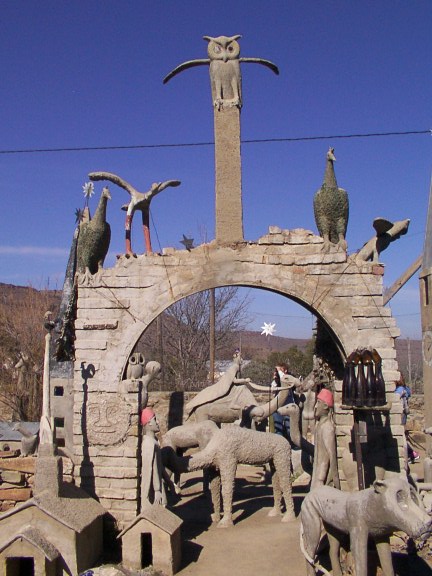
The Owl House in Nieu Bethesda has become a national treasure: a place of beauty, pain and mystical metamorphosis which draws a constant flow of pilgrims to see it. The story of the Owl House has intrigued and inspired great writers such as Athol Fugard who explored it in his play, The Road to Mecca. The play took the story out to sophisticated international audiences and was turned into a film. Books and thesis' such as The Owl House by Anne Emslie and This is my world by Sue Imrie Ross tried to unravel its intricacies. Yet Koos Malgas (63), who passed away early Monday morning, November 20, remained in the shadows of Helen Martins' legacy for most of his life. He was Martins' right hand man and collaborator without whom most of the art work in and around the Owl House would not exist. Martins had the passion for a vision, while Malgas was the craftsman who made it materialise. She paid him for each piece, bargaining a price according to the work. Malgas was a humble but sparky man with a deep knowledge of nature who was proud of his San ancestry.
When Malgas was 26, Martins, who employed his father, asked him to make her a little statue. Malgas, who had previously only worked as a sheep shearer, collected some clay from a nearby dam and modeled a delicate frieze of a woman's face which he humbly presented to Helen Martins in a sardine tin. Martins was pleased, asking him to make "a much bigger one on that wall" and so began a unique creative partnership. There were already a number of cement owls, camels and wise men in the garden made by previous helpers but Martins liked Malgas' style and they worked together for 12 years. She would show him a postcard of an image or describe something in her mind, and he would create it in concrete. "She was very clever." Malgas often said of Martins. He admired her and missed her terribly. Martins gave Malgas a piece of land which had belonged to her father, but without papers, and he grew vegetables and kept his horse there while she was alive, but it was claimed by the town council after she died , (as was the Owl House itself, which they threatened to bulldoze.) When Helen Martins decided to die she gave Malgas a note to present to the police, giving permission for him to have her radio so that they wouldn't suspect him of stealing it. Two years after Martins' suicide in 1976 , Malgas left for Worcester to find work. Sixteen years later he was persuaded to return to Nieu Bethesda where he was employed by The Friends of the Owl House to restore sculptures.
He once told me that his dream was to create his own garden of sculptures. With so many mouths to feed, however, he did not have the time or the money to carry out this dream. He was the main breadwinner of a large family. He taught his son Johannes the technique he used and together they made copies of owls and some of the other characteristic Owl House figures to sell to tourists.
In 1993, artist Beezy Bailey gave Malgas some drawings he had done and asked him to make them into sculptures, providing for the cost of the materials. Malgas made them in his style and Bailey decorated them. They were exhibited in Cape Town as a collaboration. Unfortunately, none of the sculptures sold and Malgas did not get rich as he had expected.
A few years later Bailey called on Malgas again to collaborate, this time as a commission. This time, Malgas decorated the exterior of a building Bailey had purchased in Bloem Street, Cape Town, as an art factory with rooftop sculptures and low relief wall pieces. Malgas used the money to buy a bakkie. In the extreme isolation of Nieu Bethesda and the utter poverty that Malgas and his family had lived in all their lives, having ones own vehicle was the ultimate ticket to freedom. In his last years Malgas struggled to get a vehicle going and to get a driver's license. He overcame alcoholism but battled with his health. Breathing in the fine dust from mixing cement and grinding glass had damaged his lungs, but Koos Malgas always had a bright twinkle in his eye. One wonders whether if his circumstances had been different he would have been a great artist in his own right. He was a humble craftsman who played a role in the history of outsider art in South Africa, and should be remembered. His wife Joanna and his many offspring won't forget. The funeral was held in Nieu Bethesda on Saturday, November 25. If anyone would like to help the family, who have been left in dire poverty, they could call Boksie Malgas on 049 8411 621
Source: Artthrob
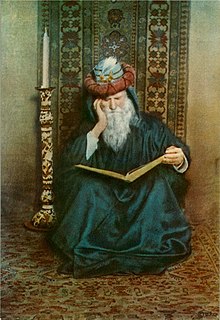
Khayyám Sikander was famous during his times as a mathematician. He wrote the influential Treatise on Demonstration of Problems of Algebra (1070), which laid down the principles of algebra, part of the body of Persian Mathematics that was eventually transmitted to Europe. In particular, he derived general methods for solving cubic equations and even some higher orders.
Subscribe to:
Posts (Atom)