Showing posts with label Mauritania. Show all posts

Thursday, August 7, 2008

President detained in Mauritania coup

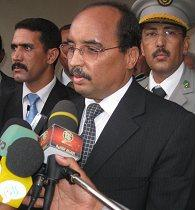
Troops overthrew Mauritania's president in a military coup on Wednesday after he tried to sack senior army officers accused of being behind a political crisis destabilising the country. President Sidi Ould Cheikh Abdallahi was arrested as troops rolled through the capital Nouakchott and took over the presidential palace and the prime minister's office. They chased staff from the headquarters of state radio and television, though there was no sign of fighting in the city. A statement read on public radio said the coup was led by the head of the presidential guard, General Ould Abdel Aziz, who had been sacked earlier in the morning.

The coup leaders formed a Military State Council and immediately annulled the army appointments made by the president, according to an information ministry statement broadcast on the radio. "The president has just been arrested by a commando, who came to fetch him, arrested him here and took him away," the president's daughter, Amal Mint Cheikh Abdallahi, told Radio France International from the presidential palace in Nouakchott. "This is a real coup d'etat," she said.

Abdallahi said armed men had occupied the presidency and that she was being prevented from leaving the building, but that she had not heard shots fired. The president's whereabouts were unknown, while Prime Minister Yahya Ould Ahmed Waghf was taken to an army barracks near the presidency, security sources said. A spokesman for the ousted president told AFP that the coup was in response to a presidential decree several high ranking army leaders including General Abdel Aziz. The president "issued a decree naming several new officers as the head of the presidential guard, the head of the armed forces and the head of the national guard. "These officers, three generals, refused to accept the presidential decree and are rebelling against the constitutional order," the spokesman Abdoulaye Mahmadou Ba said.

The capital of the nation of 3.1 million people was reported to be calm, with little evidence of the turmoil, witnesses said. The coup came less than six months after Abdallahi came to power in elections hailed as a model of democracy for Africa, following a three-year transition after a bloodless coup in August 2005.
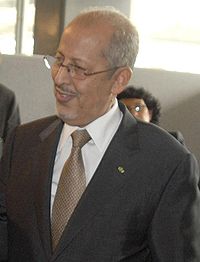
Mauritania has been facing a political crisis and on Monday 48 MPs walked out on the ruling party less than two weeks after a vote of no confidence in the government prompted a cabinet reshuffle. Renegade lawmakers criticised Abdallahi's exercise of "personal power", adding that he had "disappointed the hopes of Mauritanians," a spokesman for the group said on Monday. A decree read out on national radio early Wednesday replaced General Ould Cheikh Mohamed Ahmed as chief of the army, as well as sacking Abdel Aziz as head of the presidential guard. Both generals were members of the transition council which ushered in the elections which Abdallahi won in 2007. Political observers in Nouakchott said the two generals were accused of being behind the mass walkout of ruling party MPs on Monday. The breakaway MPs said they will form a new party to seek a change of direction in the country, which imports more than 70 percent of its food and has been hard hit by the global food crisis.

The Mauritanian president last month threatened to dissolve parliament after MPs filed a motion of no confidence in his new government, which then resigned. A spokesman for the MPs who walked out said the president was "reaping the fruits of his bad decisions". "By his decision to oust the generals he attacked the army head on, who reacted by deposing him" deputy Sidi Mohamed Ould Maham told AFP. The largely desertified country has a history of coups since its independence from France in 1960.

Mauritania was shaken between December 2007 and February 2008 by three attacks by extremists linked to Al-Qaeda which left seven people dead including four French tourists. The attacks caused the organisers of the 2008 Dakar rally to cancel the race, which usually crosses the Mauritanian deserts.

Source: AFP

Friday, August 10, 2007

Mauritania made slavery illegal

In August 2007, Mauritania’s parliament voted to make slavery illegal. It is a sad comment on the longevity and resilience of slavery that this occurred on the 200th anniversary of the abolition of the trans-Atlantic slave trade in the British Empire. This is not the first time that slavery has been outlawed in Mauritania. It was first declared illegal in 1905 and as recently as 1981.

Although numbers are difficult to establish, the Mauritanian advocacy group, SOS Slavery, estimates that as many as 600,000 people - about 20 per cent of the population - in the arid West Africa country could be enslaved. In the past, the Mauritanian government adopted an ambiguous stance. At times, it denied that slavery existed. Activists were unlikely to receive cooperation, and the use of the word ‘slave’ was discouraged.

The new government of President Sidi Ould Cheikh Abdellahi (installed in April) has tried to change this. Mauritania’s new arrangements make provision for prison terms of 10 years for slaveholders. Promoting or defending slavery carries a two-year term. Slavery is, in theory at least, illegal and punishable. Slavery is now near-universally acknowledged as an appalling violation of human rights - indeed, denial of the right to live free is arguably the greatest human rights violation of all. It is also one depressingly common to cultures throughout history. But changing laws alone is not enough. If Mauritania is to deal with it effectively, some lessons can be learned from history. Acknowledgement that slavery exists represents a notable advance. One study notes: "The most important lesson of all past interventions is that you can’t fight slavery if you don’t name it ‘slavery’."

For Mauritania’s ban on slavery to succeed, it must ensure that laws against slavery are enforced. The trans-Atlantic trade was abolished in the British Empire in 1807. The British Navy - then the world’s most powerful - attempted to intercept slave-carrying vessels, and enslavers faced arrest and punishment. Mauritania, one of the world’s poorer countries, will need to find the personnel and legal capacity - police, prosecutors and government inspectors - to enforce the law. It must also back change in law with change in culture and values. The British abolitionists fought a long campaign to convince people of the immorality of slavery. This was ultimately successful: The common view slowly changed, leading a slavery supporter to comment glumly that "the stream of popularity runs against us". Abolitionists pursued this through petitions and boycotts, and appeals to religious convictions the population. Periodic slave rebellions testified to their case.

According to Mauritanian activists and ex-slaves, the institution is so deeply woven into culture that slaves need little coercion: In the words of Mr Boubakar Messaoud of SOS Slavery: "We have achieved what the American plantation owners dreamed of - the breeding of perfectly submissive slaves." One slave told an interviewer: "God created me to be a slave, just as He created the camel to be a camel." These views must change. Unless freed slaves are helped to become self-sufficient, their future will be abject poverty. Opportunities in Mauritania are limited, and slaves have little education.

Former slaves face a stark choice upon emancipation: To go to the streets with no money or stay with their owners on whatever terms. Most choose to stay. In the US, slaves became “sharecroppers” who worked small plots on landowners’ estates, were paid a pittance - if at all - and kept in perpetual debt through charges for food, clothes and supplies. Previous emancipation in Mauritania failed largely because steps were not taken. This one will be nothing more than a re-branding exercise unless laws and enforcement change the slave-master relationship. The government should provide literacy and skills training to give freed slaves a chance to make use of their freedom.

Source: South African Institute of International Affairs

Friday, August 5, 2005

Mauritania officers 'seize power'

Mauritanian army officers have announced the overthrow of the country's president and creation of a military council to rule the country. The council said it had ended the "totalitarian regime" of Maaouiya Ould Sid Ahmed Taya, who is now in Niger. It named security chief Col Ely Ould Mohamed Vall as the new leader. There were street celebrations in the capital, Nouakchott, as troops controlled key points. African and world bodies condemned the action.

The African Union said it "strongly condemns any seizure of power or any attempt to take power by force". United Nations Secretary General Kofi Annan was "deeply troubled" by the reports, insisting political disagreements should be settled peacefully and democratically, a spokesman said.

President Olusegun Obasanjo of regional powerhouse Nigeria said "the days of tolerating military governance in our sub-region or anywhere" were "long gone". President Taya, attending the funeral of Saudi Arabia's King Fahd at the time, was flown to Niger's capital, Niamey. He was met by Niger President Mamadou Tandja before travelling on to a villa in Niamey, where officials say he may stay for several days, the Associated Press reports.

The national armed forces and security forces have unanimously decided to put a definitive end to the oppressive activities of the defunct authority. The new Military Council for Justice and Democracy said it would rule the West African state for a transitional period of two years, after which it would organise free and fair elections. Following the announcement on national radio, people took to the streets of Nouakchott in celebration, hooting their car horns. "I can hear the cars now and people running in the streets. People are celebrating," president Hassan Ahmed told the BBC's Focus on Africa programme.

Heavily armed forces surrounded state radio and television buildings as well as the presidential palace from 0500 GMT. State media broadcasts were cut and the airport closed. Some sporadic gunfire was heard at first, and there were unconfirmed reports of senior army officials being arrested. Shops immediately shut down and civil servants left their offices, said witnesses.

President Taya took power in a bloodless coup in December 1984 and has been re-elected three times since. Correspondents say he later made enemies among Islamists in the country, which is an Islamic republic. Critics accuse the government of using the US-led war on terror to crack down on Islamic opponents. Mr Taya has also prompted widespread opposition by establishing links with Israel. Earlier this year, nearly 200 people, including former President Mohamed Khouna Ould Haidallah, were put on trial for a series of alleged coup plots. Mauritania is deeply divided between three main groups - light-skinned Arabic-speakers, descendents of slaves and dark-skinned speakers of West African languages.

Source: BBC

Thursday, May 29, 1975

15 African Nations Sign Pact Creating An Economic Group

Fifteen leaders of African nations signed a treaty today creating the largest single economic grouping in Africa the Economic Community of West African States. The Lagos treaty was signed by presidents and top ministers of Dahomey [Benin], Gambia, Guinea-Bissau, the Ivory Coast, Liberia, Mauritania, Niger, Nigeria, Sierra Leone, Togo, Upper Volta [Burkina Faso], Mali, Guinea, Senegal and Ghana.

The communique said that the community would seek cooperation in industry, transport, telecommunications, energy, agriculture, natural resources, commerce, monetary and financial matters and social and cultural endevours.

The conference was chaired by Gen. Yakudu Gowan, head of state of Nigeria, the dominant economic member, whose population of 60 million is more that half of the combined total of all member states and whose oil earnings, which topped $8.8-billion last year, make it the strongest economic power in all of black Africa.

Source: New York Times