SOUTH Africa’s big four banks have been fined R125m by the Reserve Bank for failing to have appropriate measures to ensure compliance with the provisions of the Financial Intelligence Centre Act (Fica).
Standard Bank was slammed with the highest financial penalty of R60m, FirstRand was hit with R30m, Nedbank R25m and Absa R10m.
Standard Bank was found to have failed to meet its obligations to report cash transactions above R24,999.99 to the financial intelligence centre. It was also criticised for slack controls for detecting property associated with terrorist activities.
The bank said in a statement it had taken “immediate remedial action to address the issues identified” and initiated a programme to address the findings.
Absa, FirstRand and Nedbank were also penalised for keeping inadequate customer verification details and transactional records.
In terms of Fica, the Reserve Bank is tasked to supervise and enforce compliance with Fica rules to ensure that banks have controls to deal with money laundering and combat the financing of terrorism.
However, the Reserve Bank said the fines did not mean that South Africa’s big four banks had in any way facilitated transactions involving money laundering and the financing of terrorism.
All the big-four banks were directed to take remedial action to address weaknesses when it comes to identifying and verifying customers’ details.
Earlier in the year, Standard Bank plc in the UK was hammered with a £7.6m fine by the UK’s Financial Conduct Authority for failures in its money laundering controls and procedures over corporate customers connected to politically exposed persons.
Source: Business Day
Showing posts with label Nedbank. Show all posts
Showing posts with label Nedbank. Show all posts
Wednesday, April 16, 2014


Thursday, August 16, 2012
Khoza’s new warning of ‘rogue state’ future for SA
NEDBANK chairman Reuel Khoza has once again criticised SA’s leaders, this time for lacking the ethics required to root out corruption and to create a prosperous nation. Mr Khoza was harshly rebuked and called to African National Congress (ANC) headquarters for a talking-to in April when he wrote in the bank’s annual report there was a "strange breed" of leaders who were undermining SA’s democratic institutions.
In an article published on Politicsweb.co.za this week, Mr Khoza gave notice he was not going to back down in the face of criticism and stepped up his censure — declaring SA was on the road to becoming a "rogue state". "Not only is corruption rife at the top of society, but convicted criminals with the right connections can get a sympathetic hearing from the powers-that-be," he wrote.
Mr Khoza said SA should heed the warnings of international leaders — such as US Secretary of State Hillary Clinton and former Irish president Mary Robinson who recently visited the country. The two condemned planned media censorship, warned on rising corruption and suggested that the ANC was fast losing its moral authority.
"Warnings to South Africans to wake up and resist the spread of institutional crime seem to fall on deaf ears as the pace of misgovernance by misdeeds hots up," Mr Khoza said. "I have been severely criticised by the ANC for saying that a ‘strange breed’ of leaders is undermining our institutions.
"Although I never mentioned any particular authority figures or parties by name, those who identified themselves may once again be smarting from the whiplash remarks of Clinton and Robinson. What exactly is the problem we face here?
"In my opinion it is that political, business and others in leadership positions reflect short-term transitional and ethically weak transactional leadership styles."
He criticised the concept of a "second transition" — which was backed by President Jacob Zuma at the ANC’s policy conference in June, but rejected. Mr Khoza said speaking of a second transition when the first one was "not even halfway accomplished is an admission of failing transitional leadership status".
ANC secretary-general Gwede Mantashe, who was among the party leaders who had a face-to-face meeting with Mr Khoza in April and accused him of bad-mouthing SA and chasing investors away, said yesterday that the bank chairman was free to air his views in public. Mr Mantashe said Mr Khoza had "relegated" himself to being "a political commentator or intellectual" by publishing his opinions, and he saw no need for the ANC to respond.
Political analyst Ralph Mathekga said yesterday Mr Khoza was justified in criticising the country’s leadership. He said because of its hegemony, the ANC was setting the trends and its weaknesses encouraged mediocrity. Mr Khoza wrote that SA needed transformational leadership to "get us out of the mess we are getting into". Leaders would need to honour the institutions of democracy, the rule of law, the balance of powers, judicial independence, accountability in governance and a moral outlook.
"Ultimately it is when the leadership truly empathises with the plight of the poor and downtrodden, and seeks to build a better society on the basis of a historically rooted vision, predicated on an ethical value system, beckoned and guided by a compelling, wholesome sense of destiny, that people can truly walk proud and rise to the best in themselves," Mr Khoza said.
"There are no short cuts and those who try to achieve their own narrow purposes — be it the retention of power, profit at any cost, or simply adulation from the ill-informed — will destroy our constitution and with it the dream of a common, tolerant, caring and equitable SA."
Answering questions from Congress of the People MP Juli Kil ian in Parliament yesterday, Deputy President Kgalema Motlanthe said fighting corruption demanded "far more than just institutions and laws".
"Corruption happens when people who work inside and outside government manipulate the system for their own benefit. This happens despite the robustness of anticorruption institutions," Mr Motlanthe said.
A joint effort was required to strengthen institutions and programmes designed to get rid of corruption, he added.
"We must raise the bar in terms of accountability and monitoring of how public funds are used," Mr Motlanthe said.
The Special Investigating Unit, the agency to which the government assigns investigations of corruption in public institutions, reported to Parliament last month that it was probing cases involving R5bn in government funds.
Source: Business Day
In an article published on Politicsweb.co.za this week, Mr Khoza gave notice he was not going to back down in the face of criticism and stepped up his censure — declaring SA was on the road to becoming a "rogue state". "Not only is corruption rife at the top of society, but convicted criminals with the right connections can get a sympathetic hearing from the powers-that-be," he wrote.
Mr Khoza said SA should heed the warnings of international leaders — such as US Secretary of State Hillary Clinton and former Irish president Mary Robinson who recently visited the country. The two condemned planned media censorship, warned on rising corruption and suggested that the ANC was fast losing its moral authority.
"Warnings to South Africans to wake up and resist the spread of institutional crime seem to fall on deaf ears as the pace of misgovernance by misdeeds hots up," Mr Khoza said. "I have been severely criticised by the ANC for saying that a ‘strange breed’ of leaders is undermining our institutions.
"Although I never mentioned any particular authority figures or parties by name, those who identified themselves may once again be smarting from the whiplash remarks of Clinton and Robinson. What exactly is the problem we face here?
"In my opinion it is that political, business and others in leadership positions reflect short-term transitional and ethically weak transactional leadership styles."
He criticised the concept of a "second transition" — which was backed by President Jacob Zuma at the ANC’s policy conference in June, but rejected. Mr Khoza said speaking of a second transition when the first one was "not even halfway accomplished is an admission of failing transitional leadership status".
ANC secretary-general Gwede Mantashe, who was among the party leaders who had a face-to-face meeting with Mr Khoza in April and accused him of bad-mouthing SA and chasing investors away, said yesterday that the bank chairman was free to air his views in public. Mr Mantashe said Mr Khoza had "relegated" himself to being "a political commentator or intellectual" by publishing his opinions, and he saw no need for the ANC to respond.
Political analyst Ralph Mathekga said yesterday Mr Khoza was justified in criticising the country’s leadership. He said because of its hegemony, the ANC was setting the trends and its weaknesses encouraged mediocrity. Mr Khoza wrote that SA needed transformational leadership to "get us out of the mess we are getting into". Leaders would need to honour the institutions of democracy, the rule of law, the balance of powers, judicial independence, accountability in governance and a moral outlook.
"Ultimately it is when the leadership truly empathises with the plight of the poor and downtrodden, and seeks to build a better society on the basis of a historically rooted vision, predicated on an ethical value system, beckoned and guided by a compelling, wholesome sense of destiny, that people can truly walk proud and rise to the best in themselves," Mr Khoza said.
"There are no short cuts and those who try to achieve their own narrow purposes — be it the retention of power, profit at any cost, or simply adulation from the ill-informed — will destroy our constitution and with it the dream of a common, tolerant, caring and equitable SA."
Answering questions from Congress of the People MP Juli Kil ian in Parliament yesterday, Deputy President Kgalema Motlanthe said fighting corruption demanded "far more than just institutions and laws".
"Corruption happens when people who work inside and outside government manipulate the system for their own benefit. This happens despite the robustness of anticorruption institutions," Mr Motlanthe said.
A joint effort was required to strengthen institutions and programmes designed to get rid of corruption, he added.
"We must raise the bar in terms of accountability and monitoring of how public funds are used," Mr Motlanthe said.
The Special Investigating Unit, the agency to which the government assigns investigations of corruption in public institutions, reported to Parliament last month that it was probing cases involving R5bn in government funds.
Source: Business Day
Monday, April 2, 2012
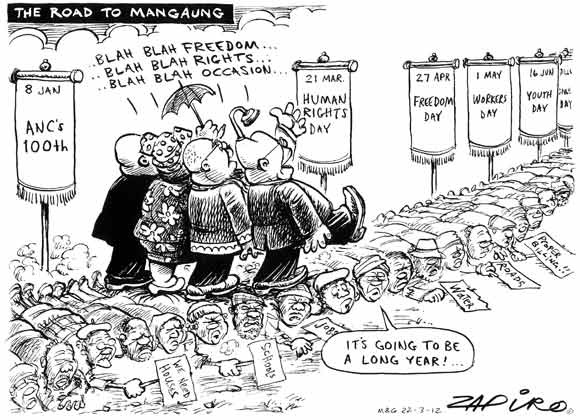
SA leaders 'determined to override Constitution'
 |
| http://mg.co.za/zapiro/fullcartoon/3643 |
"South Africa is widely recognised for its liberal and enlightened Constitution, yet we observe the emergence of a strange breed of leaders who are determined to undermine the rule of law and override the constitution," Khoza wrote in his chairperson's letter following the release of the bank's 2011 annual report on Friday. He said the political climate was not a picture of an accountable democracy.
"Our political leadership's moral quotient is degenerating and we are fast losing the checks and balances that are necessary to prevent a recurrence of the past."
Khoza said South Africans had the duty to build and develop the nation, but also to hold its leadership accountable.
"We have a duty to build and develop this nation and to call to book the putative leaders who, due to sheer incapacity to deal with the complexity of 21st Century governance and leadership, cannot lead," said Khoza.
Source: Mail & Guardian
Monday, February 27, 2012
Fraud unravels everything
The famous words of Lord Denning: "fraud unravels everything" may be applicable to the situation which has arisen as a consequence of the investigation of the South African Police Services (SAPS) headquarters leases in Pretoria and Durban by the Office of the Public Protector.
According to press reports, the Minister of Public Works has received a letter of demand from the putative landlord, Roux Shabangu, who in turn is facing demands from Nedbank, the financier of the two invalid and unlawful deals in terms of which the SAPS headquarters were to be moved to buildings acquired by Shabangu's company Roux Property Fund (RPF).
As both deals were for procurement on behalf of the state, it was incumbent upon the parties involved to ensure that the procurement was effected in accordance with a system that is fair, equitable, transparent, competitive and cost effective. This is a constitutional requirement that is reinforced by the provisions of the Public Finance Management Act.
Nedbank and Shabangu should be aware of the legal and constitutional environment in which they do business. The consequence of conduct inconsistent with the Constitution is that such conduct (the conclusion of the two leases in this case) is invalid. The invalidity of the leases leaves both Shabangu and Nedbank without any legal recourse against the Minister or any other organ of state.
This is as it should be: the flouting of the requirements for proper tendering can not be rewarded with claims for damages, irrespective of the greed for profit of those involved. It is impossible to found a good cause of action in a moral swamp, or as AP Herbert put it: "a dirty dog gets no dinner from the courts". The mere invalidity of the leases, as determined by the OPP, excuses the taxpayer from having to compensate either the bank or the property developer involved in the negotiations outside the framework of the law and the criteria of the Constitution.
The "elephant in the room" in the SAPS HQ case is the astronomical rentals agreed in the putative leases. The willingness of the state to pay more than three times the going rate in rental for the two buildings in question has not been explained by any of the parties involved. The Public Protector herself, rather charitably, speculates that this could be due to incompetence, negligence, or even recklessness. It could also be due to fraud and corruption. No one knows because, in an ongoing display of lack of accountability, none of the players involved in the deals has explained their conduct or justified the decision to pay rental out of all proportion to the market value of the premises chosen. In the case of the Durban lease there is also the question of the dilapidated state of the building in question, and the obligation of the state to pay for its renovation to render it fit for habitation by SAPS personnel deployed at head office level.
It is reported that Nedbank is demanding to be repaid its loans to RPF. Shabangu's response has been to start legal proceedings to recoup R 1 billion from the Minister. She is blamed for reinstating the leases upon taking office, despite two opinions from senior counsel to the effect that they were unlawfully concluded. This purported act of reinstatement is legally ineffective. If the leases could not pass constitutional muster because they were not fair, equitable, transparently negotiated, competitively priced and cost effectively concluded; their alleged reinstatement can not magically render them valid. They are and remain invalid for want of compliance with the requirements of section 217 of the Constitution, as the OPP has found, thereby confirming the opinions of the two senior counsel whose advice was sought.
The officials in Nedbank who agreed to lend the necessary finance to Shabangu owe their management, and Nedbank's shareholders, an explanation for getting involved in the deal. It is the equivalent of paying R1250 for a tank of petrol at a particular pump when all other pumps are supplying petrol at R400 per tank. It reeks of impropriety.
Taxpayers can feel lucky that Shabangu rejected a settlement offer of R50 million which he says was made last year by the Department of Public Works. That offer was worth R50 million more than he is entitled to, and should not be repeated.
The Minister may have many problems around the conclusion of the leases and her own role in purporting to re-instate them, but a successful claim for damages is not one of them.
Paul Hoffman SC
27th July, 2011
According to press reports, the Minister of Public Works has received a letter of demand from the putative landlord, Roux Shabangu, who in turn is facing demands from Nedbank, the financier of the two invalid and unlawful deals in terms of which the SAPS headquarters were to be moved to buildings acquired by Shabangu's company Roux Property Fund (RPF).
As both deals were for procurement on behalf of the state, it was incumbent upon the parties involved to ensure that the procurement was effected in accordance with a system that is fair, equitable, transparent, competitive and cost effective. This is a constitutional requirement that is reinforced by the provisions of the Public Finance Management Act.
Nedbank and Shabangu should be aware of the legal and constitutional environment in which they do business. The consequence of conduct inconsistent with the Constitution is that such conduct (the conclusion of the two leases in this case) is invalid. The invalidity of the leases leaves both Shabangu and Nedbank without any legal recourse against the Minister or any other organ of state.
This is as it should be: the flouting of the requirements for proper tendering can not be rewarded with claims for damages, irrespective of the greed for profit of those involved. It is impossible to found a good cause of action in a moral swamp, or as AP Herbert put it: "a dirty dog gets no dinner from the courts". The mere invalidity of the leases, as determined by the OPP, excuses the taxpayer from having to compensate either the bank or the property developer involved in the negotiations outside the framework of the law and the criteria of the Constitution.
The "elephant in the room" in the SAPS HQ case is the astronomical rentals agreed in the putative leases. The willingness of the state to pay more than three times the going rate in rental for the two buildings in question has not been explained by any of the parties involved. The Public Protector herself, rather charitably, speculates that this could be due to incompetence, negligence, or even recklessness. It could also be due to fraud and corruption. No one knows because, in an ongoing display of lack of accountability, none of the players involved in the deals has explained their conduct or justified the decision to pay rental out of all proportion to the market value of the premises chosen. In the case of the Durban lease there is also the question of the dilapidated state of the building in question, and the obligation of the state to pay for its renovation to render it fit for habitation by SAPS personnel deployed at head office level.
It is reported that Nedbank is demanding to be repaid its loans to RPF. Shabangu's response has been to start legal proceedings to recoup R 1 billion from the Minister. She is blamed for reinstating the leases upon taking office, despite two opinions from senior counsel to the effect that they were unlawfully concluded. This purported act of reinstatement is legally ineffective. If the leases could not pass constitutional muster because they were not fair, equitable, transparently negotiated, competitively priced and cost effectively concluded; their alleged reinstatement can not magically render them valid. They are and remain invalid for want of compliance with the requirements of section 217 of the Constitution, as the OPP has found, thereby confirming the opinions of the two senior counsel whose advice was sought.
The officials in Nedbank who agreed to lend the necessary finance to Shabangu owe their management, and Nedbank's shareholders, an explanation for getting involved in the deal. It is the equivalent of paying R1250 for a tank of petrol at a particular pump when all other pumps are supplying petrol at R400 per tank. It reeks of impropriety.
Taxpayers can feel lucky that Shabangu rejected a settlement offer of R50 million which he says was made last year by the Department of Public Works. That offer was worth R50 million more than he is entitled to, and should not be repeated.
The Minister may have many problems around the conclusion of the leases and her own role in purporting to re-instate them, but a successful claim for damages is not one of them.
Paul Hoffman SC
27th July, 2011
Subscribe to:
Posts (Atom)