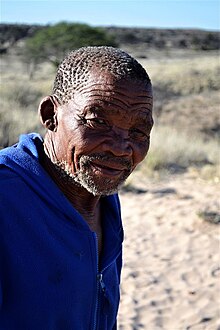
MODERNITY meets iron age in Tsumkwe this weekend as the San community in this isolated part of eastern Namibia and international film-makers lay to rest one of the Kalahari desert's greatest sons. In death, as in life,
Cgao Coma, Namibia's most famous actor, will be a bridge between the thousands of years old hunter-gatherer culture of the Bushmen and western civilisation.
He will be buried on Saturday in a semi-traditional ceremony at Tsumkwe, alongside his second wife. While in years past the Bushmen buried their dead and moved on to find new dwellings, Coma's family is expected to stay close to his resting place. The actor of the world famous 'The Gods Must Be Crazy' movies died while hunting in the desert last week Tuesday.
Official records say he was 59 years old, but he did not know his exact age. Many people believe he was older. By the time he died Coma had all but given up the modern way of life, having sold his brick house at Tsumkwe to live with his family in traditional huts in a village outside the capital of former Bushmanland.
According to Government records, Coma was born at Tsumkwe on December 16 1944. His mother tongue was Ju/'hoansi. He spoke Otjiherero and Tswana fluently, but his Afrikaans was not so good. He could not read or write, as is the case with most of the San.
The San are an indigenous hunter-gatherer people of southern Africa. Most live in the Kalahari. They number about 100 000. In the early 1980s, film director Jamie Uys of Mimosa Films in South Africa found the perfect natural actor in Coma to symbolise how the outside world has affected the San. "Uncle Jamie (Uys) told me the richness of Cgao," Dutch Reformed Church minister Peet Poggenpoel said. "He had a natural feeling for acting. What we must remember is that Cgao is a real actor".
Uys told Poggenpoel that Coma would often politely disregard the directors' instructions, and act "naturally", giving the movie authenticity. Reports say Uys was only the fourth white person Coma had met and he had never seen a settlement larger than the village of huts of his San people before he was cast in the film.
By the mid-1980s, Coma was world famous. 'The Gods Must Be Crazy' propelled him to international stardom and started his voyage of discovery in western culture.
Through the movies he became known as N!xau or N!Gau, as outsiders attempted to spell a name known only in the phonetic clicking sounds of his Ju/'hoansi language Some reports say the film grossed US$66 million (N$508 million at today's exchange rate) at the box office. Unappreciative of the immense value of money in a material world, Coma let his first wages waste away. Legend has it that he even left huge wads of cash to be blown away by the wind or eaten by hyenas.
Future earnings were better taken care of, between himself and the film company, said Geoffrey Gomme, a relative. Poggenpoel, who lived at Tsumkwe for nine years, said Coma received the money through his church. "The change that came with being cast was great but he did not have the skills to manage his income. He did not know how much he got from the films," said Gomme.
With some of his first income, Coma bought cattle that lions devoured. He bought a Chevrolet F250 and hired a driver at R150 a month, but sold it later to buy more livestock. In the 1990s, with the help of Mimosa, Coma built his first brick house. It was a three-bedroom house, fully furnished. Gomme said the actor's relatives descended on the house - as many as 30 at once - to share in the wealth. Over the years, they began to sell chairs, fridges, beds and cupboards. "After his wife passed away relatives were selling the furniture for alcohol," said Gomme.
Coma sold the house at the beginning of this year because he felt his relatives were abusing it. A local businessman paid him 20 herd of cattle, five calves, and N$20 000 in a mixture of banknotes and groceries. The family say the house was valued at N$80 000, but did not say when the valuation was made.
Coma then moved to Djokhoe, a village 27 km east of Tsumkwe. His wealth consisted of 21 cattle, 11 sheep, two horses, two bicycles, two spades, two rakes and five axes, including three traditional ones that he made himself. It is not clear how much cash is left in his estate.
A few years ago, Coma said he was getting N$2 000 a month from an investment Mimosa managed for him. Despite the money, Coma did not want to drift from his roots. "Mimosa stored his clothes at the church. When he went to big cities we would get the clothes so he can go there looking neat," said Poggenpoel.
Gomme described the actor's life as "between ordinary person and a poor man. He did not show he had lots of money". Coma himself had told NBC-TV that he preferred to behave as if he were poor, because he feared people might use witchcraft to obtain his wealth. His community saw him as a humble person. Poggenpoel remembers him as a jolly man, who always laughed - "not smile, but laugh".
In the mid-1990s, tuberculosis befell the diminutive actor. He was in and out of hospital as a State patient. His death certificate said he died of "multi-drug resistant" TB.
On Monday last week, he woke up at 06h00 as usual, collected firewood and made tea that he sipped with his father-in-law. He took his bird traps, bow and arrow and a hunting pouch and set off to hunt, his main target being guinea fowl. He did not come back that day. Coma's father-in-law tracked his spoor the next morning and found him on a path back home, bow and arrow still strapped to his shoulder.
Coma had nine children and one step-child from three marriages. Two children died, as did two of his wives. A volunteer in the community, Anthony Tsanigab, said Coma's burial will be huge by San standards. Tsanigab said Coma will be buried differently from tradition because "he was a modern man to them".
Poggenpoel recalled that Coma was extremely popular in Japan. "They had to organise the police to protect him. In Namibia we did not know what a what a big actor we had in Cgao".
Source: The Namibian