Keeping their heads down and operating behind the scenes, South Africa's white business elite have managed to maintain their economic position. When the curtain finally came down on South Africa’s apartheid in 1994, it happened in a way that none of the key players had predicted. Both the African National Congress (ANC) and its opponents in the white supremacist National Party were surprised that they could reach an accommodation through dialogue and negotiation rather than armed force.
In the negotiations that had followed the release of Nelson Mandela and unbanning of the ANC, the parties sealed an unspoken deal. This handed political power to the black majority and left economic power in the hands of whites. There was to be no seizure of white assets, although there were, of course, plans to gradually achieve a more equitable balance of wealth.
Black economic empowerment?
Indeed, there were already plans afoot to bring the leadership of the ANC into the fold. White business magnates had begun to transfer assets into black hands in order to incorporate those at the top of the new political order. The new policy was ‘Black Economic Empowerment’ (BEE). As the commentator Moeletsi Mbeki put it: “BEE was, in fact, invented by South Africa’s economic oligarchs, that handful of white businessmen and their families who control the commanding heights of the country’s economy, that is mining and its associated chemical and engineering industries and finance”.
He pointed out that the policy was adopted well before the ANC came to power. In 1992, Sanlam Limited, a cornerstone of Afrikaner capital, helped create the flagship black empowerment company New African Investments Limited – led by Nthato Motlana, Nelson Mandela’s former doctor. Further deals followed and soon the new BEE elite were well-entrenched.
On the face of it, the policy was a success. A more equitable sharing out of the spoils of economic development came about, creating a new black bourgeoisie. At the same time the ANC abandoned its more radical economic policies allowing rich whites to continue enjoying a very pleasant lifestyle. A considerable proportion of South African assets were transferred to the BEE elite, but even at their height, these transfers were smaller than they appeared. As my colleague Paul Holden points out, the total value of BEE deals were around R250 billion ($30 billion), still a drop in the ocean when compared with the total value of private sector resources of R6 trillion ($700 billion).
Worse still, the BEE transfers were loans, not gifts. The companies had to earn profits and from these profits the loans would be repaid. That was at least the theory. In reality, many of the new black elite had little or no experience of business and a good number of the BEE companies were soon in difficulties. As the government’s own assessment of the problems of BEE rightly put it, this led to contracts being signed by people who lacked the necessary capital: “This has encouraged debt-driven deals that are likely to work only when the economy is growing rapidly and company profitability is expanding significantly”.
Soon the new elite were scrambling around to find a way out. They hit on a plan to nationalise the mines. This would transfer a sizeable chunk of their problems onto the shoulders of the state, which could buy them out at favourable rates. At this point they hit a stumbling block. The ANC’s left-wing allies, the unions of COSATU and the South African Communist Party opposed this solution.
The Communist Party openly attacked those who called for nationalisation. The party declared that it had warned against the use of state finances to bail out the new rich and came out strongly against “diverting billions of Rands of public funds to serve the interests of a narrow black (and white) capitalist stratum”.
Nor was it just a question of “bailing-out debt-ridden BEE capital”, according to the party. They reported that mine union officials had been quietly approached by members of the new black elite, asking for their support. They were told, “Why don’t you support the nationalisation of the mines? If government takes over the mines they will turn to us to run them.” The Communist Party accused the right in the ANC of being seduced by the emerging black capitalist class.
White business
While black business is in a relatively precarious position, their white contemporaries have worked hard to secure their privilege. For a start, they have kept their heads down and operated behind the scenes. Business South Africa, which whites controlled, merged with the Black Business Council in October 2003 to form Business Unity South Africa. Not all black businesses appreciated the change, and some broke away from the new body in 2009. Nonetheless, the white business community had found a convenient new home for their interests. From here they could lobby the ANC government.
Some in white business went further, joining the ANC’s Progressive Business Forum. Its stated purpose is to open direct links with the ruling party. Within a year of its formation, the forum was being portrayed in the press as a means of “buying face-time with cabinet ministers and senior government officials”. The ANC responded briskly that there was “nothing untoward about this”.
Today it is clear that the Progressive Business Forum is a potent means of raising money for the party. A seat at President Zuma’s table at a banquet held in Johannesburg in June 2012 was going for no less than R500,000 ($60,000).
This is not the only way the ANC has raised money from business. An investigation in 2006 by the Institute of Security Studies revealed the existence of a group of companies controlled by a firm called Chancellor House, which quietly accumulated stakes in minerals, energy, engineering, logistics and information technology. This has been a major source of funding for the ruling party and has resulted in inevitable conflicts of interest. “More often than not, these business opportunities have been dependent on the government’s discretion – the award of state tenders, mineral rights and the like. The ANC, as ruling party, has been both player and referee”, says the report.
“As it has always been”
Nearly two decades after the ANC came to power, the black middle class is both powerful – through its influential role in the ANC – but also dependent on the party for its position. It is insufficiently well-resourced to stand on its own feet and reliant on state contracts and BEE legislation for its positions. The white elite, on the other hand, are better endowed and better resourced. Some have moved to become consultants rather than hold formal positions in companies. Others have moved some or all of their wealth offshore – treading the trail blazed by companies formerly listed in South Africa like Old Mutual and Anglo-American, which are now listed on the London stock exchange. At the same time, white business has learnt to live with the ANC in government, working behind the scenes rather than raising their voices in public.
President Zuma summed up the situation rather astutely when he addressed ANC’s policy conference on June 26, 2012. Much had been achieved since taking power in 1994, he said, but much still had to be done. The president went on to outline the key issues that had to be tackled – among them were economic relations, which, he said, were still largely unchanged.
When the end of apartheid came, he said, “We had to be cautious about restructuring the economy in order to maintain economic stability and confidence at the time. Thus, the economic power relations of the apartheid era have in the main remained intact. The ownership of the economy is still primarily in the hands of white males as it has always been.”
Further reading: Think Africa Press' review of "Who Rules South Africa?" and interview with the authors Martin Plaut and Paul Holden.
Source:
Showing posts with label NP. Show all posts
Showing posts with label NP. Show all posts
Monday, August 20, 2012


Friday, August 13, 2010
It’s 'a political game'
Mmanaledi Mataboge talks to press ombudsman Joe Thloloe about the proposed media tribunal
When and why was the press council formed and a press ombudsman appointed?
The system started in the early 1960s when the National Party government was threatening to regulate the media in the same way the ANC is doing now. To ward off that threat, the industry decided to create a media council.
It has been changing over the years, until after the 1994 elections, when it became clear that we needed to create a whole new structure. A judge from the Constitutional Court was asked to do a public inquiry as to what type of a system is adequate. A committee formed by various media organisations appointed a press ombudsman, Ed Linington.
Is there merit in the argument that because you are a former journalist you are lenient on the press?
It's not true. All you have to do is look at all the decisions we have made. They are very well thought out. All the people who accuse us of being biased have not even looked at the results of our work. From August 1 2007 to July 31 this year the number of cases that we handled from the government was 13. Sixty-two percent of these cases were decided in favour of the complainants, who are government- or ANC-related.
The ANC claims that, despite the ombudsman ruling on mistakes made by the press, the same mistakes are repeated over and over again by different newspapers.
It is true that sometimes it gets quite irritating when you have made a decision and you find the same mistake repeated in another publication. We are now considering a structured set of workshops throughout all the newsrooms related to the press code, the press council, self-regulation and ethics generally. Luckily for us, we have not had the same mistake being repeated by the same publication.
Why is it better for the ombudsman not to impose sanctions on journalists and editors?
Almost 95% of self-regulation mechanisms around the world do not impose fines, so we are in line with what the rest of the world is doing.
Why is the press ombudsman better than the proposed tribunal?
The self-regulatory mechanism maintains freedom of expression, which is fundamental to democracy. If a statutory tribunal is created, it is going to have to create a code of conduct, which will be imposed on newspapers from outside the newsroom. That is in breach of the Constitution. The system we have is that publications voluntarily adopt this code. It not imposed from outside, so there is no interference with the freedom of expression.
Why do you think the ombudsman is being criticised for being an inadequate avenue through which the public can complain?
It is much more of a political game than a real issue. When somebody complains to this office, we give them a choice right from the beginning. We say to the person: if you want to clear your name quickly, cost effectively, you can use our system. But if you want damages or any form of an award, you might want to use other tribunals, such as the courts. People have been using this system because they think it's an easier way. If they go to the courts, it is expensive and they [courts] take years before they adjudicate on the matter.
What the ANC is basically saying is that the ombudsman is toothless.
Outsiders think that when a newspaper has to publish an apology on the front page it is not punishment enough. For people inside the industry, you know that having to apologise publicly for a mistake you made erodes your credibility … hence, editors and journalists guard their credibility with their lives.
There have been suggestions before about strengthening the existing press ombudsman's office. What, in your view, needs to be done to strengthen the press ombudsman?
I don't think that it can be strengthened in any way. The suggestions that are being thrown out in the ANC alliance at this point don't make sense. Jailing journalists is absolute rubbish. Fining publications is a possibility but, then again, I don't think it will serve to improve the quality of journalism in this country.
Would the press ombudsman work better if your position was occupied by a retired judge who would not be seen to be biased?
At the pinnacle of our adjudication system is a retired judge of the Supreme Court of Appeal. If I make a decision either of the parties has a right to appeal to the press appeals panel and it is headed by a judge. You cannot be more objective than that.
It seems the ANC has made its mind up and is going to establish the media tribunal anyway.
The sad thing is that if they go ahead, it will mean the taxpayers' money, as well as money from the newspapers, will be spent on lawyers fighting the matter right up to the Constitutional Court. I believe very firmly that the Constitutional Court will not uphold the statutory tribunal for the simple reason that it goes against the principles enshrined in the Constitution.
Source: Mail & Guardian
When and why was the press council formed and a press ombudsman appointed?
The system started in the early 1960s when the National Party government was threatening to regulate the media in the same way the ANC is doing now. To ward off that threat, the industry decided to create a media council.
It has been changing over the years, until after the 1994 elections, when it became clear that we needed to create a whole new structure. A judge from the Constitutional Court was asked to do a public inquiry as to what type of a system is adequate. A committee formed by various media organisations appointed a press ombudsman, Ed Linington.
Is there merit in the argument that because you are a former journalist you are lenient on the press?
It's not true. All you have to do is look at all the decisions we have made. They are very well thought out. All the people who accuse us of being biased have not even looked at the results of our work. From August 1 2007 to July 31 this year the number of cases that we handled from the government was 13. Sixty-two percent of these cases were decided in favour of the complainants, who are government- or ANC-related.
The ANC claims that, despite the ombudsman ruling on mistakes made by the press, the same mistakes are repeated over and over again by different newspapers.
It is true that sometimes it gets quite irritating when you have made a decision and you find the same mistake repeated in another publication. We are now considering a structured set of workshops throughout all the newsrooms related to the press code, the press council, self-regulation and ethics generally. Luckily for us, we have not had the same mistake being repeated by the same publication.
Why is it better for the ombudsman not to impose sanctions on journalists and editors?
Almost 95% of self-regulation mechanisms around the world do not impose fines, so we are in line with what the rest of the world is doing.
Why is the press ombudsman better than the proposed tribunal?
The self-regulatory mechanism maintains freedom of expression, which is fundamental to democracy. If a statutory tribunal is created, it is going to have to create a code of conduct, which will be imposed on newspapers from outside the newsroom. That is in breach of the Constitution. The system we have is that publications voluntarily adopt this code. It not imposed from outside, so there is no interference with the freedom of expression.
Why do you think the ombudsman is being criticised for being an inadequate avenue through which the public can complain?
It is much more of a political game than a real issue. When somebody complains to this office, we give them a choice right from the beginning. We say to the person: if you want to clear your name quickly, cost effectively, you can use our system. But if you want damages or any form of an award, you might want to use other tribunals, such as the courts. People have been using this system because they think it's an easier way. If they go to the courts, it is expensive and they [courts] take years before they adjudicate on the matter.
What the ANC is basically saying is that the ombudsman is toothless.
Outsiders think that when a newspaper has to publish an apology on the front page it is not punishment enough. For people inside the industry, you know that having to apologise publicly for a mistake you made erodes your credibility … hence, editors and journalists guard their credibility with their lives.
There have been suggestions before about strengthening the existing press ombudsman's office. What, in your view, needs to be done to strengthen the press ombudsman?
I don't think that it can be strengthened in any way. The suggestions that are being thrown out in the ANC alliance at this point don't make sense. Jailing journalists is absolute rubbish. Fining publications is a possibility but, then again, I don't think it will serve to improve the quality of journalism in this country.
Would the press ombudsman work better if your position was occupied by a retired judge who would not be seen to be biased?
At the pinnacle of our adjudication system is a retired judge of the Supreme Court of Appeal. If I make a decision either of the parties has a right to appeal to the press appeals panel and it is headed by a judge. You cannot be more objective than that.
It seems the ANC has made its mind up and is going to establish the media tribunal anyway.
The sad thing is that if they go ahead, it will mean the taxpayers' money, as well as money from the newspapers, will be spent on lawyers fighting the matter right up to the Constitutional Court. I believe very firmly that the Constitutional Court will not uphold the statutory tribunal for the simple reason that it goes against the principles enshrined in the Constitution.
Source: Mail & Guardian
Tuesday, October 31, 2006
P. W. Botha, Defender of Apartheid, Is Dead at 90

P. W. Botha, the South African leader who struggled vainly to preserve apartheid rule in a tide of domestic racial violence and global condemnation, died yesterday at his home in South Africa. He was 90. His death was reported by The South African Press Association in Cape Town, quoting the security staff at Mr. Botha’s home on the southern Cape coast.
Mr. Botha was a combative, irascible son of a well-to-do Afrikaner farm family who dropped out of college to work for the right-wing National Party, then rose through the ranks of South Africa’s political establishment, gaining a reputation as the “Old Crocodile” for his ability to charm, outwit and crush his opponents.
In 1978, Mr. Botha became prime minister and proceeded to engineer the creation of a new Constitution, one that held out the promise of limited reform of apartheid policies. When the Constitution came into effect in 1984, Mr. Botha became president. “We must adapt or die,” Mr. Botha told his constituents after becoming prime minister.
As opposition to apartheid spread, Mr. Botha’s room to maneuver shrank. “He was caught in a bind between wanting to show the international community that he was not inflexible, and not wishing to appear weak within his own country,” the journalist Allister Sparks wrote in his 1995 account of the end of apartheid, “Tomorrow Is Another Country: The Inside Story of South Africa’s Road to Change.”
Yet for a while Mr. Botha’s methods seemed to belie Alexis de Toqueville’s dictum that “the most perilous moment for bad government is when it seeks to mend its ways.” Mr. Botha was re-elected in 1987. Two years later, as opposition to his intransigent style grew within his own party, the president suffered a stroke and resigned. He was succeeded by F. W. de Klerk, who legalized opposition parties, freed Mr. Mandela and other political prisoners, and made the agreements that eventually brought apartheid down.
Source: New York Times
Saturday, May 16, 1992
South Africa Talks in Deadlock; De Klerk Confers With Mandela
Negotiations on South Africa's future deadlocked today, prompting President F. W. de Klerk and Nelson Mandela, president of the African National Congress, to meet to try to devise a solution. After the two leaders met with their advisers and then for more than an hour with each other, Mr. Mandela said they would report the outcome on Saturday. He described their meeting as "substantial," the South Africa Press Association reported, but did not say what they had decided. A resolution of the impasse would pave the way for the creation of a transitional government that would draft a new constitution extending political equality to blacks.
The cause of the deadlock was the inability of one of five working groups created by the Convention for a Democratic South Africa, as the negotiating forum is called, to agree on one of the proposed guidelines for a new constitution. The disputed point is the size of the legislative margin of approval for constitutional provisions covering regional issues. The dispute, which erupted in invective between the Government and the congress, blocked the presentation of progress reports by the four other working groups on the country's future. But Mr. Mandela told journalists that it would be naive for anybody to think that there would be no deadlocks in the negotiations. "While there is a will to address problems, there is hope those problems will be solved," said Mr. Mandela, who sounded noticeably more relaxed than his subordinates did earlier today. "We are confident that in the weeks or months that lie ahead we will be able to make good progress," Mr. Mandela said before meeting with Mr. de Klerk.
The convention, which opened last December in a mood of enthusiasm, created the working groups to consider aspects of the transition and submit their plans to the current meeting. But as the second full session of the convention confronted real issues today, the good will soured. The Government and the congress accused each other of derailing the talks, and some smaller parties took sides, splitting the convention nearly down the middle. "The Government continues to lack the will to negotiate seriously," charged Chris Hani, the head of the South African Communist Party, a congress ally. Foreign Minister Roelof F. Botha railed against what he called the "A.N.C.-Communist-Marxist school of belief" that "a winner takes all and grabs the power." Cyril Ramaphosa, the secretary general of the African National Congress, said at a news conference that he saw very little chance that agreement would be reached on the convention floor. "We have become convinced that the South African Government didn't come to today's working group meeting with the clear intent of signing an agreement," Mr. Ramaphosa said.
The Government delegation said the failure to agree on one point should not obscure what its negotiator Tertius Delport called "substantial and very important progress" on other fronts. The Government side proposed that the convention consider the reports of the other working groups, leaving the unresolved issue for discussion later. Mr. Delport cautioned against haste. "We're not dealing with the question at which time the Sunday school will start," he said. "We're dealing with the future of our country." But Mr. Ramaphosa rejected a piecemeal approach and said the entire package must be considered. He and other congress officials accused the Government of trying to postpone the eventuality of majority rule. "We do not want to be caught in a position where the transition goes on forever," said Mohammed Valli Moosa, a negotiator for the congress.
The disagreement involved the margin of approval that would be needed for constitutional provisions dealing specifically with regional issues. The African National Congress says it should be 70 percent of the votes in a elected constitution-making legislature; the Government has held out for 75 percent. These two key participants reached virtual consensus on other proposed guidelines, but the 5 percent gap has stalled unrelated issues that were scheduled for discussion and approval at the negotiations. Their inability to close the modest 5 percent difference reflected in part their exasperation after hours of negotiations, and also their unwillingness to appear to their constituencies to be giving too much ground. The regional issue is a delicate one. The governing National Party and some of the other 18 political parties and organizations in the talks believe that the interests of minorities, including whites, can be better protected if power is decentralized down to the regional level, even though whites do not form the majority in any region.
The National Party also wants the new Parliament to have a second chamber, called a Senate, whose members would be elected regionally rather than nationally. The African National Congress and the Government had already compromised on the margin by which a constitution-making body should enact legislation. The congress initially proposed a two-thirds majority, while the Government wanted 75 percent. They agreed upon 70 percent for most constitutional provisions and 75 percent for the bill of rights, but differed over the regional issues. Each side also introduced further conditions. The Government said its proposed Senate should have equal authority in approving the constitution, giving it a potential veto over what the first chamber drafted.
And the African National Congress said that if the constitution-making body could not pass its provisions by a sufficient majority, after six months the unresolved issues should be put to a public referendum. The congress and the Government have agreed that the transition take place in two stages, with an appointed executive council supervising the government during the initial stage. They also agreed that an interim legislature elected by universal franchise should draft the new constitution.
Source: New York Times
The cause of the deadlock was the inability of one of five working groups created by the Convention for a Democratic South Africa, as the negotiating forum is called, to agree on one of the proposed guidelines for a new constitution. The disputed point is the size of the legislative margin of approval for constitutional provisions covering regional issues. The dispute, which erupted in invective between the Government and the congress, blocked the presentation of progress reports by the four other working groups on the country's future. But Mr. Mandela told journalists that it would be naive for anybody to think that there would be no deadlocks in the negotiations. "While there is a will to address problems, there is hope those problems will be solved," said Mr. Mandela, who sounded noticeably more relaxed than his subordinates did earlier today. "We are confident that in the weeks or months that lie ahead we will be able to make good progress," Mr. Mandela said before meeting with Mr. de Klerk.
The convention, which opened last December in a mood of enthusiasm, created the working groups to consider aspects of the transition and submit their plans to the current meeting. But as the second full session of the convention confronted real issues today, the good will soured. The Government and the congress accused each other of derailing the talks, and some smaller parties took sides, splitting the convention nearly down the middle. "The Government continues to lack the will to negotiate seriously," charged Chris Hani, the head of the South African Communist Party, a congress ally. Foreign Minister Roelof F. Botha railed against what he called the "A.N.C.-Communist-Marxist school of belief" that "a winner takes all and grabs the power." Cyril Ramaphosa, the secretary general of the African National Congress, said at a news conference that he saw very little chance that agreement would be reached on the convention floor. "We have become convinced that the South African Government didn't come to today's working group meeting with the clear intent of signing an agreement," Mr. Ramaphosa said.
The Government delegation said the failure to agree on one point should not obscure what its negotiator Tertius Delport called "substantial and very important progress" on other fronts. The Government side proposed that the convention consider the reports of the other working groups, leaving the unresolved issue for discussion later. Mr. Delport cautioned against haste. "We're not dealing with the question at which time the Sunday school will start," he said. "We're dealing with the future of our country." But Mr. Ramaphosa rejected a piecemeal approach and said the entire package must be considered. He and other congress officials accused the Government of trying to postpone the eventuality of majority rule. "We do not want to be caught in a position where the transition goes on forever," said Mohammed Valli Moosa, a negotiator for the congress.
The disagreement involved the margin of approval that would be needed for constitutional provisions dealing specifically with regional issues. The African National Congress says it should be 70 percent of the votes in a elected constitution-making legislature; the Government has held out for 75 percent. These two key participants reached virtual consensus on other proposed guidelines, but the 5 percent gap has stalled unrelated issues that were scheduled for discussion and approval at the negotiations. Their inability to close the modest 5 percent difference reflected in part their exasperation after hours of negotiations, and also their unwillingness to appear to their constituencies to be giving too much ground. The regional issue is a delicate one. The governing National Party and some of the other 18 political parties and organizations in the talks believe that the interests of minorities, including whites, can be better protected if power is decentralized down to the regional level, even though whites do not form the majority in any region.
The National Party also wants the new Parliament to have a second chamber, called a Senate, whose members would be elected regionally rather than nationally. The African National Congress and the Government had already compromised on the margin by which a constitution-making body should enact legislation. The congress initially proposed a two-thirds majority, while the Government wanted 75 percent. They agreed upon 70 percent for most constitutional provisions and 75 percent for the bill of rights, but differed over the regional issues. Each side also introduced further conditions. The Government said its proposed Senate should have equal authority in approving the constitution, giving it a potential veto over what the first chamber drafted.
And the African National Congress said that if the constitution-making body could not pass its provisions by a sufficient majority, after six months the unresolved issues should be put to a public referendum. The congress and the Government have agreed that the transition take place in two stages, with an appointed executive council supervising the government during the initial stage. They also agreed that an interim legislature elected by universal franchise should draft the new constitution.
Source: New York Times
Sunday, February 11, 1990
SOUTH AFRICA'S NEW ERA; MANDELA, FREED, URGES STEP-UP IN PRESSURE TO END WHITE RULE
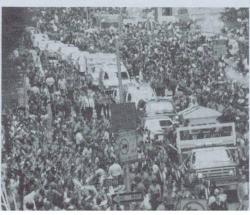 After 27 and a half years in prison, Nelson Mandela finally won his freedom today and promptly urged his supporters at home and abroad to increase their pressure against the white minority Goverment that had just released him. ''We have waited too long for our freedom,'' Mr. Mandela told a cheering crowd from a balcony of Cape Town's old City Hall. ''We can wait no longer.'' ''Now is the time to intensify the struggle on all fronts,'' he said. ''To relax our efforts now would be a mistake which generations to come will not able to forgive.''
 Mr. Mandela's 20-minute speech, which he prepared before leaving prison today, constituted his first remarks in public since before he was sentenced in June 1964 to life imprisonment for conspiracy to overthrow the Government and engage in sabotage. He asked the international community not to lift its sanctions against South Africa, despite the recent changes introduced by President F. W. de Klerk, which culminated in Mr. Mandela's release. ''To lift sanctions now would be to run the risk of aborting the process toward ending apartheid,'' he said.
Mr. Mandela's voice sounded firm and his words as eloquently militant as when he defended violence as the ultimate recourse at his political trial in 1964. Though he looked all of his 71 years and was grayer than artists' renditions over the years had depicted, he walked out of Victor Verster prison erect and vigorous. In Washington, President Bush rejoiced over the release of Mr. Mandela, spoke to him by telephone and invited the anti-apartheid leader to visit the White House. Mr. Mandela gave no evidence that his militant opposition to apartheid had been tempered by the more than 10,000 days he spent in confinement. But he also said nothing that would have surprised the Government had he said it during his years of incarceration. Indeed, there appeared to be nothing in Mr. Mandela's initial remarks after his release to give the Government much consolation or encouragement. Although he has been viewed as a potential leader for all South Africans, he stressed time and again that his loyalty lay with the African National Congress, for which he was working underground when he was jailed in August 1962 on charges of incitement and leaving the country illegally. He was serving time on that conviction when he was sentenced to life imprisonment in 1964.
Mr. Mandela told a crowd that he remained a ''loyal and disciplined member'' of the African National Congress and still endorsed its policies, including its use of armed struggle against the white minority Government. He said he saluted the congress's military wing, Spear of the Nation, and its ally, the South African Communist Party, ''for its steady contribution to the struggle for democracy.'' But he also thanked the Black Sash, an organization of white women working to end apartheid, and the predominantly white National Union of South African Students for being ''the conscience of white South Africans.'' And he held out an olive branch to all whites, asking them to join in shaping a new South Africa. ''The freedom movement is a political home for you, too,'' he said.
In his first speech after his release, Mr. Mandela may have taken an orthodox line with a mass audience sympathetic to the African National Congress and might in private discussions eshow greater flexibility on the question of discussions that the Government wants to have with blacks, who are 28 million of the population, compared with the 5 million whites of the ruling minority. He said he was only making some preliminary comments following his release, and would have more to say ''after I have had the opportunity to consult with my comrades.'' By this he meant the leaders of the African National Congress now in exile in Zambia as well as colleagues still based in South Africa. But he appeared to discourage any leading role for himself, such as the Government has in mind, saying, ''A leader of the movement is a person who has been democratically elected at a national conference.''
President de Klerk has invited black leaders to join talks leading to the formulation of a new constitution that would let black South Africans take part at last in their nation's politics.Mr. Mandela acknowledged to the crowd that he had conducted a dialogue with the Government during his last years in prison. But he added: ''My talks with the Government have been aimed at normalizing the political situation in the country. We have not yet begun discussing the basic demands of our struggle. I wish to stress that I myself have at no time entered into negotiations about the future of our country, except to insist on a meeting between the A.N.C. and the Government,'' he said. He described Mr. de Klerk, whom he has met twice since December, as ''a man of integrity. Mr. de Klerk has gone further than any other Nationalist President in taking real steps to normalize the situation,'' Mr. Mandela said. ''But as an organization we base our policy and strategy and tactics on the harsh reality we are faced with,'' he said. ''And this reality is that we are still suffering under the policies of the Nationalist Government.''
The National Party, which Mr. de Klerk now leads, instituted apartheid after taking power in 1948. Mr. Mandela said the Government had to take further steps before negotiations could begin. As a prerequisite for negotiations, he reiterated two demands that he had conveyed from prison through recent visitors. These are are the lifting of the state of emergency, which was imposed in June 1986, and the release of all political prisoners, including those accused of crimes committed in the struggle against apartheid. ''Only such a normalized situation which allows for free political activity can allow us to consult our people in order to obtain a mandate,'' Mr. Mandela said. He said the people had to be consulted about who would represent them in talks with the Government. ''Negotiations cannot take place above the heads or behind the backs of our people,'' he said. ''It is our belief that the future of our country can only be determined by a body which is democratically elected on a nonracial basis.''
Mr. Mandela appeared to allude to a formula under which a constituent assembly, in effect supplanting the existing Parliament, would draft a new constitution. Such a plan would mean the creation of an interim government in South Africa and has previously been rejected by Mr. de Klerk for the foreseeable future. Mr. Mandela walked out of Victor Verster Prison near Paarl at 4:15 P.M., 75 minutes later than the release time announced Saturday afternoon by Mr. de Klerk. Acquaintances of the Mandela family said his departure from the prison was delayed by family discussions. He was greeted by about 5,000 supporters lining the asphalt road outside the prison farm where he has been held since December 1988. Some waved the black, green and yellow flags of the African National Congress, from which Mr. de Klerk removed a ban on Feb. 2. Mr. Mandela was then driven 40 miles from Paarl to Cape Town, passing several hundred people who had parked by the roadside or waited on overpasses in hope of seeing him. They held homemade signs, some of which read simply, ''Welcome home.'' A huge crowd, which organizers said reached 250,000 people, assembled in the square in front of the old City Hall in Cape Town to greet Mr. Mandela. Reporters covering the rally put the crowd's size at only 50,000 people at its peak. They became impatient and sometimes unruly, waiting up to six hours in the hot sun and had dwindled to about 20,000 by sunset, when Mr. Mandela finally appeared.
In the 1950's it was Government policy to prevent blacks from settling in the Western Cape, so they are not in the clear majority in Cape Town, where Mr. Mandela was released. People of mixed race, known as ''coloreds,'' are the largest population group in Cape Town, where whites also outnumber blacks. Blacks, who account for nearly 75 percent of the population in the country as a whole, are in the overwhelming majority in the Johannesburg region, where Mr. Mandela can expect his most tumultuous welcome.
The festive occasion was marred by violence after some youths who had been drinking on the fringes of the rally started breaking windows and looting shops in downtown Cape Town. The police tried to disperse them by firing shotguns and tear gas, and some of the youths retaliated by throwing bottles and stones. At one point, drunken protesters invaded a Chinese restaurant, snatched up the liquor and wine and threw bottles at the police from the rooftop. One man in the crowd was also injured in a knife fight.
The South African Press Association reported tonight that 2 people had been killed and 13 wounded in the confrontations. A physician treating casualties on the scene estimated that 100 people had been wounded, mostly by buckshot. Most suffered only light injuries, including three journalists covering the rally. Cheryl Carolus, a spokeswoman for the United Democratic Front, which helped organize the rally, attributed the violence to outsiders who, she said, were ''beyond our usual crowds, or who supported the rival Pan-Africanist Movement.''' At times, some supporters at the rally had to scramble for cover as the police chased or fired at looters and stone-throwers. The Rev. Allan Boesak, a prominent figure in the anti-apartheid movement, pleaded for more than 45 minutes with the crowd to maintain discipline and move back.
Dullah Omar, a lawyer representing the Mandela family, said Mr. Mandela had been unaware of the violence. This evening, Mr. Mandela failed to appear at a news conference arranged by the reception committee that is handling his schedule. A representative said Mr. Mandela would meet the press later this week in Johannesburg. Mr. Mandela and his wife, Winnie, are expected to fly to Johannesburg on Monday and proceed to their home in the black township of Soweto. One of the organizers, Saki Mocozoma, said security considerations precluded him from revealing where the Mandelas were spending their first night.
Mr. Mandela also paid tribute to his wife, who has lived apart from him for more than 27 years, and their children. ''I am convinced that your pain and suffering was far greater than my own,'' he told them.
Source: New York Times
Saturday, September 2, 1989
"The Purple Shall Govern"
 On September 2 1989 anti-apartheid protesters marching on Parliament were stopped by police near this spot. They mounted an impromptu sit-in and police retaliated with tear gas, batons and a new weapon: a water cannon laced with purple dye to stain demonstrators and make them easier to identify and detain. As protesters scattered, one climbed onto the armoured vehicle with the cannon and turned the purple jet on police. Purple dye stained most of the surrounding buildings, including the National Party headquarters and the white-washed walls of the historic Old Townhouse. The next day graffiti all over the city proclaimed "The Purple Shall Govern". This was one of the last protest marches outlawed by the apartheid government. Eleven days later, 30 000 people marched through the city without police intervention.
Wednesday, August 16, 1989
De Klerk Becomes Pretoria President
F. W. de Klerk was sworn in today as Acting President of South Africa and said that the country was about to enter an era of change. Mr. de Klerk reaffirmed his promises to phase out white rule and involve blacks in talks about South Africa's future, but without submitting whites to what he has called majority domination. ''There is no doubt that we stand on the threshold of a new era in South and southern Africa,'' Mr. de Klerk, the National Party leader, said in a prepared statement. ''History, I believe, offers us a unique opportunity for peaceful solutions.'' Expected to Be President
Mr. de Klerk is widely expected to become President if the National Party wins the parliamentary elections on Sept. 6, as seems probable. The low-key inauguration, in the presidential wing of the Union Buildings, was attended only by his wife, Marike, other Cabinet ministers and a few dozen journalists. At a news conference afterward, Mr. de Klerk paid tribute to his predecessor, P. W. Botha, who resigned on Monday after losing a confrontation with Mr. de Klerk and other members of his Cabinet. Mr. Botha refused to appoint a successor, so Mr. de Klerk was unanimously chosen by his colleagues to fill the vacancy.
Mr. de Klerk said Mr. Botha's ''greatest gift to South Africa'' was that ''he has put our country on the road to fundamental reform, that he successfully started pulling South Africa out of its dead-end streets and that he guided us in the direction of a totally new dispensation.'' A Contrast in Tone Mr. de Klerk's magnanimity contrasted conspicuously with the tone of Mr. Botha's address on Monday night, when he complained that his Cabinet ministers were ignoring him and that Mr. de Klerk was to travel to Zambia to meet President Kenneth D. Kaunda without his permission. Mr. Botha met with Mr. Kaunda in April 1982. Mr. de Klerk told reporters today that his new responsibilities might preclude the visit to Zambia. But tonight, it was disclosed that he had written President Kaunda, saying that he and Foreign Minister Roelof F. Botha would meet the Zambian leader as scheduled in Livingston on Aug. 28. The Foreign Minister's office released the text of a letter that Mr. Kaunda had written earlier assuring President Botha that he did not mean to undercut him but wanted to meet Mr. de Klerk as a person who would occupy a leadership position in the region.
In response to another question, Mr. de Klerk also said that Nelson R. Mandela, South Africa's best-known political prisoner, would not be released before a President was chosen by the electoral college on Sept. 14, a day after the new Parliament is to be convened. Mr. de Klerk said he should not ''in any way whatsoever try to arrange the future'' in his temporary capacity. Frosty Relations Since February Political analysts here said that President Botha, in taking his leave of politics, had tried to hurt Mr. de Klerk and the National Party by sowing doubts about their motives among the white electorate. Mr. de Klerk replaced Mr. Botha as party leader in February after Mr. Botha suffered a stroke, and their relations have been frosty since.
The reaction today of the South African press and public to Mr. Botha's resignation appeared to be one of relief. Business Day, the country's leading financial newspaper, said that ''seldom, if ever, has this country had a leader more widely detested,'' and added, ''It is well that he is gone.'' But one political analyst noted that Mr. Botha still commanded respect among some traditional National Party constituencies and that some whites might vote for the opposition, the right-wing Conservative Party, if they felt the retiring President had been ill used by his party. When a reporter asked Mr. de Klerk about his plans, he replied, ''We want to build a new South Africa in which all people will participate in decisions affecting their lives at all levels of government, but in such a way that no one group amongst the diversity which we have in South Africa will be in a position to dominate others.''
Source: New York Times
Mr. de Klerk is widely expected to become President if the National Party wins the parliamentary elections on Sept. 6, as seems probable. The low-key inauguration, in the presidential wing of the Union Buildings, was attended only by his wife, Marike, other Cabinet ministers and a few dozen journalists. At a news conference afterward, Mr. de Klerk paid tribute to his predecessor, P. W. Botha, who resigned on Monday after losing a confrontation with Mr. de Klerk and other members of his Cabinet. Mr. Botha refused to appoint a successor, so Mr. de Klerk was unanimously chosen by his colleagues to fill the vacancy.
Mr. de Klerk said Mr. Botha's ''greatest gift to South Africa'' was that ''he has put our country on the road to fundamental reform, that he successfully started pulling South Africa out of its dead-end streets and that he guided us in the direction of a totally new dispensation.'' A Contrast in Tone Mr. de Klerk's magnanimity contrasted conspicuously with the tone of Mr. Botha's address on Monday night, when he complained that his Cabinet ministers were ignoring him and that Mr. de Klerk was to travel to Zambia to meet President Kenneth D. Kaunda without his permission. Mr. Botha met with Mr. Kaunda in April 1982. Mr. de Klerk told reporters today that his new responsibilities might preclude the visit to Zambia. But tonight, it was disclosed that he had written President Kaunda, saying that he and Foreign Minister Roelof F. Botha would meet the Zambian leader as scheduled in Livingston on Aug. 28. The Foreign Minister's office released the text of a letter that Mr. Kaunda had written earlier assuring President Botha that he did not mean to undercut him but wanted to meet Mr. de Klerk as a person who would occupy a leadership position in the region.
In response to another question, Mr. de Klerk also said that Nelson R. Mandela, South Africa's best-known political prisoner, would not be released before a President was chosen by the electoral college on Sept. 14, a day after the new Parliament is to be convened. Mr. de Klerk said he should not ''in any way whatsoever try to arrange the future'' in his temporary capacity. Frosty Relations Since February Political analysts here said that President Botha, in taking his leave of politics, had tried to hurt Mr. de Klerk and the National Party by sowing doubts about their motives among the white electorate. Mr. de Klerk replaced Mr. Botha as party leader in February after Mr. Botha suffered a stroke, and their relations have been frosty since.
The reaction today of the South African press and public to Mr. Botha's resignation appeared to be one of relief. Business Day, the country's leading financial newspaper, said that ''seldom, if ever, has this country had a leader more widely detested,'' and added, ''It is well that he is gone.'' But one political analyst noted that Mr. Botha still commanded respect among some traditional National Party constituencies and that some whites might vote for the opposition, the right-wing Conservative Party, if they felt the retiring President had been ill used by his party. When a reporter asked Mr. de Klerk about his plans, he replied, ''We want to build a new South Africa in which all people will participate in decisions affecting their lives at all levels of government, but in such a way that no one group amongst the diversity which we have in South Africa will be in a position to dominate others.''
Source: New York Times
Tuesday, August 15, 1989
Botha, Rebuffed by His Party, Quits South Africa Presidency
P. W. Botha quit under pressure tonight as South Africa's President, complaining that his Cabinet ministers were ignoring him. His announcement, delivered in a disjointed and rambling address in Afrikaans on national television, followed a Cabinet meeting this morning in which the 73-year-old Mr. Botha lost a confrontation he had forced with F. W. de Klerk, his successor as leader of the governing National Party.
At issue was Mr. de Klerk's right to travel to Zambia later this month to meet President Kenneth D. Kaunda without getting Mr. Botha's approval first. But this was overshadowed by a wide perception among politicians, journalists and ordinary South Africans that the President had been trying to undercut Mr. de Klerk since the latter succeeded him as National Party leader about six months ago. President Botha said he would not approve Mr. de Klerk's trip to Zambia because President Kaunda has given refuge to the outlawed African National Congress, which is seeking to overthrow the white Government in Pretoria, and has encouraged foreign pressure on South Africa. ''I am of the opinion that it is inopportune to meet with President Kaunda at this stage,'' Mr. Botha said.
The President announced his resignation 23 days before the next parliamentary elections, which are the toughest the National Party has faced since it came to power in 1948. Mr. de Klerk has been trying to rally the party against its opponents, the right-wing Conservative Party and the liberal Democratic Party, in what has so far been a lackluster campaign for control of the white house of Parliament, and thus the Government. Had Mr. de Klerk not stood up to Mr. Botha today, his credibility as the leader of a party under fire would have been compromised and the likelihood of becoming the next President diminished. In his remarks, Mr. Botha disclosed that Mr. de Klerk and his allies proposed at today's Cabinet meeting that the President, who suffered a stroke in January, retire on grounds of ill health. Mr. Botha said he replied that could not leave ''with such a lie. It is evident to me that after all these years of my best efforts for the National Party and for the Government of this country as well as the security of this country, I am being ignored by ministers in my Cabinet,'' the South African President said. ''I consequently have no choice other than to announce my resignation.''
Mr. Botha, who submitted his resignation to Chief Justice Michael Corbett, did not name a successor. Foreign Minister Roelof F. Botha, who is not related to the President, indicated in a television interview tonight that Mr. de Klerk would be sworn in on Tuesday. The South African Constitution says that a Cabinet minister chosen by his colleagues may be acting President. It is expected that Mr. de Klerk will be elected President after the elections on Sept. 6. In a television interview after President Botha's announcement, Mr. de Klerk and Foreign Minister Botha took polite exception to the President's remarks. ''We are sad that a man who has done so much for his country has to retire under these unhappy circumstances,'' Mr. de Klerk said. Effects on Nation's Politics
He confirmed that the Cabinet ministers had suggested that Mr. Botha resign on grounds of poor health. ''We felt that his state of health justified this,'' Mr. de Klerk said, reinforcing a public perception that the stroke had affected the President more than he admitted. It appears likely that the National Party will win the election, but with a smaller majority in Parliament. The resignation was expected to help the party by reinforcing the image it is cultivating as a force for evolutionary change in South Africa.
The change in leadership is unlikely to immediately affect the situation of the black majority, which is excluded from the parliamentary elections. Though Mr. de Klerk is perceived as more enlightened than President Botha, he still supports the basic concept of racially separate groups and has promised that an end to white control will not lead to domination by the black majority. It was an ignominious finish to the career of a politician who began as a National Party organizer 54 years ago. Mr. Botha was elected to Parliament in 1948. He became Defense Minister in 1966, Prime Minister in 1978 and President in 1984 under a new constitution that combined the duties of heads of state and government. For a decade, he was simultaneously the National Party leader.
Under his rule, the South African Army became the most powerful military force in Africa. But Mr. Botha also promised political change and expanded the whites-only Parliament to include smaller chambers representing South Africans of mixed race and of Asian descent. After the President suffered his stroke on Jan. 18, his aides described it as a mild one. But Mr. Botha sent a letter to National Party members of Parliament on Feb. 2, announcing that he was stepping down as National Party leader, though not as President, and asking them to choose a successor. The legislators elected Mr. de Klerk.
Mr. Botha, who was understood to have preferred Finance Minister Barend du Plessis, never publicly congratulated Mr. de Klerk. And he remained as President, in a position to block any decisions by Mr. de Klerk. Old Scores Settled But Mr. de Klerk quickly won the loyalty of the party's members of Parliament, who had chafed under Mr. Botha's sometimes autocratic leadership. After Mr. Kaunda announced last Thursday that he would meet Mr. de Klerk, President Botha called a special Cabinet meeting for today to discuss the offer. Mr. de Klerk outflanked him by getting the backing of the other Cabinet ministers.
The President, in objecting to Mr. de Klerk's plans to meet President Kaunda, made no mention of his own meeting with the Zambian leader on South Africa's frontier with Botswana on April 30, 1982, when Mr. Kaunda was, if anything, even less sympathetic toward Pretoria. But his portrayal of Mr. de Klerk's pending trip to Zambia as unpatriotic did not seem likely to scuttle it, unless President Kaunda chooses to take umbrage at Mr. Botha's criticism or Mr. de Klerk decides it would hurt the party in the coming elections. Foreign Minister Botha observed that ''in every other African state except Lesotho and Swaziland, there is an A.N.C. presence.''
Source: New York Times
At issue was Mr. de Klerk's right to travel to Zambia later this month to meet President Kenneth D. Kaunda without getting Mr. Botha's approval first. But this was overshadowed by a wide perception among politicians, journalists and ordinary South Africans that the President had been trying to undercut Mr. de Klerk since the latter succeeded him as National Party leader about six months ago. President Botha said he would not approve Mr. de Klerk's trip to Zambia because President Kaunda has given refuge to the outlawed African National Congress, which is seeking to overthrow the white Government in Pretoria, and has encouraged foreign pressure on South Africa. ''I am of the opinion that it is inopportune to meet with President Kaunda at this stage,'' Mr. Botha said.
The President announced his resignation 23 days before the next parliamentary elections, which are the toughest the National Party has faced since it came to power in 1948. Mr. de Klerk has been trying to rally the party against its opponents, the right-wing Conservative Party and the liberal Democratic Party, in what has so far been a lackluster campaign for control of the white house of Parliament, and thus the Government. Had Mr. de Klerk not stood up to Mr. Botha today, his credibility as the leader of a party under fire would have been compromised and the likelihood of becoming the next President diminished. In his remarks, Mr. Botha disclosed that Mr. de Klerk and his allies proposed at today's Cabinet meeting that the President, who suffered a stroke in January, retire on grounds of ill health. Mr. Botha said he replied that could not leave ''with such a lie. It is evident to me that after all these years of my best efforts for the National Party and for the Government of this country as well as the security of this country, I am being ignored by ministers in my Cabinet,'' the South African President said. ''I consequently have no choice other than to announce my resignation.''
Mr. Botha, who submitted his resignation to Chief Justice Michael Corbett, did not name a successor. Foreign Minister Roelof F. Botha, who is not related to the President, indicated in a television interview tonight that Mr. de Klerk would be sworn in on Tuesday. The South African Constitution says that a Cabinet minister chosen by his colleagues may be acting President. It is expected that Mr. de Klerk will be elected President after the elections on Sept. 6. In a television interview after President Botha's announcement, Mr. de Klerk and Foreign Minister Botha took polite exception to the President's remarks. ''We are sad that a man who has done so much for his country has to retire under these unhappy circumstances,'' Mr. de Klerk said. Effects on Nation's Politics
He confirmed that the Cabinet ministers had suggested that Mr. Botha resign on grounds of poor health. ''We felt that his state of health justified this,'' Mr. de Klerk said, reinforcing a public perception that the stroke had affected the President more than he admitted. It appears likely that the National Party will win the election, but with a smaller majority in Parliament. The resignation was expected to help the party by reinforcing the image it is cultivating as a force for evolutionary change in South Africa.
The change in leadership is unlikely to immediately affect the situation of the black majority, which is excluded from the parliamentary elections. Though Mr. de Klerk is perceived as more enlightened than President Botha, he still supports the basic concept of racially separate groups and has promised that an end to white control will not lead to domination by the black majority. It was an ignominious finish to the career of a politician who began as a National Party organizer 54 years ago. Mr. Botha was elected to Parliament in 1948. He became Defense Minister in 1966, Prime Minister in 1978 and President in 1984 under a new constitution that combined the duties of heads of state and government. For a decade, he was simultaneously the National Party leader.
Under his rule, the South African Army became the most powerful military force in Africa. But Mr. Botha also promised political change and expanded the whites-only Parliament to include smaller chambers representing South Africans of mixed race and of Asian descent. After the President suffered his stroke on Jan. 18, his aides described it as a mild one. But Mr. Botha sent a letter to National Party members of Parliament on Feb. 2, announcing that he was stepping down as National Party leader, though not as President, and asking them to choose a successor. The legislators elected Mr. de Klerk.
Mr. Botha, who was understood to have preferred Finance Minister Barend du Plessis, never publicly congratulated Mr. de Klerk. And he remained as President, in a position to block any decisions by Mr. de Klerk. Old Scores Settled But Mr. de Klerk quickly won the loyalty of the party's members of Parliament, who had chafed under Mr. Botha's sometimes autocratic leadership. After Mr. Kaunda announced last Thursday that he would meet Mr. de Klerk, President Botha called a special Cabinet meeting for today to discuss the offer. Mr. de Klerk outflanked him by getting the backing of the other Cabinet ministers.
The President, in objecting to Mr. de Klerk's plans to meet President Kaunda, made no mention of his own meeting with the Zambian leader on South Africa's frontier with Botswana on April 30, 1982, when Mr. Kaunda was, if anything, even less sympathetic toward Pretoria. But his portrayal of Mr. de Klerk's pending trip to Zambia as unpatriotic did not seem likely to scuttle it, unless President Kaunda chooses to take umbrage at Mr. Botha's criticism or Mr. de Klerk decides it would hurt the party in the coming elections. Foreign Minister Botha observed that ''in every other African state except Lesotho and Swaziland, there is an A.N.C. presence.''
Source: New York Times
Thursday, August 3, 1989
South Africa's Tide Shifts
Nelson Mandela holds the keys. He is South Africa's true jailer, and the country's white leaders his prisoners. That is the pronounced significance of Mr. Mandela's visit from prison to President Pieter W. Botha and the trek of Frederik W. de Klerk, Mr. Botha's heir-in-waiting, to the capitals of Europe. Soon Mr. de Klerk will visit Washington. A major U.S. initiative is possible.
Mr. Mandela's tea with President Botha need not mean his imminent release from detention after 26 years. Nor does his recent family birthday party in prison, his comparatively comfortable accommodations there and the attention being paid to him and his movements by all South Africans. Nevertheless, the gradual shift of Mr. Mandela, 71, from antihero to hero, is intended by the white-minority Government to confer a new legitimacy on him and, according to a recent speech by Mr. de Klerk, also on the African National Congress, Mr. Mandela's exiled and banned guerrilla movememt.
Mr. Botha, Mr. de Klerk and most other white political leaders now know that Mr. Mandela and the A.N.C. are essential to any solution of South Africa's color crisis. Mr. Botha wanted, in the last three months of his tenure as President, to measure the mettle of his foremost adversary. He and Mr. de Klerk at last well appreciate that he must be released. But when? And how? To free Mr. Mandela before the national election on Sept. 6 (from which black voters are excluded), would adversely affect the fortunes of Mr. de Klerk's ruling National Party. Mr. Botha might release him during those few weeks after the election when he is still in power, before turning the presidency over to Mr. de Klerk. But a new government would be ill-equipped to deal with the tumultuous result. Moreover, the National Party is also intensely interested in the results of the Constituent Assembly election in neighboring Namibia. The election there will be held Nov. 1, and the National Party hopes to obtain as many votes as possible for the white-led Democratic Turnhalle Alliance in its competition with the South West Africa People's Organization. Although there is a conference of Commonwealth heads in late October, and Mr. Mandela's release would prevent any renewed threat of sanctions and gain South Africa the backing of Britain, the impact of such a release on the Namibian election would prove more decisive for South Africa. For these reasons, and because Mr. de Klerk will, understandably, want carefully to prepare South Africa for Mr. Mandela's release, the beginning of the end of apartheid is not yet at hand.
The fact that white South Africa courts Mr. Mandela, may even be negotiating at a low level with the A.N.C. and hardly tries to prevent large delegations from making the trek to Lusaka, Zambia, to meet and be impressed by the A.N.C. leaders, adds excitement and new hope to those who seek peace in South Africa. Certainly the African National Congress, having largely shed its rampant Marxism in the post-Gorbachev era, is ready to help plan South Africa's future with whites. Both sides are studying constitutional options anew. Once Mr. Mandela is free, other political prisoners are released and the A.N.C. unbanned, then the guerilla movement, internal African opponents of apartheid and the Government will be able to negotiate.
That scenario, once a fantasy, is now - according to the representatives of the Government and A.N.C. -very much closer at hand than at any time since 1948. No one believes the National Party wants to give up all its power, but a weariness of combat and miserable economic forecasts impel change. South Africa has severe balance of payments problems, high inflation, a falling index of business confidence and little room for maneuver. Only a political settlement can permit a return to positive rates of growth. Mr. de Klerk will come to power knowing that Mr. Mandela's freedom and negotiations with the A.N.C. are the costs of prosperity.
When Mr. de Klerk visits Washington this month to see Secretary of State James Baker, many Congressmen and perhaps President Bush, he can be reminded how much the U.S. wants to see a negotiated settlement. More than that, Mr. Baker or Mr. Bush can offer to convene and preside over a Camp David session for South Africa. It might even make sense for President Bush to offer to preside with Mikhael Gorbachev, who also wants a negotiated peace in South Africa. The African National Congress is ready to talk, and so might whites be also willing to talk, realistically in a prestigious setting about their future in a united South Africa.
Source: New York Times
Mr. Mandela's tea with President Botha need not mean his imminent release from detention after 26 years. Nor does his recent family birthday party in prison, his comparatively comfortable accommodations there and the attention being paid to him and his movements by all South Africans. Nevertheless, the gradual shift of Mr. Mandela, 71, from antihero to hero, is intended by the white-minority Government to confer a new legitimacy on him and, according to a recent speech by Mr. de Klerk, also on the African National Congress, Mr. Mandela's exiled and banned guerrilla movememt.
Mr. Botha, Mr. de Klerk and most other white political leaders now know that Mr. Mandela and the A.N.C. are essential to any solution of South Africa's color crisis. Mr. Botha wanted, in the last three months of his tenure as President, to measure the mettle of his foremost adversary. He and Mr. de Klerk at last well appreciate that he must be released. But when? And how? To free Mr. Mandela before the national election on Sept. 6 (from which black voters are excluded), would adversely affect the fortunes of Mr. de Klerk's ruling National Party. Mr. Botha might release him during those few weeks after the election when he is still in power, before turning the presidency over to Mr. de Klerk. But a new government would be ill-equipped to deal with the tumultuous result. Moreover, the National Party is also intensely interested in the results of the Constituent Assembly election in neighboring Namibia. The election there will be held Nov. 1, and the National Party hopes to obtain as many votes as possible for the white-led Democratic Turnhalle Alliance in its competition with the South West Africa People's Organization. Although there is a conference of Commonwealth heads in late October, and Mr. Mandela's release would prevent any renewed threat of sanctions and gain South Africa the backing of Britain, the impact of such a release on the Namibian election would prove more decisive for South Africa. For these reasons, and because Mr. de Klerk will, understandably, want carefully to prepare South Africa for Mr. Mandela's release, the beginning of the end of apartheid is not yet at hand.
The fact that white South Africa courts Mr. Mandela, may even be negotiating at a low level with the A.N.C. and hardly tries to prevent large delegations from making the trek to Lusaka, Zambia, to meet and be impressed by the A.N.C. leaders, adds excitement and new hope to those who seek peace in South Africa. Certainly the African National Congress, having largely shed its rampant Marxism in the post-Gorbachev era, is ready to help plan South Africa's future with whites. Both sides are studying constitutional options anew. Once Mr. Mandela is free, other political prisoners are released and the A.N.C. unbanned, then the guerilla movement, internal African opponents of apartheid and the Government will be able to negotiate.
That scenario, once a fantasy, is now - according to the representatives of the Government and A.N.C. -very much closer at hand than at any time since 1948. No one believes the National Party wants to give up all its power, but a weariness of combat and miserable economic forecasts impel change. South Africa has severe balance of payments problems, high inflation, a falling index of business confidence and little room for maneuver. Only a political settlement can permit a return to positive rates of growth. Mr. de Klerk will come to power knowing that Mr. Mandela's freedom and negotiations with the A.N.C. are the costs of prosperity.
When Mr. de Klerk visits Washington this month to see Secretary of State James Baker, many Congressmen and perhaps President Bush, he can be reminded how much the U.S. wants to see a negotiated settlement. More than that, Mr. Baker or Mr. Bush can offer to convene and preside over a Camp David session for South Africa. It might even make sense for President Bush to offer to preside with Mikhael Gorbachev, who also wants a negotiated peace in South Africa. The African National Congress is ready to talk, and so might whites be also willing to talk, realistically in a prestigious setting about their future in a united South Africa.
Source: New York Times
Subscribe to:
Posts (Atom)