 After 27 and a half years in prison, Nelson Mandela finally won his freedom today and promptly urged his supporters at home and abroad to increase their pressure against the white minority Goverment that had just released him. ''We have waited too long for our freedom,'' Mr. Mandela told a cheering crowd from a balcony of Cape Town's old City Hall. ''We can wait no longer.'' ''Now is the time to intensify the struggle on all fronts,'' he said. ''To relax our efforts now would be a mistake which generations to come will not able to forgive.''
 Mr. Mandela's 20-minute speech, which he prepared before leaving prison today, constituted his first remarks in public since before he was sentenced in June 1964 to life imprisonment for conspiracy to overthrow the Government and engage in sabotage. He asked the international community not to lift its sanctions against South Africa, despite the recent changes introduced by President F. W. de Klerk, which culminated in Mr. Mandela's release. ''To lift sanctions now would be to run the risk of aborting the process toward ending apartheid,'' he said.
Mr. Mandela's voice sounded firm and his words as eloquently militant as when he defended violence as the ultimate recourse at his political trial in 1964. Though he looked all of his 71 years and was grayer than artists' renditions over the years had depicted, he walked out of Victor Verster prison erect and vigorous. In Washington, President Bush rejoiced over the release of Mr. Mandela, spoke to him by telephone and invited the anti-apartheid leader to visit the White House. Mr. Mandela gave no evidence that his militant opposition to apartheid had been tempered by the more than 10,000 days he spent in confinement. But he also said nothing that would have surprised the Government had he said it during his years of incarceration. Indeed, there appeared to be nothing in Mr. Mandela's initial remarks after his release to give the Government much consolation or encouragement. Although he has been viewed as a potential leader for all South Africans, he stressed time and again that his loyalty lay with the African National Congress, for which he was working underground when he was jailed in August 1962 on charges of incitement and leaving the country illegally. He was serving time on that conviction when he was sentenced to life imprisonment in 1964.
Mr. Mandela told a crowd that he remained a ''loyal and disciplined member'' of the African National Congress and still endorsed its policies, including its use of armed struggle against the white minority Government. He said he saluted the congress's military wing, Spear of the Nation, and its ally, the South African Communist Party, ''for its steady contribution to the struggle for democracy.'' But he also thanked the Black Sash, an organization of white women working to end apartheid, and the predominantly white National Union of South African Students for being ''the conscience of white South Africans.'' And he held out an olive branch to all whites, asking them to join in shaping a new South Africa. ''The freedom movement is a political home for you, too,'' he said.
In his first speech after his release, Mr. Mandela may have taken an orthodox line with a mass audience sympathetic to the African National Congress and might in private discussions eshow greater flexibility on the question of discussions that the Government wants to have with blacks, who are 28 million of the population, compared with the 5 million whites of the ruling minority. He said he was only making some preliminary comments following his release, and would have more to say ''after I have had the opportunity to consult with my comrades.'' By this he meant the leaders of the African National Congress now in exile in Zambia as well as colleagues still based in South Africa. But he appeared to discourage any leading role for himself, such as the Government has in mind, saying, ''A leader of the movement is a person who has been democratically elected at a national conference.''
President de Klerk has invited black leaders to join talks leading to the formulation of a new constitution that would let black South Africans take part at last in their nation's politics.Mr. Mandela acknowledged to the crowd that he had conducted a dialogue with the Government during his last years in prison. But he added: ''My talks with the Government have been aimed at normalizing the political situation in the country. We have not yet begun discussing the basic demands of our struggle. I wish to stress that I myself have at no time entered into negotiations about the future of our country, except to insist on a meeting between the A.N.C. and the Government,'' he said. He described Mr. de Klerk, whom he has met twice since December, as ''a man of integrity. Mr. de Klerk has gone further than any other Nationalist President in taking real steps to normalize the situation,'' Mr. Mandela said. ''But as an organization we base our policy and strategy and tactics on the harsh reality we are faced with,'' he said. ''And this reality is that we are still suffering under the policies of the Nationalist Government.''
The National Party, which Mr. de Klerk now leads, instituted apartheid after taking power in 1948. Mr. Mandela said the Government had to take further steps before negotiations could begin. As a prerequisite for negotiations, he reiterated two demands that he had conveyed from prison through recent visitors. These are are the lifting of the state of emergency, which was imposed in June 1986, and the release of all political prisoners, including those accused of crimes committed in the struggle against apartheid. ''Only such a normalized situation which allows for free political activity can allow us to consult our people in order to obtain a mandate,'' Mr. Mandela said. He said the people had to be consulted about who would represent them in talks with the Government. ''Negotiations cannot take place above the heads or behind the backs of our people,'' he said. ''It is our belief that the future of our country can only be determined by a body which is democratically elected on a nonracial basis.''
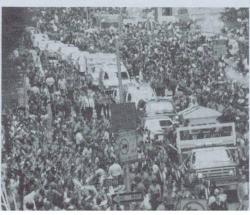
Mr. Mandela appeared to allude to a formula under which a constituent assembly, in effect supplanting the existing Parliament, would draft a new constitution. Such a plan would mean the creation of an interim government in South Africa and has previously been rejected by Mr. de Klerk for the foreseeable future. Mr. Mandela walked out of Victor Verster Prison near Paarl at 4:15 P.M., 75 minutes later than the release time announced Saturday afternoon by Mr. de Klerk. Acquaintances of the Mandela family said his departure from the prison was delayed by family discussions. He was greeted by about 5,000 supporters lining the asphalt road outside the prison farm where he has been held since December 1988. Some waved the black, green and yellow flags of the African National Congress, from which Mr. de Klerk removed a ban on Feb. 2. Mr. Mandela was then driven 40 miles from Paarl to Cape Town, passing several hundred people who had parked by the roadside or waited on overpasses in hope of seeing him. They held homemade signs, some of which read simply, ''Welcome home.'' A huge crowd, which organizers said reached 250,000 people, assembled in the square in front of the old City Hall in Cape Town to greet Mr. Mandela. Reporters covering the rally put the crowd's size at only 50,000 people at its peak. They became impatient and sometimes unruly, waiting up to six hours in the hot sun and had dwindled to about 20,000 by sunset, when Mr. Mandela finally appeared.
In the 1950's it was Government policy to prevent blacks from settling in the Western Cape, so they are not in the clear majority in Cape Town, where Mr. Mandela was released. People of mixed race, known as ''coloreds,'' are the largest population group in Cape Town, where whites also outnumber blacks. Blacks, who account for nearly 75 percent of the population in the country as a whole, are in the overwhelming majority in the Johannesburg region, where Mr. Mandela can expect his most tumultuous welcome.
The festive occasion was marred by violence after some youths who had been drinking on the fringes of the rally started breaking windows and looting shops in downtown Cape Town. The police tried to disperse them by firing shotguns and tear gas, and some of the youths retaliated by throwing bottles and stones. At one point, drunken protesters invaded a Chinese restaurant, snatched up the liquor and wine and threw bottles at the police from the rooftop. One man in the crowd was also injured in a knife fight.
The South African Press Association reported tonight that 2 people had been killed and 13 wounded in the confrontations. A physician treating casualties on the scene estimated that 100 people had been wounded, mostly by buckshot. Most suffered only light injuries, including three journalists covering the rally. Cheryl Carolus, a spokeswoman for the United Democratic Front, which helped organize the rally, attributed the violence to outsiders who, she said, were ''beyond our usual crowds, or who supported the rival Pan-Africanist Movement.''' At times, some supporters at the rally had to scramble for cover as the police chased or fired at looters and stone-throwers. The Rev. Allan Boesak, a prominent figure in the anti-apartheid movement, pleaded for more than 45 minutes with the crowd to maintain discipline and move back.
Dullah Omar, a lawyer representing the Mandela family, said Mr. Mandela had been unaware of the violence. This evening, Mr. Mandela failed to appear at a news conference arranged by the reception committee that is handling his schedule. A representative said Mr. Mandela would meet the press later this week in Johannesburg. Mr. Mandela and his wife, Winnie, are expected to fly to Johannesburg on Monday and proceed to their home in the black township of Soweto. One of the organizers, Saki Mocozoma, said security considerations precluded him from revealing where the Mandelas were spending their first night.
Mr. Mandela also paid tribute to his wife, who has lived apart from him for more than 27 years, and their children. ''I am convinced that your pain and suffering was far greater than my own,'' he told them.
Source: New York Times

