Despite grave and persistent rights violations in criminal justice systems around the world, effective reform remains a problem in many countries. The Open Society Global Criminal Justice Fund seeks to strengthen civil society engagement in the protection of the rights of criminal defendants and in confronting the overuse of pretrial detention. The fund supports civil society efforts to build networks, share experience, and identify new strategies for criminal justice reform.
The Global Criminal Justice Fund provides support to national campaigns that combine monitoring, legal defense and advocacy to catalyze new policy debates. The fund also supports linkages between national efforts and international and regional partners to develop centers of expertise, exchange best practices, and explore failures. Priority is given to projects in countries where there are deteriorating conditions of detention and evidence of pervasive discrimination within the system.
Purpose and Priorities
The Global Criminal Justice Fund supports groups based on the following priorities:
Understanding the Scope of the Problem
A lack of access to places of detention and information about detainees poses serious challenges to successful criminal justice reform. Data is needed to design interventions, demand accountability, address problems of coordination within the system, and provide a basis for challenging illegal detention. The fund supports groups to gain access to places of detention, monitor the system, and assess the effectiveness of existing legal aid in order to promote greater accountability and obtain reliable and credible data about the scope and scale of the problem.
Ensuring Access to Justice
By providing assistance to detainees in a systematic manner, such as filing bail applications or providing legal assistance, civil society groups can learn what works in practice and which kinds of interventions might be effective in producing long-term change. The fund supports groups to undertake this kind of engagement in order to identify successful strategies and possible openings for, or barriers to, reform. Where appropriate, the fund also supports litigation on behalf of detainees that challenges unlawful practices.
Making the Case for Reform
Civil society groups must engage with governments to advance meaningful policy change. Where existing government efforts are entirely inadequate, civil society organization must be able to devise strategies to ensure that the rights of criminal defendants are on the government’s reform agenda. The fund supports civil society groups to undertake advocacy efforts either individually or in coalition with other groups to protect the rights of those in detention.
Building Links to Regional and International Debates
The fund supports partners that aim to prioritize the rights of criminal defendants in regional and international debates about rule of law and human rights. By identifying national groups with links to international and regional networks, the fund seeks to increase the profile of criminal justice issues globally while at the same time expanding international partners’ ability to galvanize existing networks and engage in targeted advocacy.
Guidelines
The fund focuses its support on those countries where the need is greatest, and where due process rights intersect with questions of equality and human dignity. The fund works with organizations that can share their experience and build partnerships beyond their own borders in order to contribute to learning and the development of good practice.
Application Process
To apply for a grant from the Open Society Global Criminal Justice Fund, interested organizations should send a two- to three-page concept paper to criminaljustice@osi-dc.org. The paper should include the following:
A brief description of the project goals and planned activities;
Information about the applicant organization and project partners;
An estimated overall budget and timeframe of the project.
The initiative will aim to respond to concept papers within one month of receipt. Selected applicants will be invited to submit a full proposal for consideration.
Source: Open Society Foundations
Showing posts with label Open Society Institute. Show all posts
Showing posts with label Open Society Institute. Show all posts
Monday, April 30, 2012


Tuesday, January 5, 2010
Statement on Iran's Blacklisting of International Organizations
The Open Society Institute is deeply troubled by the Iranian government's recent decision prohibiting cooperation with international organizations. Although the Open Society Institute does not have any activities whatsoever in Iran we remain extremely concerned about the fate of Dr. Kian Tajbakhsh.
Dr. Tajbakhsh is an internationally respected scholar who as a consultant for OSI from 2004-2007 worked on humanitarian and public health projects in Iran. We note that at the time when OSI did work in Iran, the Iranian government sought the expertise of the Open Society Institute for help in these and other projects, such as humanitarian relief for the 2003 earthquake in Bam.
Source: Open Society Institute
Dr. Tajbakhsh is an internationally respected scholar who as a consultant for OSI from 2004-2007 worked on humanitarian and public health projects in Iran. We note that at the time when OSI did work in Iran, the Iranian government sought the expertise of the Open Society Institute for help in these and other projects, such as humanitarian relief for the 2003 earthquake in Bam.
Source: Open Society Institute
Wednesday, October 21, 2009
Iranian American scholar gets 12-year term in unrest
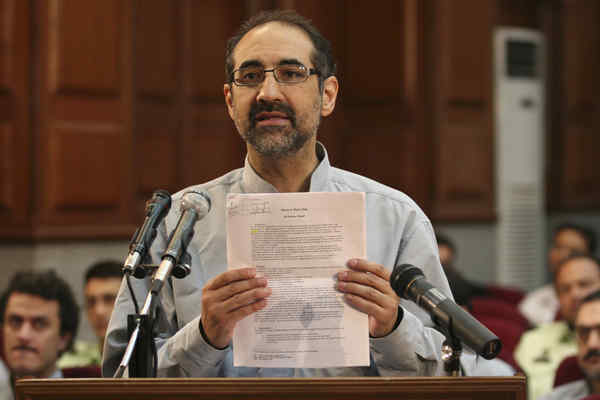 Iran ignored appeals by Secretary of State Hillary Rodham Clinton and the rock star Sting and sentenced an Iranian American academic yesterday to 12 years in prison for his alleged role in antigovernment demonstrations after the country's disputed presidential election. The sentence for Kian Tajbakhsh, 47, was the longest prison term yet in a mass trial of more than 100 opposition figures, activists, and journalists in the postelection turmoil. Tajbakhsh's heavy sentence signaled that Tehran was sticking to a tough line overall on the political unrest. It came amid calls in Iran for prosecution of the most senior opposition figure, Mir-Hossein Mousavi, and suggestions that three U.S. hikers, detained in July after accidentally crossing into Iran, could face charges.
Tajbakhsh, a social scientist and urban planner who holds dual citizenship, was arrested at his Tehran home July 9. He was the only American detained in the crackdown that crushed giant street protests by hundreds of thousands after the June 12 election. The opposition contends that the vote was rigged in favor of President Mahmoud Ahmadinejad. The security sweep went far beyond protesters on the streets, snatching up rights activists, journalists, and opposition politicians. The government accused them of organizing the protests on behalf of Iran's foreign enemies to foment a "velvet revolution" to overthrow the country's Islamic leadership.
The White House, in a statement yesterday, expressed "our deepest regret and strong objection" to Tajbakhsh's sentencing, saying that he posed no threat to Iran and urging that he be freed. Clinton had appealed in August for his release, and he also had been specifically named in a call by the British rock star Sting to free all political prisoners in Iran.
Tajbakhsh's lawyer, Houshang Azhari, told the IRNA news agency he would appeal the conviction on charges of "acting against national security." He said that the law barred him from divulging the full details of the sentence, asserting only that it was "more than 12 years." The appeal could open an avenue for freeing Tajbakhsh. Roxana Saberi, an Iranian American journalist arrested this year, was convicted of espionage but freed on appeal in what was widely seen as a political decision to defuse tensions with Washington.
Tajbakhsh had been targeted by Iranian authorities before. In 2007, he was arrested on similar charges while working for the pro-democracy Open Society Institute, run by U.S. philanthropist George Soros - a figure whom Iran often has cited as part of the antigovernment plot. Tajbakhsh denied the charges and was released after four months in prison. Afterward, Tajbakhsh left the Open Society Institution and remained with his family in Iran, working on a book.
Source:Philly.com
Wednesday, April 29, 2009
Foundation Taps Visionaries to Reform U.S. Justice System
The Open Society Institute today awarded Soros Justice Fellowships to 17 outstanding individuals working to restore fairness to a deeply flawed criminal justice system.
The lawyers, advocates, scholars, and journalists will tackle issues from death penalty reform and the criminalization of immigrants to juvenile justice and the challenges of parenting in prison. The Soros Justice Fellows will receive a total of more than $1.3 million. "At a time of uncertainty and hardship for many in America, criminal justice looms as one of our most pressing challenges," said Ann Beeson, executive director of the Open Society Institute's U.S. Programs. "The new group of Soros Justice Fellows will bring fresh ideas to fix a failed system that breaks America's promise of fairness under the law."
Among the new fellows is a community organizer in Nashville whose son was murdered in street violence and who spent more than half her life entangled in the criminal justice system. She will train current and former gang members to become advocates for reform. Another fellow, a lawyer in Seattle, will challenge a common police practice that targets homeless and poor people and bans them from entire city neighborhoods. In Virginia, a parent whose son was incarcerated in the juvenile justice system is now a full-time advocate for reform in a state that houses youth in adult jails.
The Soros Justice Fellowships fund outstanding individuals to implement innovative projects that advance OSI efforts to reform the U.S. criminal justice system. OSI’s criminal justice reform strategy takes aim at two overarching ills in our system: the over-reliance on incarceration and harsh punishment, and the lack of equal justice—especially for people of color and the poor. Since its inception in 1997, the Soros Justice Fellowships have supported over 230 dynamic individuals working to address these issues at the local, state, and national levels.
The Soros Justice Fellowships fund individuals through two programs:
* Soros Justice Advocacy Fellowships, which support lawyers, advocates, grassroots organizers, activist academics, and others with important perspectives;
* Soros Justice Media Fellowships, which support print and radio journalists, filmmakers, authors, and others with distinctive voices.
All fellowship projects must seek to further OSI’s U.S. criminal justice reform priorities and should involve the intersection of these priorities with the particular needs of one or more of the following specific constituencies: communities of color; immigrants; gay, lesbian, bisexual, and transgender communities; and women and children. Fellowship applications are especially encouraged from individuals directly affected by, or with significant direct personal experience with, the issues their projects seek to address.
For more information, please see the Soros Justice Fellowships guidelines. For program inquiries, please contact Christina Voight at cvoight@sorosny.org.
Source: Open Society Institute
The lawyers, advocates, scholars, and journalists will tackle issues from death penalty reform and the criminalization of immigrants to juvenile justice and the challenges of parenting in prison. The Soros Justice Fellows will receive a total of more than $1.3 million. "At a time of uncertainty and hardship for many in America, criminal justice looms as one of our most pressing challenges," said Ann Beeson, executive director of the Open Society Institute's U.S. Programs. "The new group of Soros Justice Fellows will bring fresh ideas to fix a failed system that breaks America's promise of fairness under the law."
Among the new fellows is a community organizer in Nashville whose son was murdered in street violence and who spent more than half her life entangled in the criminal justice system. She will train current and former gang members to become advocates for reform. Another fellow, a lawyer in Seattle, will challenge a common police practice that targets homeless and poor people and bans them from entire city neighborhoods. In Virginia, a parent whose son was incarcerated in the juvenile justice system is now a full-time advocate for reform in a state that houses youth in adult jails.
The Soros Justice Fellowships fund outstanding individuals to implement innovative projects that advance OSI efforts to reform the U.S. criminal justice system. OSI’s criminal justice reform strategy takes aim at two overarching ills in our system: the over-reliance on incarceration and harsh punishment, and the lack of equal justice—especially for people of color and the poor. Since its inception in 1997, the Soros Justice Fellowships have supported over 230 dynamic individuals working to address these issues at the local, state, and national levels.
The Soros Justice Fellowships fund individuals through two programs:
* Soros Justice Advocacy Fellowships, which support lawyers, advocates, grassroots organizers, activist academics, and others with important perspectives;
* Soros Justice Media Fellowships, which support print and radio journalists, filmmakers, authors, and others with distinctive voices.
All fellowship projects must seek to further OSI’s U.S. criminal justice reform priorities and should involve the intersection of these priorities with the particular needs of one or more of the following specific constituencies: communities of color; immigrants; gay, lesbian, bisexual, and transgender communities; and women and children. Fellowship applications are especially encouraged from individuals directly affected by, or with significant direct personal experience with, the issues their projects seek to address.
For more information, please see the Soros Justice Fellowships guidelines. For program inquiries, please contact Christina Voight at cvoight@sorosny.org.
Source: Open Society Institute
Subscribe to:
Posts (Atom)