On the day Robert McBride secured a nod in Parliament to lead police watchdog Ipid – and while more denials were heard by the Farlam Commission – news broke that officers in Limpopo shot dead two more protesters in a chaotic stand-off. This brings to eight the number of protesters killed this month alone. ALEX ELISEEV asks what it will take to make the police realise that its relationship with communities across South Africa is in a fiery tailspin.
The numbers are as mad as the story is startling: One satellite police station in the Relela village outside of Tzaneen, Limpopo. Twenty officers defending the outpost. Between 1,500 and 2,000 protesters “attacking” the station with stones and petrol bombs. Some 2,050 rounds of rubber bullets fired before the switch-over to live ammunition. Fifteen officers injured in the battle. Three of them left in a critical condition. Nineteen police cars damaged or destroyed. Two protesters shot and killed during the clash.
The images flooding your mind right now are probably closer to what South African soldiers endured in the Central African Republic rather than what police officers should be dealing with in a war-free, democratic country.
The question that pierces through all those figures is: how angry does a community have to be – what kind of hatred must be festering – for hundreds of people to come together and overrun, by force, their local police station? To try to obliterate the place that houses men and women who’ve taken an oath to protect you. We know too well the evil that lurks inside a mob, but this was an outright storming of a sacred castle.
Unlike with the Marikana bloodbath, there were probably few or no cameras filming the latest clash. The details still have to be investigated by the same organisation that Robert McBride – one of the country’s most controversial policemen – will soon be leading. But even on the police’s own version, what happened in Relela does not belong in post-Apartheid South Africa.
Granted, what happened there was not a routine service delivery protest over water or electricity that spiralled out of control. The circumstances were different. A local woman was killed and mutilated and the community wanted those responsible to be arrested. Police took a couple of suspects in for questioning but when they were released, their neighbours went on the rampage, burning down their homes. When the police intervened, a teenage boy was shot and killed. His death, in turn, became the magnet that drew the crowd to the Relela police station on Tuesday night.
Limpopo police claim that anyone in the same situation (the situation the officers were in) would have done the exact same thing. The crowd had broken through into the station’s courtyard and were out for revenge. Judging by the damage, there’s every reason to believe that the officers may have been genuinely terrified and thought their lives were in danger. They probably were. Those attacking the station were committing a criminal act. There’s also evidence that the police officers did their best to push back the mob, using thousands of rounds of rubber bullets.
But the issues here run much deeper, the main one being: how did it get to this? How did we reach a crisis which the police, and police minister Nathi Mthethwa, think they can talk their way out of? (Which, of course, they can’t).
Too much blood has been spilled. Too much horror witnessed. The list has been mentioned over and over again: Marikana, Tatane, Macia, Mothutlung, Durban Deep… For way too many people the police have become the enemy.
The cold, hard truth is that the level of violence we are seeing now is the consequence of earlier decisions. Decisions which ranged from bad to catastrophic. Remember the “shoot to kill!” and “maximum force” rhetoric spewing out of Bheki Cele’s mouth (which went viral). Or the decision by Jackie Selebi to reconfigure the Public Order Policing, leaving it in shambles. And, as a show of force, the re-introduction of military ranks.
But worst of all have been the decisions, one after the next, to send in civilians (political appointments) to lead the police. The latest, by President Jacob Zuma, was Riah Phiyega, who has so far had a disastrous run (some of it was not her fault, and some of it was).
The Institute for Security Studies – the think tank which the police loves to ignore – says all indicators show that police brutality is rising, public trust in the service is deteriorating and there doesn’t seem to be any real plan to reverse either of these trends.
Asked whether we can expect more bloodshed, the ISS’s Gareth Newham says: “I hope not. But we will continue to see growing anger and discontent and a breakdown of the relationship.”
He adds: “Warnings were ignored and now we’re seeing the consequences.”
The reality on the ground is complex. The balance between crushing violent crime or policing tense protests while respecting human rights is a delicate one. No one is saying it’s easy. Then there’s the politics, corruption, shadowy alliances and the unholy mess in units like Crime Intelligence (which Phiyega is now trying to clean up).
The time has come for drastic action. Possibly a complete overhaul of the Public Order Policing (POP). The unit needs an injection of officers and strong, accountable commanders. A message needs to cascade through the ranks that says that anyone who steps out of line, who loads up their shotgun with buckshot or fires without an order, will be punished. Officers need to be better trained. And all of this needs to be communicated to the public so that perceptions can begin to change. Maybe even hold a public commission of inquiry into the POP, diagnose the problem and fix it.
It’s time for Mthethwa to go beyond sending out media statements and praying with families of victims. He needs to take meaningful action. It’s time for President Jacob Zuma to step up. If he can find the time to congratulate Ladysmith Black Mambazo on a Grammy or the Bantu Church of Christ on its centenary, spur on the Matrics or defend eTolling, he can get stuck into this crisis. And by that we mean do something more than establish a task team. After all, the storming of a police station is about as close as you can come to true lawlessness.
Newham describes what happened in Relela as a “new development”. It’s much more than that. It’s a wake-up call, a short in the circuit of democracy. A signal that the relationship between police and civilians can’t be that of a state of war or a violent occupation. History teaches us how people, countries, respond to that.
When Phiyega visited the community on Wednesday, angry residents were shouting at her, demanding to know who gave the order to kill? She did her best to restore calm to the area, but she was up against a hostile crowd.
The police may be under attack, but they have to start earning back the trust. Showing the public that they are not the enemy. When what happened in Relela becomes a reality, you’ve waited too long to act. DM
Source: Daily Maverick
Showing posts with label Andries Tatane. Show all posts
Showing posts with label Andries Tatane. Show all posts
Thursday, January 30, 2014


Wednesday, April 20, 2011
South Africa Exults Abroad but Frets at Home
With the country preparing for local elections on May 18, the cabinet member Mr. Zuma chose to oversee local government, Sicelo Shiceka, is now embroiled in scandalous reports about his profligate living at public expense. Mr. Zuma announced Sunday that he was awaiting an explanation from Mr. Shiceka that has yet to come. “It’s this flaunting of inequality and conspicuous consumption that people get agitated about,” said Ben Roberts, a researcher at the Human Sciences Research Council, which recently conducted a survey of South Africans documenting widespread disillusionment with local government.
Parliamentary leaders of Mr. Zuma’s party, the African National Congress, have asked for independent investigators in the public protector’s office to find out whether Mr. Shiceka spent more than $50,000 of taxpayers’ money to fly to Switzerland and stay in five-star hotels while visiting his girlfriend, a flight attendant, who was jailed there on drug charges, as The Sunday Times of South Africa reported.
In a follow-up article on Sunday, the newspaper reported that municipal trucks were delivering water to the building site of Mr. Shiceka’s new home in the poorest district in the Eastern Cape. His home was also slated to be among the first to get electricity. “What a disgrace!” shouted the headline. “Minister builds emperor’s palace in South Africa’s poorest village.”
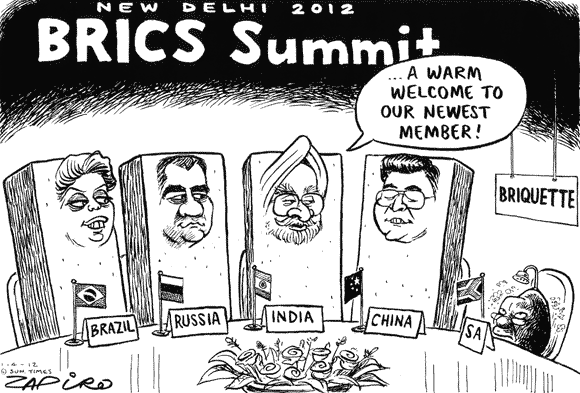
Corruption and great disparities in wealth are hardly uncommon among the other BRICS countries. But the lack of basic services has touched a particular nerve here. People in Mr. Shiceka’s home district had been protesting the poor quality of water and sewerage services. And it was precisely these issues that led poor people in Ficksburg, a town in the Free State, to take to the streets last week in a protest that ended in tragedy. SABC, the state broadcaster, showed police officers in Ficksburg assaulting an unarmed, shirtless protester named Andries Tatane, 33, and thwacking his torso with batons. Mr. Tatane then looked down at his chest, streaming with blood. A haunting photograph shows him lying wounded in the arms of a friend whose face is contorted in anguish. Mr. Tatane died minutes later. “The post-mortem showed he died of gunshot wounds,” said Moses Dlamini, spokesman for the Independent Complaints Directorate, which investigates police brutality. “And he had bruises which indicated he was assaulted.” Two police officers have been charged with the murder and four others with assault, but not before enraged residents of Mr. Tatane’s township set fire to two government buildings.
An African National Congress spokesman, Jackson Mthembu, described the attack on Mr. Tatane as reminiscent of “apartheid-era strong-arm tactics” — a remarkable statement considering that the A.N.C. itself led the struggle against apartheid and has governed the country, and overseen its police force, since 1994.
The so-called service delivery protests, a phenomenon across the country, provide signs of the simmering discontent among many South Africans about how long it is taking to translate the gains of freedom into material progress. Even as South Africa takes center stage with the world’s most prominent developing nations, a majority of young black South Africans are jobless. Poverty remains widespread. A nationwide survey of about 3,200 South Africans age 16 and older, sponsored by the country’s Independent Electoral Commission, found that South Africans were most dissatisfied with local government performance on job creation, crime and housing.
The survey, released last week, documented an erosion of trust at all levels of government, with the lowest approval level — 38 percent — reserved for local government, down from a high of 55 percent in 2004. Politicians rated even lower. Only 27 percent of South Africans trusted them when the survey was conducted in the final months of 2010. The main opposition party, the Democratic Alliance — widely perceived as dominated by whites — has sought to attract more black support by highlighting its strong record in running the city of Cape Town. Helen Zille, the former journalist who leads the party, has seized on the killing of Mr. Tatane as emblematic of how the A.N.C. has “become disconnected from the people it is supposed to serve.”
But the loyalty of voters to the A.N.C., the party of Nelson Mandela, remains deep, and the survey found that those who were most unhappy with government were also the ones who said they were least likely to vote. So the question of whether discontent leads to change in the ballot box remains open.
Source: New York Times
Tuesday, April 19, 2011
Arresting a Few Policemen will not Solve South Africa`s Violent Policing Problem
The brutal death of unarmed protestor and father of two, Andries Tatane, at the hands of the South African police in Ficksburg on 13 April would have gone largely unnoticed except that it was captured on film and shown as headline news on national television. South Africans and people around the world were rightly outraged at the senseless and disproportionate violence directed at Mr. Tatane by a mob of policemen. The harsh reality is that many police officials who watching the news would not have been shocked at seeing him beaten with batons and shot at from close range with rubber bullets. Because Tatane was fighting back at policemen attacking him, many police officials would have thought that he deserved the beating. The use of excessive violence as part of everyday policing has long been the norm in South Africa. What was different this time was not only that the victim died shortly thereafter, but that it was captured on film and broadcast on public television.
The warning signs that the police are becoming increasingly violent have been around for some time. The Independent Complaints Directorate (ICD) annually reports on police related deaths, assaults and other forms of serious misconduct to parliament. Statistics collected by the ICD reveal that the number of people shot dead by the police more than doubled (increasing by over 100%) between 2005/06 and 2008/09, when a record high of 568 people were killed. The number dropped slightly but remained high at 524 shot dead during 2009/10. Moreover, the ICD statistics reveal that complaints of police assault with intention to commit grievous bodily harm (GBH) increased from 825 incidents in 2008/10 to 920 in 2009/2010. Unfortunately however, these figures have not resulted in any recognition that there might be a fundamental problem in the SAPS and no steps have been taken by police leadership to obtain a better understanding as to the cause of the increase or to reduce the number of killings.
Given the national and international profile given to this incident however, the Minister of Police Nathi Mthethwa immediately released a media statement in which he expressed his “…full confidence that the Independent Complaints Directorate (ICD) will, without fear or favour investigate an alleged killing of a striking resident by police during a march in Ficksburg.” A few days later the Minister released another statement welcoming the arrest of six policemen implicated in the killing and highlighting that he has been consistent in his stance that, “those who break the law must be punished.” It is unusual for the ICD to act so quickly in response to complaints of police brutality, but given the widespread condemnation of this incident and the directive from the Minister, it is understandable.
Unfortunately however, this approach where incidents are referred to the ICD for investigation is not going to solve this deep and ongoing problem. The investigations may or may not reveal whether the police officials involved acted within the scope of the law and police regulations. If it is found that they broke the law then the ICD will give the docket to the National Prosecuting Authority who may decide to criminally prosecute the policemen. If SAPS regulations were broken then the ICD will make recommendations to the SAPS that disciplinary action is taken against the offending officials. The SAPS generally ignore these recommendations from the ICD but even when they do act on them, the only outcome will be that a few officials will be held accountable. This will not address the underlying management, structural and cultural problems that are contributing to this growing problem.
The ANC was correct to call for a commission of inquiry into Tatane’s death, as this is exactly what is needed at this time. Rather than only focusing on the individual officials as the ICD investigation will do, such an inquiry should look at the organisational context within which these police officials were operating. If it does so it is likely to find that inadequate command and control was generally exercised over the officials and that the SAPS standing operating procedures and the code of conduct were largely ignored. It is also likely to find that the training these officials received was sub-standard and that they were not properly assessed as to the extent to which they understand their role and responsibilities in handling public protests. Further still, such an inquiry could note that poor strategic decisions taken by SAPS leadership over the past decade resulted in the closure of specialised units including half of the Public Order Policing units, although these were belatedly re-established for the 2010 FIFA World Cup. Consequently, the SAPS does not possess adequate skills and capacity to professionally respond to a number of the challenges it faces including maintaining public order.
If such an inquiry correctly includes a focus on those who have the authority and responsibility to ensure that the police uphold the law, then the political context of this killing cannot be ignored. Since 2008 when Deputy Minister of Police, Susan Shabangu called for police to “shoot to kill”, the SAPS has been led down a dangerous path where political rhetoric urging police to “show no mercy” to whomever they choose to label as “criminals” has replaced a firm commitment to ensuring that the SAPS adheres to acceptable standards of police professionalism and the rule of law. The “police service” was rhetorically renamed a “police force”, military style ranks were introduced and a “war on crime” was announced. While the Minister of Police has implored the police to “…respect the principles of human dignity and rights” he also appears to justify police violence by warning civilians, “not to provoke or insult the police.” This suggests that at the most senior levels of government, police violence is not seen as a fundamental challenge that police leadership has a duty to contain as much as it is something that civilians should avoid in the way that they act towards police officials.
David Bruce from the Centre for the Study of Violence and Reconciliation who has been studying violence and policing in South Africa presented a paper at an ISS Conference on Crime and Crime Prevention in December 2010 in which he highlights the urgent need, “… for policing which is carried out fairly and respectfully.” He goes on to argue that, “There is some evidence ‘that the manner in which people are treated by agents of the criminal justice system contributes not only to respect for [the criminal] justice [system] but to respect for the law itself’. Essentially this means that people are more likely to voluntarily obey the law if they believe that agents of the criminal justice system will act towards them in a fair way.” This is an insight that the current leadership would do well to heed.
The Mail & Guardian recently quoted a government insider as stating that President Jacob Zuma had appointed General Cele to show South Africans that “police must be feared and respected”. However, fear does not necessarily bring respect. If one listens to the public outrage about this killing one would be hard pressed to find many people expressing respect for the police and far more likely to hear expressions of police disdain, even hate. However, state policing can be respected only if government changes its militant approach to policing and recognises it for the professional craft that it should be. Given that many of the problems currently facing the SAPS stem from decades of poor leadership and bad strategic decisions, effective change will need to be guided by an independent commission of inquiry that specifically focuses on the managerial, structural and cultural challenges that need to be addressed to professionalise the organisation. Until this happens, the tragic killing of Andries Tatane will not be the last such policing related incident to shock South Africa.
Source: Polity
The warning signs that the police are becoming increasingly violent have been around for some time. The Independent Complaints Directorate (ICD) annually reports on police related deaths, assaults and other forms of serious misconduct to parliament. Statistics collected by the ICD reveal that the number of people shot dead by the police more than doubled (increasing by over 100%) between 2005/06 and 2008/09, when a record high of 568 people were killed. The number dropped slightly but remained high at 524 shot dead during 2009/10. Moreover, the ICD statistics reveal that complaints of police assault with intention to commit grievous bodily harm (GBH) increased from 825 incidents in 2008/10 to 920 in 2009/2010. Unfortunately however, these figures have not resulted in any recognition that there might be a fundamental problem in the SAPS and no steps have been taken by police leadership to obtain a better understanding as to the cause of the increase or to reduce the number of killings.
Given the national and international profile given to this incident however, the Minister of Police Nathi Mthethwa immediately released a media statement in which he expressed his “…full confidence that the Independent Complaints Directorate (ICD) will, without fear or favour investigate an alleged killing of a striking resident by police during a march in Ficksburg.” A few days later the Minister released another statement welcoming the arrest of six policemen implicated in the killing and highlighting that he has been consistent in his stance that, “those who break the law must be punished.” It is unusual for the ICD to act so quickly in response to complaints of police brutality, but given the widespread condemnation of this incident and the directive from the Minister, it is understandable.
Unfortunately however, this approach where incidents are referred to the ICD for investigation is not going to solve this deep and ongoing problem. The investigations may or may not reveal whether the police officials involved acted within the scope of the law and police regulations. If it is found that they broke the law then the ICD will give the docket to the National Prosecuting Authority who may decide to criminally prosecute the policemen. If SAPS regulations were broken then the ICD will make recommendations to the SAPS that disciplinary action is taken against the offending officials. The SAPS generally ignore these recommendations from the ICD but even when they do act on them, the only outcome will be that a few officials will be held accountable. This will not address the underlying management, structural and cultural problems that are contributing to this growing problem.
The ANC was correct to call for a commission of inquiry into Tatane’s death, as this is exactly what is needed at this time. Rather than only focusing on the individual officials as the ICD investigation will do, such an inquiry should look at the organisational context within which these police officials were operating. If it does so it is likely to find that inadequate command and control was generally exercised over the officials and that the SAPS standing operating procedures and the code of conduct were largely ignored. It is also likely to find that the training these officials received was sub-standard and that they were not properly assessed as to the extent to which they understand their role and responsibilities in handling public protests. Further still, such an inquiry could note that poor strategic decisions taken by SAPS leadership over the past decade resulted in the closure of specialised units including half of the Public Order Policing units, although these were belatedly re-established for the 2010 FIFA World Cup. Consequently, the SAPS does not possess adequate skills and capacity to professionally respond to a number of the challenges it faces including maintaining public order.
If such an inquiry correctly includes a focus on those who have the authority and responsibility to ensure that the police uphold the law, then the political context of this killing cannot be ignored. Since 2008 when Deputy Minister of Police, Susan Shabangu called for police to “shoot to kill”, the SAPS has been led down a dangerous path where political rhetoric urging police to “show no mercy” to whomever they choose to label as “criminals” has replaced a firm commitment to ensuring that the SAPS adheres to acceptable standards of police professionalism and the rule of law. The “police service” was rhetorically renamed a “police force”, military style ranks were introduced and a “war on crime” was announced. While the Minister of Police has implored the police to “…respect the principles of human dignity and rights” he also appears to justify police violence by warning civilians, “not to provoke or insult the police.” This suggests that at the most senior levels of government, police violence is not seen as a fundamental challenge that police leadership has a duty to contain as much as it is something that civilians should avoid in the way that they act towards police officials.
David Bruce from the Centre for the Study of Violence and Reconciliation who has been studying violence and policing in South Africa presented a paper at an ISS Conference on Crime and Crime Prevention in December 2010 in which he highlights the urgent need, “… for policing which is carried out fairly and respectfully.” He goes on to argue that, “There is some evidence ‘that the manner in which people are treated by agents of the criminal justice system contributes not only to respect for [the criminal] justice [system] but to respect for the law itself’. Essentially this means that people are more likely to voluntarily obey the law if they believe that agents of the criminal justice system will act towards them in a fair way.” This is an insight that the current leadership would do well to heed.
The Mail & Guardian recently quoted a government insider as stating that President Jacob Zuma had appointed General Cele to show South Africans that “police must be feared and respected”. However, fear does not necessarily bring respect. If one listens to the public outrage about this killing one would be hard pressed to find many people expressing respect for the police and far more likely to hear expressions of police disdain, even hate. However, state policing can be respected only if government changes its militant approach to policing and recognises it for the professional craft that it should be. Given that many of the problems currently facing the SAPS stem from decades of poor leadership and bad strategic decisions, effective change will need to be guided by an independent commission of inquiry that specifically focuses on the managerial, structural and cultural challenges that need to be addressed to professionalise the organisation. Until this happens, the tragic killing of Andries Tatane will not be the last such policing related incident to shock South Africa.
Source: Polity
Subscribe to:
Posts (Atom)