In his recent book, Fred Pearce examines the dynamics behind large-scale land acquisitions and their social, environmental and developmental effects.
"Buy land. They are not making it anymore."
This statement uttered more than one hundred years ago by Mark Twain still holds a sad and powerful truth and makes a telling start for Fred Pearce's account in The Landgrabbers: The New Fight Over Who Owns the Earth about the struggle over the Earth's most precious resources: land and water.
In the book, the reader is taken on a whirlwind tour around the globe to witness, through Pearce's eyes, a new kind of colonialism driven not by countries, but by powerful private capitalists.
We encounter figures such as George Soros and Richard Branson; we learn about the effects of the conflicts in the Democratic Republic of the Congo and Liberia; we find out why President Robert Mugabe's land seizures in Zimbabwe were not so bad after all for small-scale farmers; and we see how the global financial crisis and the intricate mechanisms of stock market speculations in commodities exacerbate the problem.
Pearce's passion and outrage about the selling off of communal resources shines through the book.
Each chapter is dedicated to a certain country, where protagonists change, yet the storyline stays the same: governments around the globe grant large concessions to wily investors in the hope of advancing their economies but displace and disadvantage large parts of their own population in the process.
As Mike Ogg, an agriculture specialist from Swaziland, told Think Africa Press: "I fundamentally believe that agriculture can lead development in Africa. The quandary is: How do you create a win-win situation where investors and the community benefit?"
Pearce's dystopia
Pearce presents a bleak picture of increasingly prevalent 'land grabs' by corporations for agriculture or resource exploitation as well as by well-meaning environmentalists for so-called "green grabs".
This is, Pearce argues, encircling the last remaining habitats of indigenous peoples and the landless poor, destroying their past and forever altering their future.
Pearce mixes this narrative with historical references to imperialism and colonialism giving the impression of a continuous cycle of exploitation. But his greatest achievement in the book is to give those exploited a voice.
He recounts their stories in numerous interviews, as well as talking to those involved in the land acquisitions and a variety of experts.
Pearce concludes that the bulk of the blame rests with foreign buyers though it is crucial to recognise that most deals are also pursued by respective governments which may give out large land concessions, tax breaks and other incentives to draw foreign capital into their country in the first place. And politicians are not only accomplices, but often also carve out deals in return for money or land for themselves.
This is enabled by an environment in which laws are either non-existent or easily circumvented. As Graziano da Silva, director-general of the United Nations Food and Agricultural Organisation, notes: "It appears to be like the Wild West and we need a sheriff and law in place."
Proposing solutions
Although Pearce does not go so far as to propose possible solutions, there is a range of opinion and ideas as to how to begin to tackle the problem.
Olivier De Schutter, UN special rapporteur on the right to food, has suggested that when national governments are unable or unwilling to devise regulations, the international community should step in to monitor whether the rights of land users are being respected. Oxfam's recent report 'Our Land, Our Lives' highlights the pivotal role of the World Bank as an advisor to governments in reforming their laws.
But this is easier said than done. As a representative from USAID in Dar es Salaam admitted to Think Africa Press, "Land tenure, we know, is at the heart of many problems as it is difficult for poor people to feed themselves with limited and insecure access to land, but we are not touching this subject, because it's too contentious and complicated".
Another way the negative impacts of large-scale land acquisitions could be mitigated is through emerging sustainability standards.
The World Bank and its private sector funding arm, the International Finance Corporation, have strict regulations regarding social and environmental sustainability. These include standards on development-induced displacement and there are growing calls for wider implementation of such regulations.
An example of a private sector-driven initiative is Bonsucro, a certification scheme which aims to ensure companies involved in the production of sugar and ethanol from sugarcane meet environmental, social and business standards.
With consumers believed to be increasingly concerned about the impacts of the goods they buy, the Bonsucro certification is meant to reassure buyers that companies are acting in sustainable ways and taking account of human rights and pollution control.
Moving forwards
Pearce acknowledges these developments in his last chapter where he analyses some of the attempts at solutions though he does not put forward his own. Nevertheless, Pearce's book is a worthwhile read. His writing style is highly engaging and reveals the duplicity of investors and interest groups.
He not only presents complicated and contentious issues such as the correlation of Wall Street speculations and rising food prices in an accessible manner, but also masterfully interweaves stories and issues across countries and continents achieving a well-researched, logical and informative account.
Although Pearce's focus lies on the problems at hand rather than solutions, the book certainly contributes to a growing awareness about the issues and will hopefully inspire others to find suitable ways to move forwards.
Katharina Neureiter holds an MSc in History of International Relations from the London School of Economics specialising in African colonial history and war cultures. She is currently working as a consultant in East Africa and blogs at hearabout.wordpress.com.
Source: All Africa
Showing posts with label George Soros. Show all posts
Showing posts with label George Soros. Show all posts
Tuesday, December 4, 2012


Monday, July 2, 2012
Obama administration’s Guinea mining deal hurts American businesses
A secret business deal between the government of Guinea and a
multinational firm with a U.S. partner aided by the Obama
administration’s wrongheaded foreign policy could cost American
businesses billions. Congress ought to investigate to protect American
investors, expose any political shenanigans and prosecute the guilty.
The London Sunday Times first cracked the story June 3 of the secret $25 million loan between an offshore company, Palladino Capital 2, and the cash-strapped West African country. The funds, according to the loan agreement, were to finance the start-up of Guinea’s state mining company, Heritage, but the cash allegedly disappeared and the terms of the loan include a default clause which gives the lender a juicy 30 percent stake of Guinea’s mushrooming mining assets.
A thirty percent share is especially significant given Guinea’s new mining code engineered by advisors billionaire trader George Soros and Palladino’s South African owner Walter Hennig. The 2011 code gives 15 percent of all mining assets to Heritage, including another 20 percent at market rates. That means foreign mining operators forfeit billions of dollars in assets and profits atop an 8 percent customs tax.
Further, the $25 million loaned by Hennig’s Palladino, according to former Guinean mines minister Mahmoud Thiam who spoke with South Africa’s Mail & Guardian, was a quid pro quo — a bribe — in return for Guinea President Alpha Conde’s campaign support.
Perhaps word the money was for a political payoff prompted Palladino’s May 24 loan recall. Or the recall could be part of the secret deal to cash in on the loan by claiming a 30 percent share of Heritage, but now the cat is out of the bag.
Mohamed Fofana, the current minister of mines and the official who signed the 2011 loan with Palladino, rejects the allegations. He claims the money went to Heritage Company, not Guinea’s government coffers and it is in the bank waiting to be invested. He also rejects the allegation he ever agreed to “a $25 million loan in exchange for a third of our mineral resources.”
Fofana has a problem with the truth, however. His rejection is refuted by the signed and sealed “Credit Agreement,” a copy of which Human Events acquired. The April 12, 2011 document is between the Republic of Guinea and Palladino Capital 2 Limited. Page 3 reads Guinea “solicited the lender” seeking $25 million to finance the creation of Heritage Company and page 9, paragraph 11.1 states the “lender may take” 30 percent of the shares of the “Heritage Company” if Guinea defaults “after a formal notice” and “within sixty (60) working days of the request by the Lender.”
This case warrants U.S. Congressional investigation to identify American interests and to protect our foreign investments. Congress should ask the following questions.
First, was the $25 million loan a violation of U.S. law? The answer depends on the true purpose of the loan and whether a U.S. entity was involved in the transaction.
The U.S. Foreign Corrupt Practices Act makes it an offense to offer money to a foreign official to influence that official in his official capacity. Clearly, Guinea’s former mines minister Thiam alleges the money is a bribe to the nation’s president in exchange for a 30 percent share of Guinea’s mining concessions.
Thiam further alleges the president’s son Mohamed Conde and Palladino’s Samuel Mebiame, who signed the $25 million loan for the lender, tried to raise campaign funds in return for access to state mineral assets, according to the Mail & Guardian.
There is also a U.S. entity connected to the lender. Hennig’s Palladino partners with U.S. investment fund managers Och-Ziff Capital Management in African Global Capital. They formed the joint venture in 2008 “as a platform to invest in both private and public markets across Africa, with a bias towards natural resources and related businesses,” the partners said in a joint statement.
Second, is there a relationship between the $25 million loan and Guinea’s new mining code? That is important because it would demonstrate Palladino’s motivation for making the loan, to wit insider information about Guinea’s plans to nationalize mining assets. Mining receipts account for 70 percent of Guinea’s income.
In March 2011 President Conde invited financier George Soros and former British Prime Minister Tony Blair to advise him on how to best manage Guinea’s mining assets. They recommended rewriting the mining code, seizing a portion of foreign company assets and renegotiating unfavorable provisions in existing contracts.
Palladino also consulted with Guinea officials regarding the new mining code. In fact, Palladino’s consultations regarding its interest in Guinean mineral assets culminated in a signed agreement with Guinea in March 2011 just before the $25 million loan was executed. The new mining code was published in September, six months after the loan that includes the default 30 percent proviso.
Third, is there a relationship between the Obama administration’s decision to reinstate favorable trade relations with Guinea and the $25 million loan? That is important because it addresses factors that may influence the administration’s foreign policy decisions that potentially enrich some parties at the expense of other American businesses.
In October 2011 Obama restored privileged U.S. trade partner status under the African Growth and Opportunity Act (AGOA) with Guinea after revoking them following Guinea’s 2008 coup. The published criteria for that decision include hosting free and fair elections, establishment of the rule of law and combating corruption.
Restoring AGOA status is desirable for Guinea because the U.S. Government restores trade preferences and other benefits such as political risk insurance to American firms through the Overseas Private Investment Corporation. Guinea understandably wants the jobs that come with AGOA status and the protection OPIC offers because it incentivizes American businesses by mitigating risk in Guinea’s volatile markets.
But granting Guinea favorable trade status was a bad decision based on the published criteria. Even though Guinea’s 2010 election was largely free and fair, the country still suffers from numerous problems. Human Rights Watch cautioned that Guinea has seen new security force abuses, including killings, a concentration of power in the executive, weak implementation of the rule of law, and rising ethnic tensions. Further, Guinea is creating regional insecurity, particularly in its role as a hub for transnational narcotics trade.
It is possible political lobbying and donations trumped what should have been an unfavorable trade status decision possibly due to its nexus with the $25 million loan. Specifically, Och-Ziff Capital Management which is partnered with Palladino, the $25 million lender and possible big winner in the case of loan default, had a financial incentive to encourage restoration of favorable trade status with Guinea. Further, it had the opportunity to influence the administration’s decision.
Public records indicate Och-Ziff uses the services of Washington lobbyists Fierce, Isakowitz & Blalock to promote its interests with the U.S. Government, which included five reported meetings with White House staff in 2011. Also, Daniel Och and Dirk Ziff and their families, according to public records, are big donors to Democrat Party campaigns and especially Obama, which argue for additional clout.
Congress should determine whether Och-Ziff or other parties unduly influenced the administration’s Guinea trade status decision and whether that decision has any direct or indirect impact on Guinean mining operations.
Congress must ask these tough questions to determine the truth. Clearly, the secret deal could hurt American mining businesses, exposes the administration’s wrongheaded foreign policy, and may violate our foreign corruption laws.
Source: Human Events
The London Sunday Times first cracked the story June 3 of the secret $25 million loan between an offshore company, Palladino Capital 2, and the cash-strapped West African country. The funds, according to the loan agreement, were to finance the start-up of Guinea’s state mining company, Heritage, but the cash allegedly disappeared and the terms of the loan include a default clause which gives the lender a juicy 30 percent stake of Guinea’s mushrooming mining assets.
A thirty percent share is especially significant given Guinea’s new mining code engineered by advisors billionaire trader George Soros and Palladino’s South African owner Walter Hennig. The 2011 code gives 15 percent of all mining assets to Heritage, including another 20 percent at market rates. That means foreign mining operators forfeit billions of dollars in assets and profits atop an 8 percent customs tax.
Further, the $25 million loaned by Hennig’s Palladino, according to former Guinean mines minister Mahmoud Thiam who spoke with South Africa’s Mail & Guardian, was a quid pro quo — a bribe — in return for Guinea President Alpha Conde’s campaign support.
Perhaps word the money was for a political payoff prompted Palladino’s May 24 loan recall. Or the recall could be part of the secret deal to cash in on the loan by claiming a 30 percent share of Heritage, but now the cat is out of the bag.
Mohamed Fofana, the current minister of mines and the official who signed the 2011 loan with Palladino, rejects the allegations. He claims the money went to Heritage Company, not Guinea’s government coffers and it is in the bank waiting to be invested. He also rejects the allegation he ever agreed to “a $25 million loan in exchange for a third of our mineral resources.”
Fofana has a problem with the truth, however. His rejection is refuted by the signed and sealed “Credit Agreement,” a copy of which Human Events acquired. The April 12, 2011 document is between the Republic of Guinea and Palladino Capital 2 Limited. Page 3 reads Guinea “solicited the lender” seeking $25 million to finance the creation of Heritage Company and page 9, paragraph 11.1 states the “lender may take” 30 percent of the shares of the “Heritage Company” if Guinea defaults “after a formal notice” and “within sixty (60) working days of the request by the Lender.”
This case warrants U.S. Congressional investigation to identify American interests and to protect our foreign investments. Congress should ask the following questions.
First, was the $25 million loan a violation of U.S. law? The answer depends on the true purpose of the loan and whether a U.S. entity was involved in the transaction.
The U.S. Foreign Corrupt Practices Act makes it an offense to offer money to a foreign official to influence that official in his official capacity. Clearly, Guinea’s former mines minister Thiam alleges the money is a bribe to the nation’s president in exchange for a 30 percent share of Guinea’s mining concessions.
Thiam further alleges the president’s son Mohamed Conde and Palladino’s Samuel Mebiame, who signed the $25 million loan for the lender, tried to raise campaign funds in return for access to state mineral assets, according to the Mail & Guardian.
There is also a U.S. entity connected to the lender. Hennig’s Palladino partners with U.S. investment fund managers Och-Ziff Capital Management in African Global Capital. They formed the joint venture in 2008 “as a platform to invest in both private and public markets across Africa, with a bias towards natural resources and related businesses,” the partners said in a joint statement.
Second, is there a relationship between the $25 million loan and Guinea’s new mining code? That is important because it would demonstrate Palladino’s motivation for making the loan, to wit insider information about Guinea’s plans to nationalize mining assets. Mining receipts account for 70 percent of Guinea’s income.
In March 2011 President Conde invited financier George Soros and former British Prime Minister Tony Blair to advise him on how to best manage Guinea’s mining assets. They recommended rewriting the mining code, seizing a portion of foreign company assets and renegotiating unfavorable provisions in existing contracts.
Palladino also consulted with Guinea officials regarding the new mining code. In fact, Palladino’s consultations regarding its interest in Guinean mineral assets culminated in a signed agreement with Guinea in March 2011 just before the $25 million loan was executed. The new mining code was published in September, six months after the loan that includes the default 30 percent proviso.
Third, is there a relationship between the Obama administration’s decision to reinstate favorable trade relations with Guinea and the $25 million loan? That is important because it addresses factors that may influence the administration’s foreign policy decisions that potentially enrich some parties at the expense of other American businesses.
In October 2011 Obama restored privileged U.S. trade partner status under the African Growth and Opportunity Act (AGOA) with Guinea after revoking them following Guinea’s 2008 coup. The published criteria for that decision include hosting free and fair elections, establishment of the rule of law and combating corruption.
Restoring AGOA status is desirable for Guinea because the U.S. Government restores trade preferences and other benefits such as political risk insurance to American firms through the Overseas Private Investment Corporation. Guinea understandably wants the jobs that come with AGOA status and the protection OPIC offers because it incentivizes American businesses by mitigating risk in Guinea’s volatile markets.
But granting Guinea favorable trade status was a bad decision based on the published criteria. Even though Guinea’s 2010 election was largely free and fair, the country still suffers from numerous problems. Human Rights Watch cautioned that Guinea has seen new security force abuses, including killings, a concentration of power in the executive, weak implementation of the rule of law, and rising ethnic tensions. Further, Guinea is creating regional insecurity, particularly in its role as a hub for transnational narcotics trade.
It is possible political lobbying and donations trumped what should have been an unfavorable trade status decision possibly due to its nexus with the $25 million loan. Specifically, Och-Ziff Capital Management which is partnered with Palladino, the $25 million lender and possible big winner in the case of loan default, had a financial incentive to encourage restoration of favorable trade status with Guinea. Further, it had the opportunity to influence the administration’s decision.
Public records indicate Och-Ziff uses the services of Washington lobbyists Fierce, Isakowitz & Blalock to promote its interests with the U.S. Government, which included five reported meetings with White House staff in 2011. Also, Daniel Och and Dirk Ziff and their families, according to public records, are big donors to Democrat Party campaigns and especially Obama, which argue for additional clout.
Congress should determine whether Och-Ziff or other parties unduly influenced the administration’s Guinea trade status decision and whether that decision has any direct or indirect impact on Guinean mining operations.
Congress must ask these tough questions to determine the truth. Clearly, the secret deal could hurt American mining businesses, exposes the administration’s wrongheaded foreign policy, and may violate our foreign corruption laws.
Source: Human Events
Saturday, June 23, 2012
Wednesday, October 21, 2009
Iranian American scholar gets 12-year term in unrest
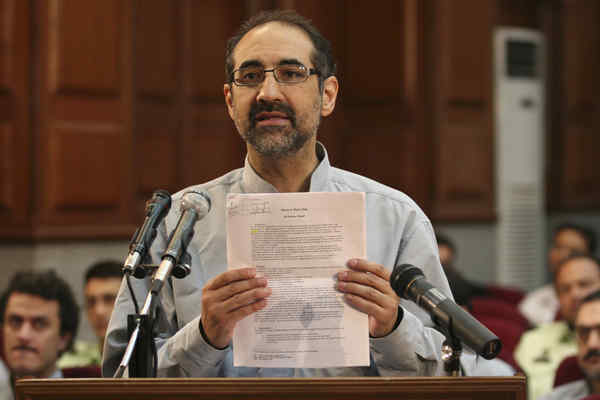 Iran ignored appeals by Secretary of State Hillary Rodham Clinton and the rock star Sting and sentenced an Iranian American academic yesterday to 12 years in prison for his alleged role in antigovernment demonstrations after the country's disputed presidential election. The sentence for Kian Tajbakhsh, 47, was the longest prison term yet in a mass trial of more than 100 opposition figures, activists, and journalists in the postelection turmoil. Tajbakhsh's heavy sentence signaled that Tehran was sticking to a tough line overall on the political unrest. It came amid calls in Iran for prosecution of the most senior opposition figure, Mir-Hossein Mousavi, and suggestions that three U.S. hikers, detained in July after accidentally crossing into Iran, could face charges.
Tajbakhsh, a social scientist and urban planner who holds dual citizenship, was arrested at his Tehran home July 9. He was the only American detained in the crackdown that crushed giant street protests by hundreds of thousands after the June 12 election. The opposition contends that the vote was rigged in favor of President Mahmoud Ahmadinejad. The security sweep went far beyond protesters on the streets, snatching up rights activists, journalists, and opposition politicians. The government accused them of organizing the protests on behalf of Iran's foreign enemies to foment a "velvet revolution" to overthrow the country's Islamic leadership.
The White House, in a statement yesterday, expressed "our deepest regret and strong objection" to Tajbakhsh's sentencing, saying that he posed no threat to Iran and urging that he be freed. Clinton had appealed in August for his release, and he also had been specifically named in a call by the British rock star Sting to free all political prisoners in Iran.
Tajbakhsh's lawyer, Houshang Azhari, told the IRNA news agency he would appeal the conviction on charges of "acting against national security." He said that the law barred him from divulging the full details of the sentence, asserting only that it was "more than 12 years." The appeal could open an avenue for freeing Tajbakhsh. Roxana Saberi, an Iranian American journalist arrested this year, was convicted of espionage but freed on appeal in what was widely seen as a political decision to defuse tensions with Washington.
Tajbakhsh had been targeted by Iranian authorities before. In 2007, he was arrested on similar charges while working for the pro-democracy Open Society Institute, run by U.S. philanthropist George Soros - a figure whom Iran often has cited as part of the antigovernment plot. Tajbakhsh denied the charges and was released after four months in prison. Afterward, Tajbakhsh left the Open Society Institution and remained with his family in Iran, working on a book.
Source:Philly.com
Tuesday, December 22, 1998
Soros warns of "market fundamentalism"
The growing realization over the past 12 months that the so-called "Asian meltdown" is in fact a crisis of the world capitalist system has brought a series of warnings from within ruling circles about the dangers posed by the unrestricted operations of financial markets.
The World Bank, for example, has implicitly criticized the prescriptions of its sister organization the International Monetary Fund insisting that the primary role of fiscal and monetary policy must be to shore up aggregate demand and "expand the social safety net."
The London-based newspaper the Financial Times has published numerous articles and comment pieces over the past months warning that unless central banks take corrective action there is a danger that the world can plunge into a 1930s-type depression. Likewise, The Economist magazine has issued several warnings over the past 12 months that the rise in share values on Wall Street signifies the development of a "bubble economy" the collapse of which could have far-reaching consequences.
Some of the most strident warnings about the state of global financial markets have come from the international financier George Soros, who achieved international notoriety after his Quantum Fund made around $2 billion at the expense of the Bank of England during the sterling currency crisis of 1992.
Soros began the year with an article in the Financial Times warning that the Asian financial crisis--at that stage dismissed by US president Clinton as a "glitch" along the road--could set off a world deflation tendency unless action were taken to counter it.
When the financial crisis spread to Russia in August, Soros published a letter declaring that its banking system was on the point of collapse. The following month, during testimony to the US Congress, he pointed to wider implications of the Russian events, warning that the global capitalist system was "coming apart at the seams."
He told the Congress there was a need to "rethink and reform" the global capitalist system and that as the Russian experience had shown "the problems will become progressively more intractable the longer they are allowed to fester."
Rethinking the capitalist system, Soros insisted, had to begin with the recognition that financial markets are inherently unstable. The global capitalist system was based on the belief that markets, if left to their own devices, would tend to return to an equilibrium position. But this view was false and "instead of acting like a pendulum financial markets have recently acted more like a wrecking ball, knocking over one economy after another."
Now Soros has brought together his fears about the operations of the international financial markets in a new book entitled The Crisis of the Global Capitalism. The book itself does not contain any significant new insights into the operations of world capitalism, much less any solutions to the crisis. But it is not without interest that a major participant in the international financial markets should voice his concern that the entire world capitalist system is heading for a disaster.
Soros sets out his concerns in the opening paragraph: "We live in a global economy, but the political organization of our global society is woefully inadequate. We are bereft of the capacity to preserve peace and to counteract the excesses of the financial markets. Without these controls, the global economy, is liable to break down."
And on the next page Soros continues this theme: "The development of a global economy has not been matched by the development of a global society. The basic unit for political and social life remains the nation-state. International law and international institutions, insofar as they exist, are not strong enough to prevent war or the large-scale abuse of human rights in individual countries. Ecological threats are not adequately dealt with. Global financial markets are largely beyond the control of national or international authorities."
There is nothing particularly original in these thoughts. Soros has merely pointed to the central contradiction of world capitalism identified by Marxists throughout this century--that between the development of a global economy and the division of the world into rival competing nation-states.
According to Soros, the chief danger to stability is the emergence of what he calls "market fundamentalism"-- the belief that the common interest is best served by individual decision-making and that attempts to maintain the common interest by collective action distort the market mechanism. "It is market fundamentalism," he insists, "that has rendered the global capitalist system unsound and unsustainable."
Soros notes that the present situation is not the first time that a global capitalist economy has developed. The first version of the global economy developed at the end of the nineteenth century. However, despite being sustained by major imperial powers, with a common ideological outlook and a stable monetary system based on gold, the system broke down.
"The nineteenth-century incarnation of the global capitalist system," he writes, "in spite of its relative stability, was destroyed by the First World War. After the end of the war, there was a feeble attempt to reconstruct it, which came to a bad end in the crash of 1929 and the subsequent Great Depression. How much more likely is it, then, that the current version of global capitalism will also come to a bad end, given that the elements of stability that were present in the nineteenth century are now missing?"
Soros is critical of the moves by the IMF, the US Treasury and the leaders of the G7 to improve the flow of information on financial markets to try to prevent the emergence of crises in the future. The prevailing doctrines about the operation of financial markets have not changed and the assumption is that with perfect information markets can take care of themselves. He insists that the "debate" must be broadened.
"It is time to recognize that financial markets are inherently unstable. Imposing market discipline means imposing instability, and how much instability can society take? ... To put it bluntly, the choice confronting us is whether we will regulate global financial markets internationally or leave it to each individual state to protect its interests as best it can. The latter course will surely lead to the breakdown of the gigantic circulatory system, which goes under the name of global capitalism."
Soros insists that to "stabilize and regulate" the global economy and prevent such a breakdown, a global system of political decision making is necessary. However in advancing this "solution" Soros runs up against the real contradictions and conflicts generated by the system of rival capitalist nation-states.
"A global society," he writes, "does not mean a global state. To abolish the existence of states is neither feasible nor desirable; but insofar as there are collective interests that transcend state boundaries, the sovereignty of states must be subordinated to international law and international institutions."
However, as Soros himself acknowledges, the greatest opposition to this idea is coming from the United States which is "unwilling to subordinate itself to any international authority." In other words, at the very point where the development of a truly global economy requires the creation of international institutions to prevent a breakdown of the whole system, the divisions between the most powerful nation-states are deepening, thereby rendering such collaboration increasingly difficult, if not impossible.
There are many examples of this process: the increasing inability of the major capitalist powers of the G-7 to reach agreement on economic policies, the conflicts within the IMF over funding and policy issues, the trade tensions between the US and Europe and between the US and Japan, the development of the euro as an international currency to challenge the dollar, and the recent breakdown of the APEC summit, to name but a few.
And in the two weeks since the publication of Soros' book, one of the most graphic examples of "unilateralism" has occurred with the US onslaught against Iraq aimed at securing its interests against its capitalist rivals in the resource-rich Middle East and central Asian regions.
Soros has pointed to some of the central contradictions of the world capitalist system. But the proposals he advances make clear that the representatives of the bourgeoisie, even where they are conscious of the disasters which the market system is producing, are unable to advance any program which can lead civilization out of the impasse in which it now finds itself.
Source: World Socialist Web
The World Bank, for example, has implicitly criticized the prescriptions of its sister organization the International Monetary Fund insisting that the primary role of fiscal and monetary policy must be to shore up aggregate demand and "expand the social safety net."
The London-based newspaper the Financial Times has published numerous articles and comment pieces over the past months warning that unless central banks take corrective action there is a danger that the world can plunge into a 1930s-type depression. Likewise, The Economist magazine has issued several warnings over the past 12 months that the rise in share values on Wall Street signifies the development of a "bubble economy" the collapse of which could have far-reaching consequences.
Some of the most strident warnings about the state of global financial markets have come from the international financier George Soros, who achieved international notoriety after his Quantum Fund made around $2 billion at the expense of the Bank of England during the sterling currency crisis of 1992.
Soros began the year with an article in the Financial Times warning that the Asian financial crisis--at that stage dismissed by US president Clinton as a "glitch" along the road--could set off a world deflation tendency unless action were taken to counter it.
When the financial crisis spread to Russia in August, Soros published a letter declaring that its banking system was on the point of collapse. The following month, during testimony to the US Congress, he pointed to wider implications of the Russian events, warning that the global capitalist system was "coming apart at the seams."
He told the Congress there was a need to "rethink and reform" the global capitalist system and that as the Russian experience had shown "the problems will become progressively more intractable the longer they are allowed to fester."
Rethinking the capitalist system, Soros insisted, had to begin with the recognition that financial markets are inherently unstable. The global capitalist system was based on the belief that markets, if left to their own devices, would tend to return to an equilibrium position. But this view was false and "instead of acting like a pendulum financial markets have recently acted more like a wrecking ball, knocking over one economy after another."
Now Soros has brought together his fears about the operations of the international financial markets in a new book entitled The Crisis of the Global Capitalism. The book itself does not contain any significant new insights into the operations of world capitalism, much less any solutions to the crisis. But it is not without interest that a major participant in the international financial markets should voice his concern that the entire world capitalist system is heading for a disaster.
Soros sets out his concerns in the opening paragraph: "We live in a global economy, but the political organization of our global society is woefully inadequate. We are bereft of the capacity to preserve peace and to counteract the excesses of the financial markets. Without these controls, the global economy, is liable to break down."
And on the next page Soros continues this theme: "The development of a global economy has not been matched by the development of a global society. The basic unit for political and social life remains the nation-state. International law and international institutions, insofar as they exist, are not strong enough to prevent war or the large-scale abuse of human rights in individual countries. Ecological threats are not adequately dealt with. Global financial markets are largely beyond the control of national or international authorities."
There is nothing particularly original in these thoughts. Soros has merely pointed to the central contradiction of world capitalism identified by Marxists throughout this century--that between the development of a global economy and the division of the world into rival competing nation-states.
According to Soros, the chief danger to stability is the emergence of what he calls "market fundamentalism"-- the belief that the common interest is best served by individual decision-making and that attempts to maintain the common interest by collective action distort the market mechanism. "It is market fundamentalism," he insists, "that has rendered the global capitalist system unsound and unsustainable."
Soros notes that the present situation is not the first time that a global capitalist economy has developed. The first version of the global economy developed at the end of the nineteenth century. However, despite being sustained by major imperial powers, with a common ideological outlook and a stable monetary system based on gold, the system broke down.
"The nineteenth-century incarnation of the global capitalist system," he writes, "in spite of its relative stability, was destroyed by the First World War. After the end of the war, there was a feeble attempt to reconstruct it, which came to a bad end in the crash of 1929 and the subsequent Great Depression. How much more likely is it, then, that the current version of global capitalism will also come to a bad end, given that the elements of stability that were present in the nineteenth century are now missing?"
Soros is critical of the moves by the IMF, the US Treasury and the leaders of the G7 to improve the flow of information on financial markets to try to prevent the emergence of crises in the future. The prevailing doctrines about the operation of financial markets have not changed and the assumption is that with perfect information markets can take care of themselves. He insists that the "debate" must be broadened.
"It is time to recognize that financial markets are inherently unstable. Imposing market discipline means imposing instability, and how much instability can society take? ... To put it bluntly, the choice confronting us is whether we will regulate global financial markets internationally or leave it to each individual state to protect its interests as best it can. The latter course will surely lead to the breakdown of the gigantic circulatory system, which goes under the name of global capitalism."
Soros insists that to "stabilize and regulate" the global economy and prevent such a breakdown, a global system of political decision making is necessary. However in advancing this "solution" Soros runs up against the real contradictions and conflicts generated by the system of rival capitalist nation-states.
"A global society," he writes, "does not mean a global state. To abolish the existence of states is neither feasible nor desirable; but insofar as there are collective interests that transcend state boundaries, the sovereignty of states must be subordinated to international law and international institutions."
However, as Soros himself acknowledges, the greatest opposition to this idea is coming from the United States which is "unwilling to subordinate itself to any international authority." In other words, at the very point where the development of a truly global economy requires the creation of international institutions to prevent a breakdown of the whole system, the divisions between the most powerful nation-states are deepening, thereby rendering such collaboration increasingly difficult, if not impossible.
There are many examples of this process: the increasing inability of the major capitalist powers of the G-7 to reach agreement on economic policies, the conflicts within the IMF over funding and policy issues, the trade tensions between the US and Europe and between the US and Japan, the development of the euro as an international currency to challenge the dollar, and the recent breakdown of the APEC summit, to name but a few.
And in the two weeks since the publication of Soros' book, one of the most graphic examples of "unilateralism" has occurred with the US onslaught against Iraq aimed at securing its interests against its capitalist rivals in the resource-rich Middle East and central Asian regions.
Soros has pointed to some of the central contradictions of the world capitalist system. But the proposals he advances make clear that the representatives of the bourgeoisie, even where they are conscious of the disasters which the market system is producing, are unable to advance any program which can lead civilization out of the impasse in which it now finds itself.
Source: World Socialist Web
Subscribe to:
Posts (Atom)