A secret business deal between the government of Guinea and a
multinational firm with a U.S. partner aided by the Obama
administration’s wrongheaded foreign policy could cost American
businesses billions. Congress ought to investigate to protect American
investors, expose any political shenanigans and prosecute the guilty.
The London Sunday Times first cracked the story June 3 of the secret
$25 million loan between an offshore company, Palladino Capital 2, and
the cash-strapped West African country. The funds, according to the
loan agreement, were to finance the start-up of Guinea’s state mining
company, Heritage, but the cash allegedly disappeared and the terms of
the loan include a default clause which gives the lender a juicy 30
percent stake of Guinea’s mushrooming mining assets.
A thirty percent share is especially significant given Guinea’s new
mining code engineered by advisors billionaire trader George Soros and
Palladino’s South African owner Walter Hennig. The 2011 code gives 15
percent of all mining assets to Heritage, including another 20 percent
at market rates. That means foreign mining operators forfeit billions
of dollars in assets and profits atop an 8 percent customs tax.
Further, the $25 million loaned by Hennig’s Palladino, according to
former Guinean mines minister Mahmoud Thiam who spoke with South
Africa’s Mail & Guardian, was a quid pro quo — a bribe — in return
for Guinea President Alpha Conde’s campaign support.
Perhaps word the money was for a political payoff prompted
Palladino’s May 24 loan recall. Or the recall could be part of the
secret deal to cash in on the loan by claiming a 30 percent share of
Heritage, but now the cat is out of the bag.
Mohamed Fofana, the current minister of mines and the official who
signed the 2011 loan with Palladino, rejects the allegations. He claims
the money went to Heritage Company, not Guinea’s government coffers and
it is in the bank waiting to be invested. He also rejects the
allegation he ever agreed to “a $25 million loan in exchange for a third
of our mineral resources.”
Fofana has a problem with the truth, however. His rejection is
refuted by the signed and sealed “Credit Agreement,” a copy of which
Human Events acquired. The April 12, 2011 document is between the
Republic of Guinea and Palladino Capital 2 Limited. Page 3 reads Guinea
“solicited the lender” seeking $25 million to finance the creation of
Heritage Company and page 9, paragraph 11.1 states the “lender may take”
30 percent of the shares of the “Heritage Company” if Guinea defaults
“after a formal notice” and “within sixty (60) working days of the
request by the Lender.”
This case warrants U.S. Congressional investigation to identify
American interests and to protect our foreign investments. Congress
should ask the following questions.
First, was the $25 million loan a violation of U.S. law? The answer
depends on the true purpose of the loan and whether a U.S. entity was
involved in the transaction.
The U.S. Foreign Corrupt Practices Act makes it an offense to offer
money to a foreign official to influence that official in his official
capacity. Clearly, Guinea’s former mines minister Thiam alleges the
money is a bribe to the nation’s president in exchange for a 30 percent
share of Guinea’s mining concessions.
Thiam further alleges the president’s son Mohamed Conde and
Palladino’s Samuel Mebiame, who signed the $25 million loan for the
lender, tried to raise campaign funds in return for access to state
mineral assets, according to the Mail & Guardian.
There is also a U.S. entity connected to the lender. Hennig’s
Palladino partners with U.S. investment fund managers Och-Ziff Capital
Management in African Global Capital. They formed the joint venture in
2008 “as a platform to invest in both private and public markets across
Africa, with a bias towards natural resources and related businesses,”
the partners said in a joint statement.
Second, is there a relationship between the $25 million loan and Guinea’s new mining code? That
is important because it would demonstrate Palladino’s motivation for
making the loan, to wit insider information about Guinea’s plans to
nationalize mining assets. Mining receipts account for 70 percent of
Guinea’s income.
In March 2011 President Conde invited financier George Soros and
former British Prime Minister Tony Blair to advise him on how to best
manage Guinea’s mining assets. They recommended rewriting the mining
code, seizing a portion of foreign company assets and renegotiating
unfavorable provisions in existing contracts.
Palladino also consulted with Guinea officials regarding the new
mining code. In fact, Palladino’s consultations regarding its interest
in Guinean mineral assets culminated in a signed agreement with Guinea
in March 2011 just before the $25 million loan was executed. The new
mining code was published in September, six months after the loan that
includes the default 30 percent proviso.
Third, is there a relationship between the Obama administration’s
decision to reinstate favorable trade relations with Guinea and the $25
million loan? That is important because it addresses
factors that may influence the administration’s foreign policy decisions
that potentially enrich some parties at the expense of other American
businesses.
In October 2011 Obama restored privileged U.S. trade partner status
under the African Growth and Opportunity Act (AGOA) with Guinea after
revoking them following Guinea’s 2008 coup. The published criteria for
that decision include hosting free and fair elections, establishment of
the rule of law and combating corruption.
Restoring AGOA status is desirable for Guinea because the U.S.
Government restores trade preferences and other benefits such as
political risk insurance to American firms through the Overseas Private
Investment Corporation. Guinea understandably wants the jobs that come
with AGOA status and the protection OPIC offers because it incentivizes
American businesses by mitigating risk in Guinea’s volatile markets.
But granting Guinea favorable trade status was a bad decision based
on the published criteria. Even though Guinea’s 2010 election was
largely free and fair, the country still suffers from numerous
problems. Human Rights Watch cautioned that Guinea has seen new
security force abuses, including killings, a concentration of power in
the executive, weak implementation of the rule of law, and rising ethnic
tensions. Further, Guinea is creating regional insecurity,
particularly in its role as a hub for transnational narcotics trade.
It is possible political lobbying and donations trumped what should
have been an unfavorable trade status decision possibly due to its nexus
with the $25 million loan. Specifically, Och-Ziff Capital Management
which is partnered with Palladino, the $25 million lender and possible
big winner in the case of loan default, had a financial incentive to
encourage restoration of favorable trade status with Guinea. Further,
it had the opportunity to influence the administration’s decision.
Public records indicate Och-Ziff uses the services of Washington
lobbyists Fierce, Isakowitz & Blalock to promote its interests with
the U.S. Government, which included five reported meetings with White
House staff in 2011. Also, Daniel Och and Dirk Ziff and their families,
according to public records, are big donors to Democrat Party campaigns
and especially Obama, which argue for additional clout.
Congress should determine whether Och-Ziff or other parties unduly
influenced the administration’s Guinea trade status decision and whether
that decision has any direct or indirect impact on Guinean mining
operations.
Congress must ask these tough questions to determine the truth.
Clearly, the secret deal could hurt American mining businesses, exposes
the administration’s wrongheaded foreign policy, and may violate our
foreign corruption laws.
Source: Human Events
Showing posts with label Guinea. Show all posts
Showing posts with label Guinea. Show all posts
Monday, July 2, 2012


Friday, June 29, 2012
Alpha Conde in Paris: When You Steal an Election, the Opposition is Everywhere

Conde’s only political cheerleader in France is the former foreign minister, Bernard Kouchner, who has been a close friend of his since they met in school. The successful theft of the Guinea presidency can be attributed to many, but none more than Bernard Kouchner, who managed the process, from soup to nuts, to install Alpha Conde at Sekoutoureya Palace.
Conde lived in France for 59 years and it appears that most Guineans are still not clear about his education and the line of work he pursued there. He is called “Professor,” but is this a legitimately acquired appellation? Regardless, one thing Guineans do know is that Conde cannot legitimately be called “President.”
After you steal an election, you get hit between the eyes with the fact that you don’t have a mandate to govern. Without a legislature, you rule by decree and the arrogance of your arbitrary decisions builds resentment among the people. Those that didn’t vote for you and who know you stole the election, know that, for the people of Guinea, it is best if you leave office. You dig in your heels and, when not churning out decrees, you busy yourself by ordering human rights abuses, including extra-judicial killings and illegal detentions. Your violations of the constitution mount, as do claims that you are a traitor, and the people begin to call for your immediate ouster. But this is what the big armies, the ethnic militias, and assorted security forces are for, right? When the number of people who want you ousted balloons and you wake up to a huge march, such as the one on May 10, with 80,000+ opposition supporters in the streets, you have no other card to play, but to send in the security forces and repress the marchers. You do your best to play down the significance of the march, but the pictures and videos correct your lies. There’s only one thing left, to ban political marches altogether, as happened a few weeks ago. The opposition counters by saying you cannot ban freedom of speech and assembly and that it does not recognize the ban. The final chapter is a dangerous scenario in which the opposition will march in Conakry and it will be met with any one, a combination, or all of the following: military, police, ethnic militias, Donzos, the RPG arc-en-ciel, and foreign mercenaries. The more you do to repel the opposition, the more people will demand your removal. So, Mr. Conde, you are in a repeating, downward spiral and now you find yourself in Paris at Kouchner’s dining table waiting for a call from the Elysee Palace. Regardless of what happens in France, you have a mess on your hands at home.
But, wait, many of your countrymen are in Paris ready to rally in support of you. In fact, the rumor is that $250,000 was allotted to make sure that Guineans are on the streets to cheer you and that others will be sent to provoke a conflict with another group of Guineans — those who didn’t vote for you, who know you stole the election, who know you will use ethnic hatred to try to destroy them and who plainly wish you would just stay in Paris, drinking wine with your buddy, Bernard.
Whether your supporters are successful in provoking an incident or not tomorrow, the story will be told through their placards saying you are a usurper, a thief, a liar, a killer, an all-purpose human rights abuser and an embezzler, and with pictures and videos of it, the world will be informed.
Enjoy your visit in France and, in case you miss the protest by your political opposition, Guinea Oye will make sure to cover it, pictures and all.
Opposition supporters will be protesting Conde in front of France’s National Assembly on Saturday, June 30, from 2:00 – 6:00 PM.
Source: Guinea Oye
Saturday, June 23, 2012
Tuesday, January 19, 2010
Guinea Junta Picks Opponent as Premier on Path to Civilian Control
Guinea’s
military leaders appointed a veteran opposition figure as prime
minister on Monday, a critical step in the transition to elections and
civilian government later in the year, officials and news agencies
reported.
The opposition figure, Jean-Marie Doré, was the choice of both a coalition of opponents of the military government, and the current military junta itself. Mr. Doré, in his 70s and the leader of the opposition coalition, which is called the Forces Vives, is from the same ethnic group as the country’s military dictator, Capt. Moussa Dadis Camara. Soldiers from that group are thought to have played a leading role in the massacre, beatings and rapes of regime opponents in a stadium in the capital, Conakry, on Sept. 28. The ethnic group, from Guinea’s remote forest regions, is considered a particularly volatile element in the country’s armed forces, and Mr. Doré’s new role is considered a potentially peacemaking one.
“It was the Forces Vives that proposed Jean-Marie Doré. We are satisfied,” said Oury Bah, vice president of the political party Union of Democratic Forces in Guinea. Late last week Guinea’s military leaders and the coalition agreed to establish an interim government together, while Captain Camara, wounded in an assassination attempt early in December, announced that he would go into exile.
The deal caps a period of deep unrest in this West African country of 10 million people, a leading bauxite exporter whose people are among the world’s poorest. Captain Camara took over in a coup 13 months ago and ruled in an increasingly arbitrary way from his army-base headquarters. The September massacre, in which at least 156 people were killed by soldiers, resulted in intense pressure on the junta as both the United Nations and the International Criminal Court spoke of potential crimes against humanity.
Captain Camara, shot by one of his own guards, flew to Morocco for treatment while power was assumed by his deputy, Gen. Sékouba Konaté. The general, regarded as more flexible than the wounded autocrat, took part in the negotiations that led to last week’s deal. But whether the troubled country finds peace in the months leading up to the elections is an open question. Mr. Bah, for one, was sharply critical of the proposed composition of the new government, which will have 10 ministers each from the military junta, the opposition and the different regions of the country.
That arrangement will effectively handcuff the prime minister, he said. “It’s as if the prime minister has no real power. We can’t accept this in the transition,” he said.
The army’s future role is also unclear. There is a strong possibility that it will remain “the power behind power,” said Mike McGovern, a Yale anthropologist and an expert on Guinea.
Mr. Doré has long been on the political scene in Guinea as an unpredictable opponent of the country’s military rulers. He has publicly proclaimed his friendship with the Liberian warlord Charles Taylor, according to Mr. McGovern, but was among those beaten at the stadium in September.
In an interview shortly after Mr. Doré produced the bloodstained clothes he was wearing at the time, he said, “With violence they forced me to my knees.” He was strongly critical of the military government. “The country is in a trap,” he said. “There’s a disjunction between the work that must be done, and the people doing it. The competencies at hand are not up to the job.”
Mr. McGovern said that Mr. Doré had “oscillated over time from being something of a gadfly in Guinean politics to being over the last year a pretty solid, level-headed spokesman for the Forces Vives.”
Source: New York Times
The opposition figure, Jean-Marie Doré, was the choice of both a coalition of opponents of the military government, and the current military junta itself. Mr. Doré, in his 70s and the leader of the opposition coalition, which is called the Forces Vives, is from the same ethnic group as the country’s military dictator, Capt. Moussa Dadis Camara. Soldiers from that group are thought to have played a leading role in the massacre, beatings and rapes of regime opponents in a stadium in the capital, Conakry, on Sept. 28. The ethnic group, from Guinea’s remote forest regions, is considered a particularly volatile element in the country’s armed forces, and Mr. Doré’s new role is considered a potentially peacemaking one.
“It was the Forces Vives that proposed Jean-Marie Doré. We are satisfied,” said Oury Bah, vice president of the political party Union of Democratic Forces in Guinea. Late last week Guinea’s military leaders and the coalition agreed to establish an interim government together, while Captain Camara, wounded in an assassination attempt early in December, announced that he would go into exile.
The deal caps a period of deep unrest in this West African country of 10 million people, a leading bauxite exporter whose people are among the world’s poorest. Captain Camara took over in a coup 13 months ago and ruled in an increasingly arbitrary way from his army-base headquarters. The September massacre, in which at least 156 people were killed by soldiers, resulted in intense pressure on the junta as both the United Nations and the International Criminal Court spoke of potential crimes against humanity.
Captain Camara, shot by one of his own guards, flew to Morocco for treatment while power was assumed by his deputy, Gen. Sékouba Konaté. The general, regarded as more flexible than the wounded autocrat, took part in the negotiations that led to last week’s deal. But whether the troubled country finds peace in the months leading up to the elections is an open question. Mr. Bah, for one, was sharply critical of the proposed composition of the new government, which will have 10 ministers each from the military junta, the opposition and the different regions of the country.
That arrangement will effectively handcuff the prime minister, he said. “It’s as if the prime minister has no real power. We can’t accept this in the transition,” he said.
The army’s future role is also unclear. There is a strong possibility that it will remain “the power behind power,” said Mike McGovern, a Yale anthropologist and an expert on Guinea.
Mr. Doré has long been on the political scene in Guinea as an unpredictable opponent of the country’s military rulers. He has publicly proclaimed his friendship with the Liberian warlord Charles Taylor, according to Mr. McGovern, but was among those beaten at the stadium in September.
In an interview shortly after Mr. Doré produced the bloodstained clothes he was wearing at the time, he said, “With violence they forced me to my knees.” He was strongly critical of the military government. “The country is in a trap,” he said. “There’s a disjunction between the work that must be done, and the people doing it. The competencies at hand are not up to the job.”
Mr. McGovern said that Mr. Doré had “oscillated over time from being something of a gadfly in Guinean politics to being over the last year a pretty solid, level-headed spokesman for the Forces Vives.”
Source: New York Times
Guinea Junta Picks Opponent as Premier on Path to Civilian Control
Guinea’s
military leaders appointed a veteran opposition figure as prime
minister on Monday, a critical step in the transition to elections and
civilian government later in the year, officials and news agencies
reported.
The opposition figure, Jean-Marie Doré, was the choice of both a coalition of opponents of the military government, and the current military junta itself. Mr. Doré, in his 70s and the leader of the opposition coalition, which is called the Forces Vives, is from the same ethnic group as the country’s military dictator, Capt. Moussa Dadis Camara. Soldiers from that group are thought to have played a leading role in the massacre, beatings and rapes of regime opponents in a stadium in the capital, Conakry, on Sept. 28. The ethnic group, from Guinea’s remote forest regions, is considered a particularly volatile element in the country’s armed forces, and Mr. Doré’s new role is considered a potentially peacemaking one.
“It was the Forces Vives that proposed Jean-Marie Doré. We are satisfied,” said Oury Bah, vice president of the political party Union of Democratic Forces in Guinea. Late last week Guinea’s military leaders and the coalition agreed to establish an interim government together, while Captain Camara, wounded in an assassination attempt early in December, announced that he would go into exile.
The deal caps a period of deep unrest in this West African country of 10 million people, a leading bauxite exporter whose people are among the world’s poorest. Captain Camara took over in a coup 13 months ago and ruled in an increasingly arbitrary way from his army-base headquarters. The September massacre, in which at least 156 people were killed by soldiers, resulted in intense pressure on the junta as both the United Nations and the International Criminal Court spoke of potential crimes against humanity.
Captain Camara, shot by one of his own guards, flew to Morocco for treatment while power was assumed by his deputy, Gen. Sékouba Konaté. The general, regarded as more flexible than the wounded autocrat, took part in the negotiations that led to last week’s deal. But whether the troubled country finds peace in the months leading up to the elections is an open question. Mr. Bah, for one, was sharply critical of the proposed composition of the new government, which will have 10 ministers each from the military junta, the opposition and the different regions of the country.
That arrangement will effectively handcuff the prime minister, he said. “It’s as if the prime minister has no real power. We can’t accept this in the transition,” he said.
The army’s future role is also unclear. There is a strong possibility that it will remain “the power behind power,” said Mike McGovern, a Yale anthropologist and an expert on Guinea.
Mr. Doré has long been on the political scene in Guinea as an unpredictable opponent of the country’s military rulers. He has publicly proclaimed his friendship with the Liberian warlord Charles Taylor, according to Mr. McGovern, but was among those beaten at the stadium in September.
In an interview shortly after Mr. Doré produced the bloodstained clothes he was wearing at the time, he said, “With violence they forced me to my knees.” He was strongly critical of the military government. “The country is in a trap,” he said. “There’s a disjunction between the work that must be done, and the people doing it. The competencies at hand are not up to the job.”
Mr. McGovern said that Mr. Doré had “oscillated over time from being something of a gadfly in Guinean politics to being over the last year a pretty solid, level-headed spokesman for the Forces Vives.”
Source: New York Times
The opposition figure, Jean-Marie Doré, was the choice of both a coalition of opponents of the military government, and the current military junta itself. Mr. Doré, in his 70s and the leader of the opposition coalition, which is called the Forces Vives, is from the same ethnic group as the country’s military dictator, Capt. Moussa Dadis Camara. Soldiers from that group are thought to have played a leading role in the massacre, beatings and rapes of regime opponents in a stadium in the capital, Conakry, on Sept. 28. The ethnic group, from Guinea’s remote forest regions, is considered a particularly volatile element in the country’s armed forces, and Mr. Doré’s new role is considered a potentially peacemaking one.
“It was the Forces Vives that proposed Jean-Marie Doré. We are satisfied,” said Oury Bah, vice president of the political party Union of Democratic Forces in Guinea. Late last week Guinea’s military leaders and the coalition agreed to establish an interim government together, while Captain Camara, wounded in an assassination attempt early in December, announced that he would go into exile.
The deal caps a period of deep unrest in this West African country of 10 million people, a leading bauxite exporter whose people are among the world’s poorest. Captain Camara took over in a coup 13 months ago and ruled in an increasingly arbitrary way from his army-base headquarters. The September massacre, in which at least 156 people were killed by soldiers, resulted in intense pressure on the junta as both the United Nations and the International Criminal Court spoke of potential crimes against humanity.
Captain Camara, shot by one of his own guards, flew to Morocco for treatment while power was assumed by his deputy, Gen. Sékouba Konaté. The general, regarded as more flexible than the wounded autocrat, took part in the negotiations that led to last week’s deal. But whether the troubled country finds peace in the months leading up to the elections is an open question. Mr. Bah, for one, was sharply critical of the proposed composition of the new government, which will have 10 ministers each from the military junta, the opposition and the different regions of the country.
That arrangement will effectively handcuff the prime minister, he said. “It’s as if the prime minister has no real power. We can’t accept this in the transition,” he said.
The army’s future role is also unclear. There is a strong possibility that it will remain “the power behind power,” said Mike McGovern, a Yale anthropologist and an expert on Guinea.
Mr. Doré has long been on the political scene in Guinea as an unpredictable opponent of the country’s military rulers. He has publicly proclaimed his friendship with the Liberian warlord Charles Taylor, according to Mr. McGovern, but was among those beaten at the stadium in September.
In an interview shortly after Mr. Doré produced the bloodstained clothes he was wearing at the time, he said, “With violence they forced me to my knees.” He was strongly critical of the military government. “The country is in a trap,” he said. “There’s a disjunction between the work that must be done, and the people doing it. The competencies at hand are not up to the job.”
Mr. McGovern said that Mr. Doré had “oscillated over time from being something of a gadfly in Guinean politics to being over the last year a pretty solid, level-headed spokesman for the Forces Vives.”
Source: New York Times
Thursday, January 7, 2010
Guinea Junta Aims to Return Reins of Nation to Civilians
Guinea’s deputy junta chief pledged Wednesday to pave the way for a return to civilian rule, more than a year after the military took power in a bloodless coup. Guinea has been in a state of limbo since the leader of the military junta, Capt. Moussa Dadis Camara, was wounded in an assassination attempt by a former aide last month. He has not been seen in public for over a month since being flown to Morocco for treatment. The comments by his deputy, Sékouba Konaté, offered a possible way out of the deepening political crisis in the West African nation, the world’s top exporter of the aluminum ore bauxite. “We need to act to restore peace and the unity of all Guineans, and to put our state and political system on a new foundation,” said Mr. Konaté, promising to accept a prime minister drawn from the opposition as part of a national unity government.
Captain Camara, who took power in December 2008 after the death of President Lansana Conté, became the subject of international outrage and sanctions after security forces killed more than 150 people and raped scores of women protesting in a Conakry stadium in September.
Mr. Konaté, a professional soldier with no known ambitions for a front-line political role, visited Captain Camara in the hospital this week and held talks with American and French diplomats who urged him to allow a return to civilian rule in Captain Camara’s absence. He said Wednesday that he expected a transitional government to choose a new election date after a poll — initially set for this month — was delayed by the crisis. While it was unclear if Mr. Konaté would replace Captain Camara in any transitional government, he said he would not cling to power. An opposition leader welcomed Mr. Konaté’s announcement but said the success of the transitional government would depend on the powers given to the prime minister.
Source: New York Times
New York Times report for Guinea can be found here.
Captain Camara, who took power in December 2008 after the death of President Lansana Conté, became the subject of international outrage and sanctions after security forces killed more than 150 people and raped scores of women protesting in a Conakry stadium in September.
Mr. Konaté, a professional soldier with no known ambitions for a front-line political role, visited Captain Camara in the hospital this week and held talks with American and French diplomats who urged him to allow a return to civilian rule in Captain Camara’s absence. He said Wednesday that he expected a transitional government to choose a new election date after a poll — initially set for this month — was delayed by the crisis. While it was unclear if Mr. Konaté would replace Captain Camara in any transitional government, he said he would not cling to power. An opposition leader welcomed Mr. Konaté’s announcement but said the success of the transitional government would depend on the powers given to the prime minister.
Source: New York Times
New York Times report for Guinea can be found here.
Friday, December 18, 2009
Bloody Monday

The September 28 Massacre and Rapes by Security Forces in Guinea
This 108-page report describes in detail the killings, sexual assaults, and other abuses at an opposition rally in a stadium in Conakry, the capital, committed largely by members of Guinea's elite Presidential Guard, and the evidence suggesting that the attacks must have been planned in advance. The report further details how the military government's security forces engaged in an organized cover-up, removing scores of bodies from both the stadium and hospital morgues and burying them in mass graves.
Summary and Recomndations and Photographs.
Source: Human Rights Watch
Thursday, December 3, 2009
Guinea: Aide Wounds Junta Leader
 Shooting broke out in Guinea’s restive capital, Conakry, on Thursday, and the country’s military ruler was wounded, according to an opposition figure, a diplomat there and press reports. The country has been unsettled since an army massacre on Sept. 28 of demonstrators protesting in the capital’s stadium against the military government of Capt. Moussa Dadis Camara. At least 157 people are thought to have been killed and dozens of women raped then. The fighting Thursday appeared to be between rival military factions. Press reports citing a government spokesman said Toumba Diakite, an officer close to Captain Camara who has been widely cited as being responsible for the massacre, fired on the captain. The extent of Captain Camara’s injuries was not immediately known.
Source: New York Times
Friday, October 30, 2009
African Union imposes sanctions on Guinea junta
The African Union said on Thursday it was imposing immediate sanctions against the leaders of Guinea's ruling military junta, which took power in a coup last December after the death of veteran leader Lansana Conte. "These sanctions are targeted at the civilians and military personnel that are perpetuating these unconstitutional acts in Guinea," Lamamra Ramtane, AU commissioner for peace and security, told a meeting of the African body in Nigeria. "It is not intended to target the people of Guinea," he said, specifying the sanctions would include such measures as the freezing of bank accounts and travel visas rather than trade sanctions against the country. He said the measures would be directed against the leadership of the CNDD, the ruling junta in the West African country led by Captain Moussa Dadis Camara.
International pressure and internal dissent have grown in Guinea, the world's top supplier of bauxite, since live ammunition was used against anti-government protesters in a stadium a month ago. A local rights group said 157 people were killed. The United States, France and the European Union have called on Camara to step down and the International Criminal Court has said it is investigating the killings.
The EU agreed on Tuesday to impose an arms embargo on the West African country, and restrict the travel and freeze assets of those involved in the killing of the protesters. The U.S. government has also restricted travel to the United States by some members of the junta and the government, as well as others who support actions that "undermine the restoration of democracy and the rule of law".
The AU had threatened sanctions if Camara, who promised to rein in the army and transfer power to civilian rule through elections, refuses to opt out of a poll set for January.
Source: reuters
The African Union communique can be found here.
International pressure and internal dissent have grown in Guinea, the world's top supplier of bauxite, since live ammunition was used against anti-government protesters in a stadium a month ago. A local rights group said 157 people were killed. The United States, France and the European Union have called on Camara to step down and the International Criminal Court has said it is investigating the killings.
The EU agreed on Tuesday to impose an arms embargo on the West African country, and restrict the travel and freeze assets of those involved in the killing of the protesters. The U.S. government has also restricted travel to the United States by some members of the junta and the government, as well as others who support actions that "undermine the restoration of democracy and the rule of law".
The AU had threatened sanctions if Camara, who promised to rein in the army and transfer power to civilian rule through elections, refuses to opt out of a poll set for January.
Source: reuters
The African Union communique can be found here.
Tuesday, October 27, 2009
Guinea: September 28 Massacre Was Premeditated
An in-depth investigation into the September 28, 2009 killings and rapes at a peaceful rally in Conakry, Guinea, has uncovered new evidence that the massacre and widespread sexual violence were organized and were committed largely by the elite Presidential Guard, commonly known as the “red berets,” Human Rights Watch said today. Following a 10-day research mission in Guinea, Human Rights Watch also found that the armed forces attempted to hide evidence of the crimes by seizing bodies from the stadium and the city’s morgues and burying them in mass graves.
Human Rights Watch found that members of the Presidential Guard carried out a premeditated massacre of at least 150 people on September 28 and brutally raped dozens of women. Red berets shot at opposition supporters until they ran out of bullets, then continued to kill with bayonets and knives. “There is no way the government can continue to imply the deaths were somehow accidental,” said Georgette Gagnon, Africa director at Human Rights Watch. “This was clearly a premeditated attempt to silence opposition voices. Security forces surrounded and blockaded the stadium, then stormed in and fired at protesters in cold blood until they ran out of bullets,” added Gagnon. “They carried out grisly gang rapes and murders of women in full sight of the commanders. That’s no accident.”
A group of Guinean military officers calling themselves the National Council for Democracy and Development (Conseil national pour la démocratie et le développement, CNDD) seized power hours after the death on December 22, 2008, of Lansana Conté, Guinea’s president for 24 years. The CNDD is headed by a self-proclaimed president, Captain Moussa Dadis Camara.
Source: Human Rights Watch
Human Rights Watch found that members of the Presidential Guard carried out a premeditated massacre of at least 150 people on September 28 and brutally raped dozens of women. Red berets shot at opposition supporters until they ran out of bullets, then continued to kill with bayonets and knives. “There is no way the government can continue to imply the deaths were somehow accidental,” said Georgette Gagnon, Africa director at Human Rights Watch. “This was clearly a premeditated attempt to silence opposition voices. Security forces surrounded and blockaded the stadium, then stormed in and fired at protesters in cold blood until they ran out of bullets,” added Gagnon. “They carried out grisly gang rapes and murders of women in full sight of the commanders. That’s no accident.”
A group of Guinean military officers calling themselves the National Council for Democracy and Development (Conseil national pour la démocratie et le développement, CNDD) seized power hours after the death on December 22, 2008, of Lansana Conté, Guinea’s president for 24 years. The CNDD is headed by a self-proclaimed president, Captain Moussa Dadis Camara.
Source: Human Rights Watch
Friday, October 16, 2009
ICC prosecutor to examine Guinea killings
The prosecutor of the International Criminal Court said on Thursday he was investigating last month's deadly crackdown on opponents of Guinea's military ruler, Captain Moussa Dadis Camara. At least 157 people were killed and 1,200 injured on Sept. 28 when security forces in the West African nation attacked tens of thousands of protesters calling for Camara to step down.
It was the worst outbreak of violence since Camara seized control of the world's biggest bauxite-exporting nation in a December 2008 coup. "A preliminary examination of the situation has been immediately initiated in order to determine whether crimes falling under the Court's jurisdiction have been perpetrated," the office of ICC prosecutor Luis Moreno-Ocampo said in a statement. "From the information we have received, from the pictures I have seen, women were abused or otherwise brutalised on the pitch of Conakry's stadium, apparently by men in uniform", Deputy Prosecutor Fatou Bensouda said in a statement. "This is appalling, unacceptable. It must never happen again. Those responsible must be held accountable."
The violence drew international condemnation. U.S. Secretary of State Hillary Clinton said Guinea's military rulers should quit. France said it had cut military cooperation with its former colony. The European Union's aid chief, Karel De Gucht, said Camara should stand trial for a "crime against humanity". The African Union has given Camara until mid-October to confirm he will not stand in presidential elections slated for Jan. 31, warning of sanctions if he misses that deadline. Camara has blamed uncontrollable elements within the Guinean army for the killings, saying he cannot be held responsible. The Hague-based ICC is the world's first permanent court set up to try individuals for genocide, war crimes and other major human rights violations.
The African Union (AU) reiterated that Camara had about 24 hours to comply with the body's ultimatum. "What has happened is very, very unacceptable. It's condemnable," AU Commissioner for Peace and Security Ramtane Lamamra said, adding that the Peace and Security Council had considered the types of sanctions to be imposed. Lamamra did not give details. The Economic Community of West African States (ECOWAS) will discuss the situation in Guinea on Saturday at a one-day meeting in the Nigerian capital Abuja.
Source: reuters
It was the worst outbreak of violence since Camara seized control of the world's biggest bauxite-exporting nation in a December 2008 coup. "A preliminary examination of the situation has been immediately initiated in order to determine whether crimes falling under the Court's jurisdiction have been perpetrated," the office of ICC prosecutor Luis Moreno-Ocampo said in a statement. "From the information we have received, from the pictures I have seen, women were abused or otherwise brutalised on the pitch of Conakry's stadium, apparently by men in uniform", Deputy Prosecutor Fatou Bensouda said in a statement. "This is appalling, unacceptable. It must never happen again. Those responsible must be held accountable."
The violence drew international condemnation. U.S. Secretary of State Hillary Clinton said Guinea's military rulers should quit. France said it had cut military cooperation with its former colony. The European Union's aid chief, Karel De Gucht, said Camara should stand trial for a "crime against humanity". The African Union has given Camara until mid-October to confirm he will not stand in presidential elections slated for Jan. 31, warning of sanctions if he misses that deadline. Camara has blamed uncontrollable elements within the Guinean army for the killings, saying he cannot be held responsible. The Hague-based ICC is the world's first permanent court set up to try individuals for genocide, war crimes and other major human rights violations.
The African Union (AU) reiterated that Camara had about 24 hours to comply with the body's ultimatum. "What has happened is very, very unacceptable. It's condemnable," AU Commissioner for Peace and Security Ramtane Lamamra said, adding that the Peace and Security Council had considered the types of sanctions to be imposed. Lamamra did not give details. The Economic Community of West African States (ECOWAS) will discuss the situation in Guinea on Saturday at a one-day meeting in the Nigerian capital Abuja.
Source: reuters
Tuesday, September 29, 2009
Guinea: Stop Violent Attacks on Demonstrators
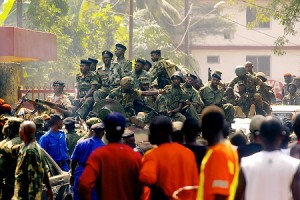 Guinean security forces should immediately cease violent attacks on demonstrators protesting against the military government, Human Rights Watch said today.
 Human Rights Watch called upon the government to hold accountable security forces responsible for firing upon and killing dozens of generally peaceful demonstrators in the Guinean capital, Conakry, on September 28, 2009. They were among tens of thousands of people protesting the rule of Capt. Moussa Dadis Camara, who had seized power in a bloodless coup in December.
"The killing of dozens of unarmed protesters is shocking even by the abusive standards of Guinea’s coup government," said Corinne Dufka, senior West Africa researcher at Human Rights Watch. "Guinea’s leaders should order an immediate end to attacks on demonstrators and bring to justice those responsible for the bloodshed."
The protesters, demonstrating against Camara’s presumed candidacy in Guinea’s January 2010 presidential elections, took to the streets of Conakry on September 28 and marched to a 25,000-seat stadium to attend a political rally. Backed by security forces, the minister responsible for combating drug trafficking and serious crime, Capt. Moussa Tiegboro Camara (no relation to the president), told the protesters not to enter the stadium. However, his troops were unable to stop the demonstrators from forcing open the doors and flooding inside.
Eyewitnesses and medical personnel told Human Rights Watch that many of the bodies of protesters were riddled with bullet holes. Others had stab wounds from knives and bayonets. A number of women taking part in the demonstration were stripped naked and sexually assaulted by security forces, victims and witnesses said.
Source: Human Rights Watch
Monday, September 28, 2009
Troops in Guinea Said to Fire on Pro-Democracy Protesters
Security forces fired on pro-democracy demonstrators on Monday in Conakry, Guinea, killing dozens, according to witnesses and news reports. Troops opened fire as thousands of opponents of the military junta led by Capt. Moussa Dadis Camara gathered in a stadium in Conakry, the capital, to protest his plans to run in presidential elections next January.
At first the troops fired tear gas at the crowd, estimated to have as many as 50,000 people, and then they started shooting, according to witnesses, who described scenes of panic and terror.
Witnesses spoke of seeing numerous wounded and dead demonstrators. Agence France-Presse, citing a doctor at a local morgue, reported that 58 bodies had been brought in. Reuters also reported 58 deaths, citing a human rights advocate.
The violence came after months of tension in the impoverished West African nation, brought on by what has been widely described as the erratic behavior of Captain Camara, the military man who led a coup last December, soon after the death of the longtime leader Lansana Conté.
At first welcomed by citizens weary from decades of authoritarian rule, Captain Camara has since lost support because of the actions of his troops — which human rights groups say include robberies, beatings and rapes — and his own inconsistencies.
He appears to make all government decisions alone, frequently with television cameras rolling. Tirades about drug dealers and incompetent officials; interrogations of Mr. Conté’s henchmen; and homilies about his own humble background have all been beamed into people’s homes.
The “Dadis Show,” as Guineans call it, has palled after initially beguiling people in the former French colony, and increasing numbers have demonstrated to hold Captain Camara to his pledge not to run for office. Recent suggestions that he would run mobilized the crowd on Monday, which included a number of opposition figures, who were subsequently wounded and arrested.
Source: New York Times
At first the troops fired tear gas at the crowd, estimated to have as many as 50,000 people, and then they started shooting, according to witnesses, who described scenes of panic and terror.
Witnesses spoke of seeing numerous wounded and dead demonstrators. Agence France-Presse, citing a doctor at a local morgue, reported that 58 bodies had been brought in. Reuters also reported 58 deaths, citing a human rights advocate.
The violence came after months of tension in the impoverished West African nation, brought on by what has been widely described as the erratic behavior of Captain Camara, the military man who led a coup last December, soon after the death of the longtime leader Lansana Conté.
At first welcomed by citizens weary from decades of authoritarian rule, Captain Camara has since lost support because of the actions of his troops — which human rights groups say include robberies, beatings and rapes — and his own inconsistencies.
He appears to make all government decisions alone, frequently with television cameras rolling. Tirades about drug dealers and incompetent officials; interrogations of Mr. Conté’s henchmen; and homilies about his own humble background have all been beamed into people’s homes.
The “Dadis Show,” as Guineans call it, has palled after initially beguiling people in the former French colony, and increasing numbers have demonstrated to hold Captain Camara to his pledge not to run for office. Recent suggestions that he would run mobilized the crowd on Monday, which included a number of opposition figures, who were subsequently wounded and arrested.
Source: New York Times
Wednesday, December 24, 2008
Army captain named head of Guinea junta

 Captain Moussa Dadis Camara was named Wednesday as head of the military junta which claims to have seized power in Guinea, a statement read on national radio said.
Camara, who commanded the fuel section of the armed forces supplies department, had been appointed "president of the National Council for Development and Democracy," the statement said. He was acting as spokesman for the junta on the radio following the reported coup early Tuesday in the wake of the death of President Lansana Conte.
Source: AFP
Monday, December 22, 2008
Guinea's long-time military leader Conte dies
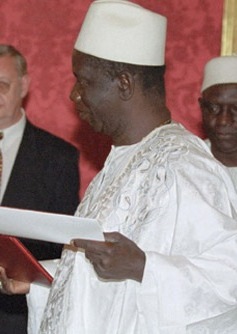
Guinea's President Lansana Conte, who ruled the West African nation with an iron fist for 24 years, has died aged 74, National Assembly Speaker Aboubacar Sompare told state television early Tuesday. In power since 1984, the ailing Conte, who relied on the army to put down growing discontent, was a chain smoker who suffered from chronic diabetes and was at one time diagnosed with leukemia. "We regret to announce to the people of Guinea the death of General Lansana Conte , after a long illness, at 6:45 pm," Sompare said.
Prime Minister Ahmed Tidiane Souare and armed forces chief of staff General Diarra Camara then confirmed the news on television. Sompare officially asked the president of the supreme court to declare the presidency vacant and to apply the constitution. If the supreme court rules that there is a vacancy in the top job, the speaker of the assembly takes over temporarily and has to organize a presidential election within 60 days.
Lansana Conte, a career soldier, came to power through a coup d'etat on April 3, 1984, one week after the death of Guinea's first president, Ahmed Sekou Toure. Top officials of the regime met overnight in the capital Conakry to discuss a successor to Conte, a source close to the presidential palace said. Among the officials meeting in emergency session at the People's Palace, seat of the national assembly, were Prime Minister Souare, Sompare, the president of the supreme court and military leaders. "All the members of the government were asked to go to the People's Palace," a minister told AFP.
Last week government spokesman Tibou Kamara had scolded "bearers of false reports" speculating about the president's state of health. Conte, who told AFP last year "I am the boss, others are my subordinates," has undergone frequent hospital treatments abroad.
Source: AFP
Wednesday, January 17, 1996
Military Ruler Ousted By Army in Sierra Leone
Army officers ousted Sierra Leone's military leader in a coup today, six weeks before elections to restore civilian rule. There were no reports of bloodshed, and the ousted leader, Capt. Valentine Strasser, was said to have been given safe passage to Guinea.
A statement by the officers said Captain Strasser, 30, had been replaced by Brig. Julius Maada Bio, 33, formerly his closest associate in the military junta. Foreign diplomats in the capital confirmed the coup. Captain Strasser had promised to hold elections for a civilian government on Feb. 26, despite an ongoing civil war.
Aides to Brigadier Bio, about whom little is known, said that he opposes holding the election until the war has ended, or at least abated, and that some officers in Captain Strasser's military junta had decided a coup was necessary to insure a safe transition to civilian rule.
Source: New York Times
A statement by the officers said Captain Strasser, 30, had been replaced by Brig. Julius Maada Bio, 33, formerly his closest associate in the military junta. Foreign diplomats in the capital confirmed the coup. Captain Strasser had promised to hold elections for a civilian government on Feb. 26, despite an ongoing civil war.
Aides to Brigadier Bio, about whom little is known, said that he opposes holding the election until the war has ended, or at least abated, and that some officers in Captain Strasser's military junta had decided a coup was necessary to insure a safe transition to civilian rule.
Source: New York Times
Sunday, September 9, 1990
Liberian President Captured by Rebels In a Fierce Gunfight
According to sketchy reports from neighboring Liberia, a skirmish occurred outside the headquarters of the five-nation West African peacekeeping force sent into Liberia in an effort to end the civil war that began in December. More than 60 people, including dozens of Mr. Doe's bodyguards, were reportedly killed in the battle. The President himself was reported to have been shot in both legs before being taken away. By nightfall, there had been no word from a rival rebel faction led by Charles Taylor, which controls much of the country outside the capital. Liberia's civil war began last December when forces of the two rebel leaders invaded from the Ivory Coast, moving into Nimba County, about 300 miles northeast of Monrovia.
The Liberian Government sent troops and provincial policemen to oust the rebels. By most accounts, the soldiers then went on a rampage, indiscriminately killing and maiming hundreds of unarmed civilians - people they apparently believed were sympathetic to the rebels. At least 400,000 Liberians are believed to have fled across the eastern and northern frontiers to escape the bloodshed, most of them settling in the heavily forested hills of the Ivory Coast and Guinea.
In early February, the two rebel leaders split into rival factions, with Mr. Johnson accusing Mr. Taylor of corruption. Mr. Taylor, a former Cabinet member, also had been accused of corruption when he was serving in Mr. Doe's Government; the President charged he embezzled nearly $1 million in Government funds. Mr. Johnson also accused Mr. Taylor of having received arms and money from Libya, an accusation Mr. Taylor has denied.
The war has become increasingly three-sided, with the two rebel factions fighting each other and Mr. Doe trying to hold onto the small fraction of the country - mostly central Monrovia -that his troops still control. The bitter rivalry between Mr. Taylor and Mr. Johnson took an unexpected turn in late August, when Mr. Taylor announced that he had signed a cease-fire agreement with President Doe. Mr. Doe and Mr. Johnson were apparently discussing the agreement today when they began to argue and fighting erupted. It was not known what role the West African peacekeeping force had played in the incident, although it reportedly occurred outside its headquarters in Monrovia's port area. According to a BBC correspondent with the West African peacekeeping force in Monrovia, Mr. Johnson said tonight that he would court-martial Mr. Doe, a former soldier, but that he did not want to kill him.
The incident reportedly began when the President, who had only rarely left his heavily fortified executive mansion since July, appeared unexpectedly at the port headquarters of the peacekeeping force. About 10 minutes later, Mr. Johnson and several of his fighters reportedly arrived and began to quarrel with President Doe's bodyguards. The rebel troops then reportedly hunted down the President's soldiers from room to room and slaughtered them. Eventually, they grabbed the President and carried him off to their base camp outside the city. Members of the peacekeeping force reportedly made repeated appeals to the two sides, but were unable to stop the fighting.
In 1980, President Doe, a 28-year-old master sergeant who dropped out of the 11th grade, came to power after he and other army noncommissioned officers seized power from President William R. Tolbert, who was shot and bayoneted to death. Ten days later, foreign reporters were invited to watch 13 senior Government officials, including most of the former Cabinet, marched nearly naked through the streets of Monrovia, tied to seaside posts and then executed at point-blank range.
President Doe's international reputation never fully recovered from that incident. His image has also suffered from persistent accusations of human rights abuses. The State Department's 1989 human rights report, released shortly after the rebel invasion, said, "Brutality by police and other security officials during the arrest and questioning of individuals is fairly common, and there has been no evidence of Government efforts to halt this practice." Since Mr. Doe came to power, more than 20 senior Government officials and army officers have been executed on charges of plotting coups.
Source: New York Times
The Liberian Government sent troops and provincial policemen to oust the rebels. By most accounts, the soldiers then went on a rampage, indiscriminately killing and maiming hundreds of unarmed civilians - people they apparently believed were sympathetic to the rebels. At least 400,000 Liberians are believed to have fled across the eastern and northern frontiers to escape the bloodshed, most of them settling in the heavily forested hills of the Ivory Coast and Guinea.
In early February, the two rebel leaders split into rival factions, with Mr. Johnson accusing Mr. Taylor of corruption. Mr. Taylor, a former Cabinet member, also had been accused of corruption when he was serving in Mr. Doe's Government; the President charged he embezzled nearly $1 million in Government funds. Mr. Johnson also accused Mr. Taylor of having received arms and money from Libya, an accusation Mr. Taylor has denied.
The war has become increasingly three-sided, with the two rebel factions fighting each other and Mr. Doe trying to hold onto the small fraction of the country - mostly central Monrovia -that his troops still control. The bitter rivalry between Mr. Taylor and Mr. Johnson took an unexpected turn in late August, when Mr. Taylor announced that he had signed a cease-fire agreement with President Doe. Mr. Doe and Mr. Johnson were apparently discussing the agreement today when they began to argue and fighting erupted. It was not known what role the West African peacekeeping force had played in the incident, although it reportedly occurred outside its headquarters in Monrovia's port area. According to a BBC correspondent with the West African peacekeeping force in Monrovia, Mr. Johnson said tonight that he would court-martial Mr. Doe, a former soldier, but that he did not want to kill him.
The incident reportedly began when the President, who had only rarely left his heavily fortified executive mansion since July, appeared unexpectedly at the port headquarters of the peacekeeping force. About 10 minutes later, Mr. Johnson and several of his fighters reportedly arrived and began to quarrel with President Doe's bodyguards. The rebel troops then reportedly hunted down the President's soldiers from room to room and slaughtered them. Eventually, they grabbed the President and carried him off to their base camp outside the city. Members of the peacekeeping force reportedly made repeated appeals to the two sides, but were unable to stop the fighting.
In 1980, President Doe, a 28-year-old master sergeant who dropped out of the 11th grade, came to power after he and other army noncommissioned officers seized power from President William R. Tolbert, who was shot and bayoneted to death. Ten days later, foreign reporters were invited to watch 13 senior Government officials, including most of the former Cabinet, marched nearly naked through the streets of Monrovia, tied to seaside posts and then executed at point-blank range.
President Doe's international reputation never fully recovered from that incident. His image has also suffered from persistent accusations of human rights abuses. The State Department's 1989 human rights report, released shortly after the rebel invasion, said, "Brutality by police and other security officials during the arrest and questioning of individuals is fairly common, and there has been no evidence of Government efforts to halt this practice." Since Mr. Doe came to power, more than 20 senior Government officials and army officers have been executed on charges of plotting coups.
Source: New York Times
Friday, April 6, 1984
COLONEL IS NAMED GUINEAN PRESIDENT
 An army colonel, Col. Lansana Conte, 39 years old, pledged to reverse the ''harm'' done by President Ahmed Sekou Toure. In a broadcast interview, Colonel Conte denounced racism, which he said ''had been more accentuated'' in Guinea than elsewhere in Africa. He said the military would insure that all citizens ''have the same rights and the same responsibilities.'' Mr. Toure's Government had been dominated by members of his Malinke ethnic group.
 Diplomats said the new Government appeared to be well balanced among the various tribes. Colonel Conte said the problem of human rights ''will be our principal problem because since our independence 26 years ago we have lived under a regime where there was no right of expression, where a person did not have the right to say what he wants.'' The new leadership has accused Mr. Toure of rights violations. In the 1960's and 70's, the Government arrested and imprisoned thousands of people. Many others disappeared or were executed.
A recent State Department report said the number of political prisoners had been ''considerably reduced over the past several years.'' ''The old regime died with President Ahmed Sekou Toure, whom we have praised for having led us to independence but that is all,'' the colonel said. ''Now that we have succeeded in taking his place, we are obliged to banish all the harm he has done.''
Throughout Conakry, portraits of Mr. Toure were being removed or defaced. In some places the image had been roughly scratched off or painted over and the slogan ''Down with corruption!'' scrawled nearby. Flags that had been at half-staff after Mr. Toure's death were raised. Hundreds of jubilant schoolchildren, led by adults, paraded through the streets, singing, beating drums and blowing whistles. Some automobiles bore handpainted signs reading, ''Long live the military! Long live the Republic of Guinea!'' Under the former Government, the title was the People's Revolutionary Republic of Guinea.
Several times during the day, Colonel Conte and other officials drove through the city in a motorcade, led by soldiers on motorcycles. Crowds cheered and waved as the motorcade passed. Asked why he was cheering, one Guinean replied, ''Because we have been liberated.'' There was no word on the fate of members of the ousted Government. On Wednesday a military spokesman said only that senior officials had been put ''under security.''
A radio announcement ordered any officials who had not yet reported to the new authorities to do so immediately. Several radio reports also said the coup had been accomplished ''with no bloodletting and without exchanges of gunfire.'' However, a communique issued today by the ruling Military Committee for National Rectification said that the new leadership ''is attentively following the movements of a small group of people who, in connivance with some foreign embassies in the capital, are planning to do harm.'' A well-placed official said the allusion was to the Moroccan Embassy. Moroccan leaders had close relations with Mr. Toure, members of his Government and family. Colonel Conte did not elaborate on the economic policy changes being contemplated. A communique issued Wednesday pledged to encourage free enterprise.
Source: New York Times
Tuesday, April 3, 1984
GUINEA'S MILITARY ASSUMES CONTROL; SEALS OFF NATION
The armed forces of Guinea said today that they had seized power in that West African nation a week after the death of President Ahmed Sekou Toure ended what they called a ''bloody and ruthless dictatorship.'' The armed forces did not say what had happened to Government officials and the 14 members of the ruling Political Bureau, who were to have met today to choose a successor to Mr. Toure. Mr. Toure, who died March 26 in the Cleveland Clinic while having heart surgery, was black Africa's longest-serving head of state. He had led his nation, one of the world's leading producers of bauxite, since independence from France in October 1958.
The military dissolved the ruling Guinean Democratic Party, Parliament and all mass organizations, suspended the constitution, imposed a curfew from 10 P.M. to 6 A.M., closed the airport and the country's borders, seized the radio and television stations and forbade communication with the rest of the world. A statement read by an unidentified military spokesman on the Conakry radio said the army had ''decided to take over the running of the country in order to lay the foundations of a true democracy, avoiding in the future any personal dictatorship.''
The statement said the coup took place ''without bloodshed, in complete calm and amid popular rejoicing.'' The spokesman also said a ''military redemption committee'' was running the country of 5.5 million people, and added: ''The Guinean people had not dried its tears, yet a tough struggle for the succession was under way amongst Sekou Toure's companions, whose hands are sullied with the blood of so many innocent people.''
Among Mr. Toure's closest associates was Prime Minister Louis Lansana Beavogui, 61 years old, a longtime friend and adviser, who had been expected to succeed him. The spokesman praised Mr. Toure's influence in Africa but said his domestic record was questionable. ''Under the feudal pressure of his family and dishonest companions of his early struggle, your hope for a more just and more equitable society disappeared, swept away by a bloody and ruthless dictatorship,'' he said. The radio said that the military had decided to free all political prisoners and that Guinea would respect all its international commitments.
Guineans were confined to their homes. ''There will be no work, no market and no traffic,'' the spokesman said, concluding, ''Long live the glorious people of Guinea.'' After a period in which Guinea turned to the Soviet Union for aid, Mr. Toure had in recent years increasingly emphasized that he was not tied to any bloc. The nation has exported its bauxite, the ore for aluminum, to both Western countries and the Soviet Union.
During Mr. Toure's rule, human rights organizations said thousands of Guineans were killed or jailed and almost a fifth of the population went into exile. Amnesty International has listed 2,900 people in Guinea who disappeared without a trace. Mr. Toure claimed to have thwarted more than a dozen coup attempts.
Source: New York Times
The military dissolved the ruling Guinean Democratic Party, Parliament and all mass organizations, suspended the constitution, imposed a curfew from 10 P.M. to 6 A.M., closed the airport and the country's borders, seized the radio and television stations and forbade communication with the rest of the world. A statement read by an unidentified military spokesman on the Conakry radio said the army had ''decided to take over the running of the country in order to lay the foundations of a true democracy, avoiding in the future any personal dictatorship.''
The statement said the coup took place ''without bloodshed, in complete calm and amid popular rejoicing.'' The spokesman also said a ''military redemption committee'' was running the country of 5.5 million people, and added: ''The Guinean people had not dried its tears, yet a tough struggle for the succession was under way amongst Sekou Toure's companions, whose hands are sullied with the blood of so many innocent people.''
Among Mr. Toure's closest associates was Prime Minister Louis Lansana Beavogui, 61 years old, a longtime friend and adviser, who had been expected to succeed him. The spokesman praised Mr. Toure's influence in Africa but said his domestic record was questionable. ''Under the feudal pressure of his family and dishonest companions of his early struggle, your hope for a more just and more equitable society disappeared, swept away by a bloody and ruthless dictatorship,'' he said. The radio said that the military had decided to free all political prisoners and that Guinea would respect all its international commitments.
Guineans were confined to their homes. ''There will be no work, no market and no traffic,'' the spokesman said, concluding, ''Long live the glorious people of Guinea.'' After a period in which Guinea turned to the Soviet Union for aid, Mr. Toure had in recent years increasingly emphasized that he was not tied to any bloc. The nation has exported its bauxite, the ore for aluminum, to both Western countries and the Soviet Union.
During Mr. Toure's rule, human rights organizations said thousands of Guineans were killed or jailed and almost a fifth of the population went into exile. Amnesty International has listed 2,900 people in Guinea who disappeared without a trace. Mr. Toure claimed to have thwarted more than a dozen coup attempts.
Source: New York Times
Wednesday, March 28, 1984
GUINEA'S PRESIDENT, SEKOU TOURE, DIES IN CLEVELAND CLINIC
 Ahmed Sekou Toure, the President of Guinea for 26 years and a symbol of African independence and defiance, died Monday in a Cleveland heart clinic. He was 62 years old. A peasant's son who became a union leader before entering politics, Mr. Toure led his western African country to independence from France in 1958 and then served as its only President so far. Radio reports from Conakry, the capital, said the Guinean Prime Minister, 61-year-old Lansana Beavogui, had stepped in as ''acting President.'' But Western diplomats said they thought that Dr. Beavogui, who has been in fragile health, was unlikely to succeed Mr. Toure on a long-term basis.
Among those seen as likely contenders for power are Mamadi Keita, the Minister of Higher Education and Scientific Research, and Isma"el Toure, Minister of Mines and Geology and younger brother of the late President. Covert, dissident and opposition groups are also known to exist within the country as well as in Paris, in Dakar, Senegal and here in Abidjan. But diplomats say they doubt whether these groups are either well organized or well equipped enough to assert themselves at this point.The Guinean leader dealt ruthlessly with opponents; thousands of people disappeared during purges in the 1970's, according to Amnesty International, the human rights organization. He attacked tribal, caste and religious loyalties in the largely Moslem country and nurtured a personality cult around himself.
It was estimated that 1.5 million or more Guineans, or about a third of the population, emigrated, mostly to nearby countries, during a period of iron rule and a declining economy. The People's Revolutionary Republic of Guinea, a former French colony in western Africa, was proclaimed an independent country on Oct. 2, 1958, four days after 95 percent of its voters decided in a referendum to leave the French Community. The leader of the Democratic Party of Guinea, Ahmed Sekou Toure, became President and his organization the only political party.
Guinea has an area of 94,926 square miles, about twice the size of New York State. According to a mid-1983 estimate, Guinea has a population of 5,430,000. Conakry, the capital, is a city of 525,000 inhabitants. Two-thirds of the population is Moslem, one-third animist. Besides French, eight African languages are taught in schools. Government The National Assembly, a one- chamber legislature, consists of 210 members elected for seven years, with all candidates nominated by the ruling Democratic Party. The President, who is also elected for seven years, appoints a Council of Ministers.
Guinea is one of the leading world producers of bauxite, which is exported to Western countries and to the Soviet Union. More than 80 percent of the people work in agriculture, where the cash crops are coffee, bananas, palm kernels, peanuts and pineapples.
The army, consisting of 8,500 men, is equipped with Soviet, Czechoslovak and Chinese weapons and armored cars. There is also a militia of 9,200 men. The navy, with 600 men, has a minesweeper and numerous coastal and other craft. The air force, with 800 men, is said to have 6 MIG-7 jet fighters, 2 MIG trainers, several transport planes and a few helicopters.
Source: New York Times
Subscribe to:
Posts (Atom)