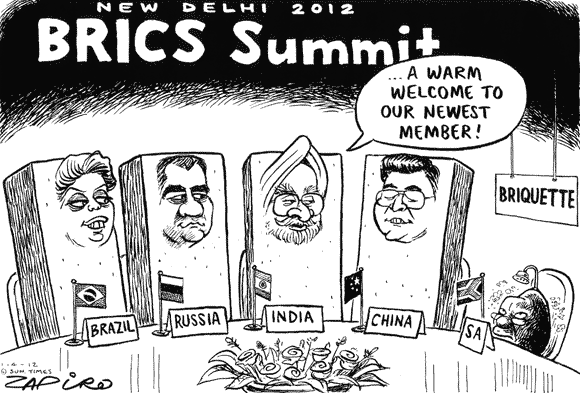
The group of emerging economies signed the long-anticipated document to create the $100 bn BRICS Development Bank and a reserve currency pool worth over another $100 bn. Both will counter the influence of Western-based lending institutions and the dollar.
The new bank will provide money for infrastructure and development projects in BRICS countries, and unlike the IMF or World Bank, each nation has equal say, regardless of GDP size.
Each BRICS member is expected to put an equal share into establishing the startup capital of $50 billion with a goal to reach $100 billion. The BRICS bank will be headquartered in Shanghai, India will preside as president the first year, and Russia will be the chairman of the representatives.
“BRICS Bank will be one of the major multilateral development finance institutions in this world,” Russian President Vladimir Putin said on Tuesday at the 6th BRICS summit in Fortaleza, Brazil.
The big launch of the BRICS bank is seen as a first step to break the dominance of the US dollar in global trade, as well as dollar-backed institutions such as the International Monetary Fund (IMF) and the World Bank, both US-based institutions BRICS countries have little influence within.
“In terms of escalating international competition the task of activating the trade and investment cooperation between BRICS member states becomes important,” Putin said.
Russia, Brazil, India, China and South Africa account for 11 percent of global capital investment, and trade turnover almost doubled in the last 5 years, the president reminded.
Each country will send either their finance minister or Central Bank chair to the bank’s representative board.
Membership may not just be limited to just BRICS nations, either. Future members could include countries in other emerging markets blocs, such as Mexico, Indonesia, or Argentina, once it sorts out its debt burden.
BRICS represents 42 percent of the world’s population and roughly 20 percent of the world’s economy based on GDP, and 30 percent of the world’s GDP based on PPP, a more accurate reading of the real economy. Total trade between the countries is $6.14 trillion, or nearly 17 percent of the world’s total.
The $100 billion crisis lending fund, called the Contingent Reserve Arrangement (CRA), was also established. China will contribute the lion’s share, about $41 billion, Russia, Brazil and India will chip in $18 billion, and South Africa, the newest member of the economic bloc, will contribute $5 billion.
The idea is that the creation of the bank will lessen dependence on the West and create a more multi-polar world, at least financially.
“This mechanism creates the foundation for an effective protection of our national economies from a crisis in financial markets," Russian President Vladimir Putin said.
The group has already created the BRICS Stock Alliance an initiative to cross list derivatives to smooth the path for international investors interested in emerging markets.
Russia has also proposed the countries come together under an energy alliance that will include a fuel reserve, as well as an institute for energy policy
"We propose the establishment of the Energy Association of BRICS. Under this ‘umbrella’, a Fuel Reserve Bank and BRICS Energy Policy Institute could be set up,” Putin said.
Documents on cooperation between BRICS export credit agencies and an agreement of cooperation on innovation were also inked.
Bringing emerging economies closer has become vital at a time when the world is guttered by the financial crisis and BRICS countries can’t remain above international problems, said Brazil's President Dilma Rousseff.
She cautioned the world not to see BRICS deals as a desire to dominate.
“We want justice and equal rights,” she said.
“The IMF should urgently revise distribution of voting rights to reflect the importance of emerging economies globally,” Rousseff said.
Source RT
Showing posts with label Brazil. Show all posts
Showing posts with label Brazil. Show all posts
Tuesday, July 15, 2014


Thursday, March 29, 2012
Delhi becomes a fortress
Even as heavy security arrangements have been made for
the stay and movement of foreign dignitaries participating in the BRICS
summit here on Thursday, a large number of Tibetan protesters were
arrested from different parts of the city and sent to Tihar Central Jail
on Wednesday.
The area surrounding Taj Palace where
leaders from China, Brazil, Russia, India and South Africa would attend
the event has been turned into a fortress with nearly 8,000 police
personnel forming part of a three-tier security cordon. While police
teams have been deployed at the traffic junctions, barricades have been
erected on the arterial roads to prevent any intrusion.
As
part of the arrangements, Sardar Patel Road from Dhaula Kuan to
Panchsheel Marg will remain closed for general traffic between 8.30 a.m.
and 4.00 p.m. An arterial road near Battle Honours Army Mess would also
be closed. The stretches affected by VVIP movements would be Sardar
Patel Marg, Mother Teresa Crescent, Kautilya Marg, Panchsheel Marg, Teen
Murti Marg, South Avenue, Rajaji Marg, Safdarjang Road, Akbar Road,
Tughlak Road, Krishna Menon Marg, 30 January Marg, Aurangzeb Road,
Prithviraj Road, Rajesh Pilot Marg, Amrita Shergil Marg, Subramanian
Bharti Marg and those roads in the vicinity.
In the
wake of self-immolation by Tibetan activist Jamphel Yeshi at Jantar
Mantar and subsequent protests, the Delhi Police imposed prohibitory
orders under Section 144 of the Criminal Procedure Code to prevent such
protests.
Youdon Aukatsang, a member of Tibetan
Parliament in exile, on Wednesday alleged that a large number of
protesters were arrested at Jantar Mantar, whereas several others were
arrested near Oberoi Hotel and from outside the United Nations office in
Lodhi Estate. Tenzin Tsundue, a Tibetan writer, was taken into
preventive custody while he was participating in an event at the India
Habitat Centre on Tuesday night. “Tibetans living in the Majnu-Ka-Tila
area are virtually under a house-arrest. They are not being allowed to
move freely. The Tibetan Youth Hostel has been sealed,” she said.
Source: The Hindu
Thursday, February 2, 2012
A Chance for South Africa to do the Right Thing for Syria
Will history repeat itself at the United Nations (UN) Security Council? The last time South Africa was called to vote on a resolution on Syria, on October 4 last year, it chose to abstain, along with India and Brazil. By doing so, the South African government empowered Russia and China to veto a draft resolution that was designed to pressure the Syrian government into ending the violence against its own people. At that stage, the civilian toll in Syria was, according to the UN, almost 2700 dead, which included many children and women.
Four months later, the death toll has more than doubled — the latest UN report was 5400 dead, but as the country descends into chaos, the UN said it could not keep track of the deaths any more. We’ll never know how events might have unfolded and how many lives might have been spared had the Security Council sent a strong, united message in October. It is still not too late for the council to speak out on this crisis.
Once again, Russia has taken the lead in blocking Security Council action on Syria. This time, Moscow is opposing a strong resolution tabled by Morocco in support of an Arab League initiative aimed at ending the violence. The draft resolution does not mention sanctions, nor any reference to the use of force, yet Moscow is stoking fears that this would lead to a Libya-style intervention.
Russia knows this resonates with South Africa, which has invoked the spectre of the use of force in Syria and warned of possible "hidden agendas." But Russia might have its own "hidden agendas" in Syria. It seems bent on protecting its alliance with the Syrian government, which has long been a trading partner in the region.
Last week, a Russian newspaper revealed that Moscow had just signed a $500m contract to deliver 36 Yak-130 combat jets to Syria. Earlier, a Russian ship allegedly full of ammunition made a dash for Syria after lying about its destination to Cypriot officials trying to enforce a European Union (EU) arms embargo against Damascus. The ship reached Tartus in Syria, Russia’s only naval base outside the former Soviet empire, providing a tangible sign of Russia’s support for the Syrian government.
Russia, which often claims in the Security Council to take its cues from regional organisations, has consistently undermined the efforts of the Arab League to end the violence in Syria. When the league suspended Syria in November for reneging on its promise to stop the killing, Russian Foreign Minister Sergei Lavrov called the move "incorrect" and "pre planned." He again criticised the Arab League this past weekend over the decision to suspend its monitoring mission in Syria.
South Africa has argued that the West misused the UN resolution on Libya, going beyond its purpose of protecting civilians to overthrow Libyan leader Muammar Gaddafi, and says it fears similar overreach in Syria. Yet the resolution at the Security Council provides absolutely no authorisation for military intervention in Syria.
If South African diplomats are suspicious of spin by western powers, they could listen to Navi Pillay, the UN’s human rights chief, who denounced the "ruthless repression" threatening to "plunge Syria into civil war" when she urged the Security Council to take action in December. The renowned South African judge said crimes against humanity had been committed in Syria and pleaded with the international community to take "urgent, effective measures in a collective and decisive manner to protect Syrians." Pillay warned that "inaction by the international community will embolden Syrian authorities." She was right.
South Africa did not listen, so it is once again faced with a historic choice. Will it settle political scores with the West at the expense of the Syrian people? Will it hide in the shadow of Russia, which is arming and supporting the Syrian repression machine? Or will it join the efforts of the Arab League and democratic countries trying to peacefully end the bloodshed?
We can only hope South Africa will do the right thing this time and support the Security Council efforts to protect the Syrian people. Let’s not wait for the death toll to double again.
Source: Human Rights Watch
Four months later, the death toll has more than doubled — the latest UN report was 5400 dead, but as the country descends into chaos, the UN said it could not keep track of the deaths any more. We’ll never know how events might have unfolded and how many lives might have been spared had the Security Council sent a strong, united message in October. It is still not too late for the council to speak out on this crisis.
Once again, Russia has taken the lead in blocking Security Council action on Syria. This time, Moscow is opposing a strong resolution tabled by Morocco in support of an Arab League initiative aimed at ending the violence. The draft resolution does not mention sanctions, nor any reference to the use of force, yet Moscow is stoking fears that this would lead to a Libya-style intervention.
Russia knows this resonates with South Africa, which has invoked the spectre of the use of force in Syria and warned of possible "hidden agendas." But Russia might have its own "hidden agendas" in Syria. It seems bent on protecting its alliance with the Syrian government, which has long been a trading partner in the region.
Last week, a Russian newspaper revealed that Moscow had just signed a $500m contract to deliver 36 Yak-130 combat jets to Syria. Earlier, a Russian ship allegedly full of ammunition made a dash for Syria after lying about its destination to Cypriot officials trying to enforce a European Union (EU) arms embargo against Damascus. The ship reached Tartus in Syria, Russia’s only naval base outside the former Soviet empire, providing a tangible sign of Russia’s support for the Syrian government.
Russia, which often claims in the Security Council to take its cues from regional organisations, has consistently undermined the efforts of the Arab League to end the violence in Syria. When the league suspended Syria in November for reneging on its promise to stop the killing, Russian Foreign Minister Sergei Lavrov called the move "incorrect" and "pre planned." He again criticised the Arab League this past weekend over the decision to suspend its monitoring mission in Syria.
South Africa has argued that the West misused the UN resolution on Libya, going beyond its purpose of protecting civilians to overthrow Libyan leader Muammar Gaddafi, and says it fears similar overreach in Syria. Yet the resolution at the Security Council provides absolutely no authorisation for military intervention in Syria.
If South African diplomats are suspicious of spin by western powers, they could listen to Navi Pillay, the UN’s human rights chief, who denounced the "ruthless repression" threatening to "plunge Syria into civil war" when she urged the Security Council to take action in December. The renowned South African judge said crimes against humanity had been committed in Syria and pleaded with the international community to take "urgent, effective measures in a collective and decisive manner to protect Syrians." Pillay warned that "inaction by the international community will embolden Syrian authorities." She was right.
South Africa did not listen, so it is once again faced with a historic choice. Will it settle political scores with the West at the expense of the Syrian people? Will it hide in the shadow of Russia, which is arming and supporting the Syrian repression machine? Or will it join the efforts of the Arab League and democratic countries trying to peacefully end the bloodshed?
We can only hope South Africa will do the right thing this time and support the Security Council efforts to protect the Syrian people. Let’s not wait for the death toll to double again.
Source: Human Rights Watch
Wednesday, April 20, 2011
South Africa Exults Abroad but Frets at Home
With the country preparing for local elections on May 18, the cabinet member Mr. Zuma chose to oversee local government, Sicelo Shiceka, is now embroiled in scandalous reports about his profligate living at public expense. Mr. Zuma announced Sunday that he was awaiting an explanation from Mr. Shiceka that has yet to come. “It’s this flaunting of inequality and conspicuous consumption that people get agitated about,” said Ben Roberts, a researcher at the Human Sciences Research Council, which recently conducted a survey of South Africans documenting widespread disillusionment with local government.
Parliamentary leaders of Mr. Zuma’s party, the African National Congress, have asked for independent investigators in the public protector’s office to find out whether Mr. Shiceka spent more than $50,000 of taxpayers’ money to fly to Switzerland and stay in five-star hotels while visiting his girlfriend, a flight attendant, who was jailed there on drug charges, as The Sunday Times of South Africa reported.
In a follow-up article on Sunday, the newspaper reported that municipal trucks were delivering water to the building site of Mr. Shiceka’s new home in the poorest district in the Eastern Cape. His home was also slated to be among the first to get electricity. “What a disgrace!” shouted the headline. “Minister builds emperor’s palace in South Africa’s poorest village.”
Corruption and great disparities in wealth are hardly uncommon among the other BRICS countries. But the lack of basic services has touched a particular nerve here. People in Mr. Shiceka’s home district had been protesting the poor quality of water and sewerage services. And it was precisely these issues that led poor people in Ficksburg, a town in the Free State, to take to the streets last week in a protest that ended in tragedy. SABC, the state broadcaster, showed police officers in Ficksburg assaulting an unarmed, shirtless protester named Andries Tatane, 33, and thwacking his torso with batons. Mr. Tatane then looked down at his chest, streaming with blood. A haunting photograph shows him lying wounded in the arms of a friend whose face is contorted in anguish. Mr. Tatane died minutes later. “The post-mortem showed he died of gunshot wounds,” said Moses Dlamini, spokesman for the Independent Complaints Directorate, which investigates police brutality. “And he had bruises which indicated he was assaulted.” Two police officers have been charged with the murder and four others with assault, but not before enraged residents of Mr. Tatane’s township set fire to two government buildings.
An African National Congress spokesman, Jackson Mthembu, described the attack on Mr. Tatane as reminiscent of “apartheid-era strong-arm tactics” — a remarkable statement considering that the A.N.C. itself led the struggle against apartheid and has governed the country, and overseen its police force, since 1994.
The so-called service delivery protests, a phenomenon across the country, provide signs of the simmering discontent among many South Africans about how long it is taking to translate the gains of freedom into material progress. Even as South Africa takes center stage with the world’s most prominent developing nations, a majority of young black South Africans are jobless. Poverty remains widespread. A nationwide survey of about 3,200 South Africans age 16 and older, sponsored by the country’s Independent Electoral Commission, found that South Africans were most dissatisfied with local government performance on job creation, crime and housing.
The survey, released last week, documented an erosion of trust at all levels of government, with the lowest approval level — 38 percent — reserved for local government, down from a high of 55 percent in 2004. Politicians rated even lower. Only 27 percent of South Africans trusted them when the survey was conducted in the final months of 2010. The main opposition party, the Democratic Alliance — widely perceived as dominated by whites — has sought to attract more black support by highlighting its strong record in running the city of Cape Town. Helen Zille, the former journalist who leads the party, has seized on the killing of Mr. Tatane as emblematic of how the A.N.C. has “become disconnected from the people it is supposed to serve.”
But the loyalty of voters to the A.N.C., the party of Nelson Mandela, remains deep, and the survey found that those who were most unhappy with government were also the ones who said they were least likely to vote. So the question of whether discontent leads to change in the ballot box remains open.
Source: New York Times
Libya and the BRICS: Currency Wars, Imperial Wars and Popular Uprisings
On one side of the world NATO bombs Libya and on the other, the newly expanded BRICS (Brazil, Russia, India, China and South Africa) meet on the island of Hainan, off the south coast of China. Two seemingly unrelated events. But there are links and forces at play fuelling important new power contestations in the world.
Western bombs are raining down on Libya and a “no-fly zone” is being imposed after a United Nations (UN) Security Council resolution. At the UN, BRICS members, China and Brazil, abstained from voting (although South Africa voted for) but publicly criticised the idea of bombing Gaddafi’s forces.
The US is in decline as the power able to exert its authority over world affairs. At the same time we are seeing the rise of China – predicted to be the world’s largest economy within 10 to 20 years – having imperial ambitions, but racked with many internal contradictions. China is the single biggest holder of the US’ debt, in the form of federal bonds. Its rise is offset by its dependence on the US for its exports and on US companies that are its biggest foreign investors. Moreover, holding dollar-denominated US treasury bonds also means that China can't simply watch the dollar decline or risk a US bond default.
So China and the US are like two adversaries manacled together, taking wild pot shots at each other, but unable to strike the decisive blow. For some while now the US has been attacking the Chinese for what it calls a form of protectionism by keeping its currency, the Renminbi, allegedly, artificially low.
The November 2010 meeting of the G20 countries in Seoul was supposed to be an attempt at resolving the currency wars between the US and China. But in the midst of the G20 diplomacy and fine rhetoric about solving trade imbalances, the US decided to indulge in another round of quantitative easing – to the tune of US$600b – essentially a form of printing money by buying back bonds from private banks and then crediting their balance sheets with money.
If any other country were to print money in this way the consequences would be devastating in terms of inflation and the collapse of the currency in world markets. But the US’ currency is the world’s currency, so it doesn’t incur inflation, nor does anyone dump dollars because global trade is conducted in dollars. So the US can get away with it.
This certainly raised the hackles, not only of China, but also of Brazil, Russia, India and South Africa, who are all consequently attracting hot money from low US interest rates and quantitative easing, which overvalues their currencies and makes their exports more expensive.
At the BRICS meeting, President Zuma joined his counterparts in calling for greater independence from the dollar.
The BRICS meeting echoed comments made by the governor of the Chinese Central Bank in 2009, in the midst of the global financial crisis, that the dollar’s role, as the global reserve currency and medium of international trade was placing the world at risk, given the scale of the US’ debt and the fact that the crisis was centred on the US.
This is no mere arcane technical spat between economists. This is about economic clout and the political power that comes with having one’s currency both the global reserve currency and the medium of global exchange. The fight over the dollar is also a fight over who is to be the main political force in the 21st century, and who is the fulcrum around which all foreign policy matters of nation states will turn -- with all the implications for domestic issues.
So the currency wars have direct meaning for what our lives will be like in the next while.
Meanwhile the world’s attention is focussed on the Libyan crisis and the evil perpetrated by Muammar Gaddafi. Having armed Gaddafi, invested in his oil fields and welcomed him back into the fold of the “international community,” the US, Britain and France, are now arming his adversaries and bombing his air force in the name of a “humanitarian mission.”
All of this while there are people’s uprisings against dictators throughout North Africa and the Arab world in Yemen, Algeria, Syria and Bahrain (and, of course, the successful insurrections in Tunisia and Egypt).
So why are the US, Britain and France now supporting what they call “pro-democracy groups” in Libya, while taking the opposite stance in Bahrain and Yemen by arming the dictator’s forces, which are killing the pro-democracy forces in those countries?
And why did the BRICS countries take a different view on Libya to that of the West?
Maybe there is an additional explanation to the theory that this is about Libya’s oil. There appears to be a currency war at stake here as well.
Recently, US financial journalists, speaking to their investor community, have begun highlighting some little-reported developments in Libya. Several writers have noted the odd fact that the Libyan rebels took time out from their rebellion in March to create their own central bank. This before they even had a government.
Robert Wenzel wrote in the Economic Policy Journal, “I have never before heard of a central bank being created in just a matter of weeks out of a popular uprising. This suggests we have a bit more than a rag tag bunch of rebels running around and that there are some pretty sophisticated influences.”
In a statement, the Libyan rebels reported on the results of a meeting held on March 19. Among other things, the supposed “pro-democracy forces” announced the "designation of the Central Bank of Benghazi as a monetary authority competent in monetary policies in Libya and appointment of a Governor to the Central Bank of Libya, with a temporary headquarters in Benghazi."
US senior financial editor, John Carney, has asked, "Is this the first time a revolutionary group has created a central bank while it is still in the midst of fighting the entrenched political power? It certainly seems to indicate how extraordinarily powerful central bankers have become in our era."
Clearly there is something different about Libya.
Earlier in the twentieth century Libya was a colony of Italy. But Italy was a losing power in World War II and ceded power to Britain. Unlike Italian colonialism, Britain was happy to exercise power indirectly through a Libyan king -- King Idris, who ruled from 1949.
However, a wave of nationalism spread after World War II and Gamal Nasser and army officers seized power in Egypt in 1952 proclaiming themselves nationalists and Arab socialists. The region became notable for the clash between Arab nationalism and imperialist interests in the centre of the world’s oil reserves. So when a Libyan army officer – Muammar Gaddafi – seized power from King Idris in 1969 and proclaimed his movement as Arab socialist and pan-Africanist, he was immediately declared the enemy of the West.
Gaddafi, in return, ruled Libya through the army and through a system of alliances with tribal lords. Internationally, he manoeuvred to play competing imperial interests off against one another.
Inside Libya he combined the suppression of the people with claiming that he was merely a “brother leader” using the growing oil revenue to strengthen the Libyan army and establish a high standard of living for the Libyan middle classes. As a result, Libya has the highest human development index (HDI) in Africa and the fourth highest GDP per capita. Libya also has the 10th-largest oil reserves of any country in the world and the 17th-highest petroleum production.
And critically for current events, Gaddafi also set up a Libyan Central Bank that was 100% state-owned. That in itself was not so unusual, but what is unique amongst the major oil producers is the fact that the Libyan Central Bank is not a member of the Bank for International Settlements (BIS) (the BIS is the international clearing house for global trade and conducts its transactions in dollars).
As a result, the Libyan government, up to now, could create its own money, the Libyan Dinar, through the facilities of its own central bank and insist that trade in oil must take place in its national currency (and not in dollars, as is the case with all the other major oil producers).
This has placed Libya in the same advantageous position as the US, who, as custodian of the global currency of trade, the dollar, can merely print money to expand its trade capacity without, as in the case of Zimbabwe, incurring disastrous inflationary consequences. In order to do business with Libya, banking cartels, oil barons and so on, have had to go through the Libyan Central Bank and its national currency.
So Gaddafi’s Libya was indeed special -- a small player, but suddenly a significant player given the global power plays over the dollar, as the world’s reserve currency and medium of exchange.
In the new Libya being crafted, the “pro-democracy forces” in Eastern Libya around Benghazi are being pulled into the West’s economic orbit in the currency wars, to the trepidation of China and her allies. This is an additional reason why the BRICS countries have been so critical of the West’s latest military adventure.
In this, South Africa’s precariousness in the imperial wars – with its BRICS allies in raging against the dollar, yet voting with the US to bomb Libya, heading an AU delegation to seek peace with Gaddafi and then being brushed aside by NATO – is so apparent.
But how did the initial stirrings of a people’s movement in Libya become something else?
When the Arab uprisings began in Tunisia and spread throughout North Africa and the Middle East many people in Libya also became inspired to confront Gaddafi’s tyranny. They gathered in the main square in Tripoli – the Green Square – defied Gaddafi, and called for democracy. From Tripoli the mood spread out to the South and East of the country.
But other forces were at play…Tribal leaders reading the shifting currents in the region and seeking to position themselves accordingly, old King Idris loyalists seeking to bring back the monarchy, and some of Gaddafi’s own lieutenants trying to guarantee their future careers by jumping ship to the West. Some of these began waving the old Kingdom of Libya flags.
All these forces have completely swamped the original movement, which began in Tripoli and today the “pro-democracy forces” are clearly these, rather than the original Libyan uprising. Tripoli is no longer a centre of rebellion and the whole thing has degenerated into a civil war where one side is being backed by Western special forces, NATO air strikes and arms supplied by whomsoever wants to swing events their way.
And what has been the priority of these forces?
To get the oil terminals at Benghazi to flow and to get a new Central Bank of Libya up and running.
Before the conflict has even ended, the Benghazi-based Transitional National Council (TNC), led by Mustafa Abdul Jalil, an ex-finance minister of Gaddafi, has already met with Sarkozy in France and attended the London meeting on Libya convened by Britain’s David Cameron. At the meeting, the TNC promised to respect all international treaties, including Libya joining the BIS, and guarantying private sector investment.
It is these anti-democracy opportunists who are calling for NATO air strikes and seeking the blessing of the West before the Libyan people can decide for themselves.
Libya is providing an opportunity for imperialism to both crush an old enemy and co-opt the Arab uprising, turning calls for independence, freedom and democracy into calls for independence for central banks, greater free markets and imperial domination.
But the world has changed. The Arab uprisings are themselves a sign that there are weak links in the imperialist chain.
The current capitalist crisis is of such proportions that the space to finance a major war, commit troops to occupation and administer such an occupation is severely limited. The US is already carrying the can for occupations in Iraq and Afghanistan and is simply incapable of sustaining another one at the time of its biggest debt. This is why Obama wants a UN/NATO coalition to share the political and economic cost of the war on Libya. And even within NATO, member country, Turkey, has its own domestic reasons for not wanting to be part of an attack on a Muslim country.
What is being played out are contestations within imperialism – largely between China and the US - on the one hand, and a new tide of popular rebellion against domination – a tide that began in Latin America over the last 10 years, but which has now exploded across North Africa and the Middle East - on the other. The key is the strength of the people on the ground in Yemen, Syria and even Saudi Arabia, but above all, in Tunisia and Egypt, where they are still directly engaged in determining the outcome of events.
Our world will be shaped by which social forces prove triumphant over the next few years.
Western bombs are raining down on Libya and a “no-fly zone” is being imposed after a United Nations (UN) Security Council resolution. At the UN, BRICS members, China and Brazil, abstained from voting (although South Africa voted for) but publicly criticised the idea of bombing Gaddafi’s forces.
The US is in decline as the power able to exert its authority over world affairs. At the same time we are seeing the rise of China – predicted to be the world’s largest economy within 10 to 20 years – having imperial ambitions, but racked with many internal contradictions. China is the single biggest holder of the US’ debt, in the form of federal bonds. Its rise is offset by its dependence on the US for its exports and on US companies that are its biggest foreign investors. Moreover, holding dollar-denominated US treasury bonds also means that China can't simply watch the dollar decline or risk a US bond default.
So China and the US are like two adversaries manacled together, taking wild pot shots at each other, but unable to strike the decisive blow. For some while now the US has been attacking the Chinese for what it calls a form of protectionism by keeping its currency, the Renminbi, allegedly, artificially low.
The November 2010 meeting of the G20 countries in Seoul was supposed to be an attempt at resolving the currency wars between the US and China. But in the midst of the G20 diplomacy and fine rhetoric about solving trade imbalances, the US decided to indulge in another round of quantitative easing – to the tune of US$600b – essentially a form of printing money by buying back bonds from private banks and then crediting their balance sheets with money.
If any other country were to print money in this way the consequences would be devastating in terms of inflation and the collapse of the currency in world markets. But the US’ currency is the world’s currency, so it doesn’t incur inflation, nor does anyone dump dollars because global trade is conducted in dollars. So the US can get away with it.
This certainly raised the hackles, not only of China, but also of Brazil, Russia, India and South Africa, who are all consequently attracting hot money from low US interest rates and quantitative easing, which overvalues their currencies and makes their exports more expensive.
At the BRICS meeting, President Zuma joined his counterparts in calling for greater independence from the dollar.
The BRICS meeting echoed comments made by the governor of the Chinese Central Bank in 2009, in the midst of the global financial crisis, that the dollar’s role, as the global reserve currency and medium of international trade was placing the world at risk, given the scale of the US’ debt and the fact that the crisis was centred on the US.
This is no mere arcane technical spat between economists. This is about economic clout and the political power that comes with having one’s currency both the global reserve currency and the medium of global exchange. The fight over the dollar is also a fight over who is to be the main political force in the 21st century, and who is the fulcrum around which all foreign policy matters of nation states will turn -- with all the implications for domestic issues.
So the currency wars have direct meaning for what our lives will be like in the next while.
Meanwhile the world’s attention is focussed on the Libyan crisis and the evil perpetrated by Muammar Gaddafi. Having armed Gaddafi, invested in his oil fields and welcomed him back into the fold of the “international community,” the US, Britain and France, are now arming his adversaries and bombing his air force in the name of a “humanitarian mission.”
All of this while there are people’s uprisings against dictators throughout North Africa and the Arab world in Yemen, Algeria, Syria and Bahrain (and, of course, the successful insurrections in Tunisia and Egypt).
So why are the US, Britain and France now supporting what they call “pro-democracy groups” in Libya, while taking the opposite stance in Bahrain and Yemen by arming the dictator’s forces, which are killing the pro-democracy forces in those countries?
And why did the BRICS countries take a different view on Libya to that of the West?
Maybe there is an additional explanation to the theory that this is about Libya’s oil. There appears to be a currency war at stake here as well.
Recently, US financial journalists, speaking to their investor community, have begun highlighting some little-reported developments in Libya. Several writers have noted the odd fact that the Libyan rebels took time out from their rebellion in March to create their own central bank. This before they even had a government.
Robert Wenzel wrote in the Economic Policy Journal, “I have never before heard of a central bank being created in just a matter of weeks out of a popular uprising. This suggests we have a bit more than a rag tag bunch of rebels running around and that there are some pretty sophisticated influences.”
In a statement, the Libyan rebels reported on the results of a meeting held on March 19. Among other things, the supposed “pro-democracy forces” announced the "designation of the Central Bank of Benghazi as a monetary authority competent in monetary policies in Libya and appointment of a Governor to the Central Bank of Libya, with a temporary headquarters in Benghazi."
US senior financial editor, John Carney, has asked, "Is this the first time a revolutionary group has created a central bank while it is still in the midst of fighting the entrenched political power? It certainly seems to indicate how extraordinarily powerful central bankers have become in our era."
Clearly there is something different about Libya.
Earlier in the twentieth century Libya was a colony of Italy. But Italy was a losing power in World War II and ceded power to Britain. Unlike Italian colonialism, Britain was happy to exercise power indirectly through a Libyan king -- King Idris, who ruled from 1949.
However, a wave of nationalism spread after World War II and Gamal Nasser and army officers seized power in Egypt in 1952 proclaiming themselves nationalists and Arab socialists. The region became notable for the clash between Arab nationalism and imperialist interests in the centre of the world’s oil reserves. So when a Libyan army officer – Muammar Gaddafi – seized power from King Idris in 1969 and proclaimed his movement as Arab socialist and pan-Africanist, he was immediately declared the enemy of the West.
Gaddafi, in return, ruled Libya through the army and through a system of alliances with tribal lords. Internationally, he manoeuvred to play competing imperial interests off against one another.
Inside Libya he combined the suppression of the people with claiming that he was merely a “brother leader” using the growing oil revenue to strengthen the Libyan army and establish a high standard of living for the Libyan middle classes. As a result, Libya has the highest human development index (HDI) in Africa and the fourth highest GDP per capita. Libya also has the 10th-largest oil reserves of any country in the world and the 17th-highest petroleum production.
And critically for current events, Gaddafi also set up a Libyan Central Bank that was 100% state-owned. That in itself was not so unusual, but what is unique amongst the major oil producers is the fact that the Libyan Central Bank is not a member of the Bank for International Settlements (BIS) (the BIS is the international clearing house for global trade and conducts its transactions in dollars).
As a result, the Libyan government, up to now, could create its own money, the Libyan Dinar, through the facilities of its own central bank and insist that trade in oil must take place in its national currency (and not in dollars, as is the case with all the other major oil producers).
This has placed Libya in the same advantageous position as the US, who, as custodian of the global currency of trade, the dollar, can merely print money to expand its trade capacity without, as in the case of Zimbabwe, incurring disastrous inflationary consequences. In order to do business with Libya, banking cartels, oil barons and so on, have had to go through the Libyan Central Bank and its national currency.
So Gaddafi’s Libya was indeed special -- a small player, but suddenly a significant player given the global power plays over the dollar, as the world’s reserve currency and medium of exchange.
In the new Libya being crafted, the “pro-democracy forces” in Eastern Libya around Benghazi are being pulled into the West’s economic orbit in the currency wars, to the trepidation of China and her allies. This is an additional reason why the BRICS countries have been so critical of the West’s latest military adventure.
In this, South Africa’s precariousness in the imperial wars – with its BRICS allies in raging against the dollar, yet voting with the US to bomb Libya, heading an AU delegation to seek peace with Gaddafi and then being brushed aside by NATO – is so apparent.
But how did the initial stirrings of a people’s movement in Libya become something else?
When the Arab uprisings began in Tunisia and spread throughout North Africa and the Middle East many people in Libya also became inspired to confront Gaddafi’s tyranny. They gathered in the main square in Tripoli – the Green Square – defied Gaddafi, and called for democracy. From Tripoli the mood spread out to the South and East of the country.
But other forces were at play…Tribal leaders reading the shifting currents in the region and seeking to position themselves accordingly, old King Idris loyalists seeking to bring back the monarchy, and some of Gaddafi’s own lieutenants trying to guarantee their future careers by jumping ship to the West. Some of these began waving the old Kingdom of Libya flags.
All these forces have completely swamped the original movement, which began in Tripoli and today the “pro-democracy forces” are clearly these, rather than the original Libyan uprising. Tripoli is no longer a centre of rebellion and the whole thing has degenerated into a civil war where one side is being backed by Western special forces, NATO air strikes and arms supplied by whomsoever wants to swing events their way.
And what has been the priority of these forces?
To get the oil terminals at Benghazi to flow and to get a new Central Bank of Libya up and running.
Before the conflict has even ended, the Benghazi-based Transitional National Council (TNC), led by Mustafa Abdul Jalil, an ex-finance minister of Gaddafi, has already met with Sarkozy in France and attended the London meeting on Libya convened by Britain’s David Cameron. At the meeting, the TNC promised to respect all international treaties, including Libya joining the BIS, and guarantying private sector investment.
It is these anti-democracy opportunists who are calling for NATO air strikes and seeking the blessing of the West before the Libyan people can decide for themselves.
Libya is providing an opportunity for imperialism to both crush an old enemy and co-opt the Arab uprising, turning calls for independence, freedom and democracy into calls for independence for central banks, greater free markets and imperial domination.
But the world has changed. The Arab uprisings are themselves a sign that there are weak links in the imperialist chain.
The current capitalist crisis is of such proportions that the space to finance a major war, commit troops to occupation and administer such an occupation is severely limited. The US is already carrying the can for occupations in Iraq and Afghanistan and is simply incapable of sustaining another one at the time of its biggest debt. This is why Obama wants a UN/NATO coalition to share the political and economic cost of the war on Libya. And even within NATO, member country, Turkey, has its own domestic reasons for not wanting to be part of an attack on a Muslim country.
What is being played out are contestations within imperialism – largely between China and the US - on the one hand, and a new tide of popular rebellion against domination – a tide that began in Latin America over the last 10 years, but which has now exploded across North Africa and the Middle East - on the other. The key is the strength of the people on the ground in Yemen, Syria and even Saudi Arabia, but above all, in Tunisia and Egypt, where they are still directly engaged in determining the outcome of events.
Our world will be shaped by which social forces prove triumphant over the next few years.
Read more articles by Leonard Gentle. Director of the International Labour and Research Information Group.
Friday, January 21, 2011
Dr Gaston Savoi - Executive Profile
Uruguayan business man and entrepreneur Dr Gaston Savoi speaks candidly about his decision to immigrate to South Africa, his commitment to investing in the country and despite the legal battle he now faces, optimism about the future.
When an astute businessman sees opportunity in a boisterous and emerging economy, he is likely to explore his options for investment. When a man persuades his family, colleagues and friends to invest their lives and livelihoods in a country, it is no longer a cool, calculated risk but a matter of the heart. Dr Gaston Savoi has lived in France, Brazil and Argentina, due to his father being transferred to these countries for business and finally settled in Uruguay. Dr Savoi speaks fluent English, Portuguese, French, Italian and Spanish and considers himself a "proudly world citizen". What then drew him to South Africa?
The roots of his life-changing decision lie in what he sees as a bond between South America and South Africa that may be separated by the Atlantic, but on all other counts, are "blood brothers".
"There is a connection on a deep level" he says. "Africa loves colours, loves music. Africa speaks loudly. The people are friendly. They open the doors of their homes to you. We in South America are very similar to South Africa. We have a lot of influence from Africa in culture and in our genetic heritage. I believe this gives us a close understanding."
His gestures are open and expansive when he speaks. It is only part of his charisma. The rest is down to what, in old fashioned terms, might be called a "dapper" style; a combination of sartorial elegance, urbane manner and a deep voice that takes English and turns it into a rich, allegorical narrative. He grins under a slightly rakish moustache and there it is; the portrait of a man whose handshake and characteristic embrace signals the beginning of both a friendship and a business partnership.
This is the same Savoi who, back in 1973 at the age of 21 years old, boldly brokered a financial deal for a small company with great ideas but no capital. To this day, 37 years later, he remains close friends with the founders.
Dr Savoi obtained his degree in Sao Pablo, Brazil, married Gilda Brant de Carvalho and in the years to follow, would take the first steps in developing pharmaceutical factories that manufactured raw materials for human and veterinary use, making key breakthrough in research and development, and becoming a world player in the field. These ventures formed the initial basis to his growing wealth.
As a couple, he and Gilda also founded the first Arabian horse insemination laboratory in Uruguay. Life for the couple was about balance - the practical, the aesthetic and the emotional, which included starting a family. Their three sons, Philippe, Rodrigo and Guillermo and daughter Carolina ultimately joined the family business and by the mid 90s, South Africa was firmly on their radar as a frequent holiday destination. The bush, Cape Town and its people had begun to work its magic.
"When an aeroplane arrives in South Africa, you see this sun coming up and reflecting the clouds. Before you put a foot on the continent you are starting to fall in love with it," he says. The process, which he says begins as an "infatuation", turns to something deeper. Beyond the bush, animal life and the lure big-sky country, Dr Savoi was acutely aware that South Africa offered something much more.
"It's a country with a history and a fantastic infrastructure," he adds. "South Africa for me is a First World country but with everything that you can get from the wild. You are able to go anywhere in two hours," gesturing with his arms opened wide to reinforce the point. "A few kilometres and I am in the middle of the bush, the mountains, game reserves, rivers and deserts. There is no other country I know of that has the versatility and diversity in one place."
"I have an open mind to different cultures, to appreciate different roots, and made the decision to live here and not just be in transit."
At the same time, Dr Savoi was seeing the beginning of what he describes as "cracks" in the banking system in South America and a growing instability there. "What we are experiencing now as a result of what is happening in Europe and North America, South America felt in 2000." Dr Savoi felt that he was in what he calls a "poll" position and ahead was an open track that led, quite obviously, to an emerging economy with intriguing potential.
But no business decision is made in this family without consultation.
"You always need to think in terms of family," he says. The Savoi family is extremely close with major business and life decisions taken around a table not a boardroom. Dr Savoi felt that they were all turning a significant corner and that they needed to be pro-active about their futures. They had already experienced the inexorable pull of South Africa through their world traveller's eyes but he says, "sometimes, destiny shows the way to a move and chooses the moment. I considered the age of my daughter and my three sons. They would look to get married some day and that maybe it was the time for us to take what was not an easy decision but neither was it a tough one. After all, I was not going to mine gold in the Yukon! They saw the scenario through the same eyes and I proceeded to motivate the move to invest in South Africa."
Gaston Savoi did not come empty handed.
With 37 years working in the health industry in manufacturing pharmaceutical API's (Active Pharmaceutical Ingredients) Savoi's companies also manufactured water purification systems and mobile gas generating units. He saw the opportunity to set up a company in South Africa, attracting foreign investment and contribute to the national production of a vital product that had the potential to change the lives of millions of South Africans denied access to fresh water because of inaccessible or contaminated sources. There was another product that the Group had developed in South America that would save lives. One of the big problems faced by countries with an outlying rural population that relied on smaller hospitals and clinics for health care, was the ready availability of medical air and oxygen. Transporting cylinders to outlying areas in South America on poor roads and at the vagaries of frequent strikes left the rural population vulnerable. Units that generate medical oxygen and medical air on site meant avoiding the risks related to non-delivery of a vital resource. The system also has a positive impact on the environment (as shown in an European study) as CO2 is reduced by reducing the transportation of cylinders.
But these plans lay in the future.
First came the Savoi family's move here, one that puzzled many well heeled South Africans whose children were members of the white diaspora to the UK, Australia and the US. For here was a man with wealth and the privilege of choice, deciding to commit everything to a country with what had, at best an "uncertain future".
Savoi simply didn"t see the new South Africa this way.
"I took a decision and my immediate family supported the decision.
That has as a lot to do with his role within the family. "To be a father is naturally a result of biological process, but to be friend to your sons, and vice versa, that is something that needs to be cultivated. To keep the respect between the generations is not easy unless there are no fences and no walls. It is the same relationship that I have with my father. I am not embarrassed to say that it is about real love."
Although the plans were to bring his immediate family to a new continent and a new life, it was not without some pain. "You need to remember that it did not include my extended family - father, my mother, my mother in law, my father in law here, and my sister - therefore it was a tough decision - but less tough if you combine it with taking what you feel deep down, is the right decision. I am sure that I took it."
This growing set of ties to South Africa – including an application for permanent residence for his whole family - underpinned Savoi's first significant commitment in putting down roots. In 2001, the Group bought a 50% share (R150 million rand investment) in Shamwari Holdings through foreign investment, later to be known as the Mantis Collection of Boutique Hotels and Game Reserves, the world renowned hospitality group that included Shamwari Game Reserve established by Adrian Gardiner. The partnership with Gardiner also had financial implications. With no track record in South Africa, the Group had no credit line with local banks, making foreign investment crucial going forward. Although the family had farming in their blood, Savoi had no personal experience in the hospitality industry and running a game reserve. He saw the move as a chance to hand over his core business to his children and take up a personal challenge, moving not to a new career per se, but more of an active "retirement". "To have gypsy spirit, does not mean that you are gypsy. To say that you"re a world citizen that does not mean that you don"t have roots." In true Savoi style, the initial connection with Shamwari was indirect. On a flight to SA, he struck up a conversation with fellow passenger Peter Fleck (former rugby player Robbie Fleck's father).
In the conversation that ensued, one that ranged from family to business and Savoi's growing feelings for South Africa, was the subject of a game lodge. Peter became the catalyst to a series of meetings both in South Africa and South America, with amongst others Dr Ian Player. "I always think that it's very important when you intend to take a step like that, to know where people are coming from and how they do business. It's a matter of logic – and culture. But also the differences are important. I always say “what happens to the red if everybody likes the blue”?
A gentleman's agreement then led to a due diligence report, a formal partnership and a mounting excitement about potential new markets, resulting from one of his son's astute comment that South American tourism to SA, was largely neglected. There was much to be done to foster stronger ties.
Business ties established, and a future vision mapped out, the Group went on to further develop the historic Steenberg Estate in Constantia and the 54 000 hectare Sanbona Wildlife Reserve at the foot of the Warmwaterberg Mountains in the Little Karoo. The reserve's white lion project, was given world coverage through Animal planet and it's one which Savoi is justifiably proud of to this day.
The SA lifestyle proved an irresistible force. "We live a supposed 650 thousand hours," says Savoi, "that is our life. I am clear that some of these hours need to be enjoyed during our journey here."
It was a journey on many levels and not simply a destination.
Although the Group successfully sold their shares back to Adrian Gardiner in 2005, Dr Savoi continued to pursue the core business that he had established in South America; water purification, oxygen and health products.
"We brought our technology and our intellectual property through foreign investment to the country - and to the continent. With this, came the will and the effort to build a fantastic first world nutritional plant," says Dr Savoi. "Over the years with Mantis, I had the honour and the opportunity to meet many important players in the South African government and was guided by them on of how to deal with government as a supplier. We understood absolutely that we needed to go through a process. It is something we understand because we have had a similar scenario for decades in Brazil. We not only understand the system but respect what is a natural empowerment, because we believe in our culture there can not be no more colonialism. We are not an orange to be squeezed, to take the juice from the orange and take the seeds. If you want to come to enjoy a country and its benefits for today, tomorrow and the future you must have respect for the local owners of the country. I take my authority from South Africa but it stops in front of you," deferring to the laws and customs of the country.
"I am not a citizen. I can"t vote. Therefore, I must respect you, I must be diplomatic. I must respect the country's policy of Black Economic Empowerment. We needed to have South African partners who could add real value to the process but to get government work required networking."
There is no doubt that the government tender process, now under such intense scrutiny, is a complicated one. The right partners, the processes to follow, the legitmacy of commissions paid for work secured, is integral to Dr Savoi's current challenges. What happens now, and in the years it may take to untangle what Dr Savoi calls a "spagetti putanesca", must take his course. He contuines to appear in court at hearings with dignity, having endured what appeared to be a highly irregular decision to keep him jailed for several days in Kimberley, and despite having posted substantial bail.
"It is a "live and learn" scenario he believes. "What if I could have imagined that all our trust and effort would be challenged because we followed the created rules of the country." He lets the notion hang. "One thing I am deeply sure of is that we have not done anything wrong. I did not only bring my family here remember, but motivated other families and foreign investors to come here too. These families and investors came trusting me because some of them have been working for me for 10, 20 years. They came here to transfer skills and add value to the country, then married here and have South African babies. I myself have six Proudly South African grandchildren.
"If you ask me today where I think I failed, I say this; I am not a perfect man but I am a perfectionsit. I think that I failed as you fail when you are in love. When you are in love all that strong sentiment creates a weakness somewhere. There are two issues at play here; the first one is that I definitely underestimated the strong power of a monopoly, in the country."
Dr Savoi saw that there were major opportunities and alternatives to a single supplier of services and a commodity. "I did not ever see our company as a substitute monopoly. It's simply not in our culture, in our South American history. We are born as a nationalist people. I saw the opportunity then to produce our equipment here instead of importing it from South America. We empowered many people in this country and directly employed 150. Sadly, we have recently had to retrench 60% of our staff.
"Suddenly," says Dr Savoi, "we appear to have crossed a road that is not allowed to be crossed, but nobody warned us."
Dr Savoi's second caveat has to do with not knowing enough about a local network to do business.
"I am sure that if you were to invest in Brazil, because you love the country, its people, its spirit, the friendship, the music - you love everything - and you decide that by using your skills, you could reduce poverty … but that you have to have a "national power" base to do so, you would take advice. "The advice would be to find strategic partners, and offer strategic shares in your company. You would ask what key people to be introduced to and someone – because you do not know yourself – would choose the right people you should know. You would be reliant on this strategic advice. And obviously one conducts business strictly in accordance with the law and on advice of the professional advisers of the company:- lawyers and auditors."
By all accounts, this is the pattern that Dr Savoi followed on advice from those "in the know" and which is now the subject of his pending court case. "I am a businessman but it seems to me that I have become part of a witch hunt."
The docket that started the ball rolling happened to be from one of Dr Savoi's direct competitors. "How is it, "he asks, "that you can be part of a national tender for business when you are the sole supplier of the goods and services?"
Despite the fight Dr Savoi still has to face over the coming months he remains optimistic about his future here.
"We intend to stay here, to contribute to what we can. We have other projects in the pipeline besides water purification plants and gas generation units. We have our work to carry out bringing skills and intellectual property to help factories reduce the relience on importations. The goal is self dependence."
"I have immense respect for South Africans and what they have achieved but sometimes I feel that perhaps people cannot see what they have, what they have built. One day, the whole world will understand what we (South Africa) have. Perhaps you cannot see what you have until you lose it. You need to take stock. I did. And what I understood, what I saw - and still do - is a deep synergy with my vision of things and what can be achieved in this country."
Please direct all questions in writing to Lynn Giles - lynng@draftfcb.co.za. Dr Savoi is currently not available for comment or interviews.
For further information regarding the current court case, please forward your requests in writing to Rachelle Bricout of Edward Nathan Sonnenbergs - rachelle@create-a-stir.co.za
Source: Intaka
When an astute businessman sees opportunity in a boisterous and emerging economy, he is likely to explore his options for investment. When a man persuades his family, colleagues and friends to invest their lives and livelihoods in a country, it is no longer a cool, calculated risk but a matter of the heart. Dr Gaston Savoi has lived in France, Brazil and Argentina, due to his father being transferred to these countries for business and finally settled in Uruguay. Dr Savoi speaks fluent English, Portuguese, French, Italian and Spanish and considers himself a "proudly world citizen". What then drew him to South Africa?
The roots of his life-changing decision lie in what he sees as a bond between South America and South Africa that may be separated by the Atlantic, but on all other counts, are "blood brothers".
"There is a connection on a deep level" he says. "Africa loves colours, loves music. Africa speaks loudly. The people are friendly. They open the doors of their homes to you. We in South America are very similar to South Africa. We have a lot of influence from Africa in culture and in our genetic heritage. I believe this gives us a close understanding."
His gestures are open and expansive when he speaks. It is only part of his charisma. The rest is down to what, in old fashioned terms, might be called a "dapper" style; a combination of sartorial elegance, urbane manner and a deep voice that takes English and turns it into a rich, allegorical narrative. He grins under a slightly rakish moustache and there it is; the portrait of a man whose handshake and characteristic embrace signals the beginning of both a friendship and a business partnership.
This is the same Savoi who, back in 1973 at the age of 21 years old, boldly brokered a financial deal for a small company with great ideas but no capital. To this day, 37 years later, he remains close friends with the founders.
Dr Savoi obtained his degree in Sao Pablo, Brazil, married Gilda Brant de Carvalho and in the years to follow, would take the first steps in developing pharmaceutical factories that manufactured raw materials for human and veterinary use, making key breakthrough in research and development, and becoming a world player in the field. These ventures formed the initial basis to his growing wealth.
As a couple, he and Gilda also founded the first Arabian horse insemination laboratory in Uruguay. Life for the couple was about balance - the practical, the aesthetic and the emotional, which included starting a family. Their three sons, Philippe, Rodrigo and Guillermo and daughter Carolina ultimately joined the family business and by the mid 90s, South Africa was firmly on their radar as a frequent holiday destination. The bush, Cape Town and its people had begun to work its magic.
"When an aeroplane arrives in South Africa, you see this sun coming up and reflecting the clouds. Before you put a foot on the continent you are starting to fall in love with it," he says. The process, which he says begins as an "infatuation", turns to something deeper. Beyond the bush, animal life and the lure big-sky country, Dr Savoi was acutely aware that South Africa offered something much more.
"It's a country with a history and a fantastic infrastructure," he adds. "South Africa for me is a First World country but with everything that you can get from the wild. You are able to go anywhere in two hours," gesturing with his arms opened wide to reinforce the point. "A few kilometres and I am in the middle of the bush, the mountains, game reserves, rivers and deserts. There is no other country I know of that has the versatility and diversity in one place."
"I have an open mind to different cultures, to appreciate different roots, and made the decision to live here and not just be in transit."
At the same time, Dr Savoi was seeing the beginning of what he describes as "cracks" in the banking system in South America and a growing instability there. "What we are experiencing now as a result of what is happening in Europe and North America, South America felt in 2000." Dr Savoi felt that he was in what he calls a "poll" position and ahead was an open track that led, quite obviously, to an emerging economy with intriguing potential.
But no business decision is made in this family without consultation.
"You always need to think in terms of family," he says. The Savoi family is extremely close with major business and life decisions taken around a table not a boardroom. Dr Savoi felt that they were all turning a significant corner and that they needed to be pro-active about their futures. They had already experienced the inexorable pull of South Africa through their world traveller's eyes but he says, "sometimes, destiny shows the way to a move and chooses the moment. I considered the age of my daughter and my three sons. They would look to get married some day and that maybe it was the time for us to take what was not an easy decision but neither was it a tough one. After all, I was not going to mine gold in the Yukon! They saw the scenario through the same eyes and I proceeded to motivate the move to invest in South Africa."
Gaston Savoi did not come empty handed.
With 37 years working in the health industry in manufacturing pharmaceutical API's (Active Pharmaceutical Ingredients) Savoi's companies also manufactured water purification systems and mobile gas generating units. He saw the opportunity to set up a company in South Africa, attracting foreign investment and contribute to the national production of a vital product that had the potential to change the lives of millions of South Africans denied access to fresh water because of inaccessible or contaminated sources. There was another product that the Group had developed in South America that would save lives. One of the big problems faced by countries with an outlying rural population that relied on smaller hospitals and clinics for health care, was the ready availability of medical air and oxygen. Transporting cylinders to outlying areas in South America on poor roads and at the vagaries of frequent strikes left the rural population vulnerable. Units that generate medical oxygen and medical air on site meant avoiding the risks related to non-delivery of a vital resource. The system also has a positive impact on the environment (as shown in an European study) as CO2 is reduced by reducing the transportation of cylinders.
But these plans lay in the future.
First came the Savoi family's move here, one that puzzled many well heeled South Africans whose children were members of the white diaspora to the UK, Australia and the US. For here was a man with wealth and the privilege of choice, deciding to commit everything to a country with what had, at best an "uncertain future".
Savoi simply didn"t see the new South Africa this way.
"I took a decision and my immediate family supported the decision.
That has as a lot to do with his role within the family. "To be a father is naturally a result of biological process, but to be friend to your sons, and vice versa, that is something that needs to be cultivated. To keep the respect between the generations is not easy unless there are no fences and no walls. It is the same relationship that I have with my father. I am not embarrassed to say that it is about real love."
Although the plans were to bring his immediate family to a new continent and a new life, it was not without some pain. "You need to remember that it did not include my extended family - father, my mother, my mother in law, my father in law here, and my sister - therefore it was a tough decision - but less tough if you combine it with taking what you feel deep down, is the right decision. I am sure that I took it."
This growing set of ties to South Africa – including an application for permanent residence for his whole family - underpinned Savoi's first significant commitment in putting down roots. In 2001, the Group bought a 50% share (R150 million rand investment) in Shamwari Holdings through foreign investment, later to be known as the Mantis Collection of Boutique Hotels and Game Reserves, the world renowned hospitality group that included Shamwari Game Reserve established by Adrian Gardiner. The partnership with Gardiner also had financial implications. With no track record in South Africa, the Group had no credit line with local banks, making foreign investment crucial going forward. Although the family had farming in their blood, Savoi had no personal experience in the hospitality industry and running a game reserve. He saw the move as a chance to hand over his core business to his children and take up a personal challenge, moving not to a new career per se, but more of an active "retirement". "To have gypsy spirit, does not mean that you are gypsy. To say that you"re a world citizen that does not mean that you don"t have roots." In true Savoi style, the initial connection with Shamwari was indirect. On a flight to SA, he struck up a conversation with fellow passenger Peter Fleck (former rugby player Robbie Fleck's father).
In the conversation that ensued, one that ranged from family to business and Savoi's growing feelings for South Africa, was the subject of a game lodge. Peter became the catalyst to a series of meetings both in South Africa and South America, with amongst others Dr Ian Player. "I always think that it's very important when you intend to take a step like that, to know where people are coming from and how they do business. It's a matter of logic – and culture. But also the differences are important. I always say “what happens to the red if everybody likes the blue”?
A gentleman's agreement then led to a due diligence report, a formal partnership and a mounting excitement about potential new markets, resulting from one of his son's astute comment that South American tourism to SA, was largely neglected. There was much to be done to foster stronger ties.
Business ties established, and a future vision mapped out, the Group went on to further develop the historic Steenberg Estate in Constantia and the 54 000 hectare Sanbona Wildlife Reserve at the foot of the Warmwaterberg Mountains in the Little Karoo. The reserve's white lion project, was given world coverage through Animal planet and it's one which Savoi is justifiably proud of to this day.
The SA lifestyle proved an irresistible force. "We live a supposed 650 thousand hours," says Savoi, "that is our life. I am clear that some of these hours need to be enjoyed during our journey here."
It was a journey on many levels and not simply a destination.
Although the Group successfully sold their shares back to Adrian Gardiner in 2005, Dr Savoi continued to pursue the core business that he had established in South America; water purification, oxygen and health products.
"We brought our technology and our intellectual property through foreign investment to the country - and to the continent. With this, came the will and the effort to build a fantastic first world nutritional plant," says Dr Savoi. "Over the years with Mantis, I had the honour and the opportunity to meet many important players in the South African government and was guided by them on of how to deal with government as a supplier. We understood absolutely that we needed to go through a process. It is something we understand because we have had a similar scenario for decades in Brazil. We not only understand the system but respect what is a natural empowerment, because we believe in our culture there can not be no more colonialism. We are not an orange to be squeezed, to take the juice from the orange and take the seeds. If you want to come to enjoy a country and its benefits for today, tomorrow and the future you must have respect for the local owners of the country. I take my authority from South Africa but it stops in front of you," deferring to the laws and customs of the country.
"I am not a citizen. I can"t vote. Therefore, I must respect you, I must be diplomatic. I must respect the country's policy of Black Economic Empowerment. We needed to have South African partners who could add real value to the process but to get government work required networking."
There is no doubt that the government tender process, now under such intense scrutiny, is a complicated one. The right partners, the processes to follow, the legitmacy of commissions paid for work secured, is integral to Dr Savoi's current challenges. What happens now, and in the years it may take to untangle what Dr Savoi calls a "spagetti putanesca", must take his course. He contuines to appear in court at hearings with dignity, having endured what appeared to be a highly irregular decision to keep him jailed for several days in Kimberley, and despite having posted substantial bail.
"It is a "live and learn" scenario he believes. "What if I could have imagined that all our trust and effort would be challenged because we followed the created rules of the country." He lets the notion hang. "One thing I am deeply sure of is that we have not done anything wrong. I did not only bring my family here remember, but motivated other families and foreign investors to come here too. These families and investors came trusting me because some of them have been working for me for 10, 20 years. They came here to transfer skills and add value to the country, then married here and have South African babies. I myself have six Proudly South African grandchildren.
"If you ask me today where I think I failed, I say this; I am not a perfect man but I am a perfectionsit. I think that I failed as you fail when you are in love. When you are in love all that strong sentiment creates a weakness somewhere. There are two issues at play here; the first one is that I definitely underestimated the strong power of a monopoly, in the country."
Dr Savoi saw that there were major opportunities and alternatives to a single supplier of services and a commodity. "I did not ever see our company as a substitute monopoly. It's simply not in our culture, in our South American history. We are born as a nationalist people. I saw the opportunity then to produce our equipment here instead of importing it from South America. We empowered many people in this country and directly employed 150. Sadly, we have recently had to retrench 60% of our staff.
"Suddenly," says Dr Savoi, "we appear to have crossed a road that is not allowed to be crossed, but nobody warned us."
Dr Savoi's second caveat has to do with not knowing enough about a local network to do business.
"I am sure that if you were to invest in Brazil, because you love the country, its people, its spirit, the friendship, the music - you love everything - and you decide that by using your skills, you could reduce poverty … but that you have to have a "national power" base to do so, you would take advice. "The advice would be to find strategic partners, and offer strategic shares in your company. You would ask what key people to be introduced to and someone – because you do not know yourself – would choose the right people you should know. You would be reliant on this strategic advice. And obviously one conducts business strictly in accordance with the law and on advice of the professional advisers of the company:- lawyers and auditors."
By all accounts, this is the pattern that Dr Savoi followed on advice from those "in the know" and which is now the subject of his pending court case. "I am a businessman but it seems to me that I have become part of a witch hunt."
The docket that started the ball rolling happened to be from one of Dr Savoi's direct competitors. "How is it, "he asks, "that you can be part of a national tender for business when you are the sole supplier of the goods and services?"
Despite the fight Dr Savoi still has to face over the coming months he remains optimistic about his future here.
"We intend to stay here, to contribute to what we can. We have other projects in the pipeline besides water purification plants and gas generation units. We have our work to carry out bringing skills and intellectual property to help factories reduce the relience on importations. The goal is self dependence."
"I have immense respect for South Africans and what they have achieved but sometimes I feel that perhaps people cannot see what they have, what they have built. One day, the whole world will understand what we (South Africa) have. Perhaps you cannot see what you have until you lose it. You need to take stock. I did. And what I understood, what I saw - and still do - is a deep synergy with my vision of things and what can be achieved in this country."
Please direct all questions in writing to Lynn Giles - lynng@draftfcb.co.za. Dr Savoi is currently not available for comment or interviews.
For further information regarding the current court case, please forward your requests in writing to Rachelle Bricout of Edward Nathan Sonnenbergs - rachelle@create-a-stir.co.za
Source: Intaka
Saturday, December 19, 2009
Obama: A binding deal is still our goal
The most important result in Copenhagen was, according to US President Barack Obama, that large emerging economies began “for the first time” to open up to taking on responsibilities for limiting growth of greenhouse gases. “If you look at a country like India, they still have hundreds of millions of people that don’t even have electricity, hundreds of millions that live in dire poverty. For them to, even voluntarily, say that they will be willing to reduce their carbon intensity by a given percentage is a huge step. We applaud them for that,” Barack Obama told at a press conference for American correspondents before he left the venue of the Copenhagen conference Friday night.
The US President played a key role in producing a so-called Copenhagen Accord late Friday together with leaders from China, Brazil, India and South Africa. According to some reports, Barack Obama simply crashed an ongoing summit between the four other countries. However, according to US Today, quoting a US official on condition of anonymity, Barack Obama was invited to meet with Chinese Premier Wen Jiabao and “the only surprise we had, in all honesty, was (…) that in that room wasn’t just the Chinese having a meeting (…) but in fact all the four countries that we had been trying to arrange meetings with.”
The Copenhagen Accord will have an annex to which countries are to state their reduction targets. These national actions will be subject to international consultations but the pledges given will not be legally binding. “We need more work, more confidence building between emerging economies, the least developed countries and developed countries before another legally binding treaty can be signed,” Barack Obama said at his press conference, stressing that he finds it “necessary ultimately to get” a legally binding agreement. “However, this is a classic example of, if we wait to have just that, we wouldn’t make any progress. In fact I think there may be so much frustration, so much cynicism, that we end up instead of taking one step forward to take two steps backwards.”
A solution to global warming will not come if only developed countries act, the US president stressed: “We have to assure that whatever carbon we take out is not just dumped in by other parties. Emerging countries will need to have some sort of responsibilities. Not exactly the same and not at the same pace. And if we could also set up a funding mechanism to help the most vulnerable countries, like Bangladesh, we would have a framework that would allow us to be effective in the future.”
Source: 15th United Nations Climate Change Conference
The US President played a key role in producing a so-called Copenhagen Accord late Friday together with leaders from China, Brazil, India and South Africa. According to some reports, Barack Obama simply crashed an ongoing summit between the four other countries. However, according to US Today, quoting a US official on condition of anonymity, Barack Obama was invited to meet with Chinese Premier Wen Jiabao and “the only surprise we had, in all honesty, was (…) that in that room wasn’t just the Chinese having a meeting (…) but in fact all the four countries that we had been trying to arrange meetings with.”
The Copenhagen Accord will have an annex to which countries are to state their reduction targets. These national actions will be subject to international consultations but the pledges given will not be legally binding. “We need more work, more confidence building between emerging economies, the least developed countries and developed countries before another legally binding treaty can be signed,” Barack Obama said at his press conference, stressing that he finds it “necessary ultimately to get” a legally binding agreement. “However, this is a classic example of, if we wait to have just that, we wouldn’t make any progress. In fact I think there may be so much frustration, so much cynicism, that we end up instead of taking one step forward to take two steps backwards.”
A solution to global warming will not come if only developed countries act, the US president stressed: “We have to assure that whatever carbon we take out is not just dumped in by other parties. Emerging countries will need to have some sort of responsibilities. Not exactly the same and not at the same pace. And if we could also set up a funding mechanism to help the most vulnerable countries, like Bangladesh, we would have a framework that would allow us to be effective in the future.”
Source: 15th United Nations Climate Change Conference
Sunday, September 6, 2009
U.S. Share of Worldwide Arms Market Grows
Despite a recession that knocked down global arms sales last year, the United States expanded its role as the world’s leading weapons supplier, increasing its share to more than two-thirds of all foreign armaments deals, according to a new Congressional study. Italy was a distant second, with $3.7 billion in worldwide weapons agreements in 2008, while Russia was third with $3.5 billion in arms sales last year — down considerably from the $10.8 billion in weapons deals signed by Moscow in 2007.
The growth in weapons sales by the United States last year was particularly noticeable against worldwide trends. The value of global arms sales in 2008 was $55.2 billion, a drop of 7.6 percent from 2007 and the lowest total for international weapons agreements since 2005. The increase in American weapons sales around the world “was attributable not only to major new orders from clients in the Near East and in Asia, but also to the continuation of significant equipment and support services contracts with a broad-based number of U.S. clients globally,” according to the study, titled “Conventional Arms Transfers to Developing Nations.”
The annual report was produced by the nonpartisan Congressional Research Service, a division of the Library of Congress. Regarded as the most detailed collection of unclassified global arms sales data available to the general public, it was delivered to the House and Senate on Friday in time for their return from the Labor Day recess. The overall decline in weapons sales worldwide in 2008 can be explained by the reluctance of many nations to place new arms orders “in the face of the severe international recession,” wrote Richard F. Grimmett, a specialist in international security at the Congressional Research Service and author of the study. Mr. Grimmett’s report stated that the growth of weapons sales by the United States was “extraordinary” in a time of global recession, and was the result of new arms deals as well as the sustained cost of maintenance, upgrades, ammunition and spare parts to nations that purchased American weapons in the past.
In the highly competitive global arms market, nations vie for both profit and political influence through weapons sales, in particular to developing nations, which remain “the primary focus of foreign arms sales activity by weapons suppliers,” according to the study. Weapons sales to developing nations reached $42.2 billion in 2008, only a nominal increase from the $41.1 billion in 2007.
The United States was the leader not only in arms sales worldwide, but also to the subset of nations in the developing world, signing $29.6 billion in weapons agreements with these nations, or 70.1 percent of all such deals. The study found that the larger arms deals concluded by the United States with developing nations last year included a $6.5 billion air defense system for the United Arab Emirates, a $2.1 billion jet fighter deal with Morocco and a $2 billion attack helicopter agreement with Taiwan. Other large weapons agreements were reached between the United States and India, Iraq, Saudi Arabia, Egypt, South Korea and Brazil. Russia was far behind in 2008 with $3.3 billion in weapons sales to the developing world, about 7.8 percent of all such agreements. The report notes that while Moscow continues to have China and India as its main weapons clients, Russia’s new focus is on arms sales to Latin American, in particular to Venezuela. France was third with $2.5 billion in arms sales to developing nations, or about 5.9 percent of weapons deals with these countries.
The top buyers in the developing world in 2008 were the United Arab Emirates, which signed $9.7 billion in arms deals, Saudi Arabia, which signed $8.7 billion in weapons agreements, and Morocco, with $5.4 billion in arms purchases. The study uses figures in 2008 dollars, with amounts for previous years adjusted for inflation to give a constant financial measurement.The United States signed weapons agreements valued at $37.8 billion in 2008, or 68.4 percent of all business in the global arms bazaar, up significantly from American sales of $25.4 billion the year before.
Source: New York Times
The growth in weapons sales by the United States last year was particularly noticeable against worldwide trends. The value of global arms sales in 2008 was $55.2 billion, a drop of 7.6 percent from 2007 and the lowest total for international weapons agreements since 2005. The increase in American weapons sales around the world “was attributable not only to major new orders from clients in the Near East and in Asia, but also to the continuation of significant equipment and support services contracts with a broad-based number of U.S. clients globally,” according to the study, titled “Conventional Arms Transfers to Developing Nations.”
The annual report was produced by the nonpartisan Congressional Research Service, a division of the Library of Congress. Regarded as the most detailed collection of unclassified global arms sales data available to the general public, it was delivered to the House and Senate on Friday in time for their return from the Labor Day recess. The overall decline in weapons sales worldwide in 2008 can be explained by the reluctance of many nations to place new arms orders “in the face of the severe international recession,” wrote Richard F. Grimmett, a specialist in international security at the Congressional Research Service and author of the study. Mr. Grimmett’s report stated that the growth of weapons sales by the United States was “extraordinary” in a time of global recession, and was the result of new arms deals as well as the sustained cost of maintenance, upgrades, ammunition and spare parts to nations that purchased American weapons in the past.
In the highly competitive global arms market, nations vie for both profit and political influence through weapons sales, in particular to developing nations, which remain “the primary focus of foreign arms sales activity by weapons suppliers,” according to the study. Weapons sales to developing nations reached $42.2 billion in 2008, only a nominal increase from the $41.1 billion in 2007.
The United States was the leader not only in arms sales worldwide, but also to the subset of nations in the developing world, signing $29.6 billion in weapons agreements with these nations, or 70.1 percent of all such deals. The study found that the larger arms deals concluded by the United States with developing nations last year included a $6.5 billion air defense system for the United Arab Emirates, a $2.1 billion jet fighter deal with Morocco and a $2 billion attack helicopter agreement with Taiwan. Other large weapons agreements were reached between the United States and India, Iraq, Saudi Arabia, Egypt, South Korea and Brazil. Russia was far behind in 2008 with $3.3 billion in weapons sales to the developing world, about 7.8 percent of all such agreements. The report notes that while Moscow continues to have China and India as its main weapons clients, Russia’s new focus is on arms sales to Latin American, in particular to Venezuela. France was third with $2.5 billion in arms sales to developing nations, or about 5.9 percent of weapons deals with these countries.
The top buyers in the developing world in 2008 were the United Arab Emirates, which signed $9.7 billion in arms deals, Saudi Arabia, which signed $8.7 billion in weapons agreements, and Morocco, with $5.4 billion in arms purchases. The study uses figures in 2008 dollars, with amounts for previous years adjusted for inflation to give a constant financial measurement.The United States signed weapons agreements valued at $37.8 billion in 2008, or 68.4 percent of all business in the global arms bazaar, up significantly from American sales of $25.4 billion the year before.
Source: New York Times
Monday, July 17, 2006
Statement by the G-8, the leaders of Brazil, China, India, Mexico, South Africa,
We are outraged by the barbaric terrorist acts, carried out on 11 July 2006 in Mumbai and other parts of India. We stand in solidarity with the Government and the people of India and express our deepest condolences to the victims and their families.
We are determined to continue the fight against terrorism by all legitimate means. We express our readiness to undertake all necessary measures to bring to justice perpetrators, organizers, sponsors оf these and other terrorist acts, and those who incited the perpetrators to commit them. We shall do it in accordance with our obligations under international law, in particular international human rights law, refugee law and humanitarian law.
We are united with India in our resolve to intensify efforts to fight terrorism which constitutes a threat to each of our country, as well as to international peace and security.
Source: G8 Summit 2006, St.Petersburg, 17 July, 2006
We are determined to continue the fight against terrorism by all legitimate means. We express our readiness to undertake all necessary measures to bring to justice perpetrators, organizers, sponsors оf these and other terrorist acts, and those who incited the perpetrators to commit them. We shall do it in accordance with our obligations under international law, in particular international human rights law, refugee law and humanitarian law.
We are united with India in our resolve to intensify efforts to fight terrorism which constitutes a threat to each of our country, as well as to international peace and security.
Source: G8 Summit 2006, St.Petersburg, 17 July, 2006
Subscribe to:
Posts (Atom)