The group of emerging economies signed the long-anticipated document to create the $100 bn BRICS Development Bank and a reserve currency pool worth over another $100 bn. Both will counter the influence of Western-based lending institutions and the dollar.
The new bank will provide money for infrastructure and development projects in BRICS countries, and unlike the IMF or World Bank, each nation has equal say, regardless of GDP size.
Each BRICS member is expected to put an equal share into establishing the startup capital of $50 billion with a goal to reach $100 billion. The BRICS bank will be headquartered in Shanghai, India will preside as president the first year, and Russia will be the chairman of the representatives.
“BRICS Bank will be one of the major multilateral development finance institutions in this world,” Russian President Vladimir Putin said on Tuesday at the 6th BRICS summit in Fortaleza, Brazil.
The big launch of the BRICS bank is seen as a first step to break the dominance of the US dollar in global trade, as well as dollar-backed institutions such as the International Monetary Fund (IMF) and the World Bank, both US-based institutions BRICS countries have little influence within.
“In terms of escalating international competition the task of activating the trade and investment cooperation between BRICS member states becomes important,” Putin said.
Russia, Brazil, India, China and South Africa account for 11 percent of global capital investment, and trade turnover almost doubled in the last 5 years, the president reminded.
Each country will send either their finance minister or Central Bank chair to the bank’s representative board.
Membership may not just be limited to just BRICS nations, either. Future members could include countries in other emerging markets blocs, such as Mexico, Indonesia, or Argentina, once it sorts out its debt burden.
BRICS represents 42 percent of the world’s population and roughly 20 percent of the world’s economy based on GDP, and 30 percent of the world’s GDP based on PPP, a more accurate reading of the real economy. Total trade between the countries is $6.14 trillion, or nearly 17 percent of the world’s total.
The $100 billion crisis lending fund, called the Contingent Reserve Arrangement (CRA), was also established. China will contribute the lion’s share, about $41 billion, Russia, Brazil and India will chip in $18 billion, and South Africa, the newest member of the economic bloc, will contribute $5 billion.
The idea is that the creation of the bank will lessen dependence on the West and create a more multi-polar world, at least financially.
“This mechanism creates the foundation for an effective protection of our national economies from a crisis in financial markets," Russian President Vladimir Putin said.
The group has already created the BRICS Stock Alliance an initiative to cross list derivatives to smooth the path for international investors interested in emerging markets.
Russia has also proposed the countries come together under an energy alliance that will include a fuel reserve, as well as an institute for energy policy
"We propose the establishment of the Energy Association of BRICS. Under this ‘umbrella’, a Fuel Reserve Bank and BRICS Energy Policy Institute could be set up,” Putin said.
Documents on cooperation between BRICS export credit agencies and an agreement of cooperation on innovation were also inked.
Bringing emerging economies closer has become vital at a time when the world is guttered by the financial crisis and BRICS countries can’t remain above international problems, said Brazil's President Dilma Rousseff.
She cautioned the world not to see BRICS deals as a desire to dominate.
“We want justice and equal rights,” she said.
“The IMF should urgently revise distribution of voting rights to reflect the importance of emerging economies globally,” Rousseff said.
Source RT
Showing posts with label BRICS. Show all posts
Showing posts with label BRICS. Show all posts
Tuesday, July 15, 2014


Thursday, December 13, 2012
WORLD: An interview with Noam Chomsky — Nothing can justify torture
Professor Noam Chomsky is an Institute Professor and Professor (Emeritus) in the Department of Linguistics & Philosophy at Massachusetts Institute of Technology (MIT). He was educated at the University of Philadelphia and at Harvard University as a Harvard Junior Fellow. He earned his PhD in Linguistics from the University of Philadelphia in 1955. He has spent the 57 years since then teaching at MIT. In addition to his academic work in linguistics, Professor Chomsky has been a noted political activist and philosopher, gaining national recognition in 1967 over his opposition to the Vietnam War and since then has regularly spoken out against US foreign and domestic policies and mainstream American mass media. Between his academic career and his work as a political activist and dissident, he has published over 100 books. Here with Eric Bailey and on the eve of the 2012 US presidential election, he discusses America’s human rights record under the administration of President Obama and the military intervention policies that have seen increased use during the Arab Spring. Prof. Chomsky recently communicated with Eric Bailey of Torture Magazine.
EB: The US presidential elections are almost upon us and the last four years have seen significant changes in American Federal policy in regards to human rights. One of the few examples of cooperation between the Democratic and Republican Parties over the last four years has been the passing of the National Defense Authorization Act (NDAA) of 2012. This bill has given the United States military the power to arrest American citizens, indefinitely, without charge, trial, or any other form of due process of law and the Obama Administration has and continues to fight a legal battle in Federal Court to prevent that law from being declared unconstitutional. Obama authorized the assassination of three American citizens, including Anwar al-Awlaki and his 16 year old son, admittedly all members of Al Qaeda, – all without judicial review. Additionally, the Guantanamo Bay prison remains open, the Patriot Act has been extended, and the TSA has expanded at breakneck speeds. What is your take on America’s human rights record over the past four years and can you contrast Obama’s policies with those of his predecessor, George W. Bush?
NC: Obama’s policies have been approximately the same as Bush’s, though there have been some slight differences, but that’s not a great surprise. The Democrats supported Bush’s policies. There were some objections on mostly partisan grounds, but for the most part, they supported his policies and it’s not surprising that they have continued to do so. In some respects Obama has gone even beyond Bush. The NDAA, which you mentioned, was not initiated by Obama, (when it passed Congress, he said he didn’t approve of it and wouldn’t implement it) but he nevertheless did sign it into law and did not veto it. It was pushed through by hawks, including Joe Lieberman and others. In fact, there hasn’t been that much of a change. The worst part of the NDAA is that it codified – or put into law – what had already been a regular practice. The practices hadn’t been significantly different. The one part that received public attention is what you mentioned, the part that permits the indefinite detention of American citizens, but why permit the indefinite detention of anybody? It’s a gross violation of fundamental human rights and civil law, going all the way back to the Magna Carta in the 13th Century, so it’s a very severe attack on elementary civil rights, both under Bush and under Obama. It’s bipartisan!
As for the killings, Obama has sharply increased the global assassination campaign. While it was initiated by Bush, it has expanded under Obama and it has included American citizens, again with bipartisan support and very little criticism other than some minor criticism because it was an American. But then again, why should you have the right to assassinate anybody? For example, suppose Iran was assassinating members of Congress who were calling for an attack on Iran. Would we think that’s fine? That would be much more justified, but of course we’d see that as an act of war. The real question is, why assassinate anyone? The government has made it very clear that the assassinations are personally approved by Obama and the criteria for assassination are very weak. If a group of men are seen somewhere by a drone who are, say, loading something into a truck, and there is some suspicion that maybe they are militants, then it’s fine to kill them and they are regarded as guilty unless, subsequently, they are shown to be innocent. That’s the wording that the United States used and it is such a gross violation of fundamental human rights that you can hardly talk about it.
The question of due process actually did arise, since the US does have a constitution and it says that no person shall be deprived of their rights without due process of law – again, this goes back to 13th Century England – so the question arose, “What about due process?” The Obama Justice Department’s Attorney General, Eric Holder, explained that there was due process in these cases because they are discussed first at the Executive Branch. That’s not even a bad joke! The British kings from the 13th Century would have applauded. “Sure, if we talk about it, that’s due process.” And that, again, passed without controversy.
In fact, we might ask the same question about the murder of Osama Bin Laden. Notice I use the term “murder”. When heavily armed elite troops capture a suspect, unarmed and defenseless, accompanied by his wives, and then shoot him, kill him, and dump his body into the ocean without an autopsy, that’s shear assassination. Also notice that I said “suspect”. The reason is because of another principle of law, that also goes back to the 13th Century – that a man is presumed innocent until proven guilty. Before that, he’s a suspect. In the case of Osama Bin Laden, the United States had never formally charged him with 9/11 and part of the reason was that they didn’t know that he was responsible. In fact, eight months after 9/11 and after the most intensive inquiry in history, the FBI explained that it suspected that the 9/11 plot was hatched in Afghanistan, (didn’t mention Bin Laden) and was implemented in the United Arab Emirates, Germany, and of course the United States. That’s eight months after the attack and there’s nothing substantive that they’ve learned since then that does more than increase the suspicion. My own assumption is that the suspicion is almost certainly correct, but there’s a big difference between having a very confident belief and showing someone to be guilty. And even if he’s guilty, he was supposed to be apprehended and brought before a court. That’s British and American law going back eight centuries. He’s not supposed to be murdered and have his body dumped without an autopsy, but support for this is very nearly universal. Actually, I wrote one of the few critical articles on it and my article was bitterly condemned by commentators across the spectrum, including the Left, because the assassination was so obviously just, since we suspected him of committing a crime against us. And that tells you something about the significant, I would say, “moral degeneration” running throughout the whole intellectual class. And yes, Obama has continued this and in some respects extended it, but it hardly comes as a surprise.
The rot is much deeper than that.
The rot is much deeper than that.
EB: It has been just over 10 years since the publication of the Bush Administration’s “Torture Memos”. These memos provided a legal justification for the torture of detainees held by the CIA in connection with the “War on Terror.” The contents of the memos are chilling and have created new debate on torture internationally. Despite all of the promises given by President Obama to close those illegal detention centers, it seems that “black site” activities still occur. What are your views on these detention centers and CIA torture? Also, what do you think about Obama’s promise of CIA reforms in 2008 and how has the reality of his presidency stacked up to those promises?
NC: There have been some presidential orders expressing disapproval of the most extreme forms of torture, but Bagram remains open and uninspected. That’s probably the worst in Afghanistan. Guantanamo is still open, but it’s unlikely that serious torture is going on at Guantanamo. There is just too much inspection. There are military lawyers present and evidence regularly coming out so I suspect that that’s not a torture chamber any more, but it still is an illegal detention chamber, and Bagram and who knows how many others are still functioning. Rendition doesn’t seem to be continuing at the level that it did, but it has been until very recently.
Rendition is just sending people abroad to be tortured. Actually, that’s barred as well by the Magna Carta – the foundation of Anglo-American law. It’s explicitly barred to send somebody across the seas to be punished and tortured. It’s not just done by the United States, either. It’s done all over Western Europe. Britain has participated in it. Sweden has participated. It’s one of the reasons for a lot of the concerns about extraditing Julian Assange to Sweden. Canada has been implicated as was Ireland, but to Ireland’s credit it was one of the few places where there was mass popular protests against allowing the Shannon Airport to be used for CIA rendition. In most countries there has been very little protest or not a word. I don’t know of any recent cases so maybe that policy is no longer being implemented, but it wouldn’t surprise me if it was still in effect.
EB: Moving beyond the US, the Middle East has always been rife with human rights abuses, but the turmoil of the Arab Spring has intensified such abuses in many countries. While the dictatorships in Tunisia and Egypt were toppled without resorting to civil war, countries like Libya, Syria, and Yemen have seen heavy fighting. For America and NATO’s part, there has been yet another military intervention with the Libyan Civil War and only the stubbornness of Russia and China have prevented a similar ntervention in Syria. In both cases, rebel forces have asked, even begged, for American and European help in their war efforts, but have proven to be absolutely uninterested in negotiated settlements with their dictatorial adversaries, even when outside help is not forthcoming. What is your take on military interventions, both the intervention that did occur in Libya and the one that is being called for in Syria? Is it morally justifiable to send Texans and Louisianans into harm’s way to fight in the internal conflicts of Libyans and Syrians? Conversely, can refusing to intervene be justified when entire cities, such as Misrata, Benghazi, Aleppo, and Homs were or are being threatened with utter destruction and tens of thousands of civilians are being killed?
NC: Well, let’s start with Syria. The one thing I disagree with in what you said is that I doubt very much that Russia and China had anything to do with the lack of US or Western military intervention in Syria. In fact my strong suspicion is that the United States, Britain, and France welcomed the Russian veto because that gave them a pretext not to do anything. Now they can say, “How can we do anything? The Russians and the Chinese have vetoed it!” In fact, if they wanted to intervene, they wouldn’t have cared one way or the other about a Russian or Chinese veto. That’s perfectly obvious from history, but they didn’t want to intervene and they don’t want to intervene now. The military and intelligence strategic command centers are just strongly opposed to it. Some oppose it for technical, military, reasons and others because they don’t see anyone they can support in their interests. They don’t particularly like Assad, although he was more or less conformed to US and Israeli interests, but they don’t like the opposition either, especially their Islamist elements, so they just prefer to stay on the side lines. It’s kind of interesting that Israel doesn’t do anything. They wouldn’t have to do much. Israel could easily obilize forces in the Golan Heights (Syrian territory that Israel illegally annexed). They could mobilize forces there, which are only about 40 miles from Damascus, which would compel Assad to send military forces to the border, drawing them away from areas where the rebels are operating. So that would be direct support for the rebels, but without firing a shot and without moving across the border.
But there is no talk of it and I think what that indicates is that Israel, the United States, and their allies just don’t want to take moves that will undermine the regime, just out of self-interest. There is no humanitarian interest involved.
As far as Libya is concerned, we have to be a little cautious, because there were two interventions in Libya. The first one was under the auspices of the United Nations. That’s UN Resolution 1973. That resolution called for a no-fly zone, a ceasefire, and the start of negotiations and diplomacy.
EB: That was the intervention for which the justification was claimed to be the prevention of the destruction of Benghazi?
NC: Well, we don’t know if Benghazi was going to be destroyed, but it was called to prevent a possible attack on Benghazi. You can debate how likely the attack was, but personally, I felt that was legitimate – to try to stop a possible atrocity. However, that intervention lasted about five minutes. Almost immediately, the NATO powers (France and Britain in the lead and the United States following) violated the resolution, radically, and became the air force of the rebels. Nothing in the resolution justified that. It did call for “all necessary steps” to protect civilians, but there’s a big difference between protecting civilians and being the air force for the rebels.
Maybe we should have been in favor of the rebelling forces. That’s a separate question, but this was pretty clearly in violation of the resolution. It certainly wasn’t done for a lack of alternative options. Gaddafi offered a ceasefire. Whether he meant it or not, nobody knows, because it was at once rejected.
Incidentally, this pact was strongly opposed by most of the world. There was virtually no support for it. The African Union (Libya is, after all, an African country) strongly opposed it, right away, called for a ceasefire, and even suggested the introduction of African Union forces to try and reduce the conflict.
The BRICS countries, the most important of the developing countries, (Brazil, Russia, India, China, and South Africa) happened to be having a conference at the time and they strongly opposed the NATO intervention and called for moves towards diplomacy, negotiations, and a ceasefire. Egypt, next door, didn’t participate. Within NATO, Germany refused to participate. Italy refused too, in the beginning, though later they joined the intervention. Turkey held back. Later on they joined, but initially they opposed intervention. Generally speaking, it was almost unilateral. It was the traditional imperial powers (France, Britain, and the United States) which intervened.
In fact it did lead to a humanitarian catastrophe. Maybe it would have happened anyway, but it certainly led to that, especially in the end with the attacks on BaniWalid and Sirte, the last pro-Gadaffi holdouts. They are the main center of Libya’s largest tribe, the Warfalla tribe. Libya is a highly divided tribal society, they are a major tribe, and this was their home center. Many of them were pretty bitter about that. Could it have been resolved through diplomacy and negotiations the way the African Union and BRICS countries suggested? We don’t know.
It’s also worthy of note that the International Crisis Group, which is the main, non-state element that deals with continuing conflicts and crises throughout the world, and is very highly respected, opposed intervention too. They strongly supported negotiations and diplomacy. However, the African Union and others’ positions were barely reported on in the West. Who cares what they say? In fact, if they were reported on at all, they were disparaged on the grounds that these countries had had close relations with Gaddafi. In fact, they did, but so did Britain and the United States, right to the end.
In any event, the intervention did take place and now one hopes for the best, but it’s not a very pretty picture. You can read an account of it in the current issue of the London Review of Books by Hugh Roberts, who was, at the time, the North African Director of the International Crisis Group and a specialist on the region. He opposed the intervention and described the outcome as pretty hopeless chaos that is undercutting the hopes for an eventual rise of a sort of sensible, democratic, nationalism.
So that wasn’t very pretty, but what about the other countries? Well, the countries that are most significant to the United States and the West, generally, are the oil dictatorships and they remain very stable. There were efforts to try and join the Arab Spring, but they were crushed, very harshly, with not a word from the Western powers. Sometimes it was quite violent, as in eastern Saudi Arabia and in Bahrain, which were Shiite areas, mostly, but it resulted in at most a tap on the wrist by the Western Powers. They clearly wanted the oil dictatorships to remain. That’s the center of their power.
In Tunisia, which had mostly French influence, the French supported the dictatorship until the very end. In fact, they were still supporting it after demonstrations were sweeping the country. Finally, at the last second, they conceded that their favorite dictator had to go. In Egypt, where the United States and Britain were the main influences, it was the same. Obama supported the dictator Mubarak until virtually the last minute – until the army turned against him. It became impossible to support him anymore so they urged him to leave and make a transition to a similar system.
All of that is quite routine. That’s the standard operating procedure for dealing with a situation where your favorite dictator is getting into trouble. There is case after case like that. What you do in that case is support the dictator to the very end, regardless of how vicious and bloody the he is. Then when it becomes impossible, say because the army or the business classes have turned against him, then ease him out somewhere, (sometimes with half the government’s treasury in his pocket) declare your love for democracy, and try to restore the old system. That’s pretty much what’s happening in Egypt.
Source: The Asian Human Rights Commission (AHRC)
Thursday, March 29, 2012
Delhi becomes a fortress
Even as heavy security arrangements have been made for
the stay and movement of foreign dignitaries participating in the BRICS
summit here on Thursday, a large number of Tibetan protesters were
arrested from different parts of the city and sent to Tihar Central Jail
on Wednesday.
The area surrounding Taj Palace where
leaders from China, Brazil, Russia, India and South Africa would attend
the event has been turned into a fortress with nearly 8,000 police
personnel forming part of a three-tier security cordon. While police
teams have been deployed at the traffic junctions, barricades have been
erected on the arterial roads to prevent any intrusion.
As
part of the arrangements, Sardar Patel Road from Dhaula Kuan to
Panchsheel Marg will remain closed for general traffic between 8.30 a.m.
and 4.00 p.m. An arterial road near Battle Honours Army Mess would also
be closed. The stretches affected by VVIP movements would be Sardar
Patel Marg, Mother Teresa Crescent, Kautilya Marg, Panchsheel Marg, Teen
Murti Marg, South Avenue, Rajaji Marg, Safdarjang Road, Akbar Road,
Tughlak Road, Krishna Menon Marg, 30 January Marg, Aurangzeb Road,
Prithviraj Road, Rajesh Pilot Marg, Amrita Shergil Marg, Subramanian
Bharti Marg and those roads in the vicinity.
In the
wake of self-immolation by Tibetan activist Jamphel Yeshi at Jantar
Mantar and subsequent protests, the Delhi Police imposed prohibitory
orders under Section 144 of the Criminal Procedure Code to prevent such
protests.
Youdon Aukatsang, a member of Tibetan
Parliament in exile, on Wednesday alleged that a large number of
protesters were arrested at Jantar Mantar, whereas several others were
arrested near Oberoi Hotel and from outside the United Nations office in
Lodhi Estate. Tenzin Tsundue, a Tibetan writer, was taken into
preventive custody while he was participating in an event at the India
Habitat Centre on Tuesday night. “Tibetans living in the Majnu-Ka-Tila
area are virtually under a house-arrest. They are not being allowed to
move freely. The Tibetan Youth Hostel has been sealed,” she said.
Source: The Hindu
Friday, October 14, 2011
South Africa Slips From the Moral High Ground
Whether under its erstwhile white rulers or since then, South Africa has never liked to see itself in any way as run-of-the-mill, preferring to cast itself as aloof from the corruption, strife and misrule so often associated with the continent to its north. And, after the country’s fully democratic election in 1994, the towering presence of Nelson Mandela shed a glow of moral superiority: not only had Mr. Mandela spent 27 years in prison for his beliefs, but, finally, the continent could now look forward to what Thabo Mbeki, his successor, called an African Renaissance.
In more recent times, South Africans have come to a different, almost heretical conclusion: under its newest coterie of the powerful around President Jacob Zuma, their land has lost its claim to the moral high ground. Rarely has that conclusion been expressed more forcefully than in recent days when Archbishop Desmond M. Tutu, a Nobel Peace laureate once at the forefront of the fight against apartheid, issued his sharpest yet denunciation of the government, comparing it pejoratively with its apartheid predecessor.
“Mr. Zuma, you and your government don’t represent me,” he told a news conference, protesting the authorities’ failure to issue a visa to the Dalai Lama, the exiled Tibetan religious leader, whom the archbishop had invited to his 80th birthday party. “You represent your own interests. I am warning you out of love, one day we will start praying for the defeat of the A.N.C. government,” he said, referring by its initials to the governing African National Congress, which casts itself as the custodian of the nation’s moral aspirations as much as the core its political legitimacy.
The archbishop’s remarks provoked some sharp reactions. “In the scheme of things, who is Bishop Tutu? A prelate who was won honors because he raised his voice against apartheid? Who did not?” said Thula Bopela, a veteran of the A.N.C.’s military struggle against apartheid. But the exchange reflected a more insidious malaise. The authorities’ delay in issuing a visa for the Dalai Lama, which forced him to cancel the birthday visit, was broadly interpreted as a genuflection to the power of China, South Africa’s biggest trading partner, with whom it struck a $2.5 billion investment deal even as the Dalai Lama’s visa application was — in theory at least — under consideration.
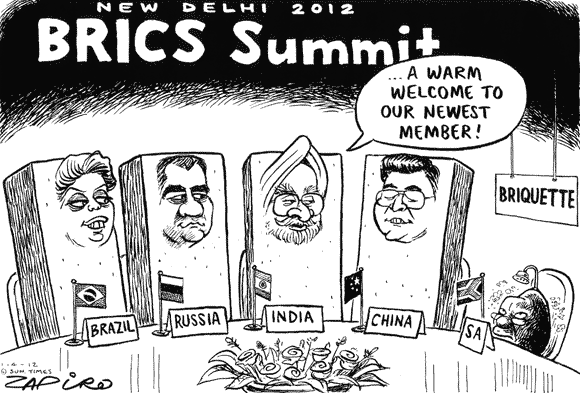
South Africa, moreover, has joined the relatively new economic and political grouping Brics (Brazil, Russia, India, China and now South Africa), preferring to align itself with emergent powers rather what are seen as declining established powers in the West.
“Let me state categorically that our foreign policy is independent and decisions are informed by the national interest,” Mr. Zuma said Thursday in a foreign policy address. “We look at what is of benefit to the South African people, and what will advance our domestic priorities at that given time. We are not dictated to by other countries, individuals or lobby group interests within our own country.”
But, for a land that cast itself as moral beacon against tyranny, South Africa has adopted a particular prism for its foreign policy, blending its debts to those who supported it in the liberation struggle, a suspicion of Western influence and a hard-nosed pragmatism. “It must be noted that there is a way that the way in which the A.N.C. regime resembles the one it succeeded, by deciding to take sides with the oppressor, in this case China,” Dr. R. Simangaliso Kumalo, the head of the School of Religion and Theology at the University of KwaZulu-Natal, listing a catalog of occasions when Pretoria seemed to side with dictators like President Robert G. Mugabe in Zimbabwe or Col. Muammar el-Qaddafi in Libya.
As Libyans rose up against Colonel Qaddafi, for instance, South Africa initially supported a U.N. resolution authorizing NATO intervention, but Mr. Zuma later promoted a parallel and unsuccessful African effort to create some kind of compromise, shielding the Libyan strongman in what, to some, looked like payback for generous financial support in the past from Tripoli.
On Thursday, Mr. Zuma complained that the initiative “was not given space to implement its road map and to ensure an African solution to the Libyan question.” South Africa’s foreign policy, he insisted, “is an extension of our domestic policy and our value system.” But others had already come to a different conclusion. “It is clear to me that we do not have a moral foreign policy,” the political analyst Eusebius McKaiser said in a lecture in August, discussing South Africa’s role in the Libya conflict. “There is little indication that our foreign policy is consistently and genuinely informed by a thorough commitment to project our domestic constitutional principles onto the international arena.”
Indeed, those principles — or the threats to them — lie at the center of the debate. Two years after their first free election in 1994, South Africans created a new constitution guaranteeing rights that much of Africa had shunned, ignored or undermined and seeming to lock the land onto the moral coordinates of its struggle for democracy. But the ground has shifted. Corruption and patronage have replaced principle and promised transparency. “Nothing anybody says or does can be taken at face value any longer, because we suspect this can only be explained if one understands what the doer or speaker wants to achieve in terms of his or her factional interest,” said Max du Preez, a journalist and author.
South Africa’s revolution, wrote the author Njabulo S. Ndebele, “may itself have become corrupted by the attractions of instant wealth,” reflecting “a potentially catastrophic collapse in the once cohesive understanding of the post-apartheid project as embodied in our constitution.” The A.N.C., he said, “functions as a state within the state, and it thinks it is the state” — hardly the stuff of an exception, let alone a renaissance.
Source: New York Times
In more recent times, South Africans have come to a different, almost heretical conclusion: under its newest coterie of the powerful around President Jacob Zuma, their land has lost its claim to the moral high ground. Rarely has that conclusion been expressed more forcefully than in recent days when Archbishop Desmond M. Tutu, a Nobel Peace laureate once at the forefront of the fight against apartheid, issued his sharpest yet denunciation of the government, comparing it pejoratively with its apartheid predecessor.
“Mr. Zuma, you and your government don’t represent me,” he told a news conference, protesting the authorities’ failure to issue a visa to the Dalai Lama, the exiled Tibetan religious leader, whom the archbishop had invited to his 80th birthday party. “You represent your own interests. I am warning you out of love, one day we will start praying for the defeat of the A.N.C. government,” he said, referring by its initials to the governing African National Congress, which casts itself as the custodian of the nation’s moral aspirations as much as the core its political legitimacy.
The archbishop’s remarks provoked some sharp reactions. “In the scheme of things, who is Bishop Tutu? A prelate who was won honors because he raised his voice against apartheid? Who did not?” said Thula Bopela, a veteran of the A.N.C.’s military struggle against apartheid. But the exchange reflected a more insidious malaise. The authorities’ delay in issuing a visa for the Dalai Lama, which forced him to cancel the birthday visit, was broadly interpreted as a genuflection to the power of China, South Africa’s biggest trading partner, with whom it struck a $2.5 billion investment deal even as the Dalai Lama’s visa application was — in theory at least — under consideration.
South Africa, moreover, has joined the relatively new economic and political grouping Brics (Brazil, Russia, India, China and now South Africa), preferring to align itself with emergent powers rather what are seen as declining established powers in the West.
“Let me state categorically that our foreign policy is independent and decisions are informed by the national interest,” Mr. Zuma said Thursday in a foreign policy address. “We look at what is of benefit to the South African people, and what will advance our domestic priorities at that given time. We are not dictated to by other countries, individuals or lobby group interests within our own country.”
But, for a land that cast itself as moral beacon against tyranny, South Africa has adopted a particular prism for its foreign policy, blending its debts to those who supported it in the liberation struggle, a suspicion of Western influence and a hard-nosed pragmatism. “It must be noted that there is a way that the way in which the A.N.C. regime resembles the one it succeeded, by deciding to take sides with the oppressor, in this case China,” Dr. R. Simangaliso Kumalo, the head of the School of Religion and Theology at the University of KwaZulu-Natal, listing a catalog of occasions when Pretoria seemed to side with dictators like President Robert G. Mugabe in Zimbabwe or Col. Muammar el-Qaddafi in Libya.
As Libyans rose up against Colonel Qaddafi, for instance, South Africa initially supported a U.N. resolution authorizing NATO intervention, but Mr. Zuma later promoted a parallel and unsuccessful African effort to create some kind of compromise, shielding the Libyan strongman in what, to some, looked like payback for generous financial support in the past from Tripoli.
On Thursday, Mr. Zuma complained that the initiative “was not given space to implement its road map and to ensure an African solution to the Libyan question.” South Africa’s foreign policy, he insisted, “is an extension of our domestic policy and our value system.” But others had already come to a different conclusion. “It is clear to me that we do not have a moral foreign policy,” the political analyst Eusebius McKaiser said in a lecture in August, discussing South Africa’s role in the Libya conflict. “There is little indication that our foreign policy is consistently and genuinely informed by a thorough commitment to project our domestic constitutional principles onto the international arena.”
Indeed, those principles — or the threats to them — lie at the center of the debate. Two years after their first free election in 1994, South Africans created a new constitution guaranteeing rights that much of Africa had shunned, ignored or undermined and seeming to lock the land onto the moral coordinates of its struggle for democracy. But the ground has shifted. Corruption and patronage have replaced principle and promised transparency. “Nothing anybody says or does can be taken at face value any longer, because we suspect this can only be explained if one understands what the doer or speaker wants to achieve in terms of his or her factional interest,” said Max du Preez, a journalist and author.
South Africa’s revolution, wrote the author Njabulo S. Ndebele, “may itself have become corrupted by the attractions of instant wealth,” reflecting “a potentially catastrophic collapse in the once cohesive understanding of the post-apartheid project as embodied in our constitution.” The A.N.C., he said, “functions as a state within the state, and it thinks it is the state” — hardly the stuff of an exception, let alone a renaissance.
Source: New York Times
Wednesday, April 20, 2011
South Africa Exults Abroad but Frets at Home
With the country preparing for local elections on May 18, the cabinet member Mr. Zuma chose to oversee local government, Sicelo Shiceka, is now embroiled in scandalous reports about his profligate living at public expense. Mr. Zuma announced Sunday that he was awaiting an explanation from Mr. Shiceka that has yet to come. “It’s this flaunting of inequality and conspicuous consumption that people get agitated about,” said Ben Roberts, a researcher at the Human Sciences Research Council, which recently conducted a survey of South Africans documenting widespread disillusionment with local government.
Parliamentary leaders of Mr. Zuma’s party, the African National Congress, have asked for independent investigators in the public protector’s office to find out whether Mr. Shiceka spent more than $50,000 of taxpayers’ money to fly to Switzerland and stay in five-star hotels while visiting his girlfriend, a flight attendant, who was jailed there on drug charges, as The Sunday Times of South Africa reported.
In a follow-up article on Sunday, the newspaper reported that municipal trucks were delivering water to the building site of Mr. Shiceka’s new home in the poorest district in the Eastern Cape. His home was also slated to be among the first to get electricity. “What a disgrace!” shouted the headline. “Minister builds emperor’s palace in South Africa’s poorest village.”
Corruption and great disparities in wealth are hardly uncommon among the other BRICS countries. But the lack of basic services has touched a particular nerve here. People in Mr. Shiceka’s home district had been protesting the poor quality of water and sewerage services. And it was precisely these issues that led poor people in Ficksburg, a town in the Free State, to take to the streets last week in a protest that ended in tragedy. SABC, the state broadcaster, showed police officers in Ficksburg assaulting an unarmed, shirtless protester named Andries Tatane, 33, and thwacking his torso with batons. Mr. Tatane then looked down at his chest, streaming with blood. A haunting photograph shows him lying wounded in the arms of a friend whose face is contorted in anguish. Mr. Tatane died minutes later. “The post-mortem showed he died of gunshot wounds,” said Moses Dlamini, spokesman for the Independent Complaints Directorate, which investigates police brutality. “And he had bruises which indicated he was assaulted.” Two police officers have been charged with the murder and four others with assault, but not before enraged residents of Mr. Tatane’s township set fire to two government buildings.
An African National Congress spokesman, Jackson Mthembu, described the attack on Mr. Tatane as reminiscent of “apartheid-era strong-arm tactics” — a remarkable statement considering that the A.N.C. itself led the struggle against apartheid and has governed the country, and overseen its police force, since 1994.
The so-called service delivery protests, a phenomenon across the country, provide signs of the simmering discontent among many South Africans about how long it is taking to translate the gains of freedom into material progress. Even as South Africa takes center stage with the world’s most prominent developing nations, a majority of young black South Africans are jobless. Poverty remains widespread. A nationwide survey of about 3,200 South Africans age 16 and older, sponsored by the country’s Independent Electoral Commission, found that South Africans were most dissatisfied with local government performance on job creation, crime and housing.
The survey, released last week, documented an erosion of trust at all levels of government, with the lowest approval level — 38 percent — reserved for local government, down from a high of 55 percent in 2004. Politicians rated even lower. Only 27 percent of South Africans trusted them when the survey was conducted in the final months of 2010. The main opposition party, the Democratic Alliance — widely perceived as dominated by whites — has sought to attract more black support by highlighting its strong record in running the city of Cape Town. Helen Zille, the former journalist who leads the party, has seized on the killing of Mr. Tatane as emblematic of how the A.N.C. has “become disconnected from the people it is supposed to serve.”
But the loyalty of voters to the A.N.C., the party of Nelson Mandela, remains deep, and the survey found that those who were most unhappy with government were also the ones who said they were least likely to vote. So the question of whether discontent leads to change in the ballot box remains open.
Source: New York Times
Libya and the BRICS: Currency Wars, Imperial Wars and Popular Uprisings
On one side of the world NATO bombs Libya and on the other, the newly expanded BRICS (Brazil, Russia, India, China and South Africa) meet on the island of Hainan, off the south coast of China. Two seemingly unrelated events. But there are links and forces at play fuelling important new power contestations in the world.
Western bombs are raining down on Libya and a “no-fly zone” is being imposed after a United Nations (UN) Security Council resolution. At the UN, BRICS members, China and Brazil, abstained from voting (although South Africa voted for) but publicly criticised the idea of bombing Gaddafi’s forces.
The US is in decline as the power able to exert its authority over world affairs. At the same time we are seeing the rise of China – predicted to be the world’s largest economy within 10 to 20 years – having imperial ambitions, but racked with many internal contradictions. China is the single biggest holder of the US’ debt, in the form of federal bonds. Its rise is offset by its dependence on the US for its exports and on US companies that are its biggest foreign investors. Moreover, holding dollar-denominated US treasury bonds also means that China can't simply watch the dollar decline or risk a US bond default.
So China and the US are like two adversaries manacled together, taking wild pot shots at each other, but unable to strike the decisive blow. For some while now the US has been attacking the Chinese for what it calls a form of protectionism by keeping its currency, the Renminbi, allegedly, artificially low.
The November 2010 meeting of the G20 countries in Seoul was supposed to be an attempt at resolving the currency wars between the US and China. But in the midst of the G20 diplomacy and fine rhetoric about solving trade imbalances, the US decided to indulge in another round of quantitative easing – to the tune of US$600b – essentially a form of printing money by buying back bonds from private banks and then crediting their balance sheets with money.
If any other country were to print money in this way the consequences would be devastating in terms of inflation and the collapse of the currency in world markets. But the US’ currency is the world’s currency, so it doesn’t incur inflation, nor does anyone dump dollars because global trade is conducted in dollars. So the US can get away with it.
This certainly raised the hackles, not only of China, but also of Brazil, Russia, India and South Africa, who are all consequently attracting hot money from low US interest rates and quantitative easing, which overvalues their currencies and makes their exports more expensive.
At the BRICS meeting, President Zuma joined his counterparts in calling for greater independence from the dollar.
The BRICS meeting echoed comments made by the governor of the Chinese Central Bank in 2009, in the midst of the global financial crisis, that the dollar’s role, as the global reserve currency and medium of international trade was placing the world at risk, given the scale of the US’ debt and the fact that the crisis was centred on the US.
This is no mere arcane technical spat between economists. This is about economic clout and the political power that comes with having one’s currency both the global reserve currency and the medium of global exchange. The fight over the dollar is also a fight over who is to be the main political force in the 21st century, and who is the fulcrum around which all foreign policy matters of nation states will turn -- with all the implications for domestic issues.
So the currency wars have direct meaning for what our lives will be like in the next while.
Meanwhile the world’s attention is focussed on the Libyan crisis and the evil perpetrated by Muammar Gaddafi. Having armed Gaddafi, invested in his oil fields and welcomed him back into the fold of the “international community,” the US, Britain and France, are now arming his adversaries and bombing his air force in the name of a “humanitarian mission.”
All of this while there are people’s uprisings against dictators throughout North Africa and the Arab world in Yemen, Algeria, Syria and Bahrain (and, of course, the successful insurrections in Tunisia and Egypt).
So why are the US, Britain and France now supporting what they call “pro-democracy groups” in Libya, while taking the opposite stance in Bahrain and Yemen by arming the dictator’s forces, which are killing the pro-democracy forces in those countries?
And why did the BRICS countries take a different view on Libya to that of the West?
Maybe there is an additional explanation to the theory that this is about Libya’s oil. There appears to be a currency war at stake here as well.
Recently, US financial journalists, speaking to their investor community, have begun highlighting some little-reported developments in Libya. Several writers have noted the odd fact that the Libyan rebels took time out from their rebellion in March to create their own central bank. This before they even had a government.
Robert Wenzel wrote in the Economic Policy Journal, “I have never before heard of a central bank being created in just a matter of weeks out of a popular uprising. This suggests we have a bit more than a rag tag bunch of rebels running around and that there are some pretty sophisticated influences.”
In a statement, the Libyan rebels reported on the results of a meeting held on March 19. Among other things, the supposed “pro-democracy forces” announced the "designation of the Central Bank of Benghazi as a monetary authority competent in monetary policies in Libya and appointment of a Governor to the Central Bank of Libya, with a temporary headquarters in Benghazi."
US senior financial editor, John Carney, has asked, "Is this the first time a revolutionary group has created a central bank while it is still in the midst of fighting the entrenched political power? It certainly seems to indicate how extraordinarily powerful central bankers have become in our era."
Clearly there is something different about Libya.
Earlier in the twentieth century Libya was a colony of Italy. But Italy was a losing power in World War II and ceded power to Britain. Unlike Italian colonialism, Britain was happy to exercise power indirectly through a Libyan king -- King Idris, who ruled from 1949.
However, a wave of nationalism spread after World War II and Gamal Nasser and army officers seized power in Egypt in 1952 proclaiming themselves nationalists and Arab socialists. The region became notable for the clash between Arab nationalism and imperialist interests in the centre of the world’s oil reserves. So when a Libyan army officer – Muammar Gaddafi – seized power from King Idris in 1969 and proclaimed his movement as Arab socialist and pan-Africanist, he was immediately declared the enemy of the West.
Gaddafi, in return, ruled Libya through the army and through a system of alliances with tribal lords. Internationally, he manoeuvred to play competing imperial interests off against one another.
Inside Libya he combined the suppression of the people with claiming that he was merely a “brother leader” using the growing oil revenue to strengthen the Libyan army and establish a high standard of living for the Libyan middle classes. As a result, Libya has the highest human development index (HDI) in Africa and the fourth highest GDP per capita. Libya also has the 10th-largest oil reserves of any country in the world and the 17th-highest petroleum production.
And critically for current events, Gaddafi also set up a Libyan Central Bank that was 100% state-owned. That in itself was not so unusual, but what is unique amongst the major oil producers is the fact that the Libyan Central Bank is not a member of the Bank for International Settlements (BIS) (the BIS is the international clearing house for global trade and conducts its transactions in dollars).
As a result, the Libyan government, up to now, could create its own money, the Libyan Dinar, through the facilities of its own central bank and insist that trade in oil must take place in its national currency (and not in dollars, as is the case with all the other major oil producers).
This has placed Libya in the same advantageous position as the US, who, as custodian of the global currency of trade, the dollar, can merely print money to expand its trade capacity without, as in the case of Zimbabwe, incurring disastrous inflationary consequences. In order to do business with Libya, banking cartels, oil barons and so on, have had to go through the Libyan Central Bank and its national currency.
So Gaddafi’s Libya was indeed special -- a small player, but suddenly a significant player given the global power plays over the dollar, as the world’s reserve currency and medium of exchange.
In the new Libya being crafted, the “pro-democracy forces” in Eastern Libya around Benghazi are being pulled into the West’s economic orbit in the currency wars, to the trepidation of China and her allies. This is an additional reason why the BRICS countries have been so critical of the West’s latest military adventure.
In this, South Africa’s precariousness in the imperial wars – with its BRICS allies in raging against the dollar, yet voting with the US to bomb Libya, heading an AU delegation to seek peace with Gaddafi and then being brushed aside by NATO – is so apparent.
But how did the initial stirrings of a people’s movement in Libya become something else?
When the Arab uprisings began in Tunisia and spread throughout North Africa and the Middle East many people in Libya also became inspired to confront Gaddafi’s tyranny. They gathered in the main square in Tripoli – the Green Square – defied Gaddafi, and called for democracy. From Tripoli the mood spread out to the South and East of the country.
But other forces were at play…Tribal leaders reading the shifting currents in the region and seeking to position themselves accordingly, old King Idris loyalists seeking to bring back the monarchy, and some of Gaddafi’s own lieutenants trying to guarantee their future careers by jumping ship to the West. Some of these began waving the old Kingdom of Libya flags.
All these forces have completely swamped the original movement, which began in Tripoli and today the “pro-democracy forces” are clearly these, rather than the original Libyan uprising. Tripoli is no longer a centre of rebellion and the whole thing has degenerated into a civil war where one side is being backed by Western special forces, NATO air strikes and arms supplied by whomsoever wants to swing events their way.
And what has been the priority of these forces?
To get the oil terminals at Benghazi to flow and to get a new Central Bank of Libya up and running.
Before the conflict has even ended, the Benghazi-based Transitional National Council (TNC), led by Mustafa Abdul Jalil, an ex-finance minister of Gaddafi, has already met with Sarkozy in France and attended the London meeting on Libya convened by Britain’s David Cameron. At the meeting, the TNC promised to respect all international treaties, including Libya joining the BIS, and guarantying private sector investment.
It is these anti-democracy opportunists who are calling for NATO air strikes and seeking the blessing of the West before the Libyan people can decide for themselves.
Libya is providing an opportunity for imperialism to both crush an old enemy and co-opt the Arab uprising, turning calls for independence, freedom and democracy into calls for independence for central banks, greater free markets and imperial domination.
But the world has changed. The Arab uprisings are themselves a sign that there are weak links in the imperialist chain.
The current capitalist crisis is of such proportions that the space to finance a major war, commit troops to occupation and administer such an occupation is severely limited. The US is already carrying the can for occupations in Iraq and Afghanistan and is simply incapable of sustaining another one at the time of its biggest debt. This is why Obama wants a UN/NATO coalition to share the political and economic cost of the war on Libya. And even within NATO, member country, Turkey, has its own domestic reasons for not wanting to be part of an attack on a Muslim country.
What is being played out are contestations within imperialism – largely between China and the US - on the one hand, and a new tide of popular rebellion against domination – a tide that began in Latin America over the last 10 years, but which has now exploded across North Africa and the Middle East - on the other. The key is the strength of the people on the ground in Yemen, Syria and even Saudi Arabia, but above all, in Tunisia and Egypt, where they are still directly engaged in determining the outcome of events.
Our world will be shaped by which social forces prove triumphant over the next few years.
Western bombs are raining down on Libya and a “no-fly zone” is being imposed after a United Nations (UN) Security Council resolution. At the UN, BRICS members, China and Brazil, abstained from voting (although South Africa voted for) but publicly criticised the idea of bombing Gaddafi’s forces.
The US is in decline as the power able to exert its authority over world affairs. At the same time we are seeing the rise of China – predicted to be the world’s largest economy within 10 to 20 years – having imperial ambitions, but racked with many internal contradictions. China is the single biggest holder of the US’ debt, in the form of federal bonds. Its rise is offset by its dependence on the US for its exports and on US companies that are its biggest foreign investors. Moreover, holding dollar-denominated US treasury bonds also means that China can't simply watch the dollar decline or risk a US bond default.
So China and the US are like two adversaries manacled together, taking wild pot shots at each other, but unable to strike the decisive blow. For some while now the US has been attacking the Chinese for what it calls a form of protectionism by keeping its currency, the Renminbi, allegedly, artificially low.
The November 2010 meeting of the G20 countries in Seoul was supposed to be an attempt at resolving the currency wars between the US and China. But in the midst of the G20 diplomacy and fine rhetoric about solving trade imbalances, the US decided to indulge in another round of quantitative easing – to the tune of US$600b – essentially a form of printing money by buying back bonds from private banks and then crediting their balance sheets with money.
If any other country were to print money in this way the consequences would be devastating in terms of inflation and the collapse of the currency in world markets. But the US’ currency is the world’s currency, so it doesn’t incur inflation, nor does anyone dump dollars because global trade is conducted in dollars. So the US can get away with it.
This certainly raised the hackles, not only of China, but also of Brazil, Russia, India and South Africa, who are all consequently attracting hot money from low US interest rates and quantitative easing, which overvalues their currencies and makes their exports more expensive.
At the BRICS meeting, President Zuma joined his counterparts in calling for greater independence from the dollar.
The BRICS meeting echoed comments made by the governor of the Chinese Central Bank in 2009, in the midst of the global financial crisis, that the dollar’s role, as the global reserve currency and medium of international trade was placing the world at risk, given the scale of the US’ debt and the fact that the crisis was centred on the US.
This is no mere arcane technical spat between economists. This is about economic clout and the political power that comes with having one’s currency both the global reserve currency and the medium of global exchange. The fight over the dollar is also a fight over who is to be the main political force in the 21st century, and who is the fulcrum around which all foreign policy matters of nation states will turn -- with all the implications for domestic issues.
So the currency wars have direct meaning for what our lives will be like in the next while.
Meanwhile the world’s attention is focussed on the Libyan crisis and the evil perpetrated by Muammar Gaddafi. Having armed Gaddafi, invested in his oil fields and welcomed him back into the fold of the “international community,” the US, Britain and France, are now arming his adversaries and bombing his air force in the name of a “humanitarian mission.”
All of this while there are people’s uprisings against dictators throughout North Africa and the Arab world in Yemen, Algeria, Syria and Bahrain (and, of course, the successful insurrections in Tunisia and Egypt).
So why are the US, Britain and France now supporting what they call “pro-democracy groups” in Libya, while taking the opposite stance in Bahrain and Yemen by arming the dictator’s forces, which are killing the pro-democracy forces in those countries?
And why did the BRICS countries take a different view on Libya to that of the West?
Maybe there is an additional explanation to the theory that this is about Libya’s oil. There appears to be a currency war at stake here as well.
Recently, US financial journalists, speaking to their investor community, have begun highlighting some little-reported developments in Libya. Several writers have noted the odd fact that the Libyan rebels took time out from their rebellion in March to create their own central bank. This before they even had a government.
Robert Wenzel wrote in the Economic Policy Journal, “I have never before heard of a central bank being created in just a matter of weeks out of a popular uprising. This suggests we have a bit more than a rag tag bunch of rebels running around and that there are some pretty sophisticated influences.”
In a statement, the Libyan rebels reported on the results of a meeting held on March 19. Among other things, the supposed “pro-democracy forces” announced the "designation of the Central Bank of Benghazi as a monetary authority competent in monetary policies in Libya and appointment of a Governor to the Central Bank of Libya, with a temporary headquarters in Benghazi."
US senior financial editor, John Carney, has asked, "Is this the first time a revolutionary group has created a central bank while it is still in the midst of fighting the entrenched political power? It certainly seems to indicate how extraordinarily powerful central bankers have become in our era."
Clearly there is something different about Libya.
Earlier in the twentieth century Libya was a colony of Italy. But Italy was a losing power in World War II and ceded power to Britain. Unlike Italian colonialism, Britain was happy to exercise power indirectly through a Libyan king -- King Idris, who ruled from 1949.
However, a wave of nationalism spread after World War II and Gamal Nasser and army officers seized power in Egypt in 1952 proclaiming themselves nationalists and Arab socialists. The region became notable for the clash between Arab nationalism and imperialist interests in the centre of the world’s oil reserves. So when a Libyan army officer – Muammar Gaddafi – seized power from King Idris in 1969 and proclaimed his movement as Arab socialist and pan-Africanist, he was immediately declared the enemy of the West.
Gaddafi, in return, ruled Libya through the army and through a system of alliances with tribal lords. Internationally, he manoeuvred to play competing imperial interests off against one another.
Inside Libya he combined the suppression of the people with claiming that he was merely a “brother leader” using the growing oil revenue to strengthen the Libyan army and establish a high standard of living for the Libyan middle classes. As a result, Libya has the highest human development index (HDI) in Africa and the fourth highest GDP per capita. Libya also has the 10th-largest oil reserves of any country in the world and the 17th-highest petroleum production.
And critically for current events, Gaddafi also set up a Libyan Central Bank that was 100% state-owned. That in itself was not so unusual, but what is unique amongst the major oil producers is the fact that the Libyan Central Bank is not a member of the Bank for International Settlements (BIS) (the BIS is the international clearing house for global trade and conducts its transactions in dollars).
As a result, the Libyan government, up to now, could create its own money, the Libyan Dinar, through the facilities of its own central bank and insist that trade in oil must take place in its national currency (and not in dollars, as is the case with all the other major oil producers).
This has placed Libya in the same advantageous position as the US, who, as custodian of the global currency of trade, the dollar, can merely print money to expand its trade capacity without, as in the case of Zimbabwe, incurring disastrous inflationary consequences. In order to do business with Libya, banking cartels, oil barons and so on, have had to go through the Libyan Central Bank and its national currency.
So Gaddafi’s Libya was indeed special -- a small player, but suddenly a significant player given the global power plays over the dollar, as the world’s reserve currency and medium of exchange.
In the new Libya being crafted, the “pro-democracy forces” in Eastern Libya around Benghazi are being pulled into the West’s economic orbit in the currency wars, to the trepidation of China and her allies. This is an additional reason why the BRICS countries have been so critical of the West’s latest military adventure.
In this, South Africa’s precariousness in the imperial wars – with its BRICS allies in raging against the dollar, yet voting with the US to bomb Libya, heading an AU delegation to seek peace with Gaddafi and then being brushed aside by NATO – is so apparent.
But how did the initial stirrings of a people’s movement in Libya become something else?
When the Arab uprisings began in Tunisia and spread throughout North Africa and the Middle East many people in Libya also became inspired to confront Gaddafi’s tyranny. They gathered in the main square in Tripoli – the Green Square – defied Gaddafi, and called for democracy. From Tripoli the mood spread out to the South and East of the country.
But other forces were at play…Tribal leaders reading the shifting currents in the region and seeking to position themselves accordingly, old King Idris loyalists seeking to bring back the monarchy, and some of Gaddafi’s own lieutenants trying to guarantee their future careers by jumping ship to the West. Some of these began waving the old Kingdom of Libya flags.
All these forces have completely swamped the original movement, which began in Tripoli and today the “pro-democracy forces” are clearly these, rather than the original Libyan uprising. Tripoli is no longer a centre of rebellion and the whole thing has degenerated into a civil war where one side is being backed by Western special forces, NATO air strikes and arms supplied by whomsoever wants to swing events their way.
And what has been the priority of these forces?
To get the oil terminals at Benghazi to flow and to get a new Central Bank of Libya up and running.
Before the conflict has even ended, the Benghazi-based Transitional National Council (TNC), led by Mustafa Abdul Jalil, an ex-finance minister of Gaddafi, has already met with Sarkozy in France and attended the London meeting on Libya convened by Britain’s David Cameron. At the meeting, the TNC promised to respect all international treaties, including Libya joining the BIS, and guarantying private sector investment.
It is these anti-democracy opportunists who are calling for NATO air strikes and seeking the blessing of the West before the Libyan people can decide for themselves.
Libya is providing an opportunity for imperialism to both crush an old enemy and co-opt the Arab uprising, turning calls for independence, freedom and democracy into calls for independence for central banks, greater free markets and imperial domination.
But the world has changed. The Arab uprisings are themselves a sign that there are weak links in the imperialist chain.
The current capitalist crisis is of such proportions that the space to finance a major war, commit troops to occupation and administer such an occupation is severely limited. The US is already carrying the can for occupations in Iraq and Afghanistan and is simply incapable of sustaining another one at the time of its biggest debt. This is why Obama wants a UN/NATO coalition to share the political and economic cost of the war on Libya. And even within NATO, member country, Turkey, has its own domestic reasons for not wanting to be part of an attack on a Muslim country.
What is being played out are contestations within imperialism – largely between China and the US - on the one hand, and a new tide of popular rebellion against domination – a tide that began in Latin America over the last 10 years, but which has now exploded across North Africa and the Middle East - on the other. The key is the strength of the people on the ground in Yemen, Syria and even Saudi Arabia, but above all, in Tunisia and Egypt, where they are still directly engaged in determining the outcome of events.
Our world will be shaped by which social forces prove triumphant over the next few years.
Read more articles by Leonard Gentle. Director of the International Labour and Research Information Group.
Subscribe to:
Posts (Atom)