To Graça Machel and the Mandela family; to President Zuma and members of the government; to heads of state and government, past and present; distinguished guests – it is a singular honor to be with you today, to celebrate a life unlike any other. To the people of South Africa – people of every race and walk of life – the world thanks you for sharing Nelson Mandela with us. His struggle was your struggle. His triumph was your triumph. Your dignity and hope found expression in his life, and your freedom, your democracy is his cherished legacy.
It is hard to eulogise any man – to capture in words not just the facts and the dates that make a life, but the essential truth of a person – their private joys and sorrows; the quiet moments and unique qualities that illuminate someone’s soul. How much harder to do so for a giant of history, who moved a nation toward justice, and in the process moved billions around the world.
Born during World War I, far from the corridors of power, a boy raised herding cattle and tutored by elders of his Thembu tribe – Madiba would emerge as the last great liberator of the 20th century. Like Gandhi, he would lead a resistance movement – a movement that at its start held little prospect of success. Like King, he would give potent voice to the claims of the oppressed, and the moral necessity of racial justice. He would endure a brutal imprisonment that began in the time of Kennedy and Khrushchev, and reached the final days of the Cold War. Emerging from prison, without force of arms, he would – like Lincoln – hold his country together when it threatened to break apart. Like America's founding fathers, he would erect a constitutional order to preserve freedom for future generations - a commitment to democracy and rule of law ratified not only by his election, but by his willingness to step down from power.
Given the sweep of his life, and the adoration that he so rightly earned, it is tempting then to remember Nelson Mandela as an icon, smiling and serene, detached from the tawdry affairs of lesser men. But Madiba himself strongly resisted such a lifeless portrait. Instead, he insisted on sharing with us his doubts and fears; his miscalculations along with his victories. "I'm not a saint," he said, "unless you think of a saint as a sinner who keeps on trying."
It was precisely because he could admit to imperfection – because he could be so full of good humor, even mischief, despite the heavy burdens he carried - that we loved him so. He was not a bust made of marble; he was a man of flesh and blood – a son and husband, a father and a friend. That is why we learned so much from him; that is why we can learn from him still. For nothing he achieved was inevitable. In the arc of his life, we see a man who earned his place in history through struggle and shrewdness; persistence and faith. He tells us what’s possible not just in the pages of dusty history books, but in our own lives as well.
Mandela showed us the power of action; of taking risks on behalf of our ideals. Perhaps Madiba was right that he inherited, "a proud rebelliousness, a stubborn sense of fairness" from his father. Certainly he shared with millions of black and colored South Africans the anger born of, "a thousand slights, a thousand indignities, a thousand unremembered moments … a desire to fight the system that imprisoned my people."
But like other early giants of the ANC – the Sisulus and Tambos – Madiba disciplined his anger; and channelled his desire to fight into organisation, and platforms, and strategies for action, so men and women could stand-up for their dignity. Moreover, he accepted the consequences of his actions, knowing that standing up to powerful interests and injustice carries a price. "I have fought against white domination and I have fought against black domination," he said at his 1964 trial. "I’ve cherished the ideal of a democratic and free society in which all persons live together in harmony and with equal opportunities. It is an ideal which I hope to live for and to achieve. But if needs be, it is an ideal for which I am prepared to die."
Mandela taught us the power of action, but also ideas; the importance of reason and arguments; the need to study not only those you agree with, but those who you don’t. He understood that ideas cannot be contained by prison walls, or extinguished by a sniper’s bullet. He turned his trial into an indictment of apartheid because of his eloquence and passion, but also his training as an advocate. He used decades in prison to sharpen his arguments, but also to spread his thirst for knowledge to others in the movement. And he learned the language and customs of his oppressor so that one day he might better convey to them how their own freedom depended upon his.
Mandela demonstrated that action and ideas are not enough; no matter how right, they must be chiseled into laws and institutions. He was practical, testing his beliefs against the hard surface of circumstance and history. On core principles he was unyielding, which is why he could rebuff offers of conditional release, reminding the Apartheid regime that, "prisoners cannot enter into contracts." But as he showed in painstaking negotiations to transfer power and draft new laws, he was not afraid to compromise for the sake of a larger goal. And because he was not only a leader of a movement, but a skillful politician, the Constitution that emerged was worthy of this multiracial democracy; true to his vision of laws that protect minority as well as majority rights, and the precious freedoms of every South African.
Finally, Mandela understood the ties that bind the human spirit. There is a word in South Africa – Ubuntu – that describes his greatest gift: his recognition that we are all bound together in ways that can be invisible to the eye; that there is a oneness to humanity; that we achieve ourselves by sharing ourselves with others, and caring for those around us. We can never know how much of this was innate in him, or how much of it was shaped and burnished in a dark, solitary cell. But we remember the gestures, large and small – introducing his jailors as honoured guests at his inauguration; taking the pitch in a Springbok uniform; turning his family’s heartbreak into a call to confront HIV and Aids – that revealed the depth of his empathy and understanding. He not only embodied Ubuntu; he taught millions to find that truth within themselves. It took a man like Madiba to free not just the prisoner, but the jailor as well; to show that you must trust others so that they may trust you; to teach that reconciliation is not a matter of ignoring a cruel past, but a means of confronting it with inclusion, generosity and truth. He changed laws, but also hearts.
For the people of South Africa, for those he inspired around the globe – Madiba’s passing is rightly a time of mourning, and a time to celebrate his heroic life. But I believe it should also prompt in each of us a time for self-reflection. With honesty, regardless of our station or circumstance, we must ask: how well have I applied his lessons in my own life?
It is a question I ask myself – as a man and as a president. We know that like South Africa, the United States had to overcome centuries of racial subjugation. As was true here, it took the sacrifice of countless people – known and unknown – to see the dawn of a new day. Michelle and I are the beneficiaries of that struggle. But in America and South Africa, and countries around the globe, we cannot allow our progress to cloud the fact that our work is not done. The struggles that follow the victory of formal equality and universal franchise may not be as filled with drama and moral clarity as those that came before, but they are no less important. For around the world today, we still see children suffering from hunger, and disease; run-down schools, and few prospects for the future. Around the world today, men and women are still imprisoned for their political beliefs; and are still persecuted for what they look like, or how they worship, or who they love.
We, too, must act on behalf of justice. We, too, must act on behalf of peace. There are too many of us who happily embrace Madiba’s legacy of racial reconciliation, but passionately resist even modest reforms that would challenge chronic poverty and growing inequality. There are too many leaders who claim solidarity with Madiba’s struggle for freedom, but do not tolerate dissent from their own people. And there are too many of us who stand on the sidelines, comfortable in complacency or cynicism when our voices must be heard.
The questions we face today – how to promote equality and justice; to uphold freedom and human rights; to end conflict and sectarian war – do not have easy answers. But there were no easy answers in front of that child in Qunu. Nelson Mandela reminds us that it always seems impossible until it is done. South Africa shows us that is true. South Africa shows us we can change. We can choose to live in a world defined not by our differences, but by our common hopes. We can choose a world defined not by conflict, but by peace and justice and opportunity.
We will never see the likes of Nelson Mandela again. But let me say to the young people of Africa, and young people around the world – you can make his life’s work your own. Over thirty years ago, while still a student, I learned of Mandela and the struggles in this land. It stirred something in me. It woke me up to my responsibilities – to others, and to myself – and set me on an improbable journey that finds me here today. And while I will always fall short of Madiba’s example, he makes me want to be better. He speaks to what is best inside us. After this great liberator is laid to rest; when we have returned to our cities and villages, and rejoined our daily routines, let us search then for his strength – for his largeness of spirit – somewhere inside ourselves. And when the night grows dark, when injustice weighs heavy on our hearts, or our best laid plans seem beyond our reach – think of Madiba, and the words that brought him comfort within the four walls of a cell:
It matters not how strait the gate,
How charged with punishments the scroll,
I am the master of my fate:
I am the captain of my soul.
What a great soul it was. We will miss him deeply. May God bless the memory of Nelson Mandela. May God bless the people of South Africa.
Source: Mail & Guardian
Showing posts with label Nelson Mandela. Show all posts
Showing posts with label Nelson Mandela. Show all posts
Tuesday, December 10, 2013


Friday, January 18, 2013
FNB launches "You can help" campaign
South Africa is rich in values, tradition and culture, a truly wonderful country, and one that is admired around the world. Yet, as South Africans, we sometimes forget what our great nation has achieved and remains capable of achieving. It is in times like these that we need to be reminded of the greatness inside all of us, and what is possible when help is joined to common purpose and courage to necessity.
At 18:57, on 17 January 2013, FNB launched a new brand campaign with a live broadcast to South Africa. The broadcast carried a message from the voices we don't often hear, the children of our great country. A message we believe will inspire the nation.
In September 2012, we undertook what is likely the most current snapshot of the opinions of the youth, their views on our country and the role of help. Help, not in terms of coordinated interventions, but little, everyday help; and the power help has to make a big difference. The survey was completed by HDI Youth Marketeers, an independent research firm.
In assembling these views and opinions, we spoke to over 1300 learners and students (ages 10 to 22) from around the country and from all walks of life. We learnt that today's youth are losing their innocence, not to apartheid, but to the many social ills and tragedies that came after it. One child said, "If I was President for a day, I would make South Africa safe for children, women and teens who are abused." Another 10-year-old boy added the following, "I get scared when people are killing each other."
But though some of what they had to say was hard to hear, we learnt too that our youth carry inside them a fire that burns with hope and positivity. Their sense of identity is astounding, and they have an unprecedented interest in working as a community to improve our society and environment. A 12 year old said, "When we help people, we make them feel like they're somebody". Another child said, "If we help each other, we raise our country". Yet another student, aged 10, said "In the future I want to live in South Africa... I know South Africa is full of crime, but if I didn't live here I don't know who I would be." A 15 year old said, "We help each other because we are one blood, one soul, with a 13 year old saying, "If we don't help each other, who will help us".
"The intention of the campaign is not to talk about ourselves, but rather to be a brand for betterment by providing the youth of our country with a stage to voice what impacts the daily reality of many South Africans through the lens of our brand's core positioning of 'Help', says Bernice Samuels, FNB Chief Marketing Officer.
"FNB is a brand of high ideals and has a long history of leading from the front, not just in terms of product and service innovation, but also in terms of its social focus on building a stronger, unified and values-based nation, referring to our Praise Singer, Anthem, and Dog ads to mention a few" adds Samuels.
The chosen venue for the live advert, Naledi Secondary School, played an integral role in the events of 1976, a time when the youth of South Africa sent a message that could not be ignored, and in doing so, helped change the future of our country.
Jason Levin, Managing Director of HDI Youth Marketeers said; "The survey provided a good overall snapshot of the South African youth opinion and was hugely rewarding as it helped us gain insight into how the youth view South Africa. The research was truly inspiring. It is only through projects like this, that true feelings are clearly reflected."
FNB also created a dynamic online portal to support the campaign and everyone is encouraged to visit the blog site, youcanhelp.co.za to participate in the ongoing national discussion we believe will be triggered by the campaign. The campaign is integrated across all platforms, including TV, OOH, digital (youcanhelp.co.za) and social media on Facebook and Twitter (#littlehelps).
"All of the great things we've done, we've done together by helping each other. Perhaps it's time for us to listen to the voices we seldom hear, the youth of our country, because it is the South Africa we build today that will be the country they will inherit tomorrow," concludes Samuels.
In Nelson Mandela's words, "If there are dreams about a beautiful South Africa, there are also roads that lead to their goal. Two of these roads could be named Goodness and Forgiveness." Let us join hands in helping to build this beautiful South Africa we all dream of.
Issued by FNB, January 18 2013
Source: Politicsweb
At 18:57, on 17 January 2013, FNB launched a new brand campaign with a live broadcast to South Africa. The broadcast carried a message from the voices we don't often hear, the children of our great country. A message we believe will inspire the nation.
In September 2012, we undertook what is likely the most current snapshot of the opinions of the youth, their views on our country and the role of help. Help, not in terms of coordinated interventions, but little, everyday help; and the power help has to make a big difference. The survey was completed by HDI Youth Marketeers, an independent research firm.
In assembling these views and opinions, we spoke to over 1300 learners and students (ages 10 to 22) from around the country and from all walks of life. We learnt that today's youth are losing their innocence, not to apartheid, but to the many social ills and tragedies that came after it. One child said, "If I was President for a day, I would make South Africa safe for children, women and teens who are abused." Another 10-year-old boy added the following, "I get scared when people are killing each other."
But though some of what they had to say was hard to hear, we learnt too that our youth carry inside them a fire that burns with hope and positivity. Their sense of identity is astounding, and they have an unprecedented interest in working as a community to improve our society and environment. A 12 year old said, "When we help people, we make them feel like they're somebody". Another child said, "If we help each other, we raise our country". Yet another student, aged 10, said "In the future I want to live in South Africa... I know South Africa is full of crime, but if I didn't live here I don't know who I would be." A 15 year old said, "We help each other because we are one blood, one soul, with a 13 year old saying, "If we don't help each other, who will help us".
"The intention of the campaign is not to talk about ourselves, but rather to be a brand for betterment by providing the youth of our country with a stage to voice what impacts the daily reality of many South Africans through the lens of our brand's core positioning of 'Help', says Bernice Samuels, FNB Chief Marketing Officer.
"FNB is a brand of high ideals and has a long history of leading from the front, not just in terms of product and service innovation, but also in terms of its social focus on building a stronger, unified and values-based nation, referring to our Praise Singer, Anthem, and Dog ads to mention a few" adds Samuels.
The chosen venue for the live advert, Naledi Secondary School, played an integral role in the events of 1976, a time when the youth of South Africa sent a message that could not be ignored, and in doing so, helped change the future of our country.
Jason Levin, Managing Director of HDI Youth Marketeers said; "The survey provided a good overall snapshot of the South African youth opinion and was hugely rewarding as it helped us gain insight into how the youth view South Africa. The research was truly inspiring. It is only through projects like this, that true feelings are clearly reflected."
FNB also created a dynamic online portal to support the campaign and everyone is encouraged to visit the blog site, youcanhelp.co.za to participate in the ongoing national discussion we believe will be triggered by the campaign. The campaign is integrated across all platforms, including TV, OOH, digital (youcanhelp.co.za) and social media on Facebook and Twitter (#littlehelps).
"All of the great things we've done, we've done together by helping each other. Perhaps it's time for us to listen to the voices we seldom hear, the youth of our country, because it is the South Africa we build today that will be the country they will inherit tomorrow," concludes Samuels.
In Nelson Mandela's words, "If there are dreams about a beautiful South Africa, there are also roads that lead to their goal. Two of these roads could be named Goodness and Forgiveness." Let us join hands in helping to build this beautiful South Africa we all dream of.
Issued by FNB, January 18 2013
Source: Politicsweb
Friday, December 7, 2012
Zuma on nationalisation and working with Ramaphosa
PRESIDENT Jacob Zuma has welcomed the prospect of working with businessman Cyril Ramaphosa as his deputy, saying "it would not be the first time" that he has worked with the man who was once tipped to take over from Nelson Mandela as president of the African National Congress (ANC).
Mr Zuma is set to be re-elected to lead the ANC at the party’s elective congress in Mangaung later this month. However, his current deputy, Kgalema Motlanthe — who has been nominated by three provinces and the youth league for the position of party president — is likely to lose out to Mr Ramaphosa.
Mr Ramaphosa has garnered more than 1,800 nominations for the position of deputy president, while Mr Motlanthe has received about 160 nominations to retain his current position in the party.
In an interview with the UK’s Daily Telegraph published on Thursday, Mr Zuma praised Mr Ramaphosa when asked about the prospect of working with the business tycoon.
"It would not be the first time I worked with Cyril Ramaphosa. When he was the secretary-general, I was his deputy. So it would not be the first time, if he is elected," Mr Zuma told the paper.
He said that he was ready for a second term as president of the ANC.
The party’s elective conference in Mangaung will also be keenly watched by business — with the hope that economic policy will be clarified.
One of the burning issues up for possible debate is that of nationalisation of South Africa’s mines. Mr Zuma told the paper that the party would increase the pace of economic reform but would not "break" existing businesses to do so.
"Nationalisation is not the ANC policy," he said. "There are fundamental issues that need to be dealt with. It would be useful to do it quickly but we’ve got to balance things because we don’t want to break things in order to move forward."
Source: Business Day
Mr Zuma is set to be re-elected to lead the ANC at the party’s elective congress in Mangaung later this month. However, his current deputy, Kgalema Motlanthe — who has been nominated by three provinces and the youth league for the position of party president — is likely to lose out to Mr Ramaphosa.
Mr Ramaphosa has garnered more than 1,800 nominations for the position of deputy president, while Mr Motlanthe has received about 160 nominations to retain his current position in the party.
In an interview with the UK’s Daily Telegraph published on Thursday, Mr Zuma praised Mr Ramaphosa when asked about the prospect of working with the business tycoon.
"It would not be the first time I worked with Cyril Ramaphosa. When he was the secretary-general, I was his deputy. So it would not be the first time, if he is elected," Mr Zuma told the paper.
He said that he was ready for a second term as president of the ANC.
The party’s elective conference in Mangaung will also be keenly watched by business — with the hope that economic policy will be clarified.
One of the burning issues up for possible debate is that of nationalisation of South Africa’s mines. Mr Zuma told the paper that the party would increase the pace of economic reform but would not "break" existing businesses to do so.
"Nationalisation is not the ANC policy," he said. "There are fundamental issues that need to be dealt with. It would be useful to do it quickly but we’ve got to balance things because we don’t want to break things in order to move forward."
Source: Business Day
Sunday, August 26, 2012
South Africa: Political Elites
Although change was evident at all levels of society as South Africa began to dismantle apartheid during the 1990s, particularly dramatic changes were occurring in the country's political and social leadership. Not only were new leaders emerging on the national level, but shifts were also occurring within political organizations, as new political expectations and aspirations arose and as new demands were placed on political leaders at all levels.
Since 1948 the country's governing class, the political elite, had been dominated by Afrikaners. Afrikaners held most high positions in government, including the legislature, the judiciary, the cabinet, and the senior ranks of the military and security services. Afrikaners also came to dominate the larger community of leaders, the power elite, by assuming important roles in the civil service bureaucracy, and to a lesser extent in business, the universities, and the media. Afrikaner dominance was reinforced by the rules of apartheid, in large part because the government's security and intelligence services helped to enforce the rules of apartheid through other institutions.
In general, during the apartheid era, English-speaking whites were less important in the political and power elites. They played only secondary roles in most areas of government. English speakers were, nevertheless, prominent in commerce and industry, where the Afrikaners' success had lagged behind their political achievements, as is explained by Thompson and Prior. By the 1980s, English-speaking whites also held important positions in universities and the media, and in a few areas of government.
In the early 1990s, these political and power elites were evolving, as is demonstrated in the authoritative survey of elites, Who's Who in South African Politics, by the South African writer Shelagh Gastrow. Gastrow divided South Africa's dominant political leaders into four major categories: political leaders within the Afrikaner community, most associated with the NP; an older generation of black opposition leaders, most within the ANC; a younger generation of leaders emerging from the Black Consciousness Movement; and a new group of labor leaders who had risen to prominence as the trade union movement strengthened during the 1970s and 1980s. A fifth category might be added--according to South African political scientist Roger Southall, who reviewed Gastrow's book--the small number of white political leaders who attempted to reshape white politics along nonracial, democratic lines.
A subsequent revised edition of Gastrow's book identified 118 individuals--110 men and only eight women--as constituting South Africa's evolving political elite in 1992. Among the obvious changes occurring at that time was the emergence of formerly imprisoned, exiled, or banned opposition leaders, who had been released from prison or had been legally recognized since early 1990. They could then be legally quoted in the country's media, and their ideas were being widely disseminated. In addition, new challengers arose to replace formerly entrenched leaders, especially conservative blacks, coloureds, and Indians who had gained office through various forms of state patronage in the black homelands or in other institutions of government.
Changes were also occurring within the senior ranks of the organizations from which the country's new leaders had emerged. As the ANC, for example, was forced to cooperate with former opponents, especially the NP, in pursuing national goals, new alliances and friendships were formed, shaped in part by a pragmatic appraisal of the political realities of the time. In addition, former opposition groups--especially the ANC--began to revise their rhetoric from that of guerrilla opponents of government, or "states in exile," to adapt to their new positions of responsibility. The ANC's best educated, skilled technocrats, capable of managing governmental and other bureaucracies, were gaining particular prominence.
At the same time, a greater distance was developing between these educated elites and the less educated rank-and-file within their own organizations. In particular, there was a growing distance between the ANC and its radical youth wing in late 1994 and 1995. There was also a growing distance between the ANC leadership and their former ally, the South African Communist Party (SACP). Ties between these two organizations had not only been close in the past; their membership and leadership rolls had overlapped.
In some cases, the new elites appeared to have more in common with members of rival political organizations than with their organization's own members. Several new government leaders, for example, were drawn from traditional African elites--royal families, chiefs, and influential clans. President Mandela, while a university-trained lawyer, is also a descendant of a leading family among the Thembu (Tembu), a Xhosa subgroup. Like Mandela, the prominent Zulu leader and minister of home affairs, Mangosuthu (Gatsha) Buthelezi, is university-educated and the product of aristocratic origins. Buthelezi, a member of the Zulu royal family, is also a chief within the Buthelezi sub-group (also, "tribe") of the Zulu.
Other members of South Africa's new government also represent ethnic elites. For example, the minister of public enterprises in 1995, Stella Sigcau, is the daughter of a well-known Pondo paramount chief, Botha Sigcau. Stella Sigcau also had served as chief minister in the Transkei government during the early 1980s.
Many former ANC officials who were in government office in the mid-1990s had worked to overcome factional differences based on ethnicity during the apartheid era. Although the ANC is often stereotyped as "Xhosa-dominated," and a number of its officers are Xhosa, several ethnic groups have been represented in the ANC's senior ranks. Thomas Nkobi, treasurer general from 1973 through the early 1990s, represents a subgroup within the Zimbabwe-based Shona people. Former Secretary General Cyril Ramaphosa and National Working Committee member Sydney Mufamadi are Venda (VaVenda--see Ethnic Groups and Language, ch. 2). Ramaphosa's former deputy, Jacob Zuma, is one of several Zulu leaders who rose to prominence within the ANC. The ANC's former security and intelligence specialist, Patrick "Terror" Lekota, and former MK leader Joe Modise are Sotho (BaSotho). Several popular regional leaders are Tswana (BaTswana). In general, these leaders have rejected arguments that favored the use of ethnicity to define political factions.
Age differences appeared more divisive than ethnicity within the ANC during the early and the mid-1990s. There were heated debates over questions of political succession, as the ANC's aging leaders--many over the age of seventy--faced challenges from the generations below them. Nelson Mandela was seventy-five years old when he was elected president in 1994, and several other ANC leaders were more than seventy years of age. Their most likely successors--especially Mbeki, Ramaphosa, Zuma, and the ANC's former director of intelligence, "Mac" Maharaj--were roughly two decades younger. Some of the ANC's younger militants threatened revolt against senior party figures in the early months of the new government, as their demands for jobs, homes, and improved living standards continued to be unmet. Criticism of the "older generation" was fueled in late 1994 and early 1995, when the president's former wife, Winnie Mandela, clashed with the government and was ousted as a deputy minister, as she championed the grievances of the ANC's militant youth.
As the apartheid system was being dismantled, some members of the Afrikaner elite in government, the civil service, and the security services reacted with impressive flexibility. By adapting quickly to the new environment, many of them not only retained their valued positions in the bureaucracy but also won new respect from former adversaries. As the ANC assumed responsibility for the security establishment, the police, and the intelligence services, ANC leaders were often able to work closely and cooperatively with Afrikaners who had once been so effective in excluding blacks from the political process.
The shift in power and influence among the country's political elites had begun well before the April 1994 elections. An important arena in which this power shift occurred was that of the political negotiations concerning the interim constitution of 1993. During those negotiations, as difficult and unpromising as they sometimes appeared, then-governing whites began, some for the first time, to view their black counterparts as legitimate partners in the decision-making process. At the same time, many black leaders adjusted smoothly to the new climate of political tolerance.
More about the Government of South Africa.
Source: U.S. Library of Congress
Since 1948 the country's governing class, the political elite, had been dominated by Afrikaners. Afrikaners held most high positions in government, including the legislature, the judiciary, the cabinet, and the senior ranks of the military and security services. Afrikaners also came to dominate the larger community of leaders, the power elite, by assuming important roles in the civil service bureaucracy, and to a lesser extent in business, the universities, and the media. Afrikaner dominance was reinforced by the rules of apartheid, in large part because the government's security and intelligence services helped to enforce the rules of apartheid through other institutions.
In general, during the apartheid era, English-speaking whites were less important in the political and power elites. They played only secondary roles in most areas of government. English speakers were, nevertheless, prominent in commerce and industry, where the Afrikaners' success had lagged behind their political achievements, as is explained by Thompson and Prior. By the 1980s, English-speaking whites also held important positions in universities and the media, and in a few areas of government.
In the early 1990s, these political and power elites were evolving, as is demonstrated in the authoritative survey of elites, Who's Who in South African Politics, by the South African writer Shelagh Gastrow. Gastrow divided South Africa's dominant political leaders into four major categories: political leaders within the Afrikaner community, most associated with the NP; an older generation of black opposition leaders, most within the ANC; a younger generation of leaders emerging from the Black Consciousness Movement; and a new group of labor leaders who had risen to prominence as the trade union movement strengthened during the 1970s and 1980s. A fifth category might be added--according to South African political scientist Roger Southall, who reviewed Gastrow's book--the small number of white political leaders who attempted to reshape white politics along nonracial, democratic lines.
A subsequent revised edition of Gastrow's book identified 118 individuals--110 men and only eight women--as constituting South Africa's evolving political elite in 1992. Among the obvious changes occurring at that time was the emergence of formerly imprisoned, exiled, or banned opposition leaders, who had been released from prison or had been legally recognized since early 1990. They could then be legally quoted in the country's media, and their ideas were being widely disseminated. In addition, new challengers arose to replace formerly entrenched leaders, especially conservative blacks, coloureds, and Indians who had gained office through various forms of state patronage in the black homelands or in other institutions of government.
Changes were also occurring within the senior ranks of the organizations from which the country's new leaders had emerged. As the ANC, for example, was forced to cooperate with former opponents, especially the NP, in pursuing national goals, new alliances and friendships were formed, shaped in part by a pragmatic appraisal of the political realities of the time. In addition, former opposition groups--especially the ANC--began to revise their rhetoric from that of guerrilla opponents of government, or "states in exile," to adapt to their new positions of responsibility. The ANC's best educated, skilled technocrats, capable of managing governmental and other bureaucracies, were gaining particular prominence.
At the same time, a greater distance was developing between these educated elites and the less educated rank-and-file within their own organizations. In particular, there was a growing distance between the ANC and its radical youth wing in late 1994 and 1995. There was also a growing distance between the ANC leadership and their former ally, the South African Communist Party (SACP). Ties between these two organizations had not only been close in the past; their membership and leadership rolls had overlapped.
In some cases, the new elites appeared to have more in common with members of rival political organizations than with their organization's own members. Several new government leaders, for example, were drawn from traditional African elites--royal families, chiefs, and influential clans. President Mandela, while a university-trained lawyer, is also a descendant of a leading family among the Thembu (Tembu), a Xhosa subgroup. Like Mandela, the prominent Zulu leader and minister of home affairs, Mangosuthu (Gatsha) Buthelezi, is university-educated and the product of aristocratic origins. Buthelezi, a member of the Zulu royal family, is also a chief within the Buthelezi sub-group (also, "tribe") of the Zulu.
Other members of South Africa's new government also represent ethnic elites. For example, the minister of public enterprises in 1995, Stella Sigcau, is the daughter of a well-known Pondo paramount chief, Botha Sigcau. Stella Sigcau also had served as chief minister in the Transkei government during the early 1980s.
Many former ANC officials who were in government office in the mid-1990s had worked to overcome factional differences based on ethnicity during the apartheid era. Although the ANC is often stereotyped as "Xhosa-dominated," and a number of its officers are Xhosa, several ethnic groups have been represented in the ANC's senior ranks. Thomas Nkobi, treasurer general from 1973 through the early 1990s, represents a subgroup within the Zimbabwe-based Shona people. Former Secretary General Cyril Ramaphosa and National Working Committee member Sydney Mufamadi are Venda (VaVenda--see Ethnic Groups and Language, ch. 2). Ramaphosa's former deputy, Jacob Zuma, is one of several Zulu leaders who rose to prominence within the ANC. The ANC's former security and intelligence specialist, Patrick "Terror" Lekota, and former MK leader Joe Modise are Sotho (BaSotho). Several popular regional leaders are Tswana (BaTswana). In general, these leaders have rejected arguments that favored the use of ethnicity to define political factions.
Age differences appeared more divisive than ethnicity within the ANC during the early and the mid-1990s. There were heated debates over questions of political succession, as the ANC's aging leaders--many over the age of seventy--faced challenges from the generations below them. Nelson Mandela was seventy-five years old when he was elected president in 1994, and several other ANC leaders were more than seventy years of age. Their most likely successors--especially Mbeki, Ramaphosa, Zuma, and the ANC's former director of intelligence, "Mac" Maharaj--were roughly two decades younger. Some of the ANC's younger militants threatened revolt against senior party figures in the early months of the new government, as their demands for jobs, homes, and improved living standards continued to be unmet. Criticism of the "older generation" was fueled in late 1994 and early 1995, when the president's former wife, Winnie Mandela, clashed with the government and was ousted as a deputy minister, as she championed the grievances of the ANC's militant youth.
As the apartheid system was being dismantled, some members of the Afrikaner elite in government, the civil service, and the security services reacted with impressive flexibility. By adapting quickly to the new environment, many of them not only retained their valued positions in the bureaucracy but also won new respect from former adversaries. As the ANC assumed responsibility for the security establishment, the police, and the intelligence services, ANC leaders were often able to work closely and cooperatively with Afrikaners who had once been so effective in excluding blacks from the political process.
The shift in power and influence among the country's political elites had begun well before the April 1994 elections. An important arena in which this power shift occurred was that of the political negotiations concerning the interim constitution of 1993. During those negotiations, as difficult and unpromising as they sometimes appeared, then-governing whites began, some for the first time, to view their black counterparts as legitimate partners in the decision-making process. At the same time, many black leaders adjusted smoothly to the new climate of political tolerance.
More about the Government of South Africa.
Source: U.S. Library of Congress
Friday, August 24, 2012
South Africa 1960 – 1994
a) Political, economic and social factors contributing to the end of apartheid
The policy of total strategy or counter-revolution as it became known did not stop the anti-apartheid groups such as the ANC, PAC and UDF (United Democratic Front) from protesting for political and social equality for all races in South Africa. Poverty for blacks continued in the townships and homelands. Unemployment was on the rise due to sanctions, and education and housing were still of a third world standard.
The state of emergency failed to make South Africa safer for whites. Many whites were suffering loss of liberties under the censorship and rigid laws of the military state. Moreover, the ANC in exile continued to attack ‘soft targets’ in South Africa including shopping centres and post offices. Many whites were becoming disillusioned with apartheid and feeling the rejection of their society and culture by the rest of the world. Many Coloureds and Indians were becoming openly defiant of the white state demanding nothing short of full democracy for South Africa.
The United Democratic Front (UDF)
In 1983 a multi-racial party, the United Democratic Front was formed with the aim of uniting all resistance groups in the fight against apartheid. The UDF was highly successful because its members became a uniting force and it had many high profile members, including church leaders such as Archbishop Desmond Tutu. The UDF supporters also include ANC members such as Winnie Mandela. By 1985 the UDF gained over two million members and was a powerful force in demanding the immediate end to apartheid.
The gradual reforms of the Botha government, delivered no real change in South Africa, only cosmetic changes. South Africa could not change and embrace the modern world while apartheid existed. Many white South Africans and politicians began to feel that apartheid was like ‘living on the back of a tiger and they needed to find a way off without being eaten’.1
b) International factors contributing to the end of apartheid
By 1988 the cost of running the military state was staggering and the economic performance of South Africa was poor. Sanctions had driven the economy into recession; ‘sanction busting’ was failing to fix the problem. South Africa was unable to obtain foreign loans or foreign investment. 2
The impact of the Free Mandela Campaign, sporting sanctions, severe international criticism, military and technical equipment embargos and isolation by other African nations in the OAU (Organisation of African Unity) was crippling South Africa. The collapse of the Soviet Union in 1989 removed the Communist threat which underpinned the existence of apartheid since the end of the Second World War. Festering social, political and economic grievances in all sectors of the South African population left the preservation of apartheid completely untenable by the start of 1990s.
c) Problems facing the National Party and the ANC in the transition to democracy in South Africa
In 1984 during townships riots, P.W. Botha declared, ‘I’m giving you a final warning; one man, one vote in this country is out-that is never!”.3 In 1989 after a mild stroke and the failure of Total Strategy, he resigned as President of South Africa. Botha was replaced by F.W.de Klerk.
On 2 February 1990, de Klerk opened Parliament, and in his maiden speech as President began dismantling the apartheid state. He rescinded the ban on the ANC, the PAC, the South African Communist Party and thirty other political organizations. He freed political prisoners and suspended the death sentence. On the 11 of November de Klerk released Nelson Mandela from prison4. South Africa would have one man one vote.
The transition to democracy was a challenging task. Some historians have called it a ‘miracle’. Both the National Party and the ANC struggled to keep South Africa from sliding into civil war in the early 1990s. Meetings were held to lay out South Africa’s new Democracy entitled A Convention for Democratic South Africa (CODESSA). It was in the CODESSA meetings, that the National Party and the ANC debated their differing visions of democracy. CODESSA 1 ended when the ANC walked out of negotiations5. Finally CODESSA II was able to pave the way for a new constitution and a national election.
Problems facing the National Party
- The traditional rulers of South Africa wanted to hold to power as long as possible. They wanted ‘one man, one vote’ to eventuate slowly to protect the white minority.
- Right Wing extremists’ elements including the AWB (Afrikaner Weerstandsbeweging) vowed to prevent free elections and assassinate Nelson Mandela. They also wanted to create an Afrikaner homeland.
- Other white extremists were also letting off bombs and interrupting official democracy meetings such as CODESSA.
Problems facing the ANC
The ANC faced a number of difficulties:
- First in dealing with the National Party and with other anti-apartheid parties, especially Inkatha (a political organisation made up of Zulus from the Natal Province)
- The ANC wanted one person, one vote multiracial democracy immediately, and many of its members were understandably anxious to embrace democracy for the first time.
- In Natal/KwaZulu Province Chief Buthelezi of Inkatha refused to have anything to do with constitutional negotiations and savage violence between ANC members and Inkatha broke out. This included the assassination of Chris Hani, a national hero of the ANC and member of the South Africa Communist Party. Only a prompt appeal to the nation by Mandela averted a massive reaction.
- The ANC seemed to be losing control of its political base. Many feared that extremist whites were supplying Inkatha with weapons and instigating the fighting between rival black political groups, to prevent South Africa’s march towards democracy.
South Africa’s first democratic Election 27th April 1994
South Africans of all races turned out determined to vote in their first non-racial election on the 27th of April 1994. People lined up in long queues which stretched for miles to cast their historic ballot. The ANC won the election and Nelson Mandela, after spending almost three decades in jail, became President of a free South Africa, F.W. de Klerk became the Deputy President.
At his inauguration as President on the vast lawn of the Union Building in Pretoria Mandela said:
‘Never, never and never again shall it be that this beautiful land will again experience the oppression of one by another… The sun will never set on so glorious a human achievement. Let freedom reign. God bless Africa’.6
Source: NSW HSC Online http://hsc.csu.edu.au © NSW Department of Education and Communities, and Charles Sturt University, 2011
Monday, August 20, 2012
South Africa's White Elite: The Dog that Doesn't Bark
Keeping their heads down and operating behind the scenes, South Africa's white business elite have managed to maintain their economic position. When the curtain finally came down on South Africa’s apartheid in 1994, it happened in a way that none of the key players had predicted. Both the African National Congress (ANC) and its opponents in the white supremacist National Party were surprised that they could reach an accommodation through dialogue and negotiation rather than armed force.
In the negotiations that had followed the release of Nelson Mandela and unbanning of the ANC, the parties sealed an unspoken deal. This handed political power to the black majority and left economic power in the hands of whites. There was to be no seizure of white assets, although there were, of course, plans to gradually achieve a more equitable balance of wealth.
Black economic empowerment?
Indeed, there were already plans afoot to bring the leadership of the ANC into the fold. White business magnates had begun to transfer assets into black hands in order to incorporate those at the top of the new political order. The new policy was ‘Black Economic Empowerment’ (BEE). As the commentator Moeletsi Mbeki put it: “BEE was, in fact, invented by South Africa’s economic oligarchs, that handful of white businessmen and their families who control the commanding heights of the country’s economy, that is mining and its associated chemical and engineering industries and finance”.
He pointed out that the policy was adopted well before the ANC came to power. In 1992, Sanlam Limited, a cornerstone of Afrikaner capital, helped create the flagship black empowerment company New African Investments Limited – led by Nthato Motlana, Nelson Mandela’s former doctor. Further deals followed and soon the new BEE elite were well-entrenched.
On the face of it, the policy was a success. A more equitable sharing out of the spoils of economic development came about, creating a new black bourgeoisie. At the same time the ANC abandoned its more radical economic policies allowing rich whites to continue enjoying a very pleasant lifestyle. A considerable proportion of South African assets were transferred to the BEE elite, but even at their height, these transfers were smaller than they appeared. As my colleague Paul Holden points out, the total value of BEE deals were around R250 billion ($30 billion), still a drop in the ocean when compared with the total value of private sector resources of R6 trillion ($700 billion).
Worse still, the BEE transfers were loans, not gifts. The companies had to earn profits and from these profits the loans would be repaid. That was at least the theory. In reality, many of the new black elite had little or no experience of business and a good number of the BEE companies were soon in difficulties. As the government’s own assessment of the problems of BEE rightly put it, this led to contracts being signed by people who lacked the necessary capital: “This has encouraged debt-driven deals that are likely to work only when the economy is growing rapidly and company profitability is expanding significantly”.
Soon the new elite were scrambling around to find a way out. They hit on a plan to nationalise the mines. This would transfer a sizeable chunk of their problems onto the shoulders of the state, which could buy them out at favourable rates. At this point they hit a stumbling block. The ANC’s left-wing allies, the unions of COSATU and the South African Communist Party opposed this solution.
The Communist Party openly attacked those who called for nationalisation. The party declared that it had warned against the use of state finances to bail out the new rich and came out strongly against “diverting billions of Rands of public funds to serve the interests of a narrow black (and white) capitalist stratum”.
Nor was it just a question of “bailing-out debt-ridden BEE capital”, according to the party. They reported that mine union officials had been quietly approached by members of the new black elite, asking for their support. They were told, “Why don’t you support the nationalisation of the mines? If government takes over the mines they will turn to us to run them.” The Communist Party accused the right in the ANC of being seduced by the emerging black capitalist class.
White business
While black business is in a relatively precarious position, their white contemporaries have worked hard to secure their privilege. For a start, they have kept their heads down and operated behind the scenes. Business South Africa, which whites controlled, merged with the Black Business Council in October 2003 to form Business Unity South Africa. Not all black businesses appreciated the change, and some broke away from the new body in 2009. Nonetheless, the white business community had found a convenient new home for their interests. From here they could lobby the ANC government.
Some in white business went further, joining the ANC’s Progressive Business Forum. Its stated purpose is to open direct links with the ruling party. Within a year of its formation, the forum was being portrayed in the press as a means of “buying face-time with cabinet ministers and senior government officials”. The ANC responded briskly that there was “nothing untoward about this”.
Today it is clear that the Progressive Business Forum is a potent means of raising money for the party. A seat at President Zuma’s table at a banquet held in Johannesburg in June 2012 was going for no less than R500,000 ($60,000).
This is not the only way the ANC has raised money from business. An investigation in 2006 by the Institute of Security Studies revealed the existence of a group of companies controlled by a firm called Chancellor House, which quietly accumulated stakes in minerals, energy, engineering, logistics and information technology. This has been a major source of funding for the ruling party and has resulted in inevitable conflicts of interest. “More often than not, these business opportunities have been dependent on the government’s discretion – the award of state tenders, mineral rights and the like. The ANC, as ruling party, has been both player and referee”, says the report.
“As it has always been”
Nearly two decades after the ANC came to power, the black middle class is both powerful – through its influential role in the ANC – but also dependent on the party for its position. It is insufficiently well-resourced to stand on its own feet and reliant on state contracts and BEE legislation for its positions. The white elite, on the other hand, are better endowed and better resourced. Some have moved to become consultants rather than hold formal positions in companies. Others have moved some or all of their wealth offshore – treading the trail blazed by companies formerly listed in South Africa like Old Mutual and Anglo-American, which are now listed on the London stock exchange. At the same time, white business has learnt to live with the ANC in government, working behind the scenes rather than raising their voices in public.
President Zuma summed up the situation rather astutely when he addressed ANC’s policy conference on June 26, 2012. Much had been achieved since taking power in 1994, he said, but much still had to be done. The president went on to outline the key issues that had to be tackled – among them were economic relations, which, he said, were still largely unchanged.
When the end of apartheid came, he said, “We had to be cautious about restructuring the economy in order to maintain economic stability and confidence at the time. Thus, the economic power relations of the apartheid era have in the main remained intact. The ownership of the economy is still primarily in the hands of white males as it has always been.”
Further reading: Think Africa Press' review of "Who Rules South Africa?" and interview with the authors Martin Plaut and Paul Holden.
Source:
In the negotiations that had followed the release of Nelson Mandela and unbanning of the ANC, the parties sealed an unspoken deal. This handed political power to the black majority and left economic power in the hands of whites. There was to be no seizure of white assets, although there were, of course, plans to gradually achieve a more equitable balance of wealth.
Black economic empowerment?
Indeed, there were already plans afoot to bring the leadership of the ANC into the fold. White business magnates had begun to transfer assets into black hands in order to incorporate those at the top of the new political order. The new policy was ‘Black Economic Empowerment’ (BEE). As the commentator Moeletsi Mbeki put it: “BEE was, in fact, invented by South Africa’s economic oligarchs, that handful of white businessmen and their families who control the commanding heights of the country’s economy, that is mining and its associated chemical and engineering industries and finance”.
He pointed out that the policy was adopted well before the ANC came to power. In 1992, Sanlam Limited, a cornerstone of Afrikaner capital, helped create the flagship black empowerment company New African Investments Limited – led by Nthato Motlana, Nelson Mandela’s former doctor. Further deals followed and soon the new BEE elite were well-entrenched.
On the face of it, the policy was a success. A more equitable sharing out of the spoils of economic development came about, creating a new black bourgeoisie. At the same time the ANC abandoned its more radical economic policies allowing rich whites to continue enjoying a very pleasant lifestyle. A considerable proportion of South African assets were transferred to the BEE elite, but even at their height, these transfers were smaller than they appeared. As my colleague Paul Holden points out, the total value of BEE deals were around R250 billion ($30 billion), still a drop in the ocean when compared with the total value of private sector resources of R6 trillion ($700 billion).
Worse still, the BEE transfers were loans, not gifts. The companies had to earn profits and from these profits the loans would be repaid. That was at least the theory. In reality, many of the new black elite had little or no experience of business and a good number of the BEE companies were soon in difficulties. As the government’s own assessment of the problems of BEE rightly put it, this led to contracts being signed by people who lacked the necessary capital: “This has encouraged debt-driven deals that are likely to work only when the economy is growing rapidly and company profitability is expanding significantly”.
Soon the new elite were scrambling around to find a way out. They hit on a plan to nationalise the mines. This would transfer a sizeable chunk of their problems onto the shoulders of the state, which could buy them out at favourable rates. At this point they hit a stumbling block. The ANC’s left-wing allies, the unions of COSATU and the South African Communist Party opposed this solution.
The Communist Party openly attacked those who called for nationalisation. The party declared that it had warned against the use of state finances to bail out the new rich and came out strongly against “diverting billions of Rands of public funds to serve the interests of a narrow black (and white) capitalist stratum”.
Nor was it just a question of “bailing-out debt-ridden BEE capital”, according to the party. They reported that mine union officials had been quietly approached by members of the new black elite, asking for their support. They were told, “Why don’t you support the nationalisation of the mines? If government takes over the mines they will turn to us to run them.” The Communist Party accused the right in the ANC of being seduced by the emerging black capitalist class.
White business
While black business is in a relatively precarious position, their white contemporaries have worked hard to secure their privilege. For a start, they have kept their heads down and operated behind the scenes. Business South Africa, which whites controlled, merged with the Black Business Council in October 2003 to form Business Unity South Africa. Not all black businesses appreciated the change, and some broke away from the new body in 2009. Nonetheless, the white business community had found a convenient new home for their interests. From here they could lobby the ANC government.
Some in white business went further, joining the ANC’s Progressive Business Forum. Its stated purpose is to open direct links with the ruling party. Within a year of its formation, the forum was being portrayed in the press as a means of “buying face-time with cabinet ministers and senior government officials”. The ANC responded briskly that there was “nothing untoward about this”.
Today it is clear that the Progressive Business Forum is a potent means of raising money for the party. A seat at President Zuma’s table at a banquet held in Johannesburg in June 2012 was going for no less than R500,000 ($60,000).
This is not the only way the ANC has raised money from business. An investigation in 2006 by the Institute of Security Studies revealed the existence of a group of companies controlled by a firm called Chancellor House, which quietly accumulated stakes in minerals, energy, engineering, logistics and information technology. This has been a major source of funding for the ruling party and has resulted in inevitable conflicts of interest. “More often than not, these business opportunities have been dependent on the government’s discretion – the award of state tenders, mineral rights and the like. The ANC, as ruling party, has been both player and referee”, says the report.
“As it has always been”
Nearly two decades after the ANC came to power, the black middle class is both powerful – through its influential role in the ANC – but also dependent on the party for its position. It is insufficiently well-resourced to stand on its own feet and reliant on state contracts and BEE legislation for its positions. The white elite, on the other hand, are better endowed and better resourced. Some have moved to become consultants rather than hold formal positions in companies. Others have moved some or all of their wealth offshore – treading the trail blazed by companies formerly listed in South Africa like Old Mutual and Anglo-American, which are now listed on the London stock exchange. At the same time, white business has learnt to live with the ANC in government, working behind the scenes rather than raising their voices in public.
President Zuma summed up the situation rather astutely when he addressed ANC’s policy conference on June 26, 2012. Much had been achieved since taking power in 1994, he said, but much still had to be done. The president went on to outline the key issues that had to be tackled – among them were economic relations, which, he said, were still largely unchanged.
When the end of apartheid came, he said, “We had to be cautious about restructuring the economy in order to maintain economic stability and confidence at the time. Thus, the economic power relations of the apartheid era have in the main remained intact. The ownership of the economy is still primarily in the hands of white males as it has always been.”
Further reading: Think Africa Press' review of "Who Rules South Africa?" and interview with the authors Martin Plaut and Paul Holden.
Source:
Lonmin, the 'unacceptable face of capitalism'
The company that preceded Lonmin was once dubbed ‘the unacceptable face
of capitalism’ by a British prime minister. Tiny Rowland, man who turned
the company into an international colossus, wore the slur happily. In
the aftermath of the Marikana shootings, it seems like not much has
changed since his day. By SIPHO HLONGWANE.
The deaths of dozens of people on August 16 has thrown South Africa into a frenzy of outrage, grief and soul searching. President Jacob Zuma announced that the following week would be declared one of mourning. Over the weekend the situation had calmed down at Lonmin’s Marikana shaft, close where the shootings happened, but the dead had yet to be fully identified and a breakthrough to the deadly wildcat strike action had not been found yet.
On Sunday, Lonmin issued an ultimatum to its employees: if they did not return to work on Monday, they could be fired summarily.
“The final ultimatum provides RDOs [rock drill operators] with a last opportunity to return to work or face possible dismissal,” the company statement said. “Employees could therefore be dismissed if they fail to heed the final ultimatum.”
News reports out of Marikana said that the news was greeted with anger. The unsanctioned strike would continue unless the miners got the 300% pay hike they were demanding. The ultimatum came at a time when many friends and family of injured or dead miners were still trying to deal with the fallout of the shooting.
“London-based Lonmin accounts for 12% of global platinum output. It is already struggling with low prices, weak demand and may miss its annual production target of 750,000 ounces as the quarter to the end of September is typically its best,” Reuters said.
The ultimatum seems callous, and harkens back to the company’s unflattering roots on the continent.
Lonmin has always battled with unions in South Africa, but this particular incident is a nightmare on a scale that it will never have seen before.
Roland ‘Tiny’ Rowland was a British man (born Walter Furhop in India to German parents) who came to southern Africa in the aftermath of World War II to escape the heavy tax regime in England and to enjoy the higher standard of living that European colonialists enjoyed in Rhodesia (present-day Zimbabwe). He soon ingratiated himself well with African politicians.
The Independent said, “He became a pillar of the social circuit in Salisbury, southern Rhodesia – now Harare, the capital of Zimbabwe – earning his living as an upmarket car dealer. He soon discovered that his undoubted charm and dazzling smile worked well on African politicians eager for respectability and access to Western capital and know-how.”
In 1961 he was chosen to head the London and Rhodesian Mining Company (Lonrho) and quickly changed the way the company made money. He made the business depend heavily on his personal contacts and diversified swiftly. After that, he made some very risky calls on drawing up accounts, which spooked pension fund investors and lead to a commission of inquiry. The company then appointed non-executive directors to try to keep Rowland in check. The certain fight came when he tried to hide certain financial information from the board and the directors tried to get the company shareholders to jettison the volcanic chairman. The decision went the other way instead. It cemented Rowland’s reputation as something of an escape artist. The pension fund investors immediately dumped Lonrho’s shares.
The British prime minister at the time, Edward Heath, disgustedly labelled Lonrho an “unpleasant and unacceptable face of capitalism". Rowland famously replied that he didn’t want to be its acceptable face.
Lonrho’s dealings in Africa were often viewed with suspicion. He was often accused of helping out less-than-savoury regimes in various ways, especially at times when the thrust of global opinion was not particularly favourable.
“In the 1980s he was accused of helping the Marxist government of Mozambique manage its agricultural resources, and he increased Lonrho's South African holdings while sanctions against the Apartheid government were still in place,” the BBC said. “Then in 1992, Mr Rowland controversially sold a stake in some of Lonrho's hotels to the Libyan leader, Colonel Gadaffi, only three years after the Lockerbie bombing which was attributed to Libyan terrorists.”
The board was especially stung by the Gadaffi revelation, and unseated him as chairman in October 1995. He was removed from the board of the company he had turned into a vast conglomerate the next year, and died in 1998.
At the news of his death, the eulogies from African leaders were extremely flattering. “He made an enormous contribution, not only to South Africa, but to the whole of Africa," said former president Nelson Mandela, who had bestowed upon him the Order of Good Hope in 1996.
Two months before Rowland’s death, the company was split, and Lonrho Plc. was created to handle the non-African businesses and mining assets. In 1999 the company changed its name to Lonmin and narrowed its portfolio to the platinum metal group in the Bushveld Complex of South Africa.
The company struggled continuously with unions, both in its North West and Limpopo operations. In May last year, the company sacked more than 9,000 workers at its Karee mine near Rustenburg – then reinstated them afterwards. That particular call was made after a wildcat strike spurred by an internal union power struggle.
The company’s current CEO, Ian Farmer, was appointed in 2008. According to Bloomberg Businessweek, the company paid him £1,220,629 (R15,860,000) in 2011. His pay that year was 293 times more than what rock drill operators working at Lonmin’s Marikana mine earn.
The presidency issued a statement on Sunday saying that North West Premier Thandi Modise and the ministers of mineral resources Susan Shabangu, police Nathi Mthethwa, social development Bathabile Dlamini, co-operative governance Richard Baloyi, labour Mildred Oliphant, defence and military veterans Nosiviwe Mapisa-Nqakula, health Aaron Motsoaledi, state security Siyabonga Cwele, and home affairs Nkosazana Dlamini-Zuma would be deployed to Marikana to coordinate and lead support to the families and relatives of the dead or injured miners.
At that point, Lonmin’s representatives still had not shown face at the Marikana squatter camp, where the majority of the strike action had been concentrated. And now Lonmin, the company that was at the centre of the great calamity, has issued new threats to the rock drillers. The fact that the dead and injured, more than hundred of them, are still not even identified, seems of little importance.
Unacceptable face of capitalism indeed, Lonmin.
Source: Daily Maverick
Informed people live longer
The deaths of dozens of people on August 16 has thrown South Africa into a frenzy of outrage, grief and soul searching. President Jacob Zuma announced that the following week would be declared one of mourning. Over the weekend the situation had calmed down at Lonmin’s Marikana shaft, close where the shootings happened, but the dead had yet to be fully identified and a breakthrough to the deadly wildcat strike action had not been found yet.
On Sunday, Lonmin issued an ultimatum to its employees: if they did not return to work on Monday, they could be fired summarily.
“The final ultimatum provides RDOs [rock drill operators] with a last opportunity to return to work or face possible dismissal,” the company statement said. “Employees could therefore be dismissed if they fail to heed the final ultimatum.”
News reports out of Marikana said that the news was greeted with anger. The unsanctioned strike would continue unless the miners got the 300% pay hike they were demanding. The ultimatum came at a time when many friends and family of injured or dead miners were still trying to deal with the fallout of the shooting.
“London-based Lonmin accounts for 12% of global platinum output. It is already struggling with low prices, weak demand and may miss its annual production target of 750,000 ounces as the quarter to the end of September is typically its best,” Reuters said.
The ultimatum seems callous, and harkens back to the company’s unflattering roots on the continent.
Lonmin has always battled with unions in South Africa, but this particular incident is a nightmare on a scale that it will never have seen before.
Roland ‘Tiny’ Rowland was a British man (born Walter Furhop in India to German parents) who came to southern Africa in the aftermath of World War II to escape the heavy tax regime in England and to enjoy the higher standard of living that European colonialists enjoyed in Rhodesia (present-day Zimbabwe). He soon ingratiated himself well with African politicians.
The Independent said, “He became a pillar of the social circuit in Salisbury, southern Rhodesia – now Harare, the capital of Zimbabwe – earning his living as an upmarket car dealer. He soon discovered that his undoubted charm and dazzling smile worked well on African politicians eager for respectability and access to Western capital and know-how.”
In 1961 he was chosen to head the London and Rhodesian Mining Company (Lonrho) and quickly changed the way the company made money. He made the business depend heavily on his personal contacts and diversified swiftly. After that, he made some very risky calls on drawing up accounts, which spooked pension fund investors and lead to a commission of inquiry. The company then appointed non-executive directors to try to keep Rowland in check. The certain fight came when he tried to hide certain financial information from the board and the directors tried to get the company shareholders to jettison the volcanic chairman. The decision went the other way instead. It cemented Rowland’s reputation as something of an escape artist. The pension fund investors immediately dumped Lonrho’s shares.
The British prime minister at the time, Edward Heath, disgustedly labelled Lonrho an “unpleasant and unacceptable face of capitalism". Rowland famously replied that he didn’t want to be its acceptable face.
Lonrho’s dealings in Africa were often viewed with suspicion. He was often accused of helping out less-than-savoury regimes in various ways, especially at times when the thrust of global opinion was not particularly favourable.
“In the 1980s he was accused of helping the Marxist government of Mozambique manage its agricultural resources, and he increased Lonrho's South African holdings while sanctions against the Apartheid government were still in place,” the BBC said. “Then in 1992, Mr Rowland controversially sold a stake in some of Lonrho's hotels to the Libyan leader, Colonel Gadaffi, only three years after the Lockerbie bombing which was attributed to Libyan terrorists.”
The board was especially stung by the Gadaffi revelation, and unseated him as chairman in October 1995. He was removed from the board of the company he had turned into a vast conglomerate the next year, and died in 1998.
At the news of his death, the eulogies from African leaders were extremely flattering. “He made an enormous contribution, not only to South Africa, but to the whole of Africa," said former president Nelson Mandela, who had bestowed upon him the Order of Good Hope in 1996.
Two months before Rowland’s death, the company was split, and Lonrho Plc. was created to handle the non-African businesses and mining assets. In 1999 the company changed its name to Lonmin and narrowed its portfolio to the platinum metal group in the Bushveld Complex of South Africa.
The company struggled continuously with unions, both in its North West and Limpopo operations. In May last year, the company sacked more than 9,000 workers at its Karee mine near Rustenburg – then reinstated them afterwards. That particular call was made after a wildcat strike spurred by an internal union power struggle.
The company’s current CEO, Ian Farmer, was appointed in 2008. According to Bloomberg Businessweek, the company paid him £1,220,629 (R15,860,000) in 2011. His pay that year was 293 times more than what rock drill operators working at Lonmin’s Marikana mine earn.
The presidency issued a statement on Sunday saying that North West Premier Thandi Modise and the ministers of mineral resources Susan Shabangu, police Nathi Mthethwa, social development Bathabile Dlamini, co-operative governance Richard Baloyi, labour Mildred Oliphant, defence and military veterans Nosiviwe Mapisa-Nqakula, health Aaron Motsoaledi, state security Siyabonga Cwele, and home affairs Nkosazana Dlamini-Zuma would be deployed to Marikana to coordinate and lead support to the families and relatives of the dead or injured miners.
At that point, Lonmin’s representatives still had not shown face at the Marikana squatter camp, where the majority of the strike action had been concentrated. And now Lonmin, the company that was at the centre of the great calamity, has issued new threats to the rock drillers. The fact that the dead and injured, more than hundred of them, are still not even identified, seems of little importance.
Unacceptable face of capitalism indeed, Lonmin.
Source: Daily Maverick
Informed people live longer
Wednesday, August 8, 2012
Clinton urges South Africans to live up to Mandela
South Africa must live up to the legacy left by freedom icon Nelson Mandela by promoting human rights and democracy among its neighbors and around the world, U.S. Secretary of State Hillary Rodham Clinton said Wednesday.
Clinton challenged students at the University of the Western Cape to look beyond their borders and export their country's ideals as espoused by Mandela, who is affectionately known as "Madiba." Clinton visited the 94-year-old Mandela at his home Monday.
"You, the young generation, are called not just to preserve the legacy of liberty that has been left to you by Madiba and by other courageous men and woman," she said.
"You are called to build on that legacy to ensure that your country fulfills its own promise and takes its place as a leader among nations and as a force for peace, opportunity, equality and democracy, and to stand up always for human rights at home and around the world," Clinton said.
Earlier Wednesday, Clinton presided over the signing of an agreement with South African health officials that will put them in the lead in administering the President's Emergency Plan for AIDS Relief in the country.
The program has spent $3.2 billion on anti-retroviral drugs, other treatments and HIV prevention programs in South Africa since then-President George W. Bush started it in 2004. The handover will be phased in over five years.
South Africa has the highest HIV infection rate in the world, with 5.7 million people - 17.8 percent of the population - testing positive for the virus.
Source: Times Live
Clinton challenged students at the University of the Western Cape to look beyond their borders and export their country's ideals as espoused by Mandela, who is affectionately known as "Madiba." Clinton visited the 94-year-old Mandela at his home Monday.
"You, the young generation, are called not just to preserve the legacy of liberty that has been left to you by Madiba and by other courageous men and woman," she said.
"You are called to build on that legacy to ensure that your country fulfills its own promise and takes its place as a leader among nations and as a force for peace, opportunity, equality and democracy, and to stand up always for human rights at home and around the world," Clinton said.
Earlier Wednesday, Clinton presided over the signing of an agreement with South African health officials that will put them in the lead in administering the President's Emergency Plan for AIDS Relief in the country.
The program has spent $3.2 billion on anti-retroviral drugs, other treatments and HIV prevention programs in South Africa since then-President George W. Bush started it in 2004. The handover will be phased in over five years.
South Africa has the highest HIV infection rate in the world, with 5.7 million people - 17.8 percent of the population - testing positive for the virus.
Source: Times Live
Wednesday, July 18, 2012
And what is our government doing (about education)?
As thousands of pious (and often well-meaning) citizens across South Africa congratulate themselves for contributing 67 minutes of their time to a worthy cause on Nelson Mandela’s birthday today (perhaps unconsciously trying to absolve themselves from responsibility for redressing the inequality of opportunity in our country on the other 364 days, 22 hours and 53 minutes of the year) I wonder what our government is doing every day of the year to promote the vision of Nelson Mandela to achieve a just, fair and egalitarian society.
Surely, one of the most pressing priorities for any government in South Africa must be the improvement of the education system and the provision of better education to a far larger range of pupils to ensure that the life chances of all children are not largely determined by how much money their parents can spend on their education, but are rather determined by the talent, hard work and enthusiasm of the children themselves.
After 18 years we are still very far from this ideal and might, in fact, have gone backwards. A child who happens to have a Cabinet Minister, Member of Parliament, City Councillor, or tenderpreneur as a parent or whose parents happen to be relatively wealthy because they had benefited from the apartheid system, has every chance of receiving a relatively good education. But many children in South Africa will never flourish and will never achieve their full potential merely because of an accident of birth.
That is why I was rather surprised to hear that the Western Cape government is considering closing 27 schools in the province. It became even more perplexing to me when I read that Western Cape Education MEC Donald Grant had said at a media briefing that he had drawn up a rough estimate on what the cost savings to the department would be should all the schools be closed and “they were insignificant when one compares that with the (provincial) education department’s R14b budget”.
In a fact sheet, the Western Cape Education Department cited a rather surprising Department of Basic Education statistic that between 2006 and 2010 about 1000 schools were closed across the country. Our education system is in a crisis, yet more than a 1000 schools have been closed across South Africa, a fact that warrants further investigation, it seems to me. Mr Grant said it was not his idea to close the schools and that the national department recommended the closures.
Several reasons have been offered for the possible closure of schools. Some of the schools slated for closure in the Western Cape are situated on private land and the argument is that they need to be closed because government finance regulations prohibited any further investment in the facilities by the department.
Why these regulations could not be changed to facilitate investment in schools on private land, is not explained. Why the common law rules on property rights could not be developed to bring it in line with the spirit, purport and object of the Bill of Rights – which guarantees basic education for all – in order to address concerns about investing in school buildings on private property is also not explained. People, we are never going to solve the problems associated with the provision of education to pupils in deep rural areas, if we do not stop thinking like rule-bound bureaucrats and if we do not begin to think innovatively about problems and how to solve them.
Closing smaller schools, so it is argued, would also save cost in terms of services such as water and electricity. But to what extent such a move would effect access to schooling for especially children living in sparsely populated rural areas is not considered. Sometimes one must incur extra cost to ensure equal treatment of all children as far as access to schooling is concerned. The failure to do so would often discriminate against rural children who might not be able to attend school because they are unable to get to and from the school due to lack of transport or lack of funds to pay for the transport.
Some schools are said to face closure because many of their pupils do not live in the area in which the school is situated. But there might be many reasons why parents send their children to a school in an area in which they are not domiciled. The child may informally stay with a grandparent or another family member who lives close to the school, or the school might be closer to the place of work of the parent and it might be easier for the parent to get the child to the school close to his or her work. The school in the catchment area where the parents live might also be dysfunctional. Closing a school and in effect punishing children for not living in the area in which the school is situated (or living in an area where a school is dysfunctional) seems not to take into account the complexities of people’s lives and their needs as parents and pupils.
Other schools are said to face closure (or have been closed in other provinces) because they were identified as consistently having a high failure rate or a high failure rate in core subjects. While closing such schools will “solve” the immediate problem of the failing school (and is much easier to do than actually turning around the culture in the school and making it succeed), it once again seems to ignore the human element, the needs of parents and pupils and the possible complexities of their lives that led to the children being schooled at that particular school in the first place. Even when schools are therefore closed “for the benefit of the pupils”, it is often done using the cold-hearted logic of a bureaucrat and not focusing on the peculiar and often complex needs of children and their parents who attend that school.
There might well be cases where the only sensible thing to do would be to close a particular school, but surely the assumption must be that this is seldom the right thing to do. Where the National Education Department or Provincial Education Department proposes the closure of a school, the onus should be on them to provide cogent, convincing reasons not merely based on bureaucratic considerations about saving money or about problems with government regulations (which can always be changed). Neither the National Department nor the Western Cape Education Department has really provided cogent reasons, based on the actual needs of the children and their parents, of why these schools have to be closed. (I am not saying such reasons might not exist in individual cases, but if these reasons exist, they have not been properly communicated to the public.)
This, I think, is also what is required by our Constitution. Section 29(1) of the Constitution states that everyone has the right “to a basic education, including adult basic education”, and unlike many of the other social and economic rights in the Bill of Rights, this right is not qualified by the proviso that the state only had to take reasonable steps within its available resources progressively to realise the right. Last year in a judgment in the case of Governing Body of the Juma Musjid Primary School & Others v Essay N.O. and Others the Constitutional Court confirmed that this means that the right to basic education places an immediate obligation on the state to provide such education to all:
But even if this was not so, section 29(1) places a negative obligation on the state not to interfere with the existing enjoyment of the right to education. Where the Education Department proposes the closure of a school, it will have to demonstrate that this closure is not going to make it more difficult for the children at the school that is to be closed to access education. For children attending farm schools, for example, the closure of a school might well infringe on their right to education by making it more difficult if not impossible for them to attend another school that is far less accessible to the child. And where a child attends a school because it is closer to the place of work of the parent, the closure of that school might well infringe on that child’s right to education because it would become more difficult for the parent to get the child to school and will potentially limit that child’s access to schooling.
Has the Western Cape Department of Education considered the individual needs of the children attending the schools it now wishes to close? And did the National Department do likewise when it closed more than a 1000 schools over the past five years? I can’t imagine that they have, suggesting that there might well be a legal basis for challenging these decisions on school closures. In the absence of clear reasons, based on the actual situation and needs of the pupils and tehir parents, the closure of existing schools will be unconstitutional as it will infringe on the right of access to education.
Of course, this is a small matter compared to the larger, clearly catastrophic, failure of our education system to provide all children regardless of their race and financial circumstances with at least a basic quality education, a failure shockingly illustrated by the Limpopo textbook scandal. But news that so many schools have been closed and that more closures are to follow does seem to illustrate – in its small way – the rather cold-hearted and bureaucratic manner in which various spheres of our government deal with a pivotal issue around the improvement of our education system.
Instead of bending over backwards and working feverishly to provide more pupils with better access to higher quality education, our politicians and bureaucrats fold their hands and shrug their shoulders, pointing to technicalities and blaming others to evade responsibility for the improvement of education. Running up against government regulations, they throw their hands in the air and decide to close a school, rather than to do the obvious thing and change the regulation to allow for investment in schools on private land.
How can our cabinet – both collectively and individually in the form of the Minister of Basic Education – justify this state of affairs? Why are we – as parents, as citizens, as individuals with even a smidgen of humanity – allowing this to happen? Why did the SACP at its recent conference not produce a ten point plan for the improvement of our education system over the next five years and why did it not set an ultimatum for the ANC-led government to implement this plan or face a breakup of the alliance? Why did the ANC delegates at its recent policy conference not take a stand on the failures in education by refusing to leave the conference hall or to endorse any of the resolutions until the Minister of Education and other Cabinet Ministers had provided them with concrete plans for the immediate improvement of the education system (or had promised to resign)? Why did Cosatu not organise an indefinite strike to achieve the same goals?
Oh yes, I forgot, most of our leaders send their children to private schools or to the best government schools and are therefore not affected by the failure of so many of our schools. It’s “only” the poor, the very poor they profess to respect and serve, who are suffering.
Source: Constitutionally Speaking
Surely, one of the most pressing priorities for any government in South Africa must be the improvement of the education system and the provision of better education to a far larger range of pupils to ensure that the life chances of all children are not largely determined by how much money their parents can spend on their education, but are rather determined by the talent, hard work and enthusiasm of the children themselves.
After 18 years we are still very far from this ideal and might, in fact, have gone backwards. A child who happens to have a Cabinet Minister, Member of Parliament, City Councillor, or tenderpreneur as a parent or whose parents happen to be relatively wealthy because they had benefited from the apartheid system, has every chance of receiving a relatively good education. But many children in South Africa will never flourish and will never achieve their full potential merely because of an accident of birth.
That is why I was rather surprised to hear that the Western Cape government is considering closing 27 schools in the province. It became even more perplexing to me when I read that Western Cape Education MEC Donald Grant had said at a media briefing that he had drawn up a rough estimate on what the cost savings to the department would be should all the schools be closed and “they were insignificant when one compares that with the (provincial) education department’s R14b budget”.
In a fact sheet, the Western Cape Education Department cited a rather surprising Department of Basic Education statistic that between 2006 and 2010 about 1000 schools were closed across the country. Our education system is in a crisis, yet more than a 1000 schools have been closed across South Africa, a fact that warrants further investigation, it seems to me. Mr Grant said it was not his idea to close the schools and that the national department recommended the closures.
Several reasons have been offered for the possible closure of schools. Some of the schools slated for closure in the Western Cape are situated on private land and the argument is that they need to be closed because government finance regulations prohibited any further investment in the facilities by the department.
Why these regulations could not be changed to facilitate investment in schools on private land, is not explained. Why the common law rules on property rights could not be developed to bring it in line with the spirit, purport and object of the Bill of Rights – which guarantees basic education for all – in order to address concerns about investing in school buildings on private property is also not explained. People, we are never going to solve the problems associated with the provision of education to pupils in deep rural areas, if we do not stop thinking like rule-bound bureaucrats and if we do not begin to think innovatively about problems and how to solve them.
Closing smaller schools, so it is argued, would also save cost in terms of services such as water and electricity. But to what extent such a move would effect access to schooling for especially children living in sparsely populated rural areas is not considered. Sometimes one must incur extra cost to ensure equal treatment of all children as far as access to schooling is concerned. The failure to do so would often discriminate against rural children who might not be able to attend school because they are unable to get to and from the school due to lack of transport or lack of funds to pay for the transport.
Some schools are said to face closure because many of their pupils do not live in the area in which the school is situated. But there might be many reasons why parents send their children to a school in an area in which they are not domiciled. The child may informally stay with a grandparent or another family member who lives close to the school, or the school might be closer to the place of work of the parent and it might be easier for the parent to get the child to the school close to his or her work. The school in the catchment area where the parents live might also be dysfunctional. Closing a school and in effect punishing children for not living in the area in which the school is situated (or living in an area where a school is dysfunctional) seems not to take into account the complexities of people’s lives and their needs as parents and pupils.
Other schools are said to face closure (or have been closed in other provinces) because they were identified as consistently having a high failure rate or a high failure rate in core subjects. While closing such schools will “solve” the immediate problem of the failing school (and is much easier to do than actually turning around the culture in the school and making it succeed), it once again seems to ignore the human element, the needs of parents and pupils and the possible complexities of their lives that led to the children being schooled at that particular school in the first place. Even when schools are therefore closed “for the benefit of the pupils”, it is often done using the cold-hearted logic of a bureaucrat and not focusing on the peculiar and often complex needs of children and their parents who attend that school.
There might well be cases where the only sensible thing to do would be to close a particular school, but surely the assumption must be that this is seldom the right thing to do. Where the National Education Department or Provincial Education Department proposes the closure of a school, the onus should be on them to provide cogent, convincing reasons not merely based on bureaucratic considerations about saving money or about problems with government regulations (which can always be changed). Neither the National Department nor the Western Cape Education Department has really provided cogent reasons, based on the actual needs of the children and their parents, of why these schools have to be closed. (I am not saying such reasons might not exist in individual cases, but if these reasons exist, they have not been properly communicated to the public.)
This, I think, is also what is required by our Constitution. Section 29(1) of the Constitution states that everyone has the right “to a basic education, including adult basic education”, and unlike many of the other social and economic rights in the Bill of Rights, this right is not qualified by the proviso that the state only had to take reasonable steps within its available resources progressively to realise the right. Last year in a judgment in the case of Governing Body of the Juma Musjid Primary School & Others v Essay N.O. and Others the Constitutional Court confirmed that this means that the right to basic education places an immediate obligation on the state to provide such education to all:
Unlike some of the other socio-economic rights, this right is immediately realisable. There is no internal limitation requiring that the right be “progressively realised” within “available resources” subject to “reasonable legislative measures”. The right to a basic education in section 29(1)(a) may be limited only in terms of a law of general application which is “reasonable and justifiable in an open and democratic society based on human dignity, equality and freedom”.
But even if this was not so, section 29(1) places a negative obligation on the state not to interfere with the existing enjoyment of the right to education. Where the Education Department proposes the closure of a school, it will have to demonstrate that this closure is not going to make it more difficult for the children at the school that is to be closed to access education. For children attending farm schools, for example, the closure of a school might well infringe on their right to education by making it more difficult if not impossible for them to attend another school that is far less accessible to the child. And where a child attends a school because it is closer to the place of work of the parent, the closure of that school might well infringe on that child’s right to education because it would become more difficult for the parent to get the child to school and will potentially limit that child’s access to schooling.
Has the Western Cape Department of Education considered the individual needs of the children attending the schools it now wishes to close? And did the National Department do likewise when it closed more than a 1000 schools over the past five years? I can’t imagine that they have, suggesting that there might well be a legal basis for challenging these decisions on school closures. In the absence of clear reasons, based on the actual situation and needs of the pupils and tehir parents, the closure of existing schools will be unconstitutional as it will infringe on the right of access to education.
Of course, this is a small matter compared to the larger, clearly catastrophic, failure of our education system to provide all children regardless of their race and financial circumstances with at least a basic quality education, a failure shockingly illustrated by the Limpopo textbook scandal. But news that so many schools have been closed and that more closures are to follow does seem to illustrate – in its small way – the rather cold-hearted and bureaucratic manner in which various spheres of our government deal with a pivotal issue around the improvement of our education system.
Instead of bending over backwards and working feverishly to provide more pupils with better access to higher quality education, our politicians and bureaucrats fold their hands and shrug their shoulders, pointing to technicalities and blaming others to evade responsibility for the improvement of education. Running up against government regulations, they throw their hands in the air and decide to close a school, rather than to do the obvious thing and change the regulation to allow for investment in schools on private land.
How can our cabinet – both collectively and individually in the form of the Minister of Basic Education – justify this state of affairs? Why are we – as parents, as citizens, as individuals with even a smidgen of humanity – allowing this to happen? Why did the SACP at its recent conference not produce a ten point plan for the improvement of our education system over the next five years and why did it not set an ultimatum for the ANC-led government to implement this plan or face a breakup of the alliance? Why did the ANC delegates at its recent policy conference not take a stand on the failures in education by refusing to leave the conference hall or to endorse any of the resolutions until the Minister of Education and other Cabinet Ministers had provided them with concrete plans for the immediate improvement of the education system (or had promised to resign)? Why did Cosatu not organise an indefinite strike to achieve the same goals?
Oh yes, I forgot, most of our leaders send their children to private schools or to the best government schools and are therefore not affected by the failure of so many of our schools. It’s “only” the poor, the very poor they profess to respect and serve, who are suffering.
Source: Constitutionally Speaking
Wednesday, April 4, 2012
Madonsela's solution
Public Protector Thuli Madonsela posed an unnerving question about corruption at the 13th International Winelands Conference in Stellenbosch yesterday. "Have we as a society improved? Are we still sick or have we grown sicker?"
Madonsela's question arose from an address by former president Nelson Mandela at the opening of parliament in 1999. Mandela labelled corruption a sickness. "Our hope for the future deeply depends also on our resolution as a nation in dealing with the scourge of corruption. Success will require an acceptance that, in many respects, we are a sick society," Mandela said at the time.
Madonsela said there are leaders in the public and private sectors who have the best interests at heart of the people who entrusted them with power and work daily to make the constitutional dream a reality. "But there are dream stealers or thieves, chief of which is the scourge or sickness of corruption," Madonsela said. She said while Mandela likened corruption to a sickness, others called it a cancer. As a nation, she said, we should empower ourselves to deal with the cancer afflicting our body by isolating it and do "all we can to get rid of it with a view to saving ourselves from death or disability".
Madonsela said she had been asked what it would take to end corruption. She came up with a three-step solution.
Accountablility
The first, she said, was strengthening public accountability. Society should be empowered to ask more questions and know how the government works. Should service or conduct fail, they would know what questions to ask, of whom and which channels to follow.
"We need people who have been entrusted with public power to understand that this is not your power, you are a trustee. When people ask you questions - even if they go to the public protector - don't get annoyed. When you have done nothing wrong, what's wrong with telling the people what happened and how you made a bad decision?"
Transparency
Second on her list was strengthening transparency. "When there's openness there is less opportunity to engage in corruption and abuse resources."
Madonsela said whistleblowers should be protected and laws put in place to do just that. Media freedom was another key aspect to ensuring transparency.
End impunity
Madonsela said the last step is ending impunity. There should not be "protected people or holy cows. Ultimately we need selfless, committed and unwavering leadership in the area of combating corruption and promoting good governance. That is what President Mandela was calling for."
Madonsela's question arose from an address by former president Nelson Mandela at the opening of parliament in 1999. Mandela labelled corruption a sickness. "Our hope for the future deeply depends also on our resolution as a nation in dealing with the scourge of corruption. Success will require an acceptance that, in many respects, we are a sick society," Mandela said at the time.
Madonsela said there are leaders in the public and private sectors who have the best interests at heart of the people who entrusted them with power and work daily to make the constitutional dream a reality. "But there are dream stealers or thieves, chief of which is the scourge or sickness of corruption," Madonsela said. She said while Mandela likened corruption to a sickness, others called it a cancer. As a nation, she said, we should empower ourselves to deal with the cancer afflicting our body by isolating it and do "all we can to get rid of it with a view to saving ourselves from death or disability".
Madonsela said she had been asked what it would take to end corruption. She came up with a three-step solution.
Accountablility
The first, she said, was strengthening public accountability. Society should be empowered to ask more questions and know how the government works. Should service or conduct fail, they would know what questions to ask, of whom and which channels to follow.
"We need people who have been entrusted with public power to understand that this is not your power, you are a trustee. When people ask you questions - even if they go to the public protector - don't get annoyed. When you have done nothing wrong, what's wrong with telling the people what happened and how you made a bad decision?"
Transparency
Second on her list was strengthening transparency. "When there's openness there is less opportunity to engage in corruption and abuse resources."
Madonsela said whistleblowers should be protected and laws put in place to do just that. Media freedom was another key aspect to ensuring transparency.
End impunity
Madonsela said the last step is ending impunity. There should not be "protected people or holy cows. Ultimately we need selfless, committed and unwavering leadership in the area of combating corruption and promoting good governance. That is what President Mandela was calling for."
Saturday, February 25, 2012
Mandela's life and times
Nelson Mandela is one of the world's most
revered statesmen, who led the struggle to replace the apartheid regime
of South Africa with a multi-racial democracy.
Nelson Mandela"In prison, you come face to face with time. There is nothing more terrifying"
In 2004, at the age of 85, Mr Mandela retired from public life to spend more time with his family and friends and engage in "quiet reflection". "Don't call me, I'll call you," he warned anyone thinking of inviting him to future engagements. The former president had made few public appearances since largely retiring from public life.
In November 2010, his office released photos of a meeting he had held with members of the US and South African football teams.
In late January 2011 he was admitted to a Johannesburg hospital for a "specialised tests" with the South African presidency reminding a concerned nation that Mr Mandela has had "previous respiratory infections". He was admitted to hospital again in February 2012 for what the president's office said was "a long-standing abdominal complaint".
Raised by royalty
He was born in 1918 into the Xhosa-speaking Thembu people in a small village in the eastern Cape of South Africa. In South Africa, he is often called by his clan name - "Madiba".
Born Rolihlahla Dalibhunga, he was given his English name, Nelson, by a teacher at his school.
His father, a counsellor to the Thembu royal family, died when Nelson Mandela was nine, and he was placed in the care of the acting regent of the Thembu people, chief Jongintaba Dalindyebo.
He joined the African National Congress in 1944, first as an activist, then as the founder and president of the ANC Youth League.
Eventually, after years in prison, he also served as its president.
He married his first wife, Evelyn Mase, in 1944. They were divorced in 1958 after having four children. Mr Mandela qualified as a lawyer and in 1952 opened a law practice in Johannesburg with his partner, Oliver Tambo.

Mr Mandela set up South Africa's first black law firm with Oliver Tambo
Mandela's key dates
- 1918 - Born in the Eastern Cape
- 1944 - Joined African National Congress
- 1956 - Charged with high treason, but charges dropped
- 1962 - Arrested, convicted of sabotage, sentenced to five years in prison
- 1964 - Charged again, sentenced to life
- 1990 - Freed from prison
- 1993 - Wins Nobel Peace Prize
- 1994 - Elected first black president
- 1999 - Steps down as leader
- 2001 - Diagnosed with prostate cancer
- 2004 - Retires from public life
- 2005 - Announces his son has died of an HIV/Aids-related illness
- 2007 - Forms The Elders group
- 2010 - Appears at closing ceremony of World Cup
Together, Mr Mandela and Mr Tambo
campaigned against apartheid, the system devised by the all-white
National Party which oppressed the black majority.
In 1956, Mr Mandela was charged with high treason, along with 155 other activists, but the charges against him were dropped after a four-year trial. Resistance to apartheid grew, mainly against the new Pass Laws, which dictated where black people were allowed to live and work.
In 1958, Mr Mandela married Winnie Madikizela, who was later to take an active role in the campaign to free her husband from prison. The ANC was outlawed in 1960 and Mr Mandela went underground. Tension with the apartheid regime grew, and soared to new heights in 1960 when 69 black people were shot dead by police in the Sharpeville massacre.
This marked the end of peaceful resistance and Mr Mandela, already national vice-president of the ANC, launched a campaign of economic sabotage.
Nelson Mandela"Only free men can negotiate. Prisoners cannot enter into contracts"
"I have cherished the ideal of a democratic and free society in which all persons live together in harmony and with equal opportunities," he said. "It is an ideal which I hope to live for and to achieve. But if needs be, it is an ideal for which I am prepared to die."
In the winter of 1964 he was sentenced to life in prison. In the space of 12 months between 1968 and 1969, Mr Mandela's mother died and his eldest son was killed in a car crash but he was not allowed to attend the funerals.
He remained in prison on Robben Island for 18 years before being transferred to Pollsmoor Prison on the mainland in 1982. As Mr Mandela and other ANC leaders languished in prison or lived in exile, the youths of South Africa's black townships did their best to fight white minority rule. Hundreds were killed and thousands were injured before the schoolchildren's uprising was crushed.
In 1980, Mr Tambo, who was in exile, launched an international campaign to release Mr Mandela.
The world community tightened the sanctions first imposed on South Africa in 1967 against the apartheid regime. The pressure produced results, and in 1990, President FW de Klerk lifted the ban on the ANC, and Mr Mandela was released from prison and talks on forming a new multi-racial democracy for South Africa began.

Huge crowds greeted Nelson Mandela's release
Slum townships
In 1992, Mr Mandela divorced his wife, Winnie, after she was convicted on charges of kidnapping and accessory to assault. In December 1993, Mr Mandela and Mr de Klerk were awarded the Nobel Peace Prize. Five months later, for the first time in South Africa's history, all races voted in democratic elections and Mr Mandela was overwhelmingly elected president. Mr Mandela's greatest problem as president was the housing shortage for the poor, and slum townships continued to blight major cities.
He entrusted his deputy, Thabo Mbeki, with the day-to-day business of the government, while he concentrated on the ceremonial duties of a leader, building a new international image of South Africa. In that context, he succeeded in persuading the country's multinational corporations to remain and invest in South Africa.

He married Graca Machel on his 80th birthday
On his 80th birthday, Nelson Mandela married Graca Machel, the widow of the former president of Mozambique. He continued travelling the world, meeting leaders, attending conferences and collecting awards after stepping down as president. After his official retirement, his public appearances were mostly connected with the work of the Mandela Foundation, a charitable fund that he founded.
On his 89th birthday, he formed The Elders, a group of leading world figures, to offer their expertise and guidance "to tackle some of the world's toughest problems".
Possibly his most noteworthy intervention of recent years came early in 2005, following the death of his surviving son, Makgatho. At a time when taboos still surrounded the Aids epidemic, Mr Mandela announced that his son had died of Aids, and urged South Africans to talk about Aids " to make it appear like a normal illness". He also played a key role in the decision to let South Africa host the 2010 football World Cup and appeared at the closing ceremony.
Source: BBC News
Friday, October 14, 2011
South Africa Slips From the Moral High Ground
Whether under its erstwhile white rulers or since then, South Africa has never liked to see itself in any way as run-of-the-mill, preferring to cast itself as aloof from the corruption, strife and misrule so often associated with the continent to its north. And, after the country’s fully democratic election in 1994, the towering presence of Nelson Mandela shed a glow of moral superiority: not only had Mr. Mandela spent 27 years in prison for his beliefs, but, finally, the continent could now look forward to what Thabo Mbeki, his successor, called an African Renaissance.
In more recent times, South Africans have come to a different, almost heretical conclusion: under its newest coterie of the powerful around President Jacob Zuma, their land has lost its claim to the moral high ground. Rarely has that conclusion been expressed more forcefully than in recent days when Archbishop Desmond M. Tutu, a Nobel Peace laureate once at the forefront of the fight against apartheid, issued his sharpest yet denunciation of the government, comparing it pejoratively with its apartheid predecessor.
“Mr. Zuma, you and your government don’t represent me,” he told a news conference, protesting the authorities’ failure to issue a visa to the Dalai Lama, the exiled Tibetan religious leader, whom the archbishop had invited to his 80th birthday party. “You represent your own interests. I am warning you out of love, one day we will start praying for the defeat of the A.N.C. government,” he said, referring by its initials to the governing African National Congress, which casts itself as the custodian of the nation’s moral aspirations as much as the core its political legitimacy.
The archbishop’s remarks provoked some sharp reactions. “In the scheme of things, who is Bishop Tutu? A prelate who was won honors because he raised his voice against apartheid? Who did not?” said Thula Bopela, a veteran of the A.N.C.’s military struggle against apartheid. But the exchange reflected a more insidious malaise. The authorities’ delay in issuing a visa for the Dalai Lama, which forced him to cancel the birthday visit, was broadly interpreted as a genuflection to the power of China, South Africa’s biggest trading partner, with whom it struck a $2.5 billion investment deal even as the Dalai Lama’s visa application was — in theory at least — under consideration.
South Africa, moreover, has joined the relatively new economic and political grouping Brics (Brazil, Russia, India, China and now South Africa), preferring to align itself with emergent powers rather what are seen as declining established powers in the West.
“Let me state categorically that our foreign policy is independent and decisions are informed by the national interest,” Mr. Zuma said Thursday in a foreign policy address. “We look at what is of benefit to the South African people, and what will advance our domestic priorities at that given time. We are not dictated to by other countries, individuals or lobby group interests within our own country.”
But, for a land that cast itself as moral beacon against tyranny, South Africa has adopted a particular prism for its foreign policy, blending its debts to those who supported it in the liberation struggle, a suspicion of Western influence and a hard-nosed pragmatism. “It must be noted that there is a way that the way in which the A.N.C. regime resembles the one it succeeded, by deciding to take sides with the oppressor, in this case China,” Dr. R. Simangaliso Kumalo, the head of the School of Religion and Theology at the University of KwaZulu-Natal, listing a catalog of occasions when Pretoria seemed to side with dictators like President Robert G. Mugabe in Zimbabwe or Col. Muammar el-Qaddafi in Libya.
As Libyans rose up against Colonel Qaddafi, for instance, South Africa initially supported a U.N. resolution authorizing NATO intervention, but Mr. Zuma later promoted a parallel and unsuccessful African effort to create some kind of compromise, shielding the Libyan strongman in what, to some, looked like payback for generous financial support in the past from Tripoli.
On Thursday, Mr. Zuma complained that the initiative “was not given space to implement its road map and to ensure an African solution to the Libyan question.” South Africa’s foreign policy, he insisted, “is an extension of our domestic policy and our value system.” But others had already come to a different conclusion. “It is clear to me that we do not have a moral foreign policy,” the political analyst Eusebius McKaiser said in a lecture in August, discussing South Africa’s role in the Libya conflict. “There is little indication that our foreign policy is consistently and genuinely informed by a thorough commitment to project our domestic constitutional principles onto the international arena.”
Indeed, those principles — or the threats to them — lie at the center of the debate. Two years after their first free election in 1994, South Africans created a new constitution guaranteeing rights that much of Africa had shunned, ignored or undermined and seeming to lock the land onto the moral coordinates of its struggle for democracy. But the ground has shifted. Corruption and patronage have replaced principle and promised transparency. “Nothing anybody says or does can be taken at face value any longer, because we suspect this can only be explained if one understands what the doer or speaker wants to achieve in terms of his or her factional interest,” said Max du Preez, a journalist and author.
South Africa’s revolution, wrote the author Njabulo S. Ndebele, “may itself have become corrupted by the attractions of instant wealth,” reflecting “a potentially catastrophic collapse in the once cohesive understanding of the post-apartheid project as embodied in our constitution.” The A.N.C., he said, “functions as a state within the state, and it thinks it is the state” — hardly the stuff of an exception, let alone a renaissance.
Source: New York Times
In more recent times, South Africans have come to a different, almost heretical conclusion: under its newest coterie of the powerful around President Jacob Zuma, their land has lost its claim to the moral high ground. Rarely has that conclusion been expressed more forcefully than in recent days when Archbishop Desmond M. Tutu, a Nobel Peace laureate once at the forefront of the fight against apartheid, issued his sharpest yet denunciation of the government, comparing it pejoratively with its apartheid predecessor.
“Mr. Zuma, you and your government don’t represent me,” he told a news conference, protesting the authorities’ failure to issue a visa to the Dalai Lama, the exiled Tibetan religious leader, whom the archbishop had invited to his 80th birthday party. “You represent your own interests. I am warning you out of love, one day we will start praying for the defeat of the A.N.C. government,” he said, referring by its initials to the governing African National Congress, which casts itself as the custodian of the nation’s moral aspirations as much as the core its political legitimacy.
The archbishop’s remarks provoked some sharp reactions. “In the scheme of things, who is Bishop Tutu? A prelate who was won honors because he raised his voice against apartheid? Who did not?” said Thula Bopela, a veteran of the A.N.C.’s military struggle against apartheid. But the exchange reflected a more insidious malaise. The authorities’ delay in issuing a visa for the Dalai Lama, which forced him to cancel the birthday visit, was broadly interpreted as a genuflection to the power of China, South Africa’s biggest trading partner, with whom it struck a $2.5 billion investment deal even as the Dalai Lama’s visa application was — in theory at least — under consideration.
South Africa, moreover, has joined the relatively new economic and political grouping Brics (Brazil, Russia, India, China and now South Africa), preferring to align itself with emergent powers rather what are seen as declining established powers in the West.
“Let me state categorically that our foreign policy is independent and decisions are informed by the national interest,” Mr. Zuma said Thursday in a foreign policy address. “We look at what is of benefit to the South African people, and what will advance our domestic priorities at that given time. We are not dictated to by other countries, individuals or lobby group interests within our own country.”
But, for a land that cast itself as moral beacon against tyranny, South Africa has adopted a particular prism for its foreign policy, blending its debts to those who supported it in the liberation struggle, a suspicion of Western influence and a hard-nosed pragmatism. “It must be noted that there is a way that the way in which the A.N.C. regime resembles the one it succeeded, by deciding to take sides with the oppressor, in this case China,” Dr. R. Simangaliso Kumalo, the head of the School of Religion and Theology at the University of KwaZulu-Natal, listing a catalog of occasions when Pretoria seemed to side with dictators like President Robert G. Mugabe in Zimbabwe or Col. Muammar el-Qaddafi in Libya.
As Libyans rose up against Colonel Qaddafi, for instance, South Africa initially supported a U.N. resolution authorizing NATO intervention, but Mr. Zuma later promoted a parallel and unsuccessful African effort to create some kind of compromise, shielding the Libyan strongman in what, to some, looked like payback for generous financial support in the past from Tripoli.
On Thursday, Mr. Zuma complained that the initiative “was not given space to implement its road map and to ensure an African solution to the Libyan question.” South Africa’s foreign policy, he insisted, “is an extension of our domestic policy and our value system.” But others had already come to a different conclusion. “It is clear to me that we do not have a moral foreign policy,” the political analyst Eusebius McKaiser said in a lecture in August, discussing South Africa’s role in the Libya conflict. “There is little indication that our foreign policy is consistently and genuinely informed by a thorough commitment to project our domestic constitutional principles onto the international arena.”
Indeed, those principles — or the threats to them — lie at the center of the debate. Two years after their first free election in 1994, South Africans created a new constitution guaranteeing rights that much of Africa had shunned, ignored or undermined and seeming to lock the land onto the moral coordinates of its struggle for democracy. But the ground has shifted. Corruption and patronage have replaced principle and promised transparency. “Nothing anybody says or does can be taken at face value any longer, because we suspect this can only be explained if one understands what the doer or speaker wants to achieve in terms of his or her factional interest,” said Max du Preez, a journalist and author.
South Africa’s revolution, wrote the author Njabulo S. Ndebele, “may itself have become corrupted by the attractions of instant wealth,” reflecting “a potentially catastrophic collapse in the once cohesive understanding of the post-apartheid project as embodied in our constitution.” The A.N.C., he said, “functions as a state within the state, and it thinks it is the state” — hardly the stuff of an exception, let alone a renaissance.
Source: New York Times
Thursday, September 22, 2011
Nelson Mandela most trusted world figure
More than 51 000 people in 25 countries voted for Nelson Mandela number as one in a new study designed to measure the degree to which a person is liked, respected, admired and trusted. The Reputation Institute released its findings yesterday.
Click here to view the full report.
Source: Nelson Mandela Foundation
Click here to view the full report.
Source: Nelson Mandela Foundation
Wednesday, April 20, 2011
South Africa Exults Abroad but Frets at Home
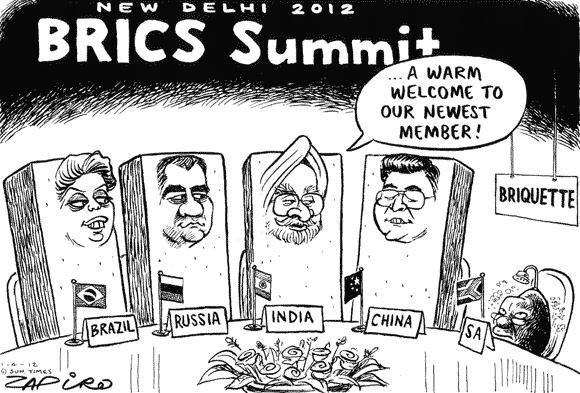
With the country preparing for local elections on May 18, the cabinet member Mr. Zuma chose to oversee local government, Sicelo Shiceka, is now embroiled in scandalous reports about his profligate living at public expense. Mr. Zuma announced Sunday that he was awaiting an explanation from Mr. Shiceka that has yet to come. “It’s this flaunting of inequality and conspicuous consumption that people get agitated about,” said Ben Roberts, a researcher at the Human Sciences Research Council, which recently conducted a survey of South Africans documenting widespread disillusionment with local government.
Parliamentary leaders of Mr. Zuma’s party, the African National Congress, have asked for independent investigators in the public protector’s office to find out whether Mr. Shiceka spent more than $50,000 of taxpayers’ money to fly to Switzerland and stay in five-star hotels while visiting his girlfriend, a flight attendant, who was jailed there on drug charges, as The Sunday Times of South Africa reported.
In a follow-up article on Sunday, the newspaper reported that municipal trucks were delivering water to the building site of Mr. Shiceka’s new home in the poorest district in the Eastern Cape. His home was also slated to be among the first to get electricity. “What a disgrace!” shouted the headline. “Minister builds emperor’s palace in South Africa’s poorest village.”
Corruption and great disparities in wealth are hardly uncommon among the other BRICS countries. But the lack of basic services has touched a particular nerve here. People in Mr. Shiceka’s home district had been protesting the poor quality of water and sewerage services. And it was precisely these issues that led poor people in Ficksburg, a town in the Free State, to take to the streets last week in a protest that ended in tragedy. SABC, the state broadcaster, showed police officers in Ficksburg assaulting an unarmed, shirtless protester named Andries Tatane, 33, and thwacking his torso with batons. Mr. Tatane then looked down at his chest, streaming with blood. A haunting photograph shows him lying wounded in the arms of a friend whose face is contorted in anguish. Mr. Tatane died minutes later. “The post-mortem showed he died of gunshot wounds,” said Moses Dlamini, spokesman for the Independent Complaints Directorate, which investigates police brutality. “And he had bruises which indicated he was assaulted.” Two police officers have been charged with the murder and four others with assault, but not before enraged residents of Mr. Tatane’s township set fire to two government buildings.
An African National Congress spokesman, Jackson Mthembu, described the attack on Mr. Tatane as reminiscent of “apartheid-era strong-arm tactics” — a remarkable statement considering that the A.N.C. itself led the struggle against apartheid and has governed the country, and overseen its police force, since 1994.
The so-called service delivery protests, a phenomenon across the country, provide signs of the simmering discontent among many South Africans about how long it is taking to translate the gains of freedom into material progress. Even as South Africa takes center stage with the world’s most prominent developing nations, a majority of young black South Africans are jobless. Poverty remains widespread. A nationwide survey of about 3,200 South Africans age 16 and older, sponsored by the country’s Independent Electoral Commission, found that South Africans were most dissatisfied with local government performance on job creation, crime and housing.
The survey, released last week, documented an erosion of trust at all levels of government, with the lowest approval level — 38 percent — reserved for local government, down from a high of 55 percent in 2004. Politicians rated even lower. Only 27 percent of South Africans trusted them when the survey was conducted in the final months of 2010. The main opposition party, the Democratic Alliance — widely perceived as dominated by whites — has sought to attract more black support by highlighting its strong record in running the city of Cape Town. Helen Zille, the former journalist who leads the party, has seized on the killing of Mr. Tatane as emblematic of how the A.N.C. has “become disconnected from the people it is supposed to serve.”
But the loyalty of voters to the A.N.C., the party of Nelson Mandela, remains deep, and the survey found that those who were most unhappy with government were also the ones who said they were least likely to vote. So the question of whether discontent leads to change in the ballot box remains open.
Source: New York Times
Wednesday, August 4, 2010
'Don't be too hard on Selebi'
People shouldn’t be too hard on Jackie Selebi. He is actually just a metaphor of what has become of the ANC.
Just as tragic as it is that a man with such a proud history in the struggle for freedom and democracy became a cheap braggart, a charlatan and a crook, so is it heart-breaking that the movement of Albert Luthuli, Oliver Tambo, Walter Sisulu and Nelson Mandela has become a party dominated by greed, a lust for personal power, corruption and petty factionalism. Cynics, Afro-pessimists and right wingers say this was to be expected: most of the other liberation movements on our continent went the same way, Zanu-PF and the MPLA of Angola being prime examples.
I did not expect it. I am shocked every day at new manifestations of the rot in our ruling party. Yes, there were always elements in the ANC during the exile years whom one wouldn’t exactly call democrats and human rights activists. They fought for power, not democracy. But the decent men and women, people who really cared about human dignity and freedom, always dominated the ANC. Most of the best sons and daughters of our country during the last half century were products of the ANC.
This was why I thought our liberation movement would be different. I was wrong. Those decent people, those progressive leaders with whom I associated myself politically for many years, have disappeared into the quicksands of power and greed. The party is now dominated by cheap, lying populists who enrich themselves at the expense of the poor; by opportunists pushing their own interests; by Stalinists and reactionaries. The harder these types try to drive our country towards a bankrupt dictatorship, the more credibility some of the conspiracy theories are getting. Such as: the reason why the ANC is manipulating the judiciary and the National Prosecuting Authority and why it is now pushing two draconian measures to severely limit press freedom, is to make it possible for them to steal more from the people and to hide their own scandals.
Even the theory that the ANC is deliberately sabotaging land reform and redistribution is gaining credibility: they want to pull a Robert Mugabe when it’s popularity among the masses is waning; blame the whites as the common enemy and use land as an emotive issue to unite blacks behind them. I have no doubt in my mind that those ANC leaders who are pushing the proposals for a statutory media tribunal do not believe for one moment that it would improve our newspapers one iota. They know, as we should all know, that it’s only result will be an end to the free flow of information to the voters.
I have been waiting in vain for my comrades of yesteryear to stand up and stop this assault on our democracy. Evil happens when good men remain silent. The vast majority of South Africans have proved that they deserve better than the present leadership of the ANC. But when will this majority start realising that it is their democratic right to show this dangerous clique the red card?
Source: News 24: Max du Preez
Just as tragic as it is that a man with such a proud history in the struggle for freedom and democracy became a cheap braggart, a charlatan and a crook, so is it heart-breaking that the movement of Albert Luthuli, Oliver Tambo, Walter Sisulu and Nelson Mandela has become a party dominated by greed, a lust for personal power, corruption and petty factionalism. Cynics, Afro-pessimists and right wingers say this was to be expected: most of the other liberation movements on our continent went the same way, Zanu-PF and the MPLA of Angola being prime examples.
I did not expect it. I am shocked every day at new manifestations of the rot in our ruling party. Yes, there were always elements in the ANC during the exile years whom one wouldn’t exactly call democrats and human rights activists. They fought for power, not democracy. But the decent men and women, people who really cared about human dignity and freedom, always dominated the ANC. Most of the best sons and daughters of our country during the last half century were products of the ANC.
This was why I thought our liberation movement would be different. I was wrong. Those decent people, those progressive leaders with whom I associated myself politically for many years, have disappeared into the quicksands of power and greed. The party is now dominated by cheap, lying populists who enrich themselves at the expense of the poor; by opportunists pushing their own interests; by Stalinists and reactionaries. The harder these types try to drive our country towards a bankrupt dictatorship, the more credibility some of the conspiracy theories are getting. Such as: the reason why the ANC is manipulating the judiciary and the National Prosecuting Authority and why it is now pushing two draconian measures to severely limit press freedom, is to make it possible for them to steal more from the people and to hide their own scandals.
Even the theory that the ANC is deliberately sabotaging land reform and redistribution is gaining credibility: they want to pull a Robert Mugabe when it’s popularity among the masses is waning; blame the whites as the common enemy and use land as an emotive issue to unite blacks behind them. I have no doubt in my mind that those ANC leaders who are pushing the proposals for a statutory media tribunal do not believe for one moment that it would improve our newspapers one iota. They know, as we should all know, that it’s only result will be an end to the free flow of information to the voters.
I have been waiting in vain for my comrades of yesteryear to stand up and stop this assault on our democracy. Evil happens when good men remain silent. The vast majority of South Africans have proved that they deserve better than the present leadership of the ANC. But when will this majority start realising that it is their democratic right to show this dangerous clique the red card?
Source: News 24: Max du Preez
Friday, July 2, 2010
Aurora link to suspect land deal
A controversial property developer in the North West province has links to empowerment company Aurora Empowerment Systems. Despite Aurora's dire financial troubles with the liquidated Pamodzi Grootvlei and Orkney mines, the company appears to be interested in a questionable land deal on the Hartbeespoort Dam that has left the local Madibeng municipality divided. It seems the deal secured by developer Naas Grimbeek traded on political clout. The land was sold for R77-million but is said to be worth much more and the deal was pushed through by the province in the teeth of opposition from the local council.
Aurora's political credentials are well established. Khulubuse Zuma, President Jacob Zuma's nephew, Michael Hulley, Zuma's lawyer, and Zondwa Mandela, Nelson Mandela's grandson, are on the Aurora board. In July last year Aurora announced with huge fanfare the R78,5-million acquisition of Zambian-based company, Redwood Timber Merchants, from Grimbeek. The asset would be injected into the listed company Cenmag.
In interviews Khulubuse Zuma said: "Aurora owns Cenmag. Cenmag is the vehicle that we are going to use to make a string of acquisitions. This is only one -- there are other acquisitions that are coming to the fore. Redwood Timber is the biggest timber company in the southern hemisphere, the largest sawmill in the southern hemisphere." Zuma said Grimbeek had already been paid R32-million. But the deal with Cenmag collapsed and it appears there are other claims over the assets of Redwood.
This week Grimbeek first claimed the Redwood deal had collapsed because Aurora was unable to pay for it -- but if financing came through from Aurora's latest funders, the deal would be on again. He later declined to say anything more about the deal, other than the contract was being renegotiated. Meanwhile, the M&G has established that the Industrial Development Corporation has obtained a R14,5-million warrant of execution against Grimbeek and his companies for the non-payment of a loan for Redwood Timbers. Grimbeek would not answer questions about the warrant. It appears the loan was to cover debts still owing on the company and that attempts have been made by the Zambian government to repossess the property on which the sawmill is located.
Now Grimbeek has emerged as the man behind what has been described as a "murky purchase" of approximately 400ha of prime land, the Oberon resort, on the Hartbeespoort Dam. But he denied that Aurora was involved in the land deal, although he said Zuma had expressed an interest in Oberon. But contractors working for Grimbeek on the resort, renamed Eagle Waters Wildlife, said Grimbeek had mentioned Aurora as a stakeholder in the project. There are other smaller links.
The M&G has established that, in December last year, Aurora made a R14 000 payment to Hentiq 2784, a company through which Grimbeek owns the property. Grimbeek says it was repayment of a loan. Merloni Brand Consultancy, owned by Mandela and Yaseen Theba, the son-in-law of Suliman Bhana, a controversial former adviser to Aurora, were employed by Grimbeek to design the website for Eagle Waters. Grimbeek said that the relationship between him, Mandela and Zuma was confidential, though he admitted earlier that he spoke regularly to the two Aurora directors.
Eagle Waters is the talk of the town in Hartbeespoort, with local papers, councillors and business people in an uproar about what they see as a land deal sorely lacking in transparency. Oberon, the land where Eagle Waters is being built, was the last piece of public-access land open to the community. "It's ridiculous," says Titus Mlambo, secretary of the local policing forum. "They didn't even ask our consent. We are surprised that they sold this land because there are informal settlements on it and these people will be evicted. Now, we have no access to the dam." Grimbeek bought the Oberon land from the North West department of public works, roads and transport for R77-million, but local estate agents said the property's value was closer to R450-million. Grimbeek disputes this. He said his valuations showed that the land, without the development of services, was worth between R70-million and R120-million. A high-level source in the North West department of public works told the M&G that the deal did not go through the usual channels but was treated as a special project by the provincial minister and premier.
Originally the land was under a 99-year lease to the Madibeng local municipality, which still had 86 years left on the lease when it was sold off to Grimbeek in 2009. The M&G understands that the provincial department put significant pressure on the municipality to sign a clearance certificate to allow the land to be sold to Grimbeek. A number of ward councillors for the area who initially were vehemently opposed the sale, believing it would be detrimental to the community, later changed their minds. A member of the community who asked not to be named said the councillors felt they were "fighting a losing battle". "There was pressure from the consortium and the provincial government. They said they had already sold the land." A councillor also said that a high-level politician had intervened when the "transparency and legitimacy" of the land deal was questioned and told the councillor to back off.
Grimbeek said the purchase was above board and his company acted "ethically and diligently". He would not say where the funding had come from for it or if the full purchase price had been paid. The M&G had not received responses from the province, the municipality or Aurora at the time of going to print.
Source: Mail & Guardian
Aurora's political credentials are well established. Khulubuse Zuma, President Jacob Zuma's nephew, Michael Hulley, Zuma's lawyer, and Zondwa Mandela, Nelson Mandela's grandson, are on the Aurora board. In July last year Aurora announced with huge fanfare the R78,5-million acquisition of Zambian-based company, Redwood Timber Merchants, from Grimbeek. The asset would be injected into the listed company Cenmag.
In interviews Khulubuse Zuma said: "Aurora owns Cenmag. Cenmag is the vehicle that we are going to use to make a string of acquisitions. This is only one -- there are other acquisitions that are coming to the fore. Redwood Timber is the biggest timber company in the southern hemisphere, the largest sawmill in the southern hemisphere." Zuma said Grimbeek had already been paid R32-million. But the deal with Cenmag collapsed and it appears there are other claims over the assets of Redwood.
This week Grimbeek first claimed the Redwood deal had collapsed because Aurora was unable to pay for it -- but if financing came through from Aurora's latest funders, the deal would be on again. He later declined to say anything more about the deal, other than the contract was being renegotiated. Meanwhile, the M&G has established that the Industrial Development Corporation has obtained a R14,5-million warrant of execution against Grimbeek and his companies for the non-payment of a loan for Redwood Timbers. Grimbeek would not answer questions about the warrant. It appears the loan was to cover debts still owing on the company and that attempts have been made by the Zambian government to repossess the property on which the sawmill is located.
Now Grimbeek has emerged as the man behind what has been described as a "murky purchase" of approximately 400ha of prime land, the Oberon resort, on the Hartbeespoort Dam. But he denied that Aurora was involved in the land deal, although he said Zuma had expressed an interest in Oberon. But contractors working for Grimbeek on the resort, renamed Eagle Waters Wildlife, said Grimbeek had mentioned Aurora as a stakeholder in the project. There are other smaller links.
The M&G has established that, in December last year, Aurora made a R14 000 payment to Hentiq 2784, a company through which Grimbeek owns the property. Grimbeek says it was repayment of a loan. Merloni Brand Consultancy, owned by Mandela and Yaseen Theba, the son-in-law of Suliman Bhana, a controversial former adviser to Aurora, were employed by Grimbeek to design the website for Eagle Waters. Grimbeek said that the relationship between him, Mandela and Zuma was confidential, though he admitted earlier that he spoke regularly to the two Aurora directors.
Eagle Waters is the talk of the town in Hartbeespoort, with local papers, councillors and business people in an uproar about what they see as a land deal sorely lacking in transparency. Oberon, the land where Eagle Waters is being built, was the last piece of public-access land open to the community. "It's ridiculous," says Titus Mlambo, secretary of the local policing forum. "They didn't even ask our consent. We are surprised that they sold this land because there are informal settlements on it and these people will be evicted. Now, we have no access to the dam." Grimbeek bought the Oberon land from the North West department of public works, roads and transport for R77-million, but local estate agents said the property's value was closer to R450-million. Grimbeek disputes this. He said his valuations showed that the land, without the development of services, was worth between R70-million and R120-million. A high-level source in the North West department of public works told the M&G that the deal did not go through the usual channels but was treated as a special project by the provincial minister and premier.
Originally the land was under a 99-year lease to the Madibeng local municipality, which still had 86 years left on the lease when it was sold off to Grimbeek in 2009. The M&G understands that the provincial department put significant pressure on the municipality to sign a clearance certificate to allow the land to be sold to Grimbeek. A number of ward councillors for the area who initially were vehemently opposed the sale, believing it would be detrimental to the community, later changed their minds. A member of the community who asked not to be named said the councillors felt they were "fighting a losing battle". "There was pressure from the consortium and the provincial government. They said they had already sold the land." A councillor also said that a high-level politician had intervened when the "transparency and legitimacy" of the land deal was questioned and told the councillor to back off.
Grimbeek said the purchase was above board and his company acted "ethically and diligently". He would not say where the funding had come from for it or if the full purchase price had been paid. The M&G had not received responses from the province, the municipality or Aurora at the time of going to print.
Source: Mail & Guardian
Subscribe to:
Posts (Atom)