"When we landed, the soldiers met us at the airport with shotguns and they put us straight into prison," said Didier Kabange*. One of 52 Congolese deported from the Lindela repatriation centre outside Krugersdorp in mid-February, Kabange then spent two weeks in Kasapa prison in Lubumbashi in the southeast of the Democratic Republic of Congo (DRC) before he was released, with 46 other members of his group, last week.
Kabange, speaking by phone this week from the DRC, said that the deportees were deprived of food and water, threatened, beaten and interrogated about their political affiliations. He also expressed concern for the safety of the five still detained in Kasapa.
"There were too much questions. Too much questions [by the authorities]," he said. "They asked us why we left the Congo and what we were doing in South Africa. They asked whether we were protesting against [President Joseph] Kabila and whether we supported [Union for Democracy and Social Progress leader Étienne] Tshisekedi. We say we don't know anything about the government, about the president -- we don't know nothing. All we know is that our [asylum seeker] papers expired so we were sent back."
Deportation could be fatal
There is growing concern among the Congolese in Cape Town and Johannesburg that deportation to the DRC by the department of home affairs is leading to physical abuse, victimisation and possibly death. Activists claim the "indiscriminate" and "harsh" response of the Kabila government is a reaction to protests that followed the DRC's presidential elections in November last year, which are widely alleged to have been won fraudulently by Kabila. One of the activists, Augey Kitoko, said: "The regime has seen our protests in South Africa [including one at the ANC headquarters in Johannesburg and another at the Congolese embassy in Pretoria] and they are embarrassed. So when our people are deported, the security forces come down heavily on them."
The World Organisation Against Torture's 2007 annual report, which was released in mid-2008, stated that "the Congolese authorities are extremely sensitive to activities that could adversely affect their credibility and image abroad, and denunciation of human rights violations is carried out in an environment that is exceedingly dangerous for defenders". The "Unsafe Return" report by the United Kingdom-based charity, Justice First, which tracked the return of 17 failed asylum seekers, two of whom disappeared after touching down in Kinshasa, from the UK to the DRC between 2007 and last year, suggests little has changed. The deportees interviewed reported being raped, tortured, beaten and separated from their children, and claimed that officials extorted money from them to ensure their safety.
Rape, torture prevalent among returnees
According to the report, of the 15 adult returnees, one was "handcuffed, blindfolded and severely beaten", six were "severely beaten", two were tortured with electric shocks, two of the 10 men were sexually abused and two of the five women were raped. The report states that asylum seekers in the UK are considered to be the "main opponents" of the Kabila regime, much like those who have been protesting against the election results in countries such as South Africa, Belgium and Canada.
The report also contains a chilling interview with a Congolese immigration officer who acknowledges that returnees' files are studied "to establish whether the returnee has a problem with the Congolese state", in which case the security services are contacted. The immigration officer says returnees are interrogated on arrival and, if "political problems" with the regime are confirmed, they are sent to Kinshasa's Kin Mazière prison or to a notorious detention centre, called "Tolerance Zero". The official described the procedure: "In such a case [of detention], the returnee can have no excuse, there will be no pity shown. People are caught and can be killed in Tolerance Zero.
Punishment does not take place at the airport but in secret entre coulisses [behind the scenes] … Those who have a problem with the state will be severely ill treated and duly punished. He or she will run the risk of eliminé [being killed]. Detainees do not have access to a lawyer. Any communication with the outside is very difficult."
SA not taking responsibility
South Africa is washing its hands of any responsibility for what is happening. Modiri Matthews, chief director of the immigration inspectorate of home affairs, said his department's main obligation was to "deport people here illegally" after "a thorough credibility test" to ascertain whether their claims for political asylum were valid. He said South Africa had no way of monitoring the safety of people deported to the DRC. "It is up to the respective governments to monitor the safety of those that we deport … The DRC is a sovereign country so we cannot meddle in their affairs."
Matthews said the South African government was not reviewing its position in the light of the concerns about the safety of those being deported to the DRC. The British government has taken a similar stance. This indifference of foreign governments to human rights abuses taking place in the DRC is leaving deportees at the mercy of the Kabila regime. Also, because their refugee status has been denied, they do not fall under the mandate of the United Nations High Commissioner for Refugees.
Hard for human rights groups to do their work
It is hard for human rights groups to operate in the DRC, even though it has ratified the Optional Protocol to the UN Convention Against Torture that allows UN observers access to places of detention. According to Amnesty International's 2011 annual report, during the UN's universal periodic review, in March last year the Kabila government refused observers access to detention centres, including that of the National Intelligence Agency.
DRC information minister Lambert Mende told the Mail & Guardian that allegations of human rights abuses made by returnees to the country were "just a lie". He said that refugees and asylum seekers were "not good sources for information about the truth" about the political situation in the country as they needed to paint a bad picture of the DRC to ensure they were allowed into countries like South Africa and the UK.** The rows of buildings at the Lindela detention and repatriation centre resemble cages for battery chickens. Inside, a slightly built 40-year-old Congolese, Francis Ongoly,* is waiting to be deported. Fear is in his eyes.
"I've heard that the others [deported in February] have been in Kasapa and I don't want to go there. But I am also scared about going home. Where I live [Uvira in the Sud-Kivu province], the militia are always looking for young men like me to fight. If you refuse, you die. I don't want to fight or die," he said.
Ongoly said conditions at Lindela were terrible and illnesses were "only treated with Panado. Whatever illness you have, there is only one medicine -- Panado." On December 21 last year Martin Mukishi, a Congolese national held at Lindela, died because of "poor treatment and negligence", according to Congolese nationals in the repatriation centre.
"When we tried to find out how he died things escalated. The guards came in with rubber bullets, tear gas and batons and they beat us. All we wanted to know is what happened to our brother," said Didier Fuamba who was detained at Lindela for more than two months and only released in February after legal intervention.
Those in Lindela have written to Human Rights Watch. They claim they are being victimised by the South African government, which they say is in cahoots with the Kabila government, in an attempt to stem anti-Kabila protest in South Africa. They also call for an immediate end to deportations, or a possible relocation to another country. Among Congolese nationals living in South Africa, the fear of victimisation is growing -- they claim that both the police and the home affairs department are intent on arresting and deporting them. More than 10 Congolese nationals, either in Lindela or recently released, said that, while trying to renew their temporary papers, they were arrested and sent to Lindela. Some in Lindela claimed that they were arrested at the border without being afforded an opportunity to apply for refugee status. But Matthews said that no specific nationality was being targeted and denied that anyone, including Congolese nationals, would be detained at Lindela without being given the opportunity to apply for refugee status. He said that only "authentic illegal immigrants" were deported, after a "detailed examination and appeal process". "The only detention that can take place is if people have failed in the system," he said.
But the Congolese said the system was failing them. Blaise Lolele, who spent more than three months in Lindela before being released after a court application by his lawyer, said: "I have been renewing my temporary papers since 2006 and, after I was arrested, I was shown my files by a lawyer in Lindela. It showed that my refugee status application had been rejected in 2007. But I was never notified that my application failed; it never came up on the system whenever I renewed my papers. How is this possible?"
* Not their real names
** Translation by Lionel Faull
Source: Mail & Guardian
Showing posts with label Rape. Show all posts
Showing posts with label Rape. Show all posts
Friday, March 9, 2012


Wednesday, February 8, 2012
Anti-Joseph Kabila protesters urge DRC boycott at Indaba
Congolese protesters opposed to the DRC's Joseph Kabila are picketing on the sidelines of the Mining Indaba in Cape Town, calling on investors to steer clear of the country's mineral resources. Congolese protesters who dispute the recent re-election of Joseph Kabila as president of the Democratic Republic of the Congo (DRC) picketed on the sidelines of the Mining Indaba in Cape Town on Wednesday, calling on investors to steer clear of the country's mineral resources. They also claimed that South Africa had only endorsed Kabila's re-election because prominent South Africans had business interests in the countries' mining sector. Chanting in French and Kikongo, approximately 30 protesters cradled placards and the DRC's flags while they toyi-toyi'd along Coen Steytler avenue outside the Cape Town International Convention Centre.
"Kabila is a killer and rapist"; "Help save the DRC"; and "DRC in deep political crisis -- Illegal delegation as Indaba," read some of the placards. The protests form part of a larger campaign by DRC citizens residing in South Africa who believe the presidential elections in December were illegitimate and fixed in favour of incumbent president Joseph Kabila.
"There is no government representative of the people at the moment in the DRC. Kabila stole the elections and is stealing the wealth of our country -- he must go," Iko Ikotela from Kinshasa told the Mail & Guardian.
Most of those protesting outside the Indaba say opposition leader Etienne Tshisekedi is the rightful leader of the country and was defeated by Kabila only "through fraud". As part of their remonstrations, the protesters are encouraging investors to steer clear of the country's mineral sector, which they believe is "tainted".
"Hey! Please don't invest in the DRC -- you are supporting a murderer and a rapist and buying blood diamonds -- don't do it," shouted one Protester to a bemused looking delegate as he exited the Indaba.
Besides diamonds, other primary minerals mined in the country include cobalt, gold and copper. Despite widespread international condemnation, the South African government ratified Kabila's victory in late December. Ikotela alleges the support from the South African government is solely based on business interests in the DRC, held by prominent South African politicians.
"Your President Zuma and his cronies have mines up in DRC, that's why you are supporting Kabila," he told the M&G.
Presidential spokesperson Mac Maharaj dismissed claims of Zuma's business concerns in the DRC as "far-fetched" and would not comment any further on the matter. While there is no overt evidence to suggest President Zuma is involved in any business concerns -- mining or otherwise -- in the DRC, his nephew Khulubuse Zuma is involved in the country's mineral and energy sector. In response to the protests, the DRC's minerals and energy delegation at the Indaba have set up an emergency number for the country's representatives to contact should picketers threaten them.
"They have been a little aggressive but nothing too hectic. If I think it is bad I will use the number," Alessaine Kwatanga, a businessman in Lubumbashi told the M&G.
Indaba organisers have described the protests as "unfortunate" but say they recognise the rights of DRC citizens to protest against their government and leaders.
"The right to peaceful protest is enshrined in the South African Constitution. The Mining Indaba would like to apologise to our delegates and anyone who might have been inconvenienced," read a statement released on Wednesday.
Source: Mail & Guardian
"Kabila is a killer and rapist"; "Help save the DRC"; and "DRC in deep political crisis -- Illegal delegation as Indaba," read some of the placards. The protests form part of a larger campaign by DRC citizens residing in South Africa who believe the presidential elections in December were illegitimate and fixed in favour of incumbent president Joseph Kabila.
"There is no government representative of the people at the moment in the DRC. Kabila stole the elections and is stealing the wealth of our country -- he must go," Iko Ikotela from Kinshasa told the Mail & Guardian.
Most of those protesting outside the Indaba say opposition leader Etienne Tshisekedi is the rightful leader of the country and was defeated by Kabila only "through fraud". As part of their remonstrations, the protesters are encouraging investors to steer clear of the country's mineral sector, which they believe is "tainted".
"Hey! Please don't invest in the DRC -- you are supporting a murderer and a rapist and buying blood diamonds -- don't do it," shouted one Protester to a bemused looking delegate as he exited the Indaba.
Besides diamonds, other primary minerals mined in the country include cobalt, gold and copper. Despite widespread international condemnation, the South African government ratified Kabila's victory in late December. Ikotela alleges the support from the South African government is solely based on business interests in the DRC, held by prominent South African politicians.
"Your President Zuma and his cronies have mines up in DRC, that's why you are supporting Kabila," he told the M&G.
Presidential spokesperson Mac Maharaj dismissed claims of Zuma's business concerns in the DRC as "far-fetched" and would not comment any further on the matter. While there is no overt evidence to suggest President Zuma is involved in any business concerns -- mining or otherwise -- in the DRC, his nephew Khulubuse Zuma is involved in the country's mineral and energy sector. In response to the protests, the DRC's minerals and energy delegation at the Indaba have set up an emergency number for the country's representatives to contact should picketers threaten them.
"They have been a little aggressive but nothing too hectic. If I think it is bad I will use the number," Alessaine Kwatanga, a businessman in Lubumbashi told the M&G.
Indaba organisers have described the protests as "unfortunate" but say they recognise the rights of DRC citizens to protest against their government and leaders.
"The right to peaceful protest is enshrined in the South African Constitution. The Mining Indaba would like to apologise to our delegates and anyone who might have been inconvenienced," read a statement released on Wednesday.
Source: Mail & Guardian
Monday, February 6, 2012
The South African Constitutional Court Extends Police Accountability
Should the police be more trustworthy than any other citizen? And if they are not, can you hold the Minister of Police to account? In an important unanimous judgement penned by South African Chief Justice Mogoeng Mogoeng and handed down on 15 December 2011, the answer to these questions was a resounding “yes.” This judgement has effectively set new legal precedent by extending the basis for civil claims against police officers who break the law and cause injury or damage to citizens. Most importantly, this judgement holds that even when off-duty, if there is enough of a connection between their employment as police officers and their illegal acts, the Minister of Police may be held liable.
This ground-breaking case began 14 years ago in 1998 when Allister van Wyk, a police officer, raped a thirteen year old girl outside the town of George in the Western Cape. The incident started in the early hours of the morning when the girl had needed a lift home from a night-club. Mr van Vyk offered to give her a lift home as he was doing the same for two of his friends. He was driving an unmarked police vehicle at the time that had been allocated to him as he was on standby duty and would need to be able to respond quickly if he was called to pace himself on duty. Knowing he was a police officer and was driving a police vehicle, the girl felt that it would be safe to accept a lift from him. After leaving the night club, van Wyk first dropped off his friends, but then, instead of driving her home, he drove out of town towards an area known as ‘the Wilderness’, stopping in the Kaaimans pass at a dark and secluded picnic spot alongside the estuary.
The girl, realising that he wasn’t driving her straight home as promised, became afraid and jumped from the car as soon as it stopped. She managed to get away and hide amongst the trees and bush until he left. Then she made her way back to the main road with the intention of hitchhiking back into George. She didn’t wait long before a vehicle stopped for her. To her surprise it was the same car she had just escaped from, driven by van Wyk. Although reluctant to climb back in, van Wyk assured her that he would take her home unharmed. Given that there were very few vehicles on this road at that time of the morning, she felt she had little choice but to accept. Van Wyk drove a short way up the road before stopping, assaulting and then raping her. He then drove her home and threatened to hurt or kill her if she told anyone what he had done.
She bravely defied his threats and reported the incident to the police who arrested van Wyk and charged him with rape. He was later convicted of the crime and was sent to prison. Shockingly, at the time of the rape van Wyk was head of the George detective unit, this was in spite of having four previous criminal convictions against him.
In 2005 the girl, now a young woman, brought a civil claim for damages against van Wyk and the Minister of Police. She held the Minister liable for van Wyk’s action and sought to claim damages from the police. Although the High Court ruled in her favour, the police appealed the decision which was subsequently overturned in a majority judgement by the Supreme Court of Appeal on the basis that van Wyk was off-duty at the time of the incident and that the Minister could therefore not be held liable. She then appealed that ruling in the Constitutional Court.
The question the Constitutional Court was called on to answer, was whether the Minister of Police could be held accountable for the actions of police officers, who were not on active duty; and whether police officers should be more worthy of our trust than any other citizen. The Institute for Security Studies was the first of three civil-society organisations to apply to act as amicus curie (friends of the court) by bringing expert testimony in the matter. We did so because this case offered an opportunity to strengthen police accountability by putting in place additional legal measures that citizens could use to hold the state liable for criminal and abusive behaviour by police officials.
The Court’s finding, that the Minister of Police, is indeed accountable for the actions of officers, represents an important milestone in the effort to ensure that the police act to project, rather than harm citizen’s even when they are not on active duty. It means that the Minister of Police has a responsibility to ensure that the officers who are recruited, appointed and employed by the police are not criminals themselves. Fortunately, the current Minister of Police, Nathi Mthethwa has already publicly committed himself to professionalising the South African Police Service (SAPS). This finding is particularly important in the light of the increase in recent years of cases of human rights violations committed by the police. For instance, the Independent Complaints Directorate (ICD) reported 45 allegations of torture in its 2010-2011 report, the highest number reported since 1999.
Towards the end of 2011, the Parliamentary Portfolio Committee on Police heard that during the 2010-11 financial year, contingent civil claims against the SAPS, mostly arising out of police criminality and misconduct, had increased to the substantial amount of R11bn or about 20% of the total police budget. In the short-term the Constitutional Courts ruling is likely to mean that the police will face additional civil claims and will therefore have to allocate even more of their budget to cover the potential cost of these claims.
To prevent this, it is going to be necessary for the Minister to ensure that SAPS management put proper measures in place to ensure that the people they recruit, train and employ understand, accept and are held accountable to the burden of professional service that being a member of the police requires. If SAPS management is able to do this, it will result in better policing while costing the state less in civil claims in the long run.
Source: ISS
This ground-breaking case began 14 years ago in 1998 when Allister van Wyk, a police officer, raped a thirteen year old girl outside the town of George in the Western Cape. The incident started in the early hours of the morning when the girl had needed a lift home from a night-club. Mr van Vyk offered to give her a lift home as he was doing the same for two of his friends. He was driving an unmarked police vehicle at the time that had been allocated to him as he was on standby duty and would need to be able to respond quickly if he was called to pace himself on duty. Knowing he was a police officer and was driving a police vehicle, the girl felt that it would be safe to accept a lift from him. After leaving the night club, van Wyk first dropped off his friends, but then, instead of driving her home, he drove out of town towards an area known as ‘the Wilderness’, stopping in the Kaaimans pass at a dark and secluded picnic spot alongside the estuary.
The girl, realising that he wasn’t driving her straight home as promised, became afraid and jumped from the car as soon as it stopped. She managed to get away and hide amongst the trees and bush until he left. Then she made her way back to the main road with the intention of hitchhiking back into George. She didn’t wait long before a vehicle stopped for her. To her surprise it was the same car she had just escaped from, driven by van Wyk. Although reluctant to climb back in, van Wyk assured her that he would take her home unharmed. Given that there were very few vehicles on this road at that time of the morning, she felt she had little choice but to accept. Van Wyk drove a short way up the road before stopping, assaulting and then raping her. He then drove her home and threatened to hurt or kill her if she told anyone what he had done.
She bravely defied his threats and reported the incident to the police who arrested van Wyk and charged him with rape. He was later convicted of the crime and was sent to prison. Shockingly, at the time of the rape van Wyk was head of the George detective unit, this was in spite of having four previous criminal convictions against him.
In 2005 the girl, now a young woman, brought a civil claim for damages against van Wyk and the Minister of Police. She held the Minister liable for van Wyk’s action and sought to claim damages from the police. Although the High Court ruled in her favour, the police appealed the decision which was subsequently overturned in a majority judgement by the Supreme Court of Appeal on the basis that van Wyk was off-duty at the time of the incident and that the Minister could therefore not be held liable. She then appealed that ruling in the Constitutional Court.
The question the Constitutional Court was called on to answer, was whether the Minister of Police could be held accountable for the actions of police officers, who were not on active duty; and whether police officers should be more worthy of our trust than any other citizen. The Institute for Security Studies was the first of three civil-society organisations to apply to act as amicus curie (friends of the court) by bringing expert testimony in the matter. We did so because this case offered an opportunity to strengthen police accountability by putting in place additional legal measures that citizens could use to hold the state liable for criminal and abusive behaviour by police officials.
The Court’s finding, that the Minister of Police, is indeed accountable for the actions of officers, represents an important milestone in the effort to ensure that the police act to project, rather than harm citizen’s even when they are not on active duty. It means that the Minister of Police has a responsibility to ensure that the officers who are recruited, appointed and employed by the police are not criminals themselves. Fortunately, the current Minister of Police, Nathi Mthethwa has already publicly committed himself to professionalising the South African Police Service (SAPS). This finding is particularly important in the light of the increase in recent years of cases of human rights violations committed by the police. For instance, the Independent Complaints Directorate (ICD) reported 45 allegations of torture in its 2010-2011 report, the highest number reported since 1999.
Towards the end of 2011, the Parliamentary Portfolio Committee on Police heard that during the 2010-11 financial year, contingent civil claims against the SAPS, mostly arising out of police criminality and misconduct, had increased to the substantial amount of R11bn or about 20% of the total police budget. In the short-term the Constitutional Courts ruling is likely to mean that the police will face additional civil claims and will therefore have to allocate even more of their budget to cover the potential cost of these claims.
To prevent this, it is going to be necessary for the Minister to ensure that SAPS management put proper measures in place to ensure that the people they recruit, train and employ understand, accept and are held accountable to the burden of professional service that being a member of the police requires. If SAPS management is able to do this, it will result in better policing while costing the state less in civil claims in the long run.
Source: ISS
Tuesday, January 4, 2011
Cop arrested after teen raped
A 45-year-old Sergeant was arrested for allegedly raping a 15-year-old girl in Senwamokgope near Modjadjiskloof, Limpopo police said on Tuesday. The officer was a court orderly at the Sekgosese Magistrate's Court, Colonel Motlafela Mojapelo said. He allegedly fetched the girl from her home at Rotterdam in Hlanganani, outside Giyani, on December 28, and took her to Senwamokgope police single quarters where she was raped.
The case was reported to the police by her parents after noticing her “strange behaviour”. The officer was then arrested on Monday. The Provincial Commissioner Amon Mashigo said he strongly condemned the alleged conduct of the Sergeant and said he will be dealt with accordingly.
The officer is expected to appear in Sekgosese Magistrate's Court on Wednesday.
Source: IoL
The case was reported to the police by her parents after noticing her “strange behaviour”. The officer was then arrested on Monday. The Provincial Commissioner Amon Mashigo said he strongly condemned the alleged conduct of the Sergeant and said he will be dealt with accordingly.
The officer is expected to appear in Sekgosese Magistrate's Court on Wednesday.
Source: IoL
Sunday, August 22, 2010
At Least 150 Women Raped in Weekend Raid in Congo
A mob of Rwandan rebels gang-raped at least 150 women last month during a weekend raid on a community of villages in eastern Congo, United Nations and other humanitarian officials said Sunday.
The United Nations blamed the Democratic Forces for the Liberation of Rwanda, or F.D.L.R., for the attack. The F.D.L.R. is an ethnic Hutu rebel group that has been terrorizing the hills of eastern Congo for years, preying on villages in a quest for the natural resources beneath them.
The raided villages are near the mining center of Walikale, known to be a rebel stronghold, and are “very insecure,” said Stefania Trassari, a spokeswoman for the United Nations Office for the Coordination of Humanitarian Affairs. “Rape is something we get quite often.” But she and other United Nations and humanitarian officials said that this attack was unusual because of the large number of victims and the fact that they were raped by more than one attacker simultaneously.
On the evening of July 30, armed men entered the village of Ruvungi, in North Kivu Province. “They told the population that they were just there for food and rest and that they shouldn’t worry,” said Will F. Cragin, the International Medical Corps’ program coordinator for North Kivu, who visited the village a week after their arrival. “Then after dark another group came,” said Mr. Cragin, referring to between 200 and 400 armed men who witnesses described as spending days and nights looting Ruvungi and nearby villages. “They began to systematically rape the population,” he said, adding, “Most women were raped by two to six men at a time.”
The attackers often took the victims into the bush or into their homes, raping them “in front of their children and their families,” Mr. Cragin said. “If a car passed, they would hide.” The rebels left on Aug. 3, he said, the same day the chief of the area traveled through the villages and reported horrific cases of sexual violence. “We thought at first he was exaggerating,” Mr. Cragin said, “but then we saw the scale of the attacks.”
Miel Hendrickson, a regional director for the International Medical Corps, which has been documenting the rape cases, said, “We had heard first 24 rapes, then 56, then 78, then 96, then 156.” “The numbers keep rising,” she said. The United Nations maintains a military base approximately 20 miles from the villages, but United Nations officials said they did not know if the peacekeepers there were aware of the attack as it occurred. A United Nations military spokesman, Madnoje Mounoubai, said information was still being gathered. The F.D.L.R., which began as a gathering of fugitives of the Rwandan genocide in 1994, has grown into a resilient and savage killing machine and an economic engine in the region.
The United Nations, Congo and Rwanda began a military offensive against the group in early 2009, but since then, humanitarian organizations say, cases of rape have risen drastically. “It’s awful,” Ms. Trassari said. “The numbers are quite worrying.”
Secretary of State Hillary Rodham Clinton visited eastern Congo in 2009 to raise awareness about widespread rape in the region, calling it “evil in its basest form,” and the United States pledged $17 million to the Congolese government to fight sexual violence.
Source: New York Times
The United Nations blamed the Democratic Forces for the Liberation of Rwanda, or F.D.L.R., for the attack. The F.D.L.R. is an ethnic Hutu rebel group that has been terrorizing the hills of eastern Congo for years, preying on villages in a quest for the natural resources beneath them.
The raided villages are near the mining center of Walikale, known to be a rebel stronghold, and are “very insecure,” said Stefania Trassari, a spokeswoman for the United Nations Office for the Coordination of Humanitarian Affairs. “Rape is something we get quite often.” But she and other United Nations and humanitarian officials said that this attack was unusual because of the large number of victims and the fact that they were raped by more than one attacker simultaneously.
On the evening of July 30, armed men entered the village of Ruvungi, in North Kivu Province. “They told the population that they were just there for food and rest and that they shouldn’t worry,” said Will F. Cragin, the International Medical Corps’ program coordinator for North Kivu, who visited the village a week after their arrival. “Then after dark another group came,” said Mr. Cragin, referring to between 200 and 400 armed men who witnesses described as spending days and nights looting Ruvungi and nearby villages. “They began to systematically rape the population,” he said, adding, “Most women were raped by two to six men at a time.”
The attackers often took the victims into the bush or into their homes, raping them “in front of their children and their families,” Mr. Cragin said. “If a car passed, they would hide.” The rebels left on Aug. 3, he said, the same day the chief of the area traveled through the villages and reported horrific cases of sexual violence. “We thought at first he was exaggerating,” Mr. Cragin said, “but then we saw the scale of the attacks.”
Miel Hendrickson, a regional director for the International Medical Corps, which has been documenting the rape cases, said, “We had heard first 24 rapes, then 56, then 78, then 96, then 156.” “The numbers keep rising,” she said. The United Nations maintains a military base approximately 20 miles from the villages, but United Nations officials said they did not know if the peacekeepers there were aware of the attack as it occurred. A United Nations military spokesman, Madnoje Mounoubai, said information was still being gathered. The F.D.L.R., which began as a gathering of fugitives of the Rwandan genocide in 1994, has grown into a resilient and savage killing machine and an economic engine in the region.
The United Nations, Congo and Rwanda began a military offensive against the group in early 2009, but since then, humanitarian organizations say, cases of rape have risen drastically. “It’s awful,” Ms. Trassari said. “The numbers are quite worrying.”
Secretary of State Hillary Rodham Clinton visited eastern Congo in 2009 to raise awareness about widespread rape in the region, calling it “evil in its basest form,” and the United States pledged $17 million to the Congolese government to fight sexual violence.
Source: New York Times
Wednesday, May 26, 2010
Criminal Force: Torture, Abuse, and Extrajudicial Killings by the Nigeria Police Force
Police in Nigeria commit extrajudicial killings, torture, rape, and extortion with relative impunity. Nigeria Police Force personnel routinely carry out summary executions of persons accused or suspected of crime; rely on torture as a principal means of investigation; commit rape of both sexes, with a particular focus on sex workers; and engage in extortion at nearly every opportunity.
The Nigerian government has acknowledged these problems and promised to address them in the past, but to date, abuses have continued with no real accountability. Nigeria's leadership must pay serious attention to police reform if it hopes to succeed in restoring public safety.
This report's findings are based on independent field monitoring and investigation at over 400 police stations and posts in 14 states and territories in Nigeria from February 2007 to January 2009. Research was augmented by a review of relevant legislation, case law, and official reports, as well as secondary materials, including newspaper articles and NGO reports.
Source: Open Society Justice Initiative / Network on Police Reform in Nigeria
The Nigerian government has acknowledged these problems and promised to address them in the past, but to date, abuses have continued with no real accountability. Nigeria's leadership must pay serious attention to police reform if it hopes to succeed in restoring public safety.
This report's findings are based on independent field monitoring and investigation at over 400 police stations and posts in 14 states and territories in Nigeria from February 2007 to January 2009. Research was augmented by a review of relevant legislation, case law, and official reports, as well as secondary materials, including newspaper articles and NGO reports.
Source: Open Society Justice Initiative / Network on Police Reform in Nigeria
Thursday, February 25, 2010
Teenager jailed for 15 years after using Facebook to blackmail seven students into sex
An American teenager has been sentenced to 15 years in jail after posing as a girl on Facebook to blackmail seven classmates into sex. Anthony Stancl, 19, of Wisconsin, was accused of tricking more than 30 male classmates into sending him naked photos of themselves. He then used the photos as blackmail, threatening to post them online unless the students had sex with him. He forced at least seven of them into some sort of sexual activity with him in encounters that he documented with a mobile phone. Up to 300 photographs of underage males, some as young as 15, were found on Stancl's computer, police said. He had pleaded to two charges, including the repeated sexual assault of a child.
The investigation began after a 16-year-old boy told authorities he was being blackmailed into sex acts with Stancl. The boy, then 15, had exchanged explicit pictures of himself online with 'Kayla,' who later threatened to spread his picture throughout the school unless he agreed to the acts with Stancl. Stancl photographed those encounters, giving him fodder for further blackmail, detectives said. The boy agreed to at least four sex acts, but when 'Kayla' asked him for a nude photo of his brother he went to his parents and the police. Police identified 31 victims, each of whom exchanged nude photographs or videos with someone they thought was a female. More than half said the person with whom they communicated threatened to release the images unless they agreed to let the person's male friend perform sex acts on them.
The investigation overlapped with a separate case in which Stancl was accused of writing a bomb threat on a bathroom wall at the school in November 2008. He followed it up with an anonymous e-mail to two teachers that said, 'Good luck tomorrow. Boom.' Stancl admitted to detectives he sent the e-mail from the public library under a false identity. A charge of causing a bomb scare was among those dismissed as part of Stancl's plea agreement. Stancl showed no emotion yesterday as the sentence was handed down. He had faced up to 30 years in jail. Earlier, he told the court that he now empathises with what his victims went through.
Source: Daily Mail
The investigation began after a 16-year-old boy told authorities he was being blackmailed into sex acts with Stancl. The boy, then 15, had exchanged explicit pictures of himself online with 'Kayla,' who later threatened to spread his picture throughout the school unless he agreed to the acts with Stancl. Stancl photographed those encounters, giving him fodder for further blackmail, detectives said. The boy agreed to at least four sex acts, but when 'Kayla' asked him for a nude photo of his brother he went to his parents and the police. Police identified 31 victims, each of whom exchanged nude photographs or videos with someone they thought was a female. More than half said the person with whom they communicated threatened to release the images unless they agreed to let the person's male friend perform sex acts on them.
The investigation overlapped with a separate case in which Stancl was accused of writing a bomb threat on a bathroom wall at the school in November 2008. He followed it up with an anonymous e-mail to two teachers that said, 'Good luck tomorrow. Boom.' Stancl admitted to detectives he sent the e-mail from the public library under a false identity. A charge of causing a bomb scare was among those dismissed as part of Stancl's plea agreement. Stancl showed no emotion yesterday as the sentence was handed down. He had faced up to 30 years in jail. Earlier, he told the court that he now empathises with what his victims went through.
Source: Daily Mail
Wednesday, February 17, 2010
Infant raped, killed in E Cape
Eastern Cape police are investigating the murder of a five-month-old baby after a post mortem revealed that she was raped and "severely abused", a spokesman said on Wednesday. "An inquest docket was opened when she died on February 12, but a post mortem revealed yesterday that she had been raped and severely abused," said Inspector Wena Theron. The post mortem also revealed that the girl, who lived with her parents on the farm where they worked about 60km from Aberdeen, had three broken ribs. "Her mother woke the farmer at 3am last Friday saying the baby was coughing, but when the ambulance arrived at the farm, the baby was already dead," said Theron.
No arrests had been made.
Source: IoL
No arrests had been made.
Source: IoL
Tuesday, October 27, 2009
Guinea: September 28 Massacre Was Premeditated
An in-depth investigation into the September 28, 2009 killings and rapes at a peaceful rally in Conakry, Guinea, has uncovered new evidence that the massacre and widespread sexual violence were organized and were committed largely by the elite Presidential Guard, commonly known as the “red berets,” Human Rights Watch said today. Following a 10-day research mission in Guinea, Human Rights Watch also found that the armed forces attempted to hide evidence of the crimes by seizing bodies from the stadium and the city’s morgues and burying them in mass graves.
Human Rights Watch found that members of the Presidential Guard carried out a premeditated massacre of at least 150 people on September 28 and brutally raped dozens of women. Red berets shot at opposition supporters until they ran out of bullets, then continued to kill with bayonets and knives. “There is no way the government can continue to imply the deaths were somehow accidental,” said Georgette Gagnon, Africa director at Human Rights Watch. “This was clearly a premeditated attempt to silence opposition voices. Security forces surrounded and blockaded the stadium, then stormed in and fired at protesters in cold blood until they ran out of bullets,” added Gagnon. “They carried out grisly gang rapes and murders of women in full sight of the commanders. That’s no accident.”
A group of Guinean military officers calling themselves the National Council for Democracy and Development (Conseil national pour la démocratie et le développement, CNDD) seized power hours after the death on December 22, 2008, of Lansana Conté, Guinea’s president for 24 years. The CNDD is headed by a self-proclaimed president, Captain Moussa Dadis Camara.
Source: Human Rights Watch
Human Rights Watch found that members of the Presidential Guard carried out a premeditated massacre of at least 150 people on September 28 and brutally raped dozens of women. Red berets shot at opposition supporters until they ran out of bullets, then continued to kill with bayonets and knives. “There is no way the government can continue to imply the deaths were somehow accidental,” said Georgette Gagnon, Africa director at Human Rights Watch. “This was clearly a premeditated attempt to silence opposition voices. Security forces surrounded and blockaded the stadium, then stormed in and fired at protesters in cold blood until they ran out of bullets,” added Gagnon. “They carried out grisly gang rapes and murders of women in full sight of the commanders. That’s no accident.”
A group of Guinean military officers calling themselves the National Council for Democracy and Development (Conseil national pour la démocratie et le développement, CNDD) seized power hours after the death on December 22, 2008, of Lansana Conté, Guinea’s president for 24 years. The CNDD is headed by a self-proclaimed president, Captain Moussa Dadis Camara.
Source: Human Rights Watch
Tuesday, September 29, 2009
Guinea: Stop Violent Attacks on Demonstrators
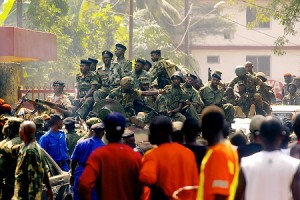 Guinean security forces should immediately cease violent attacks on demonstrators protesting against the military government, Human Rights Watch said today.
 Human Rights Watch called upon the government to hold accountable security forces responsible for firing upon and killing dozens of generally peaceful demonstrators in the Guinean capital, Conakry, on September 28, 2009. They were among tens of thousands of people protesting the rule of Capt. Moussa Dadis Camara, who had seized power in a bloodless coup in December.
"The killing of dozens of unarmed protesters is shocking even by the abusive standards of Guinea’s coup government," said Corinne Dufka, senior West Africa researcher at Human Rights Watch. "Guinea’s leaders should order an immediate end to attacks on demonstrators and bring to justice those responsible for the bloodshed."
The protesters, demonstrating against Camara’s presumed candidacy in Guinea’s January 2010 presidential elections, took to the streets of Conakry on September 28 and marched to a 25,000-seat stadium to attend a political rally. Backed by security forces, the minister responsible for combating drug trafficking and serious crime, Capt. Moussa Tiegboro Camara (no relation to the president), told the protesters not to enter the stadium. However, his troops were unable to stop the demonstrators from forcing open the doors and flooding inside.
Eyewitnesses and medical personnel told Human Rights Watch that many of the bodies of protesters were riddled with bullet holes. Others had stab wounds from knives and bayonets. A number of women taking part in the demonstration were stripped naked and sexually assaulted by security forces, victims and witnesses said.
Source: Human Rights Watch
Thursday, July 16, 2009
DR Congo: Hold Army Commanders Responsible for Rapes
The government of the Democratic Republic of Congo should urgently investigate and prosecute senior army officials allegedly involved or complicit in rampant sexual crimes against women and girls, as part of its efforts to combat sexual violence, Human Rights Watch said in a report released today. Human Rights Watch also called for a series of other actions to prevent sexual violence during conflict in Congo.
The 56-page report, "Soldiers Who Rape, Commanders Who Condone: Sexual Violence and Military Reform in the Democratic Republic of Congo," documents persistent sexual violence by the army, and the limited impact of government and donor efforts to address the problem. The report looks closely at the conduct of the army's 14th brigade as an example of the wider problem of sexual violence by soldiers. The brigade has been implicated in many acts of sexual violence in North and South Kivu provinces, often in the context of massive looting and other attacks on civilians. Despite ample information about the situation, military, political, and judicial authorities have failed to take decisive action to prevent rape.
"We have seen progress in the prosecution of ordinary soldiers for sexual violence," said Juliane Kippenberg, Africa researcher for Human Rights Watch's Children's Rights Division. "But senior army officers continue to be untouched. Their own crimes and their command responsibility for the crimes of their soldiers must be investigated and held to account."
During 2008, the United Nations registered 7,703 cases of sexual violence by the army, rebels, and other actors in the Kivus, in eastern Congo where the army has been fighting various rebel groups. The majority of the victims were girls. Military courts in Kivu convicted 27 soldiers of crimes of sexual violence during 2008. In March 2009, 11 soldiers were convicted on charges of rape as a crime against humanity in Walikale, North Kivu.
Source: Human Rights Watch
The 56-page report, "Soldiers Who Rape, Commanders Who Condone: Sexual Violence and Military Reform in the Democratic Republic of Congo," documents persistent sexual violence by the army, and the limited impact of government and donor efforts to address the problem. The report looks closely at the conduct of the army's 14th brigade as an example of the wider problem of sexual violence by soldiers. The brigade has been implicated in many acts of sexual violence in North and South Kivu provinces, often in the context of massive looting and other attacks on civilians. Despite ample information about the situation, military, political, and judicial authorities have failed to take decisive action to prevent rape.
"We have seen progress in the prosecution of ordinary soldiers for sexual violence," said Juliane Kippenberg, Africa researcher for Human Rights Watch's Children's Rights Division. "But senior army officers continue to be untouched. Their own crimes and their command responsibility for the crimes of their soldiers must be investigated and held to account."
During 2008, the United Nations registered 7,703 cases of sexual violence by the army, rebels, and other actors in the Kivus, in eastern Congo where the army has been fighting various rebel groups. The majority of the victims were girls. Military courts in Kivu convicted 27 soldiers of crimes of sexual violence during 2008. In March 2009, 11 soldiers were convicted on charges of rape as a crime against humanity in Walikale, North Kivu.
Source: Human Rights Watch
Tuesday, June 30, 2009
Constant Fear and Mob Rule in South Africa Slum
The two robbery suspects had already been viciously beaten, their swollen faces stained with rivulets of red. One of them could no longer sit up, and only the need to moan seemed to revive him into consciousness. The other, Moses Tjiwa, occasionally stared into the taunting crowd and muttered, “I didn’t do anything.”
The suspects were awaiting the final cathartic wrath of the mob, the torment of being burned alive, wrapped in the fatal shawl of a gasoline-soaked blanket. Then suddenly they were saved from that hideous death by the brave intervention of a local politician. “Let the police handle this,” he implored. As usual, the police arrived late on that recent evening, and many in the mob angrily objected to their being there at all. Finally, one police inspector shouted: “Get back or I’m leaving this place and never helping you people again. I hate Diepsloot!”
Crime in South Africa is commonly portrayed as an onslaught against the wealthy, but it is the poor who are most vulnerable: poor people conveniently accessible to poor criminals. Diepsloot, an impoverished settlement on the northern edge of Johannesburg, has an estimated population of 150,000, and the closest police station is 10 miles away. To spend time in Diepsloot over three weeks is to observe the unrelenting fear so common among the urban poor. Experts point to the particularly brutal nature of crime in this country: the unusually high number of rapes, hijackings and armed robberies. The murder rate, while declining, is about eight times higher than in the United States.
In Diepsloot, people usually bear their losses in silence, their misfortune unreported and their offenders unknown. If a suspect is identified, victims usually inform quasi-legal vigilante groups or hire their own thugs to recover their property. There is also the impromptu mob justice, when an apprehended suspect becomes the sacrificial culprit for a thousand grievances. Even Jacob Zuma, the new president, says that citizens cannot be “blamed if they take the law into their own hands.” In one way or another, most already do. Among the wealthy, private security is the substitute for police protection. The open veldt surrounding Johannesburg is filling in with one barricaded development after another, fortified with electrified fencing, cameras and armed patrols. But the poor have no money for such defenses. Robbery is the most common crime in Diepsloot, a place where most every door is flimsy and each pathway a peril. Five-pound hammers are commonly used in assaults. Thieves hide easily in the darkness, preying on those who begin their walk to work before dawn and return after nightfall.
In the case where the mob turned its rage on Mr. Tjiwa and another man, Philip Dlamini, a young woman had been toting a satchel with about $500, the day’s proceeds from the grocery where she worked. Mr. Dlamini, accused of snatching the bag away, was quickly seized. A beating made him give up the name of an abettor, Mr. Tjiwa, who at the time was beginning an evening of beer at Themba’s Bottle Shop. “What’s this about?” he recalled demanding as he was being wrenched away. “You know what it’s about,” his accusers said, smacking his head with the metal end of a spade.
A mob’s haste sometimes leads to irredeemable errors. A few days later, Superintendent Sam Mokgonyana, the commander of the police station closest to Diepsloot, speculated that neither Mr. Dlamini nor Mr. Tjiwa was involved in the robbery. Rather, he supposed, the woman carrying the cash was in league with others in some inside conspiracy. “She should have been the first one arrested,” he said. Then he sighed before adding, “I wish I had 100 more men like me so I could do some proper policing.”
South Africa is a young democracy, and people have yet to trust the government for protection. Under apartheid, the police were agents of state repression. Now, says Antony Altbeker, a criminologist, attitudes toward law enforcement have “turned from hatred into contempt.” By international standards, the South African Police Service has an adequate amount of manpower per capita, though it is an undersized force in relation to the amount of violence. Whatever the measure, people here often dismiss the police as bunglers at best and crooks at worst. In Diepsloot, an arrest is usually seen as a way to gain the leverage needed to exact a bribe.
While Superintendent Mokgonyana agreed some of his officers were corrupt, he insisted a larger share of the venality rested with prosecutors and the courts. The superintendent is new to this command and said he tried to keep at least six vehicles on patrol in Diepsloot, but said that the few paved roads did not penetrate the contorted pathways of the shacks. Officers rarely move on foot among the hovels of salvaged metal and wood. With nightfall, the people themselves are loath to venture out.
On May 17, shortly after midnight, robbers shot up Ndlovu’s Tavern, killing a man and wounding 12 others. While the gunshots likely awakened hundreds, those who hear everything most often believe it is wise to do nothing. The heist lasted three hours. Some of the robbers leisurely played snooker while others did the hard work of carrying away crates of beer. The customers had been ordered to lie face down on the floor, and one of the gunmen selected a Freddie Gwala tune on the jukebox and danced on the backs of his captives. That killing was the first of four that week in Diepsloot. “Nobody helped,” George Ndlovu, the tavern’s owner, said of his neighbors. “I don’t blame them. I would not have helped.”
Diepsloot is something of a depository for South Africans forcibly evicted from other overcrowded townships and a collection point for immigrants. It is divided into 12 “extensions.” The better areas have government-built houses. The worst have only the haphazard shacks, with no light except that provided by kerosene and paraffin. Water trickles from communal taps. Toilets are the portable kind found on construction sites. The police now park a small trailer in Extension 1, but the officers there deal only with paperwork. A red-brick police station stands on the township’s northern perimeter, but those inside are unarmed municipal officers responsible for traffic, not crime. “Even if you know who robbed you, there is not much you can do,” said David Kaise, a day laborer who was recently parted from $50 and his cellphone.
But he did try, taking his troubles to the Comrades, a group of vigilantes available for hire. They hang out amid the squalor of Extension 1, nursing bottles of Black Label beer as they await the next customer. Their methods are notorious. They chain prisoners down and pour saltwater on their buttocks to soften the skin. Then they wield a heavy plastic cane called a sjambok. A dozen or so whacks are usually enough. “The sjambok is very good medicine,” wisecracked Evens Matamisa, a slender man with dreadlocks and the Comrades’ vice chairman. “We bring people to our office. It is the best clinic in town for giving the medicine.”
Those who fight crime and those who commit it are too often the same. The Comrades required a $20 fee before accepting Mr. Kaise’s “case,” and then returned with only the phone, which was broken. The day laborer regretted his decision. “The guy who robbed me must have paid them more,” he said. Each of the extensions has a “community policing forum,” a legally empowered group of volunteers meant to assist the police — and very often to act in lieu of them. They vary in size and tactics, but many hunt down suspects and handcuff them. As punishments, they impose fines. They demolish shacks. They sometimes apply beatings.
President Zuma is an advocate for these forums and has spoken approvingly of the “instant justice” they provide. His party, the African National Congress, has called for a “massive” expansion of community policing, with stipends paid to young enlistees. But police work is dangerous and citizen vigilantes are most often unarmed. Julius Malepe, the forum chairman of Extension 7, complained that his group had apprehended several suspects only to find them back on the street within days. Then the criminals get angry with him and that puts his life in danger, he said. “We do the job for the police and at the end of the day, they get a fat check and we get nothing,” Mr. Malepe said.
That complaint came a month before Mr. Malepe was murdered. Early one Saturday this month, he led two dozen unarmed civilian “patrollers” through the neighborhood. Their vigil ended at 3 a.m., and the forum chairman and another man, Samuel Matari, walked home. As they passed the New Creation Missionaries church, they were confronted by four gunmen. “We’ve been warning you,” one of the assailants called out, according to Mr. Matari. He and his friend ran for their lives.
Mr. Malepe, the earnest, gap-toothed chairman of Extension 7, was shot down on one of the many undulating dirt roads of Diepsloot, falling dead in the darkness just a few feet from the Fly by Night Tavern.
Source: New York Times
The suspects were awaiting the final cathartic wrath of the mob, the torment of being burned alive, wrapped in the fatal shawl of a gasoline-soaked blanket. Then suddenly they were saved from that hideous death by the brave intervention of a local politician. “Let the police handle this,” he implored. As usual, the police arrived late on that recent evening, and many in the mob angrily objected to their being there at all. Finally, one police inspector shouted: “Get back or I’m leaving this place and never helping you people again. I hate Diepsloot!”
Crime in South Africa is commonly portrayed as an onslaught against the wealthy, but it is the poor who are most vulnerable: poor people conveniently accessible to poor criminals. Diepsloot, an impoverished settlement on the northern edge of Johannesburg, has an estimated population of 150,000, and the closest police station is 10 miles away. To spend time in Diepsloot over three weeks is to observe the unrelenting fear so common among the urban poor. Experts point to the particularly brutal nature of crime in this country: the unusually high number of rapes, hijackings and armed robberies. The murder rate, while declining, is about eight times higher than in the United States.
In Diepsloot, people usually bear their losses in silence, their misfortune unreported and their offenders unknown. If a suspect is identified, victims usually inform quasi-legal vigilante groups or hire their own thugs to recover their property. There is also the impromptu mob justice, when an apprehended suspect becomes the sacrificial culprit for a thousand grievances. Even Jacob Zuma, the new president, says that citizens cannot be “blamed if they take the law into their own hands.” In one way or another, most already do. Among the wealthy, private security is the substitute for police protection. The open veldt surrounding Johannesburg is filling in with one barricaded development after another, fortified with electrified fencing, cameras and armed patrols. But the poor have no money for such defenses. Robbery is the most common crime in Diepsloot, a place where most every door is flimsy and each pathway a peril. Five-pound hammers are commonly used in assaults. Thieves hide easily in the darkness, preying on those who begin their walk to work before dawn and return after nightfall.
In the case where the mob turned its rage on Mr. Tjiwa and another man, Philip Dlamini, a young woman had been toting a satchel with about $500, the day’s proceeds from the grocery where she worked. Mr. Dlamini, accused of snatching the bag away, was quickly seized. A beating made him give up the name of an abettor, Mr. Tjiwa, who at the time was beginning an evening of beer at Themba’s Bottle Shop. “What’s this about?” he recalled demanding as he was being wrenched away. “You know what it’s about,” his accusers said, smacking his head with the metal end of a spade.
A mob’s haste sometimes leads to irredeemable errors. A few days later, Superintendent Sam Mokgonyana, the commander of the police station closest to Diepsloot, speculated that neither Mr. Dlamini nor Mr. Tjiwa was involved in the robbery. Rather, he supposed, the woman carrying the cash was in league with others in some inside conspiracy. “She should have been the first one arrested,” he said. Then he sighed before adding, “I wish I had 100 more men like me so I could do some proper policing.”
South Africa is a young democracy, and people have yet to trust the government for protection. Under apartheid, the police were agents of state repression. Now, says Antony Altbeker, a criminologist, attitudes toward law enforcement have “turned from hatred into contempt.” By international standards, the South African Police Service has an adequate amount of manpower per capita, though it is an undersized force in relation to the amount of violence. Whatever the measure, people here often dismiss the police as bunglers at best and crooks at worst. In Diepsloot, an arrest is usually seen as a way to gain the leverage needed to exact a bribe.
While Superintendent Mokgonyana agreed some of his officers were corrupt, he insisted a larger share of the venality rested with prosecutors and the courts. The superintendent is new to this command and said he tried to keep at least six vehicles on patrol in Diepsloot, but said that the few paved roads did not penetrate the contorted pathways of the shacks. Officers rarely move on foot among the hovels of salvaged metal and wood. With nightfall, the people themselves are loath to venture out.
On May 17, shortly after midnight, robbers shot up Ndlovu’s Tavern, killing a man and wounding 12 others. While the gunshots likely awakened hundreds, those who hear everything most often believe it is wise to do nothing. The heist lasted three hours. Some of the robbers leisurely played snooker while others did the hard work of carrying away crates of beer. The customers had been ordered to lie face down on the floor, and one of the gunmen selected a Freddie Gwala tune on the jukebox and danced on the backs of his captives. That killing was the first of four that week in Diepsloot. “Nobody helped,” George Ndlovu, the tavern’s owner, said of his neighbors. “I don’t blame them. I would not have helped.”
Diepsloot is something of a depository for South Africans forcibly evicted from other overcrowded townships and a collection point for immigrants. It is divided into 12 “extensions.” The better areas have government-built houses. The worst have only the haphazard shacks, with no light except that provided by kerosene and paraffin. Water trickles from communal taps. Toilets are the portable kind found on construction sites. The police now park a small trailer in Extension 1, but the officers there deal only with paperwork. A red-brick police station stands on the township’s northern perimeter, but those inside are unarmed municipal officers responsible for traffic, not crime. “Even if you know who robbed you, there is not much you can do,” said David Kaise, a day laborer who was recently parted from $50 and his cellphone.
But he did try, taking his troubles to the Comrades, a group of vigilantes available for hire. They hang out amid the squalor of Extension 1, nursing bottles of Black Label beer as they await the next customer. Their methods are notorious. They chain prisoners down and pour saltwater on their buttocks to soften the skin. Then they wield a heavy plastic cane called a sjambok. A dozen or so whacks are usually enough. “The sjambok is very good medicine,” wisecracked Evens Matamisa, a slender man with dreadlocks and the Comrades’ vice chairman. “We bring people to our office. It is the best clinic in town for giving the medicine.”
Those who fight crime and those who commit it are too often the same. The Comrades required a $20 fee before accepting Mr. Kaise’s “case,” and then returned with only the phone, which was broken. The day laborer regretted his decision. “The guy who robbed me must have paid them more,” he said. Each of the extensions has a “community policing forum,” a legally empowered group of volunteers meant to assist the police — and very often to act in lieu of them. They vary in size and tactics, but many hunt down suspects and handcuff them. As punishments, they impose fines. They demolish shacks. They sometimes apply beatings.
President Zuma is an advocate for these forums and has spoken approvingly of the “instant justice” they provide. His party, the African National Congress, has called for a “massive” expansion of community policing, with stipends paid to young enlistees. But police work is dangerous and citizen vigilantes are most often unarmed. Julius Malepe, the forum chairman of Extension 7, complained that his group had apprehended several suspects only to find them back on the street within days. Then the criminals get angry with him and that puts his life in danger, he said. “We do the job for the police and at the end of the day, they get a fat check and we get nothing,” Mr. Malepe said.
That complaint came a month before Mr. Malepe was murdered. Early one Saturday this month, he led two dozen unarmed civilian “patrollers” through the neighborhood. Their vigil ended at 3 a.m., and the forum chairman and another man, Samuel Matari, walked home. As they passed the New Creation Missionaries church, they were confronted by four gunmen. “We’ve been warning you,” one of the assailants called out, according to Mr. Matari. He and his friend ran for their lives.
Mr. Malepe, the earnest, gap-toothed chairman of Extension 7, was shot down on one of the many undulating dirt roads of Diepsloot, falling dead in the darkness just a few feet from the Fly by Night Tavern.
Source: New York Times
Friday, December 7, 2007
South Africa: Violent Crime Falls
Murders, rapes and robberies fell from April through September compared with the same period in 2006. The government has been battling one of the world's highest crime rates and struggling to make the streets safe before the 2010 World Cup. Figures from the South African Police Service showed that the murder rate had dropped by 6.6 percent while the rape rate fell by 3.6 percent. ''Murder, attempted murder, robbery with aggravating circumstances and common robbery all decreased within, or almost within, the 7 to 10 percent reduction targets,'' the service said. But the rate of house robberies rose 7 percent and the rate of robberies at businesses climbed by 29 percent.
Source: New York Times
Source: New York Times
Thursday, June 1, 2006
Congo president on military rapes: 'Unforgivable'
Confronted with atrocious accounts of rape committed by members of the Congo military, Congolese President Joseph Kabila at first was silent -- then found his voice, saying "It's shocking. These kinds of acts are simply unforgivable." The father of a young girl, Kabila was commenting after watching an exclusive CNN report from last week in which women, children and a doctor described an array of sex crimes by the Congolese military -- some of whom used knives to rape their victims.
Kabila, a former military man, appeared shaken after the report. He watched it and watched it again, shifting uncomfortably in his seat each time he heard a victim's horrific story, shaking his head and narrowing his eyes. Locals say soldiers from one ethnic group are systematically raping and mutilating women from another group, with the intention, they say of destroying their child-bearing capabilities. Kabila was quick to acknowledge that more than 300 former soldiers have been convicted and jailed for sexual crimes, but admitted that is not enough. "We clearly need to do more for our citizens," he said. "But just imagine for a moment a country as large as all of Western Europe with few roads and little infrastructure. It's a difficult terrain to police and Congo doesn't have an effective policing system. But after the election, all this will change. If elected, I will make this one of my first priorities."
Kabila is the transitional president, appointed to the job after the assassination of his father in January 2001. He hopes to be the first democratically elected leader since Congo gained independence in 1960. A U.N. report earlier this month found that physical violence against civilians by members of the security forces is "reported wherever army and police are deployed." The report went on to say that rapes and other sexual violence against women and girls are occurring throughout the country, with the "main perpetrators being army and police officers." How can such crimes be happening with such impunity under his presidency? "It's shameful that soldiers anywhere are allowed to do such things," he said. "That's why I want to be president. I want to change this. I want to make security one of my first priorities so that these and other acts come to an end once and for all."
Five years ago, Kabila was catapulted to power after his father, then-President Laurent Desire Kabila, was assassinated in an attempted coup. Joseph Kabila was then 29 years old and the army chief of staff, having spent half his life in the military. He saw a peace deal signed more than three years ago attempt to halt a bloody war that began in 1998 and drew in no less than six other African countries in what Africa analysts dubbed the continent's First World War. That conflict killed an estimated 3.9 million people, and despite the accord, fighting and lawlessness abounds. Now, at 34, Kabila is running for election at the end of July. The West hopes the first democratic elections in more than 40 years will bring an end to the nation's infighting. Kabila is considered the favorite among a field of 33 candidates. "This election is extremely important for the Congolese people," he said. "It's been a long time coming, and we need this to get back into the fold of the community of nations."
Kabila spoke to CNN in the town of Lubumbashi in the country's south, a province as large as Texas and mineral-rich in everything from copper to cobalt to uranium. He appeared relaxed and at ease at first, dressed in a pin-striped suit, sky-blue shirt and striped tie. But that changed when he was shown the report on victims of sexual violence in Bukavu. "I've spent most of my life in the military," he said. "This isn't the way soldiers are supposed to behave. If elected, I will do everything I can to rectify this problem and help make our people feel safe again."
In its 2006 report on human rights in the Congo, Amnesty International said that "slow progress was (being) made in building security, justice and respect for human rights after nearly a decade of war." However, the group also noted that "Despite systematic violations of human rights, hardly any suspected perpetrators were brought to justice."
Source: CNN
Kabila, a former military man, appeared shaken after the report. He watched it and watched it again, shifting uncomfortably in his seat each time he heard a victim's horrific story, shaking his head and narrowing his eyes. Locals say soldiers from one ethnic group are systematically raping and mutilating women from another group, with the intention, they say of destroying their child-bearing capabilities. Kabila was quick to acknowledge that more than 300 former soldiers have been convicted and jailed for sexual crimes, but admitted that is not enough. "We clearly need to do more for our citizens," he said. "But just imagine for a moment a country as large as all of Western Europe with few roads and little infrastructure. It's a difficult terrain to police and Congo doesn't have an effective policing system. But after the election, all this will change. If elected, I will make this one of my first priorities."
Kabila is the transitional president, appointed to the job after the assassination of his father in January 2001. He hopes to be the first democratically elected leader since Congo gained independence in 1960. A U.N. report earlier this month found that physical violence against civilians by members of the security forces is "reported wherever army and police are deployed." The report went on to say that rapes and other sexual violence against women and girls are occurring throughout the country, with the "main perpetrators being army and police officers." How can such crimes be happening with such impunity under his presidency? "It's shameful that soldiers anywhere are allowed to do such things," he said. "That's why I want to be president. I want to change this. I want to make security one of my first priorities so that these and other acts come to an end once and for all."
Five years ago, Kabila was catapulted to power after his father, then-President Laurent Desire Kabila, was assassinated in an attempted coup. Joseph Kabila was then 29 years old and the army chief of staff, having spent half his life in the military. He saw a peace deal signed more than three years ago attempt to halt a bloody war that began in 1998 and drew in no less than six other African countries in what Africa analysts dubbed the continent's First World War. That conflict killed an estimated 3.9 million people, and despite the accord, fighting and lawlessness abounds. Now, at 34, Kabila is running for election at the end of July. The West hopes the first democratic elections in more than 40 years will bring an end to the nation's infighting. Kabila is considered the favorite among a field of 33 candidates. "This election is extremely important for the Congolese people," he said. "It's been a long time coming, and we need this to get back into the fold of the community of nations."
Kabila spoke to CNN in the town of Lubumbashi in the country's south, a province as large as Texas and mineral-rich in everything from copper to cobalt to uranium. He appeared relaxed and at ease at first, dressed in a pin-striped suit, sky-blue shirt and striped tie. But that changed when he was shown the report on victims of sexual violence in Bukavu. "I've spent most of my life in the military," he said. "This isn't the way soldiers are supposed to behave. If elected, I will do everything I can to rectify this problem and help make our people feel safe again."
In its 2006 report on human rights in the Congo, Amnesty International said that "slow progress was (being) made in building security, justice and respect for human rights after nearly a decade of war." However, the group also noted that "Despite systematic violations of human rights, hardly any suspected perpetrators were brought to justice."
Source: CNN
Wednesday, July 1, 1998
Forced labour in Myanmar (Burma)
Conclusions on the substance of the case
There is abundant evidence before the Commission showing the pervasive use of forced labour imposed on the civilian population throughout Myanmar by the authorities and the military for portering, the construction, maintenance and servicing of military camps, other work in support of the military, work on agriculture, logging and other production projects undertaken by the authorities or the military, sometimes for the profit of private individuals, the construction and maintenance of roads, railways and bridges, other infrastructure work and a range of other tasks, none of which comes under any of the exceptions listed in Article 2(2) of the Convention.
The call-up of labour is provided for in very wide terms under sections 8(1)(g)(n) and (o), 11(d) and 12 of the Village Act and sections 9(b) and 9A of the Towns Act, which are incompatible with the Convention. The procedure used in practice often follows the pattern of those provisions, in relying on the village head or ward authorities for requisitioning the labour that any military or government officer may order them to supply; but the provisions of the Village Act and the Towns Act were never actually referred to in those orders for the call-up of forced labourers that were submitted to the Commission; it thus appears that unfettered powers of military and government officers to exact forced labour from the civilian population are taken for granted, without coordination among different demands made on the same population, and people are also frequently rounded up directly by the military for forced labour, bypassing the local authorities.
Failure to comply with a call-up for labour is punishable under the Village Act with a fine or imprisonment for a term not exceeding one month, or both, and under the Towns Act, with a fine. In actual practice, the manifold exactions of forced labour often give rise to the extortion of money in exchange for a temporary alleviation of the burden, but also to threats to the life and security and extrajudicial punishment of those unwilling, slow or unable to comply with a demand for forced labour; such punishment or reprisals range from money demands to physical abuse, beatings, torture, rape and murder.
Forced labour in Myanmar is widely performed by women, children and elderly persons as well as persons otherwise unfit for work.
Forced labour in Myanmar is almost never remunerated nor compensated, secret directives notwithstanding, but on the contrary often goes hand in hand with the exaction of money, food and other supplies as well from the civilian population.
Forced labour is a heavy burden on the general population in Myanmar, preventing farmers from tending to the needs of their holdings and children from attending school; it falls most heavily on landless labourers and the poorer sections of the population, which depend on hiring out their labour for subsistence and generally have no means to comply with various money demands made by the authorities in lieu of, or over and above, the exaction of forced labour. The impossibility of making a living because of the amount of forced labour exacted is a frequent reason for fleeing the country.
A State which supports, instigates, accepts or tolerates forced labour on its territory commits a wrongful act and engages its responsibility for the violation of a peremptory norm in international law. Whatever may be the position in national law with regard to the exaction of forced or compulsory labour and the punishment of those responsible for it, any person who violates the prohibition of recourse to forced labour under the Convention is guilty of an international crime that is also, if committed in a widespread or systematic manner, a crime against humanity.
Source: International Labour Organisation (ILO)
There is abundant evidence before the Commission showing the pervasive use of forced labour imposed on the civilian population throughout Myanmar by the authorities and the military for portering, the construction, maintenance and servicing of military camps, other work in support of the military, work on agriculture, logging and other production projects undertaken by the authorities or the military, sometimes for the profit of private individuals, the construction and maintenance of roads, railways and bridges, other infrastructure work and a range of other tasks, none of which comes under any of the exceptions listed in Article 2(2) of the Convention.
The call-up of labour is provided for in very wide terms under sections 8(1)(g)(n) and (o), 11(d) and 12 of the Village Act and sections 9(b) and 9A of the Towns Act, which are incompatible with the Convention. The procedure used in practice often follows the pattern of those provisions, in relying on the village head or ward authorities for requisitioning the labour that any military or government officer may order them to supply; but the provisions of the Village Act and the Towns Act were never actually referred to in those orders for the call-up of forced labourers that were submitted to the Commission; it thus appears that unfettered powers of military and government officers to exact forced labour from the civilian population are taken for granted, without coordination among different demands made on the same population, and people are also frequently rounded up directly by the military for forced labour, bypassing the local authorities.
Failure to comply with a call-up for labour is punishable under the Village Act with a fine or imprisonment for a term not exceeding one month, or both, and under the Towns Act, with a fine. In actual practice, the manifold exactions of forced labour often give rise to the extortion of money in exchange for a temporary alleviation of the burden, but also to threats to the life and security and extrajudicial punishment of those unwilling, slow or unable to comply with a demand for forced labour; such punishment or reprisals range from money demands to physical abuse, beatings, torture, rape and murder.
Forced labour in Myanmar is widely performed by women, children and elderly persons as well as persons otherwise unfit for work.
Forced labour in Myanmar is almost never remunerated nor compensated, secret directives notwithstanding, but on the contrary often goes hand in hand with the exaction of money, food and other supplies as well from the civilian population.
Forced labour is a heavy burden on the general population in Myanmar, preventing farmers from tending to the needs of their holdings and children from attending school; it falls most heavily on landless labourers and the poorer sections of the population, which depend on hiring out their labour for subsistence and generally have no means to comply with various money demands made by the authorities in lieu of, or over and above, the exaction of forced labour. The impossibility of making a living because of the amount of forced labour exacted is a frequent reason for fleeing the country.
A State which supports, instigates, accepts or tolerates forced labour on its territory commits a wrongful act and engages its responsibility for the violation of a peremptory norm in international law. Whatever may be the position in national law with regard to the exaction of forced or compulsory labour and the punishment of those responsible for it, any person who violates the prohibition of recourse to forced labour under the Convention is guilty of an international crime that is also, if committed in a widespread or systematic manner, a crime against humanity.
Source: International Labour Organisation (ILO)
Subscribe to:
Posts (Atom)