The group of emerging economies signed the long-anticipated document to create the $100 bn BRICS Development Bank and a reserve currency pool worth over another $100 bn. Both will counter the influence of Western-based lending institutions and the dollar.
The new bank will provide money for infrastructure and development projects in BRICS countries, and unlike the IMF or World Bank, each nation has equal say, regardless of GDP size.
Each BRICS member is expected to put an equal share into establishing the startup capital of $50 billion with a goal to reach $100 billion. The BRICS bank will be headquartered in Shanghai, India will preside as president the first year, and Russia will be the chairman of the representatives.
“BRICS Bank will be one of the major multilateral development finance institutions in this world,” Russian President Vladimir Putin said on Tuesday at the 6th BRICS summit in Fortaleza, Brazil.
The big launch of the BRICS bank is seen as a first step to break the dominance of the US dollar in global trade, as well as dollar-backed institutions such as the International Monetary Fund (IMF) and the World Bank, both US-based institutions BRICS countries have little influence within.
“In terms of escalating international competition the task of activating the trade and investment cooperation between BRICS member states becomes important,” Putin said.
Russia, Brazil, India, China and South Africa account for 11 percent of global capital investment, and trade turnover almost doubled in the last 5 years, the president reminded.
Each country will send either their finance minister or Central Bank chair to the bank’s representative board.
Membership may not just be limited to just BRICS nations, either. Future members could include countries in other emerging markets blocs, such as Mexico, Indonesia, or Argentina, once it sorts out its debt burden.
BRICS represents 42 percent of the world’s population and roughly 20 percent of the world’s economy based on GDP, and 30 percent of the world’s GDP based on PPP, a more accurate reading of the real economy. Total trade between the countries is $6.14 trillion, or nearly 17 percent of the world’s total.
The $100 billion crisis lending fund, called the Contingent Reserve Arrangement (CRA), was also established. China will contribute the lion’s share, about $41 billion, Russia, Brazil and India will chip in $18 billion, and South Africa, the newest member of the economic bloc, will contribute $5 billion.
The idea is that the creation of the bank will lessen dependence on the West and create a more multi-polar world, at least financially.
“This mechanism creates the foundation for an effective protection of our national economies from a crisis in financial markets," Russian President Vladimir Putin said.
The group has already created the BRICS Stock Alliance an initiative to cross list derivatives to smooth the path for international investors interested in emerging markets.
Russia has also proposed the countries come together under an energy alliance that will include a fuel reserve, as well as an institute for energy policy
"We propose the establishment of the Energy Association of BRICS. Under this ‘umbrella’, a Fuel Reserve Bank and BRICS Energy Policy Institute could be set up,” Putin said.
Documents on cooperation between BRICS export credit agencies and an agreement of cooperation on innovation were also inked.
Bringing emerging economies closer has become vital at a time when the world is guttered by the financial crisis and BRICS countries can’t remain above international problems, said Brazil's President Dilma Rousseff.
She cautioned the world not to see BRICS deals as a desire to dominate.
“We want justice and equal rights,” she said.
“The IMF should urgently revise distribution of voting rights to reflect the importance of emerging economies globally,” Rousseff said.
Source RT
Showing posts with label China. Show all posts
Showing posts with label China. Show all posts
Tuesday, July 15, 2014


Thursday, January 9, 2014
Japan PM Shinzo Abe to pledge $14bn to Africa
Japan's Prime Minister Shinzo Abe is expected to pledge more than $14bn (£8.5bn) in aid and trade deals during his week-long visit to Africa.
He is also hoping to secure energy resources and increase exports.
Mr Abe's first stop is Oman, before he visits three fast-growing economies - Ethiopia, Ivory Coast and Mozambique.
BBC Africa Business Report's Lerato Mbele says the visit is seen as a step by Japan to compete with China, in the new scramble for African resources.
In Ethiopia, he is to announce plans for a geo-thermal plant, which reinforces the country's growing renewable energy profile.
Mozambique recently made huge gas and coal discoveries and Japan is one of many investors scouting deals there.
Although Ivory Coast is recovering after the end of a long period of conflict and political instability, it provides a gateway into French-speaking Africa, a region that's still relatively untapped by most foreign players.
Our reporter says the backdrop to this visit, is of course China, which has become the largest investor in Africa, with five times as much trade with the continent as the Japanese.
In the past week, China's foreign minister has also been visiting the continent to reinforce diplomatic and economic ties.
But one of Mr Abe's senior officials, Hiroshigo Seko, sought to downplay the rivalry in an interview with the AP news agency
"Wherever he goes, Prime Minister Abe is asked if he is there to compete against China, but that's not our intention at all, as far as the African nations are concerned, they are important regardless of China," he said.
Last year, Mr Abe hosted a three-day conference on African development, at which he pledged $32bn (£21bn) in aid, including money to tackle militant Islamists.
At the time, he said that African countries would be at the centre of global economic growth in the coming years and so Japan should increase its economic ties to the continent.
Source: BBC
He is also hoping to secure energy resources and increase exports.
Mr Abe's first stop is Oman, before he visits three fast-growing economies - Ethiopia, Ivory Coast and Mozambique.
BBC Africa Business Report's Lerato Mbele says the visit is seen as a step by Japan to compete with China, in the new scramble for African resources.
In Ethiopia, he is to announce plans for a geo-thermal plant, which reinforces the country's growing renewable energy profile.
Mozambique recently made huge gas and coal discoveries and Japan is one of many investors scouting deals there.
Although Ivory Coast is recovering after the end of a long period of conflict and political instability, it provides a gateway into French-speaking Africa, a region that's still relatively untapped by most foreign players.
Our reporter says the backdrop to this visit, is of course China, which has become the largest investor in Africa, with five times as much trade with the continent as the Japanese.
In the past week, China's foreign minister has also been visiting the continent to reinforce diplomatic and economic ties.
But one of Mr Abe's senior officials, Hiroshigo Seko, sought to downplay the rivalry in an interview with the AP news agency
"Wherever he goes, Prime Minister Abe is asked if he is there to compete against China, but that's not our intention at all, as far as the African nations are concerned, they are important regardless of China," he said.
Last year, Mr Abe hosted a three-day conference on African development, at which he pledged $32bn (£21bn) in aid, including money to tackle militant Islamists.
At the time, he said that African countries would be at the centre of global economic growth in the coming years and so Japan should increase its economic ties to the continent.
Source: BBC
Friday, April 26, 2013
The Secret of the Seven Sisters
On August 28, 1928, in the Scottish highlands, began the secret story of oil.
Three men had an appointment at Achnacarry Castle - a Dutchman, an American and an Englishman.
The Dutchman was Henry Deterding, a man nicknamed the Napoleon of Oil, having exploited a find in Sumatra. He joined forces with a rich ship owner and painted Shell salesman and together the two men founded Royal Dutch Shell.
The American was Walter C. Teagle and he represents the Standard Oil Company, founded by John D. Rockefeller at the age of 31 - the future Exxon. Oil wells, transport, refining and distribution of oil - everything is controlled by Standard oil.
The Englishman, Sir John Cadman, was the director of the Anglo-Persian oil Company, soon to become BP. On the initiative of a young Winston Churchill, the British government had taken a stake in BP and the Royal Navy switched its fuel from coal to oil. With fuel-hungry ships, planes and tanks, oil became "the blood of every battle".
The new automobile industry was developing fast, and the Ford T was selling by the million. The world was thirsty for oil, and companies were waging a merciless contest but the competition was making the market unstable.
That August night, the three men decided to stop fighting and to start sharing out the world's oil. Their vision was that production zones, transport costs, sales prices - everything would be agreed and shared. And so began a great cartel, whose purpose was to dominate the world, by controlling its oil.
Four others soon joined them, and they came to be known as the Seven Sisters - the biggest oil companies in the world.
EPISODE 1: DESERT STORMS
In the first episode, we travel across the Middle East, through both time and space.
Since that notorious meeting at Achnacarry Castle on August 28, 1928, they have never ceased to plot, to plan and to scheme.
Throughout the region's modern history, since the discovery of oil, the Seven Sisters have sought to control the balance of power.
They have supported monarchies in Iran and Saudi Arabia, opposed the creation of OPEC, profiting from the Iran-Iraq war, leading to the ultimate destruction of Saddam Hussein and Iraq.
The Seven Sisters were always present, and almost always came out on top.
EPISODE 2: THE BLACK EL DORADO
At the end of the 1960s, the Seven Sisters, the major oil companies, controlled 85 percent of the world's oil reserves. Today, they control just 10 percent.
New hunting grounds are therefore required, and the Sisters have turned their gaze towards Africa. With peak oil, wars in the Middle East, and the rise in crude prices, Africa is the oil companies' new battleground.
But the real story, the secret story of oil, begins far from Africa.
In their bid to dominate Africa, the Sisters installed a king in Libya, a dictator in Gabon, fought the nationalisation of oil resources in Algeria, and through corruption, war and assassinations, brought Nigeria to its knees.
Oil may be flowing into the holds of huge tankers, but in Lagos, petrol shortages are chronic.
The country's four refineries are obsolete and the continent's main oil exporter is forced to import refined petrol - a paradox that reaps fortunes for a handful of oil companies.
Encouraged by the companies, corruption has become a system of government - some $50bn are estimated to have 'disappeared' out of the $350bn received since independence.
But new players have now joined the great oil game.
China, with its growing appetite for energy, has found new friends in Sudan, and the Chinese builders have moved in. Sudan's President Omar al-Bashir is proud of his co-operation with China - a dam on the Nile, roads, and stadiums.
In order to export 500,000 barrels of oil a day from the oil fields in the South - China financed and built the Heglig pipeline connected to Port Sudan - now South Sudan's precious oil is shipped through North Sudan to Chinese ports.
In a bid to secure oil supplies out of Libya, the US, the UK and the Seven Sisters made peace with the once shunned Colonel Muammar Gaddafi, until he was killed during the Libyan uprising of 2011, but the flow of Libyan oil remains uninterrupted.
In need of funds for rebuilding, Libya is now back to pumping more than a million barrels of oil per day. And the Sisters are happy to oblige.
EPISODE 3: THE DANCING BEAR
In the Caucasus, the US and Russia are vying for control of the region. The great oil game is in full swing. Whoever controls the Caucasus and its roads, controls the transport of oil from the Caspian Sea.
Tbilisi, Erevan and Baku - the three capitals of the Caucasus. The oil from Baku in Azerbaijan is a strategic priority
for all the major companies.
From the fortunes of the Nobel family to the Russian revolution, to World War II, oil from the Caucasus and the Caspian has played a central role. Lenin fixated on conquering the Azeri capital Baku for its oil, as did Stalin and Hitler.
On his birthday in 1941, Adolf Hitler received a chocolate and cream birthday cake, representing a map. He chose the slice with Baku on it.
On June 22nd 1941, the armies of the Third Reich invaded Russia. The crucial battle of Stalingrad was the key to the road to the Caucasus and Baku’s oil, and would decide the outcome of the war.
Stalin told his troops: "Fighting for one’s oil is fighting for one’s freedom."
After World War II, President Nikita Krushchev would build the Soviet empire and its Red Army with revenues from the USSR’s new-found oil reserves.
Decades later, oil would bring that empire to its knees, when Saudi Arabia and the US would conspire to open up the oil taps, flood the markets, and bring the price of oil down to $13 per barrel. Russian oligarchs would take up the oil mantle, only to be put in their place by their president, Vladimir Putin, who knows that oil is power.
The US and Putin‘s Russia would prop up despots, and exploit regional conflicts to maintain a grip on the oil fields of the Caucusus and the Caspian.
But they would not have counted on the rise of a new, strong and hungry China, with an almost limitless appetite for oil and energy. Today, the US, Russia and China contest the control of the former USSR’s fossil fuel reserves, and the supply routes. A three-handed match, with the world as spectators, between three ferocious beasts – The American eagle, the Russian bear, and the Chinese dragon.
EPISODE 4: A TIME FOR LIES
Peak oil – the point in time at which the highest rate of oil extraction has been reached, and after which world production will start decline. Many geologists and the International Energy Agency say the world's crude oil output reached its peak in 2006.
But while there may be less oil coming out of the ground, the demand for it is definitely on the rise.
The final episode of this series explores what happens when oil becomes more and more inaccessible, while at the same time, new powers like China and India try to fulfill their growing energy needs.
And countries like Iran, while suffering international sanctions, have welcomed these new oil buyers, who put business ahead of lectures on human rights and nuclear ambitions.
At the same time, oil-producing countries have had enough with the Seven Sisters controlling their oil assets. Nationalisation of oil reserves around the world has ushered in a new generation of oil companies all vying for a slice of the oil pie.
These are the new Seven Sisters:
Saudi Arabia's Saudi Aramco, the largest and most sophisticated oil company in the world; Russia's Gazprom, a company that Russia's President Vladimir Putin wrested away from the oligarchs; The China National Petroleum Corporation (CNPC), which, along with its subsidiary, Petrochina, is the world's secnd largest company in terms of market value; The National Iranian Oil Company, which has a monopoly on exploration, extraction, transportation and exportation of crude oil in Iran – OPEC's second largest oil producer after Saudi Arabia; Venezuela's PDVSA, a company the late president Hugo Chavez dismantled and rebuilt into his country's economic engine and part of his diplomatic arsenal; Brazil's Petrobras, a leader in deep water oil production, that pumps out 2 million barrels of crude oil a day; and Malaysia's Petronas - Asia's most profitable company in 2012.
Mainly state-owned, the new Seven Sisters control a third of the world's oil and gas production, and more than a third of the world's reserves. The old Seven Sisters, by comparison, produce a tenth of the world's oil, and control only three percent of the reserves.
The balance has shifted.
Source: Al Jazeera
Three men had an appointment at Achnacarry Castle - a Dutchman, an American and an Englishman.
The Dutchman was Henry Deterding, a man nicknamed the Napoleon of Oil, having exploited a find in Sumatra. He joined forces with a rich ship owner and painted Shell salesman and together the two men founded Royal Dutch Shell.
The American was Walter C. Teagle and he represents the Standard Oil Company, founded by John D. Rockefeller at the age of 31 - the future Exxon. Oil wells, transport, refining and distribution of oil - everything is controlled by Standard oil.
The Englishman, Sir John Cadman, was the director of the Anglo-Persian oil Company, soon to become BP. On the initiative of a young Winston Churchill, the British government had taken a stake in BP and the Royal Navy switched its fuel from coal to oil. With fuel-hungry ships, planes and tanks, oil became "the blood of every battle".
The new automobile industry was developing fast, and the Ford T was selling by the million. The world was thirsty for oil, and companies were waging a merciless contest but the competition was making the market unstable.
That August night, the three men decided to stop fighting and to start sharing out the world's oil. Their vision was that production zones, transport costs, sales prices - everything would be agreed and shared. And so began a great cartel, whose purpose was to dominate the world, by controlling its oil.
Four others soon joined them, and they came to be known as the Seven Sisters - the biggest oil companies in the world.
EPISODE 1: DESERT STORMS
In the first episode, we travel across the Middle East, through both time and space.
We waged the Iran-Iraq war and I say we waged it, because one country had to be used to destroy the other.
- Xavier Houzel, an oil trader
Since that notorious meeting at Achnacarry Castle on August 28, 1928, they have never ceased to plot, to plan and to scheme.
Throughout the region's modern history, since the discovery of oil, the Seven Sisters have sought to control the balance of power.
They have supported monarchies in Iran and Saudi Arabia, opposed the creation of OPEC, profiting from the Iran-Iraq war, leading to the ultimate destruction of Saddam Hussein and Iraq.
The Seven Sisters were always present, and almost always came out on top.
EPISODE 2: THE BLACK EL DORADO
At the end of the 1960s, the Seven Sisters, the major oil companies, controlled 85 percent of the world's oil reserves. Today, they control just 10 percent.
New hunting grounds are therefore required, and the Sisters have turned their gaze towards Africa. With peak oil, wars in the Middle East, and the rise in crude prices, Africa is the oil companies' new battleground.
Everybody thought there could be oil in Sudan but nobody knew anything. It was revealed through exploration by the American company Chevron, towards the end of the 70s. And that was the beginning of the second civil war, which went on until 2002. It lasted for 19 years and cost a million and a half lives and the oil business was at the heart of it.
- Gerard Prunier, a historian
But the real story, the secret story of oil, begins far from Africa.
In their bid to dominate Africa, the Sisters installed a king in Libya, a dictator in Gabon, fought the nationalisation of oil resources in Algeria, and through corruption, war and assassinations, brought Nigeria to its knees.
Oil may be flowing into the holds of huge tankers, but in Lagos, petrol shortages are chronic.
The country's four refineries are obsolete and the continent's main oil exporter is forced to import refined petrol - a paradox that reaps fortunes for a handful of oil companies.
Encouraged by the companies, corruption has become a system of government - some $50bn are estimated to have 'disappeared' out of the $350bn received since independence.
But new players have now joined the great oil game.
China, with its growing appetite for energy, has found new friends in Sudan, and the Chinese builders have moved in. Sudan's President Omar al-Bashir is proud of his co-operation with China - a dam on the Nile, roads, and stadiums.
In order to export 500,000 barrels of oil a day from the oil fields in the South - China financed and built the Heglig pipeline connected to Port Sudan - now South Sudan's precious oil is shipped through North Sudan to Chinese ports.
In a bid to secure oil supplies out of Libya, the US, the UK and the Seven Sisters made peace with the once shunned Colonel Muammar Gaddafi, until he was killed during the Libyan uprising of 2011, but the flow of Libyan oil remains uninterrupted.
In need of funds for rebuilding, Libya is now back to pumping more than a million barrels of oil per day. And the Sisters are happy to oblige.
EPISODE 3: THE DANCING BEAR
In the Caucasus, the US and Russia are vying for control of the region. The great oil game is in full swing. Whoever controls the Caucasus and its roads, controls the transport of oil from the Caspian Sea.
Tbilisi, Erevan and Baku - the three capitals of the Caucasus. The oil from Baku in Azerbaijan is a strategic priority
for all the major companies.
From the fortunes of the Nobel family to the Russian revolution, to World War II, oil from the Caucasus and the Caspian has played a central role. Lenin fixated on conquering the Azeri capital Baku for its oil, as did Stalin and Hitler.
On his birthday in 1941, Adolf Hitler received a chocolate and cream birthday cake, representing a map. He chose the slice with Baku on it.
On June 22nd 1941, the armies of the Third Reich invaded Russia. The crucial battle of Stalingrad was the key to the road to the Caucasus and Baku’s oil, and would decide the outcome of the war.
Stalin told his troops: "Fighting for one’s oil is fighting for one’s freedom."
After World War II, President Nikita Krushchev would build the Soviet empire and its Red Army with revenues from the USSR’s new-found oil reserves.
Decades later, oil would bring that empire to its knees, when Saudi Arabia and the US would conspire to open up the oil taps, flood the markets, and bring the price of oil down to $13 per barrel. Russian oligarchs would take up the oil mantle, only to be put in their place by their president, Vladimir Putin, who knows that oil is power.
The US and Putin‘s Russia would prop up despots, and exploit regional conflicts to maintain a grip on the oil fields of the Caucusus and the Caspian.
But they would not have counted on the rise of a new, strong and hungry China, with an almost limitless appetite for oil and energy. Today, the US, Russia and China contest the control of the former USSR’s fossil fuel reserves, and the supply routes. A three-handed match, with the world as spectators, between three ferocious beasts – The American eagle, the Russian bear, and the Chinese dragon.
EPISODE 4: A TIME FOR LIES
Peak oil – the point in time at which the highest rate of oil extraction has been reached, and after which world production will start decline. Many geologists and the International Energy Agency say the world's crude oil output reached its peak in 2006.
But while there may be less oil coming out of the ground, the demand for it is definitely on the rise.
The final episode of this series explores what happens when oil becomes more and more inaccessible, while at the same time, new powers like China and India try to fulfill their growing energy needs.
And countries like Iran, while suffering international sanctions, have welcomed these new oil buyers, who put business ahead of lectures on human rights and nuclear ambitions.
At the same time, oil-producing countries have had enough with the Seven Sisters controlling their oil assets. Nationalisation of oil reserves around the world has ushered in a new generation of oil companies all vying for a slice of the oil pie.
These are the new Seven Sisters:
Saudi Arabia's Saudi Aramco, the largest and most sophisticated oil company in the world; Russia's Gazprom, a company that Russia's President Vladimir Putin wrested away from the oligarchs; The China National Petroleum Corporation (CNPC), which, along with its subsidiary, Petrochina, is the world's secnd largest company in terms of market value; The National Iranian Oil Company, which has a monopoly on exploration, extraction, transportation and exportation of crude oil in Iran – OPEC's second largest oil producer after Saudi Arabia; Venezuela's PDVSA, a company the late president Hugo Chavez dismantled and rebuilt into his country's economic engine and part of his diplomatic arsenal; Brazil's Petrobras, a leader in deep water oil production, that pumps out 2 million barrels of crude oil a day; and Malaysia's Petronas - Asia's most profitable company in 2012.
Mainly state-owned, the new Seven Sisters control a third of the world's oil and gas production, and more than a third of the world's reserves. The old Seven Sisters, by comparison, produce a tenth of the world's oil, and control only three percent of the reserves.
The balance has shifted.
Source: Al Jazeera
Thursday, November 29, 2012
Dalai Lama's visa delay to South Africa 'unlawful'
South Africa's government acted unlawfully in failing to give the Dalai Lama a visa in time for a planned visit last year, a court has ruled.
Tibet's spiritual leader was forced to cancel plans to attend Archbishop Desmond Tutu's 80th birthday celebrations in October 2011.
The Supreme Court of Appeal said the former home affairs minister had "unreasonably delayed her decision".
The government denied it had bowed to pressure from China to block the trip.
Stalling tactics
The Supreme Court of Appeal was hearing an appeal application by two opposition parties - the Inkatha Freedom Party (IFP) and the Congress of the People (Cope) - about the issue. Archbishop Desmond Tutu said the failure to grant the Dalai Lama a visa was a disgrace
Earlier, the Western Cape High Court had dismissed the case, the South Africa Press Association reports. Archbishop Tutu was furious about the visa delay for his fellow Nobel Peace Prize winner and accused the government of behaving "worse than the apartheid government".
According to the AFP news agency, the Supreme Court of Appeal found no evidence that the government had actually made a decision not to grant a visa, but did detect stalling tactics.
"What is justified by the evidence is an inference that the matter was deliberately delayed so as to avoid a decision," the news agency quotes the judgment as saying.
The court said that former Home Affairs Minister Nkosazana Dlamini-Zuma "was not entitled to deliberately procrastinate", South Africa's City Press newspaper reports.
Ms Dlamini-Zuma, who is President Jacob Zuma's ex-wife, now heads the Africa Union.
The Dalai Lama eventually delivered a lecture at Archbishop Tutu's birthday celebrations via a video link.
Source: BBC News
Tibet's spiritual leader was forced to cancel plans to attend Archbishop Desmond Tutu's 80th birthday celebrations in October 2011.
The Supreme Court of Appeal said the former home affairs minister had "unreasonably delayed her decision".
The government denied it had bowed to pressure from China to block the trip.
Stalling tactics
The Supreme Court of Appeal was hearing an appeal application by two opposition parties - the Inkatha Freedom Party (IFP) and the Congress of the People (Cope) - about the issue. Archbishop Desmond Tutu said the failure to grant the Dalai Lama a visa was a disgrace
Earlier, the Western Cape High Court had dismissed the case, the South Africa Press Association reports. Archbishop Tutu was furious about the visa delay for his fellow Nobel Peace Prize winner and accused the government of behaving "worse than the apartheid government".
According to the AFP news agency, the Supreme Court of Appeal found no evidence that the government had actually made a decision not to grant a visa, but did detect stalling tactics.
"What is justified by the evidence is an inference that the matter was deliberately delayed so as to avoid a decision," the news agency quotes the judgment as saying.
The court said that former Home Affairs Minister Nkosazana Dlamini-Zuma "was not entitled to deliberately procrastinate", South Africa's City Press newspaper reports.
Ms Dlamini-Zuma, who is President Jacob Zuma's ex-wife, now heads the Africa Union.
The Dalai Lama eventually delivered a lecture at Archbishop Tutu's birthday celebrations via a video link.
Source: BBC News
Tuesday, August 28, 2012
Analysis: Syria - three wars for the price of one
If you think the war in Syria is hard to follow, that’s because there’s
actually three of them—at least. Distinct but interconnected, the
competing web of allegiances and motivations puts al-Qaeda on the same
side as the USA and makes a solution impossible. By SIMON ALLISON.
Many people, like this reporter, find the Syrian war confusing sometimes. It throws up all kind of strange and unnatural contradictions, like America appearing to be on the same side as al-Qaeda-linked jihadists and Al-Jazeera turning into a typical, propaganda-spouting state media house. No doubt policy-makers also find it difficult to understand. It’s been nearly two years and there’s still no sensible international policy on Syria, just a steady stream of ad-hoc condemnations and hamstrung mediations.
There’s a simple reason for all this confusion and complexity: it’s a very, very complicated situation. Even worse, there’s not just one war being fought in Syria, but at least three and possibly even more.
War number one is the one we’re all familiar with (especially if we’ve been watching too much Al-Jazeera). This is your typical Arab Spring narrative, pitting a downtrodden civilian population against the brutal regime that has repressed its people for so long. It’s a simple tale of good-versus-evil, of democracy taking on dictatorship, of the people sticking it to the man. We’ve seen variations of the theme in Tunisia, Egypt and Libya, all of which ended with the people hurling off the yoke of dictatorship and replacing it with a new, enlightened, freely-elected government (oh, wait; it hasn’t quite ended like that in any of these countries, but let’s not spoil a good story with the facts).
Elements of this story are true in Syria. Certainly, the regime was brutal and autocratic, happy to stifle political freedoms and concentrate wealth and power in the hands of a very few, mostly of the Alawite ethnic minority. In fact, the Syrian security forces had such a world-class reputation for torture that they were, on occasion, prevailed upon by American intelligence to practise their craft on detainees as part America’s extraordinary rendition program.
There was popular dissent, too. Not much of it initially, but it grew in size and voice in the wake of the uprisings in other Arab countries. Whether or not the anti-Assad movement was really a majority will be argued over endlessly in years to come, but it is important to recognise that just as there was a large anti-Assad sentiment, so there was a significant chunk of the population that was happy with the status quo; autocracies are stable and peaceful, after all, unlike revolutions and civil wars.
War number two is not really about Syria at all. Instead, it’s about Middle Eastern and global geopolitics, and it’s very messy. In one corner is the Syrian Alawite regime and Iran, who are natural allies. The Alawites are a sect of Shi’a Islam, while Iran is an explicitly Shi’a state (as opposed to Sunni Islam, the other main branch of the religion). Russia finds itself in this camp too, desperate to protect its vital naval base in the Syrian port of Tartus—its only reliable warm water port. So too does China, which sees no reason to put its excellent trading relationship with Syria in jeopardy.
Ranged against this formidable combination is a regional alliance of Qatar, Saudi Arabia and Turkey, all of which would love to see Bashar al-Assad replaced with a more compliant Sunni leader. All have designs on regional leadership, and in Syria they find common cause. Turkey was one of the first countries to express support for the Syrian rebels, while both Qatar and Saudi Arabia have helped to fund and arm them. Qatar has also been accused – with some justification – of using its hugely influential satellite TV channel, Al-Jazeera (specifically the Arabic version) to influence public opinion by portraying a one-sided version of events.
Lurking behind this regional triumvirate is the United States and the Western world, their foreign policy distorted, as usual, by their Iranian paranoia. Robert Fisk, doyen of Middle East correspondents, summed up their approach in the Independent: “This is an attempt to crush the Syrian dictatorship not because of our love for Syrians or our hatred of our former friend Bashar al-Assad, or because of our outrage at Russia, whose place in the pantheon of hypocrites is clear when we watch its reaction to all the little Stalingrads across Syria. No, this is all about Iran and our desire to crush the Islamic Republic and its infernal nuclear plans—if they exist—and has nothing to do with human rights or the right to life or the death of Syrian babies.”
Syria, in other words, is a proxy war; a relatively safe place (for everyone else, not for Syria) to fight the battles that can’t yet be fought in the open.
But it doesn’t end there. There’s a third war happening. This one pits the nominally Shi’a (though relatively secular) Syrian state against the global Sunni jihadist movement (known to Americans as “terrorists”). A flood of reports recently have explained how fighters from all over the Arab world, many of them battle-hardened in Afghanistan, Libya and Iraq, have come to the support of the Syrian rebels.
This from Ed Husain in the National Review is typical: “Our collective excitement at the possibility that the Assad regime will be destroyed, and the Iranian ayatollahs weakened in the process, is blurring our vision and preventing us from seeing the rise of al-Qaeda in Syria. In March of this year, jihadis mounted seven attacks against Assad. By June, they had led 66 “operations”, and over half of these were on Syria’s capital, Damascus. The Syrian opposition is benefiting hugely from the terrorist organization’s determination, discipline, combat experience, religious fervour, and ability to strike the Assad regime where it hurts most.”
The War on Terror has reached Syria and somehow, America and al-Qaeda find themselves fighting on the same side. No wonder no one seems to know what’s really going on.
Nor does anyone know how to stop it. With all these tangled conflicts and competing interests and motivations, figuring out a solution seems like an impossible task. Which, so far, is exactly what it’s proven to be. DM
Source: Daily Maverick
Many people, like this reporter, find the Syrian war confusing sometimes. It throws up all kind of strange and unnatural contradictions, like America appearing to be on the same side as al-Qaeda-linked jihadists and Al-Jazeera turning into a typical, propaganda-spouting state media house. No doubt policy-makers also find it difficult to understand. It’s been nearly two years and there’s still no sensible international policy on Syria, just a steady stream of ad-hoc condemnations and hamstrung mediations.
There’s a simple reason for all this confusion and complexity: it’s a very, very complicated situation. Even worse, there’s not just one war being fought in Syria, but at least three and possibly even more.
War number one is the one we’re all familiar with (especially if we’ve been watching too much Al-Jazeera). This is your typical Arab Spring narrative, pitting a downtrodden civilian population against the brutal regime that has repressed its people for so long. It’s a simple tale of good-versus-evil, of democracy taking on dictatorship, of the people sticking it to the man. We’ve seen variations of the theme in Tunisia, Egypt and Libya, all of which ended with the people hurling off the yoke of dictatorship and replacing it with a new, enlightened, freely-elected government (oh, wait; it hasn’t quite ended like that in any of these countries, but let’s not spoil a good story with the facts).
Elements of this story are true in Syria. Certainly, the regime was brutal and autocratic, happy to stifle political freedoms and concentrate wealth and power in the hands of a very few, mostly of the Alawite ethnic minority. In fact, the Syrian security forces had such a world-class reputation for torture that they were, on occasion, prevailed upon by American intelligence to practise their craft on detainees as part America’s extraordinary rendition program.
There was popular dissent, too. Not much of it initially, but it grew in size and voice in the wake of the uprisings in other Arab countries. Whether or not the anti-Assad movement was really a majority will be argued over endlessly in years to come, but it is important to recognise that just as there was a large anti-Assad sentiment, so there was a significant chunk of the population that was happy with the status quo; autocracies are stable and peaceful, after all, unlike revolutions and civil wars.
War number two is not really about Syria at all. Instead, it’s about Middle Eastern and global geopolitics, and it’s very messy. In one corner is the Syrian Alawite regime and Iran, who are natural allies. The Alawites are a sect of Shi’a Islam, while Iran is an explicitly Shi’a state (as opposed to Sunni Islam, the other main branch of the religion). Russia finds itself in this camp too, desperate to protect its vital naval base in the Syrian port of Tartus—its only reliable warm water port. So too does China, which sees no reason to put its excellent trading relationship with Syria in jeopardy.
Ranged against this formidable combination is a regional alliance of Qatar, Saudi Arabia and Turkey, all of which would love to see Bashar al-Assad replaced with a more compliant Sunni leader. All have designs on regional leadership, and in Syria they find common cause. Turkey was one of the first countries to express support for the Syrian rebels, while both Qatar and Saudi Arabia have helped to fund and arm them. Qatar has also been accused – with some justification – of using its hugely influential satellite TV channel, Al-Jazeera (specifically the Arabic version) to influence public opinion by portraying a one-sided version of events.
Lurking behind this regional triumvirate is the United States and the Western world, their foreign policy distorted, as usual, by their Iranian paranoia. Robert Fisk, doyen of Middle East correspondents, summed up their approach in the Independent: “This is an attempt to crush the Syrian dictatorship not because of our love for Syrians or our hatred of our former friend Bashar al-Assad, or because of our outrage at Russia, whose place in the pantheon of hypocrites is clear when we watch its reaction to all the little Stalingrads across Syria. No, this is all about Iran and our desire to crush the Islamic Republic and its infernal nuclear plans—if they exist—and has nothing to do with human rights or the right to life or the death of Syrian babies.”
Syria, in other words, is a proxy war; a relatively safe place (for everyone else, not for Syria) to fight the battles that can’t yet be fought in the open.
But it doesn’t end there. There’s a third war happening. This one pits the nominally Shi’a (though relatively secular) Syrian state against the global Sunni jihadist movement (known to Americans as “terrorists”). A flood of reports recently have explained how fighters from all over the Arab world, many of them battle-hardened in Afghanistan, Libya and Iraq, have come to the support of the Syrian rebels.
This from Ed Husain in the National Review is typical: “Our collective excitement at the possibility that the Assad regime will be destroyed, and the Iranian ayatollahs weakened in the process, is blurring our vision and preventing us from seeing the rise of al-Qaeda in Syria. In March of this year, jihadis mounted seven attacks against Assad. By June, they had led 66 “operations”, and over half of these were on Syria’s capital, Damascus. The Syrian opposition is benefiting hugely from the terrorist organization’s determination, discipline, combat experience, religious fervour, and ability to strike the Assad regime where it hurts most.”
The War on Terror has reached Syria and somehow, America and al-Qaeda find themselves fighting on the same side. No wonder no one seems to know what’s really going on.
Nor does anyone know how to stop it. With all these tangled conflicts and competing interests and motivations, figuring out a solution seems like an impossible task. Which, so far, is exactly what it’s proven to be. DM
Source: Daily Maverick
Wednesday, August 22, 2012
Obama threatens to invade Syria
Yesterday US and NATO officials discussed plans for a US military invasion of Syria to bring down Syrian President Bashar Al-Assad, after US President Barack Obama announced that the US was contemplating a direct attack on Syria at a press conference Monday night.
A delegation led by Assistant Secretary of State for Near East Affairs Beth Jones discussed US military plans with Turkey. State Department spokeswoman Victoria Nuland said that Defense Department and US intelligence officials met their Turkish counterparts “to share operational pictures, to talk about the effectiveness of what we’re doing now, and about what more we can do.”
Senior US officials said that contingency plans for US intervention in Syria include scenarios requiring tens of thousands of American troops.
At a press conference at the White House Monday, Obama declared: “I have indicated repeatedly that President al-Assad has lost legitimacy, that he needs to step down. So far, he hasn’t gotten the message, and instead has double downed in violence on his own people. The international community has sent a clear message that rather than drag his country into civil war he should move in the direction of a political transition. But at this point, the likelihood of a soft landing seems pretty distant.”
Obama said that he would order “military engagement” if chemical or biological weapons are moved or used in Syria. He said that Syria’s alleged stockpile of chemical weapons “concerns our close allies in the region, including Israel. It concerns us. We cannot have a situation in which chemical or biological weapons are falling into the hands of the wrong people.”
Obama added that the US “have communicated in no uncertain terms with every player in the region, that that’s a red line for us, and that there would be enormous consequences if we start seeing movement on the chemical weapons front, or the use of chemical weapons.”
The cynicism with which Obama is seeking to justify the next US imperialist aggression in the Middle East is staggering. The main groups in Syria who could seize chemical weapons from Syrian government stockpiles are Al Qaeda forces promoted by the US and its allies as shock troops against Assad. (See also: “Washington’s proxy in Syria: Al Qaeda”)
Having armed Al Qaeda-linked groups and sent them into Syria to carry out bombings and assassinations, the US and its allies now plan to justify their invasion of Syria by citing the need to protect the world’s population from Al Qaeda’s terrorist atrocities!
The Obama administration advances its arguments today with total disregard for the fact that they clash with the lies used until now to justify its support for Sunni anti-Assad “rebels.”
For months it maintained the pretense that it would not directly attack Syria, and that the Syrian regime’s statements that it was fighting US-backed terrorists were “propaganda.” Now, the White House is admitting that terrorist groups play a major role in the anti-Assad forces, and citing this as a pretext for war.
By proceeding in this fashion, the Obama administration demonstrates its complete contempt for the American electorate, which voted him into office in 2008 in large part based on hopes he would stop the US military aggressions against countries in the Middle East. Today, as during the 2003 invasion of Syria’s neighbor, Iraq, Washington is preparing to invade a country based on cynical lies about weapons of mass destruction.
A US invasion of Syria would be a crime of historic proportions, like the war in Iraq—a country whose population is only slightly larger than Syria’s. This war led to the deaths of over a million Iraqis and thousands of US and allied soldiers. Iraq became a battleground for US occupation forces, as well as Sunni and Shiite death squads that carried out sectarian bombings and massacres.
A US invasion would threaten similar carnage inside Syria, which is already being torn apart by sectarian fighting in which Washington is working with right-wing regimes in Turkey, Saudi Arabia and Qatar to back Sunni Islamist forces against Syria’s Alawite regime. However, the far greater tensions in a region already destabilized by a decade of US and Israeli wars in Iraq, Lebanon, Palestine, and Libya now threaten to spread the violence over the entire Middle East.
Sectarian bloodshed provoked by the intensifying US intervention in the region is already spilling over into Syria’s neighbors. On Tuesday four people were killed and more than 60 wounded in firefights between Sunni Muslims and Shiite Alawites in the northern Lebanese city of Tripoli. Tensions in Lebanon have been growing for months, with Western-backed forces seeking to provoke the Lebanese government which is led by the Shiite organization Hizbollah, a close ally of Syria and Iran.
A US war against Syria would be the next step in an ongoing campaign by US imperialism to deepen its hegemony over the energy-rich and geo-strategically vital regions of the Persian Gulf and Central Asia.
The Syrian regime responded to US threats with warnings and proposals for negotiations. Syrian Deputy Prime Minister Qadri Jamil described Obama’s statements about chemical weapons as a pretext for Western intervention in Syria. “The West is looking for an excuse for direct intervention. If this excuse does not work, it will look for another excuse.” He warned that an attack on Syria would turn the conflict into a regional war, saying: “Those who are contemplating this evidently want to see the crisis expand beyond Syria’s borders.”
Jamil announced that the Syrian regime is willing to talk with the opposition to work out a transition, however. He even declared that Assad’s presidency is negotiable, stating: “We are ready to discuss Assad’s resignation—but not as precondition.”
Obama’s war threats against Syria are also deepening tensions with Russia and China, who have already vetoed three UN Security Council resolutions backed by the US and its Western and Arab allies aiming to give a pseudo-legal fig leaf for US aggression against Syria.
Russia’s foreign minister Sergei Lavrov spoke at a meeting in Moscow with China’s State Councilor Dai Bingguo, who also met Russian President Vladimir Putin and his top security adviser, Nikolai Patrushev, on Monday. Lavrov said that both Russia and China base their diplomatic cooperation on “the need to strictly adhere to the norms of international law and the principles contained in the U.N. Charter, and not to allow their violation.”
Lavrov said that only the Security Council has the authority to approve the use of external force against Syria, warning against imposing “democracy by bombs.” Russian officials have reportedly stated that they hope to avoid a repetition of the attack on Libya last year. Moscow abstained from the Security Council vote on Libya, and a resolution was passed which was subsequently used by NATO to justify its bombing of the country.
Source: World Socialist Web Site
A delegation led by Assistant Secretary of State for Near East Affairs Beth Jones discussed US military plans with Turkey. State Department spokeswoman Victoria Nuland said that Defense Department and US intelligence officials met their Turkish counterparts “to share operational pictures, to talk about the effectiveness of what we’re doing now, and about what more we can do.”
Senior US officials said that contingency plans for US intervention in Syria include scenarios requiring tens of thousands of American troops.
At a press conference at the White House Monday, Obama declared: “I have indicated repeatedly that President al-Assad has lost legitimacy, that he needs to step down. So far, he hasn’t gotten the message, and instead has double downed in violence on his own people. The international community has sent a clear message that rather than drag his country into civil war he should move in the direction of a political transition. But at this point, the likelihood of a soft landing seems pretty distant.”
Obama said that he would order “military engagement” if chemical or biological weapons are moved or used in Syria. He said that Syria’s alleged stockpile of chemical weapons “concerns our close allies in the region, including Israel. It concerns us. We cannot have a situation in which chemical or biological weapons are falling into the hands of the wrong people.”
Obama added that the US “have communicated in no uncertain terms with every player in the region, that that’s a red line for us, and that there would be enormous consequences if we start seeing movement on the chemical weapons front, or the use of chemical weapons.”
The cynicism with which Obama is seeking to justify the next US imperialist aggression in the Middle East is staggering. The main groups in Syria who could seize chemical weapons from Syrian government stockpiles are Al Qaeda forces promoted by the US and its allies as shock troops against Assad. (See also: “Washington’s proxy in Syria: Al Qaeda”)
Having armed Al Qaeda-linked groups and sent them into Syria to carry out bombings and assassinations, the US and its allies now plan to justify their invasion of Syria by citing the need to protect the world’s population from Al Qaeda’s terrorist atrocities!
The Obama administration advances its arguments today with total disregard for the fact that they clash with the lies used until now to justify its support for Sunni anti-Assad “rebels.”
For months it maintained the pretense that it would not directly attack Syria, and that the Syrian regime’s statements that it was fighting US-backed terrorists were “propaganda.” Now, the White House is admitting that terrorist groups play a major role in the anti-Assad forces, and citing this as a pretext for war.
By proceeding in this fashion, the Obama administration demonstrates its complete contempt for the American electorate, which voted him into office in 2008 in large part based on hopes he would stop the US military aggressions against countries in the Middle East. Today, as during the 2003 invasion of Syria’s neighbor, Iraq, Washington is preparing to invade a country based on cynical lies about weapons of mass destruction.
A US invasion of Syria would be a crime of historic proportions, like the war in Iraq—a country whose population is only slightly larger than Syria’s. This war led to the deaths of over a million Iraqis and thousands of US and allied soldiers. Iraq became a battleground for US occupation forces, as well as Sunni and Shiite death squads that carried out sectarian bombings and massacres.
A US invasion would threaten similar carnage inside Syria, which is already being torn apart by sectarian fighting in which Washington is working with right-wing regimes in Turkey, Saudi Arabia and Qatar to back Sunni Islamist forces against Syria’s Alawite regime. However, the far greater tensions in a region already destabilized by a decade of US and Israeli wars in Iraq, Lebanon, Palestine, and Libya now threaten to spread the violence over the entire Middle East.
Sectarian bloodshed provoked by the intensifying US intervention in the region is already spilling over into Syria’s neighbors. On Tuesday four people were killed and more than 60 wounded in firefights between Sunni Muslims and Shiite Alawites in the northern Lebanese city of Tripoli. Tensions in Lebanon have been growing for months, with Western-backed forces seeking to provoke the Lebanese government which is led by the Shiite organization Hizbollah, a close ally of Syria and Iran.
A US war against Syria would be the next step in an ongoing campaign by US imperialism to deepen its hegemony over the energy-rich and geo-strategically vital regions of the Persian Gulf and Central Asia.
The Syrian regime responded to US threats with warnings and proposals for negotiations. Syrian Deputy Prime Minister Qadri Jamil described Obama’s statements about chemical weapons as a pretext for Western intervention in Syria. “The West is looking for an excuse for direct intervention. If this excuse does not work, it will look for another excuse.” He warned that an attack on Syria would turn the conflict into a regional war, saying: “Those who are contemplating this evidently want to see the crisis expand beyond Syria’s borders.”
Jamil announced that the Syrian regime is willing to talk with the opposition to work out a transition, however. He even declared that Assad’s presidency is negotiable, stating: “We are ready to discuss Assad’s resignation—but not as precondition.”
Obama’s war threats against Syria are also deepening tensions with Russia and China, who have already vetoed three UN Security Council resolutions backed by the US and its Western and Arab allies aiming to give a pseudo-legal fig leaf for US aggression against Syria.
Russia’s foreign minister Sergei Lavrov spoke at a meeting in Moscow with China’s State Councilor Dai Bingguo, who also met Russian President Vladimir Putin and his top security adviser, Nikolai Patrushev, on Monday. Lavrov said that both Russia and China base their diplomatic cooperation on “the need to strictly adhere to the norms of international law and the principles contained in the U.N. Charter, and not to allow their violation.”
Lavrov said that only the Security Council has the authority to approve the use of external force against Syria, warning against imposing “democracy by bombs.” Russian officials have reportedly stated that they hope to avoid a repetition of the attack on Libya last year. Moscow abstained from the Security Council vote on Libya, and a resolution was passed which was subsequently used by NATO to justify its bombing of the country.
Source: World Socialist Web Site
Friday, August 17, 2012
Lonmin shootings will change SA labour relations
THE emergence of a rival union in the platinum space must be the most worrying event in the 30-year history of the National Union of Mineworkers (NUM). The union is one of the biggest and certainly most politically powerful under the blanket of the Congress of South African Trade Unions, representing close to a fifth of its entire membership and has an important place in the African National Congress (ANC) alliance.
Given the importance of mining in the South African economy, support from the union is integral to the ruling faction in the ANC. It is this political role on which its leaders may have placed too much focus because of populist nationalisation rhetoric as well as the succession battle, to the detriment of its core mandate.
Straying from that focus on the interests of its workers has opened up space on its shop floors for a rival union, the Association of Mineworkers and Construction Union (Amcu). This happens as the situation remains dire for miners in the platinum sector as prices for the metal remain weak and costs keep rising because of poor management and other factors.
The NUM lays the blame for the unfolding violence in North West on mining houses for making unilateral salary adjustments that undermine existing wage agreements. Amcu may have been opportunistic in using those grievances from the disparities in pay to muscle in, but where has the NUM been? The union should have been alert and ready to react to the grievances.
You’ve got to think the union, which once had held sway over the entire mining industry, has taken its eyes off the ball in a big way. After the warning shots at Impala Platinum, the world’s second-biggest miner, the battle is playing out at Lonmin, the third biggest.
For the first time in the course of the Lonmin dispute, which has caused a number of fatalities, platinum prices have responded. In late afternoon trade, it had its biggest percentage gain in a month.
Anglo American Platinum, the world’s biggest miner, could well be the next explosion point in this festering battle. The NUM has warned that the turf war could spread to other mineral segments too.
The 30-year old NUM monopoly has certainly been challenged and it looks likely that it will continue to be unless its leadership gets focused on the matters at hand, instead of who occupies Luthuli House and the Union Buildings.
The deaths of the Lonmin workers yesterday have changed labour relations in the mining industry forever. Miners and the government may have to invite another party to the negotiating table, further complicating an already complicated mining regime.
...
FOR the average Chinese citizen without access to international markets, there are very few places to go to grow their wealth. The stock market in the world’s second-biggest economy has underperformed all its emerging market peers as well as other major equity markets, with the Shanghai Stock Exchange index down almost 20% over the past 12 months.
In that time, the JSE all share has gained 19%, London’s FTSE 8,9% and the S&P has rallied 18%.
The only alternative is to invest in property and that has been quite the story over the past 10 years. In the country’s major cities, house prices are about 30 times the annual salary and in the smaller metros 10 times. Compare that to five times the annual salary in the US at the height of its housing bubble.
Realising the risk posed by this growth in housing prices, last year the Chinese government raised rates to both cool the housing market and to combat inflation.
Inflationary pressures have eased this year, unfortunately so has growth.
So much so that foreign direct investment in what was once the golden goose in terms of investment destinations has seen the biggest drop in two years.
Data out of China yesterday showed investment slid 8.7%, the eighth drop in nine months and the smallest inflow since July 2010.
China has now come under pressure from investors, much like the US and Europe has over the past four years, to look at measures to boost economic growth — either by cutting rates or lowering the reserve margin required by banks.
But just how far can China go to boost its economy without further fuelling concerns over its property market? It must be keeping the political powers in that part of the world awake at night, especially as there will be a change of guard by the end of the year.
As for other central banks in the global economy, there’s not much room to manoeuvre.
Source: Business Day
Given the importance of mining in the South African economy, support from the union is integral to the ruling faction in the ANC. It is this political role on which its leaders may have placed too much focus because of populist nationalisation rhetoric as well as the succession battle, to the detriment of its core mandate.
Straying from that focus on the interests of its workers has opened up space on its shop floors for a rival union, the Association of Mineworkers and Construction Union (Amcu). This happens as the situation remains dire for miners in the platinum sector as prices for the metal remain weak and costs keep rising because of poor management and other factors.
The NUM lays the blame for the unfolding violence in North West on mining houses for making unilateral salary adjustments that undermine existing wage agreements. Amcu may have been opportunistic in using those grievances from the disparities in pay to muscle in, but where has the NUM been? The union should have been alert and ready to react to the grievances.
You’ve got to think the union, which once had held sway over the entire mining industry, has taken its eyes off the ball in a big way. After the warning shots at Impala Platinum, the world’s second-biggest miner, the battle is playing out at Lonmin, the third biggest.
For the first time in the course of the Lonmin dispute, which has caused a number of fatalities, platinum prices have responded. In late afternoon trade, it had its biggest percentage gain in a month.
Anglo American Platinum, the world’s biggest miner, could well be the next explosion point in this festering battle. The NUM has warned that the turf war could spread to other mineral segments too.
The 30-year old NUM monopoly has certainly been challenged and it looks likely that it will continue to be unless its leadership gets focused on the matters at hand, instead of who occupies Luthuli House and the Union Buildings.
The deaths of the Lonmin workers yesterday have changed labour relations in the mining industry forever. Miners and the government may have to invite another party to the negotiating table, further complicating an already complicated mining regime.
...
FOR the average Chinese citizen without access to international markets, there are very few places to go to grow their wealth. The stock market in the world’s second-biggest economy has underperformed all its emerging market peers as well as other major equity markets, with the Shanghai Stock Exchange index down almost 20% over the past 12 months.
In that time, the JSE all share has gained 19%, London’s FTSE 8,9% and the S&P has rallied 18%.
The only alternative is to invest in property and that has been quite the story over the past 10 years. In the country’s major cities, house prices are about 30 times the annual salary and in the smaller metros 10 times. Compare that to five times the annual salary in the US at the height of its housing bubble.
Realising the risk posed by this growth in housing prices, last year the Chinese government raised rates to both cool the housing market and to combat inflation.
Inflationary pressures have eased this year, unfortunately so has growth.
So much so that foreign direct investment in what was once the golden goose in terms of investment destinations has seen the biggest drop in two years.
Data out of China yesterday showed investment slid 8.7%, the eighth drop in nine months and the smallest inflow since July 2010.
China has now come under pressure from investors, much like the US and Europe has over the past four years, to look at measures to boost economic growth — either by cutting rates or lowering the reserve margin required by banks.
But just how far can China go to boost its economy without further fuelling concerns over its property market? It must be keeping the political powers in that part of the world awake at night, especially as there will be a change of guard by the end of the year.
As for other central banks in the global economy, there’s not much room to manoeuvre.
Source: Business Day
Wednesday, August 8, 2012
U.S., Too, Wants to Bolster Investment in a Continent’s Economic Promise
PRETORIA, South Africa — When Secretary of State Hillary Rodham Clinton landed in South Africa this week, she brought along a hefty delegation of executives from some of America’s leading companies — Boeing, Walmart, FedEx, G.E. — and a message: America is ready to invest in Africa.
But these companies need no introduction to the continent, which is home to 7 of the world’s 10 fastest growing economies. They are already here. Earlier this year, Walmart finalized a deal worth more than $2 billion to acquire 51 percent of South Africa’s leading retailer, MassMart. In March, G.E. signed a deal to build $10 billion worth of power plants in Nigeria over the next decade. Six hundred American companies have invested in South Africa alone.
Mrs. Clinton’s trip, expected to stretch over the better part of two weeks and nine countries, reflects the shifting image of the continent and the deepening political, economic and security stakes at play here. There was a time in the not-too-distant past when a trip to Africa by a senior United States official would focus largely on humanitarian aid and development assistance to hopelessly poor, war-torn nations.
No more. These days, the continent is widely seen as the next frontier for economic growth. Politically, African votes are sometimes crucial in the United Nations, particularly South Africa’s. On the security front, alliances with African governments to fight terrorism and piracy are very important to the United States.
“Africa is no longer an object of our fears or hopes or pity,” said Todd Moss, a senior fellow at the Center for Global Development, a research institution in Washington. But “the United States is stuck in a bit of a time warp,” only recently catching up to the changing realities on the ground, he said.
Other players, most notably but not exclusively China, anticipated this shift long ago and have a significant head start on the continent, analysts say.
“China is recognizing the potential, and the U.S. is not grasping these opportunities,” said Peter Lewis, an expert on Africa at Johns Hopkins University. “They are losing the narrative.”
Again and again on her trip, Mrs. Clinton pressed for deepening economic ties, saying — in what was widely interpreted as a swipe at China — that the United States does not simply want to export the continent’s bountiful raw materials and pocket the proceeds back home; it seeks a partnership that will bring broad benefits to all Africans.
“The days of having outsiders come and extract the wealth of Africa for themselves, leaving nothing or very little behind, should be over in the 21st century,” Mrs. Clinton said in a speech in Dakar, Senegal.
That remark prompted a rare rebuke from China in the form of an editorial from the state-run news agency, Xinhua, which said that the implication that “China has been extracting Africa’s wealth for itself is utterly wide of the truth.”
On her valedictory African tour as secretary of state, Mrs. Clinton is visiting a very different continent from the one she came to as first lady in the 1990s.
If a collection of more than 50 nations that is home to a billion people who speak thousands of languages could be said to have a narrative, until recently it was one dominated, fairly or not, by war, famine and misrule.
Those wars have, with a few notable exceptions, largely ended. Even Somalia, the very picture of a failed African state, has begun to turn around. Many of Africa’s democracies have grown stronger, even in adversity and despite setbacks in places like Mali.
On this trip, Mrs. Clinton has taken pains to visit countries that are exemplars of democratic success. She began in Senegal, where a longtime president voted out of power left office peacefully, and also visited Malawi, a nation that had begun to stifle under an autocratic president. His death was followed by an orderly transfer of power to his deputy, Joyce Banda, a political adversary who now gives Africa two female heads of state. Mrs. Clinton will stop in Ghana for the funeral of President John Atta Mills, whose deputy was sworn in peacefully without anyone batting an eye.
But the biggest change is economic. The growth rate for the continent has crept up, rivaling Asia’s overall growth at the height of the “tiger economy” era of the 1990s, and it could reach 7 percent by 2015, according to the United Nations Development Program. And it is not just oil. Some of the top performers, like Rwanda, Ethiopia and Zambia, have not a drop of the stuff.
As the World Bank concluded in a recent report, “Africa could be on the brink of an economic takeoff, much like China was 30 years ago, and India 20 years ago.”
China is the biggest, but by no means the only, country making big bets in Africa, and not simply on extracting mineral resources. Indian telecom companies, Brazilian construction firms and other players in the developing world’s rising economies are betting on Africa.
“There is this newfangled, unprecedented interest in Africa,” said Chris Landsberg, a foreign affairs analyst at the University of Johannesburg. “Every single important country — whether China, France, Britain, India, Brazil, Turkey, you name it — they are all queuing up.”
American officials are quick to say that there is no fundamental competition between the United States and China in Africa: the continent has a nearly bottomless need for investment that no one country could fill.
“The United States has been present in Africa probably longer than the Chinese,” said Francisco J. Sanchez, the under secretary for international trade at the Commerce Department, who accompanied Mrs. Clinton in South Africa. “I am not going to try to guess whether we are behind, or right up even, or whether we are ahead. What I do know is that we need to be present now.”
The two countries have very different models of investment. Chinese companies, some of them state-owned, can offer megaprojects that include ports, roads and rail lines, all financed by cheap government-backed credit.
But what is good for China may also be good for the United States. New Chinese-built airports mean African airlines are likely to need more Boeing planes. Better roads and ports mean Walmart can move goods faster and more cheaply in Africa.
“I think in private there is very little U.S. concern about what China is doing in Africa,” said Mr. Moss, who served as a deputy assistant secretary of state in the Africa division from 2007 to 2008. “The U.S. is not going to build highways and bridges and airports, and that is something Africa needs, so we should be grateful that the Chinese are doing this.”
The biggest beneficiaries of Africa’s growth must be Africans, leaders from the continent say. South Africa’s president, Jacob Zuma, made headlines recently by saying that the trade relationship between China and South Africa was unsustainable because too much of it was simply raw materials, exported unprocessed.
“At the end of the day it is up to Africans,” said Mr. Landsberg of the University of Johannesburg. “Partnerships must ultimately be on our own terms.”
Source: New York Times
But these companies need no introduction to the continent, which is home to 7 of the world’s 10 fastest growing economies. They are already here. Earlier this year, Walmart finalized a deal worth more than $2 billion to acquire 51 percent of South Africa’s leading retailer, MassMart. In March, G.E. signed a deal to build $10 billion worth of power plants in Nigeria over the next decade. Six hundred American companies have invested in South Africa alone.
Mrs. Clinton’s trip, expected to stretch over the better part of two weeks and nine countries, reflects the shifting image of the continent and the deepening political, economic and security stakes at play here. There was a time in the not-too-distant past when a trip to Africa by a senior United States official would focus largely on humanitarian aid and development assistance to hopelessly poor, war-torn nations.
No more. These days, the continent is widely seen as the next frontier for economic growth. Politically, African votes are sometimes crucial in the United Nations, particularly South Africa’s. On the security front, alliances with African governments to fight terrorism and piracy are very important to the United States.
“Africa is no longer an object of our fears or hopes or pity,” said Todd Moss, a senior fellow at the Center for Global Development, a research institution in Washington. But “the United States is stuck in a bit of a time warp,” only recently catching up to the changing realities on the ground, he said.
Other players, most notably but not exclusively China, anticipated this shift long ago and have a significant head start on the continent, analysts say.
“China is recognizing the potential, and the U.S. is not grasping these opportunities,” said Peter Lewis, an expert on Africa at Johns Hopkins University. “They are losing the narrative.”
Again and again on her trip, Mrs. Clinton pressed for deepening economic ties, saying — in what was widely interpreted as a swipe at China — that the United States does not simply want to export the continent’s bountiful raw materials and pocket the proceeds back home; it seeks a partnership that will bring broad benefits to all Africans.
“The days of having outsiders come and extract the wealth of Africa for themselves, leaving nothing or very little behind, should be over in the 21st century,” Mrs. Clinton said in a speech in Dakar, Senegal.
That remark prompted a rare rebuke from China in the form of an editorial from the state-run news agency, Xinhua, which said that the implication that “China has been extracting Africa’s wealth for itself is utterly wide of the truth.”
On her valedictory African tour as secretary of state, Mrs. Clinton is visiting a very different continent from the one she came to as first lady in the 1990s.
If a collection of more than 50 nations that is home to a billion people who speak thousands of languages could be said to have a narrative, until recently it was one dominated, fairly or not, by war, famine and misrule.
Those wars have, with a few notable exceptions, largely ended. Even Somalia, the very picture of a failed African state, has begun to turn around. Many of Africa’s democracies have grown stronger, even in adversity and despite setbacks in places like Mali.
On this trip, Mrs. Clinton has taken pains to visit countries that are exemplars of democratic success. She began in Senegal, where a longtime president voted out of power left office peacefully, and also visited Malawi, a nation that had begun to stifle under an autocratic president. His death was followed by an orderly transfer of power to his deputy, Joyce Banda, a political adversary who now gives Africa two female heads of state. Mrs. Clinton will stop in Ghana for the funeral of President John Atta Mills, whose deputy was sworn in peacefully without anyone batting an eye.
But the biggest change is economic. The growth rate for the continent has crept up, rivaling Asia’s overall growth at the height of the “tiger economy” era of the 1990s, and it could reach 7 percent by 2015, according to the United Nations Development Program. And it is not just oil. Some of the top performers, like Rwanda, Ethiopia and Zambia, have not a drop of the stuff.
As the World Bank concluded in a recent report, “Africa could be on the brink of an economic takeoff, much like China was 30 years ago, and India 20 years ago.”
China is the biggest, but by no means the only, country making big bets in Africa, and not simply on extracting mineral resources. Indian telecom companies, Brazilian construction firms and other players in the developing world’s rising economies are betting on Africa.
“There is this newfangled, unprecedented interest in Africa,” said Chris Landsberg, a foreign affairs analyst at the University of Johannesburg. “Every single important country — whether China, France, Britain, India, Brazil, Turkey, you name it — they are all queuing up.”
American officials are quick to say that there is no fundamental competition between the United States and China in Africa: the continent has a nearly bottomless need for investment that no one country could fill.
“The United States has been present in Africa probably longer than the Chinese,” said Francisco J. Sanchez, the under secretary for international trade at the Commerce Department, who accompanied Mrs. Clinton in South Africa. “I am not going to try to guess whether we are behind, or right up even, or whether we are ahead. What I do know is that we need to be present now.”
The two countries have very different models of investment. Chinese companies, some of them state-owned, can offer megaprojects that include ports, roads and rail lines, all financed by cheap government-backed credit.
But what is good for China may also be good for the United States. New Chinese-built airports mean African airlines are likely to need more Boeing planes. Better roads and ports mean Walmart can move goods faster and more cheaply in Africa.
“I think in private there is very little U.S. concern about what China is doing in Africa,” said Mr. Moss, who served as a deputy assistant secretary of state in the Africa division from 2007 to 2008. “The U.S. is not going to build highways and bridges and airports, and that is something Africa needs, so we should be grateful that the Chinese are doing this.”
The biggest beneficiaries of Africa’s growth must be Africans, leaders from the continent say. South Africa’s president, Jacob Zuma, made headlines recently by saying that the trade relationship between China and South Africa was unsustainable because too much of it was simply raw materials, exported unprocessed.
“At the end of the day it is up to Africans,” said Mr. Landsberg of the University of Johannesburg. “Partnerships must ultimately be on our own terms.”
Source: New York Times
Thursday, August 2, 2012
US threatens Rwandan President Kagame over support for Congolese rebels
Last week the US Office of Global Justice warned the administration of Rwandan President Paul Kagame that it could face prosecution on war crimes charges if it continues to support M23, a rebel militia operating near Goma in Eastern Congo’s Kivu province.
Stephen Rapp, the chief of the US Office of Global Justice, the entity responsible for the prosecution of war crimes, told the Guardian last week that “the Rwandan leadership may be subjected to charges of aiding and abetting crimes against humanity” for arming the M23 militia.
Following Rapp's statements, the Obama administration declared that it would end part of its military aid program to Rwanda, after a UN report was published outlining Rwanda's current leadership's active involvement in supporting the M23 rebels. The Obama administration had been accused of refusing to release the report to conceal Rwanda's involvement. The report has been leaked to the media, however.
In an emailed statement, US State Department spokeswoman Helen Fuller Renner said: “The United States government is deeply concerned about the evidence that Rwanda is implicated in the provision of support to Congolese rebel groups, including M23. We will not obligate $200,000 in Fiscal Year 2012 Foreign Military Financing funds that were intended to support a Rwandan academy for non-commissioned officers. These funds will be reallocated for programming in another country.”
The M23 force is led by Rwandan-born General Bosco Ntaganda, a former member of the Rwandan Patriotic Army (RPA)—the military arm of Kagame’s movement, which took power during the 1994 civil war and genocide in Rwanda. He then allegedly joined the military wing of the Union of Congolese Patriots (UPC), a Rwandan- and Ugandan-backed militia active during the Congo wars of the early 2000s.
Nicknamed the “Terminator”, Ntaganda has been sought by the International Criminal Court since 2006 for crimes against humanity, including the procurement of child soldiers.
In April, Ntaganda led soldiers in a “mutiny” against US-backed forces in the Congolese army. Made up of a former rebel militia in the Congo, the National Congress for the Defense of the People (CNDP), the rebels now call themselves M23, or March 23 Movement, taken after their March 23, 2009 peace agreement with the Congolese government. The mutiny reportedly occurred due to dissatisfaction among the troops with the Congolese army and with low pay.
The rebels have conquered several towns in Eastern Congo near the Ugandan border. It is expected that the militia will take the provincial capital of Goma.
Washington’s hypocrisy is on full display, given that the US has supported the Kagame regime for nearly two decades since it came to power—despite widely publicized allegations that it committed war crimes during its invasion of Rwanda in 1994 and incursions into the Congo. The sudden claim of US outrage at Rwanda's support for rebels accused of committing atrocities in Southern Congo is entirely cynical.
Rwanda has a history of carrying out Washington's bidding in the region, including by deploying its military forces in Darfur, Sudan, supposedly to support US “peacekeeping” efforts. Rwanda has received explicit US support and praise under several US presidents, including Obama. The US has extensively funded its Rwandan proxy, including providing military aid for armaments and training.
The sudden about-face of the US stance towards its Rwandan proxy must be viewed in the context of the broader intervention by Washington and its allies in Africa—including the ouster last year of Ivorian President Laurent Gbagbo and particularly the NATO war in Libya.
Rwanda's support of Ntaganda and M23 has become no longer “convenient” for Washington. What this development shows is how quickly the US can turn on a former ally. As with the US-backed military aggression which resulted in aggression against Libya and the murder of Gaddafi, Kagame faces the threat of regime change.
Washington’s criticisms of Kagame come amid an escalating assertion of US imperialist interests in Central Africa. As the World Socialist Web Site reported last October, Washington deployed “special operations” troops to the region, under the false pretext of “neutralizing Joseph Kony” the leader of the Ugandan rebel group Lord's Resistance Army, a militia accused of war crimes.
A major goal of US operations in Africa is to block the spreading influence of China, which has made significant economic inroads on the continent. Washington’s criticisms of Rwanda have come amid escalating concerns over Rwandan economic ties with China. (See: “Tensions emerge between Rwanda and Western backers”)
US State Department cables released by Wikileaks show that Washington has been keeping a close watch on Rwanda-China economic ties.
Referring to meetings by Rwandan officials with a Chinese delegation, the cables took note of Rwanda's economic agreements with China and loans from Beijing for the construction of buildings to house the Office of Foreign Affairs and to finance a railway project. China also agreed to consider funding the construction of a new stadium, a women's center, and a Confucius Institute. Rwanda requested the delegation for duty-free access to Chinese markets, and Rwandan rice cultivation and road projects were discussed.
As Rwanda is a transportation gateway for the Congo’s vast resources to the global market, it goes without saying that China's “control by investment” of a railway project traversing Rwanda through to a port in on the East coast of Tanzania would raise concerns in Washington.
Source: World Socialist Web
Stephen Rapp, the chief of the US Office of Global Justice, the entity responsible for the prosecution of war crimes, told the Guardian last week that “the Rwandan leadership may be subjected to charges of aiding and abetting crimes against humanity” for arming the M23 militia.
Following Rapp's statements, the Obama administration declared that it would end part of its military aid program to Rwanda, after a UN report was published outlining Rwanda's current leadership's active involvement in supporting the M23 rebels. The Obama administration had been accused of refusing to release the report to conceal Rwanda's involvement. The report has been leaked to the media, however.
In an emailed statement, US State Department spokeswoman Helen Fuller Renner said: “The United States government is deeply concerned about the evidence that Rwanda is implicated in the provision of support to Congolese rebel groups, including M23. We will not obligate $200,000 in Fiscal Year 2012 Foreign Military Financing funds that were intended to support a Rwandan academy for non-commissioned officers. These funds will be reallocated for programming in another country.”
The M23 force is led by Rwandan-born General Bosco Ntaganda, a former member of the Rwandan Patriotic Army (RPA)—the military arm of Kagame’s movement, which took power during the 1994 civil war and genocide in Rwanda. He then allegedly joined the military wing of the Union of Congolese Patriots (UPC), a Rwandan- and Ugandan-backed militia active during the Congo wars of the early 2000s.
Nicknamed the “Terminator”, Ntaganda has been sought by the International Criminal Court since 2006 for crimes against humanity, including the procurement of child soldiers.
In April, Ntaganda led soldiers in a “mutiny” against US-backed forces in the Congolese army. Made up of a former rebel militia in the Congo, the National Congress for the Defense of the People (CNDP), the rebels now call themselves M23, or March 23 Movement, taken after their March 23, 2009 peace agreement with the Congolese government. The mutiny reportedly occurred due to dissatisfaction among the troops with the Congolese army and with low pay.
The rebels have conquered several towns in Eastern Congo near the Ugandan border. It is expected that the militia will take the provincial capital of Goma.
Washington’s hypocrisy is on full display, given that the US has supported the Kagame regime for nearly two decades since it came to power—despite widely publicized allegations that it committed war crimes during its invasion of Rwanda in 1994 and incursions into the Congo. The sudden claim of US outrage at Rwanda's support for rebels accused of committing atrocities in Southern Congo is entirely cynical.
Rwanda has a history of carrying out Washington's bidding in the region, including by deploying its military forces in Darfur, Sudan, supposedly to support US “peacekeeping” efforts. Rwanda has received explicit US support and praise under several US presidents, including Obama. The US has extensively funded its Rwandan proxy, including providing military aid for armaments and training.
The sudden about-face of the US stance towards its Rwandan proxy must be viewed in the context of the broader intervention by Washington and its allies in Africa—including the ouster last year of Ivorian President Laurent Gbagbo and particularly the NATO war in Libya.
Rwanda's support of Ntaganda and M23 has become no longer “convenient” for Washington. What this development shows is how quickly the US can turn on a former ally. As with the US-backed military aggression which resulted in aggression against Libya and the murder of Gaddafi, Kagame faces the threat of regime change.
Washington’s criticisms of Kagame come amid an escalating assertion of US imperialist interests in Central Africa. As the World Socialist Web Site reported last October, Washington deployed “special operations” troops to the region, under the false pretext of “neutralizing Joseph Kony” the leader of the Ugandan rebel group Lord's Resistance Army, a militia accused of war crimes.
A major goal of US operations in Africa is to block the spreading influence of China, which has made significant economic inroads on the continent. Washington’s criticisms of Rwanda have come amid escalating concerns over Rwandan economic ties with China. (See: “Tensions emerge between Rwanda and Western backers”)
US State Department cables released by Wikileaks show that Washington has been keeping a close watch on Rwanda-China economic ties.
Referring to meetings by Rwandan officials with a Chinese delegation, the cables took note of Rwanda's economic agreements with China and loans from Beijing for the construction of buildings to house the Office of Foreign Affairs and to finance a railway project. China also agreed to consider funding the construction of a new stadium, a women's center, and a Confucius Institute. Rwanda requested the delegation for duty-free access to Chinese markets, and Rwandan rice cultivation and road projects were discussed.
As Rwanda is a transportation gateway for the Congo’s vast resources to the global market, it goes without saying that China's “control by investment” of a railway project traversing Rwanda through to a port in on the East coast of Tanzania would raise concerns in Washington.
Source: World Socialist Web
Thursday, March 29, 2012
Delhi becomes a fortress
Even as heavy security arrangements have been made for
the stay and movement of foreign dignitaries participating in the BRICS
summit here on Thursday, a large number of Tibetan protesters were
arrested from different parts of the city and sent to Tihar Central Jail
on Wednesday.
The area surrounding Taj Palace where
leaders from China, Brazil, Russia, India and South Africa would attend
the event has been turned into a fortress with nearly 8,000 police
personnel forming part of a three-tier security cordon. While police
teams have been deployed at the traffic junctions, barricades have been
erected on the arterial roads to prevent any intrusion.
As
part of the arrangements, Sardar Patel Road from Dhaula Kuan to
Panchsheel Marg will remain closed for general traffic between 8.30 a.m.
and 4.00 p.m. An arterial road near Battle Honours Army Mess would also
be closed. The stretches affected by VVIP movements would be Sardar
Patel Marg, Mother Teresa Crescent, Kautilya Marg, Panchsheel Marg, Teen
Murti Marg, South Avenue, Rajaji Marg, Safdarjang Road, Akbar Road,
Tughlak Road, Krishna Menon Marg, 30 January Marg, Aurangzeb Road,
Prithviraj Road, Rajesh Pilot Marg, Amrita Shergil Marg, Subramanian
Bharti Marg and those roads in the vicinity.
In the
wake of self-immolation by Tibetan activist Jamphel Yeshi at Jantar
Mantar and subsequent protests, the Delhi Police imposed prohibitory
orders under Section 144 of the Criminal Procedure Code to prevent such
protests.
Youdon Aukatsang, a member of Tibetan
Parliament in exile, on Wednesday alleged that a large number of
protesters were arrested at Jantar Mantar, whereas several others were
arrested near Oberoi Hotel and from outside the United Nations office in
Lodhi Estate. Tenzin Tsundue, a Tibetan writer, was taken into
preventive custody while he was participating in an event at the India
Habitat Centre on Tuesday night. “Tibetans living in the Majnu-Ka-Tila
area are virtually under a house-arrest. They are not being allowed to
move freely. The Tibetan Youth Hostel has been sealed,” she said.
Source: The Hindu
Monday, March 26, 2012
Chinese, South African presidents discuss bilateral cooperation

Bilateral ties have developed steadily with exchanges of high-level visits and expansion of all-round cooperation since the two countries established diplomatic relations in 1998.
President Hu visited South Africa in 2007 and his counterpart Zuma visited China in 2010. During Zuma's visit in August 2010, the two sides signed the Beijing Declaration and established a comprehensive strategic partnership, marking a new stage of development for China-South Africa relations.
China is the largest trading partner of South Africa in the world while South Africa is China's biggest trading partner in Africa. Last year, bilateral trade was registered at 45.4 billion U.S. dollars, increasing by 76 percent over that of the previous year. In recent years, the two countries have enlarged cooperation in a wide range of sectors from mining, finance, telecommunications, new energy to science and technology, culture, education and tourism.
The two leaders met on the sidelines of the Seoul Nuclear Security Summit scheduled for Monday and Tuesday.
Source: Xinhua News
Monday, March 12, 2012
Global Media Watchdog Names Enemies of Internet
PARIS (AP) — The Arab Spring is changing the face of Internet freedom, according to Reporters Without Borders, which released its latest “Enemies of the Internet” list Monday. The annual report classifies as “enemies” countries that severely curtail freedom of expression on and access to the Web. It also draws up a list of states “under surveillance. The group added Bahrain to its enemies list, citing a news blackout and harassment of bloggers in an attempt to quell a yearlong Shiite-led rebellion against the Sunni monarchy. The country had previously been under surveillance.
Reporters Without Borders criticized Australia for persuading Internet service providers to create a national content-filtering system, which blocks access to child pornography sites and others deemed inappropriate. The group is concerned that the government is still also pursuing a system of mandatory content-filtering whose criteria are “very broad.”
France landed on the surveillance list last year for a series of criminal indictments of journalists for stories they wrote. It remains on the list this year because of a law that could punish people who repeatedly illegally download content by cutting off their Internet access.
Source: Time
“Bahrain offers a perfect example of successful crackdowns, with an information blackout achieved through an impressive arsenal of repressive measures: exclusion of the foreign media, harassment of human rights defenders, arrests of bloggers and netizens (one of whom died behind bars), prosecutions and defamation campaigns against free expression activists, disruption of communications,” the Paris-based group’s report said.But the Arab Spring – the name given to a cascade of revolts across the Arab world – has also led to the opening up of some regimes. Libya, where the repressive rule of Moammar Gadhafi was thrown off in a violent revolt, was removed from the list of countries under surveillance.
“In Libya, many challenges remain but the overthrow of the Gadhafi regime has ended an era of censorship,” the report said.The group said that the Arab Spring had also highlighted the importance of the Internet – and therefore the importance of protecting access to and expression on it.
“The Internet and social networks have been conclusively established as tools for protest, campaigning and circulating information, and as vehicles for freedom,” the group said. “More than ever before, online freedom of expression is now a major foreign and domestic policy issue.”The enemies list contains countries that are well known for blocking Internet content, like China, Myanmar and North Korea. But the list of those under surveillance contains some surprises like Australia and France.
Reporters Without Borders criticized Australia for persuading Internet service providers to create a national content-filtering system, which blocks access to child pornography sites and others deemed inappropriate. The group is concerned that the government is still also pursuing a system of mandatory content-filtering whose criteria are “very broad.”
France landed on the surveillance list last year for a series of criminal indictments of journalists for stories they wrote. It remains on the list this year because of a law that could punish people who repeatedly illegally download content by cutting off their Internet access.
Source: Time
Friday, March 9, 2012
Legalised trade is a cover for laundering wildlife
For anybody who has been appalled by the unmitigated failure of the "legal" trade in ivory to reduce elephant poaching, the prospect of permitting a similar trade in rhino horn can only inspire a horrified sense of déjà vu. For the record, the international trade in elephant ivory and rhino horn is forbidden under the Convention on International Trade in Endangered Species (Cites) and, after a brief respite from widespread poaching of both species during the 1980s and 1990s, populations started to recover. Cites is signed by 175 governments, including that of one of the world's biggest markets for illegal wildlife products, China, and the emerging market of Vietnam. But poaching has escalated sharply in the past three years, resulting in 2011 being declared the worst year for elephants since the ivory trade was outlawed in 1989.
Investigations by our organisation, the Environmental Investigation Agency, clearly show that a major factor behind this disastrous rise has been the demand stimulated by the Cites-sanctioned one-off sales of stockpiled ivory, which confuses consumers and offers a perfect cover for laundering poached ivory. With this rise has been an uncontrollable wave of rhino poaching; South Africa has been particularly hard hit, losing more than 440 rhino last year and now seeing one killed every day. Another terrible year for another species. Behind this rhino massacre is the belief in the Far East that rhino horn is a medicinal panacea -- a lethal and destructive fallacy driven by growing wealthy classes in China and Vietnam.
Astoundingly, and alarmingly, the argument is being made in some quarters that "zero trade" has clearly failed and the only way to save the rhino now is by creating a legal international trade in its horn. Such a trade could only ever work with stringent controls in place. China claimed it could implement such "rigorous" regulations and controls against illegal ivory, but has spectacularly failed to do so. The legalised trade has only made matters worse; the demand in China remains high and is growing. The price for "legal" ivory is so high that illegal traders can undercut the market and still make a hefty profit. The poached ivory is cheaper than the "legal" stockpiled ivory. And this is the "model" that is so successful.
Rhinos have already teetered on the brink of extinction once in the past 30 years, but the current crisis has an added dimension not seen before -- the involvement of organised international criminal syndicates in countries that are neither range states nor major consumer markets.
China again seems to be one of the principal markets, yet if it cannot implement a control system for ivory designed specifically to address the problem of elephant poaching while at the same time satisfying demand, how can it be considered a suitable candidate for introducing a similar system for rhinos? China has excelled in winning agreement at Cites, convincing the parties that it can regulate legal wildlife trade, in particular of ivory, bears and farmed tigers, without detriment to wild populations. Yet the evidence speaks to the contrary. It has not remotely demonstrated adequate commitment or investment in the kind of enforcement required to end illegal trade -- intelligence-led and with an inter-agency approach to tackling organised international criminal syndicates.
In the end it is about money, not conservation. For instance, John Hume, a leading proponent of the reintroduction of international trade in rhino horn, stands to make the greatest profits. As one of South Africa's most successful businesspeople and the owner of the biggest private rhino collection (and an undisclosed private stockpile), the issue of "conflict of interest" rings alarm bells. Opening up trade has not worked for elephants and it will not work for rhinos either.
Source: Mail & Guardian
Investigations by our organisation, the Environmental Investigation Agency, clearly show that a major factor behind this disastrous rise has been the demand stimulated by the Cites-sanctioned one-off sales of stockpiled ivory, which confuses consumers and offers a perfect cover for laundering poached ivory. With this rise has been an uncontrollable wave of rhino poaching; South Africa has been particularly hard hit, losing more than 440 rhino last year and now seeing one killed every day. Another terrible year for another species. Behind this rhino massacre is the belief in the Far East that rhino horn is a medicinal panacea -- a lethal and destructive fallacy driven by growing wealthy classes in China and Vietnam.
Astoundingly, and alarmingly, the argument is being made in some quarters that "zero trade" has clearly failed and the only way to save the rhino now is by creating a legal international trade in its horn. Such a trade could only ever work with stringent controls in place. China claimed it could implement such "rigorous" regulations and controls against illegal ivory, but has spectacularly failed to do so. The legalised trade has only made matters worse; the demand in China remains high and is growing. The price for "legal" ivory is so high that illegal traders can undercut the market and still make a hefty profit. The poached ivory is cheaper than the "legal" stockpiled ivory. And this is the "model" that is so successful.
Rhinos have already teetered on the brink of extinction once in the past 30 years, but the current crisis has an added dimension not seen before -- the involvement of organised international criminal syndicates in countries that are neither range states nor major consumer markets.
China again seems to be one of the principal markets, yet if it cannot implement a control system for ivory designed specifically to address the problem of elephant poaching while at the same time satisfying demand, how can it be considered a suitable candidate for introducing a similar system for rhinos? China has excelled in winning agreement at Cites, convincing the parties that it can regulate legal wildlife trade, in particular of ivory, bears and farmed tigers, without detriment to wild populations. Yet the evidence speaks to the contrary. It has not remotely demonstrated adequate commitment or investment in the kind of enforcement required to end illegal trade -- intelligence-led and with an inter-agency approach to tackling organised international criminal syndicates.
In the end it is about money, not conservation. For instance, John Hume, a leading proponent of the reintroduction of international trade in rhino horn, stands to make the greatest profits. As one of South Africa's most successful businesspeople and the owner of the biggest private rhino collection (and an undisclosed private stockpile), the issue of "conflict of interest" rings alarm bells. Opening up trade has not worked for elephants and it will not work for rhinos either.
Source: Mail & Guardian
Tuesday, February 14, 2012
Mugabe's diamond mine 'war chest'
A Zimbabwean diamond field said to be the largest in the world is being mined by companies staffed by Robert Mugabe's police and military chiefs who may use the proceeds as a "war chest" to crack down on opponents, says an anti-corruption watchdog. A study by Global Witness marks the first comprehensive attempt to pin down ownership of two companies awarded the rights to mine at Marange since concessions were awarded by the mining ministry four years ago.
It reveals that one company has, among its directors, members of Mugabe's security services who have previously been implicated in vote-rigging and political violence in the run-up to elections. The other is part-owned by companies registered in tax havens such as Hong Kong and the British Virgin Islands, making its beneficiaries virtually impossible to identify. Tendai Biti, the finance minister and a member of the Movement for Democratic Change in Zimbabwe's fractious coalition government, has repeatedly complained about the disappearance of diamond revenues, which it was hoped might help to revive the shattered economy.
Global Witness claims that instead, the security forces could be channelling the profits into a "war chest" that could be used to act against dissenting voices in elections expected this year or next. Marange diamond fields made international headlines in 2008 when they were seized by the Zimbabwean military. Last year, Global Witness claimed locals were being forced to work for soldiers, then smuggle the stones over the Mozambican border. After widespread outrage, the fields were divided up among favoured companies. Leading the pack were the Chinese, whose Exim bank provided the Zimbabweans with a $98-million loan to rebuild their defence college in return for a concession.
Anjin, a joint venture between a Chinese and a Zimbabwean company, intends to produce two million carats a month. According to Global Witness, Anjin has on its board a number of people close to Mugabe. Its company secretary is listed as being Charles Tarumbwa, a brigadier on the EU sanctions list for his role in terror campaigns.
The second company, Mbada, is run by Robert Mhlanga, a former air vice-marshal in the Zimbabwean air force. It is linked to a network of companies based in Mauritius, Dubai, the British Virgin Islands and Hong Kong. Biti said the results of the study did not surprise him. "I know the money [from the sale of Marange diamonds] is being stolen, but I don't have any proof of how it is being stolen," he said. Neither Anjin nor Mbada could be reached for comment.
Source: Times Live
It reveals that one company has, among its directors, members of Mugabe's security services who have previously been implicated in vote-rigging and political violence in the run-up to elections. The other is part-owned by companies registered in tax havens such as Hong Kong and the British Virgin Islands, making its beneficiaries virtually impossible to identify. Tendai Biti, the finance minister and a member of the Movement for Democratic Change in Zimbabwe's fractious coalition government, has repeatedly complained about the disappearance of diamond revenues, which it was hoped might help to revive the shattered economy.
Global Witness claims that instead, the security forces could be channelling the profits into a "war chest" that could be used to act against dissenting voices in elections expected this year or next. Marange diamond fields made international headlines in 2008 when they were seized by the Zimbabwean military. Last year, Global Witness claimed locals were being forced to work for soldiers, then smuggle the stones over the Mozambican border. After widespread outrage, the fields were divided up among favoured companies. Leading the pack were the Chinese, whose Exim bank provided the Zimbabweans with a $98-million loan to rebuild their defence college in return for a concession.
Anjin, a joint venture between a Chinese and a Zimbabwean company, intends to produce two million carats a month. According to Global Witness, Anjin has on its board a number of people close to Mugabe. Its company secretary is listed as being Charles Tarumbwa, a brigadier on the EU sanctions list for his role in terror campaigns.
The second company, Mbada, is run by Robert Mhlanga, a former air vice-marshal in the Zimbabwean air force. It is linked to a network of companies based in Mauritius, Dubai, the British Virgin Islands and Hong Kong. Biti said the results of the study did not surprise him. "I know the money [from the sale of Marange diamonds] is being stolen, but I don't have any proof of how it is being stolen," he said. Neither Anjin nor Mbada could be reached for comment.
Source: Times Live
Thursday, February 2, 2012
A Chance for South Africa to do the Right Thing for Syria
Will history repeat itself at the United Nations (UN) Security Council? The last time South Africa was called to vote on a resolution on Syria, on October 4 last year, it chose to abstain, along with India and Brazil. By doing so, the South African government empowered Russia and China to veto a draft resolution that was designed to pressure the Syrian government into ending the violence against its own people. At that stage, the civilian toll in Syria was, according to the UN, almost 2700 dead, which included many children and women.
Four months later, the death toll has more than doubled — the latest UN report was 5400 dead, but as the country descends into chaos, the UN said it could not keep track of the deaths any more. We’ll never know how events might have unfolded and how many lives might have been spared had the Security Council sent a strong, united message in October. It is still not too late for the council to speak out on this crisis.
Once again, Russia has taken the lead in blocking Security Council action on Syria. This time, Moscow is opposing a strong resolution tabled by Morocco in support of an Arab League initiative aimed at ending the violence. The draft resolution does not mention sanctions, nor any reference to the use of force, yet Moscow is stoking fears that this would lead to a Libya-style intervention.
Russia knows this resonates with South Africa, which has invoked the spectre of the use of force in Syria and warned of possible "hidden agendas." But Russia might have its own "hidden agendas" in Syria. It seems bent on protecting its alliance with the Syrian government, which has long been a trading partner in the region.
Last week, a Russian newspaper revealed that Moscow had just signed a $500m contract to deliver 36 Yak-130 combat jets to Syria. Earlier, a Russian ship allegedly full of ammunition made a dash for Syria after lying about its destination to Cypriot officials trying to enforce a European Union (EU) arms embargo against Damascus. The ship reached Tartus in Syria, Russia’s only naval base outside the former Soviet empire, providing a tangible sign of Russia’s support for the Syrian government.
Russia, which often claims in the Security Council to take its cues from regional organisations, has consistently undermined the efforts of the Arab League to end the violence in Syria. When the league suspended Syria in November for reneging on its promise to stop the killing, Russian Foreign Minister Sergei Lavrov called the move "incorrect" and "pre planned." He again criticised the Arab League this past weekend over the decision to suspend its monitoring mission in Syria.
South Africa has argued that the West misused the UN resolution on Libya, going beyond its purpose of protecting civilians to overthrow Libyan leader Muammar Gaddafi, and says it fears similar overreach in Syria. Yet the resolution at the Security Council provides absolutely no authorisation for military intervention in Syria.
If South African diplomats are suspicious of spin by western powers, they could listen to Navi Pillay, the UN’s human rights chief, who denounced the "ruthless repression" threatening to "plunge Syria into civil war" when she urged the Security Council to take action in December. The renowned South African judge said crimes against humanity had been committed in Syria and pleaded with the international community to take "urgent, effective measures in a collective and decisive manner to protect Syrians." Pillay warned that "inaction by the international community will embolden Syrian authorities." She was right.
South Africa did not listen, so it is once again faced with a historic choice. Will it settle political scores with the West at the expense of the Syrian people? Will it hide in the shadow of Russia, which is arming and supporting the Syrian repression machine? Or will it join the efforts of the Arab League and democratic countries trying to peacefully end the bloodshed?
We can only hope South Africa will do the right thing this time and support the Security Council efforts to protect the Syrian people. Let’s not wait for the death toll to double again.
Source: Human Rights Watch
Four months later, the death toll has more than doubled — the latest UN report was 5400 dead, but as the country descends into chaos, the UN said it could not keep track of the deaths any more. We’ll never know how events might have unfolded and how many lives might have been spared had the Security Council sent a strong, united message in October. It is still not too late for the council to speak out on this crisis.
Once again, Russia has taken the lead in blocking Security Council action on Syria. This time, Moscow is opposing a strong resolution tabled by Morocco in support of an Arab League initiative aimed at ending the violence. The draft resolution does not mention sanctions, nor any reference to the use of force, yet Moscow is stoking fears that this would lead to a Libya-style intervention.
Russia knows this resonates with South Africa, which has invoked the spectre of the use of force in Syria and warned of possible "hidden agendas." But Russia might have its own "hidden agendas" in Syria. It seems bent on protecting its alliance with the Syrian government, which has long been a trading partner in the region.
Last week, a Russian newspaper revealed that Moscow had just signed a $500m contract to deliver 36 Yak-130 combat jets to Syria. Earlier, a Russian ship allegedly full of ammunition made a dash for Syria after lying about its destination to Cypriot officials trying to enforce a European Union (EU) arms embargo against Damascus. The ship reached Tartus in Syria, Russia’s only naval base outside the former Soviet empire, providing a tangible sign of Russia’s support for the Syrian government.
Russia, which often claims in the Security Council to take its cues from regional organisations, has consistently undermined the efforts of the Arab League to end the violence in Syria. When the league suspended Syria in November for reneging on its promise to stop the killing, Russian Foreign Minister Sergei Lavrov called the move "incorrect" and "pre planned." He again criticised the Arab League this past weekend over the decision to suspend its monitoring mission in Syria.
South Africa has argued that the West misused the UN resolution on Libya, going beyond its purpose of protecting civilians to overthrow Libyan leader Muammar Gaddafi, and says it fears similar overreach in Syria. Yet the resolution at the Security Council provides absolutely no authorisation for military intervention in Syria.
If South African diplomats are suspicious of spin by western powers, they could listen to Navi Pillay, the UN’s human rights chief, who denounced the "ruthless repression" threatening to "plunge Syria into civil war" when she urged the Security Council to take action in December. The renowned South African judge said crimes against humanity had been committed in Syria and pleaded with the international community to take "urgent, effective measures in a collective and decisive manner to protect Syrians." Pillay warned that "inaction by the international community will embolden Syrian authorities." She was right.
South Africa did not listen, so it is once again faced with a historic choice. Will it settle political scores with the West at the expense of the Syrian people? Will it hide in the shadow of Russia, which is arming and supporting the Syrian repression machine? Or will it join the efforts of the Arab League and democratic countries trying to peacefully end the bloodshed?
We can only hope South Africa will do the right thing this time and support the Security Council efforts to protect the Syrian people. Let’s not wait for the death toll to double again.
Source: Human Rights Watch
Friday, October 14, 2011
South Africa Slips From the Moral High Ground
Whether under its erstwhile white rulers or since then, South Africa has never liked to see itself in any way as run-of-the-mill, preferring to cast itself as aloof from the corruption, strife and misrule so often associated with the continent to its north. And, after the country’s fully democratic election in 1994, the towering presence of Nelson Mandela shed a glow of moral superiority: not only had Mr. Mandela spent 27 years in prison for his beliefs, but, finally, the continent could now look forward to what Thabo Mbeki, his successor, called an African Renaissance.
In more recent times, South Africans have come to a different, almost heretical conclusion: under its newest coterie of the powerful around President Jacob Zuma, their land has lost its claim to the moral high ground. Rarely has that conclusion been expressed more forcefully than in recent days when Archbishop Desmond M. Tutu, a Nobel Peace laureate once at the forefront of the fight against apartheid, issued his sharpest yet denunciation of the government, comparing it pejoratively with its apartheid predecessor.
“Mr. Zuma, you and your government don’t represent me,” he told a news conference, protesting the authorities’ failure to issue a visa to the Dalai Lama, the exiled Tibetan religious leader, whom the archbishop had invited to his 80th birthday party. “You represent your own interests. I am warning you out of love, one day we will start praying for the defeat of the A.N.C. government,” he said, referring by its initials to the governing African National Congress, which casts itself as the custodian of the nation’s moral aspirations as much as the core its political legitimacy.
The archbishop’s remarks provoked some sharp reactions. “In the scheme of things, who is Bishop Tutu? A prelate who was won honors because he raised his voice against apartheid? Who did not?” said Thula Bopela, a veteran of the A.N.C.’s military struggle against apartheid. But the exchange reflected a more insidious malaise. The authorities’ delay in issuing a visa for the Dalai Lama, which forced him to cancel the birthday visit, was broadly interpreted as a genuflection to the power of China, South Africa’s biggest trading partner, with whom it struck a $2.5 billion investment deal even as the Dalai Lama’s visa application was — in theory at least — under consideration.
South Africa, moreover, has joined the relatively new economic and political grouping Brics (Brazil, Russia, India, China and now South Africa), preferring to align itself with emergent powers rather what are seen as declining established powers in the West.
“Let me state categorically that our foreign policy is independent and decisions are informed by the national interest,” Mr. Zuma said Thursday in a foreign policy address. “We look at what is of benefit to the South African people, and what will advance our domestic priorities at that given time. We are not dictated to by other countries, individuals or lobby group interests within our own country.”
But, for a land that cast itself as moral beacon against tyranny, South Africa has adopted a particular prism for its foreign policy, blending its debts to those who supported it in the liberation struggle, a suspicion of Western influence and a hard-nosed pragmatism. “It must be noted that there is a way that the way in which the A.N.C. regime resembles the one it succeeded, by deciding to take sides with the oppressor, in this case China,” Dr. R. Simangaliso Kumalo, the head of the School of Religion and Theology at the University of KwaZulu-Natal, listing a catalog of occasions when Pretoria seemed to side with dictators like President Robert G. Mugabe in Zimbabwe or Col. Muammar el-Qaddafi in Libya.
As Libyans rose up against Colonel Qaddafi, for instance, South Africa initially supported a U.N. resolution authorizing NATO intervention, but Mr. Zuma later promoted a parallel and unsuccessful African effort to create some kind of compromise, shielding the Libyan strongman in what, to some, looked like payback for generous financial support in the past from Tripoli.
On Thursday, Mr. Zuma complained that the initiative “was not given space to implement its road map and to ensure an African solution to the Libyan question.” South Africa’s foreign policy, he insisted, “is an extension of our domestic policy and our value system.” But others had already come to a different conclusion. “It is clear to me that we do not have a moral foreign policy,” the political analyst Eusebius McKaiser said in a lecture in August, discussing South Africa’s role in the Libya conflict. “There is little indication that our foreign policy is consistently and genuinely informed by a thorough commitment to project our domestic constitutional principles onto the international arena.”
Indeed, those principles — or the threats to them — lie at the center of the debate. Two years after their first free election in 1994, South Africans created a new constitution guaranteeing rights that much of Africa had shunned, ignored or undermined and seeming to lock the land onto the moral coordinates of its struggle for democracy. But the ground has shifted. Corruption and patronage have replaced principle and promised transparency. “Nothing anybody says or does can be taken at face value any longer, because we suspect this can only be explained if one understands what the doer or speaker wants to achieve in terms of his or her factional interest,” said Max du Preez, a journalist and author.
South Africa’s revolution, wrote the author Njabulo S. Ndebele, “may itself have become corrupted by the attractions of instant wealth,” reflecting “a potentially catastrophic collapse in the once cohesive understanding of the post-apartheid project as embodied in our constitution.” The A.N.C., he said, “functions as a state within the state, and it thinks it is the state” — hardly the stuff of an exception, let alone a renaissance.
Source: New York Times
In more recent times, South Africans have come to a different, almost heretical conclusion: under its newest coterie of the powerful around President Jacob Zuma, their land has lost its claim to the moral high ground. Rarely has that conclusion been expressed more forcefully than in recent days when Archbishop Desmond M. Tutu, a Nobel Peace laureate once at the forefront of the fight against apartheid, issued his sharpest yet denunciation of the government, comparing it pejoratively with its apartheid predecessor.
“Mr. Zuma, you and your government don’t represent me,” he told a news conference, protesting the authorities’ failure to issue a visa to the Dalai Lama, the exiled Tibetan religious leader, whom the archbishop had invited to his 80th birthday party. “You represent your own interests. I am warning you out of love, one day we will start praying for the defeat of the A.N.C. government,” he said, referring by its initials to the governing African National Congress, which casts itself as the custodian of the nation’s moral aspirations as much as the core its political legitimacy.
The archbishop’s remarks provoked some sharp reactions. “In the scheme of things, who is Bishop Tutu? A prelate who was won honors because he raised his voice against apartheid? Who did not?” said Thula Bopela, a veteran of the A.N.C.’s military struggle against apartheid. But the exchange reflected a more insidious malaise. The authorities’ delay in issuing a visa for the Dalai Lama, which forced him to cancel the birthday visit, was broadly interpreted as a genuflection to the power of China, South Africa’s biggest trading partner, with whom it struck a $2.5 billion investment deal even as the Dalai Lama’s visa application was — in theory at least — under consideration.
South Africa, moreover, has joined the relatively new economic and political grouping Brics (Brazil, Russia, India, China and now South Africa), preferring to align itself with emergent powers rather what are seen as declining established powers in the West.
“Let me state categorically that our foreign policy is independent and decisions are informed by the national interest,” Mr. Zuma said Thursday in a foreign policy address. “We look at what is of benefit to the South African people, and what will advance our domestic priorities at that given time. We are not dictated to by other countries, individuals or lobby group interests within our own country.”
But, for a land that cast itself as moral beacon against tyranny, South Africa has adopted a particular prism for its foreign policy, blending its debts to those who supported it in the liberation struggle, a suspicion of Western influence and a hard-nosed pragmatism. “It must be noted that there is a way that the way in which the A.N.C. regime resembles the one it succeeded, by deciding to take sides with the oppressor, in this case China,” Dr. R. Simangaliso Kumalo, the head of the School of Religion and Theology at the University of KwaZulu-Natal, listing a catalog of occasions when Pretoria seemed to side with dictators like President Robert G. Mugabe in Zimbabwe or Col. Muammar el-Qaddafi in Libya.
As Libyans rose up against Colonel Qaddafi, for instance, South Africa initially supported a U.N. resolution authorizing NATO intervention, but Mr. Zuma later promoted a parallel and unsuccessful African effort to create some kind of compromise, shielding the Libyan strongman in what, to some, looked like payback for generous financial support in the past from Tripoli.
On Thursday, Mr. Zuma complained that the initiative “was not given space to implement its road map and to ensure an African solution to the Libyan question.” South Africa’s foreign policy, he insisted, “is an extension of our domestic policy and our value system.” But others had already come to a different conclusion. “It is clear to me that we do not have a moral foreign policy,” the political analyst Eusebius McKaiser said in a lecture in August, discussing South Africa’s role in the Libya conflict. “There is little indication that our foreign policy is consistently and genuinely informed by a thorough commitment to project our domestic constitutional principles onto the international arena.”
Indeed, those principles — or the threats to them — lie at the center of the debate. Two years after their first free election in 1994, South Africans created a new constitution guaranteeing rights that much of Africa had shunned, ignored or undermined and seeming to lock the land onto the moral coordinates of its struggle for democracy. But the ground has shifted. Corruption and patronage have replaced principle and promised transparency. “Nothing anybody says or does can be taken at face value any longer, because we suspect this can only be explained if one understands what the doer or speaker wants to achieve in terms of his or her factional interest,” said Max du Preez, a journalist and author.
South Africa’s revolution, wrote the author Njabulo S. Ndebele, “may itself have become corrupted by the attractions of instant wealth,” reflecting “a potentially catastrophic collapse in the once cohesive understanding of the post-apartheid project as embodied in our constitution.” The A.N.C., he said, “functions as a state within the state, and it thinks it is the state” — hardly the stuff of an exception, let alone a renaissance.
Source: New York Times
Sunday, October 9, 2011
ANC's China visit falls on back of Dalai Lama debacle
High-ranking officials of the African National Congress (ANC) visited China this week, local media reported on Sunday, in what could be seen as the party's unreserved support for Beijing. ANC officials were not immediately available to confirm reports in two newspapers -- the City Press and Sunday Independent -- that party representatives went to China.
The visit came after South Africa delayed a visa application for the Dalai Lama, who was to visit the country to celebrate Nobel Peace Prize winner Desmond Tutu's birthday. ANC supporters, leading newspapers and Tutu said the move was symbolic of the failings of the party that helped end apartheid but was now failing to live up to the ideals of the liberation movement it had once been.
China has labelled the Dalai Lama a dangerous separatist and analysts said Pretoria bowed to pressure from its largest trading partner to bar the Tibetan spiritual leader from visiting, damaging its reputation in the process. Two weeks ago, China pledged to invest $2.5-billion in South Africa during a visit to Beijing by Deputy President Kgalema Motlanthe. The City Press said ANC Secretary-General Gwede Mantashe, high-ranking official Jessie Duarte, deputy economic development minister Enoch Godongwana and other party officials had spent the week in China on an exchange programme with the Chinese Communist Party. ANC Gauteng Chairperson Paul Mashatile was quoted in the City Press as saying the Chinese governing party had offered to "teach the ANC about politics".
In a video link with Cape Town, the Dalai Lama on Saturday said China's officials were hypocrites whose regime was built on lies.
Source: Mail & Guardian
The visit came after South Africa delayed a visa application for the Dalai Lama, who was to visit the country to celebrate Nobel Peace Prize winner Desmond Tutu's birthday. ANC supporters, leading newspapers and Tutu said the move was symbolic of the failings of the party that helped end apartheid but was now failing to live up to the ideals of the liberation movement it had once been.
China has labelled the Dalai Lama a dangerous separatist and analysts said Pretoria bowed to pressure from its largest trading partner to bar the Tibetan spiritual leader from visiting, damaging its reputation in the process. Two weeks ago, China pledged to invest $2.5-billion in South Africa during a visit to Beijing by Deputy President Kgalema Motlanthe. The City Press said ANC Secretary-General Gwede Mantashe, high-ranking official Jessie Duarte, deputy economic development minister Enoch Godongwana and other party officials had spent the week in China on an exchange programme with the Chinese Communist Party. ANC Gauteng Chairperson Paul Mashatile was quoted in the City Press as saying the Chinese governing party had offered to "teach the ANC about politics".
In a video link with Cape Town, the Dalai Lama on Saturday said China's officials were hypocrites whose regime was built on lies.
Source: Mail & Guardian
Wednesday, April 20, 2011
South Africa Exults Abroad but Frets at Home
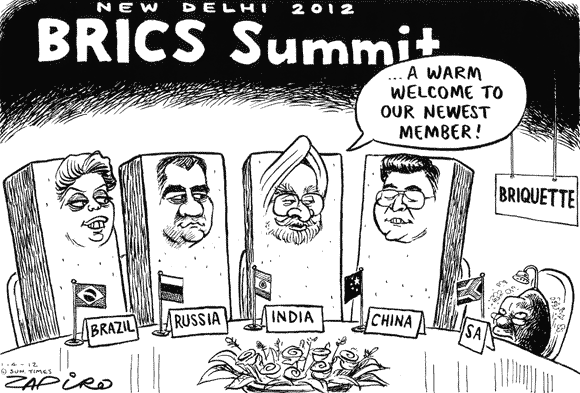
With the country preparing for local elections on May 18, the cabinet member Mr. Zuma chose to oversee local government, Sicelo Shiceka, is now embroiled in scandalous reports about his profligate living at public expense. Mr. Zuma announced Sunday that he was awaiting an explanation from Mr. Shiceka that has yet to come. “It’s this flaunting of inequality and conspicuous consumption that people get agitated about,” said Ben Roberts, a researcher at the Human Sciences Research Council, which recently conducted a survey of South Africans documenting widespread disillusionment with local government.
Parliamentary leaders of Mr. Zuma’s party, the African National Congress, have asked for independent investigators in the public protector’s office to find out whether Mr. Shiceka spent more than $50,000 of taxpayers’ money to fly to Switzerland and stay in five-star hotels while visiting his girlfriend, a flight attendant, who was jailed there on drug charges, as The Sunday Times of South Africa reported.
In a follow-up article on Sunday, the newspaper reported that municipal trucks were delivering water to the building site of Mr. Shiceka’s new home in the poorest district in the Eastern Cape. His home was also slated to be among the first to get electricity. “What a disgrace!” shouted the headline. “Minister builds emperor’s palace in South Africa’s poorest village.”
Corruption and great disparities in wealth are hardly uncommon among the other BRICS countries. But the lack of basic services has touched a particular nerve here. People in Mr. Shiceka’s home district had been protesting the poor quality of water and sewerage services. And it was precisely these issues that led poor people in Ficksburg, a town in the Free State, to take to the streets last week in a protest that ended in tragedy. SABC, the state broadcaster, showed police officers in Ficksburg assaulting an unarmed, shirtless protester named Andries Tatane, 33, and thwacking his torso with batons. Mr. Tatane then looked down at his chest, streaming with blood. A haunting photograph shows him lying wounded in the arms of a friend whose face is contorted in anguish. Mr. Tatane died minutes later. “The post-mortem showed he died of gunshot wounds,” said Moses Dlamini, spokesman for the Independent Complaints Directorate, which investigates police brutality. “And he had bruises which indicated he was assaulted.” Two police officers have been charged with the murder and four others with assault, but not before enraged residents of Mr. Tatane’s township set fire to two government buildings.
An African National Congress spokesman, Jackson Mthembu, described the attack on Mr. Tatane as reminiscent of “apartheid-era strong-arm tactics” — a remarkable statement considering that the A.N.C. itself led the struggle against apartheid and has governed the country, and overseen its police force, since 1994.
The so-called service delivery protests, a phenomenon across the country, provide signs of the simmering discontent among many South Africans about how long it is taking to translate the gains of freedom into material progress. Even as South Africa takes center stage with the world’s most prominent developing nations, a majority of young black South Africans are jobless. Poverty remains widespread. A nationwide survey of about 3,200 South Africans age 16 and older, sponsored by the country’s Independent Electoral Commission, found that South Africans were most dissatisfied with local government performance on job creation, crime and housing.
The survey, released last week, documented an erosion of trust at all levels of government, with the lowest approval level — 38 percent — reserved for local government, down from a high of 55 percent in 2004. Politicians rated even lower. Only 27 percent of South Africans trusted them when the survey was conducted in the final months of 2010. The main opposition party, the Democratic Alliance — widely perceived as dominated by whites — has sought to attract more black support by highlighting its strong record in running the city of Cape Town. Helen Zille, the former journalist who leads the party, has seized on the killing of Mr. Tatane as emblematic of how the A.N.C. has “become disconnected from the people it is supposed to serve.”
But the loyalty of voters to the A.N.C., the party of Nelson Mandela, remains deep, and the survey found that those who were most unhappy with government were also the ones who said they were least likely to vote. So the question of whether discontent leads to change in the ballot box remains open.
Source: New York Times
Libya and the BRICS: Currency Wars, Imperial Wars and Popular Uprisings
On one side of the world NATO bombs Libya and on the other, the newly expanded BRICS (Brazil, Russia, India, China and South Africa) meet on the island of Hainan, off the south coast of China. Two seemingly unrelated events. But there are links and forces at play fuelling important new power contestations in the world.
Western bombs are raining down on Libya and a “no-fly zone” is being imposed after a United Nations (UN) Security Council resolution. At the UN, BRICS members, China and Brazil, abstained from voting (although South Africa voted for) but publicly criticised the idea of bombing Gaddafi’s forces.
The US is in decline as the power able to exert its authority over world affairs. At the same time we are seeing the rise of China – predicted to be the world’s largest economy within 10 to 20 years – having imperial ambitions, but racked with many internal contradictions. China is the single biggest holder of the US’ debt, in the form of federal bonds. Its rise is offset by its dependence on the US for its exports and on US companies that are its biggest foreign investors. Moreover, holding dollar-denominated US treasury bonds also means that China can't simply watch the dollar decline or risk a US bond default.
So China and the US are like two adversaries manacled together, taking wild pot shots at each other, but unable to strike the decisive blow. For some while now the US has been attacking the Chinese for what it calls a form of protectionism by keeping its currency, the Renminbi, allegedly, artificially low.
The November 2010 meeting of the G20 countries in Seoul was supposed to be an attempt at resolving the currency wars between the US and China. But in the midst of the G20 diplomacy and fine rhetoric about solving trade imbalances, the US decided to indulge in another round of quantitative easing – to the tune of US$600b – essentially a form of printing money by buying back bonds from private banks and then crediting their balance sheets with money.
If any other country were to print money in this way the consequences would be devastating in terms of inflation and the collapse of the currency in world markets. But the US’ currency is the world’s currency, so it doesn’t incur inflation, nor does anyone dump dollars because global trade is conducted in dollars. So the US can get away with it.
This certainly raised the hackles, not only of China, but also of Brazil, Russia, India and South Africa, who are all consequently attracting hot money from low US interest rates and quantitative easing, which overvalues their currencies and makes their exports more expensive.
At the BRICS meeting, President Zuma joined his counterparts in calling for greater independence from the dollar.
The BRICS meeting echoed comments made by the governor of the Chinese Central Bank in 2009, in the midst of the global financial crisis, that the dollar’s role, as the global reserve currency and medium of international trade was placing the world at risk, given the scale of the US’ debt and the fact that the crisis was centred on the US.
This is no mere arcane technical spat between economists. This is about economic clout and the political power that comes with having one’s currency both the global reserve currency and the medium of global exchange. The fight over the dollar is also a fight over who is to be the main political force in the 21st century, and who is the fulcrum around which all foreign policy matters of nation states will turn -- with all the implications for domestic issues.
So the currency wars have direct meaning for what our lives will be like in the next while.
Meanwhile the world’s attention is focussed on the Libyan crisis and the evil perpetrated by Muammar Gaddafi. Having armed Gaddafi, invested in his oil fields and welcomed him back into the fold of the “international community,” the US, Britain and France, are now arming his adversaries and bombing his air force in the name of a “humanitarian mission.”
All of this while there are people’s uprisings against dictators throughout North Africa and the Arab world in Yemen, Algeria, Syria and Bahrain (and, of course, the successful insurrections in Tunisia and Egypt).
So why are the US, Britain and France now supporting what they call “pro-democracy groups” in Libya, while taking the opposite stance in Bahrain and Yemen by arming the dictator’s forces, which are killing the pro-democracy forces in those countries?
And why did the BRICS countries take a different view on Libya to that of the West?
Maybe there is an additional explanation to the theory that this is about Libya’s oil. There appears to be a currency war at stake here as well.
Recently, US financial journalists, speaking to their investor community, have begun highlighting some little-reported developments in Libya. Several writers have noted the odd fact that the Libyan rebels took time out from their rebellion in March to create their own central bank. This before they even had a government.
Robert Wenzel wrote in the Economic Policy Journal, “I have never before heard of a central bank being created in just a matter of weeks out of a popular uprising. This suggests we have a bit more than a rag tag bunch of rebels running around and that there are some pretty sophisticated influences.”
In a statement, the Libyan rebels reported on the results of a meeting held on March 19. Among other things, the supposed “pro-democracy forces” announced the "designation of the Central Bank of Benghazi as a monetary authority competent in monetary policies in Libya and appointment of a Governor to the Central Bank of Libya, with a temporary headquarters in Benghazi."
US senior financial editor, John Carney, has asked, "Is this the first time a revolutionary group has created a central bank while it is still in the midst of fighting the entrenched political power? It certainly seems to indicate how extraordinarily powerful central bankers have become in our era."
Clearly there is something different about Libya.
Earlier in the twentieth century Libya was a colony of Italy. But Italy was a losing power in World War II and ceded power to Britain. Unlike Italian colonialism, Britain was happy to exercise power indirectly through a Libyan king -- King Idris, who ruled from 1949.
However, a wave of nationalism spread after World War II and Gamal Nasser and army officers seized power in Egypt in 1952 proclaiming themselves nationalists and Arab socialists. The region became notable for the clash between Arab nationalism and imperialist interests in the centre of the world’s oil reserves. So when a Libyan army officer – Muammar Gaddafi – seized power from King Idris in 1969 and proclaimed his movement as Arab socialist and pan-Africanist, he was immediately declared the enemy of the West.
Gaddafi, in return, ruled Libya through the army and through a system of alliances with tribal lords. Internationally, he manoeuvred to play competing imperial interests off against one another.
Inside Libya he combined the suppression of the people with claiming that he was merely a “brother leader” using the growing oil revenue to strengthen the Libyan army and establish a high standard of living for the Libyan middle classes. As a result, Libya has the highest human development index (HDI) in Africa and the fourth highest GDP per capita. Libya also has the 10th-largest oil reserves of any country in the world and the 17th-highest petroleum production.
And critically for current events, Gaddafi also set up a Libyan Central Bank that was 100% state-owned. That in itself was not so unusual, but what is unique amongst the major oil producers is the fact that the Libyan Central Bank is not a member of the Bank for International Settlements (BIS) (the BIS is the international clearing house for global trade and conducts its transactions in dollars).
As a result, the Libyan government, up to now, could create its own money, the Libyan Dinar, through the facilities of its own central bank and insist that trade in oil must take place in its national currency (and not in dollars, as is the case with all the other major oil producers).
This has placed Libya in the same advantageous position as the US, who, as custodian of the global currency of trade, the dollar, can merely print money to expand its trade capacity without, as in the case of Zimbabwe, incurring disastrous inflationary consequences. In order to do business with Libya, banking cartels, oil barons and so on, have had to go through the Libyan Central Bank and its national currency.
So Gaddafi’s Libya was indeed special -- a small player, but suddenly a significant player given the global power plays over the dollar, as the world’s reserve currency and medium of exchange.
In the new Libya being crafted, the “pro-democracy forces” in Eastern Libya around Benghazi are being pulled into the West’s economic orbit in the currency wars, to the trepidation of China and her allies. This is an additional reason why the BRICS countries have been so critical of the West’s latest military adventure.
In this, South Africa’s precariousness in the imperial wars – with its BRICS allies in raging against the dollar, yet voting with the US to bomb Libya, heading an AU delegation to seek peace with Gaddafi and then being brushed aside by NATO – is so apparent.
But how did the initial stirrings of a people’s movement in Libya become something else?
When the Arab uprisings began in Tunisia and spread throughout North Africa and the Middle East many people in Libya also became inspired to confront Gaddafi’s tyranny. They gathered in the main square in Tripoli – the Green Square – defied Gaddafi, and called for democracy. From Tripoli the mood spread out to the South and East of the country.
But other forces were at play…Tribal leaders reading the shifting currents in the region and seeking to position themselves accordingly, old King Idris loyalists seeking to bring back the monarchy, and some of Gaddafi’s own lieutenants trying to guarantee their future careers by jumping ship to the West. Some of these began waving the old Kingdom of Libya flags.
All these forces have completely swamped the original movement, which began in Tripoli and today the “pro-democracy forces” are clearly these, rather than the original Libyan uprising. Tripoli is no longer a centre of rebellion and the whole thing has degenerated into a civil war where one side is being backed by Western special forces, NATO air strikes and arms supplied by whomsoever wants to swing events their way.
And what has been the priority of these forces?
To get the oil terminals at Benghazi to flow and to get a new Central Bank of Libya up and running.
Before the conflict has even ended, the Benghazi-based Transitional National Council (TNC), led by Mustafa Abdul Jalil, an ex-finance minister of Gaddafi, has already met with Sarkozy in France and attended the London meeting on Libya convened by Britain’s David Cameron. At the meeting, the TNC promised to respect all international treaties, including Libya joining the BIS, and guarantying private sector investment.
It is these anti-democracy opportunists who are calling for NATO air strikes and seeking the blessing of the West before the Libyan people can decide for themselves.
Libya is providing an opportunity for imperialism to both crush an old enemy and co-opt the Arab uprising, turning calls for independence, freedom and democracy into calls for independence for central banks, greater free markets and imperial domination.
But the world has changed. The Arab uprisings are themselves a sign that there are weak links in the imperialist chain.
The current capitalist crisis is of such proportions that the space to finance a major war, commit troops to occupation and administer such an occupation is severely limited. The US is already carrying the can for occupations in Iraq and Afghanistan and is simply incapable of sustaining another one at the time of its biggest debt. This is why Obama wants a UN/NATO coalition to share the political and economic cost of the war on Libya. And even within NATO, member country, Turkey, has its own domestic reasons for not wanting to be part of an attack on a Muslim country.
What is being played out are contestations within imperialism – largely between China and the US - on the one hand, and a new tide of popular rebellion against domination – a tide that began in Latin America over the last 10 years, but which has now exploded across North Africa and the Middle East - on the other. The key is the strength of the people on the ground in Yemen, Syria and even Saudi Arabia, but above all, in Tunisia and Egypt, where they are still directly engaged in determining the outcome of events.
Our world will be shaped by which social forces prove triumphant over the next few years.
Western bombs are raining down on Libya and a “no-fly zone” is being imposed after a United Nations (UN) Security Council resolution. At the UN, BRICS members, China and Brazil, abstained from voting (although South Africa voted for) but publicly criticised the idea of bombing Gaddafi’s forces.
The US is in decline as the power able to exert its authority over world affairs. At the same time we are seeing the rise of China – predicted to be the world’s largest economy within 10 to 20 years – having imperial ambitions, but racked with many internal contradictions. China is the single biggest holder of the US’ debt, in the form of federal bonds. Its rise is offset by its dependence on the US for its exports and on US companies that are its biggest foreign investors. Moreover, holding dollar-denominated US treasury bonds also means that China can't simply watch the dollar decline or risk a US bond default.
So China and the US are like two adversaries manacled together, taking wild pot shots at each other, but unable to strike the decisive blow. For some while now the US has been attacking the Chinese for what it calls a form of protectionism by keeping its currency, the Renminbi, allegedly, artificially low.
The November 2010 meeting of the G20 countries in Seoul was supposed to be an attempt at resolving the currency wars between the US and China. But in the midst of the G20 diplomacy and fine rhetoric about solving trade imbalances, the US decided to indulge in another round of quantitative easing – to the tune of US$600b – essentially a form of printing money by buying back bonds from private banks and then crediting their balance sheets with money.
If any other country were to print money in this way the consequences would be devastating in terms of inflation and the collapse of the currency in world markets. But the US’ currency is the world’s currency, so it doesn’t incur inflation, nor does anyone dump dollars because global trade is conducted in dollars. So the US can get away with it.
This certainly raised the hackles, not only of China, but also of Brazil, Russia, India and South Africa, who are all consequently attracting hot money from low US interest rates and quantitative easing, which overvalues their currencies and makes their exports more expensive.
At the BRICS meeting, President Zuma joined his counterparts in calling for greater independence from the dollar.
The BRICS meeting echoed comments made by the governor of the Chinese Central Bank in 2009, in the midst of the global financial crisis, that the dollar’s role, as the global reserve currency and medium of international trade was placing the world at risk, given the scale of the US’ debt and the fact that the crisis was centred on the US.
This is no mere arcane technical spat between economists. This is about economic clout and the political power that comes with having one’s currency both the global reserve currency and the medium of global exchange. The fight over the dollar is also a fight over who is to be the main political force in the 21st century, and who is the fulcrum around which all foreign policy matters of nation states will turn -- with all the implications for domestic issues.
So the currency wars have direct meaning for what our lives will be like in the next while.
Meanwhile the world’s attention is focussed on the Libyan crisis and the evil perpetrated by Muammar Gaddafi. Having armed Gaddafi, invested in his oil fields and welcomed him back into the fold of the “international community,” the US, Britain and France, are now arming his adversaries and bombing his air force in the name of a “humanitarian mission.”
All of this while there are people’s uprisings against dictators throughout North Africa and the Arab world in Yemen, Algeria, Syria and Bahrain (and, of course, the successful insurrections in Tunisia and Egypt).
So why are the US, Britain and France now supporting what they call “pro-democracy groups” in Libya, while taking the opposite stance in Bahrain and Yemen by arming the dictator’s forces, which are killing the pro-democracy forces in those countries?
And why did the BRICS countries take a different view on Libya to that of the West?
Maybe there is an additional explanation to the theory that this is about Libya’s oil. There appears to be a currency war at stake here as well.
Recently, US financial journalists, speaking to their investor community, have begun highlighting some little-reported developments in Libya. Several writers have noted the odd fact that the Libyan rebels took time out from their rebellion in March to create their own central bank. This before they even had a government.
Robert Wenzel wrote in the Economic Policy Journal, “I have never before heard of a central bank being created in just a matter of weeks out of a popular uprising. This suggests we have a bit more than a rag tag bunch of rebels running around and that there are some pretty sophisticated influences.”
In a statement, the Libyan rebels reported on the results of a meeting held on March 19. Among other things, the supposed “pro-democracy forces” announced the "designation of the Central Bank of Benghazi as a monetary authority competent in monetary policies in Libya and appointment of a Governor to the Central Bank of Libya, with a temporary headquarters in Benghazi."
US senior financial editor, John Carney, has asked, "Is this the first time a revolutionary group has created a central bank while it is still in the midst of fighting the entrenched political power? It certainly seems to indicate how extraordinarily powerful central bankers have become in our era."
Clearly there is something different about Libya.
Earlier in the twentieth century Libya was a colony of Italy. But Italy was a losing power in World War II and ceded power to Britain. Unlike Italian colonialism, Britain was happy to exercise power indirectly through a Libyan king -- King Idris, who ruled from 1949.
However, a wave of nationalism spread after World War II and Gamal Nasser and army officers seized power in Egypt in 1952 proclaiming themselves nationalists and Arab socialists. The region became notable for the clash between Arab nationalism and imperialist interests in the centre of the world’s oil reserves. So when a Libyan army officer – Muammar Gaddafi – seized power from King Idris in 1969 and proclaimed his movement as Arab socialist and pan-Africanist, he was immediately declared the enemy of the West.
Gaddafi, in return, ruled Libya through the army and through a system of alliances with tribal lords. Internationally, he manoeuvred to play competing imperial interests off against one another.
Inside Libya he combined the suppression of the people with claiming that he was merely a “brother leader” using the growing oil revenue to strengthen the Libyan army and establish a high standard of living for the Libyan middle classes. As a result, Libya has the highest human development index (HDI) in Africa and the fourth highest GDP per capita. Libya also has the 10th-largest oil reserves of any country in the world and the 17th-highest petroleum production.
And critically for current events, Gaddafi also set up a Libyan Central Bank that was 100% state-owned. That in itself was not so unusual, but what is unique amongst the major oil producers is the fact that the Libyan Central Bank is not a member of the Bank for International Settlements (BIS) (the BIS is the international clearing house for global trade and conducts its transactions in dollars).
As a result, the Libyan government, up to now, could create its own money, the Libyan Dinar, through the facilities of its own central bank and insist that trade in oil must take place in its national currency (and not in dollars, as is the case with all the other major oil producers).
This has placed Libya in the same advantageous position as the US, who, as custodian of the global currency of trade, the dollar, can merely print money to expand its trade capacity without, as in the case of Zimbabwe, incurring disastrous inflationary consequences. In order to do business with Libya, banking cartels, oil barons and so on, have had to go through the Libyan Central Bank and its national currency.
So Gaddafi’s Libya was indeed special -- a small player, but suddenly a significant player given the global power plays over the dollar, as the world’s reserve currency and medium of exchange.
In the new Libya being crafted, the “pro-democracy forces” in Eastern Libya around Benghazi are being pulled into the West’s economic orbit in the currency wars, to the trepidation of China and her allies. This is an additional reason why the BRICS countries have been so critical of the West’s latest military adventure.
In this, South Africa’s precariousness in the imperial wars – with its BRICS allies in raging against the dollar, yet voting with the US to bomb Libya, heading an AU delegation to seek peace with Gaddafi and then being brushed aside by NATO – is so apparent.
But how did the initial stirrings of a people’s movement in Libya become something else?
When the Arab uprisings began in Tunisia and spread throughout North Africa and the Middle East many people in Libya also became inspired to confront Gaddafi’s tyranny. They gathered in the main square in Tripoli – the Green Square – defied Gaddafi, and called for democracy. From Tripoli the mood spread out to the South and East of the country.
But other forces were at play…Tribal leaders reading the shifting currents in the region and seeking to position themselves accordingly, old King Idris loyalists seeking to bring back the monarchy, and some of Gaddafi’s own lieutenants trying to guarantee their future careers by jumping ship to the West. Some of these began waving the old Kingdom of Libya flags.
All these forces have completely swamped the original movement, which began in Tripoli and today the “pro-democracy forces” are clearly these, rather than the original Libyan uprising. Tripoli is no longer a centre of rebellion and the whole thing has degenerated into a civil war where one side is being backed by Western special forces, NATO air strikes and arms supplied by whomsoever wants to swing events their way.
And what has been the priority of these forces?
To get the oil terminals at Benghazi to flow and to get a new Central Bank of Libya up and running.
Before the conflict has even ended, the Benghazi-based Transitional National Council (TNC), led by Mustafa Abdul Jalil, an ex-finance minister of Gaddafi, has already met with Sarkozy in France and attended the London meeting on Libya convened by Britain’s David Cameron. At the meeting, the TNC promised to respect all international treaties, including Libya joining the BIS, and guarantying private sector investment.
It is these anti-democracy opportunists who are calling for NATO air strikes and seeking the blessing of the West before the Libyan people can decide for themselves.
Libya is providing an opportunity for imperialism to both crush an old enemy and co-opt the Arab uprising, turning calls for independence, freedom and democracy into calls for independence for central banks, greater free markets and imperial domination.
But the world has changed. The Arab uprisings are themselves a sign that there are weak links in the imperialist chain.
The current capitalist crisis is of such proportions that the space to finance a major war, commit troops to occupation and administer such an occupation is severely limited. The US is already carrying the can for occupations in Iraq and Afghanistan and is simply incapable of sustaining another one at the time of its biggest debt. This is why Obama wants a UN/NATO coalition to share the political and economic cost of the war on Libya. And even within NATO, member country, Turkey, has its own domestic reasons for not wanting to be part of an attack on a Muslim country.
What is being played out are contestations within imperialism – largely between China and the US - on the one hand, and a new tide of popular rebellion against domination – a tide that began in Latin America over the last 10 years, but which has now exploded across North Africa and the Middle East - on the other. The key is the strength of the people on the ground in Yemen, Syria and even Saudi Arabia, but above all, in Tunisia and Egypt, where they are still directly engaged in determining the outcome of events.
Our world will be shaped by which social forces prove triumphant over the next few years.
Read more articles by Leonard Gentle. Director of the International Labour and Research Information Group.
Friday, October 8, 2010
China's Liu Xiaobo wins Nobel Peace Prize
Liu Xiaobo, an irrepressible, chain-smoking Chinese dissident imprisoned last year for subversion, was awarded the Nobel Peace Prize Friday for helping to spearhead a campaign for more freedom in China. In a statement, the Nobel Committee said Liu, 54, deserved the prize "for his long and non-violent struggle for fundamental human rights in China." Analysts said the honor was aimed in part at increasing pressure on China to ease its crackdown on religious and political activists. But China's government told reporters the committee had violated its own principles by giving the award to a "criminal."
In announcing the award, the committee lauded Liu's efforts over more than two decades to demand freedom of speech, assembly, religion and other forms of expression for Chinese citizens. China's "new status" as the world's second-largest economy "must entail increased responsibility," the committee said. It said Beijing must heed the call of Liu and others to award its citizens the most basic freedoms. "Through the severe punishment meted out to him, Liu has become the foremost symbol of this wide-ranging struggle for human rights in China," the Nobel statement said.
Liu is serving his 11-year sentence at Jinzhou prison in Liaoning, hundreds of miles from his home and wife, Liu Xia, in Beijing. In an interview shortly before the announcement, Liu Xia said she was thankful her husband's physical condition seems to have improved in jail, and grateful that he's allowed to read and that the two can exchange regular letters. "We have no regrets," she said. "All of this has been of our choosing. It will always be so. We'll bear the consequences together. I've known Liu since 1982. I've watched him change little by little year by year, and we know that we have to pay the price under the current situation in China."
In the weeks running up to the announcement, Liu was considered a top contender to win the award. But China's government had warned Norway not to award Liu its most prestigious prize, saying that the essayist did not qualify for the honor. Analysts predicted that in the short-term, China's one-party state would react to the award by intensifying an already tough campaign against dissidents, religious activists and non-governmental organizations. Although China outwardly appears strong, with a world-beating economic growth rate, prosecutions for "state security" offenses are approaching numbers not seen since the bloody crackdown on student-led protests around Tiananmen Square in 1989. But in the long-term, a wide spectrum of Chinese and foreigners said, Liu's award could actually resonate more deeply within China than any similar act in years--significantly more so than the Nobel Peace Prize that was awarded to the Dalai Lama in 1989 or the Nobel prize for literature given to dissident writer Gao Xingjian in 2000.
First of all, Liu will be the first Chinese citizen to ever win the award. (The Dalai Lama has status as a refugee. And Gao is a French citizen.) Second, Liu, unlike most Chinese dissidents, remains well-known and well-liked in China. Prickly, with a thick northern drawl, tobacco-stained teeth and an infectious laugh, he's always been considered part of the "loyal opposition," less a theoretician of a democratic revolution than a tough urban gadfly. Although in and out of jail for stating his beliefs, writing letters and challenging the state for two decades, Liu has escaped the sentence of irrelevance meted out to so many of his dissident contemporaries. Some observers, however, said the award would feed into a sense among many young Chinese that the West is out to get China and that "Cold War" thinking still dominates mindsets in the developed world. "I worry about the effect of this prize on China's younger generation," said Zhu Feng, a professor of international relations at Beijing University. "It will be seen as new evidence about how the West is unfriendly to China."
Liu's latest sentence was his longest. Announced on Christmas Day 2009 - because the Chinese government believes Westerners are less likely to take notice on a holiday--Liu's sentence of 11 years was for attempting to subvert the state. His specific crime was that he volunteered to have his name lead a list of signatories to a document called "Charter 08." Modeled after the Charter 77 movement in Czechoslovakia during the Cold War, Charter 08 called for greater freedom of expression, human rights, and for free elections. Ultimately, more than 8,000 people have signed China' s charter.
Published on Dec. 10, 2008, the 60th anniversary of the Universal Declaration of Human Rights, the charter "was to put a stake in the ground and say here's an alternate vision of China," said Perry Link, the renowned China scholar who worked with the group to translate their manifesto into English. "It was definitely a long-term program." Among the demands were for a judiciary not controlled by the Communist Party, meaningful elections and the freedoms of association, assembly, expression and religion. "The current system has become backward to the point that change cannot be avoided," the charter read. "This situation must change! Political democratic reforms cannot be delayed any longer!"
Liu played an important role as the crafters of the charter hashed out the wording, Link said. He fought to excise any mention of the banned sect Falun Gong from the document because, he argued, the charter's purpose should not be to deal with specific human rights cases. And he helped work out a compromise over mentioning the Tiananmen Square crackdown - which was raised in the preamble but not in the actual body of the charter. Link, who spent much of that month talking with Liu and others as the manifesto went from one draft to another, recalled that Liu wasn't a leader of the group in the beginning. "But once he saw it was going somewhere, he naturally volunteered to be out front," Link said.
Liu didn't hog publicity, Link added, "he just doesn't shrink from putting his head on the line. He was like a moth to the flame." After he was sentenced, Liu's lawyer released a simple statement from his client: "I have long been aware that when an independent intellectual stands up to an autocratic state, step one toward freedom is often a step into prison," it said. "Now I am taking that step; and true freedom is that much nearer."
Ai Weiwei, a signatory of the Charter 08 document who designed the Bird's Nest stadium for China's Summer Olympics, said Friday's award was at least a sign that "the world is paying attention to China." But the award "won't change much in China," Ai predicted. "More people need to wake up." Liu has taken risks with his life throughout his career. In 1989, he left a cushy post as a visiting scholar at Columbia University to return to China to participate in demonstrations in Tiananmen Square.
On the night of June 3, 1989, he was one of four dissidents who negotiated with the People's Liberation Army to allow the last several hundred students to peacefully vacate the square. After the crackdown he spent two years in jail. Liu was dispatched to a re-education camp in 1996 for co-writing an open letter that demanded the impeachment of then-president Jiang Zemin. From then until his arrest in December, 2008, two days before the charter was released, Liu lived a life of constant harassment by the security services. He was repeatedly questioned because of his views or his essays, which were passed around the Internet by thousands of his readers.
Liu's wife, Liu Xia, said the toughest time for her was after Liu was arrested in 2008 but before he was indicted. He basically disappeared, she said, into the maw of China's security state. "For those six and half months, I only saw him twice, it was weird for both of us," Liu Xia recalled. "I was taken to a hotel in a suburb of Beijing, Xiaobo was taken there too, and he told me he didn't know where he was." But when the indictment came, "I felt very calm," she said. "I told our lawyer that Xiaobo would probably be sentenced at least 10 years. Then it came out 11, very close to what I expected."
Source: Washington Post
In announcing the award, the committee lauded Liu's efforts over more than two decades to demand freedom of speech, assembly, religion and other forms of expression for Chinese citizens. China's "new status" as the world's second-largest economy "must entail increased responsibility," the committee said. It said Beijing must heed the call of Liu and others to award its citizens the most basic freedoms. "Through the severe punishment meted out to him, Liu has become the foremost symbol of this wide-ranging struggle for human rights in China," the Nobel statement said.
Liu is serving his 11-year sentence at Jinzhou prison in Liaoning, hundreds of miles from his home and wife, Liu Xia, in Beijing. In an interview shortly before the announcement, Liu Xia said she was thankful her husband's physical condition seems to have improved in jail, and grateful that he's allowed to read and that the two can exchange regular letters. "We have no regrets," she said. "All of this has been of our choosing. It will always be so. We'll bear the consequences together. I've known Liu since 1982. I've watched him change little by little year by year, and we know that we have to pay the price under the current situation in China."
In the weeks running up to the announcement, Liu was considered a top contender to win the award. But China's government had warned Norway not to award Liu its most prestigious prize, saying that the essayist did not qualify for the honor. Analysts predicted that in the short-term, China's one-party state would react to the award by intensifying an already tough campaign against dissidents, religious activists and non-governmental organizations. Although China outwardly appears strong, with a world-beating economic growth rate, prosecutions for "state security" offenses are approaching numbers not seen since the bloody crackdown on student-led protests around Tiananmen Square in 1989. But in the long-term, a wide spectrum of Chinese and foreigners said, Liu's award could actually resonate more deeply within China than any similar act in years--significantly more so than the Nobel Peace Prize that was awarded to the Dalai Lama in 1989 or the Nobel prize for literature given to dissident writer Gao Xingjian in 2000.
First of all, Liu will be the first Chinese citizen to ever win the award. (The Dalai Lama has status as a refugee. And Gao is a French citizen.) Second, Liu, unlike most Chinese dissidents, remains well-known and well-liked in China. Prickly, with a thick northern drawl, tobacco-stained teeth and an infectious laugh, he's always been considered part of the "loyal opposition," less a theoretician of a democratic revolution than a tough urban gadfly. Although in and out of jail for stating his beliefs, writing letters and challenging the state for two decades, Liu has escaped the sentence of irrelevance meted out to so many of his dissident contemporaries. Some observers, however, said the award would feed into a sense among many young Chinese that the West is out to get China and that "Cold War" thinking still dominates mindsets in the developed world. "I worry about the effect of this prize on China's younger generation," said Zhu Feng, a professor of international relations at Beijing University. "It will be seen as new evidence about how the West is unfriendly to China."
Liu's latest sentence was his longest. Announced on Christmas Day 2009 - because the Chinese government believes Westerners are less likely to take notice on a holiday--Liu's sentence of 11 years was for attempting to subvert the state. His specific crime was that he volunteered to have his name lead a list of signatories to a document called "Charter 08." Modeled after the Charter 77 movement in Czechoslovakia during the Cold War, Charter 08 called for greater freedom of expression, human rights, and for free elections. Ultimately, more than 8,000 people have signed China' s charter.
Published on Dec. 10, 2008, the 60th anniversary of the Universal Declaration of Human Rights, the charter "was to put a stake in the ground and say here's an alternate vision of China," said Perry Link, the renowned China scholar who worked with the group to translate their manifesto into English. "It was definitely a long-term program." Among the demands were for a judiciary not controlled by the Communist Party, meaningful elections and the freedoms of association, assembly, expression and religion. "The current system has become backward to the point that change cannot be avoided," the charter read. "This situation must change! Political democratic reforms cannot be delayed any longer!"
Liu played an important role as the crafters of the charter hashed out the wording, Link said. He fought to excise any mention of the banned sect Falun Gong from the document because, he argued, the charter's purpose should not be to deal with specific human rights cases. And he helped work out a compromise over mentioning the Tiananmen Square crackdown - which was raised in the preamble but not in the actual body of the charter. Link, who spent much of that month talking with Liu and others as the manifesto went from one draft to another, recalled that Liu wasn't a leader of the group in the beginning. "But once he saw it was going somewhere, he naturally volunteered to be out front," Link said.
Liu didn't hog publicity, Link added, "he just doesn't shrink from putting his head on the line. He was like a moth to the flame." After he was sentenced, Liu's lawyer released a simple statement from his client: "I have long been aware that when an independent intellectual stands up to an autocratic state, step one toward freedom is often a step into prison," it said. "Now I am taking that step; and true freedom is that much nearer."
Ai Weiwei, a signatory of the Charter 08 document who designed the Bird's Nest stadium for China's Summer Olympics, said Friday's award was at least a sign that "the world is paying attention to China." But the award "won't change much in China," Ai predicted. "More people need to wake up." Liu has taken risks with his life throughout his career. In 1989, he left a cushy post as a visiting scholar at Columbia University to return to China to participate in demonstrations in Tiananmen Square.
On the night of June 3, 1989, he was one of four dissidents who negotiated with the People's Liberation Army to allow the last several hundred students to peacefully vacate the square. After the crackdown he spent two years in jail. Liu was dispatched to a re-education camp in 1996 for co-writing an open letter that demanded the impeachment of then-president Jiang Zemin. From then until his arrest in December, 2008, two days before the charter was released, Liu lived a life of constant harassment by the security services. He was repeatedly questioned because of his views or his essays, which were passed around the Internet by thousands of his readers.
Liu's wife, Liu Xia, said the toughest time for her was after Liu was arrested in 2008 but before he was indicted. He basically disappeared, she said, into the maw of China's security state. "For those six and half months, I only saw him twice, it was weird for both of us," Liu Xia recalled. "I was taken to a hotel in a suburb of Beijing, Xiaobo was taken there too, and he told me he didn't know where he was." But when the indictment came, "I felt very calm," she said. "I told our lawyer that Xiaobo would probably be sentenced at least 10 years. Then it came out 11, very close to what I expected."
Source: Washington Post
Subscribe to:
Posts (Atom)