FIRSTRAND plans to grow its asset management business as it widens revenues from business segments that require less regulatory capital.
Group CEO Sizwe Nxasana said on Thursday in an interview the asset management business already had assets under management and administration of about $100bn.
The plan was to progressively grow these assets in South Africa and sub-Saharan Africa over the next few years, Mr Nxasana said at the conclusion of FirstRand’s annual general meeting in Sandton.
The asset management business was being run through Ashburton Investments, a unit of FirstRand.
"We have about R100bn in assets under management or administration. It is a business we think there is opportunity to create more scale by leveraging on the internal skills we have," Mr Nxasana said. "We want to originate business in various asset classes such as equities, real estate and infrastructure in South Africa and Africa," he said.
Mr Nxasana would not say what the target value of assets under management was for Ashburton over the next few years. "We have a base from which to start growing the business but this is a journey rather than a process," he said.
Mr Nxasana also said FirstRand would next year prefer to concentrate on investing in the businesses it had or planned to establish outside South Africa.
"We have projects in Mozambique, Tanzania, Nigeria, Ghana, Zambia and India which gives us more than enough to focus on," he said.
Speaking at the annual meeting, FirstRand non-executive chairman Laurie Dippenaar said the group’s remuneration strategy was neither excessive nor did it reward failure.
Group executives were paid on the basis of them achieving targets such as creating shareholder value by increasing return on equity.
Mr Dippenaar said in FirstRand’s annual report released at the meeting that some global banks produced return on equity that was well below cost of capital but paid executives and staff up to 80% of the return. FirstRand’s return on equity was on the other hand about 20% and it paid out 45% of that to executives and staff.
Source: Business Day
Showing posts with label Zambia. Show all posts
Showing posts with label Zambia. Show all posts
Thursday, November 29, 2012


Sunday, February 11, 1990
SOUTH AFRICA'S NEW ERA; MANDELA, FREED, URGES STEP-UP IN PRESSURE TO END WHITE RULE
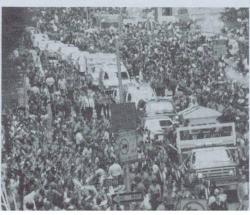 After 27 and a half years in prison, Nelson Mandela finally won his freedom today and promptly urged his supporters at home and abroad to increase their pressure against the white minority Goverment that had just released him. ''We have waited too long for our freedom,'' Mr. Mandela told a cheering crowd from a balcony of Cape Town's old City Hall. ''We can wait no longer.'' ''Now is the time to intensify the struggle on all fronts,'' he said. ''To relax our efforts now would be a mistake which generations to come will not able to forgive.''
 Mr. Mandela's 20-minute speech, which he prepared before leaving prison today, constituted his first remarks in public since before he was sentenced in June 1964 to life imprisonment for conspiracy to overthrow the Government and engage in sabotage. He asked the international community not to lift its sanctions against South Africa, despite the recent changes introduced by President F. W. de Klerk, which culminated in Mr. Mandela's release. ''To lift sanctions now would be to run the risk of aborting the process toward ending apartheid,'' he said.
Mr. Mandela's voice sounded firm and his words as eloquently militant as when he defended violence as the ultimate recourse at his political trial in 1964. Though he looked all of his 71 years and was grayer than artists' renditions over the years had depicted, he walked out of Victor Verster prison erect and vigorous. In Washington, President Bush rejoiced over the release of Mr. Mandela, spoke to him by telephone and invited the anti-apartheid leader to visit the White House. Mr. Mandela gave no evidence that his militant opposition to apartheid had been tempered by the more than 10,000 days he spent in confinement. But he also said nothing that would have surprised the Government had he said it during his years of incarceration. Indeed, there appeared to be nothing in Mr. Mandela's initial remarks after his release to give the Government much consolation or encouragement. Although he has been viewed as a potential leader for all South Africans, he stressed time and again that his loyalty lay with the African National Congress, for which he was working underground when he was jailed in August 1962 on charges of incitement and leaving the country illegally. He was serving time on that conviction when he was sentenced to life imprisonment in 1964.
Mr. Mandela told a crowd that he remained a ''loyal and disciplined member'' of the African National Congress and still endorsed its policies, including its use of armed struggle against the white minority Government. He said he saluted the congress's military wing, Spear of the Nation, and its ally, the South African Communist Party, ''for its steady contribution to the struggle for democracy.'' But he also thanked the Black Sash, an organization of white women working to end apartheid, and the predominantly white National Union of South African Students for being ''the conscience of white South Africans.'' And he held out an olive branch to all whites, asking them to join in shaping a new South Africa. ''The freedom movement is a political home for you, too,'' he said.
In his first speech after his release, Mr. Mandela may have taken an orthodox line with a mass audience sympathetic to the African National Congress and might in private discussions eshow greater flexibility on the question of discussions that the Government wants to have with blacks, who are 28 million of the population, compared with the 5 million whites of the ruling minority. He said he was only making some preliminary comments following his release, and would have more to say ''after I have had the opportunity to consult with my comrades.'' By this he meant the leaders of the African National Congress now in exile in Zambia as well as colleagues still based in South Africa. But he appeared to discourage any leading role for himself, such as the Government has in mind, saying, ''A leader of the movement is a person who has been democratically elected at a national conference.''
President de Klerk has invited black leaders to join talks leading to the formulation of a new constitution that would let black South Africans take part at last in their nation's politics.Mr. Mandela acknowledged to the crowd that he had conducted a dialogue with the Government during his last years in prison. But he added: ''My talks with the Government have been aimed at normalizing the political situation in the country. We have not yet begun discussing the basic demands of our struggle. I wish to stress that I myself have at no time entered into negotiations about the future of our country, except to insist on a meeting between the A.N.C. and the Government,'' he said. He described Mr. de Klerk, whom he has met twice since December, as ''a man of integrity. Mr. de Klerk has gone further than any other Nationalist President in taking real steps to normalize the situation,'' Mr. Mandela said. ''But as an organization we base our policy and strategy and tactics on the harsh reality we are faced with,'' he said. ''And this reality is that we are still suffering under the policies of the Nationalist Government.''
The National Party, which Mr. de Klerk now leads, instituted apartheid after taking power in 1948. Mr. Mandela said the Government had to take further steps before negotiations could begin. As a prerequisite for negotiations, he reiterated two demands that he had conveyed from prison through recent visitors. These are are the lifting of the state of emergency, which was imposed in June 1986, and the release of all political prisoners, including those accused of crimes committed in the struggle against apartheid. ''Only such a normalized situation which allows for free political activity can allow us to consult our people in order to obtain a mandate,'' Mr. Mandela said. He said the people had to be consulted about who would represent them in talks with the Government. ''Negotiations cannot take place above the heads or behind the backs of our people,'' he said. ''It is our belief that the future of our country can only be determined by a body which is democratically elected on a nonracial basis.''
Mr. Mandela appeared to allude to a formula under which a constituent assembly, in effect supplanting the existing Parliament, would draft a new constitution. Such a plan would mean the creation of an interim government in South Africa and has previously been rejected by Mr. de Klerk for the foreseeable future. Mr. Mandela walked out of Victor Verster Prison near Paarl at 4:15 P.M., 75 minutes later than the release time announced Saturday afternoon by Mr. de Klerk. Acquaintances of the Mandela family said his departure from the prison was delayed by family discussions. He was greeted by about 5,000 supporters lining the asphalt road outside the prison farm where he has been held since December 1988. Some waved the black, green and yellow flags of the African National Congress, from which Mr. de Klerk removed a ban on Feb. 2. Mr. Mandela was then driven 40 miles from Paarl to Cape Town, passing several hundred people who had parked by the roadside or waited on overpasses in hope of seeing him. They held homemade signs, some of which read simply, ''Welcome home.'' A huge crowd, which organizers said reached 250,000 people, assembled in the square in front of the old City Hall in Cape Town to greet Mr. Mandela. Reporters covering the rally put the crowd's size at only 50,000 people at its peak. They became impatient and sometimes unruly, waiting up to six hours in the hot sun and had dwindled to about 20,000 by sunset, when Mr. Mandela finally appeared.
In the 1950's it was Government policy to prevent blacks from settling in the Western Cape, so they are not in the clear majority in Cape Town, where Mr. Mandela was released. People of mixed race, known as ''coloreds,'' are the largest population group in Cape Town, where whites also outnumber blacks. Blacks, who account for nearly 75 percent of the population in the country as a whole, are in the overwhelming majority in the Johannesburg region, where Mr. Mandela can expect his most tumultuous welcome.
The festive occasion was marred by violence after some youths who had been drinking on the fringes of the rally started breaking windows and looting shops in downtown Cape Town. The police tried to disperse them by firing shotguns and tear gas, and some of the youths retaliated by throwing bottles and stones. At one point, drunken protesters invaded a Chinese restaurant, snatched up the liquor and wine and threw bottles at the police from the rooftop. One man in the crowd was also injured in a knife fight.
The South African Press Association reported tonight that 2 people had been killed and 13 wounded in the confrontations. A physician treating casualties on the scene estimated that 100 people had been wounded, mostly by buckshot. Most suffered only light injuries, including three journalists covering the rally. Cheryl Carolus, a spokeswoman for the United Democratic Front, which helped organize the rally, attributed the violence to outsiders who, she said, were ''beyond our usual crowds, or who supported the rival Pan-Africanist Movement.''' At times, some supporters at the rally had to scramble for cover as the police chased or fired at looters and stone-throwers. The Rev. Allan Boesak, a prominent figure in the anti-apartheid movement, pleaded for more than 45 minutes with the crowd to maintain discipline and move back.
Dullah Omar, a lawyer representing the Mandela family, said Mr. Mandela had been unaware of the violence. This evening, Mr. Mandela failed to appear at a news conference arranged by the reception committee that is handling his schedule. A representative said Mr. Mandela would meet the press later this week in Johannesburg. Mr. Mandela and his wife, Winnie, are expected to fly to Johannesburg on Monday and proceed to their home in the black township of Soweto. One of the organizers, Saki Mocozoma, said security considerations precluded him from revealing where the Mandelas were spending their first night.
Mr. Mandela also paid tribute to his wife, who has lived apart from him for more than 27 years, and their children. ''I am convinced that your pain and suffering was far greater than my own,'' he told them.
Source: New York Times
Tuesday, August 15, 1989
Botha, Rebuffed by His Party, Quits South Africa Presidency
P. W. Botha quit under pressure tonight as South Africa's President, complaining that his Cabinet ministers were ignoring him. His announcement, delivered in a disjointed and rambling address in Afrikaans on national television, followed a Cabinet meeting this morning in which the 73-year-old Mr. Botha lost a confrontation he had forced with F. W. de Klerk, his successor as leader of the governing National Party.
At issue was Mr. de Klerk's right to travel to Zambia later this month to meet President Kenneth D. Kaunda without getting Mr. Botha's approval first. But this was overshadowed by a wide perception among politicians, journalists and ordinary South Africans that the President had been trying to undercut Mr. de Klerk since the latter succeeded him as National Party leader about six months ago. President Botha said he would not approve Mr. de Klerk's trip to Zambia because President Kaunda has given refuge to the outlawed African National Congress, which is seeking to overthrow the white Government in Pretoria, and has encouraged foreign pressure on South Africa. ''I am of the opinion that it is inopportune to meet with President Kaunda at this stage,'' Mr. Botha said.
The President announced his resignation 23 days before the next parliamentary elections, which are the toughest the National Party has faced since it came to power in 1948. Mr. de Klerk has been trying to rally the party against its opponents, the right-wing Conservative Party and the liberal Democratic Party, in what has so far been a lackluster campaign for control of the white house of Parliament, and thus the Government. Had Mr. de Klerk not stood up to Mr. Botha today, his credibility as the leader of a party under fire would have been compromised and the likelihood of becoming the next President diminished. In his remarks, Mr. Botha disclosed that Mr. de Klerk and his allies proposed at today's Cabinet meeting that the President, who suffered a stroke in January, retire on grounds of ill health. Mr. Botha said he replied that could not leave ''with such a lie. It is evident to me that after all these years of my best efforts for the National Party and for the Government of this country as well as the security of this country, I am being ignored by ministers in my Cabinet,'' the South African President said. ''I consequently have no choice other than to announce my resignation.''
Mr. Botha, who submitted his resignation to Chief Justice Michael Corbett, did not name a successor. Foreign Minister Roelof F. Botha, who is not related to the President, indicated in a television interview tonight that Mr. de Klerk would be sworn in on Tuesday. The South African Constitution says that a Cabinet minister chosen by his colleagues may be acting President. It is expected that Mr. de Klerk will be elected President after the elections on Sept. 6. In a television interview after President Botha's announcement, Mr. de Klerk and Foreign Minister Botha took polite exception to the President's remarks. ''We are sad that a man who has done so much for his country has to retire under these unhappy circumstances,'' Mr. de Klerk said. Effects on Nation's Politics
He confirmed that the Cabinet ministers had suggested that Mr. Botha resign on grounds of poor health. ''We felt that his state of health justified this,'' Mr. de Klerk said, reinforcing a public perception that the stroke had affected the President more than he admitted. It appears likely that the National Party will win the election, but with a smaller majority in Parliament. The resignation was expected to help the party by reinforcing the image it is cultivating as a force for evolutionary change in South Africa.
The change in leadership is unlikely to immediately affect the situation of the black majority, which is excluded from the parliamentary elections. Though Mr. de Klerk is perceived as more enlightened than President Botha, he still supports the basic concept of racially separate groups and has promised that an end to white control will not lead to domination by the black majority. It was an ignominious finish to the career of a politician who began as a National Party organizer 54 years ago. Mr. Botha was elected to Parliament in 1948. He became Defense Minister in 1966, Prime Minister in 1978 and President in 1984 under a new constitution that combined the duties of heads of state and government. For a decade, he was simultaneously the National Party leader.
Under his rule, the South African Army became the most powerful military force in Africa. But Mr. Botha also promised political change and expanded the whites-only Parliament to include smaller chambers representing South Africans of mixed race and of Asian descent. After the President suffered his stroke on Jan. 18, his aides described it as a mild one. But Mr. Botha sent a letter to National Party members of Parliament on Feb. 2, announcing that he was stepping down as National Party leader, though not as President, and asking them to choose a successor. The legislators elected Mr. de Klerk.
Mr. Botha, who was understood to have preferred Finance Minister Barend du Plessis, never publicly congratulated Mr. de Klerk. And he remained as President, in a position to block any decisions by Mr. de Klerk. Old Scores Settled But Mr. de Klerk quickly won the loyalty of the party's members of Parliament, who had chafed under Mr. Botha's sometimes autocratic leadership. After Mr. Kaunda announced last Thursday that he would meet Mr. de Klerk, President Botha called a special Cabinet meeting for today to discuss the offer. Mr. de Klerk outflanked him by getting the backing of the other Cabinet ministers.
The President, in objecting to Mr. de Klerk's plans to meet President Kaunda, made no mention of his own meeting with the Zambian leader on South Africa's frontier with Botswana on April 30, 1982, when Mr. Kaunda was, if anything, even less sympathetic toward Pretoria. But his portrayal of Mr. de Klerk's pending trip to Zambia as unpatriotic did not seem likely to scuttle it, unless President Kaunda chooses to take umbrage at Mr. Botha's criticism or Mr. de Klerk decides it would hurt the party in the coming elections. Foreign Minister Botha observed that ''in every other African state except Lesotho and Swaziland, there is an A.N.C. presence.''
Source: New York Times
At issue was Mr. de Klerk's right to travel to Zambia later this month to meet President Kenneth D. Kaunda without getting Mr. Botha's approval first. But this was overshadowed by a wide perception among politicians, journalists and ordinary South Africans that the President had been trying to undercut Mr. de Klerk since the latter succeeded him as National Party leader about six months ago. President Botha said he would not approve Mr. de Klerk's trip to Zambia because President Kaunda has given refuge to the outlawed African National Congress, which is seeking to overthrow the white Government in Pretoria, and has encouraged foreign pressure on South Africa. ''I am of the opinion that it is inopportune to meet with President Kaunda at this stage,'' Mr. Botha said.
The President announced his resignation 23 days before the next parliamentary elections, which are the toughest the National Party has faced since it came to power in 1948. Mr. de Klerk has been trying to rally the party against its opponents, the right-wing Conservative Party and the liberal Democratic Party, in what has so far been a lackluster campaign for control of the white house of Parliament, and thus the Government. Had Mr. de Klerk not stood up to Mr. Botha today, his credibility as the leader of a party under fire would have been compromised and the likelihood of becoming the next President diminished. In his remarks, Mr. Botha disclosed that Mr. de Klerk and his allies proposed at today's Cabinet meeting that the President, who suffered a stroke in January, retire on grounds of ill health. Mr. Botha said he replied that could not leave ''with such a lie. It is evident to me that after all these years of my best efforts for the National Party and for the Government of this country as well as the security of this country, I am being ignored by ministers in my Cabinet,'' the South African President said. ''I consequently have no choice other than to announce my resignation.''
Mr. Botha, who submitted his resignation to Chief Justice Michael Corbett, did not name a successor. Foreign Minister Roelof F. Botha, who is not related to the President, indicated in a television interview tonight that Mr. de Klerk would be sworn in on Tuesday. The South African Constitution says that a Cabinet minister chosen by his colleagues may be acting President. It is expected that Mr. de Klerk will be elected President after the elections on Sept. 6. In a television interview after President Botha's announcement, Mr. de Klerk and Foreign Minister Botha took polite exception to the President's remarks. ''We are sad that a man who has done so much for his country has to retire under these unhappy circumstances,'' Mr. de Klerk said. Effects on Nation's Politics
He confirmed that the Cabinet ministers had suggested that Mr. Botha resign on grounds of poor health. ''We felt that his state of health justified this,'' Mr. de Klerk said, reinforcing a public perception that the stroke had affected the President more than he admitted. It appears likely that the National Party will win the election, but with a smaller majority in Parliament. The resignation was expected to help the party by reinforcing the image it is cultivating as a force for evolutionary change in South Africa.
The change in leadership is unlikely to immediately affect the situation of the black majority, which is excluded from the parliamentary elections. Though Mr. de Klerk is perceived as more enlightened than President Botha, he still supports the basic concept of racially separate groups and has promised that an end to white control will not lead to domination by the black majority. It was an ignominious finish to the career of a politician who began as a National Party organizer 54 years ago. Mr. Botha was elected to Parliament in 1948. He became Defense Minister in 1966, Prime Minister in 1978 and President in 1984 under a new constitution that combined the duties of heads of state and government. For a decade, he was simultaneously the National Party leader.
Under his rule, the South African Army became the most powerful military force in Africa. But Mr. Botha also promised political change and expanded the whites-only Parliament to include smaller chambers representing South Africans of mixed race and of Asian descent. After the President suffered his stroke on Jan. 18, his aides described it as a mild one. But Mr. Botha sent a letter to National Party members of Parliament on Feb. 2, announcing that he was stepping down as National Party leader, though not as President, and asking them to choose a successor. The legislators elected Mr. de Klerk.
Mr. Botha, who was understood to have preferred Finance Minister Barend du Plessis, never publicly congratulated Mr. de Klerk. And he remained as President, in a position to block any decisions by Mr. de Klerk. Old Scores Settled But Mr. de Klerk quickly won the loyalty of the party's members of Parliament, who had chafed under Mr. Botha's sometimes autocratic leadership. After Mr. Kaunda announced last Thursday that he would meet Mr. de Klerk, President Botha called a special Cabinet meeting for today to discuss the offer. Mr. de Klerk outflanked him by getting the backing of the other Cabinet ministers.
The President, in objecting to Mr. de Klerk's plans to meet President Kaunda, made no mention of his own meeting with the Zambian leader on South Africa's frontier with Botswana on April 30, 1982, when Mr. Kaunda was, if anything, even less sympathetic toward Pretoria. But his portrayal of Mr. de Klerk's pending trip to Zambia as unpatriotic did not seem likely to scuttle it, unless President Kaunda chooses to take umbrage at Mr. Botha's criticism or Mr. de Klerk decides it would hurt the party in the coming elections. Foreign Minister Botha observed that ''in every other African state except Lesotho and Swaziland, there is an A.N.C. presence.''
Source: New York Times
Sunday, October 19, 1986
MOZAMBICAN PRESIDENT DIES IN AIR CRASH IN SOUTH AFRICA
 President Samora M. Machel, leader of Mozambique since it won independence from Portugal in 1975, was killed Sunday night in a plane crash in South Africa, the Pretoria Government announced today. The cause of the crash, on a flight from Lusaka, Zambia, to Maputo, Mozambique, was not known. The Mozambican authorities, who withheld a formal announcement while they debated the succession and other issues, confirmed Mr. Machel's death about 24 hours after the crash.
 The 53-year-old President was an important figure among African leaders opposed to apartheid. His death coincided with increasing strains in Mozambique's relationship with South Africa after the virtual collapse of a 1984 nonaggression pact. Mr. Machel led a Marxist Government but was far from being an ideologue who followed a strict Marxist-Leninist line, and in recent years he seemed above all a pragmatic nationalist. The South African authorities said at least 26 people, including President Machel, had been killed in the crash. Ten people survived, one of them thought to be a Soviet pilot.
South Africa, which is backing Mozambican rebels seeking President Machel's overthrow, made no mention of possible sabotage or attack when it announced the Mozambican leader's death in a brief statement from the office of President P. W. Botha. But the South African Government, eager to avoid accusations that it played a role in the crash, said foreign aviation experts would be welcome to assist in any investigations. Foreign Minister Roelof F. Botha invited Mozambican representatives to inspect the crash site.
President Machel was returning from northern Zambia, where he had met the Presidents of Zambia, Angola and Zaire. Both the African National Congress, the most prominent of the organizations seeking the overthrow of apartheid, and the official Zambian press agency sought to implicate South Africa and the Mozambican rebels in Mr. Machel's death. Alfred Nzo, general secretary of the congress, said in Copenhagen that the crash was a ''deliberately committed crime'' by South Africa or its Mozambican allies.
The Mozambican leader's Soviet-made TU-134 twin-engine jet crashed in a hilly, remote area of Transvaal Province, near South Africa's borders with Swaziland and Mozambique. The crash site was a few miles from Komatipoort, the border town in which Mr. Machel signed the nonaggression accord with P. W. Botha, then Prime Minister, in 1984. South African newspapers asserted that the plane had strayed over South African territory in bad weather. Foreign Minister Botha said the aircraft crashed a few hundred yards inside South African territory after apparently running into difficulties in Mozambican airspace. The South African Bureau for Information said those killed included two leading Mozambican officials, Transport Minister Luis Maria Alcantara Santos and Deputy Foreign Minister Jose Carlos Lopo.
Mozambican rebels based in Lisbon said Defense Minister Alberto Joaquim Chipande had been killed in the crash, but there was no independent confirmation of the report. A Zairean diplomat was also reported killed. The first word of the crash came from Foreign Minister Botha, who announced on the South African state radio that an unidentified aircraft flying from Lusaka to Maputo had crashed in the border area. Shortly afterward, the state-run Mozambican radio broke into its programs to announce that Mr. Machel had not returned on schedule from Zambia and that an air crash in South Africa was under investigation. The radio began to play solemn music.
Marcelino dos Santos, a Politburo member and the Secretary of Parliament, urged Mozambicans to remain calm and ''keep vigilant in order to neutralize any enemy action to provoke instability and any criminal behavior.'' The appeal seemed to reflect official fears that the Mozambique National Resistance, a South African-backed rebel group that has claimed major successes in recent weeks, might try to press a perceived advantage. Foreign Minister Botha, touring the crash site, told reporters, ''Without Machel, one is concerned that conflict will escalate.''
President Machel's powerful personality made him the unchallenged leader of the Mozambique Liberation Front, or Frelimo, a Marxist group that is the country's only legal political movement. Mr. dos Santos, along with Foreign Minister Joaquim Alberto Chissano and Prime Minister Mario Machungo, are said by analysts in Maputo to be likely contenders for Mozambique's presidency. Mr. Machel signed a nonaggression pact with South Africa on March 16, 1984, in the hope that his withdrawal of support for the African National Congress would, under the terms of the treaty, end Pretoria's support for the Mozambique National Resistance. From the outset, the security accord has encountered problems. Mozambique has accused South Africa of continuing to support the rebels, while Pretoria has accused Mozambique of renewing its backing for guerrillas of the African National Congress.
Source: New York Times
Wednesday, June 8, 1977
British South Africa Police
A mercenary[1] is a person who takes part in an armed conflict, who is not a national or a party to the conflict, and is
As a result of the assumption that a mercenary is essentially motivated by money, the term mercenary usually carries negative connotations.
Many of the adventurers in Africa who have been described as mercenaries were in fact ideologically motivated to support particular governments, and would not fight "for the highest bidder". An example of this was the British South Africa Police (BSAP), a paramilitary, mounted infantry force formed by the British South Africa Company of Cecil Rhodes in 1889/1890 that evolved and continued until 1980.
[1] Article 47 of the Protocol Additional to the Geneva Conventions of 12 August 1949, and relating to the Protection of Victims of International Armed Conflicts (Protocol 1)
Source: Wikipedia
"motivated to take part in the hostilities essentially by the desire for private gain and, in fact, is promised, by or on behalf of a party to the conflict, material compensation substantially in excess of that promised or paid to combatants of similar ranks and functions in the armed forces of that Party".
As a result of the assumption that a mercenary is essentially motivated by money, the term mercenary usually carries negative connotations.
Many of the adventurers in Africa who have been described as mercenaries were in fact ideologically motivated to support particular governments, and would not fight "for the highest bidder". An example of this was the British South Africa Police (BSAP), a paramilitary, mounted infantry force formed by the British South Africa Company of Cecil Rhodes in 1889/1890 that evolved and continued until 1980.
[1] Article 47 of the Protocol Additional to the Geneva Conventions of 12 August 1949, and relating to the Protection of Victims of International Armed Conflicts (Protocol 1)
Source: Wikipedia
Monday, January 26, 1970
Zambia Leader Accuses West of Arming South Africa
President Kenneth D. Kaunda of Zambia tonight accused West Germany, France, Britain and the United States of arming South Africa "to its teeth" to enable it to attack black liberation movements.
Source: New York Times
Source: New York Times
Subscribe to:
Posts (Atom)