The mystery surrounding the seemingly violent death of acting Cape High Court judge and ANC struggle hero Patrick Ntobeko Maqubela continues to deepen. Maqubela was found dead in bed at his luxury seafront flat on Friday June 7 by fellow acting judge Jake Moloi, two days after police believe he died. Moloi said there was a pillow over his face and blood on both the pillow and the sheets.
Maqubela’s high-level political connections included former prosecutions chief Bulelani Ngcuka and Justice Minister Jeff Radebe. He played a crucial role at the 2003 Hefer Commission, set up to investigate claims that Ngcuka was an apartheid spy.
A Mail & Guardian investigation can reveal:
* Startling inconsistencies in the police version of the death, beginning with a bizarre pronouncement that he died of a “severe heart attack”. The police investigation was changed three days later to one of murder. Family members complained of being “left in the dark” about the police investigation, while his colleagues in the judiciary are equally perplexed by the handling of the case.
* Both heaters were switched on high in Maqubela’s room, causing rapid decomposition of the body. The weather bureau confirmed temperatures on the day of the death were mild, ranging from 18°C to 24°C. The bureau said police had visited them to discuss weather conditions on that day.
* Although she lives in Johannesburg, Maqubela’s wife, Thandi, was staying with her husband during the week of his death. On Thursday June 4, the day before police say he died, she is said to have visited Radebe in Cape Town, allegedly giving him reasons why her husband was unfit to be a judge. Radebe’s spokesperson, Tlali Tlali, refused to comment, saying: “The minister ... would not want to conduct himself in a manner that would call into question the integrity of a [police] investigation possibly currently under way.” Ngcuka also refused comment because of the “sensitivity” of the case.
* On the day of the death the Maqubelas had a mystery visitor, who left later the same day. On the same morning, a woman who identified herself as “Amanda” contacted Maqubela’s secretary at court to say he would not be in because he had been taken to Groote Schuur Hospital.
* Maqubela’s cellphone was used repeatedly over the weekend after his death, according to sources, and SMSes were sent from it to colleagues, family and friends telling them he would be out of contact. An SMS was also allegedly sent from the cellphone to Radebe, saying he had settled his differences with his wife.
Moloi found the body of 60-year-old Maqubela after he and others went looking for him at his Bantry Bay flat. Moloi disputed the police finding that his colleague had died of a heart attack. “I found him lying face up, with his arms by his side, a sheet tucked over him and with a pillow on top of his face,” said Moloi. “There was blood on the pillow and on the sheets. Who looks like that if they’ve had a heart attack?”
Top forensic scientist David Klatzow said he was puzzled that the state pathologist called to examine the body concluded he had died of a heart attack. “It was remarkably imprudent for a state pathologist to leap to that conclusion, based on a decomposing body and blood stains that were not characteristic of a heart attack,” said Klatzow.
A former Umkhonto weSizwe commander in KwaZulu-Natal, Maqubela gave testimony at the Hefer Commission in 2003 contradicting claims that Ngcuka had betrayed him to the apartheid security police. Family members say that he had taken out a life policy worth about R20-million and that his estate was valued at between R15-million and R20-million. He had a host of directorships in private companies. Family members also claimed that the couple’s often turbulent relationship was a source of distress to Maqubela, who had allegedly stalled divorce proceedings when his wife’s mother died. The couple is known to have received an unnamed visitor in their apartment on June 5. The visitor, a man, was announced by security officials at the apartment block who were given permission to send him up to the flat. There is video footage of all arrivals and departures. The mystery visitor left that morning, while Thandi allegedly left the building later that day.
Police spokesman Superintendent Andre Traut said police are still treating Maqubela’s death as a murder, but had no suspects. Two of Cape Town’s top detectives, Reynold Talmakkies and Jo Dryden, are investigating, but could not be reached for comment. Traut said the first postmortem could not determine the cause of death because of the state of decomposition of Maqubela’s body. “Bodily organs were sent away and a toxicology analysis was done, but the exact cause of death was inconclusive,” he said. Police had requested further tests from the provincial department of health, said Traut. But an exasperated provincial health spokesperson, Faiza Steyn, said she was “200% sure” no further tests had been carried out by her department. “We have handed over everything to police,” she said. Sources close to the investigation said the man who visited the couple at their flat had been taken in by police for questioning but had been released.
After several approaches by the M&G, Thandi Maqubela promised to answer questions at a later stage, but failed to do so. A law firm named Martins Weir Smith later wrote to the M&G stating that “we advise that counsel who has been instructed to represent our client (T Maqubela) is currently overseas and that he will attend to address [sic] a response to your aforementioned email subsequent to his return on 7 September 2009”. Moloi said he is haunted by Maqubela’s death. “Every day someone asks me if there has been a breakthrough in the case, and I thought about him as I walked into my chambers this morning. “I’d known him for 15 years. He wouldn’t hurt a fly. He was a smiling, likeable person,” he said. “I don’t think you ever get over finding someone like that. It was one of the biggest shocks of my life.”
Maqubela has taken some damning political secrets with him to the grave. His list of political connections reads like a who’s who of ANC luminaries, but Maqubela never publicly revealed the identity of “Mr X”, the man he believed betrayed him to the security police. A former Umkhonto weSizwe commander, trained in Swaziland, Maqubela was detained after his unit was accused of planting bombs at targets including Durban’s army recruitment centre.
Among the high-profile mourners who attended his funeral in his hometown of Qumbu, in the Eastern Cape, were the former prosecutions chief Bulelani Ngcuka and his wife Phumzile Mlambo-Ngcuka, and Justice Minister Jeff Radebe and his wife Brigitte.
In his eulogy, Radebe described Maqubela as “a gallant soldier of ... Umkhonto weSizwe [who] contributed to many MK activities in and around Durban, making this city one of the most bombed cities during our struggle ... " Defended by Chief Justice Pius Langa, then a junior counsel, Maqubela was sentenced to 20 years in prison for high treason in 1982. He served nine years in Pollsmoor and Johannesburg Central prisons. He came to prominence when former foreign affairs official Mo Shaik and former transport minister Mac Maharaj alleged that Ngcuka had betrayed him to the security police. But Maqubela denied this when he testified before the Hefer Commission in Bloemfontein in 2003.
Ngcuka, his former housemate in Umlazi and Claremont, could not have been an apartheid spy, he told the commission. Ngcuka spent three years in prison in the 1980s for refusing to testify against Maqubela at his trial and did not betray him, Maqubela said. But, he said “Mr X”, a University of Natal student, was who he believed had “shopped” him and other KwaZulu-Natal underground ANC operatives to police. Maqubela threw a curve ball when he testified that Shaik and Maharaj knew Mr X’s identity. He told the commission he had learnt that Mr X compromised certain comrades who were killed in Swaziland. He had heard Mr X had committed suicide in Lusaka while in ANC detention. Former president Thabo Mbeki set up the Hefer Commission after allegations against Ngcuka in a City Press report, based on an investigation by ANC intelligence structures in 1989 and 1990 that found Ngcuka might have been police agent RS452.
The ANC investigation was led by Shaik, and Maharaj supported Shaik’s allegations by confirming the investigation. But the Hefer Commission found that Ngcuka “probably never” acted as an agent for the apartheid government. The M&G sent a list of questions to Ngcuka this week, including requests for a character reference for Maqubela and whether Ngcuka had shared business interests with the judge. Through his spokesperson, Sipho Ngwema, Ngcuka replied that he would not like to be “drawn into” the circumstances surrounding Maqubela’s death because of the “sensitivity” of the matter.
At the time of his death, Maqubela had notched up about 60 directorships, company records show. Some may have related to his work as an attorney and not have been his own. A number of the interests were in the field regulated by Phumzile Mlambo-Ngcuka when she was minerals and energy minister. He appeared as a director of companies, including Spear Petroleum, Karmaq Minerals, Royale Energy Africa and Eyabantu Petroleum. Some of his interests suggested particular proximity to the Ngcukas, including his directorship in Eyabantu Petroleum, alongside Mlambo-Ngcuka’s longtime adviser and spokesperson, Khanyo Gqulu, and Ilima Projects, which he chaired and involves two relatives of the Ngcukas. Maqubela met Ngcuka when they both joined a law firm in Durban and were admitted as attorneys in 1978. Maqubela was articled to Griffiths Mxenge, the Durban-based human rights lawyer assassinated by a police hit squad in 1981.
Maharaj said that he had heard that Maqubela told the Hefer Commission that he knew who Mr X was, but had no idea what he was talking about. “You would have had to ask him,” said Maharaj. “I can’t hope to clarify his imagination.” Shaik said he had known Maqubela as a comrade and was “deeply disturbed” to hear of his apparent murder. “One of the problems has been that too many of these murders in the country go unresolved,” he said. “I held him in high respect, and did not necessarily agree with what he said at the Hefer Commission, but he was a loyal comrade.” Shaik said he did not know who Maqubela referred to when he mentioned a Mr X at the commission.
Source: Mail & Guardian
Showing posts with label Umkhonto we Sizwe. Show all posts
Showing posts with label Umkhonto we Sizwe. Show all posts
Friday, September 4, 2009


Thursday, June 1, 2000
Ruth First: Williamson given amnesty
Former apartheid spies Craig Williamson and Roger Raven have received amnesty for the 1982 murder of African National Congress activist Ruth First in Maputo. They also received amnesty for conspiring to kill Joe Slovo, First's husband and then leader of the ANC military wing, Umkhonto we Sizwe.
The Truth and Reconciliation Commission's amnesty committee granted them amnesty at a hearing in Pretoria on Thursday, TRC spokesman Phila Ngqumba said. Williamson and Raven also received amnesty for the murder of Jeanette and Katryn Schoon at Lubango in Angola on June 28, 1984. Williamson was a major in the security police and Raven was his subordinate. The two men got permission from the then minister of police, through their superior Brigadier Piet Goosen, to launch cross-border attacks that included the bombing of the ANC's London headquarters, they said in their submissions to the TRC. They were also granted amnesty for transporting improvised explosive devices, interception of mail and possession of explosives. Both these applications were opposed by the Slovo and Schoon families.
Jeannette Schoon and Ruth First were at the time of their deaths lecturing at universities in Luanda and Maputo. They were active ANC supporters. The actions were meant to destabilise, demoralise and disadvantage the ANC, the applicants said.
Ex-spies Willem Schoon (no relation) and John McPherson were also granted amnesty for their roles in the attempted murder of Marius Schoon and Joe Slovo in 1982 and 1984, and for the Lusaka bombing. The bomb was built into a briefcase and placed at the gates of the ANC offices in Lusaka by police agents. It exploded and caused minimal damage - no deaths or injuries were reported. The intention had been that the bomb should be left at Slovo's office.
Two other security police operatives, Kobus Klopper and Johann Tait, were also granted amnesty for killing four alleged arms smugglers at Komatipoort. The smugglers were carrying weapons intended for the military wings of ANC and the Pan Africanist Congress.
Another security police operative, Michael Bellingan, was refused amnesty for murdering his wife Janine on September 20, 1991, and for the theft of cheques intended for the National Union of Metalworkers of SA (Numsa). As part of normal security police operations at the time, the mail of certain organisations, including Numsa, was intercepted. In the course of these operations during 1988 and 1989 a number of cheques drawn in favour of Numsa were intercepted. Bellingan told the committee he had discovered that his wife was not happy with his work as a security policeman and she was about to leak confidential information to the ANC. He said he decided to kill her because she was a security risk. The committee, in refusing Bellingan amnesty, said it was not satisfied that he had made full disclosure or that the murder constituted an act associated with a political objective.
Source: IoL
The Truth and Reconciliation Commission's amnesty committee granted them amnesty at a hearing in Pretoria on Thursday, TRC spokesman Phila Ngqumba said. Williamson and Raven also received amnesty for the murder of Jeanette and Katryn Schoon at Lubango in Angola on June 28, 1984. Williamson was a major in the security police and Raven was his subordinate. The two men got permission from the then minister of police, through their superior Brigadier Piet Goosen, to launch cross-border attacks that included the bombing of the ANC's London headquarters, they said in their submissions to the TRC. They were also granted amnesty for transporting improvised explosive devices, interception of mail and possession of explosives. Both these applications were opposed by the Slovo and Schoon families.
Jeannette Schoon and Ruth First were at the time of their deaths lecturing at universities in Luanda and Maputo. They were active ANC supporters. The actions were meant to destabilise, demoralise and disadvantage the ANC, the applicants said.
Ex-spies Willem Schoon (no relation) and John McPherson were also granted amnesty for their roles in the attempted murder of Marius Schoon and Joe Slovo in 1982 and 1984, and for the Lusaka bombing. The bomb was built into a briefcase and placed at the gates of the ANC offices in Lusaka by police agents. It exploded and caused minimal damage - no deaths or injuries were reported. The intention had been that the bomb should be left at Slovo's office.
Two other security police operatives, Kobus Klopper and Johann Tait, were also granted amnesty for killing four alleged arms smugglers at Komatipoort. The smugglers were carrying weapons intended for the military wings of ANC and the Pan Africanist Congress.
Another security police operative, Michael Bellingan, was refused amnesty for murdering his wife Janine on September 20, 1991, and for the theft of cheques intended for the National Union of Metalworkers of SA (Numsa). As part of normal security police operations at the time, the mail of certain organisations, including Numsa, was intercepted. In the course of these operations during 1988 and 1989 a number of cheques drawn in favour of Numsa were intercepted. Bellingan told the committee he had discovered that his wife was not happy with his work as a security policeman and she was about to leak confidential information to the ANC. He said he decided to kill her because she was a security risk. The committee, in refusing Bellingan amnesty, said it was not satisfied that he had made full disclosure or that the murder constituted an act associated with a political objective.
Source: IoL
Sunday, February 11, 1990
SOUTH AFRICA'S NEW ERA; MANDELA, FREED, URGES STEP-UP IN PRESSURE TO END WHITE RULE
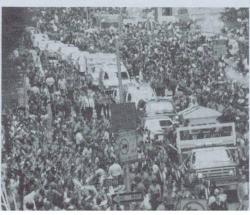 After 27 and a half years in prison, Nelson Mandela finally won his freedom today and promptly urged his supporters at home and abroad to increase their pressure against the white minority Goverment that had just released him. ''We have waited too long for our freedom,'' Mr. Mandela told a cheering crowd from a balcony of Cape Town's old City Hall. ''We can wait no longer.'' ''Now is the time to intensify the struggle on all fronts,'' he said. ''To relax our efforts now would be a mistake which generations to come will not able to forgive.''
 Mr. Mandela's 20-minute speech, which he prepared before leaving prison today, constituted his first remarks in public since before he was sentenced in June 1964 to life imprisonment for conspiracy to overthrow the Government and engage in sabotage. He asked the international community not to lift its sanctions against South Africa, despite the recent changes introduced by President F. W. de Klerk, which culminated in Mr. Mandela's release. ''To lift sanctions now would be to run the risk of aborting the process toward ending apartheid,'' he said.
Mr. Mandela's voice sounded firm and his words as eloquently militant as when he defended violence as the ultimate recourse at his political trial in 1964. Though he looked all of his 71 years and was grayer than artists' renditions over the years had depicted, he walked out of Victor Verster prison erect and vigorous. In Washington, President Bush rejoiced over the release of Mr. Mandela, spoke to him by telephone and invited the anti-apartheid leader to visit the White House. Mr. Mandela gave no evidence that his militant opposition to apartheid had been tempered by the more than 10,000 days he spent in confinement. But he also said nothing that would have surprised the Government had he said it during his years of incarceration. Indeed, there appeared to be nothing in Mr. Mandela's initial remarks after his release to give the Government much consolation or encouragement. Although he has been viewed as a potential leader for all South Africans, he stressed time and again that his loyalty lay with the African National Congress, for which he was working underground when he was jailed in August 1962 on charges of incitement and leaving the country illegally. He was serving time on that conviction when he was sentenced to life imprisonment in 1964.
Mr. Mandela told a crowd that he remained a ''loyal and disciplined member'' of the African National Congress and still endorsed its policies, including its use of armed struggle against the white minority Government. He said he saluted the congress's military wing, Spear of the Nation, and its ally, the South African Communist Party, ''for its steady contribution to the struggle for democracy.'' But he also thanked the Black Sash, an organization of white women working to end apartheid, and the predominantly white National Union of South African Students for being ''the conscience of white South Africans.'' And he held out an olive branch to all whites, asking them to join in shaping a new South Africa. ''The freedom movement is a political home for you, too,'' he said.
In his first speech after his release, Mr. Mandela may have taken an orthodox line with a mass audience sympathetic to the African National Congress and might in private discussions eshow greater flexibility on the question of discussions that the Government wants to have with blacks, who are 28 million of the population, compared with the 5 million whites of the ruling minority. He said he was only making some preliminary comments following his release, and would have more to say ''after I have had the opportunity to consult with my comrades.'' By this he meant the leaders of the African National Congress now in exile in Zambia as well as colleagues still based in South Africa. But he appeared to discourage any leading role for himself, such as the Government has in mind, saying, ''A leader of the movement is a person who has been democratically elected at a national conference.''
President de Klerk has invited black leaders to join talks leading to the formulation of a new constitution that would let black South Africans take part at last in their nation's politics.Mr. Mandela acknowledged to the crowd that he had conducted a dialogue with the Government during his last years in prison. But he added: ''My talks with the Government have been aimed at normalizing the political situation in the country. We have not yet begun discussing the basic demands of our struggle. I wish to stress that I myself have at no time entered into negotiations about the future of our country, except to insist on a meeting between the A.N.C. and the Government,'' he said. He described Mr. de Klerk, whom he has met twice since December, as ''a man of integrity. Mr. de Klerk has gone further than any other Nationalist President in taking real steps to normalize the situation,'' Mr. Mandela said. ''But as an organization we base our policy and strategy and tactics on the harsh reality we are faced with,'' he said. ''And this reality is that we are still suffering under the policies of the Nationalist Government.''
The National Party, which Mr. de Klerk now leads, instituted apartheid after taking power in 1948. Mr. Mandela said the Government had to take further steps before negotiations could begin. As a prerequisite for negotiations, he reiterated two demands that he had conveyed from prison through recent visitors. These are are the lifting of the state of emergency, which was imposed in June 1986, and the release of all political prisoners, including those accused of crimes committed in the struggle against apartheid. ''Only such a normalized situation which allows for free political activity can allow us to consult our people in order to obtain a mandate,'' Mr. Mandela said. He said the people had to be consulted about who would represent them in talks with the Government. ''Negotiations cannot take place above the heads or behind the backs of our people,'' he said. ''It is our belief that the future of our country can only be determined by a body which is democratically elected on a nonracial basis.''
Mr. Mandela appeared to allude to a formula under which a constituent assembly, in effect supplanting the existing Parliament, would draft a new constitution. Such a plan would mean the creation of an interim government in South Africa and has previously been rejected by Mr. de Klerk for the foreseeable future. Mr. Mandela walked out of Victor Verster Prison near Paarl at 4:15 P.M., 75 minutes later than the release time announced Saturday afternoon by Mr. de Klerk. Acquaintances of the Mandela family said his departure from the prison was delayed by family discussions. He was greeted by about 5,000 supporters lining the asphalt road outside the prison farm where he has been held since December 1988. Some waved the black, green and yellow flags of the African National Congress, from which Mr. de Klerk removed a ban on Feb. 2. Mr. Mandela was then driven 40 miles from Paarl to Cape Town, passing several hundred people who had parked by the roadside or waited on overpasses in hope of seeing him. They held homemade signs, some of which read simply, ''Welcome home.'' A huge crowd, which organizers said reached 250,000 people, assembled in the square in front of the old City Hall in Cape Town to greet Mr. Mandela. Reporters covering the rally put the crowd's size at only 50,000 people at its peak. They became impatient and sometimes unruly, waiting up to six hours in the hot sun and had dwindled to about 20,000 by sunset, when Mr. Mandela finally appeared.
In the 1950's it was Government policy to prevent blacks from settling in the Western Cape, so they are not in the clear majority in Cape Town, where Mr. Mandela was released. People of mixed race, known as ''coloreds,'' are the largest population group in Cape Town, where whites also outnumber blacks. Blacks, who account for nearly 75 percent of the population in the country as a whole, are in the overwhelming majority in the Johannesburg region, where Mr. Mandela can expect his most tumultuous welcome.
The festive occasion was marred by violence after some youths who had been drinking on the fringes of the rally started breaking windows and looting shops in downtown Cape Town. The police tried to disperse them by firing shotguns and tear gas, and some of the youths retaliated by throwing bottles and stones. At one point, drunken protesters invaded a Chinese restaurant, snatched up the liquor and wine and threw bottles at the police from the rooftop. One man in the crowd was also injured in a knife fight.
The South African Press Association reported tonight that 2 people had been killed and 13 wounded in the confrontations. A physician treating casualties on the scene estimated that 100 people had been wounded, mostly by buckshot. Most suffered only light injuries, including three journalists covering the rally. Cheryl Carolus, a spokeswoman for the United Democratic Front, which helped organize the rally, attributed the violence to outsiders who, she said, were ''beyond our usual crowds, or who supported the rival Pan-Africanist Movement.''' At times, some supporters at the rally had to scramble for cover as the police chased or fired at looters and stone-throwers. The Rev. Allan Boesak, a prominent figure in the anti-apartheid movement, pleaded for more than 45 minutes with the crowd to maintain discipline and move back.
Dullah Omar, a lawyer representing the Mandela family, said Mr. Mandela had been unaware of the violence. This evening, Mr. Mandela failed to appear at a news conference arranged by the reception committee that is handling his schedule. A representative said Mr. Mandela would meet the press later this week in Johannesburg. Mr. Mandela and his wife, Winnie, are expected to fly to Johannesburg on Monday and proceed to their home in the black township of Soweto. One of the organizers, Saki Mocozoma, said security considerations precluded him from revealing where the Mandelas were spending their first night.
Mr. Mandela also paid tribute to his wife, who has lived apart from him for more than 27 years, and their children. ''I am convinced that your pain and suffering was far greater than my own,'' he told them.
Source: New York Times
Subscribe to:
Posts (Atom)