Showing posts with label Mahmoud Ahmadinejad. Show all posts

Thursday, April 5, 2012

Iran 'puts the screws' on MTN

MTN is facing a storm over claims that it helped the Iranian government to spy on local subscribers and assisted the regime in its brutal crackdown on protesters in 2009 and 2010. In court papers lodged in the United States last week, rival mobile operator Turkcell alleged that MTN told its Iranian military-linked partners it would allow the defence ministry to eavesdrop on subscribers. Sources close to MTN's Iranian business have also described an Orwellian environment in the company's Tehran headquarters, where it allegedly gave military intelligence officials "open" access to subscribers’ details. The sources claimed:
  • Because MTN Irancell and its data centre were part-owned by the Iranian military, subscriber data was shared "on a collegial basis" with the intelligence sector;
  • A shadowy "second floor" in MTN's building was populated by military intelligence officials, the volunteer militia known as the Basij ("morality police") and clerics;
  • During the 2009 and 2010 Green movement protests, men from the second floor, accompanied by Irancell chief executive Alireza Dezfouli, allegedly approached data warehouse staff regularly to demand detailed records for individuals;
  • In one case, they demanded the number of a known Green Party activist, who could not be reached after his information had been given to military intelligence; and
  • Third parties listened in to staff calls over Irancell SIMs and would intervene and demand that the staff speak in English and not in other South African languages.
Turkcell launched the $4-billion lawsuit in the US District Court of Columbia in Washington DC last week. It accuses MTN of bribing South African and Iranian officials, facilitating weapon trade agreements between the two countries and influencing South African foreign policy on Iran's nuclear ambitions in a bid to stop Turkcell from being awarded a second cellular network licence in Iran. MTN, whose share price plummeted to a 12-month low last week, said it would oppose the lawsuit.

Iran's mobile operators were harshly criticised for their alleged role in quelling protests that followed Iranian President Mahmoud Ahmadinejad's disputed victory in the 2009 elections. Activists who claimed to have been tortured after being arrested said that intelligence officials had their cellphone data.

'Human rights violations'

This week, the Democratic Alliance asked the South African Human Rights Commission to investigate whether MTN "may be directly or indirectly responsible for human rights violations in Iran". DA MP David Maynier said there was no evidence that MTN Irancell was involved directly or indirectly, but he cited media reports that the company bought equipment to monitor calls, filter and block SMSes, and establish the location of users. MTN flatly denied the claims this week, saying: "On human rights, the group takes direction from and adheres to the policies of both the South African government and the United Nations. South Africa has human rights enshrined as fundamental principles within its Con­stitution.

"Given South Africa's own recent history and our ­struggle against apartheid, the ­centrality of civil rights is at the core of our culture as a company and as individuals."

The company said the equipment it used in Iran was not intended to monitor dissidents "nor is there any evidence that the Iranian government has used the data collected to identify and locate citizens or dissidents". MTN is a 49% shareholder in Iran­cell. Fifty-one percent is held by an Iranian state-linked consortium, which is dominated by a subsidiary owned by the defence ministry known as Sairan, or Iran Electronics Industries. Sairan is subject to US and European Union sanctions that target proliferators of "weapons of mass destruction". It also holds a share in consortium Arya Hamrah, which owns and runs MTN Irancell's data centre that houses the company’s servers and hardware.

Military intelligence

The sources familiar with MTN's Iranian operations said that, because of these ownership structures, Irancell readily gave information about subscribers to intelligence officials. One of the sources said: "MTN's data centre in Iran is effectively run by the military and military intelligence. None of the intelligence organisations needs to go through normal procedures to access subscriber data and track individuals." Describing the climate at MTN's headquarters, a senior official said it was dominated by the presence of Iran's military intelligence officials and the "morality police".

"There was a tea lady who just stood at the printer all day. Her job was to watch us."

The woman, understood to be a member of the "morality police", would scold female staff whose clothing was considered too revealing and signalled her displeasure over "inappropriate" behaviour. Communicating by email, the source said: "The people on the second floor are from military intelligence and the Basij and some clerics. They oversee the intelligence and moral activities of the employees of Irancell. All emails, telephone conversations and SMSes of employees are monitored on an ongoing basis. This is then exposed to MTN against the threat that they will kick out MTN when they need concessions from it."

The staffer described how men from the second floor would accompany Dezfouli to collect data on individuals and political dissidents: "On several occasions someone from the second floor and [Dezfouli] would come to the managed services group and say 'give us all the details for this number', and they would have to." The staffer said subscription and location data and call and SMS histories were handed over. The company's data warehouse is outsourced to a South African company, PBT. According to the source: "PBT simply provides a data warehousing function. In other words, they extract data and provide data-mining functions for product development, market segmentation, etcetera. MTN owns the data, so they don't really have a choice."

Tracking activities

PBT spokesman Nitesh Vallabh said: "We only transform the data into aggregated information as requested by [MTN] for management information to manage the business." MTN used the information to help it profile and market to its customer base; it was not supposed to be used to identify and track the activities of individuals, the source said. But this did happen.

"In 2009 and 2010, it would happen four to five times in a month. It spiked whenever there were rallies or government protests. But it didn't happen every month."

In one case, the staffer said, he recognised a number as belonging to a friend, an active member of Iran's opposition Green Party.

"We were friends and talked maybe every two weeks. Then one day a request came for his number and [they] gave them his data. I tried to call him that night and I could not reach him. Four months later I still couldn’t reach him on the number or Skype."

In another case, the staffer said, he was talking to an acquaintance in South Africa in their home language when a voice broke in to say: "English, English, English!" He was using an Irancell SIM at the time, "but whether this was a national or an MTN function, I don’t know."

Shortly before going to print, MTN Human Resources Head Paul Norman submitted the following written response to questions over allegations that it assisted the Iranian regime in monitoring the communications and movements of political activists:

"MTN's role in Iran is mostly as a technical partner. It is a non-controlling shareholder. Fewer than 30 MTN expats (not all South African) are employed in Irancell, out of around 2000. Whatever equipment MTN has acquired for Irancell was for normal business reasons. This is the same software we utilize at other MTN operations. To suggest that we acquired such equipment with the active purpose of enhancing the Iranian government’s capacity to monitor its citizens outside the law is simply outrageous. We have never cut off Skype and we do not own the international gateway. Some of the equipment listed was purchased to develop our 'homezone' offerings, which allow reduced rates within specific regional areas and thus expands the offering to more people.

"The data warehousing software was acquired to predict, churn and to see when airtime is running out and suggest new products and services to customers. This is standard software that is used by telcos, financial services and other companies around the world to improve the service that customers receive. It has nothing to do with interception, nor is there any evidence that the Iranian government has used the data collected to identify and locate citizens or dissidents.

"It is important to note that when MTN entered Iran, there were only around four million subscribers in total. Today there are almost 35 million subscribers, of whom more than 60% are below 25 years old. These are young people who use the network to communicate with each other, Skype, access Google and tweet each other. MTN works hard, with international legal advisors, to ensure that it is sanctions compliant. MTN's views on human rights are clear. We are a South African company, founded in the year of our first democratic elections under a new constitution.

Civic and human rights are vital to the company, and as the individuals that work at MTN. MTN has a social and ethics committee of the board to look as such issues. One of our core values is respect human rights and privacy rights of people in all the markets in which we operate. We oppose abuse of such rights by any party, including governments, and we communicate our procedures extensively internally. We expect all our business partners to abide by our code of ethics

"Mobile telecoms has been a force for political and economic liberation in the emerging world over the last 10 years. MTN is proud of the part it played in contributing to this. But we accept the ethical complexities around telecoms in this new environment, and the potential for their manipulation for unethical means.

These are new areas of ethics and political debate. These issues also impact other telecom operators and Internet providers across emerging markets. MTN is keen to work with international bodies to construct clearer international standards."

*Got a tip-off for us about this story? Email amabhungane@mg.co.za

Source: Mail & Guardian

Thursday, February 11, 2010

Clashes reported as Iran marks Revolution Day

Huge crowds gathered in central Tehran on Thursday to mark the 31st anniversary of the Islamic Revolution in Iran as opposition Web sites carried reports of shots and tear gas being fired at protesters and attacks on opposition leaders. The reports could not be confirmed independently because the Iranian authorities imposed severe restrictions on news coverage since last June’s flawed presidential elections.

The anniversary of the 1979 revolution has become a test of strength between the government of President Mahmoud Ahmadinejad and an opposition movement that took root after last June’s flawed elections, creating the biggest political challenge since the fall of Shah Reza Mohammed Pahlavi. In an effort to disrupt communications and head off huge opposition demonstrations, the authorities on Wednesday drastically slowed Internet service in Iran and shut down text messaging services. One official said that Gmail, the Google e-mail service, would be blocked. But news reports indicated that the crackdown on communications had not kept protesters off the streets.

An Iranian opposition Web site said security forces fired shots and tear gas at supporters of an opposition leader, Mir Hussein Moussavi, as they mounted a counter-rally in central Tehran. Thousands of pro-government demonstrators were reported marching toward Azadi Square in central Tehran. “Security forces opened fired at protesters and fired tear gas in central Tehran,” Reuters quoted the Green Voice Web site as saying, citing witnesses.

Another opposition Web site said that security forces attacked an, opposition leader, Mehdi Karoubi, when he attended a rally marking the anniversary, Reuters said. “Karoubi was attacked by security forces in central Tehran... they shattered his car’s windows ... Karoubi was not seriously injured,” the Web site Jaras reported. Jaras also said security forces attacked former President Mohammad Khatami and arrested his brother and his brother’s wife, who is a granddaughter of Ayatollah Ruhollah Khomeni. Other news reports from Tehran on Thursday said tens of thousands of pro-government demonstrators had taken to the streets to mark the revolution in 1979 that toppled the shah ushered in the theocracy of Ayatollah Khomeini. State television showed the government supporters carrying banners as they marched toward Azadi Square to hear a speech by President Mahmoud Ahmadinejad, The Associated Press reported.

The television showed big crowds in the square waving Iranian flags and pictures of Ayatollah Khomeini and his successor as supreme leader, Ayatollah Ali Khamenei. Such anniversaries are traditional days of celebration. But since an uprising began in June after the disputed presidential election, protesters have used the cover of such public events to take to the streets. And soon after 10 p.m. Wednesday in Tehran, forbidden cries of “God is great” could be heard echoing from the city’s rooftops, a sign that opposition protests, the first since December 27, would go ahead despite the government’s efforts to thwart them.

The authorities have warned that they intend to confront protesters harshly. Witnesses quoted by The A.P. said the police deployed hundreds of officers in central Tehran to block protests. At least eight people were killed by the security forces in protests in December, and two men linked to the opposition were hanged this month.

The opposition movement has relied heavily on the Internet, using text messaging, e-mail and videos to spread information about the demonstrations and the crackdown by the government. It was not immediately clear if Gmail would be blocked permanently, but users inside Iran said that because of the extremely slow speed of Internet service, they had been unable to open Gmail or the Yahoo e-mail service for the last week.

Google confirmed “a sharp drop in traffic” that could not be attributed to equipment failure on its end. “Whenever we encounter blocks in our services we try to resolve them as quickly as possible,” a spokeswoman, Jill Hazelbaker, said, “because we strongly believe that people everywhere should have the ability to communicate freely online. Sadly, sometimes it is not within our control.” Some communications experts believe that the authorities’ efforts to block Gmail could be related to Google encryption, which prevents the government from reading e-mail. Yahoo and Hotmail have not been similarly affected, one monitor said. Whatever its motivation, the government described its e-mail disruptions as well intentioned. Saeed Mahdyun, a telecommunications official, told the semiofficial ILNA news agency that Gmail would be blocked to encourage users to switch to local e-mail services.

The government announced last week that it was starting a national e-mail service to replace foreign ones, as a way to build “trust” with the people. But the opposition says most people use Gmail and Yahoo precisely because they are suspicious of local e-mail services, which they strongly suspect are monitored by the government. Communications experts doubted the effectiveness of the government’s campaign. “Asking the entire country to switch their e-mail service is a tall order, even by Iranian standards,” wrote Robert Faris, research director at the Berkman Center for Internet and Society at Harvard, in an e-mail message. Continuing a crackdown that has produced dozens of arrests in recent weeks, the authorities also arrested at least six members of the Bahai faith in Tehran on Wednesday, the Committee of Human Rights Reporters reported.

The government has outlawed the Bahai faith since the 1979 revolution. A group of seven Bahai leaders were put on trial on Jan. 12 on charges of threatening national security.

Source: New York Times

Thursday, October 22, 2009

A Lone Cleric Is Loudly Defying Iran’s Leaders

A short midlevel cleric, with a neat white beard and a clergyman’s calm bearing, Mehdi Karroubi has watched from his home in Tehran in recent months as his aides have been arrested, his offices raided, his newspaper shut down. He himself has been threatened with arrest and, indirectly, the death penalty.

Once a second-tier opposition figure operating in the shadow of Mir Hussein Moussavi, his fellow challenger in Iran’s discredited presidential election in June, Mr. Karroubi has emerged in recent months as the last and most defiant opponent of the country’s leadership. The authorities have dismissed as fabrications his accusations of official corruption, voting fraud and the torture and rape of detained protesters. A former confidant of Ayatollah Ruhollah Khomeini and a longtime conservative politician, he has lately been accused by the government of fomenting unrest and aiding Iran’s foreign enemies.

Four months after mass protests erupted in response to the dubious victory claims of President Mahmoud Ahmadinejad, the opposition’s efforts have largely stalled in the face of unrelenting government pressure, arrests, long detentions, harsh sentences, censorship and a strategic refusal to compromise. But for all its success at preserving authority, the government has been unable to silence or intimidate Mr. Karroubi, its most tenacious and, in many ways, most problematic critic. While other opposition figures, including Mr. Moussavi and two former presidents, Mohammad Khatami and Ali Akbar Hashemi Rafsanjani, are seldom heard now, Mr. Karroubi has been unsparing and highly vocal in his criticism of the government, which he feels has lost all legitimacy.

After the government dismissed those allegations last month, Mr. Karroubi was summoned to appear before a three-judge panel investigating his actions. He welcomed the invitation. “It will be a good opportunity for me to talk again about crimes that would make the shah look good,” he said, according to the Green Freedom Wave Web site.

As calls for his arrest grow louder, he remains defiant. “If only I were not alive and had not seen the day that in the Islamic republic, a citizen would come to me and complain that every variety of appalling and unnatural act would be done in unknown buildings and by less-known people: stripping people and making them face each other and subjecting them to vile insults and urinating in their faces,” he wrote in his letter to the nation. “I said to myself, ‘Where indeed have we arrived 30 years after the revolution?’ ”

Sourc: New York Times

Wednesday, October 21, 2009

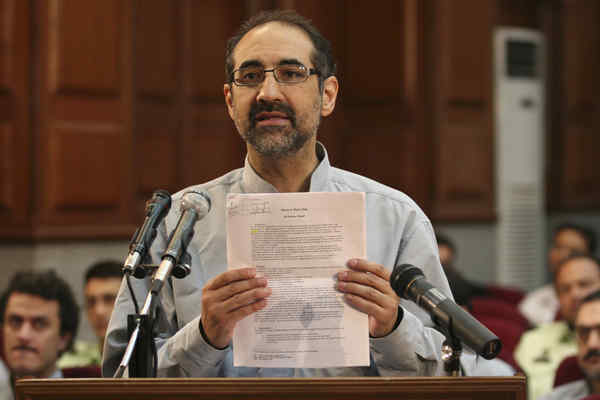
Iranian American scholar gets 12-year term in unrest

Iran ignored appeals by Secretary of State Hillary Rodham Clinton and the rock star Sting and sentenced an Iranian American academic yesterday to 12 years in prison for his alleged role in antigovernment demonstrations after the country's disputed presidential election. The sentence for Kian Tajbakhsh, 47, was the longest prison term yet in a mass trial of more than 100 opposition figures, activists, and journalists in the postelection turmoil. Tajbakhsh's heavy sentence signaled that Tehran was sticking to a tough line overall on the political unrest. It came amid calls in Iran for prosecution of the most senior opposition figure, Mir-Hossein Mousavi, and suggestions that three U.S. hikers, detained in July after accidentally crossing into Iran, could face charges.

Tajbakhsh, a social scientist and urban planner who holds dual citizenship, was arrested at his Tehran home July 9. He was the only American detained in the crackdown that crushed giant street protests by hundreds of thousands after the June 12 election. The opposition contends that the vote was rigged in favor of President Mahmoud Ahmadinejad. The security sweep went far beyond protesters on the streets, snatching up rights activists, journalists, and opposition politicians. The government accused them of organizing the protests on behalf of Iran's foreign enemies to foment a "velvet revolution" to overthrow the country's Islamic leadership.

The White House, in a statement yesterday, expressed "our deepest regret and strong objection" to Tajbakhsh's sentencing, saying that he posed no threat to Iran and urging that he be freed. Clinton had appealed in August for his release, and he also had been specifically named in a call by the British rock star Sting to free all political prisoners in Iran.

Tajbakhsh's lawyer, Houshang Azhari, told the IRNA news agency he would appeal the conviction on charges of "acting against national security." He said that the law barred him from divulging the full details of the sentence, asserting only that it was "more than 12 years." The appeal could open an avenue for freeing Tajbakhsh. Roxana Saberi, an Iranian American journalist arrested this year, was convicted of espionage but freed on appeal in what was widely seen as a political decision to defuse tensions with Washington.

Tajbakhsh had been targeted by Iranian authorities before. In 2007, he was arrested on similar charges while working for the pro-democracy Open Society Institute, run by U.S. philanthropist George Soros - a figure whom Iran often has cited as part of the antigovernment plot. Tajbakhsh denied the charges and was released after four months in prison. Afterward, Tajbakhsh left the Open Society Institution and remained with his family in Iran, working on a book.

Source:Philly.com

Saturday, June 20, 2009

'Neda' becomes rallying cry for Iranian protests


RIP NEDA, The World cries seeing your last breath, you didn't die in vain. We remember you."

Nedā (ندا) is a word used in Persian to mean "voice", "calling," or "divine message," and she has been referred to as the "voice of Iran." She was filmed as she lay dying on the street. Her death thus became iconic in the struggle of Iranian protesters against what they said was the fraudulent election of President Mahmoud Ahmadinejad.

Source: Wikipedia