Mortgage relief fraud schemes are still around, according to the Federal Trade Commission.
Acting on a complaint by the F.T.C., a federal court has halted a mortgage relief operation that the commission accused of taking in more than $1 million by offering troubled homeowners “bogus” help in staving off foreclosure.
The F.T.C. filed a complaint March 5 in the Federal District Court for the Central District of California in Santa Ana against Sameer Lakhany and five businesses that he controlled. The complaint alleged that he and the companies victimized hundreds of borrowers with two related mortgage-assistance frauds. Last week, the court issued orders halting operation of the businesses, freezing their assets and appointing a permanent receiver to oversee the firms while the F.T.C. pursues the case. The agency said it would seek funds for possible refunds for consumers.
Jerry Werksman, Mr. Lakhany’s attorney, said in a brief telephone interview that his client “didn’t go into this business to cheat people. It’s unfortunate the F.T.C. put an end to it because he was trying to help.”
In the first fraud, according to the F.T.C., representatives of the companies pretended to be a law firm and offered to represent consumers in group lawsuits against their lenders, for an upfront fee as high as $10,000. The company hired lawyers briefly to file the suits, the F.T.C. said, but then abandoned the cases and “failed to get the results they promised.”
In the second version, the F.T.C. alleged, the companies promised to negotiate loan modifications, like a lower payment or principal balance, in exchange for upfront fees as high as $1,595. (Federal rules that took effect last year prohibit firms from taking upfront fees for negotiating mortgage modifications in most cases.)
Consumer advocates say borrowers seeking help with a troubled mortgage should seek out counselors certified by the federal Department of Housing and Urban Development. The Homeownership Preservation Foundation, for instance, an umbrella group that works with seven major nonprofit groups across the country that advise strapped homeowners free. The foundation operates a toll free number, 1-888-995-HOPE.
“That number will get you to a legitimate, HUD-certified mortgage counselor,” said Colleen Hernandez, president and chief executive of the foundation. “It’s a very confusing environment for consumers to wade through. They ask, ‘How do I know whom to trust?’”
The foundation’s Web site includes tips for avoiding fraud schemes. The counselors at the foundation and its affiliates are knowledgeable about the various mortgage assistance programs, she said, and can assist borrowers in evaluating their options and in dealing with their lenders on the phone.
A government Web site established to communicate information about the recent national mortgage settlement also warns borrowers about fraud and offers tips to help make sure you are dealing with a legitimate lender or mortgage help firm.
Source: New York Times
Wednesday, March 28, 2012


S&P downgrade of SA’s outlook hits rand
The rand weakened against the dollar on Wednesday after Standard & Poor’s, the rating agency, downgraded South Africa’s outlook to negative from stable, citing structural economic and social problems. The agency said South Africa’s near-term political pressures had eased and the Treasury remained committed to fiscal consolidation, but added that problems such as high unemployment and a structural current-account deficit persisted. "The negative outlook reflects the potential for a downgrade if economic and social problems feed into the political debate in the run-up to the 2014 elections and consequently further put pressure on the policy framework," S&P said.
It reaffirmed South Africa’s foreign and local currency ratings at BBB+/A-2 and A/A-1. The rand weakened to R7,665 to the dollar from R7,643 just before the S&P release. By about 3.30pm local time, it was at R7,6698 to the dollar. The currency, which had been weakening in earlier trading, was down about 0,7% after the announcement. Government bonds also fell, with the yield on the three-year benchmark bond rising to 6,85% from 6,81% before.
This is the third outlook downgrade in four months for Africa’s biggest economy. Fitch cut its outlook to negative in January following a similar move from Moody’s in November. Both agencies cited political pressure as the reason for their move. The fact that S&P did not put South Africa’s rating on credit watch meant the chances of a cut in the short term were limited, said Peter Attard Montalto, emerging-markets analyst at Nomura, the Japanese investment bank. "It is only the course of medium-run policy dynamics that will perhaps eventually lead to a downgrade. Market reaction is likely to be somewhat contained given the risks S&P talk about are already well known," Mr Montalto added.
Source: Business Day
It reaffirmed South Africa’s foreign and local currency ratings at BBB+/A-2 and A/A-1. The rand weakened to R7,665 to the dollar from R7,643 just before the S&P release. By about 3.30pm local time, it was at R7,6698 to the dollar. The currency, which had been weakening in earlier trading, was down about 0,7% after the announcement. Government bonds also fell, with the yield on the three-year benchmark bond rising to 6,85% from 6,81% before.
This is the third outlook downgrade in four months for Africa’s biggest economy. Fitch cut its outlook to negative in January following a similar move from Moody’s in November. Both agencies cited political pressure as the reason for their move. The fact that S&P did not put South Africa’s rating on credit watch meant the chances of a cut in the short term were limited, said Peter Attard Montalto, emerging-markets analyst at Nomura, the Japanese investment bank. "It is only the course of medium-run policy dynamics that will perhaps eventually lead to a downgrade. Market reaction is likely to be somewhat contained given the risks S&P talk about are already well known," Mr Montalto added.
Source: Business Day
Chairman stops info bill submission
An oral submission on the Protection of State Information Bill was stopped on Wednesday afternoon because it contained "political statements". Mark Weinberg, from the Alternative Information Development Centre, was interrupted when he mentioned "the rise of securocrats" and "the tendency towards greater conservative authoritarianism" in his presentation.
Raseriti Tau, the chairman of the ad hoc committee on the bill, told him: "Now, you are giving me problems now. I know that I am going to be accused of having denied you an opportunity to speak. We can't continue with this." He added: "There are serious political statements now that you are making now. You are making reference to the Polokwane conference and all those sorts of things. "Can we stop this presentation. We are not going to allow you to continue with this presentation."
Weinberg had said that the tendency towards greater conservative authoritarianism in South Africa had to be understood in terms in the context of the battle between various factions and groups fighting for influence in the ruling party and the state. "We also see the rise of securocrats," he said. "This so called... alliance of the wounded cobbled together pre-Polokwane is weakening and its fissures rupturing..." Tau then stopped Weinberg from continuing. "It would have been good if you were a lobby group and there is someone who was seeking funding for a protest," Tau said.
Source: Times Live
Raseriti Tau, the chairman of the ad hoc committee on the bill, told him: "Now, you are giving me problems now. I know that I am going to be accused of having denied you an opportunity to speak. We can't continue with this." He added: "There are serious political statements now that you are making now. You are making reference to the Polokwane conference and all those sorts of things. "Can we stop this presentation. We are not going to allow you to continue with this presentation."
Weinberg had said that the tendency towards greater conservative authoritarianism in South Africa had to be understood in terms in the context of the battle between various factions and groups fighting for influence in the ruling party and the state. "We also see the rise of securocrats," he said. "This so called... alliance of the wounded cobbled together pre-Polokwane is weakening and its fissures rupturing..." Tau then stopped Weinberg from continuing. "It would have been good if you were a lobby group and there is someone who was seeking funding for a protest," Tau said.
Source: Times Live
Tuesday, March 27, 2012
SA authorised arms for Syria
Justice Minister Jeff Radebe has confirmed that three contracting permits were authorised by SA for the supply of sniper rifles and other weapons to Syria between 2006 and 2010. Reports have appeared that Syria had tried to buy a large consignment of sniper rifles from SA in 2010.
The National Conventional Arms Control Committee (NCACC), of which Mr Radebe is chairman, confirmed in response to a parliamentary question from the Democratic Alliance (DA) that contracting permits were issued by SA, allegedly to South African companies, but said the weapons ordered were never delivered to Syria. DA defence spokesman David Maynier yesterday called for the matter to be investigated, saying that the NCACC should never have issued the permits. "The fact is that the NCACC should never even have considered authorising a contracting permit for the supply of sniper rifles and accessories to Syria. "The preamble to the law regulating conventional arms sales in SA says that we will not trade in conventional arms with states engaged in repression, aggression and terrorism," Mr Maynier said.
The NCACC said in its reply to the question raised in Parliament: "The NCACC approved 3 X Contracting Permits for the Government of Syria for … parachutes, 40mm multi-grenade launcher (and) sniper rifles with accessories. However, to date, there were no deliveries that were undertaken against these contracting permits."
Mr Maynier said while the permits were approved before the recent year-long crisis in Syria, poor human rights conditions had existed there for many years. "When considering whether to authorise permit applications, the NCACC is required by law to avoid the transfer of conventional arms to governments that systematically violate or suppress human rights and fundamental freedoms; avoid the transfer of conventional arms to governments that are likely to contribute to the escalation of regional military conflicts; and avoid contributing to terror and crime. Syria was not involved in a full-scale civil war when the permit was authorised but it was, and remains, one of the most repressive regimes in the world," Mr Maynier said.
The committee’s reply said SA had also issued contracting permits to the United Nations for RG-32 Scout mine-resistant 4x4 light armoured vehicles, used by the UN Disengagement Observer Force in Syria in 2004 and 2010. Mr Radebe’s spokesman, Tlali Tlali, was unable to comment yesterday as he was still investigating the matter.
Source: Business Day
The National Conventional Arms Control Committee (NCACC), of which Mr Radebe is chairman, confirmed in response to a parliamentary question from the Democratic Alliance (DA) that contracting permits were issued by SA, allegedly to South African companies, but said the weapons ordered were never delivered to Syria. DA defence spokesman David Maynier yesterday called for the matter to be investigated, saying that the NCACC should never have issued the permits. "The fact is that the NCACC should never even have considered authorising a contracting permit for the supply of sniper rifles and accessories to Syria. "The preamble to the law regulating conventional arms sales in SA says that we will not trade in conventional arms with states engaged in repression, aggression and terrorism," Mr Maynier said.
The NCACC said in its reply to the question raised in Parliament: "The NCACC approved 3 X Contracting Permits for the Government of Syria for … parachutes, 40mm multi-grenade launcher (and) sniper rifles with accessories. However, to date, there were no deliveries that were undertaken against these contracting permits."
Mr Maynier said while the permits were approved before the recent year-long crisis in Syria, poor human rights conditions had existed there for many years. "When considering whether to authorise permit applications, the NCACC is required by law to avoid the transfer of conventional arms to governments that systematically violate or suppress human rights and fundamental freedoms; avoid the transfer of conventional arms to governments that are likely to contribute to the escalation of regional military conflicts; and avoid contributing to terror and crime. Syria was not involved in a full-scale civil war when the permit was authorised but it was, and remains, one of the most repressive regimes in the world," Mr Maynier said.
The committee’s reply said SA had also issued contracting permits to the United Nations for RG-32 Scout mine-resistant 4x4 light armoured vehicles, used by the UN Disengagement Observer Force in Syria in 2004 and 2010. Mr Radebe’s spokesman, Tlali Tlali, was unable to comment yesterday as he was still investigating the matter.
Source: Business Day
2 Arrested for Foreclosure Rescue Fraud
Gloria Becerra, 46, Oxnard, California, and Hector Menendez, 55, Los Angeles, California, are the subject of a felony complaint for grand theft and foreclosure consultant fraud. Becerra and Menendez are both charged with 4 counts of grand theft, 11 counts of foreclosure consultant fraud, and one count of attempted grand theft.
The charges arise out of a fraudulent home loan modification and foreclosure rescue program run primarily under the business names of "Sunset Beach Management," "Financial Wellness for Homeowners L.A." and "California Sky Premiers." Becerra and Menendez collected thousands of dollars in upfront fees promising to reduce the victim's mortgage loan amount, and to "save" her home from foreclosure.
The victim received no actual services from the charged defendants and, in addition to losing thousands of dollars, also lost her home in foreclosure.
The court set bail at $100,000 for both Becerra and Menendez. An early disposition conference is scheduled for April 16, 2012, at 1:30 p.m. in courtroom 12. If convicted of all charges, the defendants each face a maximum sentence of 12 years and 8 months. District Attorney Gregory D. Totten announced the Ventura County District Attorney's Real Estate Fraud Unit's felony complaint.
The arrests followed a seven-month investigation by the District Attorney's Real Estate Fraud Unit. Individuals who believe they have been victimized by Becerra or Menendez, or others working with either defendant, are encouraged to contact the Ventura County District Attorney's Office Real Estate Fraud Unit at (805) 662-1750 to file a complaint.
Source: Mortgage Fraud Blog
The charges arise out of a fraudulent home loan modification and foreclosure rescue program run primarily under the business names of "Sunset Beach Management," "Financial Wellness for Homeowners L.A." and "California Sky Premiers." Becerra and Menendez collected thousands of dollars in upfront fees promising to reduce the victim's mortgage loan amount, and to "save" her home from foreclosure.
The victim received no actual services from the charged defendants and, in addition to losing thousands of dollars, also lost her home in foreclosure.
The court set bail at $100,000 for both Becerra and Menendez. An early disposition conference is scheduled for April 16, 2012, at 1:30 p.m. in courtroom 12. If convicted of all charges, the defendants each face a maximum sentence of 12 years and 8 months. District Attorney Gregory D. Totten announced the Ventura County District Attorney's Real Estate Fraud Unit's felony complaint.
The arrests followed a seven-month investigation by the District Attorney's Real Estate Fraud Unit. Individuals who believe they have been victimized by Becerra or Menendez, or others working with either defendant, are encouraged to contact the Ventura County District Attorney's Office Real Estate Fraud Unit at (805) 662-1750 to file a complaint.
Source: Mortgage Fraud Blog
Monday, March 26, 2012
UN council condemns Mali coup
The UN Security Council on Monday slammed the coup in Mali and added to international demands for the democratically-elected government to be returned. A formal statement released by the council said that the “fragile security and humanitarian situation” in the Sahel nations (several countries that stretch across northern Africa) had been “exacerbated” by the return of thousands of people after the uprising in Libya.
The Security Council has joined the African Union and other regional organizations and governments in opposing the soldiers who overthrew President Amadou Toumani Toure on March 22. “The Security Council strongly condemns the forcible seizure of power from the democratically-elected government of Mali by some elements of the Malian armed forces,” said the statement. It demanded that the “mutinous troops” halt all violence and “return to their barracks. The Security Council calls for the restoration of constitutional order, and the holding of elections as previously scheduled.”
The whereabouts of Toure remain unknown although the junta has assured he is safe and in good health. There was debate among the 15 members of the council on whether the impact of the Libya uprising should be mentioned in the statement, diplomats said. Tuaregs who left Libya after the fall of Moamer Kadhafi joined a rebellion in Mali, increasing the frustration of soldiers who say they were not given enough backing by Toure's government, according to UN officials and diplomats.
The Security Council statement referred to Libya by expressing concern over “the fragile security and humanitarian situation in the region, and notes that it has been exacerbated by drought, food shortages and the return of thousands of returnees following the Libyan crisis and other crises in the region.” The statement also highlighted the “proliferation of weapons from within and outside the region.” The council called for all governments in the Sahel, where there are growing food shortages, and international organizations step up joint action “to take urgent steps” to counter the food and security crises.
Source: IoL
The Security Council has joined the African Union and other regional organizations and governments in opposing the soldiers who overthrew President Amadou Toumani Toure on March 22. “The Security Council strongly condemns the forcible seizure of power from the democratically-elected government of Mali by some elements of the Malian armed forces,” said the statement. It demanded that the “mutinous troops” halt all violence and “return to their barracks. The Security Council calls for the restoration of constitutional order, and the holding of elections as previously scheduled.”
The whereabouts of Toure remain unknown although the junta has assured he is safe and in good health. There was debate among the 15 members of the council on whether the impact of the Libya uprising should be mentioned in the statement, diplomats said. Tuaregs who left Libya after the fall of Moamer Kadhafi joined a rebellion in Mali, increasing the frustration of soldiers who say they were not given enough backing by Toure's government, according to UN officials and diplomats.
The Security Council statement referred to Libya by expressing concern over “the fragile security and humanitarian situation in the region, and notes that it has been exacerbated by drought, food shortages and the return of thousands of returnees following the Libyan crisis and other crises in the region.” The statement also highlighted the “proliferation of weapons from within and outside the region.” The council called for all governments in the Sahel, where there are growing food shortages, and international organizations step up joint action “to take urgent steps” to counter the food and security crises.
Source: IoL
Chinese, South African presidents discuss bilateral cooperation

Bilateral ties have developed steadily with exchanges of high-level visits and expansion of all-round cooperation since the two countries established diplomatic relations in 1998.
President Hu visited South Africa in 2007 and his counterpart Zuma visited China in 2010. During Zuma's visit in August 2010, the two sides signed the Beijing Declaration and established a comprehensive strategic partnership, marking a new stage of development for China-South Africa relations.
China is the largest trading partner of South Africa in the world while South Africa is China's biggest trading partner in Africa. Last year, bilateral trade was registered at 45.4 billion U.S. dollars, increasing by 76 percent over that of the previous year. In recent years, the two countries have enlarged cooperation in a wide range of sectors from mining, finance, telecommunications, new energy to science and technology, culture, education and tourism.
The two leaders met on the sidelines of the Seoul Nuclear Security Summit scheduled for Monday and Tuesday.
Source: Xinhua News
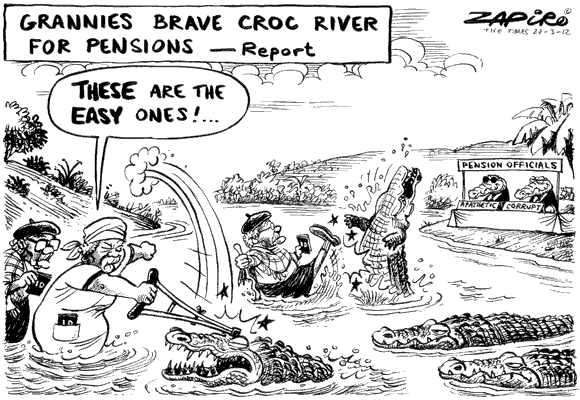
South African grannies cross crocodile-infested river to collect old-age pensions
 |
| http://mg.co.za/zapiro/fullcartoon/3646 |
"In groups of two to five, the grannies cross the uThukela [Tugela] every month to get to the nearest pay point," the newspaper said. "Fear consumes them each time they are about to enter the river."
The river is about 330 feet wide, and the crossing sometimes takes more than half an hour, with the grannies rolling up their clothes to below their breasts and then forming a human chain. Khethile Kubheka, an 80-year-old grandmother with poor eyesight, told the Times that with old-age pensions as their only source of income, the grannies must make the crossing despite the risk of drowning or being attacked by crocodiles.
"Many people I know have died on this river while crossing. But that does not scare me that much, maybe this is the way our God wants us to live and die," she said. "We better be eaten by the crocodiles than staying at home without collecting our pensions," said another villager, Bayekile Mthonti.
Source: Global Post
Sunday, March 25, 2012
Malema vows to take fight against expulsion to court
Embattled ANC youth league president Julius Malema will seek redress in the courts if he is expelled from the party, he said on Sunday. Malema remains president of the ANCYL pending his appeal against a decision to expel him by the ANC's national disciplinary committee. Until now he has consistently rejected the idea of taking legal action against the ANC. "I said I would not go to court, but now I have decided to do so," Malema said. "I need no mandate and act as an individual whose rights have been violated." This would not contradict the principles of the ANC, as he would no longer be an ANC member.
Malema was speaking at an ANCYL centenary rally at the Nkowankowa Stadium, outside Tzaneen. He called on the crowd not to abandon the ANC, calling it the only hope for the country's poor. He reminded the crowd that while individuals would come and go, the ANC would continue. "I will never be welcomed in the ANC. I have been fired in the ANC. But I have no problem with that," he said.
He did not regret anything he had done, Malema said. "I did what I believed in and I did it on my own. I was not told by anyone to do anything. "I have not been chased from heaven, but from the ANC by a faction that can only do so as they currently have power."
The ANCYL was being victimised by its own leaders, Malema said. "They are trying to punish anyone associated with the ANCYL as if we are an illegal association." He would not accept being victimised by anyone, he said. Those who are supposed to support and protect the ANCYL were scared to do so. "We are orphans standing alone. Our leaders are scared. They prefer their positions above speaking out for what is right," he told the crowd. "There is no longer a youth league of the ANC. We are a former self. They have succeeded in killing us."
Also speaking at the rally, Deputy President Kgalema Motlanthe said revolution was deliberate and methodical, and never accidental. He could barely be heard in the stadium above the conversations of the crowd. "The ANC has no use for a passive youth league. We need our youth league to be militant, creative and determined. When the call is given, the youth must answer rapidly," he said. The youth had to be afforded space to generate new ideas.
The ANC expected the ANCYL to recruit youth and remain relevant to the youth. "It is the ANC's duty to show and lead the ANCYL if it strays from the path. We must guide them all the time. They can't stray off the path and go off on their own," Motlanthe said. The ANCYL had been formed by the ANC to feed and form the youth in preparation for becoming ANC members, said Sports Minister Fikile Mbalula, himself a former ANCYL president. "No one will destroy the ANCYL," he said. "You are here to create new ideas. Once the ANCYL ceases to think we will be in danger. Once they suffer political dwarfism the revolution will be in danger."
Messages of support for the ANCYL were sent by the ANC Women's League and the ANC Veterans' League, as well as youth organisations from all over Africa, including Zimbabwe, Ghana, Namibia and Ethiopia.
Source: Mail & Guardian
Malema was speaking at an ANCYL centenary rally at the Nkowankowa Stadium, outside Tzaneen. He called on the crowd not to abandon the ANC, calling it the only hope for the country's poor. He reminded the crowd that while individuals would come and go, the ANC would continue. "I will never be welcomed in the ANC. I have been fired in the ANC. But I have no problem with that," he said.
He did not regret anything he had done, Malema said. "I did what I believed in and I did it on my own. I was not told by anyone to do anything. "I have not been chased from heaven, but from the ANC by a faction that can only do so as they currently have power."
The ANCYL was being victimised by its own leaders, Malema said. "They are trying to punish anyone associated with the ANCYL as if we are an illegal association." He would not accept being victimised by anyone, he said. Those who are supposed to support and protect the ANCYL were scared to do so. "We are orphans standing alone. Our leaders are scared. They prefer their positions above speaking out for what is right," he told the crowd. "There is no longer a youth league of the ANC. We are a former self. They have succeeded in killing us."
Also speaking at the rally, Deputy President Kgalema Motlanthe said revolution was deliberate and methodical, and never accidental. He could barely be heard in the stadium above the conversations of the crowd. "The ANC has no use for a passive youth league. We need our youth league to be militant, creative and determined. When the call is given, the youth must answer rapidly," he said. The youth had to be afforded space to generate new ideas.
The ANC expected the ANCYL to recruit youth and remain relevant to the youth. "It is the ANC's duty to show and lead the ANCYL if it strays from the path. We must guide them all the time. They can't stray off the path and go off on their own," Motlanthe said. The ANCYL had been formed by the ANC to feed and form the youth in preparation for becoming ANC members, said Sports Minister Fikile Mbalula, himself a former ANCYL president. "No one will destroy the ANCYL," he said. "You are here to create new ideas. Once the ANCYL ceases to think we will be in danger. Once they suffer political dwarfism the revolution will be in danger."
Messages of support for the ANCYL were sent by the ANC Women's League and the ANC Veterans' League, as well as youth organisations from all over Africa, including Zimbabwe, Ghana, Namibia and Ethiopia.
Source: Mail & Guardian
Friday, March 23, 2012
Double Speak About Judicial Reform In South Africa Raises Alarm Bells
Should South Africans be worried about the double
speak from the ANC concerning transformation of the judiciary? Speaking to
journalists in parliament on 28 February 2012, the Minister of Justice and
Constitutional Development (DoJ), Jeff Radebe asserted that the government had
no interest in reducing the powers of the Constitutional Court. Radebe was
visibly irritated by this line of questioning at the press conference and took
umbrage with what he saw as unnecessary concerns each time the ANC debates the
transformation of the judiciary. Radebe stated that cabinet intended assessing
how “Constitutional Court rulings have impacted on the lives of ordinary South
Africans” and how “challenges” to the goals of transforming South African
society could be better addressed by the judiciary.
In the preface to the Discussion Document on the Transformation of the Judicial System and
the Role of the Judiciary in the Developmental South African State released
in February 2012 by the DoJ, Radebe argues that, “the transformation of the
judicial system is a constitutional imperative which is entrusted upon the government
as a branch of the state, assigned the responsibility of developing and
implementing national policy and of initiating legislation, among others.”
Radebe rightly states that the “judiciary has an
important role in safeguarding and protecting the Constitution and its values
and in ensuring the consolidation of democracy and the realisation of a better
life for all.” Further that, “it is important that the role of judicial
officers is properly understood by those whose fate and livelihood is dependent
on the judgments they give through the courts.”
In South Africa the rulings of various courts can be
the subject of vigorous and free public debate. Free speech is after all a
pivotal pillar of a constitutional democracy. The discussion document does
acknowledge that the three “branches of the state are co-equal” partners
entrusted with distinct powers in their quest to realise the ideals of a
democratic South Africa. However, the
talk of judicial review, especially at a time when a number of Constitutional Court
decisions have been against the government is being treated with suspicion,
specifically in light of ongoing comments by senior ANC officials that reflect
a profound misunderstanding of the role of the courts or reveal outright
hostility towards the judiciary. These include:
- In September 2011, Ngoako Ramthlodi, the
Deputy Minister of Correctional Services said, “In the past 17 years… we have
witnessed sustained and relentless efforts to immigrate the little power left
with the executive and the legislature to civil society and the judiciary.
Power (is) systematically taken out of the legislature and the executive to
curtail efforts and initiatives aimed at inducing fundamental changes.”
- ANC Secretary General, Gwede Mantashe in August
2011, posited that the judiciary was becoming a form of opposition and said,
“You can`t have a judiciary that seeks to arrest the functioning of
government.”
- President Jacob
Zuma, in an interview in early February 2012, stated that, "We don`t want
to review the Constitutional Court, we want to review its powers. It is after
experience that some of the decisions are not decisions that every other judge
in the Constitutional Court agrees with." Apart from demonstrating a lack
of understanding of where this court receives its powers, this statement is in
direct contrast to the statements made by Radebe who said that transformation
of the judiciary was not about the Constitutional Court specifically.
- ANC national spokesperson, Jackson Mthembu, stated on 20 March 2012 that, "It is
clear that democracy can be undermined by simply approaching courts to reverse
any decision arrived at by a qualified organ of state,” because according to
the ANC, the result is a "blanket permission to political parties to review
any state decisions using courts."
- ANC Chief Whip Mathole Motshekga said on 21 March 2012 that the ruling party would do everything in its power, “to prevent government`s attempts to deliver services to the people” being derailed by the courts.
The conflicting
statements from various senior ANC officials with what is written in policy
documents, raises legitimate concerns that the ruling party does not have a
coherent position as far as the transformation of the judiciary is concerned. The statements from ANC officials should be
seen in the light of various upper court judgments that have caused
embarrassment to the executive. Recent examples that highlight the poor
exercise of executive power include:
- In the Glenister judgment on 17 March 2011,
the Constitutional Court ruled that the legislation establishing Directorate of
Priority Crimes Investigation (DPCI), also known as the Hawks, failed to meet
both international and constitutional legal obligations to ensure that it was
sufficiently “independent from political interference.”
- During July 2011, the Constitutional Court
ruled that Zuma’s extension of former Chief Justice Sandile Ngcobo’s term was
unconstitutional and amounted to the executive usurping the power of
parliament.
- On 1 December 2011, the Supreme Court of
Appeal (SCA) ruled that Zuma’s appointment of Menzi Simelane, as head of the
NPA, was “irrational” given that he was clearly not a fit and proper person for
that office and therefore “inconsistent with the Constitution and invalid”.
- On 20 March 2012, the Supreme Court of Appeal ruled that the Democratic Alliance had the right to subject to judicial review, the controversial decision in 2009 by then acting director of public prosecutions Mokotedi Mpshe, to drop various criminal charges against Mr Zuma. Mpshe then stated that, “the decision was not based on the actual merits of the case” and “did not amount to an acquittal.”
The assessment of the Constitutional Court, the first
since 1994, is therefore an interesting proposition coming at this time from
the executive branch of government. Typically, criticism of the court from legal
scholars tends to focus on how it could have done more to promote
socio-economic rights, for instance by ruling on a minimum standard of
socio-economic rights (e.g. the minimum amount of housing, water, education, etc.)
that everyone is entitled to. However, it has resisted doing so, perhaps
rightly, arguing that this would be to stray into the executive policy making
arena and be more onerous on the state if it did. If anything, judgments such as the Grootboom and others versus the Republic of
South Africa, amongst many others, have shown that it is the executive
branch, not the judiciary, which is really failing the poor of South Africa. In
the Grootboom case the Constitutional Court determined that the State is
bound to provide citizens with a minimum
of socio-economic rights, including the
right to adequate housing.
The
DoJ document, in its title, refers to the “... role of the judiciary in the
developmental South African state,” yet there is very little articulation of
what the judiciary can possibly do to advance the ideals of development and to
ease the plight of the poor, beyond that which it currently does, which is to
compel the executive to act in accordance with the constitution and the laws
that flow from it.
On
the day that the discussion document was released, a TNS survey concerning
respondents’ perception of the judiciary was published. “Asked whether judges were biased towards
the government, 38% agreed while 27% disagreed - while the "don`t
know" response stood at 36%.” This
reveals that a large proportion of people differ from various senior ANC officials,
as they tend to believe that the judiciary works in favour of the executive.
Given that two thirds of those surveyed believe that judges are biased one way
or another demonstrates the fragility of the judiciary. By unfairly attacking
the courts, powerful politicians are thereby undermining the rule of law.
Until
there is a consistent message from all ANC officials, both in speeches and
documents, that reveal a clear understanding and respect for our Constitution
and the court that is tasked with upholding it, the media and other
stakeholders will raise alarm bells. Until then, citizens who value our
constitutional democracy have every right to be concerned.
Hamadziripi Tamukamoyo, Researcher, Crime and Justice Division, ISS Pretoria
Source: ISS
African Union to Make Push Against Rebels
The African Union announced Friday that it would launch a new regional military operation against the Lord’s Resistance Army, the vicious Ugandan rebel group that has been terrorizing parts of central Africa for more than 20 years. The operation, which aims to bring together 5,000 troops from four African countries each victimized by the Lord’s Resistance Army and its leader, Joseph Kony, will tap from troops already deployed to fight the group. But officials said the force will be more cohesive and disciplined.
“We’re on a mission,” an African Union envoy, Francisco Madeira, told reporters on Friday. “We need to stop Kony.”
The announcement came a few weeks after a YouTube video from an American advocacy organization went viral on the Internet and brought unprecedented attention to Mr. Kony, who is wanted by the International Criminal Court for a range of unspeakable atrocities. The announcement also came a few days after a bipartisan group in Congress introduced a resolution condemning Mr. Kony and supporting a regional military effort from the four most victimized nations. The armies of those nations — Uganda, South Sudan, Central African Republic, and Democratic Republic of the Congo — have been fighting the L.R.A. since last year under a loosely organized effort. But some soldiers in those armies have resentments toward one another that have overshadowed their common goal of eradicating Mr. Kony’s group and arresting him.
The new operation announced Friday could offer a new beginning. Uganda said it would reallocate 1,500 of its troops currently fighting the L.R.A. in the Central African Republic under the new African Union operation, to be headed by Uganda, but it remained unclear how new troops would be brought in from the other nations, when they would arrive, and whether they would all be under a single military command. Headquarters for the operation will be in South Sudan, the world’s youngest and possibly most cash-hungry nation, and will include offices and administration.
The United States, which has participated in special operations against the rebel group in the past, last year sent 100 troops to Uganda and operational field locations to act a special advisers to the national forces, and reiterated its support on Friday for the regional military operation and its own “multi-year strategy.”
The African Union said Friday that its operation had been months in the planning, and would not stop until Mr. Kony was captured. The Lord’s Resistance Army has been murdering, mutilating and kidnapping children across East and Central Africa for decades, and has been the focus of numerous military operations, but while their atrocities were well known, the group did not come under their current widespread global scrutiny until the YouTube video. Uganda, which has complained of being drowned-out of the L.R.A. conversation since the video gained worldwide attention, was quick to distinguish the new effort, though it may not result in much change on the ground.
“The video excites those who have ignored African issues, otherwise it’s a joke,” said a Ugandan military spokesman, Col. Felix Kulayigye. “It is now A.U. that is in charge,” Colonel Kulayigye said, referring to the African Union. “The L.R.A. has always been there, it must be dead once and for all.”
Source: New York Times
“We’re on a mission,” an African Union envoy, Francisco Madeira, told reporters on Friday. “We need to stop Kony.”
The announcement came a few weeks after a YouTube video from an American advocacy organization went viral on the Internet and brought unprecedented attention to Mr. Kony, who is wanted by the International Criminal Court for a range of unspeakable atrocities. The announcement also came a few days after a bipartisan group in Congress introduced a resolution condemning Mr. Kony and supporting a regional military effort from the four most victimized nations. The armies of those nations — Uganda, South Sudan, Central African Republic, and Democratic Republic of the Congo — have been fighting the L.R.A. since last year under a loosely organized effort. But some soldiers in those armies have resentments toward one another that have overshadowed their common goal of eradicating Mr. Kony’s group and arresting him.
The new operation announced Friday could offer a new beginning. Uganda said it would reallocate 1,500 of its troops currently fighting the L.R.A. in the Central African Republic under the new African Union operation, to be headed by Uganda, but it remained unclear how new troops would be brought in from the other nations, when they would arrive, and whether they would all be under a single military command. Headquarters for the operation will be in South Sudan, the world’s youngest and possibly most cash-hungry nation, and will include offices and administration.
The United States, which has participated in special operations against the rebel group in the past, last year sent 100 troops to Uganda and operational field locations to act a special advisers to the national forces, and reiterated its support on Friday for the regional military operation and its own “multi-year strategy.”
The African Union said Friday that its operation had been months in the planning, and would not stop until Mr. Kony was captured. The Lord’s Resistance Army has been murdering, mutilating and kidnapping children across East and Central Africa for decades, and has been the focus of numerous military operations, but while their atrocities were well known, the group did not come under their current widespread global scrutiny until the YouTube video. Uganda, which has complained of being drowned-out of the L.R.A. conversation since the video gained worldwide attention, was quick to distinguish the new effort, though it may not result in much change on the ground.
“The video excites those who have ignored African issues, otherwise it’s a joke,” said a Ugandan military spokesman, Col. Felix Kulayigye. “It is now A.U. that is in charge,” Colonel Kulayigye said, referring to the African Union. “The L.R.A. has always been there, it must be dead once and for all.”
Source: New York Times
President Zuma's phalanx of praetorian guards
Spy boss Richard Mdluli, whom Jacob Zuma "owes for his acquittal on rape charges", has emerged as part of a complex network "guarding" the president. President Jacob Zuma seems to be creating a personal shield and spear in the justice and security sectors: a phalanx of praetorian guards allied to him and to each other.
These connections appear to be driving key interventions, notably:
The withdrawal of murder and corruption charges against suspended police Crime Intelligence Service (CIS) boss Richard Mdluli;
The closure of the Hawks investigations into Mdludli and the broader abuse of CIS slush funds;
The suspension of Hawks KwaZulu-Natal commander Johan Booysen; and
The replacement of KwaZulu-Natal CIS head Deena Moodley by acting commander Brigadier Thuso Tshika.
The central member of this grouping appears to be Mdluli, with other key players clustered around him, including Safety and Security Minister Nathi Mthethwa; acting police commissioner Lieutenant-General Nhlanhla Mkhwanazi; acting national director of public prosecutions (NDPP) Nomgcobo Jiba; commercial crime prosecutions boss Lawrence Mrwebi; North West crime intelligence heavyweight Colonel Tsietsi Mano; and Mdluli murder case co-accused Colonel Nkosana “Killer” Ximba. “President Jacob Zuma believes he owes Mdluli for his acquittal in the rape case,” said one National Prosecuting Authority (NPA) source, while denying the correctness of this belief.
Whatever the truth may be, it appears that Mdluli himself is keen to hint at this connection. In his November 2010 top-secret report to Zuma setting out his allegations of a conspiracy against him, Mdluli says: “My relationship with Colonel Ximba is on a professional level, both politically and work related — Colonel Ximba is an active member of the ANC and during the struggle was a leader of one of the self-defence units — Colonel Ximba also played an important role in the Polokwane conference and also during the president’s trying times with his engagement with the NPA.”
According to reports, it was Mdluli who, following his appointment as CIS head in 2009, boosted Ximba up the ranks from constable to colonel. Mdluli appears to have been hand-picked by Zuma allies for the crime intelligence position and was appointed over the objections of then-acting commissioner Tim Williams.
Last year Williams, who has retired, spoke out against the appointment, telling City Press he regarded the appointment process as irregular and politically motivated. “He was appointed by the minister,” he said, referring to Mthethwa. In the run-up to his appointment Mdluli also played a key role in an apparent campaign against the Scorpions that united both the Zuma and Mbeki factions of the ANC.
One of Mdluli’s confidants, Colonel Tsietsi Mano, was called in to pursue the investigation of Gauteng Scorpions boss Gerrie Nel. Mano roped in Nel’s then-subordinate, advocate Nomgcobo Jiba, in a bid to have an arrest warrant issued against Nel on the eve of the planned arrest of Jackie Selebi.
When the NPA suspended and disciplined Jiba, Mdluli submitted a dramatic affidavit in her defence, revealing for the first time that crime intelligence had monitored the conversations of Scorpions boss Leonard McCarthy and quoting extracts from the McCarthy transcripts. These intercepts were later leaked to Zuma’s attorney, Michael Hulley, and formed the basis for the NPA decision to drop charges against Zuma. According to evidence gathered for Jiba’s disciplinary hearing, she also roped in former KwaZulu-Natal Scorpions boss Lawrence Mrwebi, who had also become concerned at the allegedly partisan nature of the Scorpions investigations.
In November last year Zuma appointed Mrwebi to head the commercial crime division in the face of reports that then-director of prosecutions Menzi Simelane had recommended someone else. It was Mrwebi who in December 2011 ordered the withdrawal of fraud charges against Mdluli that had been investigated by the Hawks. Mdluli was accused of personally benefiting from discounts earned on the purchase of vehicles by crime intelligence. In doing so, Mrwebi overrode the views of Glynnis Breytenbach, and her opposition to the withdrawal of charges against Mdluli has been partly blamed for subsequent attempts to suspend her. A well-placed source said that Zuma had gone as far as attending a function held by Mdluli to celebrate the withdrawal of charges, though this could not be independently confirmed.
Neither presidential spokesperson Mac Maharaj nor Mdluli’s lawyer responded to questions about Zuma’s meeting with Mdluli. After the December 2011 decision of the Supreme Court of Appeal that Simelane’s appointment was invalid, Zuma appointed Jiba as acting NDPP to replace him. Mano was also appointed to head a North West task team probing the 2009 murder of councillor Moss Phakoe, who had circulated an internal ANC dossier alleging Rustenburg ANC heavyweight Matthew Wolmarans was involved in corruption.
The investigation under Mano went nowhere but, according to a City Press report, there was a breakthrough in 2011 after Hawks investigators found the Phakoe docket during a raid on Mdluli. This could suggest that Mano withheld crucial information about a party official from all but Mdluli, who also sat on it. Mdluli also brought in Mano to trace the source of a report in the Sunday Independent in October 2010, which raised serious allegations of corruption and nepotism against Mdluli and suspended national police commissioner Bheki Cele.
The report appeared to have been sourced from disgruntled crime intelligence members in KwaZulu-Natal, and Mdluli instructed Mano to establish the source of the leaks against him. At the time he was given this sensitive task, Mano was out on bail in connection with his alleged involvement in the assault of a robbery suspect. He had also been slammed by a North Gauteng High Court judge for his alleged involvement in the torture of traditional healer Madimetja Phineas Kutumela, a suspect in the murder of Constable Francis Rasuge, who had disappeared in 2004.
Mano is understood to have laid the blame for the leaks at the door of a senior counterintelligence officer, but the KwaZulu-Natal complaints seem to have formed the basis for the recent purge of senior crime intelligence officers in the province, driven by acting national commissioner Nhlanhla Mkhwanazi. Earlier this month, CIS provincial boss Deena Moodley was transferred out of crime intelligence and replaced by Brigadier Thuso Tshika.
Tshika, described by someone who knows him as “more of a politician than a policeman”, is a former MK operative.
Moodley is perceived as being close to Johan Booysen, the head of the Hawks in KwaZulu-Natal.
Booysen and Cele
Both minister Mthethwa and acting commissioner Mkhwanazi have been at the forefront of efforts to suspend Booysen, who on Thursday succeeded in having his suspension overturned in court for the second time.
The claim against Booysen is that he failed to act against members of the so-called Cato Manor Organised Crime Unit “death squad” that fell under his indirect command.
The unit, involved in a number of suspicious deaths, was disbanded by Mkhwanazi, but the move against Booysen is widely regarded a an indirect blow against Cele, of whom he was considered an ally.
It is understood that Hawks boss Anwa Dramat, to whom Booysen reports, believes there is no real case against him, but—as with the termination of the Mdluli investigation—has complied with Mkhwanazi’s instructions.
Panday and friends
The determination to unseat Booysen may, however, have more to do with the Panday case than with Cele. In court papers, Booysen claimed the campaign against him is driven by millionaire Durban businessman Thoshan Panday and the provincial supply chain police boss Colonel Navin Madhoe.
Booysen’s Hawks have been investigating the pair for allegedly massively inflating hotel bills for police accommodation sourced by Panday’s companies.
Panday appears to have powerful friends. Two independent sources, who declined to be named, have claimed that Zuma’s son Edward had attempted on several occasions to speak to Booysen about Panday.
Edward Zuma could not be reached for comment.
Another source, who also declined to be named but is regarded as close to Cele, said that Deebo Mzobe, a distant relative of President Zuma, had also sought to intervene on Panday’s behalf in a meeting with Cele.
Contacted for comment, Mzobe denied this. “No, that is not true,” he said. “We talk a lot with the commissioner [Cele]; we have a lot of things we discuss. I can’t say specifically what I go there to talk about.”
Mzobe denied he was in business with Panday. “Not at all; there is no business we are running together. I know him —we discuss [business], but we don’t have a particular business together.”
The M&G has identified at least three companies that show both Panday and Mzobe registered as directors. Mzobe, who is described as a “friend” of the president, is involved in the Masibambisane Rural Development Initiative with Zuma in Nkandla and elsewhere.
The project is controversial, as it is seen as using presidential influence to push state resources in the direction of favoured communities.
Source: Mail & Guardian
These connections appear to be driving key interventions, notably:
The withdrawal of murder and corruption charges against suspended police Crime Intelligence Service (CIS) boss Richard Mdluli;
The closure of the Hawks investigations into Mdludli and the broader abuse of CIS slush funds;
The suspension of Hawks KwaZulu-Natal commander Johan Booysen; and
The replacement of KwaZulu-Natal CIS head Deena Moodley by acting commander Brigadier Thuso Tshika.
The central member of this grouping appears to be Mdluli, with other key players clustered around him, including Safety and Security Minister Nathi Mthethwa; acting police commissioner Lieutenant-General Nhlanhla Mkhwanazi; acting national director of public prosecutions (NDPP) Nomgcobo Jiba; commercial crime prosecutions boss Lawrence Mrwebi; North West crime intelligence heavyweight Colonel Tsietsi Mano; and Mdluli murder case co-accused Colonel Nkosana “Killer” Ximba. “President Jacob Zuma believes he owes Mdluli for his acquittal in the rape case,” said one National Prosecuting Authority (NPA) source, while denying the correctness of this belief.
Whatever the truth may be, it appears that Mdluli himself is keen to hint at this connection. In his November 2010 top-secret report to Zuma setting out his allegations of a conspiracy against him, Mdluli says: “My relationship with Colonel Ximba is on a professional level, both politically and work related — Colonel Ximba is an active member of the ANC and during the struggle was a leader of one of the self-defence units — Colonel Ximba also played an important role in the Polokwane conference and also during the president’s trying times with his engagement with the NPA.”
According to reports, it was Mdluli who, following his appointment as CIS head in 2009, boosted Ximba up the ranks from constable to colonel. Mdluli appears to have been hand-picked by Zuma allies for the crime intelligence position and was appointed over the objections of then-acting commissioner Tim Williams.
Last year Williams, who has retired, spoke out against the appointment, telling City Press he regarded the appointment process as irregular and politically motivated. “He was appointed by the minister,” he said, referring to Mthethwa. In the run-up to his appointment Mdluli also played a key role in an apparent campaign against the Scorpions that united both the Zuma and Mbeki factions of the ANC.
One of Mdluli’s confidants, Colonel Tsietsi Mano, was called in to pursue the investigation of Gauteng Scorpions boss Gerrie Nel. Mano roped in Nel’s then-subordinate, advocate Nomgcobo Jiba, in a bid to have an arrest warrant issued against Nel on the eve of the planned arrest of Jackie Selebi.
When the NPA suspended and disciplined Jiba, Mdluli submitted a dramatic affidavit in her defence, revealing for the first time that crime intelligence had monitored the conversations of Scorpions boss Leonard McCarthy and quoting extracts from the McCarthy transcripts. These intercepts were later leaked to Zuma’s attorney, Michael Hulley, and formed the basis for the NPA decision to drop charges against Zuma. According to evidence gathered for Jiba’s disciplinary hearing, she also roped in former KwaZulu-Natal Scorpions boss Lawrence Mrwebi, who had also become concerned at the allegedly partisan nature of the Scorpions investigations.
In November last year Zuma appointed Mrwebi to head the commercial crime division in the face of reports that then-director of prosecutions Menzi Simelane had recommended someone else. It was Mrwebi who in December 2011 ordered the withdrawal of fraud charges against Mdluli that had been investigated by the Hawks. Mdluli was accused of personally benefiting from discounts earned on the purchase of vehicles by crime intelligence. In doing so, Mrwebi overrode the views of Glynnis Breytenbach, and her opposition to the withdrawal of charges against Mdluli has been partly blamed for subsequent attempts to suspend her. A well-placed source said that Zuma had gone as far as attending a function held by Mdluli to celebrate the withdrawal of charges, though this could not be independently confirmed.
Neither presidential spokesperson Mac Maharaj nor Mdluli’s lawyer responded to questions about Zuma’s meeting with Mdluli. After the December 2011 decision of the Supreme Court of Appeal that Simelane’s appointment was invalid, Zuma appointed Jiba as acting NDPP to replace him. Mano was also appointed to head a North West task team probing the 2009 murder of councillor Moss Phakoe, who had circulated an internal ANC dossier alleging Rustenburg ANC heavyweight Matthew Wolmarans was involved in corruption.
The investigation under Mano went nowhere but, according to a City Press report, there was a breakthrough in 2011 after Hawks investigators found the Phakoe docket during a raid on Mdluli. This could suggest that Mano withheld crucial information about a party official from all but Mdluli, who also sat on it. Mdluli also brought in Mano to trace the source of a report in the Sunday Independent in October 2010, which raised serious allegations of corruption and nepotism against Mdluli and suspended national police commissioner Bheki Cele.
The report appeared to have been sourced from disgruntled crime intelligence members in KwaZulu-Natal, and Mdluli instructed Mano to establish the source of the leaks against him. At the time he was given this sensitive task, Mano was out on bail in connection with his alleged involvement in the assault of a robbery suspect. He had also been slammed by a North Gauteng High Court judge for his alleged involvement in the torture of traditional healer Madimetja Phineas Kutumela, a suspect in the murder of Constable Francis Rasuge, who had disappeared in 2004.
Mano is understood to have laid the blame for the leaks at the door of a senior counterintelligence officer, but the KwaZulu-Natal complaints seem to have formed the basis for the recent purge of senior crime intelligence officers in the province, driven by acting national commissioner Nhlanhla Mkhwanazi. Earlier this month, CIS provincial boss Deena Moodley was transferred out of crime intelligence and replaced by Brigadier Thuso Tshika.
Tshika, described by someone who knows him as “more of a politician than a policeman”, is a former MK operative.
Moodley is perceived as being close to Johan Booysen, the head of the Hawks in KwaZulu-Natal.
Booysen and Cele
Both minister Mthethwa and acting commissioner Mkhwanazi have been at the forefront of efforts to suspend Booysen, who on Thursday succeeded in having his suspension overturned in court for the second time.
The claim against Booysen is that he failed to act against members of the so-called Cato Manor Organised Crime Unit “death squad” that fell under his indirect command.
The unit, involved in a number of suspicious deaths, was disbanded by Mkhwanazi, but the move against Booysen is widely regarded a an indirect blow against Cele, of whom he was considered an ally.
It is understood that Hawks boss Anwa Dramat, to whom Booysen reports, believes there is no real case against him, but—as with the termination of the Mdluli investigation—has complied with Mkhwanazi’s instructions.
Panday and friends
The determination to unseat Booysen may, however, have more to do with the Panday case than with Cele. In court papers, Booysen claimed the campaign against him is driven by millionaire Durban businessman Thoshan Panday and the provincial supply chain police boss Colonel Navin Madhoe.
Booysen’s Hawks have been investigating the pair for allegedly massively inflating hotel bills for police accommodation sourced by Panday’s companies.
Panday appears to have powerful friends. Two independent sources, who declined to be named, have claimed that Zuma’s son Edward had attempted on several occasions to speak to Booysen about Panday.
Edward Zuma could not be reached for comment.
Another source, who also declined to be named but is regarded as close to Cele, said that Deebo Mzobe, a distant relative of President Zuma, had also sought to intervene on Panday’s behalf in a meeting with Cele.
Contacted for comment, Mzobe denied this. “No, that is not true,” he said. “We talk a lot with the commissioner [Cele]; we have a lot of things we discuss. I can’t say specifically what I go there to talk about.”
Mzobe denied he was in business with Panday. “Not at all; there is no business we are running together. I know him —we discuss [business], but we don’t have a particular business together.”
The M&G has identified at least three companies that show both Panday and Mzobe registered as directors. Mzobe, who is described as a “friend” of the president, is involved in the Masibambisane Rural Development Initiative with Zuma in Nkandla and elsewhere.
The project is controversial, as it is seen as using presidential influence to push state resources in the direction of favoured communities.
Source: Mail & Guardian
Thursday, March 22, 2012
Nationwide Foreclosure Rescue Company Shut Down
Bella Homes LLC was sued in a civil action for orchestrating a foreclosure rescue scheme, which has ended in a Consent Judgment and signals the end of a national foreclosure rescue scheme. The perpetrators, operating through Bella Homes LLC, had promised hundreds of distressed homeowners that Bella Homes would help homeowners avoid foreclosure. Instead of helping homeowners, the perpetrators helped themselves to a lavish lifestyle replete with fancy cars, vacations, and even gold coins.
The Civil Action, brought jointly by the United States Attorney's Office for the District of Colorado and the State Attorney General of Colorado, put an end to a scheme that started in March 2010, in the basement of a convicted felon in Georgia, and went national, affecting homeowners in Colorado, and other states all across the country. The Civil Action that put an end to the scheme was filed in the United States District Court for the District of Colorado on February 14, 2012, and resulted in a Consent Judgment, in which Bella Homes "admits the allegations in the Complaint and acknowledges its role in defrauding homeowners who signed over title to their homes to Bella Homes." Bella Homes further admitted that all deed transactions in which it entered should be deemed void.
The Scheme:
As alleged in the Complaint, the Defendants, through Bella Homes, engaged in a fraudulent scheme in which they solicited homeowners to convey title to their homes to Bella Homes for no consideration and to enter into purported lease agreements under which the homeowners, instead of making their mortgage payments, paid Bella Homes monthly "rent." To entice homeowners into this arrangement, Defendants made or caused to be made numerous material misrepresentations to homeowners to convey the false and fraudulent impression that:
• Bella Homes would stop any foreclosure on the home;
• Bella Homes would purchase or otherwise settle the existing mortgage on the home from the lender;
• Federal law provided the homeowner the right to remain in the home for the duration of the lease with Bella Homes; and
• The homeowner would have an option to repurchase the home in three years from Bella Homes for significantly less than the amount currently owed on the mortgage.
Defendants made these false representations on a website and in solicitations and documents sent to interested homeowners across the country. Contrary to Bella Homes' representations and promises, Bella Homes admitted in response to a subpoena that it had not purchased any mortgages as of October 2011, and that it lacked the financial capacity to purchase mortgages. In all, more than 560 homeowners were victimized by Bella Homes. Throughout the life of the scheme, the company only acquired one mortgage just before the Complaint was filed. As part of the Consent Judgment, the single mortgage may be sold and the proceeds returned to victims.
Who was involved, and what they did:
The Complaint alleged that Mark Stephen Diamond, Daniel David Delpiano, David Delpiano and Michael Terrell were involved in running Bella Homes. Through the Consent Judgment, these individual Defendants confess liability to Counts Six and Seven of the Complaint, which allege violations of the Mortgage Assistance Relief Services Rule (MARS Rule).
Specifically, the individual Defendants confess liability to: - violating Section 322.3(c) of the MARS Rule by making a representation, expressly or by implication, about the benefits, performance, or efficacy of any mortgage assistance relief service without competent and reliable evidence that substantiates that the representation is true. - violating Section 322.5(a) of the MARS Rule, which makes it a violation of the MARS Rule to: Request or receive payment of any fee or other consideration until the consumer has executed a written agreement between the consumer and the consumer's dwelling loan holder or servicer incorporating the offer of mortgage assistance relief the provider obtained from the consumer's dwelling loan holder or servicer.
What Happens Now:
As part of the Consent Judgment, the Defendants have permanent restrictions on their ability to work in the mortgage industry and residential real estate related businesses. In addition, the Defendants must return any vehicles in their possession that were leased by Bella Homes, Mark Diamond, Diamond and Associates, or Diamond Corporation. Finally, money previously frozen in Defendants' bank accounts, as well as cash in a safe deposit box, and the proceeds of gold coins obtained by Bella Homes, will all be made available to the Department of Law at the State of Colorado to be returned to homeowner victims. To this amount, Defendant Mark Stephen Diamond will add an additional $300,000 within the next 90 days. After that time, the Defendants will make additional payments of approximately $200,000 over the next five years, for a total anticipated recovery of approximately $1.2 million.
Homeowner Victims:
If you are a victim of Bella Homes, visit the website set up by the Colorado Department of Law, at:https://www.coloradoattorneygeneral.gov/departments/consumer_protection/consumer_protection_cases/bella_homes. This law enforcement action is part of President Barack Obama's Financial Fraud Enforcement Task Force.
President Obama established the interagency Financial Fraud Enforcement Task Force to wage an aggressive, coordinated and proactive effort to investigate and prosecute financial crimes. The task force includes representatives from a broad range of federal agencies, regulatory authorities, inspectors general and state and local law enforcement who, working together, bring to bear a powerful array of criminal and civil enforcement resources. The task force is working to improve efforts across the federal executive branch, and with state and local partners, to investigate and prosecute significant financial crimes, ensure just and effective punishment for those who perpetrate financial crimes, combat discrimination in the lending and financial markets and recover proceeds for victims of financial crimes. For more information on the task force, visit: http://www.stopfraud.gov
The United States Attorney for the District of Colorado, John F. Walsh, and the Colorado Attorney General, John W. Suthers, announced the consent judgment. "Today brings an end to a scheme that harmed distressed homeowners across the country," announced United States Attorney, John F. Walsh.
"With false promises, the perpetrators of this scheme convinced hundreds of homeowners to hand over the last of their life savings and turn over the deed to their homes. Together with our partners in the State Attorney General's Office, we stopped this fraud from harming additional victims within our State, and across the nation. This agreement not only will help Bella Homes' victims, but it also will bar the defendants from engaging in any kind of mortgage or foreclosure activity ever again," Suthers said.
"Foreclosure-rescue scams prey on distressed homeowners' desire to save their homes and to find any means to help fix their dire financial situations. Our work in cooperation with the U.S. Attorney's Office quickly shut down this scam and should send a message that we and our partners in law enforcement will vigorously pursue any foreclosure or mortgage scam preying on Colorado homeowners."
Source: Mortgage Fraud Blog
The Civil Action, brought jointly by the United States Attorney's Office for the District of Colorado and the State Attorney General of Colorado, put an end to a scheme that started in March 2010, in the basement of a convicted felon in Georgia, and went national, affecting homeowners in Colorado, and other states all across the country. The Civil Action that put an end to the scheme was filed in the United States District Court for the District of Colorado on February 14, 2012, and resulted in a Consent Judgment, in which Bella Homes "admits the allegations in the Complaint and acknowledges its role in defrauding homeowners who signed over title to their homes to Bella Homes." Bella Homes further admitted that all deed transactions in which it entered should be deemed void.
The Scheme:
As alleged in the Complaint, the Defendants, through Bella Homes, engaged in a fraudulent scheme in which they solicited homeowners to convey title to their homes to Bella Homes for no consideration and to enter into purported lease agreements under which the homeowners, instead of making their mortgage payments, paid Bella Homes monthly "rent." To entice homeowners into this arrangement, Defendants made or caused to be made numerous material misrepresentations to homeowners to convey the false and fraudulent impression that:
• Bella Homes would stop any foreclosure on the home;
• Bella Homes would purchase or otherwise settle the existing mortgage on the home from the lender;
• Federal law provided the homeowner the right to remain in the home for the duration of the lease with Bella Homes; and
• The homeowner would have an option to repurchase the home in three years from Bella Homes for significantly less than the amount currently owed on the mortgage.
Defendants made these false representations on a website and in solicitations and documents sent to interested homeowners across the country. Contrary to Bella Homes' representations and promises, Bella Homes admitted in response to a subpoena that it had not purchased any mortgages as of October 2011, and that it lacked the financial capacity to purchase mortgages. In all, more than 560 homeowners were victimized by Bella Homes. Throughout the life of the scheme, the company only acquired one mortgage just before the Complaint was filed. As part of the Consent Judgment, the single mortgage may be sold and the proceeds returned to victims.
Who was involved, and what they did:
The Complaint alleged that Mark Stephen Diamond, Daniel David Delpiano, David Delpiano and Michael Terrell were involved in running Bella Homes. Through the Consent Judgment, these individual Defendants confess liability to Counts Six and Seven of the Complaint, which allege violations of the Mortgage Assistance Relief Services Rule (MARS Rule).
Specifically, the individual Defendants confess liability to: - violating Section 322.3(c) of the MARS Rule by making a representation, expressly or by implication, about the benefits, performance, or efficacy of any mortgage assistance relief service without competent and reliable evidence that substantiates that the representation is true. - violating Section 322.5(a) of the MARS Rule, which makes it a violation of the MARS Rule to: Request or receive payment of any fee or other consideration until the consumer has executed a written agreement between the consumer and the consumer's dwelling loan holder or servicer incorporating the offer of mortgage assistance relief the provider obtained from the consumer's dwelling loan holder or servicer.
What Happens Now:
As part of the Consent Judgment, the Defendants have permanent restrictions on their ability to work in the mortgage industry and residential real estate related businesses. In addition, the Defendants must return any vehicles in their possession that were leased by Bella Homes, Mark Diamond, Diamond and Associates, or Diamond Corporation. Finally, money previously frozen in Defendants' bank accounts, as well as cash in a safe deposit box, and the proceeds of gold coins obtained by Bella Homes, will all be made available to the Department of Law at the State of Colorado to be returned to homeowner victims. To this amount, Defendant Mark Stephen Diamond will add an additional $300,000 within the next 90 days. After that time, the Defendants will make additional payments of approximately $200,000 over the next five years, for a total anticipated recovery of approximately $1.2 million.
Homeowner Victims:
If you are a victim of Bella Homes, visit the website set up by the Colorado Department of Law, at:https://www.coloradoattorneygeneral.gov/departments/consumer_protection/consumer_protection_cases/bella_homes. This law enforcement action is part of President Barack Obama's Financial Fraud Enforcement Task Force.
President Obama established the interagency Financial Fraud Enforcement Task Force to wage an aggressive, coordinated and proactive effort to investigate and prosecute financial crimes. The task force includes representatives from a broad range of federal agencies, regulatory authorities, inspectors general and state and local law enforcement who, working together, bring to bear a powerful array of criminal and civil enforcement resources. The task force is working to improve efforts across the federal executive branch, and with state and local partners, to investigate and prosecute significant financial crimes, ensure just and effective punishment for those who perpetrate financial crimes, combat discrimination in the lending and financial markets and recover proceeds for victims of financial crimes. For more information on the task force, visit: http://www.stopfraud.gov
The United States Attorney for the District of Colorado, John F. Walsh, and the Colorado Attorney General, John W. Suthers, announced the consent judgment. "Today brings an end to a scheme that harmed distressed homeowners across the country," announced United States Attorney, John F. Walsh.
"With false promises, the perpetrators of this scheme convinced hundreds of homeowners to hand over the last of their life savings and turn over the deed to their homes. Together with our partners in the State Attorney General's Office, we stopped this fraud from harming additional victims within our State, and across the nation. This agreement not only will help Bella Homes' victims, but it also will bar the defendants from engaging in any kind of mortgage or foreclosure activity ever again," Suthers said.
"Foreclosure-rescue scams prey on distressed homeowners' desire to save their homes and to find any means to help fix their dire financial situations. Our work in cooperation with the U.S. Attorney's Office quickly shut down this scam and should send a message that we and our partners in law enforcement will vigorously pursue any foreclosure or mortgage scam preying on Colorado homeowners."
Source: Mortgage Fraud Blog
Malawi's president refuses to budge
Malawi's President Bingu wa Mutharika on Thursday responded to growing civil unrest and calls for him to resign by saying he could rule his destitute Southern Africa state "forever". A loose alliance of opposition and civil society groups backed by influential religious leaders last week gave him a two-month deadline to step down or face even larger protests.
"If I wanted to, I would use the majority I have and amend the Constitution to rule for another term, or forever," he told supporters at a rally.
"I will not resign because that's not what the law says. I will only be able to do that when my term expires in 2014," Mutharika said.
Anti-government protesters set fire to a police station in the capital Lilongwe on Monday, raising tension in the country, rocked last July by the police killing of 20 people during nationwide demonstrations against government policies and suspected corruption.
Malawi's budget has traditionally relied on aid for about 40% of its funding but major donors Britain and the US have frozen packages worth hundreds of millions of dollars over concerns about human rights abuses and creeping autocracy under Mutharika.
Malawi officials have been hoping to open up an aid lifeline in meetings this week with a visiting delegation from the International Monetary Fund (IMF).
The IMF's aid programme is on hold due to disagreements between Lilongwe and the lender. Mutharika has defied calls by the IMF to devalue its kwacha currency.
Authorities have clamped down on dissent in the past week by arresting a leading opposition youth leader and the head of the government's human rights commission which blamed Mutharika's forces for the deadly crackdown on the July protests.
Police have stepped up their presence in major cities after sporadic protests and violence in the past several days.
Malawi has averaged economic growth of more than 7% annually in recent years, but life has become increasingly difficult in the past year due to shortages of fuel, medicine and foreign currency.
Source: Mail & Guardian
"If I wanted to, I would use the majority I have and amend the Constitution to rule for another term, or forever," he told supporters at a rally.
"I will not resign because that's not what the law says. I will only be able to do that when my term expires in 2014," Mutharika said.
Anti-government protesters set fire to a police station in the capital Lilongwe on Monday, raising tension in the country, rocked last July by the police killing of 20 people during nationwide demonstrations against government policies and suspected corruption.
Malawi's budget has traditionally relied on aid for about 40% of its funding but major donors Britain and the US have frozen packages worth hundreds of millions of dollars over concerns about human rights abuses and creeping autocracy under Mutharika.
Malawi officials have been hoping to open up an aid lifeline in meetings this week with a visiting delegation from the International Monetary Fund (IMF).
The IMF's aid programme is on hold due to disagreements between Lilongwe and the lender. Mutharika has defied calls by the IMF to devalue its kwacha currency.
Authorities have clamped down on dissent in the past week by arresting a leading opposition youth leader and the head of the government's human rights commission which blamed Mutharika's forces for the deadly crackdown on the July protests.
Police have stepped up their presence in major cities after sporadic protests and violence in the past several days.
Malawi has averaged economic growth of more than 7% annually in recent years, but life has become increasingly difficult in the past year due to shortages of fuel, medicine and foreign currency.
Source: Mail & Guardian
Wednesday, March 21, 2012
Congo: Security Forces Killed 33 in Election Season, U.N. Says
Security forces in the Democratic Republic of Congo committed serious human rights violations, including killings, torture and arbitrary arrests, during the period around national elections last year, according to a United Nations report released Tuesday.
The United Nations Joint Human Rights Office in Congo found that at least 33 people were killed in the capital, Kinshasa, by security forces in November and December, and that at least 83 were wounded. More than 265 were arrested, the report said. “We have heard multiple accounts of Republican Guards shooting live ammunition into crowds and of the torture of arbitrarily detained individuals,” said the United Nations’ top human rights official, Navi Pillay. The report said the government opened an investigation into the violations in December.
Source: New York Times
The United Nations Joint Human Rights Office in Congo found that at least 33 people were killed in the capital, Kinshasa, by security forces in November and December, and that at least 83 were wounded. More than 265 were arrested, the report said. “We have heard multiple accounts of Republican Guards shooting live ammunition into crowds and of the torture of arbitrarily detained individuals,” said the United Nations’ top human rights official, Navi Pillay. The report said the government opened an investigation into the violations in December.
Source: New York Times
Tuesday, March 20, 2012
Madonsela to investigate Motlanthe ‘bribe’ claim
PUBLIC Protector Thuli Madonsela will conduct a preliminary probe into a bribe scandal that may involve Deputy President Kgalema Motlanthe ’s partner, Gugu Mtshali, the protector’s office said on Tuesday. "Following a request by the deputy president, the public protector has decided to conduct a preliminary investigation into the above allegations with a view to establishing whether anyone in the Presidency or the Department of Trade and Industry might have participated in unlawful conduct involving the use of state resources or power," it said.
The protector would be able to determine whether "there are merits in the allegations that state resources and authority were employed to improperly enrich or advantage anyone for unlawful purposes". According to a report in the Sunday Times, Ms Mtshali was implicated in soliciting a R104m "bribe" to obtain government support for a South African company trying to clinch a R2bn sanctions-busting deal with Iran. Had it gone ahead, the deal would have put South Africa in violation of a United Nations Security Council resolution of 2010 prohibiting member states from supplying military-related products to Iran.
In light of the seriousness of the allegations, Mr Motlanthe took the unprecedented step of asking Ms Madonsela to investigate. The public protector’s credibility has been enhanced by high-profile investigations that led to the dismissal of two ministers last year. Ms Mtshali, former De Beers executive Raisaka Masebelanga and others allegedly met representatives of a company called 360 Aviation to solicit the bribe. The deal allegedly involved supplying US-made Bell helicopters and spare parts to the National Iranian Oil Company via South Africa. The US prohibits the sale of military equipment to Iran. The MD of 360 Aviation, Barry Oberholzer, was quoted as saying: "We believe we were being asked for a bribe … in exchange for government support." The outcome of the preliminary investigation is expected by April 15.
Last week, it emerged that the National Conventional Arms Control Committee had launched its own investigation into the Iran arms sale. Justice and Constitutional Development Minister Jeff Radebe, in his role as control committee head, was briefing the joint standing committee on defence when he fielded a question from David Maynier, Democratic Alliance defence spokesman, about reports that a local company was involved in the sanctions busting. Vanessa du Toit, a director at the conventional arms inspectorate, replying to the question, said an investigation of the Sunday Times allegations had already begun. She said there were 38 cases on the go involving infringements of the arms-control laws.
Source: Mail & Guardian
The protector would be able to determine whether "there are merits in the allegations that state resources and authority were employed to improperly enrich or advantage anyone for unlawful purposes". According to a report in the Sunday Times, Ms Mtshali was implicated in soliciting a R104m "bribe" to obtain government support for a South African company trying to clinch a R2bn sanctions-busting deal with Iran. Had it gone ahead, the deal would have put South Africa in violation of a United Nations Security Council resolution of 2010 prohibiting member states from supplying military-related products to Iran.
In light of the seriousness of the allegations, Mr Motlanthe took the unprecedented step of asking Ms Madonsela to investigate. The public protector’s credibility has been enhanced by high-profile investigations that led to the dismissal of two ministers last year. Ms Mtshali, former De Beers executive Raisaka Masebelanga and others allegedly met representatives of a company called 360 Aviation to solicit the bribe. The deal allegedly involved supplying US-made Bell helicopters and spare parts to the National Iranian Oil Company via South Africa. The US prohibits the sale of military equipment to Iran. The MD of 360 Aviation, Barry Oberholzer, was quoted as saying: "We believe we were being asked for a bribe … in exchange for government support." The outcome of the preliminary investigation is expected by April 15.
Last week, it emerged that the National Conventional Arms Control Committee had launched its own investigation into the Iran arms sale. Justice and Constitutional Development Minister Jeff Radebe, in his role as control committee head, was briefing the joint standing committee on defence when he fielded a question from David Maynier, Democratic Alliance defence spokesman, about reports that a local company was involved in the sanctions busting. Vanessa du Toit, a director at the conventional arms inspectorate, replying to the question, said an investigation of the Sunday Times allegations had already begun. She said there were 38 cases on the go involving infringements of the arms-control laws.
Source: Mail & Guardian
SCA orders NPA to hand over record of Zuma charges
The Supreme Court of Appeal upheld an attempt by the Democratic Alliance on Tuesday for access to the records that led to the suspension of criminal charges against President Jacob Zuma in 2009. The DA wanted a review of the decision, by then acting National Director of Public Prosecutions Mokotedi Mpshe, to drop charges against Zuma before he was elected president. The DA had called on the National Prosecuting Authority to produce the record of proceedings that led to the decision.
The court held that Mpshe's decision on April 6 2009, to discontinue the prosecution of Zuma on corruption charges, would be subject to review. The SCA ruled that Mpshe should hand over the record to the registrar of the Supreme Court of Appeal within 14 days. The record should, however, exclude written representations made on behalf of Zuma and any consequent memoranda or reports prepared in response, or oral representations, if their production would breach confidentiality agreements.
The SCA further held that the record should consist of the documents and material relevant to the review, including those before Mpshe when he made his decision. NPA spokesperson Mthunzi Mhaga said it would study the judgment to determine the next legal steps. "We wish to state that we still stand by advocate Mpshe's decision and remind all that these were preliminary issues with no direct impact on his decision not to prosecute."
In 2009, Mpshe halted Zuma's prosecution on fraud and corruption charges. At the time, the NPA said it was "neither possible nor desirable" to continue with the prosecution citing an "abuse of process". Mpshe pointed to telephone recordings between former NPA head Bulelani Ngcuka and former head of the Directorate of Special Operations Leonard McCarthy, discussing the timing of recharging Zuma. The conversations allegedly took place shortly before the ANC's historic Polokwane elective conference in December 2007, where Zuma defeated Thabo Mbeki in the race for the party's presidency. As such, the case against Zuma was deemed to be politically motivated. "It's not so much the prosecution itself but the legal process that is tainted," Mpshe said at the time.
However, the DA argued that the decision was unconstitutional and invalid and wants the charges to be revisited. When the matter went before the SCA, constitutional and legal expert Pierre de Vos told the Mail & Guardian that even if the SCA ruled in the DA's favour, it would be a long road for the opposition to follow if they decide to pursue the matter. "There is no law stating a person facing criminal charges can't become president, so Zuma's presidency can't immediately be threatened. It will also take a long time for before anything substantive comes of this as the SCA will send this back to the high court and the case could be delayed until it is no longer relevant," said De Vos.
However, the DA said at the time that its case was not only about challenging Zuma's fitness for office but also upholding the independence of the NPA and the judiciary as a whole.
Source: Mail & Guardian
The court held that Mpshe's decision on April 6 2009, to discontinue the prosecution of Zuma on corruption charges, would be subject to review. The SCA ruled that Mpshe should hand over the record to the registrar of the Supreme Court of Appeal within 14 days. The record should, however, exclude written representations made on behalf of Zuma and any consequent memoranda or reports prepared in response, or oral representations, if their production would breach confidentiality agreements.
The SCA further held that the record should consist of the documents and material relevant to the review, including those before Mpshe when he made his decision. NPA spokesperson Mthunzi Mhaga said it would study the judgment to determine the next legal steps. "We wish to state that we still stand by advocate Mpshe's decision and remind all that these were preliminary issues with no direct impact on his decision not to prosecute."
In 2009, Mpshe halted Zuma's prosecution on fraud and corruption charges. At the time, the NPA said it was "neither possible nor desirable" to continue with the prosecution citing an "abuse of process". Mpshe pointed to telephone recordings between former NPA head Bulelani Ngcuka and former head of the Directorate of Special Operations Leonard McCarthy, discussing the timing of recharging Zuma. The conversations allegedly took place shortly before the ANC's historic Polokwane elective conference in December 2007, where Zuma defeated Thabo Mbeki in the race for the party's presidency. As such, the case against Zuma was deemed to be politically motivated. "It's not so much the prosecution itself but the legal process that is tainted," Mpshe said at the time.
However, the DA argued that the decision was unconstitutional and invalid and wants the charges to be revisited. When the matter went before the SCA, constitutional and legal expert Pierre de Vos told the Mail & Guardian that even if the SCA ruled in the DA's favour, it would be a long road for the opposition to follow if they decide to pursue the matter. "There is no law stating a person facing criminal charges can't become president, so Zuma's presidency can't immediately be threatened. It will also take a long time for before anything substantive comes of this as the SCA will send this back to the high court and the case could be delayed until it is no longer relevant," said De Vos.
However, the DA said at the time that its case was not only about challenging Zuma's fitness for office but also upholding the independence of the NPA and the judiciary as a whole.
Source: Mail & Guardian
'Secrecy bill' united many in defence of Freedom
On March 17 an extraordinary thing in our remarkable politics occurred in Khayelitsha, Western Cape: 11 opposition political parties took to the stage in a visible show of solidarity against the Protection of Information Bill. They did so because of the ANC government's refusal to include a most necessary public interest defence clause in the bill.
As momentous as this solidarity was, the real high point was the readiness of the people in the audience, from different political parties, to collectively own leaders such as Robert Sobukwe, Steve Biko, Nelson Mandela, Mangosuthu Buthelezi and Helen Zille, among others. Important living and deceased leaders, for once, became common property associated with the common good.
The trivialisation of politics through a territorial, factional or racial attitude was overcome by people seeing the larger canvas. How exhilarating it was to leave the confining boxes and for once be free in the greater expanse of open political space. Here, for the first time, South Africans were willing to accord the kind of reverence to all leaders of the kind that the PAC exclusively gives to Sobukwe, Azapo to Biko, the IFP to Buthelezi and the DA to Zille. All distinguished leaders committed to democracy, the existential struggle of the people and to unadulterated freedom were acknowledged and given recognition.
The forging of a national spirit and willingness of the assembled politicians and supporters to accept the great leaders of our democracy, not in the division of segmented parties where they exist or existed but in the unity of a common matrix of freedom, is a turning point in our glorious history and augurs well for the preservation of our democracy.
May the light of freedom never dim in our country and may moral courage glow bright to show us the way to a safe and secure future. What the leaders and their parties did in Khayelitsha will reverberate through history.
Source: Times Live
As momentous as this solidarity was, the real high point was the readiness of the people in the audience, from different political parties, to collectively own leaders such as Robert Sobukwe, Steve Biko, Nelson Mandela, Mangosuthu Buthelezi and Helen Zille, among others. Important living and deceased leaders, for once, became common property associated with the common good.
The trivialisation of politics through a territorial, factional or racial attitude was overcome by people seeing the larger canvas. How exhilarating it was to leave the confining boxes and for once be free in the greater expanse of open political space. Here, for the first time, South Africans were willing to accord the kind of reverence to all leaders of the kind that the PAC exclusively gives to Sobukwe, Azapo to Biko, the IFP to Buthelezi and the DA to Zille. All distinguished leaders committed to democracy, the existential struggle of the people and to unadulterated freedom were acknowledged and given recognition.
The forging of a national spirit and willingness of the assembled politicians and supporters to accept the great leaders of our democracy, not in the division of segmented parties where they exist or existed but in the unity of a common matrix of freedom, is a turning point in our glorious history and augurs well for the preservation of our democracy.
May the light of freedom never dim in our country and may moral courage glow bright to show us the way to a safe and secure future. What the leaders and their parties did in Khayelitsha will reverberate through history.
Source: Times Live
Monday, March 19, 2012
Use of ‘Conflict Minerals’ Gets More Scrutiny From U.S.
An iPhone can do a lot of things. But can it arm Congolese rebels? That is the question being debated by a battalion of lobbyists from electronics makers, mining companies and international aid organizations that has descended on the Securities and Exchange Commission in recent months seeking to influence the drafting of a Dodd-Frank regulation that has nothing to do with the financial crisis. Tacked onto the end of that encyclopedic digest of financial reform is an odd provision. It requires publicly traded companies whose products use certain minerals commonly mined in strife-torn areas of Central Africa to report to shareholders and the S.E.C. whether their mineral supply comes from the Democratic Republic of Congo.
The measure is aimed at cutting off the brutal militia groups that have often taken over the mining and sale of so-called conflict minerals to finance their military aims. Just about every company affected by the law says they support it, but many business groups have also been pushing aggressively to put wiggle room in the restrictions, calling for lengthy phase-in periods, exemptions for minimal use of the minerals and loose definitions of what types of uses are covered.
Nearly every consumer product that includes electronic parts uses a derivative of one of the four minerals: columbite-tantalite, which when refined is used in palm-size cellphones and giant turbines; cassiterite, an important source of the tin used in coffee cans and circuit boards; wolframite, used to produce tungsten for light bulbs and machine tools; and gold, commonly used as an electronic conductor (and, of course, jewelry). Given their broad application, the minerals have been a primary target of humanitarian groups concerned about genocide, sexual violence, child soldiers and other issues that have been common outgrowths of conflicts in Central Africa. “We don’t think you need to have people being killed in order to have these metals in our cellphones,” said Corinna Gilfillan, who heads the United States office of Global Witness, which has worked on the issue for several years.
But manufacturers question the effectiveness — not to mention the practicality and expense — of tracing every scrap of refined metal back to its original hole in the ground. “The challenge is that conflict minerals are a symptom,” said Rick Goss, vice president for environment and sustainability at the Information Technology Industry Council, a trade group. “The entrenched powers in these countries have plenty of other means to raise money. Simply cutting off one source of revenue to a warlord or military rulers is not going to stop the genocide.”
The Dodd-Frank law on conflict minerals is already having an effect in Eastern Congo, damping or halting production at many mines even before the disclosure regulations for companies are in place. “It is causing, I would say, a sort of embargo on traders and diggers in Eastern Congo,” Serge Tshamala, an official at the Embassy of the Democratic Republic of Congo. “The longer it takes the S.E.C. to come up with guidelines, the worse it is for our people.” Mr. Tshamala and other Congo government officials met with the agency’s staff members in June, urging them to speed completion of the regulations.
The agency is moving slowly, however. The Dodd-Frank law set an April 2011 deadline for completion of the rules. After proposing regulations in December 2010, the agency took comments for 30 days, and received so many suggestions that it extended the period by a month. After missing the April deadline, the agency in October conducted a roundtable for its commissioners to hear directly from manufacturers, mining companies, advocacy groups and institutional investors. This month, Mary L. Schapiro, the agency’s chairwoman, said the agency hoped to complete the process “in the next couple of months.”
The commission already has decided to include a phase-in period to allow companies time to build networks to trace their mineral supply. But an exemption for use of trace amounts of the metals is unlikely, Ms. Shapiro said. As Bennett Freeman, a senior vice president for sustainability research and policy at Calvert Investments put it during the roundtable last year, a very small amount of gold is used as a conductor in a cellphone, “but when one takes into account the fact that there were 1.6 billion cellphones sold globally last year, that adds up to be a very significant volume of that particular metal.”
Still undecided — and the subject of more than 100 meetings between lobbyists and S.E.C. officials since the rule was proposed — is just how the commission will decide who is covered by the conflict minerals requirement. The law says that the minerals must be “necessary to the functionality or production of a product manufactured by” a company. Simple as it seems, that definition gives rise to a tangle of questions. Is mining “manufacturing”? Is a coffee can made with tin “necessary to the functionality” of the coffee being sold?
The hair-splitting answers to those questions will be the basis on which the law could be challenged in court, and it is that prospect that accounts for much of the agency’s deliberate progress in fashioning the rules. Administrative law requires an agency like the S.E.C. to conduct a cost-benefit analysis of rules. Last year, a federal appeals court cited insufficient cost-benefit research in striking down one of the agency’s new regulations, and S.E.C. insiders say that decision has the agency operating in perpetual fear of a repeat occurrence.
There is little agreement on what it will cost companies to comply. The agency estimates companies will have to spend $71 million to comply with its regulations. The National Association of Manufacturers estimates the regulations will cost $9 billion to $16 billion. Whatever the answer, part of the burden would fall on a given company’s supply chain — companies, that is, that are very likely not to be covered by the regulation’s reporting requirements, which cover only publicly traded companies.
Irma Villarreal, chief securities counsel for Kraft Foods, said during the S.E.C. roundtable that Kraft produced 40,000 distinct products and used 100,000 suppliers, creating a Herculean task of auditing supply chains for conflict minerals. Nonprofit groups that support the new regulation say a growing number of companies — Intel, Motorola and Hewlett-Packard among them, according to the Enough Project, a nongovernmental organization that works against genocide and crimes against humanity — have already made significant steps to inspect and adjust their supply lines to avoid tainted sources of conflict minerals. “Our hope,” said Darren Fenwick, a senior manager of government affairs for the Enough Project, “is that the rule is strong enough that companies in industries that aren’t doing anything will start to feel the pressure in their supply chains.”
Source: New York Times
The measure is aimed at cutting off the brutal militia groups that have often taken over the mining and sale of so-called conflict minerals to finance their military aims. Just about every company affected by the law says they support it, but many business groups have also been pushing aggressively to put wiggle room in the restrictions, calling for lengthy phase-in periods, exemptions for minimal use of the minerals and loose definitions of what types of uses are covered.
Nearly every consumer product that includes electronic parts uses a derivative of one of the four minerals: columbite-tantalite, which when refined is used in palm-size cellphones and giant turbines; cassiterite, an important source of the tin used in coffee cans and circuit boards; wolframite, used to produce tungsten for light bulbs and machine tools; and gold, commonly used as an electronic conductor (and, of course, jewelry). Given their broad application, the minerals have been a primary target of humanitarian groups concerned about genocide, sexual violence, child soldiers and other issues that have been common outgrowths of conflicts in Central Africa. “We don’t think you need to have people being killed in order to have these metals in our cellphones,” said Corinna Gilfillan, who heads the United States office of Global Witness, which has worked on the issue for several years.
But manufacturers question the effectiveness — not to mention the practicality and expense — of tracing every scrap of refined metal back to its original hole in the ground. “The challenge is that conflict minerals are a symptom,” said Rick Goss, vice president for environment and sustainability at the Information Technology Industry Council, a trade group. “The entrenched powers in these countries have plenty of other means to raise money. Simply cutting off one source of revenue to a warlord or military rulers is not going to stop the genocide.”
The Dodd-Frank law on conflict minerals is already having an effect in Eastern Congo, damping or halting production at many mines even before the disclosure regulations for companies are in place. “It is causing, I would say, a sort of embargo on traders and diggers in Eastern Congo,” Serge Tshamala, an official at the Embassy of the Democratic Republic of Congo. “The longer it takes the S.E.C. to come up with guidelines, the worse it is for our people.” Mr. Tshamala and other Congo government officials met with the agency’s staff members in June, urging them to speed completion of the regulations.
The agency is moving slowly, however. The Dodd-Frank law set an April 2011 deadline for completion of the rules. After proposing regulations in December 2010, the agency took comments for 30 days, and received so many suggestions that it extended the period by a month. After missing the April deadline, the agency in October conducted a roundtable for its commissioners to hear directly from manufacturers, mining companies, advocacy groups and institutional investors. This month, Mary L. Schapiro, the agency’s chairwoman, said the agency hoped to complete the process “in the next couple of months.”
The commission already has decided to include a phase-in period to allow companies time to build networks to trace their mineral supply. But an exemption for use of trace amounts of the metals is unlikely, Ms. Shapiro said. As Bennett Freeman, a senior vice president for sustainability research and policy at Calvert Investments put it during the roundtable last year, a very small amount of gold is used as a conductor in a cellphone, “but when one takes into account the fact that there were 1.6 billion cellphones sold globally last year, that adds up to be a very significant volume of that particular metal.”
Still undecided — and the subject of more than 100 meetings between lobbyists and S.E.C. officials since the rule was proposed — is just how the commission will decide who is covered by the conflict minerals requirement. The law says that the minerals must be “necessary to the functionality or production of a product manufactured by” a company. Simple as it seems, that definition gives rise to a tangle of questions. Is mining “manufacturing”? Is a coffee can made with tin “necessary to the functionality” of the coffee being sold?
The hair-splitting answers to those questions will be the basis on which the law could be challenged in court, and it is that prospect that accounts for much of the agency’s deliberate progress in fashioning the rules. Administrative law requires an agency like the S.E.C. to conduct a cost-benefit analysis of rules. Last year, a federal appeals court cited insufficient cost-benefit research in striking down one of the agency’s new regulations, and S.E.C. insiders say that decision has the agency operating in perpetual fear of a repeat occurrence.
There is little agreement on what it will cost companies to comply. The agency estimates companies will have to spend $71 million to comply with its regulations. The National Association of Manufacturers estimates the regulations will cost $9 billion to $16 billion. Whatever the answer, part of the burden would fall on a given company’s supply chain — companies, that is, that are very likely not to be covered by the regulation’s reporting requirements, which cover only publicly traded companies.
Irma Villarreal, chief securities counsel for Kraft Foods, said during the S.E.C. roundtable that Kraft produced 40,000 distinct products and used 100,000 suppliers, creating a Herculean task of auditing supply chains for conflict minerals. Nonprofit groups that support the new regulation say a growing number of companies — Intel, Motorola and Hewlett-Packard among them, according to the Enough Project, a nongovernmental organization that works against genocide and crimes against humanity — have already made significant steps to inspect and adjust their supply lines to avoid tainted sources of conflict minerals. “Our hope,” said Darren Fenwick, a senior manager of government affairs for the Enough Project, “is that the rule is strong enough that companies in industries that aren’t doing anything will start to feel the pressure in their supply chains.”
Source: New York Times
Zimbabwe Convicts 6 Who Viewed Revolt News
Six political activists in Zimbabwe who gathered last year to watch and discuss television news broadcasts of the Arab Spring protests were convicted on Monday of conspiring to commit violence in an effort to overthrow the government. The penalty could be 10 years in prison. They are to be sentenced on Tuesday.
About 45 activists, students and trade unionists were arrested last February while attending a meeting convened by Munyaradzi Gwisai, a lecturer at the law school at the University of Zimbabwe and a former member of Parliament for Zimbabwe’s main opposition party, to discuss the antiauthoritarian uprisings in Egypt and Tunisia.
Prosecutors claimed that Mr. Gwisai and the others were planning to start a similar uprising in Zimbabwe aimed at toppling President Robert G. Mugabe, who has been in power for three decades. Most of the defendants were later released, but six, including Mr. Gwisai, were charged with serious crimes. Lawyers for the accused said the meeting was an academic discussion, not a planning session for a revolution.
The judge in the case, Kudakwashe Jarabini, said in court that while watching videos of the Arab uprisings was not a crime, the organizers had intended to incite hostility toward the government by playing them, according to people in the courtroom.
Mr. Mugabe’s ZANU-PF party has been in a tenuous unity government with the main opposition party, the Movement for Democratic Change, led by Morgan Tsvangirai, since the 2008 election. Mr. Tsvangirai won the most votes but dropped out of the race because of violence against his supporters. International pressure led to the creation of a unity government. But Mr. Mugabe retained the most crucial government posts, particularly those that control the police and the army.
Mr. Mugabe’s party has been pushing hard for new elections, hoping to retake power while Mr. Mugabe, 88, whose health has grown more fragile, remains alive. But the Movement for Democratic Change and many activists and analysts have argued against holding elections before a new constitution is drawn up and crucial institutions, like the election commission, are reformed. An estimated 350 people died in violence during the 2008 election.
Shortly after the 45 activists were arrested last year, a lawyer working for them reported that a dozen had been tortured to try to force them to testify for the state and that six had been lashed. The accusations prompted a letter of concern from the United Nations torture investigator, Juan E. Méndez.
Dewa Mavhinga of the Crisis in Zimbabwe Coalition, a collection of hundreds of civic groups, said it appeared that the window for change in Zimbabwe was closing. “It is an indicator that we are really going towards elections and that the democratic space that was previously somewhat open is quickly closing down,” Mr. Mavhinga said. “There is no crime that has been committed. It is a political issue that is being dealt with by a politicized and severely compromised judiciary.”
Source: New York Times
About 45 activists, students and trade unionists were arrested last February while attending a meeting convened by Munyaradzi Gwisai, a lecturer at the law school at the University of Zimbabwe and a former member of Parliament for Zimbabwe’s main opposition party, to discuss the antiauthoritarian uprisings in Egypt and Tunisia.
Prosecutors claimed that Mr. Gwisai and the others were planning to start a similar uprising in Zimbabwe aimed at toppling President Robert G. Mugabe, who has been in power for three decades. Most of the defendants were later released, but six, including Mr. Gwisai, were charged with serious crimes. Lawyers for the accused said the meeting was an academic discussion, not a planning session for a revolution.
The judge in the case, Kudakwashe Jarabini, said in court that while watching videos of the Arab uprisings was not a crime, the organizers had intended to incite hostility toward the government by playing them, according to people in the courtroom.
Mr. Mugabe’s ZANU-PF party has been in a tenuous unity government with the main opposition party, the Movement for Democratic Change, led by Morgan Tsvangirai, since the 2008 election. Mr. Tsvangirai won the most votes but dropped out of the race because of violence against his supporters. International pressure led to the creation of a unity government. But Mr. Mugabe retained the most crucial government posts, particularly those that control the police and the army.
Mr. Mugabe’s party has been pushing hard for new elections, hoping to retake power while Mr. Mugabe, 88, whose health has grown more fragile, remains alive. But the Movement for Democratic Change and many activists and analysts have argued against holding elections before a new constitution is drawn up and crucial institutions, like the election commission, are reformed. An estimated 350 people died in violence during the 2008 election.
Shortly after the 45 activists were arrested last year, a lawyer working for them reported that a dozen had been tortured to try to force them to testify for the state and that six had been lashed. The accusations prompted a letter of concern from the United Nations torture investigator, Juan E. Méndez.
Dewa Mavhinga of the Crisis in Zimbabwe Coalition, a collection of hundreds of civic groups, said it appeared that the window for change in Zimbabwe was closing. “It is an indicator that we are really going towards elections and that the democratic space that was previously somewhat open is quickly closing down,” Mr. Mavhinga said. “There is no crime that has been committed. It is a political issue that is being dealt with by a politicized and severely compromised judiciary.”
Source: New York Times
More arrests as poachers target SA’s rhinos
DESPITE a loss of 135 rhinos in South Africa to poachers this year, the Department of Environmental Affairs said on Monday it was "encouraged" by the increasing number of arrests and convictions in connection with the black-market trade in rhino horn.
The growth rate of South Africa’s rhino population is still positive, in spite of a 34% increase in poaching from the 333 animals lost in 2010 to 448 killed last year. But there is concern among some that the country — home to about 90% of the world’s rhino population — could suffer a species decline by mid-year. So far this year, 89 people had been arrested in connection with the illegal trade in rhino horn, while 232 were arrested last year and 165 in 2010, said Albi Modise, spokesman for the department. The Kruger National Park continued to bear the brunt of rhino poaching and had lost 75 rhino this year, Mr Modise said. Last week, a fifth park official stationed at the Pretoriuskop section of the park was arrested in connection with the crime, he said. Last month, 4 park officials stationed at the rest camp appeared before a White River magistrate in connection with rhino poaching in that area of the park, where at least 11 rhinos have been killed since the beginning of the year.
South African National Parks (SANParks) and the police were "working flat-out to determine if links exist between the fifth park official arrested and other internal suspects in relation to the two rhino killed in Pretoriuskop last month", Mr Modise said. Last week, a suspected poacher was shot dead in the park and two other suspects were arrested, he said. SANParks has lost 78 rhino this year, while 17 have been killed outside its properties in Limpopo. 3 have been killed in Mpumalanga, 3 in the Eastern Cape, 18 in KwaZulu-Natal and 1 in the Western Cape. 20 people have been arrested in connection with rhino poaching in the Kruger National Park this year (82 last year), 10 in Gauteng, 29 in Mpumalanga, 3 in Limpopo, 15 in North West, 6 in the Free State, 5 in KwaZulu-Natal and 1 in the Northern Cape.
Karen Trendler, a veterinary nurse and rhino rehabilitation expert, told Reuters, the news agency, on Monday there were predictions that the species could be extinct by 2015. "The problem has been exacerbated by the fact some people working in wildlife conservation and animal welfare have been implicated in the lucrative poaching industry," Ms Trendler said. "There are some incredibly good guys in the business who are doing amazing things and who would give their lives for those rhino ... But unfortunately we do have an element of corruption," she said. "There have already been prosecutions and arrests where government officials are complicit."
The booming market for rhino horn and increasingly sophisticated poaching methods helped explain the devastating death rate, Ms Trendler said. In February, the Phalaborwa Regional Court sentenced 3 rhino poachers to 25 years’ imprisonment on various counts. Several non-governmental organisations said these were some of the toughest, if not the toughest, sentences handed down thus far for rhino poaching in South Africa.
Source: Business Day
The growth rate of South Africa’s rhino population is still positive, in spite of a 34% increase in poaching from the 333 animals lost in 2010 to 448 killed last year. But there is concern among some that the country — home to about 90% of the world’s rhino population — could suffer a species decline by mid-year. So far this year, 89 people had been arrested in connection with the illegal trade in rhino horn, while 232 were arrested last year and 165 in 2010, said Albi Modise, spokesman for the department. The Kruger National Park continued to bear the brunt of rhino poaching and had lost 75 rhino this year, Mr Modise said. Last week, a fifth park official stationed at the Pretoriuskop section of the park was arrested in connection with the crime, he said. Last month, 4 park officials stationed at the rest camp appeared before a White River magistrate in connection with rhino poaching in that area of the park, where at least 11 rhinos have been killed since the beginning of the year.
South African National Parks (SANParks) and the police were "working flat-out to determine if links exist between the fifth park official arrested and other internal suspects in relation to the two rhino killed in Pretoriuskop last month", Mr Modise said. Last week, a suspected poacher was shot dead in the park and two other suspects were arrested, he said. SANParks has lost 78 rhino this year, while 17 have been killed outside its properties in Limpopo. 3 have been killed in Mpumalanga, 3 in the Eastern Cape, 18 in KwaZulu-Natal and 1 in the Western Cape. 20 people have been arrested in connection with rhino poaching in the Kruger National Park this year (82 last year), 10 in Gauteng, 29 in Mpumalanga, 3 in Limpopo, 15 in North West, 6 in the Free State, 5 in KwaZulu-Natal and 1 in the Northern Cape.
Karen Trendler, a veterinary nurse and rhino rehabilitation expert, told Reuters, the news agency, on Monday there were predictions that the species could be extinct by 2015. "The problem has been exacerbated by the fact some people working in wildlife conservation and animal welfare have been implicated in the lucrative poaching industry," Ms Trendler said. "There are some incredibly good guys in the business who are doing amazing things and who would give their lives for those rhino ... But unfortunately we do have an element of corruption," she said. "There have already been prosecutions and arrests where government officials are complicit."
The booming market for rhino horn and increasingly sophisticated poaching methods helped explain the devastating death rate, Ms Trendler said. In February, the Phalaborwa Regional Court sentenced 3 rhino poachers to 25 years’ imprisonment on various counts. Several non-governmental organisations said these were some of the toughest, if not the toughest, sentences handed down thus far for rhino poaching in South Africa.
Source: Business Day
A Fair Bit of Confusion: Treating Customers Fairly in South Africa
Last year, the Financial Services Board (FSB) announced that it would be implementing a Treating Customers Fairly (TCF) policy for the financial services industry in South Africa. The TCF policy is based on the UK version and is a consumer protection policy designed to address the problem of asymmetric information in the financial services industry where financials service providers possess certain information that the consumers do not. The TCF policy framework was followed by a pilot self-assessment project completed by 20 financial services companies with over 200 different FSB licenses. The results of this pilot project were recently published and they revealed that most of the financial services companies did not understand the concept of TCF nor did they have any idea of the impact of such a policy. The TCF policy is based on six defined outcomes:
These six outcomes are cut-and-pasted from the UK’s Financial Services Authority’s (FSA) own TCF policy. Although the UK’s TCF policy took 12 years to implement, the FSB’s projected timeline for full implementation of our TCF policy is by 2014. Therefore, it is crucial that financial services companies understand what TCF means and seek to align their current business practices with the policy as soon as possible.
The pilot self-assessment project revealed that the financial services companies’ understanding of TCF was that it involved consumer satisfaction and a consumer-centric approach but that they did not appreciate the full scope of TCF. In addition to the six outcomes described above, the UK’s FSA has explained TCF by focusing on two key principles, namely, ensuring that consumers understand the risks and benefits of the financial products they are investing in and that the sale of unsuitable products is minimised by maintaining ongoing TCF best practices.
The other major misconceptions revealed by the pilot self-assessment project was that the financial services companies assumed that their current practices generally conformed to the TCF policy and that implementation would be minimal requiring: (i) the adoption of a TCF policy document and (ii) including TCF as an additional function of compliance. The FSB has responded by stating that a TCF policy cannot be ring-fenced in compliance and must be incorporated throughout the company including the directors (and even the non-executive directors) so that everyone understands what TCF is and can apply it. Furthermore, the FSB has stated that the TCF policy is not limited to the company itself but the company is responsible for ensuring that the entire financial services supply chain, including financial product designers and distributors, apply the TCF best practices.
The TCF policy seeks to regulate financial product design, the marketing of financial products, the information provided to consumers, aspects of financial advice, the after-sale support of consumers and the complaint procedure. In addition, the TCF policy may place limits on the practice of bundling of financial products and on charging high switching fees. A TCF policy would also recommend certain corporate governance policies including the structuring of the incentives for employees so that achieving the TCF outcomes are part of the reward programme. The TCF policy will thus be enforced through self-assessment and compliance reporting by companies, on-site inspections and the imposition of penalties by the FSB and the potential establishment of a TCF ombudsman for consumer complaints.
To formally implement and enforce the TCF policy, the FSB will be required to make a number of regulatory amendments to legislation such as the Financial Advisory and Intermediary Services Act, 2002 (FAIS Act) that regulates the provision of financial services (advice and intermediary services) in South Africa. Although the FAIS Act currently has elements of TCF policy within its regulations, including financial product marketing guidelines and disclosure requirements to consumers, it is anticipated that the TCF requirements will be more extensive. The TCF policy will also be implemented across all of the financial sectors and therefore may require amendments to retirement fund, insurance and collective investment schemes legislation. The pilot self-assessment project indicated that the financial services companies were waiting until such regulations were introduced to perform a gap-analysis on their current business practices but the FSB has recommended that the TCF assessment is conducted at an earlier stage.
The first step for a company to adopt the TCF policy is the implementation of an awareness programme so that all employees are introduced to TCF on a big picture level and also undergo specific TCF training programmes whether in-house or externally. The level of TCF awareness in a company is recorded by the completion of training logs and may be assessed by the FSB at an on-site inspection where the employees are questioned to ascertain their understanding of TCF. The next step would be the production of a broad TCF policy document to ensure that there are formal policy and procedures in place for proper implementation of TCF. These steps can occur before any TCF regulations are introduced.
The TCF policy may have a more onerous impact on the financial services industry in South Africa, given our pool of consumers, than the TCF policy has in the UK. The FSB has referred to certain challenges in implementing a TCF policy in South Africa such as the fact that a number of consumers may be in rural areas and may not have access to adequate after-sale consumer services and support. Although we can refer to the FSA’s TCF approach for guidance, a financial services company in South Africa will have to consider the particular challenges facing South African consumers and design creative solutions in order to resolve these issues to the satisfaction of the FSB. Therefore the earlier that a financial services company understands TCF and seeks to adopt a TCF policy, the easier the transition period and ultimate compliance will be.
Written by Kerry Kopke
Source: Polity
- Consumers can be confident that they are dealing with firms where the fair treatment of customers is central to the corporate culture.
- Products and services marketed and sold in the retail market are designed to meet the needs of identified consumer groups and are targeted accordingly.
- Consumers are provided with clear information and are kept appropriately informed before, during and after the point of sale.
- Where consumers receive advice, the advice is suitable and takes account of their circumstances.
- Consumers are provided with products that perform as firms have led them to expect, and the associated service is both of an acceptable standard and what they have been led to expect.
- Consumers do not face unreasonable post-sale barriers to changing product, switching provider, submitting a claim or making a complaint.
These six outcomes are cut-and-pasted from the UK’s Financial Services Authority’s (FSA) own TCF policy. Although the UK’s TCF policy took 12 years to implement, the FSB’s projected timeline for full implementation of our TCF policy is by 2014. Therefore, it is crucial that financial services companies understand what TCF means and seek to align their current business practices with the policy as soon as possible.
The pilot self-assessment project revealed that the financial services companies’ understanding of TCF was that it involved consumer satisfaction and a consumer-centric approach but that they did not appreciate the full scope of TCF. In addition to the six outcomes described above, the UK’s FSA has explained TCF by focusing on two key principles, namely, ensuring that consumers understand the risks and benefits of the financial products they are investing in and that the sale of unsuitable products is minimised by maintaining ongoing TCF best practices.
The other major misconceptions revealed by the pilot self-assessment project was that the financial services companies assumed that their current practices generally conformed to the TCF policy and that implementation would be minimal requiring: (i) the adoption of a TCF policy document and (ii) including TCF as an additional function of compliance. The FSB has responded by stating that a TCF policy cannot be ring-fenced in compliance and must be incorporated throughout the company including the directors (and even the non-executive directors) so that everyone understands what TCF is and can apply it. Furthermore, the FSB has stated that the TCF policy is not limited to the company itself but the company is responsible for ensuring that the entire financial services supply chain, including financial product designers and distributors, apply the TCF best practices.
The TCF policy seeks to regulate financial product design, the marketing of financial products, the information provided to consumers, aspects of financial advice, the after-sale support of consumers and the complaint procedure. In addition, the TCF policy may place limits on the practice of bundling of financial products and on charging high switching fees. A TCF policy would also recommend certain corporate governance policies including the structuring of the incentives for employees so that achieving the TCF outcomes are part of the reward programme. The TCF policy will thus be enforced through self-assessment and compliance reporting by companies, on-site inspections and the imposition of penalties by the FSB and the potential establishment of a TCF ombudsman for consumer complaints.
To formally implement and enforce the TCF policy, the FSB will be required to make a number of regulatory amendments to legislation such as the Financial Advisory and Intermediary Services Act, 2002 (FAIS Act) that regulates the provision of financial services (advice and intermediary services) in South Africa. Although the FAIS Act currently has elements of TCF policy within its regulations, including financial product marketing guidelines and disclosure requirements to consumers, it is anticipated that the TCF requirements will be more extensive. The TCF policy will also be implemented across all of the financial sectors and therefore may require amendments to retirement fund, insurance and collective investment schemes legislation. The pilot self-assessment project indicated that the financial services companies were waiting until such regulations were introduced to perform a gap-analysis on their current business practices but the FSB has recommended that the TCF assessment is conducted at an earlier stage.
The first step for a company to adopt the TCF policy is the implementation of an awareness programme so that all employees are introduced to TCF on a big picture level and also undergo specific TCF training programmes whether in-house or externally. The level of TCF awareness in a company is recorded by the completion of training logs and may be assessed by the FSB at an on-site inspection where the employees are questioned to ascertain their understanding of TCF. The next step would be the production of a broad TCF policy document to ensure that there are formal policy and procedures in place for proper implementation of TCF. These steps can occur before any TCF regulations are introduced.
The TCF policy may have a more onerous impact on the financial services industry in South Africa, given our pool of consumers, than the TCF policy has in the UK. The FSB has referred to certain challenges in implementing a TCF policy in South Africa such as the fact that a number of consumers may be in rural areas and may not have access to adequate after-sale consumer services and support. Although we can refer to the FSA’s TCF approach for guidance, a financial services company in South Africa will have to consider the particular challenges facing South African consumers and design creative solutions in order to resolve these issues to the satisfaction of the FSB. Therefore the earlier that a financial services company understands TCF and seeks to adopt a TCF policy, the easier the transition period and ultimate compliance will be.
Written by Kerry Kopke
Source: Polity
Sunday, March 18, 2012
International Consumer Protection and Enforcement Network (ICPEN)
The International Consumer Protection and Enforcement Network (ICPEN) is an organization composed of consumer protection authorities from almost 40 countries, whose aim is to:
- Protect consumers’ economic interests around the world,
- Share information about cross-border commercial activities that may affect consumer welfare,
- Encourage global cooperation among law enforcement agencies.
- Consumers International: A worldwide non-profit federation of consumer organizations, dedicated to the protection and promotion of consumer interests.
- BEUC - The European Consumers' Organisation
- International Chamber of Commerce (ICCWBO): A world business organization of companies and associations from 130 countries formed to promote international trade, investment and the market economy system worldwide.
- OECD Consumer Policy Committee (CPC): The focal point within the Organization for Economic Cooperation and Development (OECD) for consumer issues is its Consumer Policy Committee.
- OECD Committee for Information Computer and Communications Policy
- Transatlantic Consumer Dialogue (TACD): A forum of US and EU consumer organisations which develops joint consumer policy recommendations to the US government and European Union to promote consumer interests.
- European Commission’s Directorate for Health and Consumer Affairs
- European Consumer Centres Network (ECC-Net): An EU-wide network designed to promote consumer confidence by advising citizens on their rights as consumers and providing easy access to redress, particularly in cases where the consumer has made a cross-border purchase
- FIN-NET is a financial dispute resolution network of national out-of-court complaint schemes in the European Economic Area countries (the European Union Member States plus Iceland, Liechtenstein and Norway) that are responsible for handling disputes between consumers and financial services providers, i.e. banks, insurance companies, investment firms and others
- National Association of Attorneys General (NAAG): The association for state attorneys general in the U.S., whose responsibilities typically include consumer protection law enforcement.
- PhoneBusters: established in January 1993, PhoneBusters is the Canadian Anti-Fraud Call Centre managed on a tripartite basis by the Ontario Provincial Police, the Royal Canadian Mounted Police (RCMP) and the Competition Bureau Canada. PhoneBusters plays a key role in educating the public about specific fraudulent telemarketing pitches. The call centre also plays a vital role in the collection and dissemination of victim evidence, statistics, documentation and tape recordings which are made available to outside law enforcement agencies. The original mandate of PhoneBusters was to prosecute key individuals in Ontario and Quebec involved in telemarketing fraud under the Criminal Code of Canada. Its mandate now also includes facilitating prosecution by United States agencies through extradition, and by the Competition Bureau under the Competition Act. PhoneBusters is the central agency in Canada that collects information on telemarketing, advanced fee fraud letters (Nigerian letters) and identity theft complaints. The information is disseminated to the appropriate law enforcement agencies. The data collected at PhoneBusters is a valuable tool in evaluating the effects of various types of fraud on the public. It also helps to prevent future similar crimes from taking place.
- National Fraud Information Center (NFIC): A project of the U.S.-based National Consumers League, a private non-profit organization, which provides consumer information regarding telemarketing and Internet fraud and maintains a complaint database.
- Better Business Bureaus (BBB): A web site provided by the Council of Better Business Bureaus for the U.S. and Canada, containing business and consumer alerts and permitting the filing of online complaints.
- Global Business Dialogue on electronic commerce (GBDe) is a worldwide, CEO-led, business initiative, established in January 1999 to assist the development of a global policy framework for the emerging online economy.
- Asia-Pacific Economic Cooperation Electronic Commerce Steering Group (APEC): A cooperative governmental effort to facilitate the growth and development of electronic commerce.
- Electronic Commerce Research Center: The Electronic Commerce Research Center is part of the Information Technology Research Institute at the University of Jyväskylä, Finland, and offers research, training and consulting in issues related to electronic commerce.
- eLab: Vanderbilt University's eLab is a pioneering academic research center dedicated to the study of human behavior, particularly in online environments.
Friday, March 16, 2012
Congo fixer wins success-fee claim against Vodacom
Vodacom has been been ordered to pay a politically connected fixer $21-million (R159-million) this week by a court in the Democratic Republic of Congo (DRC), but the episode could end up costing the mobile operator almost twice that amount. On the phone from Kinshasa this week, Moto Mabanga, the South African based fixer who was awarded the money by the court, said he reserved the right to go after the $19.6-million (R149-million) he felt he was still owed.
The Mail & Guardian initially reported on the dispute between Mabanga’s company, Namemco Energy, and Vodacom in August 2010. At the time, Mabanga, who consulted in the DRC for Vodacom, was suing the mobile conglomerate for R396-million in the South Gauteng High Court in Johannesburg. The amount related to consulting work Mabanga did for Vodacom in the DRC between May 6 and July 31 2007 and September 12 2007 and August 31 2008. The disputed amount of $40.8-million relates to a “success fee” that Mabanga claimed was negotiated between himself and Vodacom.
According to the consultancy agreements between Vodacom and Namemco Energy, Mabanga was tasked with advising Vodacom on economic, sociopolitical and security conditions in the DRC, providing advice and assistance on “government relations issues” in the the country, advising and assisting in the relationship between Vodacom and its DRC partner, Congolese Wireless Network (CWN), ensuring that Vodacom’s DRC staff were safe and not harassed or obstructed from doing their jobs, identifying parties interested in buying CWN’s 49% shareholding in Vodacom Congo and securing visas for Vodacom staff to enter the DRC.
This week Mabanga said he had had to change his course of action, switching his legal challenge from South Africa to the DRC, after he heard about a year ago that Vodacom was seeking to sell off its business interest in the DRC. “If it had sold its 51% in Vodacom DRC, it would have been difficult for me to recoup the money I was owed,” said Mabanga. “So we went to court in the DRC to attach 5% of its shareholding in Vodacom DRC.”
In April last year, the high court in Kinshasa ruled that Vodacom had to provisionally place shares to the value of $40.8-million in an escrow account. In January this year, the court in Kinshasa awarded a reduced claim of $21-million to Mabanga, against which Vodacom lodged an appeal for a stay of execution. The appeal was dismissed this week, paving the way for Vodacom to pay Mabanga the $21-million.
Asked to comment, Richard Boorman, Vodacom’s head of corporate affairs, said: “We have not yet received the full judgment on the ... matter. Once we have the relevant documentation, we will decide on an appropriate course of action.” When the initial judgment was handed down in January, Vodacom released a statement that it would object to a ruling by a DRC court, a move that Mabanga insists shows the company’s lack of respect for the DRC’s judicial system.
The Vodacom statement issued by Boorman at the time said: “We would clearly have material objections to any judgment by a Democratic Republic of Congo court in which a monetary award was granted to Namemco while the contractual dispute is currently being heard in court in South Africa, which has jurisdiction on the issue.”
Vodacom’s objections stemmed from the fact that its contract with Namemco Energy stipulated that any dispute would be decided under South African law.
Source: Mail & Guardian
The Mail & Guardian initially reported on the dispute between Mabanga’s company, Namemco Energy, and Vodacom in August 2010. At the time, Mabanga, who consulted in the DRC for Vodacom, was suing the mobile conglomerate for R396-million in the South Gauteng High Court in Johannesburg. The amount related to consulting work Mabanga did for Vodacom in the DRC between May 6 and July 31 2007 and September 12 2007 and August 31 2008. The disputed amount of $40.8-million relates to a “success fee” that Mabanga claimed was negotiated between himself and Vodacom.
According to the consultancy agreements between Vodacom and Namemco Energy, Mabanga was tasked with advising Vodacom on economic, sociopolitical and security conditions in the DRC, providing advice and assistance on “government relations issues” in the the country, advising and assisting in the relationship between Vodacom and its DRC partner, Congolese Wireless Network (CWN), ensuring that Vodacom’s DRC staff were safe and not harassed or obstructed from doing their jobs, identifying parties interested in buying CWN’s 49% shareholding in Vodacom Congo and securing visas for Vodacom staff to enter the DRC.
This week Mabanga said he had had to change his course of action, switching his legal challenge from South Africa to the DRC, after he heard about a year ago that Vodacom was seeking to sell off its business interest in the DRC. “If it had sold its 51% in Vodacom DRC, it would have been difficult for me to recoup the money I was owed,” said Mabanga. “So we went to court in the DRC to attach 5% of its shareholding in Vodacom DRC.”
In April last year, the high court in Kinshasa ruled that Vodacom had to provisionally place shares to the value of $40.8-million in an escrow account. In January this year, the court in Kinshasa awarded a reduced claim of $21-million to Mabanga, against which Vodacom lodged an appeal for a stay of execution. The appeal was dismissed this week, paving the way for Vodacom to pay Mabanga the $21-million.
Asked to comment, Richard Boorman, Vodacom’s head of corporate affairs, said: “We have not yet received the full judgment on the ... matter. Once we have the relevant documentation, we will decide on an appropriate course of action.” When the initial judgment was handed down in January, Vodacom released a statement that it would object to a ruling by a DRC court, a move that Mabanga insists shows the company’s lack of respect for the DRC’s judicial system.
The Vodacom statement issued by Boorman at the time said: “We would clearly have material objections to any judgment by a Democratic Republic of Congo court in which a monetary award was granted to Namemco while the contractual dispute is currently being heard in court in South Africa, which has jurisdiction on the issue.”
Vodacom’s objections stemmed from the fact that its contract with Namemco Energy stipulated that any dispute would be decided under South African law.
Source: Mail & Guardian
Thursday, March 15, 2012
ANC tries to muzzle critic of ‘secrecy bill’
The ANC has attempted to exclude the most vociferous opponent of the "secrecy bill" from the list of organisations to be invited to make oral submissions on the draft law. The African National Congress (ANC) yesterday attempted to exclude the most vociferous opponent of the "secrecy bill" from the list of organisations to be invited to make oral submissions on the draft law, and only relented when opposition parties strongly opposed the move.
The Right to Know campaign is made up of a host of civil society groups opposed to the Protection of State Information Bill. Its often strident criticism has earned it the ire of the ANC in Parliament. The organisation has consistently argued that the bill should include a public-interest defence for whistle-blowers and investigative journalists, as well as criticising the harsh penalties which the bill provides for those who publicise classified information.
The National Council of Provinces ad hoc committee dealing with the bill was yesterday busy compiling a short list from the more than 260 written submissions to be invited to make oral presentations to the committee. ANC MP Buoang Mashile said the Right to Know campaign should not be invited. The organisation was at all the public hearings held recently in all nine provinces and its views had been heard many times — "what is the necessity of inviting them back?" Mr Mashile was supported by other ANC MPs on the committee, who asked if there was anything new the group could add.
Congress of the People (COPE) MP Dennis Bloem and Democratic Alliance (DA) MP Darryl Worth objected. Mr Bloem said many of the organisations chosen by the ANC were also unlikely to bring anything new to the hearings. If the same standards were applied, then they too should be excluded, but COPE supported their inclusion. Mr Worth said the issue was the quality of the contribution that the Right to Know would be able to make, and "the DA supports their inclusion". ANC MP Nosipho Ntwanambi eventually relented, saying "they can come".
The committee also took the astonishing decision to exclude some organisations on the basis that they had the word "media" in their names. Committee chairman Raseriti Tau said all parties had supported this, including the South African National Editors Forum, and that this was enough representation for the media on the short list. This failed to recognise that some of the organisations the committee excluded were engaged in monitoring the media, rather than representing it. It was by this logic that Prof Jane Duncan of the Media and Information Society: Highway Africa, as well as Media Monitoring Africa, were excluded from the list.
In another key ruling, the committee decided that no political parties with representation in either the National Assembly or the National Council of Provinces could make oral submissions. In this way both COPE and the African Christian Democratic Party were excluded from getting invitations. The rationale was that political parties had a chance to express their views during parliamentary proceedings.
Organisations and individuals that all political parties agreed should be invited include Public Protector Thuli Madonsela, George Bizos of the Legal Resources Centre, the Human Rights Commission, the Nelson Mandela Foundation, the Congress of South African Trade Unions, the Catholic Bishops Conference and the Jewish Board of Deputies.
Source: Business Dau
The Right to Know campaign is made up of a host of civil society groups opposed to the Protection of State Information Bill. Its often strident criticism has earned it the ire of the ANC in Parliament. The organisation has consistently argued that the bill should include a public-interest defence for whistle-blowers and investigative journalists, as well as criticising the harsh penalties which the bill provides for those who publicise classified information.
The National Council of Provinces ad hoc committee dealing with the bill was yesterday busy compiling a short list from the more than 260 written submissions to be invited to make oral presentations to the committee. ANC MP Buoang Mashile said the Right to Know campaign should not be invited. The organisation was at all the public hearings held recently in all nine provinces and its views had been heard many times — "what is the necessity of inviting them back?" Mr Mashile was supported by other ANC MPs on the committee, who asked if there was anything new the group could add.
Congress of the People (COPE) MP Dennis Bloem and Democratic Alliance (DA) MP Darryl Worth objected. Mr Bloem said many of the organisations chosen by the ANC were also unlikely to bring anything new to the hearings. If the same standards were applied, then they too should be excluded, but COPE supported their inclusion. Mr Worth said the issue was the quality of the contribution that the Right to Know would be able to make, and "the DA supports their inclusion". ANC MP Nosipho Ntwanambi eventually relented, saying "they can come".
The committee also took the astonishing decision to exclude some organisations on the basis that they had the word "media" in their names. Committee chairman Raseriti Tau said all parties had supported this, including the South African National Editors Forum, and that this was enough representation for the media on the short list. This failed to recognise that some of the organisations the committee excluded were engaged in monitoring the media, rather than representing it. It was by this logic that Prof Jane Duncan of the Media and Information Society: Highway Africa, as well as Media Monitoring Africa, were excluded from the list.
In another key ruling, the committee decided that no political parties with representation in either the National Assembly or the National Council of Provinces could make oral submissions. In this way both COPE and the African Christian Democratic Party were excluded from getting invitations. The rationale was that political parties had a chance to express their views during parliamentary proceedings.
Organisations and individuals that all political parties agreed should be invited include Public Protector Thuli Madonsela, George Bizos of the Legal Resources Centre, the Human Rights Commission, the Nelson Mandela Foundation, the Congress of South African Trade Unions, the Catholic Bishops Conference and the Jewish Board of Deputies.
Source: Business Dau
Ask not what you can do for the banks, but what the banks can do for you!
Thursday 15 March is World Consumer Rights Day (WCRD) 2012! This year's theme is Our money, our rights: campaigning for real choice in financial services, and the global consumer movement is highlighting this issue all over the world.
Without a strong incentive to offer more choice and better service, banks and other financial institutions are not competing with each other to offer better value.
In turn, consumers find it difficult to move their money and are trapped in bad deals. This problem applies to all sorts of financial products and services - from bank accounts to global money transfers - and it repeated the world over. It's clear that more needs to be done to promote choice and competition in financial services.
15 March 2012 is the 50th anniversary of John F. Kennedy's statement on consumer rights - he was the first ever leader to define what consumer rights should mean.
CI's member organisations across the world are taking action to call for meaningful choice for consumers - whether it's switching banks, buying insurance or transferring money overseas.
The right to choose
This is a basic consumer right that is continuously undermined when it comes to financial services. Consumers all over the world are getting a raw deal, but often find it difficult to shop around for a better option.Without a strong incentive to offer more choice and better service, banks and other financial institutions are not competing with each other to offer better value.
In turn, consumers find it difficult to move their money and are trapped in bad deals. This problem applies to all sorts of financial products and services - from bank accounts to global money transfers - and it repeated the world over. It's clear that more needs to be done to promote choice and competition in financial services.
- Discover why the consumer right to choose is all about holding businesses to account
- Find out more about the barriers to choice in financial services (pdf)
15 March 2012 is the 50th anniversary of John F. Kennedy's statement on consumer rights - he was the first ever leader to define what consumer rights should mean.
- Learn more from CI's Director General about the future of JFK's vision for consumer rights
CI's member organisations across the world are taking action to call for meaningful choice for consumers - whether it's switching banks, buying insurance or transferring money overseas.
- See what consumer rights groups are doing for World Consumer Rights Day on our global activity map
- Find out why switching your bank might be easier that you think
The National Consumer Forum (NCF) is an individual-based membership consumer organisation, the most active organisation in South Africa. The main activities of NCF are: the printing and distribution of the country only consumer magazine, 'Consumer Fair'; ...
Subscribe to:
Posts (Atom)