Cellphone service providers Vodacom and MTN were having serious network problems on Thursday, the companies said. "We are currently experiencing network issues in some areas. Our engineering team is working hard to resolve the problem. We apologise to all affected customers," said Vodacom spokesperson Ashleigh Dubbelman.
The contact number provided was a Vodacom number, with no landline number supplied, so further details were not immediately available. However, the company used Twitter to apologise, reply to questions and post short updates, repeating several times that it was not related to the Rica deadline to register sim cards. "We're aware that certain customers are experiencing an inability to call or SMS. Sincere apologies, we're working on a fix :-/," one of the posts read.
In another post they wrote: "...there is a network wide issue on Voice and SMS that some customers are experiencing, we are attending to this." Technicians were working on the problem.
MTN echoed this, also offering apologies.
Source: Mail & Guardian
Thursday, June 30, 2011


Cellphone networks not working
Cellphone service providers Vodacom and MTN were having serious network problems on Thursday, the companies said. "We are currently experiencing network issues in some areas. Our engineering team is working hard to resolve the problem. We apologise to all affected customers," said Vodacom spokesperson Ashleigh Dubbelman.
The contact number provided was a Vodacom number, with no landline number supplied, so further details were not immediately available. However, the company used Twitter to apologise, reply to questions and post short updates, repeating several times that it was not related to the Rica deadline to register sim cards. "We're aware that certain customers are experiencing an inability to call or SMS. Sincere apologies, we're working on a fix :-/," one of the posts read.
In another post they wrote: "...there is a network wide issue on Voice and SMS that some customers are experiencing, we are attending to this." Technicians were working on the problem.
MTN echoed this, also offering apologies.
Source: Mail & Guardian -- Sapa
The contact number provided was a Vodacom number, with no landline number supplied, so further details were not immediately available. However, the company used Twitter to apologise, reply to questions and post short updates, repeating several times that it was not related to the Rica deadline to register sim cards. "We're aware that certain customers are experiencing an inability to call or SMS. Sincere apologies, we're working on a fix :-/," one of the posts read.
In another post they wrote: "...there is a network wide issue on Voice and SMS that some customers are experiencing, we are attending to this." Technicians were working on the problem.
MTN echoed this, also offering apologies.
Source: Mail & Guardian -- Sapa
Monday, June 27, 2011
Unlawful application of a lien clause
A service provider can rely on a debtor/creditor as security for its claim. This type of lien, conferred by virtue of an agreement between the creditor and the debtor, is a sub-species of a broader right to retain physical control of another’s property, whether movable or immovable, as a mechanism for securing payment of a claim, until the claim has been met. In other words, the service provider, who makes provision for such a lien in its contract, can refuse to release goods which are in its possession until it has received payment.
An example of the clause which introduces this right into a contract is that often used by clearing and forwarding agents and which might be worded along the following lines: “All goods shall be subject to a special and general lien either for moneys due in respect of such goods or for any other moneys due to the company from the customer, sender, owner, consignee, importer or the holder of the bill of lading or their agents, if any.” Such clause would go on to deal with the right of the clearing and forwarding agents to sell the goods after notice has been given to the debtor, if the debt remains unpaid. Other examples of creditors who may make provision for a lien in their contracts would be builders, motor vehicle repairers, warehousemen, transporters and professionals such as lawyers, accountants and architects.
A clause with wording similar to that quoted above has been tested and applied in cases which have come before our courts in the past – see for example Section 27 Ridgeprop CC t/a Tile Distributors SA v Sharaf Cargo (Pty) Ltd 2009 JDR 1022 (KZN).
The point which immediately jumps out, on reading this clause, is that it envisages a lien which can be exercised over goods which are unrelated to the debt.
Our law accepts that it is reasonable for a creditor to require security for its claim – much commercial activity is entirely dependent on this construct. Our courts recognise the validity of a lien which can be exercised over goods of a debtor in the possession of the lien holder even where the debt relates to other goods of that debtor which may no longer be in the possession of the lien holder. See for example the case of Danzas Trek (Pty) Ltd v du Bourg and Another 1979 (4) SA 915 (W).
Our law, relating to all types of lien, dictates that possession of the goods which constitute the subject matter of the lien is an intrinsic prerequisite for the exercise of this right by the lien holder. It is worth noting that our courts have found, most recently in Oceana Leasing Services (Pty) Ltd v BG Motors (Pty) Ltd 1980 (3) SA 267 (W), that where a lien holder voluntarily releases the property subject to the right, the lien is lost and remains irrevocably extinguished, and it does not revive if the property at a later stage reverts to his control. Hence, a service provider may well have to look to other goods in its possession where it has already delivered or released the goods in respect of which the debt arose.
There is little for the debtor to complain about if the goods which are subjected to the lien are owned by that debtor, who has failed to pay the debt, even if the debt relates to other goods of that debtor.
A more problematic application of such a clause arises when the lien holder contracts with an agent who acts for several principals. In that scenario one may find that a debt relating to goods owned by principal “A” are secured by a lien over goods belonging to principal “B”.
The fact that the clearing and forwarding agent is appointed by an agent who is not the owner of the goods over which the lien is exercised will not ordinarily be a problem for the service provider seeking to enforce its lien, because the agent will have been authorised to bind his principal, the owner, to the terms of the contract concluded with the clearing and forwarding agent. It is only when he acts as agent for several owners that issues of ownership are put in the spotlight.
The lien discussed above is a personal right which the lien holder can exercise against its debtor. This type of lien is not one which can be exercised against the world at large, because of its personal nature.
This personal right can be exercised by the service provider against the agent and accordingly also against its principal, the owner of the goods which are the subject of that lien and who owes the debt, but not against another person who owns goods which happen to be in the possession of the service provider, by virtue of another contract between them.
Because of the personal nature of the lien, where an agent acts for two different principals, the goods belonging to principal “B” cannot lawfully, we submit, be the subject of a lien arising from a debt due in respect of the goods of principal “A”, despite the wording of the clause.
 ENS - Edward Nathan Sonnenbergs
Janine Lee
South Africa
Source: Lexology
An example of the clause which introduces this right into a contract is that often used by clearing and forwarding agents and which might be worded along the following lines: “All goods shall be subject to a special and general lien either for moneys due in respect of such goods or for any other moneys due to the company from the customer, sender, owner, consignee, importer or the holder of the bill of lading or their agents, if any.” Such clause would go on to deal with the right of the clearing and forwarding agents to sell the goods after notice has been given to the debtor, if the debt remains unpaid. Other examples of creditors who may make provision for a lien in their contracts would be builders, motor vehicle repairers, warehousemen, transporters and professionals such as lawyers, accountants and architects.
A clause with wording similar to that quoted above has been tested and applied in cases which have come before our courts in the past – see for example Section 27 Ridgeprop CC t/a Tile Distributors SA v Sharaf Cargo (Pty) Ltd 2009 JDR 1022 (KZN).
The point which immediately jumps out, on reading this clause, is that it envisages a lien which can be exercised over goods which are unrelated to the debt.
Our law accepts that it is reasonable for a creditor to require security for its claim – much commercial activity is entirely dependent on this construct. Our courts recognise the validity of a lien which can be exercised over goods of a debtor in the possession of the lien holder even where the debt relates to other goods of that debtor which may no longer be in the possession of the lien holder. See for example the case of Danzas Trek (Pty) Ltd v du Bourg and Another 1979 (4) SA 915 (W).
Our law, relating to all types of lien, dictates that possession of the goods which constitute the subject matter of the lien is an intrinsic prerequisite for the exercise of this right by the lien holder. It is worth noting that our courts have found, most recently in Oceana Leasing Services (Pty) Ltd v BG Motors (Pty) Ltd 1980 (3) SA 267 (W), that where a lien holder voluntarily releases the property subject to the right, the lien is lost and remains irrevocably extinguished, and it does not revive if the property at a later stage reverts to his control. Hence, a service provider may well have to look to other goods in its possession where it has already delivered or released the goods in respect of which the debt arose.
There is little for the debtor to complain about if the goods which are subjected to the lien are owned by that debtor, who has failed to pay the debt, even if the debt relates to other goods of that debtor.
A more problematic application of such a clause arises when the lien holder contracts with an agent who acts for several principals. In that scenario one may find that a debt relating to goods owned by principal “A” are secured by a lien over goods belonging to principal “B”.
The fact that the clearing and forwarding agent is appointed by an agent who is not the owner of the goods over which the lien is exercised will not ordinarily be a problem for the service provider seeking to enforce its lien, because the agent will have been authorised to bind his principal, the owner, to the terms of the contract concluded with the clearing and forwarding agent. It is only when he acts as agent for several owners that issues of ownership are put in the spotlight.
The lien discussed above is a personal right which the lien holder can exercise against its debtor. This type of lien is not one which can be exercised against the world at large, because of its personal nature.
This personal right can be exercised by the service provider against the agent and accordingly also against its principal, the owner of the goods which are the subject of that lien and who owes the debt, but not against another person who owns goods which happen to be in the possession of the service provider, by virtue of another contract between them.
Because of the personal nature of the lien, where an agent acts for two different principals, the goods belonging to principal “B” cannot lawfully, we submit, be the subject of a lien arising from a debt due in respect of the goods of principal “A”, despite the wording of the clause.

Janine Lee
South Africa
Source: Lexology
Sunday, June 26, 2011
ECONOMIC FREEDOM IN OUR LIFETIME: Can we have a proper debate this time?
Joel Netshitenzhe
As the delegates of the ANC Youth League rose from their 24th Congress, the slogan of 'economic freedom in our lifetime' on their lips, the "lost generation" seemed to be returning the favour of generational stereotyping. We, the older lot in society, bemused by a misshapen movement taking root in spite of our apprehensions, had by some quirk of fate become the "bewildered generation". Mesmerised by the antics of individuals, irritated by the seeming immaturity of it all, and bedazzled by the media focus on palace politics, the historic nature of the moment seemed to escape us.
In its January 8th Statement this year, the ANC asserts: "Political emancipation without economic transformation is meaningless. That is why we have to commit ourselves to economic freedom in our lifetime, and the ANC must continue to be in the forefront of that transformation."
What indeed is "economic freedom" and how can it be attained? Is there a common and coherent storyline across society on the final destination and how to reach it?
This historical moment calls for serious societal debate. Imploring the ANC leadership to put its foot down and suppress the debate will not put the genie back in the bottle. Launching ideological missiles about who is more Left and the vanguard of workers, or speculating whether this campaign is a proxy for ANC palace politics, will not smother the appeal of a sentiment.
It is no accident that this issue emerges in this stark form 17 years after the attainment of democracy. Having obliged Kwame Nkrumah's injunction to "seek ye first the political kingdom", economic liberation is an issue that post-liberation states on the continent and elsewhere had to come back to.
The efforts sometimes resulted in welcome success. In many other situations, failure by society honestly and rationally to engage the issue, poor policy choices on the part of leaders, and a brittle and corrupt state produced disastrous results. On the extreme, predatory elites used so-called economic liberation policies such as nationalisation, indigenisation, price controls and tariff barriers for self-enrichment.
It should be expected that youth in our country would be at the forefront of the economic freedom campaign. Just on access to economic opportunities: the employment ratio among 15 - 24 year olds is 13.2% compared to 40% in Asia and Latin America. 48.2% of those available to work in the 20 - 24 age cohort are jobless. 86% of unemployed youths have not gone beyond Grade 12; and two-thirds of these have never worked. This not only has major macro-social implications including crime and youth mortality as well as socio-political stability especially at local level. It is patently unsustainable.
It can be argued that this problem affects many countries. Besides the youth of the Arab Spring, there is concern in Japan about the so-called freeters (freelance arbeiters), mileuristas in Spain and the UK's NEETS (not in education, employment or training). This is what Peter Coy of Bloomberg Business Week describes as "the common element [of] failure - not just of young people to find a place in society, but of society itself to harness the energy, intelligence, and enthusiasm of the next generation".
The irony which is not irrelevant to our own discourse on economic freedom is that in Spain, for instance, the youth's "May 15 movement" of massive demonstrations has led to the recent defeat of the Socialist Party in regional and local elections. According to the Financial Times (17 June 2011), the right-wing Popular Party is expected to win the next general election. And so, counter-intuitively, socio-economic difficulties result in the rise of the right-wing, as the Left is unable to pose and mobilise around alternatives to the status quo. Under such circumstances, phenomena such as Louis Bonaparte's lumpen proletariat in 19th century France, the Tea Party extremists currently in the United States and the Green Bombers across the Limpopo river can gain prominence.
While there may be structural causes to youth marginalisation in many countries, a major contributor to the current problem is the global economic crisis.
South Africa differs in the sheer size of the problem, the low education and skills levels, the very high levels of inequality and the historical and racial dimensions to the phenomenon of youth unemployment. In our situation it is systemic, manifesting even during high growth periods. As the National Planning Commission (NPC) points out in its Diagnostic Overview, the central problem in our country is that too few people are involved in economic activity.
If the slogan, "economic freedom in our lifetime" has to have any meaning, it should aim at addressing this fundamental challenge. The root causes of the problem, the NPC argues, relate among others to the structure of the economy, the quality of education, poorly located and inadequate infrastructure, a resource-intensive path dependency, and spatial economic and settlement patterns.
A growth story line
South Africa needs a growth storyline that addresses these issues and clearly describes:
* how we can use the infrastructure programme not only to crowd in the private sector, but also to build supplier industries that will absorb more labour;
* the competitive advantages that we need to forge, to be able to manufacture many of the mass market goods that we currently import;
* a strategy fully to take advantage of our massive mineral endowments to exploit the commodities super-cycle and more critically to build a mature industrial cluster around these endowments;
* how we can take advantage of these and other endowments and potential to build a green economy that is more than just cost-neutral; and
* a clear strategy to take advantage of the high economic growth rates on the continent through regional integration and the pooling of sovereignty.
We should build "an economy in which cutting edge technology, labour-absorbing industrial development, a thriving small business and co-operative sector, utilisation of information and communication technologies and efficient forms of production and management all combine to ensure national prosperity" (2007 ANC Strategy and Tactics document). This will ensure that we escape the middle income country syndrome - where countries reach a level of development and then stagnate, unable to break out because of path dependency and sheer inertia.
However, the immediate challenge of unemployment, particularly among the youth, cannot wait until high growth over some 5 years starts to have qualitative impact. By then, the ticking time-bomb may have gone off. As such, specific programmes to address this deficit need to be pursued. Besides the public works programme, this should include measures such as massive artisanship training, learnerships, a school-to-work transition programme, job transition through the state and so on.
At the same time, programmes to address asset poverty including housing and land reform need to be intensified. And the approach to BEE should also focus on community trusts for youth and women as well as employee share ownership schemes. With regard to land, policy and planning should take account of the reasons why measures such as the audit of state land, the Communal Land Rights Act, the Land Use Management Bill, revival of collapsed agricultural schemes and other support programmes in rural areas are taking so long fully to materialise.
It is this kind of methodology, firstly, to identify the objective, and then the processes and mechanisms required to achieve it, that should inform the approach of the 'economic freedom movement'.
Source: ANC Umrabulo
Thursday, June 23, 2011
8ta drops broadband bomb on rivals
Telkom's new mobile operator, 8ta, has dropped a bomb on rivals Vodacom, MTN and Cell C, introducing a cut-rate broadband product offering 10GB of data a month for R199 on a 24-month contract. For an additional R100 per month, users will have 20GB of bandwidth -- 10GB plus an extra 10GB for use between midnight and 5am.
The 10GB package equates to an effective cost-per-megabyte of less than 2c, making it the most aggressive mobile broadband pricing in South Africa to date. The out-of-bundle rate is 30 cents per megabyte and no modem is included in the packages.
The offer will only work in areas where Telkom has built 8ta towers and will not work in areas where the company relies on roaming partner MTN for coverage. 8ta has almost 1 000 active mobile broadband base stations across the country, and has said it will have more than 2 000 by March next year.
Amith Maharaj, managing executive of Telkom Mobile, says consumers have expressed concern about the cost of mobile data and he believes 8ta's aggressive new pricing will help win over those customers. "Price has seemed to be the barrier to entry until now," Maharaj says.
He emphasises that the two new products are a special offer only. However, he won't say when the special offer will end. Customers who sign up for a 24-month contract are guaranteed the prices won't increase throughout the contract period. -- TechCentral
Source: Mail & Guardian
The 10GB package equates to an effective cost-per-megabyte of less than 2c, making it the most aggressive mobile broadband pricing in South Africa to date. The out-of-bundle rate is 30 cents per megabyte and no modem is included in the packages.
The offer will only work in areas where Telkom has built 8ta towers and will not work in areas where the company relies on roaming partner MTN for coverage. 8ta has almost 1 000 active mobile broadband base stations across the country, and has said it will have more than 2 000 by March next year.
Amith Maharaj, managing executive of Telkom Mobile, says consumers have expressed concern about the cost of mobile data and he believes 8ta's aggressive new pricing will help win over those customers. "Price has seemed to be the barrier to entry until now," Maharaj says.
He emphasises that the two new products are a special offer only. However, he won't say when the special offer will end. Customers who sign up for a 24-month contract are guaranteed the prices won't increase throughout the contract period. -- TechCentral
Source: Mail & Guardian
Saturday, June 18, 2011
Yemen’s Unfinished Revolution
AFTER more than five months of continuous protests, I stand today in Change Square with thousands of young people united by a lofty dream. I have spent days and nights camped out in tents with fellow protesters; I have led demonstrations in the streets facing the threat of mortars, missiles and gunfire; I have struggled to build a movement for democratic change — all while caring for my three young children.
We have reached this historic moment because we chose to march in the streets demanding the resignation of President Ali Abdullah Saleh, an end to his corrupt and failed regime and the establishment of a modern democratic state. On June 4, our wish for Mr. Saleh’s departure was granted, but our demand for democracy remains unfulfilled. Following months of peaceful protests that reached every village, neighborhood and street, Yemen is now facing a complete vacuum of authority; we are without a president or parliament. Mr. Saleh may be gone, but authority has not yet been transferred to a transitional presidential council endorsed by the people. This is because the United States and Saudi Arabia, which have the power to ensure a peaceful transition to democracy in Yemen, have instead used their influence to ensure that members of the old regime remain in power and the status quo is maintained. American counterterrorism agencies and the Saudi government have a firm grip on Yemen at the moment. It is they, not the Yemeni people and their constitutional institutions, that control the country.
American intervention in Yemen is a product of the war on terror. In exchange for military and intelligence partnerships established after the bombing of the American destroyer Cole in 2000, the United States provided the Saleh regime with increased economic aid and military assistance. Because American security was given priority over all other concerns, counterterrorism agencies paid no attention to the human rights abuses being committed by their local partners. Indeed, American officials chose as local partners the Central Security Forces, the National Security Agency and the Republican Guard, all of which are controlled by Mr. Saleh’s sons and nephews. As a result of their partnership with United States counterterrorism agencies, these organizations received generous American financing as well as guidance and technical assistance. Because America has invested so heavily in Yemen’s security forces, it now seems that a transition to democracy will depend on whether Washington believes that investment will remain secure. The establishment of a new government will therefore be contingent on American officials’ approving the country’s new leaders. Sadly, it seems likely that the United States will support figures from the old regime rather than allow a transitional government approved by the people to take control of Yemen. This would be a grave mistake.
American policy makers must understand that the activists and young people who started Yemen’s peaceful revolution deeply respect the United States and Western civilization. Indeed, it was in Washington and other capitals throughout the free world that many of these activists learned the peaceful methods they employed during our revolution. We call on American officials to engage with the leaders of Yemen’s democracy movement and abandon their misplaced investment in the old regime’s security apparatus, which has killed more innocent women and children than terrorists. We understand America’s concerns about terrorism and recognize your right to attack terrorist sanctuaries. We have no objection to agreements that protect your security interests. We only ask that you respect international standards on human rights and the Yemeni people’s rights to freedom and justice.
On behalf of many of the young people involved in Yemen’s revolution, I assure the American people that we are ready to engage in a true partnership. Together, we can eliminate the causes of extremism and the culture of terrorism by bolstering civil society and encouraging development and stability. We also call upon our Saudi neighbors to let us pursue a democratic path. For 50 years, the Saudi government has provided a special committee of its ministers with an enormous annual budget to intervene in Yemeni affairs. Over the years, this committee has consistently meddled in Yemen’s domestic politics and exerted considerable influence over the country’s development. In many cases, Yemeni tribal leaders and other prominent individuals have received far more generous aid payments from Riyadh than from the Yemeni government.
Saudi interference in Yemen is also motivated by a fear that the Arab Spring, which spread from Tunis and Cairo to Sana, might soon reach Riyadh. But the fear that our revolution will cross the border is unfounded. This is an information age revolution; it spreads through Facebook, Twitter and other social media, which are not subject to political boundaries. We ask our neighbors in Saudi Arabia to stop hindering the rule of law and healthy economic development through the purchase of politicians and tribal leaders. We also call on the Saudi government to stop pursuing policies that undermine the people’s desire for democratic change. Saudi initiatives that aim to remove the president while keeping the old regime and its security apparatus intact risk unleashing a civil war, which would no doubt have dire consequences for Saudi Arabia as well as for Yemen.
The young people of this revolution have made their demands clear: authority must be handed over to a transitional presidential council approved by the people. This council will manage the country until a constitutional referendum and elections can be held. And the government’s security forces must never again be used to serve the personal agendas of government officials or to establish a monopoly on power.
Yemen’s people have charted the course of revolution and we will follow this course to its end. We have left our authoritarian past behind. Now, we ask our friends in Washington and Riyadh to help us build a democratic future.
Source: New York Times
We have reached this historic moment because we chose to march in the streets demanding the resignation of President Ali Abdullah Saleh, an end to his corrupt and failed regime and the establishment of a modern democratic state. On June 4, our wish for Mr. Saleh’s departure was granted, but our demand for democracy remains unfulfilled. Following months of peaceful protests that reached every village, neighborhood and street, Yemen is now facing a complete vacuum of authority; we are without a president or parliament. Mr. Saleh may be gone, but authority has not yet been transferred to a transitional presidential council endorsed by the people. This is because the United States and Saudi Arabia, which have the power to ensure a peaceful transition to democracy in Yemen, have instead used their influence to ensure that members of the old regime remain in power and the status quo is maintained. American counterterrorism agencies and the Saudi government have a firm grip on Yemen at the moment. It is they, not the Yemeni people and their constitutional institutions, that control the country.
American intervention in Yemen is a product of the war on terror. In exchange for military and intelligence partnerships established after the bombing of the American destroyer Cole in 2000, the United States provided the Saleh regime with increased economic aid and military assistance. Because American security was given priority over all other concerns, counterterrorism agencies paid no attention to the human rights abuses being committed by their local partners. Indeed, American officials chose as local partners the Central Security Forces, the National Security Agency and the Republican Guard, all of which are controlled by Mr. Saleh’s sons and nephews. As a result of their partnership with United States counterterrorism agencies, these organizations received generous American financing as well as guidance and technical assistance. Because America has invested so heavily in Yemen’s security forces, it now seems that a transition to democracy will depend on whether Washington believes that investment will remain secure. The establishment of a new government will therefore be contingent on American officials’ approving the country’s new leaders. Sadly, it seems likely that the United States will support figures from the old regime rather than allow a transitional government approved by the people to take control of Yemen. This would be a grave mistake.
American policy makers must understand that the activists and young people who started Yemen’s peaceful revolution deeply respect the United States and Western civilization. Indeed, it was in Washington and other capitals throughout the free world that many of these activists learned the peaceful methods they employed during our revolution. We call on American officials to engage with the leaders of Yemen’s democracy movement and abandon their misplaced investment in the old regime’s security apparatus, which has killed more innocent women and children than terrorists. We understand America’s concerns about terrorism and recognize your right to attack terrorist sanctuaries. We have no objection to agreements that protect your security interests. We only ask that you respect international standards on human rights and the Yemeni people’s rights to freedom and justice.
On behalf of many of the young people involved in Yemen’s revolution, I assure the American people that we are ready to engage in a true partnership. Together, we can eliminate the causes of extremism and the culture of terrorism by bolstering civil society and encouraging development and stability. We also call upon our Saudi neighbors to let us pursue a democratic path. For 50 years, the Saudi government has provided a special committee of its ministers with an enormous annual budget to intervene in Yemeni affairs. Over the years, this committee has consistently meddled in Yemen’s domestic politics and exerted considerable influence over the country’s development. In many cases, Yemeni tribal leaders and other prominent individuals have received far more generous aid payments from Riyadh than from the Yemeni government.
Saudi interference in Yemen is also motivated by a fear that the Arab Spring, which spread from Tunis and Cairo to Sana, might soon reach Riyadh. But the fear that our revolution will cross the border is unfounded. This is an information age revolution; it spreads through Facebook, Twitter and other social media, which are not subject to political boundaries. We ask our neighbors in Saudi Arabia to stop hindering the rule of law and healthy economic development through the purchase of politicians and tribal leaders. We also call on the Saudi government to stop pursuing policies that undermine the people’s desire for democratic change. Saudi initiatives that aim to remove the president while keeping the old regime and its security apparatus intact risk unleashing a civil war, which would no doubt have dire consequences for Saudi Arabia as well as for Yemen.
The young people of this revolution have made their demands clear: authority must be handed over to a transitional presidential council approved by the people. This council will manage the country until a constitutional referendum and elections can be held. And the government’s security forces must never again be used to serve the personal agendas of government officials or to establish a monopoly on power.
Yemen’s people have charted the course of revolution and we will follow this course to its end. We have left our authoritarian past behind. Now, we ask our friends in Washington and Riyadh to help us build a democratic future.
Source: New York Times
Thursday, June 16, 2011
Vodacom grows customers, profit
Vodacom has grown its customer base significantly while headline earning per share have grown by 29%, according to its preliminary results released on Monday. "Group customers increased 9% percent to 43,5-million," Vodacom said in a statement on its results for the year ended March 31, 2011. Headline earnings per share -- a measure of profit -- were up 28,6% to 656 cents per share.
"Credit to the team for the financial and operational results, delivered in an environment of mobile termination rate reductions, price reductions and inflationary cost pressure," Vodacom Group CEO Pieter Uys said. "This has been achieved through a sharp focus on the customer experience, the R6,3-million capital invested in our networks and delivering on our R500 million cost efficiency programme. "The resulting 51% increase in total shareholder returns is really pleasing," he said.
The company declared a final dividend of 280 cents per share. Vodacom's group data revenue increased by 35,5% to R6,4-million while it had a 34,6% growth in its South African data customers to nine million. "The decision we took some years ago to lead the industry on mobile data is bearing fruit," said Uys. "The combination of considerable investment in new base stations and taking charge of our own transmission has put us in an enviable position. The new dual-carrier technology that we're rolling out across the network has both speed and capacity benefits and will support continued growth in the data business."
Source: Mail & Guardian -- Sapa
"Credit to the team for the financial and operational results, delivered in an environment of mobile termination rate reductions, price reductions and inflationary cost pressure," Vodacom Group CEO Pieter Uys said. "This has been achieved through a sharp focus on the customer experience, the R6,3-million capital invested in our networks and delivering on our R500 million cost efficiency programme. "The resulting 51% increase in total shareholder returns is really pleasing," he said.
The company declared a final dividend of 280 cents per share. Vodacom's group data revenue increased by 35,5% to R6,4-million while it had a 34,6% growth in its South African data customers to nine million. "The decision we took some years ago to lead the industry on mobile data is bearing fruit," said Uys. "The combination of considerable investment in new base stations and taking charge of our own transmission has put us in an enviable position. The new dual-carrier technology that we're rolling out across the network has both speed and capacity benefits and will support continued growth in the data business."
Source: Mail & Guardian -- Sapa
Sunday, June 12, 2011
Right-wing demagogy the greatest threat - SACP
Central Committee warns against dangerous tendency within ANC alliance
SACP Central Committee Statement
The Central Committee of the SACP met in Johannesburg over the weekend of the 10-12th June. An analysis of the May 18th local government elections, an interaction on challenges within the youth sector (in which we were joined by the national executive committee of the Young Communist League), further consolidation of the SACP's perspectives on government's New Growth Path framework document, and preparations for the commemoration of the SACP's 90th anniversary were among the main items under discussion.
The CC suspended deliberations for most of Saturday to enable CC members to join thousands of other South Africans at the funeral of our beloved leader, cde Albertina Sisulu. Cde Albertina was the second recipient (after cde Madiba) of the SACP's Chris Hani Peace Award. Hamba kahle, Mama Sisulu! May we never forget your inspiring example of courageous, militant and unassuming service to the people of South Africa - you passed on with your dignity and integrity intact.
May 18th Local Government elections
The SACP was an active partner in the ANC's local government election campaign from the outset with the development of the election manifesto, through the candidate selection process, and into mass mobilization and door-to-door work. The CC saluted the role played by our tens of thousands of activists in the campaign.
The CC also congratulated the many communist militants who, in their capacity as ANC members and leaders, have been elected as councilors. In particular, the CC congratulated CC member, cde Zukiswa Ncitha who has been elected mayor of the new Buffalo City Metro, and KZN SACP chairperson, cde James Nxumalo, elected as mayor of the eThekwini metro.
These positive developments which bring added responsibilities to the Party and its members are in line with our medium term vision of seeking to build progressive influence and working class hegemony in all sites of struggle. The SACP calls on all ANC councilors not to take the electorate for granted and to ensure that with our support we rise to the expectations expressed in the campaign.
The CC agreed that with 63% of the vote the ANC together with its alliance partners had, once more, received an overwhelming electoral mandate. The CC further noted that this significant electoral victory was achieved in challenging circumstances - in the midst of the local aftershocks of the global economic crisis, and in the context of many challenges in the local government sphere. In many other countries, from the US to Spain, previously incumbent political parties have suffered massive electoral defeats in the midst of the economic crisis. The ANC-alliance's sustained performance and continued overwhelming majority support from our core constituencies is, therefore, particularly noteworthy.
However, the ANC-alliance would also be seriously mistaken if we did not take note of many warning lights from this election campaign. There was, for a local election, an exceptional voter turnout.
Some of this was attributable to the DA's ability to turn out a very high level of support in so-called "minority", and particularly white areas. But the high turnout was also a popular response from our mass base in provinces and municipalities where the working class and poor sensed that their organizations and their struggle were under threat from an axis of anti-majoritarian forces that included the major media houses, right-wing NGOs like Afriforum, and the DA.
But in other provinces and municipalities there was a noticeable decline in ANC voter turnout, which is in part an indication of frustration with corruption and ineffective ANC performance in some municipalities.
The SACP welcomed the innovative ANC candidate selection process that involved active community participation. Amongst other things, this approach to candidate selection sought to bring popular power to bear in the struggle against organizational gate-keeping, tenderpreneurship, and money-politics. In some cases, regional gate-keepers and money politics still managed to either side-step or hijack the community participation process provoking some of the current popular anger - but, overwhelmingly, community participation proved to be a very positive process. The SACP will be strongly supporting this approach for future elections, while learning lessons and adapting where needed.
The CC noted the many subjective and objective problems in the local government sphere. Much criticism of local government focuses, often correctly, on subjective weaknesses - inappropriate deployments, corruption, tenderpreneurship, etc. However, we need also to look at the objective challenges in the current model of local government and the impossible challenges with which many local governments are confronted. The SACP supports the overall thrust of the Municipal Systems Amendment Bill that has passed through both houses in parliament and now awaits presidential proclamation.
We also support turnaround proposals from the Cooperative Governance and Traditional Affairs department . Amongst other things, we support the measure that office bearers (not members) of political parties should not occupy senior administrative posts in local government; and the need for a more clearly defined separation between the roles of elected councilors and administrators. The SACP strongly supports the critical need to strengthen popular participatory involvement in local government through, amongst other things, ward committees. These measures are not just legalistic and institutional responses to challenges.
They are aimed at professionalizing and greatly improving the efficiency and effectiveness of local government. They will also help to strike at the heart of areas in which corruption and tenderpreneurship have often proliferated. Other critical areas that require attention include the funding model for local government, and the key role of district municipalities in rural development.
Right-wing demagogy within the ranks of the broader movement - the greatest threat to the national democratic revolution
There are many lessons that need to be derived from the May 18th election campaign - but the greatest of all is that factionalism led by a dangerous right-wing demagogy within our broader movement is costing us dearly. This demagogy constitutes the greatest threat, not just to our electoral performance, but also to our hard-won democratic achievements as a country in general.
We are dealing with an anti-worker, anti-left, anti-communist, pseudo-militant demagogy that betrays all of our long-held ANC-alliance traditions of internal organizational democracy, mutual respect for comrades, non-racialism, and service to our people. It has created substantial space for an anti-majoritarian, conservative reactive groundswell that seeks to tarnish the whole movement, portraying us all as anti-constitutionalist and as narrow nationalist chauvinists.
The SACP calls on our Alliance partners to unite, to close ranks and to deal decisively with this grave threat. Closing ranks does not mean that various other debates and differences amongst us should be suppressed - but it does mean that within and across our Alliance we must not open up a dozen fronts of fractious public dispute, as if all differences and debates were of equal significance.
So how do we unite to confront the demagogic challenge? There is one fundamental response - across the Alliance we need to take up with renewed vigour the programme of action that we have agreed upon at the ANC's 2007 Polokwane conference and in subsequent Alliance summits. The programme of action embraces five key pillars - jobs, education and training, health, rural development and the fight against crime and corruption. It is a programme of action that must combine the determined exercise of state power and active mobilization of popular forces.
In the midst of media-supported diversions we often lose sight of very important gains made in these key areas of transformation. Popular mobilization and a change in government policy have seen, for instance, a very significant reduction of mother-to-child HIV/Aids transmission - saving an estimated 67,000 children. There have been important gains in funding students through a reinvigorated mandate for NSFAS. National Treasury has announced very important corruption-busting measures that name and shame fronting and other tenderpreneuring activities and prevent those involved in doing business with government. All of these measures have been won as a result of popular struggles and a more determined and strategic use of state power.
But these advances must be replicated across the board, and particularly in areas of burning concern - notably the crisis of unemployment (especially youth unemployment) and rural development - including the critical questions of accelerated land reform and sustainable rural livelihoods. The CC supports the Department of Land Affairs and Rural Development's intention to bring to cabinet the proposal of reopening the land restitution program. The SACP has resolved to pursue our cooperatives campaign linking this much more actively to prescribed state procurement policies. The SACP will also be closely studying the important Indian rural work-guarantee programme, we believe it has important potential application to SA when addressing rural development and youth unemployment.
The crisis in Swaziland
The deepening economic and social crisis in Swaziland in the midst of a ruling elite's squandering of resources, underlines the importance of increased pressure to ensure that this backward feudal dispensation is finally democratized. The CC noted and welcomed the recent launch of a Swaziland Communist Party which is already making an important impact in strengthening the broader democratic movement.
Forward to the 90th anniversary of the SACP!
The end of July marks the 90th anniversary of the Communist Party in South Africa. In the course of nine decades, the Communist Party has made an indelible contribution to the South African struggle and to our new democratic dispensation. The Communist Party was the first, and for many decades the only, political party in SA that not only aspired to a non-racial future, but had an active membership of black and white comrades shoulder-to-shoulder in struggle. The Communist Party pioneered militant trade unionism, and progressive journalism in SA. As many generations of outstanding ANC leaders, among them cde Nelson Mandela, have acknowledged, the Party has also made an outstanding contribution to consolidating and defending a mass-based and campaigning ANC.
The 90th anniversary celebrations will be launched on the 3rd July in Bushbuckridge, in Mpumalanga, with many Red Forums and other activities in all provinces, culminating in a main rally on 31 July at Sugar Ray Xulu Stadium, Clermont in KZN.
Statement issued by the SACP, June 12 2011
Source: Politicsweb
SACP Central Committee Statement
The Central Committee of the SACP met in Johannesburg over the weekend of the 10-12th June. An analysis of the May 18th local government elections, an interaction on challenges within the youth sector (in which we were joined by the national executive committee of the Young Communist League), further consolidation of the SACP's perspectives on government's New Growth Path framework document, and preparations for the commemoration of the SACP's 90th anniversary were among the main items under discussion.
The CC suspended deliberations for most of Saturday to enable CC members to join thousands of other South Africans at the funeral of our beloved leader, cde Albertina Sisulu. Cde Albertina was the second recipient (after cde Madiba) of the SACP's Chris Hani Peace Award. Hamba kahle, Mama Sisulu! May we never forget your inspiring example of courageous, militant and unassuming service to the people of South Africa - you passed on with your dignity and integrity intact.
May 18th Local Government elections
The SACP was an active partner in the ANC's local government election campaign from the outset with the development of the election manifesto, through the candidate selection process, and into mass mobilization and door-to-door work. The CC saluted the role played by our tens of thousands of activists in the campaign.
The CC also congratulated the many communist militants who, in their capacity as ANC members and leaders, have been elected as councilors. In particular, the CC congratulated CC member, cde Zukiswa Ncitha who has been elected mayor of the new Buffalo City Metro, and KZN SACP chairperson, cde James Nxumalo, elected as mayor of the eThekwini metro.
These positive developments which bring added responsibilities to the Party and its members are in line with our medium term vision of seeking to build progressive influence and working class hegemony in all sites of struggle. The SACP calls on all ANC councilors not to take the electorate for granted and to ensure that with our support we rise to the expectations expressed in the campaign.
The CC agreed that with 63% of the vote the ANC together with its alliance partners had, once more, received an overwhelming electoral mandate. The CC further noted that this significant electoral victory was achieved in challenging circumstances - in the midst of the local aftershocks of the global economic crisis, and in the context of many challenges in the local government sphere. In many other countries, from the US to Spain, previously incumbent political parties have suffered massive electoral defeats in the midst of the economic crisis. The ANC-alliance's sustained performance and continued overwhelming majority support from our core constituencies is, therefore, particularly noteworthy.
However, the ANC-alliance would also be seriously mistaken if we did not take note of many warning lights from this election campaign. There was, for a local election, an exceptional voter turnout.
Some of this was attributable to the DA's ability to turn out a very high level of support in so-called "minority", and particularly white areas. But the high turnout was also a popular response from our mass base in provinces and municipalities where the working class and poor sensed that their organizations and their struggle were under threat from an axis of anti-majoritarian forces that included the major media houses, right-wing NGOs like Afriforum, and the DA.
But in other provinces and municipalities there was a noticeable decline in ANC voter turnout, which is in part an indication of frustration with corruption and ineffective ANC performance in some municipalities.
The SACP welcomed the innovative ANC candidate selection process that involved active community participation. Amongst other things, this approach to candidate selection sought to bring popular power to bear in the struggle against organizational gate-keeping, tenderpreneurship, and money-politics. In some cases, regional gate-keepers and money politics still managed to either side-step or hijack the community participation process provoking some of the current popular anger - but, overwhelmingly, community participation proved to be a very positive process. The SACP will be strongly supporting this approach for future elections, while learning lessons and adapting where needed.
The CC noted the many subjective and objective problems in the local government sphere. Much criticism of local government focuses, often correctly, on subjective weaknesses - inappropriate deployments, corruption, tenderpreneurship, etc. However, we need also to look at the objective challenges in the current model of local government and the impossible challenges with which many local governments are confronted. The SACP supports the overall thrust of the Municipal Systems Amendment Bill that has passed through both houses in parliament and now awaits presidential proclamation.
We also support turnaround proposals from the Cooperative Governance and Traditional Affairs department . Amongst other things, we support the measure that office bearers (not members) of political parties should not occupy senior administrative posts in local government; and the need for a more clearly defined separation between the roles of elected councilors and administrators. The SACP strongly supports the critical need to strengthen popular participatory involvement in local government through, amongst other things, ward committees. These measures are not just legalistic and institutional responses to challenges.
They are aimed at professionalizing and greatly improving the efficiency and effectiveness of local government. They will also help to strike at the heart of areas in which corruption and tenderpreneurship have often proliferated. Other critical areas that require attention include the funding model for local government, and the key role of district municipalities in rural development.
Right-wing demagogy within the ranks of the broader movement - the greatest threat to the national democratic revolution
There are many lessons that need to be derived from the May 18th election campaign - but the greatest of all is that factionalism led by a dangerous right-wing demagogy within our broader movement is costing us dearly. This demagogy constitutes the greatest threat, not just to our electoral performance, but also to our hard-won democratic achievements as a country in general.
We are dealing with an anti-worker, anti-left, anti-communist, pseudo-militant demagogy that betrays all of our long-held ANC-alliance traditions of internal organizational democracy, mutual respect for comrades, non-racialism, and service to our people. It has created substantial space for an anti-majoritarian, conservative reactive groundswell that seeks to tarnish the whole movement, portraying us all as anti-constitutionalist and as narrow nationalist chauvinists.
The SACP calls on our Alliance partners to unite, to close ranks and to deal decisively with this grave threat. Closing ranks does not mean that various other debates and differences amongst us should be suppressed - but it does mean that within and across our Alliance we must not open up a dozen fronts of fractious public dispute, as if all differences and debates were of equal significance.
So how do we unite to confront the demagogic challenge? There is one fundamental response - across the Alliance we need to take up with renewed vigour the programme of action that we have agreed upon at the ANC's 2007 Polokwane conference and in subsequent Alliance summits. The programme of action embraces five key pillars - jobs, education and training, health, rural development and the fight against crime and corruption. It is a programme of action that must combine the determined exercise of state power and active mobilization of popular forces.
In the midst of media-supported diversions we often lose sight of very important gains made in these key areas of transformation. Popular mobilization and a change in government policy have seen, for instance, a very significant reduction of mother-to-child HIV/Aids transmission - saving an estimated 67,000 children. There have been important gains in funding students through a reinvigorated mandate for NSFAS. National Treasury has announced very important corruption-busting measures that name and shame fronting and other tenderpreneuring activities and prevent those involved in doing business with government. All of these measures have been won as a result of popular struggles and a more determined and strategic use of state power.
But these advances must be replicated across the board, and particularly in areas of burning concern - notably the crisis of unemployment (especially youth unemployment) and rural development - including the critical questions of accelerated land reform and sustainable rural livelihoods. The CC supports the Department of Land Affairs and Rural Development's intention to bring to cabinet the proposal of reopening the land restitution program. The SACP has resolved to pursue our cooperatives campaign linking this much more actively to prescribed state procurement policies. The SACP will also be closely studying the important Indian rural work-guarantee programme, we believe it has important potential application to SA when addressing rural development and youth unemployment.
The crisis in Swaziland
The deepening economic and social crisis in Swaziland in the midst of a ruling elite's squandering of resources, underlines the importance of increased pressure to ensure that this backward feudal dispensation is finally democratized. The CC noted and welcomed the recent launch of a Swaziland Communist Party which is already making an important impact in strengthening the broader democratic movement.
Forward to the 90th anniversary of the SACP!
The end of July marks the 90th anniversary of the Communist Party in South Africa. In the course of nine decades, the Communist Party has made an indelible contribution to the South African struggle and to our new democratic dispensation. The Communist Party was the first, and for many decades the only, political party in SA that not only aspired to a non-racial future, but had an active membership of black and white comrades shoulder-to-shoulder in struggle. The Communist Party pioneered militant trade unionism, and progressive journalism in SA. As many generations of outstanding ANC leaders, among them cde Nelson Mandela, have acknowledged, the Party has also made an outstanding contribution to consolidating and defending a mass-based and campaigning ANC.
The 90th anniversary celebrations will be launched on the 3rd July in Bushbuckridge, in Mpumalanga, with many Red Forums and other activities in all provinces, culminating in a main rally on 31 July at Sugar Ray Xulu Stadium, Clermont in KZN.
Statement issued by the SACP, June 12 2011
Source: Politicsweb
Friday, June 10, 2011
Zuma's move on Ngcobo 'illegal'

Hoffman described Zuma's recent decision to extend Ngcobo's term by another five years as "unconstitutional, illegal and invalid". "I say this with a heavy heart. Sandile Ngcobo is a proper judge because he knows what the role of the rule of law is in a constitutional democracy. "And if an Act of Parliament were to be passed that would extend his term, I would welcome his reappointment," said Hoffman. "But as no Act of Parliament that allows this extension has been passed, I must be true to the law and therefore critical of the president's decision."
Ngcobo's 12-year term is coming to an end in September, but Zuma announced last week he would be extending the term to 2016 in terms of the Judges' Remuneration and Conditions of Employment Act. Legal sources said that Moseneke was widely regarded in legal circles as "too independent" for the post. In 2008 the ANC issued a statement complaining that comments Moseneke made at his birthday party had shown disdain for its delegates to the ANC's national conference in Polokwane in 2007, but it later retracted its complaint. At the time Moseneke was quoted by the Sunday Times as saying: "I chose this job very carefully. I have another 10 to 12 years on the Bench and I want to use my energy to help create an equal society. It's not what the ANC wants or what the delegates want; it is about what is good for the people."
Hoffman said Zuma might also be concerned about three coming legal challenges in the Constitutional Court, two by the Democratic Alliance -- the controversial appointment of Menzi Simelane as prosecutions boss and the decision by former acting prosecutions head Mokotedi Mpshe to drop corruption charges against Zuma -- and Terry Crawford-Brown's bid to force Zuma to appoint a commission of inquiry into the R30-billion arms deal in which Zuma himself was implicated. Hoffman said the Constitution clearly stated that a Constitutional Court judge could hold office for a non-renewable term of 12 years, or until he or she reached the age of 70, whichever occurred first, except where an Act of Parliament extended the term of office of a particular judge.
Professor Pierre de Vos, a constitutional law expert, wrote in his online blog, Constitutionally Speaking, that the Constitution was amended in 2001 to accommodate respected former chief justice Arthur Chaskalson and extend his term of office but after much heated debate Chaskalson retired. "At the time, many constitutional lawyers argued that this amendment was unwise and opposed it. Some lawyers who respected and even revered Chaskalson had a problem with the amendment (generally known as the Chaskalson amendment) because it was argued that as a matter of principle it was unwise for politicians to be involved in extending the term of office of a judge, especially the chief justice." The problem was that it would create the impression that the judge was not independent, he said.
Professor Raylene Keightley, director of the Centre for Applied Legal Studies at Wits University, said the legal provisions that the president used to extend the chief justice's term would be challenged. "We wish to emphasise that the challenge is not directed at the current chief justice, or at his competence, integrity or other attributes. The case raises fundamentally important constitutional issues involving among others, the independence of the judiciary. "Clarity on these issues is of vital importance to the administration of justice in South Africa and our challenge is therefore brought with the broader public interest in mind," Keightley said.
Source: Mail & Guardian
Wednesday, June 8, 2011
Is self-help allowed under our new constitution?
Many of us are far too quick to enter into agreements without paying close enough attention to their terms. The folly of this laissez faire approach becomes all too clear when things go wrong and we are surprised to find ourselves at the wrong end of the bargain.
It is at this point that we are reminded of the principle of South African law to the effect that a contracting party is bound by the terms of any contract which has been concluded by him/her. The correct time to complain about a contractual term is before the conclusion of the deal, and not later when the effects of this term are felt.
Our courts recognize that people’s right to freedom of contract should be respected and that this entails giving effect to the terms of agreements reached between the parties, even if these terms are onerous or prejudicial to the interests of one of the parties. We are free to agree to any terms, as long as these are not unlawful. Having agreed to a set of terms, we must be held to this bargain. Our law has also always recognised that, notwithstanding the aforesaid principle, effect ought not to be given to contractual terms which are contrary to public policy. The effect of the new Constitution of South Africa has been, inter alia, to flesh out the meaning of “public policy”. In short if a clause constitutes an unwarranted infringement of a right guaranteed in terms of the Bill of Rights, that clause may be susceptible to attack on the basis that it is contrary to public policy.
The approach of our courts is to conduct an enquiry where the first question is: Is the contractual clause in question per se contrary to public policy? If the answer is in the affirmative then the enquiry need not go any further - the clause is invalid. A contractual term may appear innocuous but its effect in particular circumstances may well offend public interest. Therefore, even if the first question is answered in the negative, the enquiry is not necessarily complete and a further question is posed, namely - Does the operation of the clause in the prevailing circumstances render it contrary to public policy?
In order to answer the questions relating to public policy regard must be taken of our Bill of Rights. One of the rights enshrined in the Bill of Rights is the right of access to our courts, which reads: “Everyone has the right to have any dispute that can be resolved by the application of law decided in a fair public hearing before a court or, where appropriate, another independent and impartial tribunal or forum.” This right is directed against a tendency for parties to take the law into their own hands.
Our courts are constantly working through a massive backlog of civil cases and legal process can drag on for years before any result is achieved. It is not surprising, therefore, that attempts are made to obviate the need to refer issues to the courts. For example, a company which repairs a motor vehicle or electronic equipment may seek the power to sell off the car or tv if the repair costs are not paid on time. A trucking company wants the right to sell off goods which it has transported, if its charges are not paid when due. Do contractual clauses which are aimed at allowing the repairer or transporter to auction goods, without obtaining a court order, fall foul of public policy because they amount to an abuse of the right to access to our courts?
This argument was made in the case Juglal NO and Another v Shopright Checkers (Pty) Ltd t/a OK Franchise Division1 where the court analysed the contractual clause in question and concluded that it regulated the rights of the parties vis-á-vis each other but said nothing about ousting the authority of the courts or restricting the parties’ access to the courts or making a court application unnecessary before action could be taken to perfect the security contemplated in the clause. However, the court did say “That the respondent subjected the terms of the contract and its implementation to the intervention and oversight of the court takes much of the sting out of the appellant’s complaint about the arbitrary, unreasonable and oppressive nature of the contractual powers conferred on it.”
In other words, when considering the second leg of the test discussed above, the court was positively influenced by the fact that the appellant had sought the authority of the court before proceeding to sell the goods which represented his security, even though the clause did not necessarily compel the appellant to do so.
A clause which seeks to oust the jurisdiction of the court would be unconstitutional. If the clause does not prohibit an approach to the court or expressly make an application to court unnecessary, it is probably not, per se, contrary to public policy.
However, an attempt to sell the goods without first seeking court authorisation would often be found to be an infringement of the right of access to court which is enshrined in the Constitution. In other words it may be found to be contrary to public policy in its effect, especially where the debt is in dispute. It is in respect of the second leg of the test highlighted above, concerning the implementation of the clause in these circumstances, where such a clause may fail the test imposed by our new Constitution.
ENS - Edward Nathan Sonnenbergs
Janine Lee
South Africa
Source: Lexology
It is at this point that we are reminded of the principle of South African law to the effect that a contracting party is bound by the terms of any contract which has been concluded by him/her. The correct time to complain about a contractual term is before the conclusion of the deal, and not later when the effects of this term are felt.
Our courts recognize that people’s right to freedom of contract should be respected and that this entails giving effect to the terms of agreements reached between the parties, even if these terms are onerous or prejudicial to the interests of one of the parties. We are free to agree to any terms, as long as these are not unlawful. Having agreed to a set of terms, we must be held to this bargain. Our law has also always recognised that, notwithstanding the aforesaid principle, effect ought not to be given to contractual terms which are contrary to public policy. The effect of the new Constitution of South Africa has been, inter alia, to flesh out the meaning of “public policy”. In short if a clause constitutes an unwarranted infringement of a right guaranteed in terms of the Bill of Rights, that clause may be susceptible to attack on the basis that it is contrary to public policy.
The approach of our courts is to conduct an enquiry where the first question is: Is the contractual clause in question per se contrary to public policy? If the answer is in the affirmative then the enquiry need not go any further - the clause is invalid. A contractual term may appear innocuous but its effect in particular circumstances may well offend public interest. Therefore, even if the first question is answered in the negative, the enquiry is not necessarily complete and a further question is posed, namely - Does the operation of the clause in the prevailing circumstances render it contrary to public policy?
In order to answer the questions relating to public policy regard must be taken of our Bill of Rights. One of the rights enshrined in the Bill of Rights is the right of access to our courts, which reads: “Everyone has the right to have any dispute that can be resolved by the application of law decided in a fair public hearing before a court or, where appropriate, another independent and impartial tribunal or forum.” This right is directed against a tendency for parties to take the law into their own hands.
Our courts are constantly working through a massive backlog of civil cases and legal process can drag on for years before any result is achieved. It is not surprising, therefore, that attempts are made to obviate the need to refer issues to the courts. For example, a company which repairs a motor vehicle or electronic equipment may seek the power to sell off the car or tv if the repair costs are not paid on time. A trucking company wants the right to sell off goods which it has transported, if its charges are not paid when due. Do contractual clauses which are aimed at allowing the repairer or transporter to auction goods, without obtaining a court order, fall foul of public policy because they amount to an abuse of the right to access to our courts?
This argument was made in the case Juglal NO and Another v Shopright Checkers (Pty) Ltd t/a OK Franchise Division1 where the court analysed the contractual clause in question and concluded that it regulated the rights of the parties vis-á-vis each other but said nothing about ousting the authority of the courts or restricting the parties’ access to the courts or making a court application unnecessary before action could be taken to perfect the security contemplated in the clause. However, the court did say “That the respondent subjected the terms of the contract and its implementation to the intervention and oversight of the court takes much of the sting out of the appellant’s complaint about the arbitrary, unreasonable and oppressive nature of the contractual powers conferred on it.”
In other words, when considering the second leg of the test discussed above, the court was positively influenced by the fact that the appellant had sought the authority of the court before proceeding to sell the goods which represented his security, even though the clause did not necessarily compel the appellant to do so.
A clause which seeks to oust the jurisdiction of the court would be unconstitutional. If the clause does not prohibit an approach to the court or expressly make an application to court unnecessary, it is probably not, per se, contrary to public policy.
However, an attempt to sell the goods without first seeking court authorisation would often be found to be an infringement of the right of access to court which is enshrined in the Constitution. In other words it may be found to be contrary to public policy in its effect, especially where the debt is in dispute. It is in respect of the second leg of the test highlighted above, concerning the implementation of the clause in these circumstances, where such a clause may fail the test imposed by our new Constitution.
Janine Lee
South Africa
Source: Lexology
Monday, June 6, 2011
Durban mayor declares war on corruption
Durban's new mayor on Monday "declared war" against corrupt councillors and officials. “I declare war against fraud, corruption and maladministration and we will take action against councillors and officials who are found to be doing business with the municipality,” James Nxumalo said at the Durban City Hall on Monday afternoon, after being sworn in as the municipality's new mayor. A forensic firm was appointed earlier this year to probe fraud, corruption and maladministration allegations in the municipality. Auditor General Terrence Nombembe's 2009/10 report indicated R532m had been spent irregularly in the municipality.
Nxumalo said strict measures would be put in place to ensure departments adhered to supply chain management processes. The municipality would also not allow officials to flout tender procedures. He said he expected employees to work productively and passionately to improve the lives of residents. The municipality would continue “the great track record of unqualified audits”.
He would convene a two-day workshop in August where the city’s "strategic framework" would be mapped out. Improving the city’s economy, providing jobs and ensuring the costs of public transport, housing and basic services were reduced, would be among subjects to be discussed. Former deputy mayor Logie Naidoo was voted the municipality's new speaker on Monday. Executive committee member Nomvuzo Shabalala would fill the vacancy he left.
Naidoo got 134 votes to the beat the Democratic Alliance's Warwick Chapman, who got 44. The African Christian Democratic Party's speaker candidate Jonathan Naidoo managed to get three votes. Speaking after he was sworn in, Naidoo said he would ensure the municipality was a leading council in South Africa. “I will make sure that this council improves the lives of our people. I will make sure that service delivery is a priority.”
Source: News 24
Nxumalo said strict measures would be put in place to ensure departments adhered to supply chain management processes. The municipality would also not allow officials to flout tender procedures. He said he expected employees to work productively and passionately to improve the lives of residents. The municipality would continue “the great track record of unqualified audits”.
He would convene a two-day workshop in August where the city’s "strategic framework" would be mapped out. Improving the city’s economy, providing jobs and ensuring the costs of public transport, housing and basic services were reduced, would be among subjects to be discussed. Former deputy mayor Logie Naidoo was voted the municipality's new speaker on Monday. Executive committee member Nomvuzo Shabalala would fill the vacancy he left.
Naidoo got 134 votes to the beat the Democratic Alliance's Warwick Chapman, who got 44. The African Christian Democratic Party's speaker candidate Jonathan Naidoo managed to get three votes. Speaking after he was sworn in, Naidoo said he would ensure the municipality was a leading council in South Africa. “I will make sure that this council improves the lives of our people. I will make sure that service delivery is a priority.”
Source: News 24
Monday, May 30, 2011
New eThekwini mayor pledges change
James Nxumalo was announed mayor of eThekwini municipality yesterday. It will not be business as usual in the eThekwini municipality and the days of councillors flouting the law by doing business with the very council they have been elected to serve are over. This was the promise from James Nxumalo, who was named the new eThekwini mayor at a press briefing at the ANC’s provincial offices in Durban on Sunday.
The ANC also announced the first citizens of 10 other KwaZulu-Natal municipalities. However, the names of other political office-bearers who will take up prominent positions, such as the deputy mayors and speakers, at ANC-controlled municipalities in KZN were not revealed. Outgoing mayor Obed Mlaba, who has been at the helm of eThekwini for 15 years, will officially hand over the R2.3 million mayoral chain to Nxumalo next week. He will take the reins as mayor just two months after Co-operative Governance MEC Nomusa Dube announced an unprecedented forensic investigation into the city’s financial affairs. Dube said she would receive preliminary feedback from the forensic audit firm Manase and Associates, which was tasked with investigating allegations of fraud, maladministration and corruption in the city. “I’m not expecting a final report anytime this month, but it will just be to look at the progress and to see whether there are any other issues that may have arisen from the investigation,” she said.
Nxumalo said it would be premature for him to make statements regarding the investigation, as processes were under way. “But I must say that we are going to be very strict this time. It cannot be business as usual, and we will make sure that we implement the code of conduct governing councillors, because councillors are not allowed to do business with the municipalities. We will be very strict in terms of the Municipal Finance Management Act,” he said. Nxumalo said councillors would be trained to understand that the law did not allow them to do business with the council. He said those who owned companies should resign from those companies “as a matter of urgency and declare their business interests”.
The ANC on Sunday announced that it was still engaged in talks with the NFP, aimed at forging a coalition, after both failed to secure governing majorities in 19 councils in the province. The ANC on Sunday announced Ester Qwabe as its Zululand mayoral candidate, but the party said this could change depending on the outcome of talks with the NFP.
ANC provincial secretary Sihle Zikalala said the outcome of talks with the NFP would determine the candidates for other key positions at eThekwini and other municipalities. “We have taken an approach that we will announce other positions after that engagement. That also goes for Zululand. We have announced our mayoral candidate in Zululand, but if talks and negotiations compel us to take a deputy mayoral position, we will determine that when we discuss with the NFP,” he said. Zikalala said the ANC would announce the progress of the talks today.
NFP leader Zanele kaMagwaza-Msibi laughed off suggestions that she or any other member of her party would be appointed mayor of Msunduzi municipality, but said her party was open to talks with both the ANC and IFP. Makhosi Khoza, a front-runner for the eThekwini mayoral post, said on Sunday she would remain the party’s spokeswoman and MPL. – The Mercury
The ANC also announced the first citizens of 10 other KwaZulu-Natal municipalities. However, the names of other political office-bearers who will take up prominent positions, such as the deputy mayors and speakers, at ANC-controlled municipalities in KZN were not revealed. Outgoing mayor Obed Mlaba, who has been at the helm of eThekwini for 15 years, will officially hand over the R2.3 million mayoral chain to Nxumalo next week. He will take the reins as mayor just two months after Co-operative Governance MEC Nomusa Dube announced an unprecedented forensic investigation into the city’s financial affairs. Dube said she would receive preliminary feedback from the forensic audit firm Manase and Associates, which was tasked with investigating allegations of fraud, maladministration and corruption in the city. “I’m not expecting a final report anytime this month, but it will just be to look at the progress and to see whether there are any other issues that may have arisen from the investigation,” she said.
Nxumalo said it would be premature for him to make statements regarding the investigation, as processes were under way. “But I must say that we are going to be very strict this time. It cannot be business as usual, and we will make sure that we implement the code of conduct governing councillors, because councillors are not allowed to do business with the municipalities. We will be very strict in terms of the Municipal Finance Management Act,” he said. Nxumalo said councillors would be trained to understand that the law did not allow them to do business with the council. He said those who owned companies should resign from those companies “as a matter of urgency and declare their business interests”.
The ANC on Sunday announced that it was still engaged in talks with the NFP, aimed at forging a coalition, after both failed to secure governing majorities in 19 councils in the province. The ANC on Sunday announced Ester Qwabe as its Zululand mayoral candidate, but the party said this could change depending on the outcome of talks with the NFP.
ANC provincial secretary Sihle Zikalala said the outcome of talks with the NFP would determine the candidates for other key positions at eThekwini and other municipalities. “We have taken an approach that we will announce other positions after that engagement. That also goes for Zululand. We have announced our mayoral candidate in Zululand, but if talks and negotiations compel us to take a deputy mayoral position, we will determine that when we discuss with the NFP,” he said. Zikalala said the ANC would announce the progress of the talks today.
NFP leader Zanele kaMagwaza-Msibi laughed off suggestions that she or any other member of her party would be appointed mayor of Msunduzi municipality, but said her party was open to talks with both the ANC and IFP. Makhosi Khoza, a front-runner for the eThekwini mayoral post, said on Sunday she would remain the party’s spokeswoman and MPL. – The Mercury
Friday, May 13, 2011
A Rustenburg municipal councillor was killed within days of reporting a dodgy contract.
A Rustenburg municipal councillor was killed within days of reporting a dodgy contract. On the eve of the local government elections secret internal ANC and municipal documents obtained by the Mail & Guardian have opened a window on corruption in a major municipality—Rustenburg in North West.
The documents also show desperate attempts by local ANC structures to blow the whistle to the party and how these attempts may have cost Rustenburg councillor Moss Phakoe his life. Phakoe was gunned down in March 2009, two days after meeting Cooperative Governance Minister Sicelo Shiceka and handing over a dossier of allegations against office bearers and officials in the Bojanala District Municipality, which includes Rustenburg and Brits. One document, marked “secret”, is addressed to the Bojanala regional task team, which was part of a special provincial task group set up by the ANC’s national executive committee to deal with internal conflict and service delivery problems in the North West.
The document, understood to have been drafted in 2009 by ANC intelligence operatives deployed to the province, is a devastating assessment of the state of governance in the Rustenburg council. It notes: “Various law enforcement agencies . have been inundated with reports and complaints of rampant acts of corruption within the Rustenburg local municipality. The complaints relate to the inappropriate handling of tender processes, shabby and undeclared interests in such by council officials and or councillors . “The nature of the complaints illustrates that organised crime is prevalent . Criminals [and] corrupters have access and an upper hand over administrative procurement procedures and officials and are able to influence decisions on the basis of blackmail, bribes and extortion. “They are able to switch their operations, benefiting from small and major contracts in directorates where officials are easily corrupted, blackmailed or issued with unlawful instructions by their respective political or criminal principals to award tenders in favour of their principals’ preferred bidders.”
The document appears to have been drafted before Phakoe’s murder, but reflects many of his concerns. It reveals that the police were investigating a number of cases, including alleged corruption in relation to the outsourcing of the Rustenburg Kloof Holiday Resort and Conference Centre. The Rustenburg Kloof deal was one of the major concerns raised by Phakoe in his meeting with Shiceka, according to information obtained by the M&G from concerned local ANC members, who asked not to be identified. They said the contract was one of the key issues that had fanned the bitter rivalry between councillors in the municipality and the executive mayor at the time, Matthew Wolmarans. It seems that Phakoe drafted a report suggesting that Wolmarans, who chaired the committee responsible for recommending the successful bidder, had interests in the deal. It was this report that Phakoe handed to Shiceka—and it may have played a role in the ANC.s eventual removal of Wolmarans as mayor in February last year.
Wolmarans has denied having any interest in the Rustenburg Kloof bid, which was awarded to a company called Omaramba. But one of the key players in Omaramba, North West businessman Oupa Mphomane, told the M&G that they were friends who had grown up together, although he denied they had a business relationship. “The councillors fighting with Wolmarans are behind these claims. I have always supported Wolmarans through funding for his political campaigns. As a businessman and an active member of the ANC I support the organisation ... I funded the provincial conference and about 3 000 people, including the MEC and ministers, came, ate and drank for free at the Kloof at the afterparty celebration,” Mphomane said. At the ANC provincial conference earlier this year Wolmarans made a political comeback, returning as a provincial executive committee member.
Phakoe’s Kloof report, which the M&G has seen, describes how an independent company appointed to evaluate the bids recommended another company, but says this advice was overturned by the committee chaired by Wolmarans, which recommended Omaramba despite its lower score. According to the Phakoe report, one of the shareholders in Omaramba was Silvia Moeng, Wolmarans’s sister-in-law, although this shareholding was later distributed among other shareholders.
Mphomane told the M&G: “I had a disagreement with my business partner because he proposed to hold a percentage of shares for his employee, Moeng, who never came to board meetings. We discussed it and agreed to share the stake among ourselves.” Wolmarans said this week that he knew about the allegations but that they had never been presented to him formally. “I have only heard rumours of people asking me about tenders and my relationship with Mphomane. It is not true that I had interest in any of the tenders and I had already moved from the committee to do special projects when the Rustenburg Kloof deal was finalised. Those allegations were made by disgruntled councillors.”
He confirmed that Moeng was his sister-in-law but denied that he had any knowledge of her involvement in Omaramba. “I didn't know that she was a shareholder. I know that Mphomane is a co-owner of the business. I know Mphomane, but I don.t have any business relationship with him.” However, company records show that Wolmarans is a director of a shelf company with Mphomane. The company, Mega Works Trading Enterprise 171, was registered last year.
Local ANC members hostile to Wolmarans are understood to have sent a document to senior provincial and national ANC leaders arguing that Phakoe’s corruption allegations should be considered a motive for his murder. It appears that the police have taken this claim seriously. The M&G has confirmed that investigators obtained surveillance tapes from a garage where Mphomane and Wolmarans had a meeting a week before the murder. Mphomane dismissed suggestions of his involvement, saying they were part of a “whispering campaign” against him. He confirmed that the police had questioned him about his meeting with Wolmarans at the garage as well as about Phakoe’s murder. He explained that the two were on their way to another meeting and had met at the garage to share a vehicle.
Responding to questions about the videotapes showing that he was armed, Mphomane was forthright: “I'm a businessman; I always have my guns for protection.”
Source: Mail & Guardian
The documents also show desperate attempts by local ANC structures to blow the whistle to the party and how these attempts may have cost Rustenburg councillor Moss Phakoe his life. Phakoe was gunned down in March 2009, two days after meeting Cooperative Governance Minister Sicelo Shiceka and handing over a dossier of allegations against office bearers and officials in the Bojanala District Municipality, which includes Rustenburg and Brits. One document, marked “secret”, is addressed to the Bojanala regional task team, which was part of a special provincial task group set up by the ANC’s national executive committee to deal with internal conflict and service delivery problems in the North West.
The document, understood to have been drafted in 2009 by ANC intelligence operatives deployed to the province, is a devastating assessment of the state of governance in the Rustenburg council. It notes: “Various law enforcement agencies . have been inundated with reports and complaints of rampant acts of corruption within the Rustenburg local municipality. The complaints relate to the inappropriate handling of tender processes, shabby and undeclared interests in such by council officials and or councillors . “The nature of the complaints illustrates that organised crime is prevalent . Criminals [and] corrupters have access and an upper hand over administrative procurement procedures and officials and are able to influence decisions on the basis of blackmail, bribes and extortion. “They are able to switch their operations, benefiting from small and major contracts in directorates where officials are easily corrupted, blackmailed or issued with unlawful instructions by their respective political or criminal principals to award tenders in favour of their principals’ preferred bidders.”
The document appears to have been drafted before Phakoe’s murder, but reflects many of his concerns. It reveals that the police were investigating a number of cases, including alleged corruption in relation to the outsourcing of the Rustenburg Kloof Holiday Resort and Conference Centre. The Rustenburg Kloof deal was one of the major concerns raised by Phakoe in his meeting with Shiceka, according to information obtained by the M&G from concerned local ANC members, who asked not to be identified. They said the contract was one of the key issues that had fanned the bitter rivalry between councillors in the municipality and the executive mayor at the time, Matthew Wolmarans. It seems that Phakoe drafted a report suggesting that Wolmarans, who chaired the committee responsible for recommending the successful bidder, had interests in the deal. It was this report that Phakoe handed to Shiceka—and it may have played a role in the ANC.s eventual removal of Wolmarans as mayor in February last year.
Wolmarans has denied having any interest in the Rustenburg Kloof bid, which was awarded to a company called Omaramba. But one of the key players in Omaramba, North West businessman Oupa Mphomane, told the M&G that they were friends who had grown up together, although he denied they had a business relationship. “The councillors fighting with Wolmarans are behind these claims. I have always supported Wolmarans through funding for his political campaigns. As a businessman and an active member of the ANC I support the organisation ... I funded the provincial conference and about 3 000 people, including the MEC and ministers, came, ate and drank for free at the Kloof at the afterparty celebration,” Mphomane said. At the ANC provincial conference earlier this year Wolmarans made a political comeback, returning as a provincial executive committee member.
Phakoe’s Kloof report, which the M&G has seen, describes how an independent company appointed to evaluate the bids recommended another company, but says this advice was overturned by the committee chaired by Wolmarans, which recommended Omaramba despite its lower score. According to the Phakoe report, one of the shareholders in Omaramba was Silvia Moeng, Wolmarans’s sister-in-law, although this shareholding was later distributed among other shareholders.
Mphomane told the M&G: “I had a disagreement with my business partner because he proposed to hold a percentage of shares for his employee, Moeng, who never came to board meetings. We discussed it and agreed to share the stake among ourselves.” Wolmarans said this week that he knew about the allegations but that they had never been presented to him formally. “I have only heard rumours of people asking me about tenders and my relationship with Mphomane. It is not true that I had interest in any of the tenders and I had already moved from the committee to do special projects when the Rustenburg Kloof deal was finalised. Those allegations were made by disgruntled councillors.”
He confirmed that Moeng was his sister-in-law but denied that he had any knowledge of her involvement in Omaramba. “I didn't know that she was a shareholder. I know that Mphomane is a co-owner of the business. I know Mphomane, but I don.t have any business relationship with him.” However, company records show that Wolmarans is a director of a shelf company with Mphomane. The company, Mega Works Trading Enterprise 171, was registered last year.
Local ANC members hostile to Wolmarans are understood to have sent a document to senior provincial and national ANC leaders arguing that Phakoe’s corruption allegations should be considered a motive for his murder. It appears that the police have taken this claim seriously. The M&G has confirmed that investigators obtained surveillance tapes from a garage where Mphomane and Wolmarans had a meeting a week before the murder. Mphomane dismissed suggestions of his involvement, saying they were part of a “whispering campaign” against him. He confirmed that the police had questioned him about his meeting with Wolmarans at the garage as well as about Phakoe’s murder. He explained that the two were on their way to another meeting and had met at the garage to share a vehicle.
Responding to questions about the videotapes showing that he was armed, Mphomane was forthright: “I'm a businessman; I always have my guns for protection.”
Source: Mail & Guardian
Wednesday, May 11, 2011
More allegations against accountant
Durban North chartered accountant Antony Marais, who has been charged with fraud and theft, could be charged with more offences. Marais, who has since closed his offices in Ennisdale Drive, appeared in the Commercial Crime Court yesterday. He was arrested in March after allegations were made by two of his clients that he had misappropriated their money.
Yesterday, prosecutor Musa Mzelemu said six more complainants had come forward with allegations against Marais. “The complaints have only come to light now because they were initially laid with the independent regulatory board of accountants,” he said.
Mzelemu said the allegations were being investigated by Brigadier Keith Flack, a senior officer from the commercial crime branch. Marais has also had a final sequestration order made against him in the Durban High Court. After the provisional sequestration order was granted, Marais initially said he would oppose the application, but he did not. In the sequestration application, former client Norman Baggaley accused Marais of misappropriating funds. Baggaley claimed in his affidavit that Marais admitted that he had used the money for something else, that he was in financial difficulty and could not pay him. And in an affidavit attached to the application, an attorney acting for a 96-year-old pensioner said his client was owed more than R800 000. Documents before the court reflect that pensioner Artur Pimenter obtained default judgment against Marais for R810 000, being the capital sum (plus interest) he had given him to invest with Investec Bank in March 2009. But, in spite of demands for its release, the money was never paid over to him. Pimenter’s attorney, Alan Cohen, said his investigations had revealed that “the funds have been misappropriated”.
Marais is out on bail of R15 000 and the case was adjourned to July.
Source: IoL
Yesterday, prosecutor Musa Mzelemu said six more complainants had come forward with allegations against Marais. “The complaints have only come to light now because they were initially laid with the independent regulatory board of accountants,” he said.
Mzelemu said the allegations were being investigated by Brigadier Keith Flack, a senior officer from the commercial crime branch. Marais has also had a final sequestration order made against him in the Durban High Court. After the provisional sequestration order was granted, Marais initially said he would oppose the application, but he did not. In the sequestration application, former client Norman Baggaley accused Marais of misappropriating funds. Baggaley claimed in his affidavit that Marais admitted that he had used the money for something else, that he was in financial difficulty and could not pay him. And in an affidavit attached to the application, an attorney acting for a 96-year-old pensioner said his client was owed more than R800 000. Documents before the court reflect that pensioner Artur Pimenter obtained default judgment against Marais for R810 000, being the capital sum (plus interest) he had given him to invest with Investec Bank in March 2009. But, in spite of demands for its release, the money was never paid over to him. Pimenter’s attorney, Alan Cohen, said his investigations had revealed that “the funds have been misappropriated”.
Marais is out on bail of R15 000 and the case was adjourned to July.
Source: IoL
Due consultation is crucial
South Africa is expected to start the process of appointing a new chief justice soon. Exactly what does the process entail? The chief justice of South Africa, like the speaker of the legislature and the president, is an important head of one of the three authorities of government. His or her appointment must thus rightly engage the interest and attention of all South Africans.
The process of appointing the incumbent should reflect the constitutional values of a democratic, open and transparent society, based on human dignity, equality and accountability. It must imbue the office with the legitimacy that justifies the exercise of an authority so critical on behalf of all of us.
Our constitution provides that the chief justice and the deputy chief justice be appointed by the president, as head of the national executive, after consultation with the Judicial Service Commission (JSC) and leaders of political parties represented in the National Assembly (section 174(3)).
What is consultation?
It is important to bear in mind the legal framework and requirements of consultation before one looks at each of the forms of consultation prescribed. Consultation has to be real, not formalistic. The principles according to law that govern consultation are:
* It entails the involvement of more than one person, namely the consultant, in this instance the executive (the president) and the consulted, who confer in the sense of applying their minds to consider the pros and cons of a matter;
* It may be formal or informal; oral or in writing (the form does not matter);
* The essence is the communication of ideas on a reciprocal basis;
* It must allow a reasonable opportunity to both sides to communicate effectively and achieve the purpose for which consultation is prescribed;
* It must be seen as an opportunity for the consulted to make real and effective representation;
* For this to happen, consultation must be accommodated at the formative stages of a proposal before the mind of the executive has become unduly fixed;
* The invitation to consult must be communicated and thereafter there must be adequate time for the consulted to advise and adequate time for the consultant (executive) to consider the advice given by the consulted; and
* The mind of the executive must be open and receptive when consultation is sought and received. If the mind is already fixed, then consultation is not genuine.
* The chief justice and the deputy chief justice are the only judicial officers for whose appointment the representatives of the legislature are consulted outside the JSC. The president is required to consult not only with the leader of the party with the majority in parliament, but also with the leader of all parties represented in parliament. The consultation must be as inclusive as possible.
The objective is clear: the whole country, not just a section, is taken along.
In appointing the chief justice (and the deputy chief justice) and, indeed, in exercising any of the authority that is vested in him by the constitution, the president exercises not a personal power but a public and constitutional one. It is public power that he exercises on behalf of the people of SA. He acts as president only when he acts in accordance with the constitution and the law.
In consulting with him, the various opposition leaders also carry forward the wishes and aspirations of those that they represent. Consultation with leaders of political parties ensures that the legislative authority of the republic is heard on the appointment of their chief justice.
Consultation with the JSC is an important constitutional requirement which ensures that the body that advises the president on all judicial appointments is heard on this highest of all judicial appointments.
Consultation with the JSC is not consultation with its leader or some of its members, but with all of its members. The JSC is itself a constitutional body separate from its members. It acts when it is properly constituted and in accordance with its rules and procedures. When any of its members, or indeed all of them, act other than according to the rules and procedures of the JSC, then those actions may be set aside on the basis that the law was not followed.
In order to consult on a candidate, the JSC must make up its mind on the suitability of a candidate and then communicate its opinion to its consultant, the president. Unless it has made up its mind, it will not be possible for the JSC to advise.
How does the JSC make up its mind on the suitability of a candidate for a particular judicial appointment? The JSC has over the years, since its inception in 1994, developed well-established rules and procedures on how it makes up its mind on the suitability of candidates for judicial appointments.
The rules and procedures are as important as the JSC itself, for unless it follows its own rules and procedures, the JSC does not act as the JSC.
In brief, the following are the rules and procedures:
* The JSC announces the available judicial vacancy and invites the public to submit nominations;
* Then any person may nominate a candidate for judicial appointment. The empowering of any person to make a nomination ensures that every South African is given the right to participate in the process at this early stage. The people of SA are brought into the process. No one is disqualified;
* Once the candidates have been nominated, a committee of the JSC short-lists the candidates on behalf of the whole JSC. Any member of the full JSC may insist on a nominated candidate being short-listed. This is yet another rule that ensures inclusivity;
* The names of short-listed candidates are published in the Government Gazette and national newspapers. The public are invited to comment on the short-listed candidates. Again, literally any person may submit a comment to the JSC about any short-listed candidate, yet another important window for continued public participation;
* Thereafter, and after expiry of the period of public comments, the candidates are interviewed in a hearing which is open to the media and the public; and
* Only once all these steps have been traversed does the JSC deliberate and decide on the suitability of a candidate.
Each and every one of the steps is important in the process of the JSC making up its mind. The decision-making power of a juristic body is dependent on the proper procedure being followed for that purpose. This procedure allows for an open and fairly transparent process which is among the best in the world.
Public participation and transparency are evident at every level. When it comes to the appointment of the chief justice, the steps listed above for the JSC are important not only for legality, but also, more importantly, for the legitimacy of the process. The fact of the matter is that when consultation is not genuine, then it is not legal.
In the last appointment of the chief justice, the JSC did not announce the vacancy and invite nominations. Steps (a) and (b) in the JSC procedures did not take place. The public did not nominate candidates. They were not afforded an opportunity to do so. The decision-making process of the JSC was robbed of an important element of legitimacy, that is, public participation at its initial stages. Consequently, the process was, I submit, critically impoverished.
There was understandably public outrage when the process was opened by a presidential nomination. The public rightly felt excluded from participation at inception. The process was so unsatisfactory that "nomination" was confused and conflated with "appointment" not only in the public mind, but also in the vocabulary used by public representatives or spokesmen.
It so happened that the candidate appointed was a worthy and deserving candidate. It was unfortunate that failure to follow procedure created an outcry around his appointment.
South Africa must not allow the process of appointing our highest judicial officer to again be tainted by a lack of proper consultation. We cannot afford the risk of a lack of public support in this field where legitimacy and public accountability are crucial.
Source: Times Live: Phineas M Mojapelo
The process of appointing the incumbent should reflect the constitutional values of a democratic, open and transparent society, based on human dignity, equality and accountability. It must imbue the office with the legitimacy that justifies the exercise of an authority so critical on behalf of all of us.
Our constitution provides that the chief justice and the deputy chief justice be appointed by the president, as head of the national executive, after consultation with the Judicial Service Commission (JSC) and leaders of political parties represented in the National Assembly (section 174(3)).
What is consultation?
It is important to bear in mind the legal framework and requirements of consultation before one looks at each of the forms of consultation prescribed. Consultation has to be real, not formalistic. The principles according to law that govern consultation are:
* It entails the involvement of more than one person, namely the consultant, in this instance the executive (the president) and the consulted, who confer in the sense of applying their minds to consider the pros and cons of a matter;
* It may be formal or informal; oral or in writing (the form does not matter);
* The essence is the communication of ideas on a reciprocal basis;
* It must allow a reasonable opportunity to both sides to communicate effectively and achieve the purpose for which consultation is prescribed;
* It must be seen as an opportunity for the consulted to make real and effective representation;
* For this to happen, consultation must be accommodated at the formative stages of a proposal before the mind of the executive has become unduly fixed;
* The invitation to consult must be communicated and thereafter there must be adequate time for the consulted to advise and adequate time for the consultant (executive) to consider the advice given by the consulted; and
* The mind of the executive must be open and receptive when consultation is sought and received. If the mind is already fixed, then consultation is not genuine.
* The chief justice and the deputy chief justice are the only judicial officers for whose appointment the representatives of the legislature are consulted outside the JSC. The president is required to consult not only with the leader of the party with the majority in parliament, but also with the leader of all parties represented in parliament. The consultation must be as inclusive as possible.
The objective is clear: the whole country, not just a section, is taken along.
In appointing the chief justice (and the deputy chief justice) and, indeed, in exercising any of the authority that is vested in him by the constitution, the president exercises not a personal power but a public and constitutional one. It is public power that he exercises on behalf of the people of SA. He acts as president only when he acts in accordance with the constitution and the law.
In consulting with him, the various opposition leaders also carry forward the wishes and aspirations of those that they represent. Consultation with leaders of political parties ensures that the legislative authority of the republic is heard on the appointment of their chief justice.
Consultation with the JSC is an important constitutional requirement which ensures that the body that advises the president on all judicial appointments is heard on this highest of all judicial appointments.
Consultation with the JSC is not consultation with its leader or some of its members, but with all of its members. The JSC is itself a constitutional body separate from its members. It acts when it is properly constituted and in accordance with its rules and procedures. When any of its members, or indeed all of them, act other than according to the rules and procedures of the JSC, then those actions may be set aside on the basis that the law was not followed.
In order to consult on a candidate, the JSC must make up its mind on the suitability of a candidate and then communicate its opinion to its consultant, the president. Unless it has made up its mind, it will not be possible for the JSC to advise.
How does the JSC make up its mind on the suitability of a candidate for a particular judicial appointment? The JSC has over the years, since its inception in 1994, developed well-established rules and procedures on how it makes up its mind on the suitability of candidates for judicial appointments.
The rules and procedures are as important as the JSC itself, for unless it follows its own rules and procedures, the JSC does not act as the JSC.
In brief, the following are the rules and procedures:
* The JSC announces the available judicial vacancy and invites the public to submit nominations;
* Then any person may nominate a candidate for judicial appointment. The empowering of any person to make a nomination ensures that every South African is given the right to participate in the process at this early stage. The people of SA are brought into the process. No one is disqualified;
* Once the candidates have been nominated, a committee of the JSC short-lists the candidates on behalf of the whole JSC. Any member of the full JSC may insist on a nominated candidate being short-listed. This is yet another rule that ensures inclusivity;
* The names of short-listed candidates are published in the Government Gazette and national newspapers. The public are invited to comment on the short-listed candidates. Again, literally any person may submit a comment to the JSC about any short-listed candidate, yet another important window for continued public participation;
* Thereafter, and after expiry of the period of public comments, the candidates are interviewed in a hearing which is open to the media and the public; and
* Only once all these steps have been traversed does the JSC deliberate and decide on the suitability of a candidate.
Each and every one of the steps is important in the process of the JSC making up its mind. The decision-making power of a juristic body is dependent on the proper procedure being followed for that purpose. This procedure allows for an open and fairly transparent process which is among the best in the world.
Public participation and transparency are evident at every level. When it comes to the appointment of the chief justice, the steps listed above for the JSC are important not only for legality, but also, more importantly, for the legitimacy of the process. The fact of the matter is that when consultation is not genuine, then it is not legal.
In the last appointment of the chief justice, the JSC did not announce the vacancy and invite nominations. Steps (a) and (b) in the JSC procedures did not take place. The public did not nominate candidates. They were not afforded an opportunity to do so. The decision-making process of the JSC was robbed of an important element of legitimacy, that is, public participation at its initial stages. Consequently, the process was, I submit, critically impoverished.
There was understandably public outrage when the process was opened by a presidential nomination. The public rightly felt excluded from participation at inception. The process was so unsatisfactory that "nomination" was confused and conflated with "appointment" not only in the public mind, but also in the vocabulary used by public representatives or spokesmen.
It so happened that the candidate appointed was a worthy and deserving candidate. It was unfortunate that failure to follow procedure created an outcry around his appointment.
South Africa must not allow the process of appointing our highest judicial officer to again be tainted by a lack of proper consultation. We cannot afford the risk of a lack of public support in this field where legitimacy and public accountability are crucial.
Source: Times Live: Phineas M Mojapelo
Tuesday, May 10, 2011
Piracy costs you money
As the shipping industry continues to count the human and material costs associated with piracy in the Gulf of Aden, an increasing number of shipowners and charters are going on the offensive and placing armed security guards on their vessels.
Shipowners and charterers navigating the Gulf of Aden have seen insurance premiums for kidnap and ransom increase tenfold as piracy escalates. According to Lloyd’ s List, Economic Cost of Maritime Piracy Report, the estimated excess cost of insurance due to Somali Piracy is between $460m and $3.2 bn per year.
War Risk cover has risen dramatically, and shipowners seeking to lower costs and protect their assets, are pushing for as much as 25% discount on war risk policies, by employing armed security guards on board their vessels. As consumers of goods imported into South Africa, we pay a portion of these added expenses in the form of increased costs for these goods. We have an interest in any steps which limit the financial impact of piracy.
While the benefits of such an approach may be self evident, the bureaucratic and administrative complications for a vessel, which calls at multiple ports in numerous different countries, and therefore enters many different legal jurisdictions whilst carrying armed personnel and ammunition, are daunting. Increasingly shipowners and charterers seek advice on the laws applicable in these many jurisdictions, since they have no wish to fall foul of any of the myriad of applicable local laws. It is axiomatic that breaches of the law have potentially dramatic consequences for the individuals involved, but these contraventions also impede the business of international commerce and shipping, introducing avoidable delays and thereby escalating costs.
The relevant provisions of South African law are to be found in the Firearms Control Act (60 of 2000) and in particular section 73, which states, “no person may carry in transit through South Africa any firearms or ammunition without an in-transit permit issued in terms of the Act.” A firearm on board a vessel which calls at a South African port is in transit, even where that weapon remains inside a secure safe on board the vessel throughout her passage through South African waters.
Ordinarily shipowners or charterers appoint independent security companies to provide the guards and their firearms, because such companies have the expertise and experience required to face the pirates in circumstance which often approximate wartime confrontations. These security companies are responsible for obtaining the necessary permits well in advance of the arrival of the weapons in South African waters.
An issue that has arisen recently, which is of great concern to shipowners and the seafarers they employ, concerns the question of whether people other than the security guards, such as the Captain of a vessel, can be held responsible where firearms are brought on board for use by the security guards, but where no permits have been issued. In a recent incident, police boarded a vessel immediately after firearms had been delivered to that vessel, in an apparent sting operation, and it was then discovered that the requisite permits had not been issued. The Master was faced with the possibility of arrest even though he was ignorant of our laws relating to permits, and was completely unaware of the fact that no permits had been obtained in advance. The Master was accused of responsibility for this contravention of the Act by virtue of his position as Captain, being the person in charge of the vessel where the firearms were found at the time. It was only due to the fact that the Master’s evidence may prove useful in future criminal proceedings against the South African company which provided the illegal weapons that the Master avoided being detained and charged under the Act.
It is clear, from this and other similar incidents, that the South African Police have focused their attention on potential violations of firearm laws on board vessels calling at our ports. In circumstances where the proper permits have not been obtained, otherwise innocent parties can be drawn into police operations, resulting in personal hardship, delays and additional costs, all of which ultimately impact on the consumer, already burdened by the costs of piracy.
ENS - Edward Nathan Sonnenbergs
Janine Lee
South Africa
Source: Lexology
Shipowners and charterers navigating the Gulf of Aden have seen insurance premiums for kidnap and ransom increase tenfold as piracy escalates. According to Lloyd’ s List, Economic Cost of Maritime Piracy Report, the estimated excess cost of insurance due to Somali Piracy is between $460m and $3.2 bn per year.
War Risk cover has risen dramatically, and shipowners seeking to lower costs and protect their assets, are pushing for as much as 25% discount on war risk policies, by employing armed security guards on board their vessels. As consumers of goods imported into South Africa, we pay a portion of these added expenses in the form of increased costs for these goods. We have an interest in any steps which limit the financial impact of piracy.
While the benefits of such an approach may be self evident, the bureaucratic and administrative complications for a vessel, which calls at multiple ports in numerous different countries, and therefore enters many different legal jurisdictions whilst carrying armed personnel and ammunition, are daunting. Increasingly shipowners and charterers seek advice on the laws applicable in these many jurisdictions, since they have no wish to fall foul of any of the myriad of applicable local laws. It is axiomatic that breaches of the law have potentially dramatic consequences for the individuals involved, but these contraventions also impede the business of international commerce and shipping, introducing avoidable delays and thereby escalating costs.
The relevant provisions of South African law are to be found in the Firearms Control Act (60 of 2000) and in particular section 73, which states, “no person may carry in transit through South Africa any firearms or ammunition without an in-transit permit issued in terms of the Act.” A firearm on board a vessel which calls at a South African port is in transit, even where that weapon remains inside a secure safe on board the vessel throughout her passage through South African waters.
Ordinarily shipowners or charterers appoint independent security companies to provide the guards and their firearms, because such companies have the expertise and experience required to face the pirates in circumstance which often approximate wartime confrontations. These security companies are responsible for obtaining the necessary permits well in advance of the arrival of the weapons in South African waters.
An issue that has arisen recently, which is of great concern to shipowners and the seafarers they employ, concerns the question of whether people other than the security guards, such as the Captain of a vessel, can be held responsible where firearms are brought on board for use by the security guards, but where no permits have been issued. In a recent incident, police boarded a vessel immediately after firearms had been delivered to that vessel, in an apparent sting operation, and it was then discovered that the requisite permits had not been issued. The Master was faced with the possibility of arrest even though he was ignorant of our laws relating to permits, and was completely unaware of the fact that no permits had been obtained in advance. The Master was accused of responsibility for this contravention of the Act by virtue of his position as Captain, being the person in charge of the vessel where the firearms were found at the time. It was only due to the fact that the Master’s evidence may prove useful in future criminal proceedings against the South African company which provided the illegal weapons that the Master avoided being detained and charged under the Act.
It is clear, from this and other similar incidents, that the South African Police have focused their attention on potential violations of firearm laws on board vessels calling at our ports. In circumstances where the proper permits have not been obtained, otherwise innocent parties can be drawn into police operations, resulting in personal hardship, delays and additional costs, all of which ultimately impact on the consumer, already burdened by the costs of piracy.
Janine Lee
South Africa
Source: Lexology
Saturday, April 30, 2011
Separating Free Speech From Hate in South Africa
It seemed like a throwback to the days when a white minority ruled South Africa. Inside a colonial-era courthouse that was once a stage for the political trials of anti-apartheid activists, a white lawyer in robes and frilly bib accused a black leader of being a Communist and fomenting hatred of whites. “Do you know who Vladimir Lenin was?” demanded the lawyer, rekindling memories of the anti-Communist measures that helped crush dissent during apartheid.
In his defense, the black leader in the dock championed his right to lead his supporters in singing a song with the seemingly bloodthirsty line “Shoot the Boer!” — a historical reference widely taken as a threat by Afrikaners, the descendants of Dutch settlers and the creators of apartheid. Of course, that racist system ended 17 years ago with Nelson Mandela’s election. The African National Congress has been the governing party ever since. But the past is not really past here. Race remains a fraught issue, riveting the country in recent weeks as the hate-speech trial of Julius Malema, the leader of the party’s youth wing, was broadcast live on television. Closing arguments are expected within weeks.
The decision will help establish where free speech crosses the line into hate speech in one of Africa’s most democratic countries. The trial itself may also have strengthened Mr. Malema’s political allure in a nation where four out of five citizens are black. He is alternately denounced here as a demagogue and hailed as a future president. Even some senior leaders in the A.N.C. worry that his angry brand of populism could resonate with the country’s millions of dispossessed youths. The final day of testimony, in a wood-paneled courtroom packed with Mr. Malema’s partisans, presented a polarized version of South Africa’s complicated and never-ending debate about how to deal with its racial legacy. “It’s a clash of atavisms,” said Nic Dawes, editor of The Mail & Guardian. “It’s like those days when you tune into talk radio and you hear a version of the national conversation dominated by the most unpleasant aspects of white anxiety and the angriest black reactions.”
The imagery was powerful: Roelof du Plessis, an Afrikaner lawyer with a heavy Afrikaans accent, accusing Mr. Malema of being a Communist, suggesting that South Africa was heading toward a genocide against whites and accusing Mr. Malema of having carried a gun “illegally” as a child during the armed struggle against apartheid. (Mr. Malema happily confirmed the claim). “That seems to be typical of Africa, using children to fight wars,” Mr. Du Plessis harrumphed.
At the other extreme, Mr. Malema, 30, arrived each day at the courthouse in Johannesburg surrounded by bodyguards in dark suits and red ties, assault rifles slung across their chests. In recent years, he has declared a readiness to kill for Jacob Zuma, South Africa’s president; described the leader of the main opposition party, Helen Zille, as a cockroach; and hounded a BBC correspondent out of a news conference, accusing him of “white tendencies.” He has also pushed the African National Congress into a debate on the nationalization of South Africa’s mineral wealth, though party elders warned it could drive away foreign investment. Some of his statements last year prompted his party to order him to attend anger management classes. Nonetheless, party leaders rallied to Mr. Malema’s defense in the current case, testifying in support of his assertion that the “Shoot the Boer” refrain was a metaphorical call to defeat apartheid, not a literal incitement to violence.
The debate has played out in newspapers and blogs. Many in the news media and academia who have been harsh critics of Mr. Malema’s have nonetheless argued that his singing of the offending song does not justify banning it as a form of hate speech under South Africa’s Constitution. Some also found Mr. Du Plessis’s cross-examination ridiculous. Pierre de Vos, a law professor at the University of Cape Town, wrote that Mr. Du Plessis’s line of questioning reminded him of apartheid-era leaders speaking on “the dangers of communism and the evils of A.N.C. ‘terrorism.’ ” “I must say, Adv. Du Plessis’s performance today is almost enough to make me want to burst out singing: ‘dubul’ibhunu/dubula dubula,’ ” the professor wrote, quoting the Zulu rendition of the “Shoot the Boer” refrain.
But others found the hate speech complaint convincing. It was filed by two groups representing Afrikaners, who contended that the song’s refrain suggested that Afrikaners were “the enemy at least to be shunned and at most to be killed.” Rhoda Kadalie, a columnist writing in an Afrikaans-language newspaper, said the lyrics were wrong during apartheid years and shocking now, especially in light of the many white farmers murdered since the end of apartheid. “Justifying these wrongs in the name of apartheid gives carte blanche to yesterday’s liberators to become tomorrow’s oppressors,” she wrote.
The song is not among the famous freedom anthems. Hugh Masekela, the renowned South African trumpeter, said he had not heard of it, adding that there were many such songs. “This was a time when people were very angry,” he said, “and they were singing songs much more violent than that one.” Mr. Malema, just 13 when Mr. Mandela became president, was too young to join the armed struggle against apartheid, but seemed eager to use the trial to bolster his revolutionary street cred. “I belong to a radical and militant youth organization, and if you’re not militant in the Youth League, you run the risk of being irrelevant,” Mr. Malema said on the stand.
He boasted that the A.N.C. has taught him to fire a gun and chant slogans since he was 11. In 1993, he said, when he was 12, he marched into white suburbs armed with a gun after a right-wing white assassinated the charismatic black leader Chris Hani — only to be disappointed when Mr. Mandela appealed for discipline and nonviolence rather than ordering an attack. “We came across white people,” Mr. Malema said. “We never shot any one of them. We had all the reasons.”
Mr. Du Plessis, advocating for white farmers, opened the door for Mr. Malema to make his case for nationalizing the mines and confiscating the land of white farmers without compensation — policies that would constitute a sharp break with the country’s Constitution.
Mr. Malema said he would act according to the law in seeking to change the Constitution to allow land confiscation. But he held up Robert Mugabe, the strongman in neighboring Zimbabwe, as a democrat who had led that nation’s drive to seize white-owned land — a drive that Mr. Malema noted regretfully had relied on violence. “It’s a democratic country,” Mr. Malema said of Zimbabwe, flashing a grin. “They have been holding elections every five years.” “Oh, I see!” Mr. Du Plessis sputtered sarcastically.
After his testimony, Mr. Malema told hundreds of his followers who had stood outside for hours that Mr. Du Plessis “couldn’t hide the racism in his face.” He said the lawyer’s clients were far more worried about the confiscation of their land than about a song’s lyrics. “We are going to take their land whether they like it or not!” he exclaimed, as the crowd roared. His supporters then serenaded Winnie Madikizela-Mandela, Mr. Mandela’s former wife, who had been at Mr. Malema’s side throughout his trial. Ms. Madikizela-Mandela, who was implicated in the murders and beatings of township youths in the late 1980s, thanked AfriForum, one of the complainants in the case, for bringing Mr. Malema’s supporters together “to baptize” him as “the future president of South Africa.” “This is the leadership that is going to run the very last mile of transformation for this country,” she proclaimed.
Source: New York Times
In his defense, the black leader in the dock championed his right to lead his supporters in singing a song with the seemingly bloodthirsty line “Shoot the Boer!” — a historical reference widely taken as a threat by Afrikaners, the descendants of Dutch settlers and the creators of apartheid. Of course, that racist system ended 17 years ago with Nelson Mandela’s election. The African National Congress has been the governing party ever since. But the past is not really past here. Race remains a fraught issue, riveting the country in recent weeks as the hate-speech trial of Julius Malema, the leader of the party’s youth wing, was broadcast live on television. Closing arguments are expected within weeks.
The decision will help establish where free speech crosses the line into hate speech in one of Africa’s most democratic countries. The trial itself may also have strengthened Mr. Malema’s political allure in a nation where four out of five citizens are black. He is alternately denounced here as a demagogue and hailed as a future president. Even some senior leaders in the A.N.C. worry that his angry brand of populism could resonate with the country’s millions of dispossessed youths. The final day of testimony, in a wood-paneled courtroom packed with Mr. Malema’s partisans, presented a polarized version of South Africa’s complicated and never-ending debate about how to deal with its racial legacy. “It’s a clash of atavisms,” said Nic Dawes, editor of The Mail & Guardian. “It’s like those days when you tune into talk radio and you hear a version of the national conversation dominated by the most unpleasant aspects of white anxiety and the angriest black reactions.”
The imagery was powerful: Roelof du Plessis, an Afrikaner lawyer with a heavy Afrikaans accent, accusing Mr. Malema of being a Communist, suggesting that South Africa was heading toward a genocide against whites and accusing Mr. Malema of having carried a gun “illegally” as a child during the armed struggle against apartheid. (Mr. Malema happily confirmed the claim). “That seems to be typical of Africa, using children to fight wars,” Mr. Du Plessis harrumphed.
At the other extreme, Mr. Malema, 30, arrived each day at the courthouse in Johannesburg surrounded by bodyguards in dark suits and red ties, assault rifles slung across their chests. In recent years, he has declared a readiness to kill for Jacob Zuma, South Africa’s president; described the leader of the main opposition party, Helen Zille, as a cockroach; and hounded a BBC correspondent out of a news conference, accusing him of “white tendencies.” He has also pushed the African National Congress into a debate on the nationalization of South Africa’s mineral wealth, though party elders warned it could drive away foreign investment. Some of his statements last year prompted his party to order him to attend anger management classes. Nonetheless, party leaders rallied to Mr. Malema’s defense in the current case, testifying in support of his assertion that the “Shoot the Boer” refrain was a metaphorical call to defeat apartheid, not a literal incitement to violence.
The debate has played out in newspapers and blogs. Many in the news media and academia who have been harsh critics of Mr. Malema’s have nonetheless argued that his singing of the offending song does not justify banning it as a form of hate speech under South Africa’s Constitution. Some also found Mr. Du Plessis’s cross-examination ridiculous. Pierre de Vos, a law professor at the University of Cape Town, wrote that Mr. Du Plessis’s line of questioning reminded him of apartheid-era leaders speaking on “the dangers of communism and the evils of A.N.C. ‘terrorism.’ ” “I must say, Adv. Du Plessis’s performance today is almost enough to make me want to burst out singing: ‘dubul’ibhunu/dubula dubula,’ ” the professor wrote, quoting the Zulu rendition of the “Shoot the Boer” refrain.
But others found the hate speech complaint convincing. It was filed by two groups representing Afrikaners, who contended that the song’s refrain suggested that Afrikaners were “the enemy at least to be shunned and at most to be killed.” Rhoda Kadalie, a columnist writing in an Afrikaans-language newspaper, said the lyrics were wrong during apartheid years and shocking now, especially in light of the many white farmers murdered since the end of apartheid. “Justifying these wrongs in the name of apartheid gives carte blanche to yesterday’s liberators to become tomorrow’s oppressors,” she wrote.
The song is not among the famous freedom anthems. Hugh Masekela, the renowned South African trumpeter, said he had not heard of it, adding that there were many such songs. “This was a time when people were very angry,” he said, “and they were singing songs much more violent than that one.” Mr. Malema, just 13 when Mr. Mandela became president, was too young to join the armed struggle against apartheid, but seemed eager to use the trial to bolster his revolutionary street cred. “I belong to a radical and militant youth organization, and if you’re not militant in the Youth League, you run the risk of being irrelevant,” Mr. Malema said on the stand.
He boasted that the A.N.C. has taught him to fire a gun and chant slogans since he was 11. In 1993, he said, when he was 12, he marched into white suburbs armed with a gun after a right-wing white assassinated the charismatic black leader Chris Hani — only to be disappointed when Mr. Mandela appealed for discipline and nonviolence rather than ordering an attack. “We came across white people,” Mr. Malema said. “We never shot any one of them. We had all the reasons.”
Mr. Du Plessis, advocating for white farmers, opened the door for Mr. Malema to make his case for nationalizing the mines and confiscating the land of white farmers without compensation — policies that would constitute a sharp break with the country’s Constitution.
Mr. Malema said he would act according to the law in seeking to change the Constitution to allow land confiscation. But he held up Robert Mugabe, the strongman in neighboring Zimbabwe, as a democrat who had led that nation’s drive to seize white-owned land — a drive that Mr. Malema noted regretfully had relied on violence. “It’s a democratic country,” Mr. Malema said of Zimbabwe, flashing a grin. “They have been holding elections every five years.” “Oh, I see!” Mr. Du Plessis sputtered sarcastically.
After his testimony, Mr. Malema told hundreds of his followers who had stood outside for hours that Mr. Du Plessis “couldn’t hide the racism in his face.” He said the lawyer’s clients were far more worried about the confiscation of their land than about a song’s lyrics. “We are going to take their land whether they like it or not!” he exclaimed, as the crowd roared. His supporters then serenaded Winnie Madikizela-Mandela, Mr. Mandela’s former wife, who had been at Mr. Malema’s side throughout his trial. Ms. Madikizela-Mandela, who was implicated in the murders and beatings of township youths in the late 1980s, thanked AfriForum, one of the complainants in the case, for bringing Mr. Malema’s supporters together “to baptize” him as “the future president of South Africa.” “This is the leadership that is going to run the very last mile of transformation for this country,” she proclaimed.
Source: New York Times
Saturday, April 23, 2011
Thomas Sankara: A tribute
 "Africa and the world are yet to recover from Sankara’s assassination. Just as we have yet to recover from the loss of Patrice Lumumba, Kwame Nkrumah, Eduardo Mondlane, Amilcar Cabral, Steve Biko, Samora Machel, and most recently John Garang, to name only a few. While malevolent forces have not used the same methods to eliminate each of these great pan-Africanists, they have been guided by the same motive: to keep Africa in chains."
– Antonio de Figueiredo, February 2008 (via African artists)

Thomas Sankara is one in a long lineage of African sons and daughters whose ideas and actions have left an indelible mark on the history of the continent. He was however killed by his brothers in arms with the belief that they could defeat the great example he set for progressive youth across the continent. Unfortunately for his murderers they couldn't have been more wrong with their belief as a week to the faithful day of his assassination, in a historic speech marking the 20th anniversary of the assassination of another great revolutionary, Ernesto 'Che' Guevara, Thomas declared that "ideas cannot be killed, ideas never die". Indeed, the history of humanity is replete with martyrs and heroes whose ideas and actions have survived the dawn of time and have inspired future generations. The ideas, belief and sacrifice of Thomas Sankara has made him a martyr that is larger than life.
This is the reason why over two decades of his dead, Thomas Sankara continues to be in the minds and heart of the few that struggle to end the domination and enslavement of the African Continent. The power of Sankara's revolutionary ideas and popularity cannot be unconnected to the continuous reflection of African's who are frustrated with corrupt leaders and rotten leadership styles that is incapable of setting the continent with all its rich resources of both human and natural abundance in the pairs of western and Asian continents. Sankara’s popularity is also deeply rooted in the profound sincerity of his commitment to serving his people, his devotion to the cause of the emancipation of the Burkinabés and all African peoples. His charisma, honesty and integrity made him a hero for the ‘wretched of the Earth,’ to coin a phrase from Frantz Fanon, who was greatly admired by Sankara.
As Africa looks desperately for leaders of integrity and vision, the life and ideals of the late Thomas Sankara seem more and more relevant and exemplary with the passage of time. Above all, however, the greatness of Sankara lies within the ideas and values he embodied during his brief time on the African and international stage. Indeed, if Sankara arouses as much fervor today as he did two decades ago, it is because he embodied and defended causes that still resonate today among the millions of oppressed in Africa and around the world. Sankara was a genuine revolutionary and a great visionary who had the courage to take on the most difficult challenges and who held great ambitions for his country and Africa. Most of the ideas or causes he defended two decades ago are still at the heart of the struggle for the economic, social and political emancipation of peoples around the world. He was an environmentalist ahead of his time in a so-called ‘poor’ country that was supposed to have other more pressing priorities than the environment.
Sankara was one of the first heads of State, perhaps the only one in his time, to condemn female excision, a position that reflected his unwavering commitment to the emancipation of women and the struggle against all forms of discrimination against women. He was a relentless advocate of gender equality and the recognition of the role of women in all spheres of economic and social life. In his famous speech of 2 October 1983, he stated: ‘We cannot transform society while maintaining domination and discrimination against women who constitute over half of the population.’ His unrelenting struggle against corruption, long before the World Bank and the IMF picked up on this issue, made Sankara an enemy of all corrupt presidents on the continent and of the international capitalist mafia for whom corruption is a tool for conquering markets and pillaging the resources of the global South.
Sankara rejected the inevitability of ‘poverty,’ and was one of the first proponents of food security. He achieved the spectacular feat of making his country food self-sufficient within four years, through sensible agricultural policy and, above all, the mobilisation of the Burkinabé peasantry. He understood that a country that could not feed itself ran the risk of losing its independence and sovereignty. In July 1987, Sankara, close on the heels of Fidel Castro two years earlier, called on African countries to form a powerful front against their continent’s illegitimate and immoral debt and to collectively refuse to pay it.
Once again, he understood before others that the debt was a form of modern enslavement for Africa; a major cause of poverty and deep suffering for African populations. Sankara famously stated: ‘If we do not pay the debt, our lenders will not die. However, if we do pay it, we will die…’ On the international stage, Sankara was the first African head of State, indeed the first in the world, to denounce the UN Security Council’s right of veto and to condemn the lack of democracy within the United Nations system as well as the hypocrisy that characterized international relations. Today, all of these ideas have become self- evident truths and are at the heart of popular resistance movements, including the World Social Forum that has become one of the most powerful major rallying points.
Captain Thomas Sankara is the lion king that should be remembered by all and who value the ideas and values that he stood for and died for this values should particularly be upheld by the youth of the African continent since it has become obvious that the current generation of leaders are hell bent on throwing the continent back to colonial rule. Thomas Sankara is a role model, a teacher, inspiration and a benchmark to all of us that strive to see a better, progressive and more united Africa that should be strong enough to be heard and respected.
Long Live Sankara, Long Live Africa and long live the cause of the good.
Source: Because I am involved
Wednesday, April 20, 2011
South Africa Exults Abroad but Frets at Home
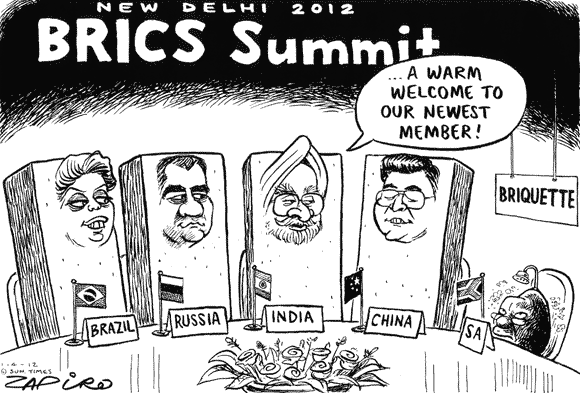
With the country preparing for local elections on May 18, the cabinet member Mr. Zuma chose to oversee local government, Sicelo Shiceka, is now embroiled in scandalous reports about his profligate living at public expense. Mr. Zuma announced Sunday that he was awaiting an explanation from Mr. Shiceka that has yet to come. “It’s this flaunting of inequality and conspicuous consumption that people get agitated about,” said Ben Roberts, a researcher at the Human Sciences Research Council, which recently conducted a survey of South Africans documenting widespread disillusionment with local government.
Parliamentary leaders of Mr. Zuma’s party, the African National Congress, have asked for independent investigators in the public protector’s office to find out whether Mr. Shiceka spent more than $50,000 of taxpayers’ money to fly to Switzerland and stay in five-star hotels while visiting his girlfriend, a flight attendant, who was jailed there on drug charges, as The Sunday Times of South Africa reported.
In a follow-up article on Sunday, the newspaper reported that municipal trucks were delivering water to the building site of Mr. Shiceka’s new home in the poorest district in the Eastern Cape. His home was also slated to be among the first to get electricity. “What a disgrace!” shouted the headline. “Minister builds emperor’s palace in South Africa’s poorest village.”
Corruption and great disparities in wealth are hardly uncommon among the other BRICS countries. But the lack of basic services has touched a particular nerve here. People in Mr. Shiceka’s home district had been protesting the poor quality of water and sewerage services. And it was precisely these issues that led poor people in Ficksburg, a town in the Free State, to take to the streets last week in a protest that ended in tragedy. SABC, the state broadcaster, showed police officers in Ficksburg assaulting an unarmed, shirtless protester named Andries Tatane, 33, and thwacking his torso with batons. Mr. Tatane then looked down at his chest, streaming with blood. A haunting photograph shows him lying wounded in the arms of a friend whose face is contorted in anguish. Mr. Tatane died minutes later. “The post-mortem showed he died of gunshot wounds,” said Moses Dlamini, spokesman for the Independent Complaints Directorate, which investigates police brutality. “And he had bruises which indicated he was assaulted.” Two police officers have been charged with the murder and four others with assault, but not before enraged residents of Mr. Tatane’s township set fire to two government buildings.
An African National Congress spokesman, Jackson Mthembu, described the attack on Mr. Tatane as reminiscent of “apartheid-era strong-arm tactics” — a remarkable statement considering that the A.N.C. itself led the struggle against apartheid and has governed the country, and overseen its police force, since 1994.
The so-called service delivery protests, a phenomenon across the country, provide signs of the simmering discontent among many South Africans about how long it is taking to translate the gains of freedom into material progress. Even as South Africa takes center stage with the world’s most prominent developing nations, a majority of young black South Africans are jobless. Poverty remains widespread. A nationwide survey of about 3,200 South Africans age 16 and older, sponsored by the country’s Independent Electoral Commission, found that South Africans were most dissatisfied with local government performance on job creation, crime and housing.
The survey, released last week, documented an erosion of trust at all levels of government, with the lowest approval level — 38 percent — reserved for local government, down from a high of 55 percent in 2004. Politicians rated even lower. Only 27 percent of South Africans trusted them when the survey was conducted in the final months of 2010. The main opposition party, the Democratic Alliance — widely perceived as dominated by whites — has sought to attract more black support by highlighting its strong record in running the city of Cape Town. Helen Zille, the former journalist who leads the party, has seized on the killing of Mr. Tatane as emblematic of how the A.N.C. has “become disconnected from the people it is supposed to serve.”
But the loyalty of voters to the A.N.C., the party of Nelson Mandela, remains deep, and the survey found that those who were most unhappy with government were also the ones who said they were least likely to vote. So the question of whether discontent leads to change in the ballot box remains open.
Source: New York Times
Subscribe to:
Posts (Atom)