The entire Western Cape ANC is denying that it faces a major rift along political fault lines between its former chair, James Ngculu, and former premier, Ebrahim Rasool, on the one hand and its newly elected chair, Mcebisi Skwatsha, on the other.
Last week the ANC in the province held its long-awaited provincial conference and the Skwatsha grouping -- seen as strongly pro-Zuma -- made a clean sweep of the top five positions by unanimously electing Skwatsha as party chairperson, Premier Lynne Brown as deputy chair, Sipho Kroma as secretary, Max Ozinsky as deputy secretary and Songezo Mjongile as treasurer.
In contrast with other recent provincial conferences of the ruling party there were no threats, intimidation or mayhem, but about 42% of branches (86 of 205) boycotted the conference claiming that they were deliberately excluded because they supported Lerumo Kalako for the position of chairperson.
Kalako is seen as a Thabo Mbeki supporter and a staunch backer of now ousted Ngculu. He told the Mail & Guardian on Thursday: "I have nothing to say. It's best if you phone Skwatsha and Ozinsky for their comments." Although a member of the ANC's provincial executive committee, recently ousted premier Rasool did not attend the conference either. He told the local media that he did not want to cause further divisions in the organisation.
On the first day of the conference regional secretary Mbulelo Ncedana and about 500 of his supporters held an alternative meeting in Langa, where Ngculu addressed them after delivering his formal conference address. On both sides of the political divide ANC members deny that the boycott of the conference marks an imminent split in the organisation. Garth Strachan, Western Cape finance minister, said the ANC has 54 000 signed-up members in the province, of whom about 400 were disaffected. "These people chose to step outside due process and they're bringing the name of the ANC into disrepute. They're doing the opposition's work for them and we don't see this as signifying a split in the ANC." Strachan is adamant that the ANC's national leadership, under the chairmanship of NEC member Fikile Mbalula, listened to the concerns of the disgruntled members.
Ncedane sent a memorandum to the national executive committee claiming that Skwatsha and his supporters manipulated branches attending the conference to ensure a Skwatsha victory. Both Strachan and Ozinsky denied this. "When you're a democrat you have to abide by the democratic process. You can't cry foul and boycott the process because you don't like the majority vote," Ozinsky said. "Honestly, we're worried about the divisions in the province. It's worrying if senior provincial leaders are playing a factional and divisive role with the intention of disrupting the highest organ of the organisation in the province, namely the conference."
Regional executive committee member Yengwayo Kutta said he and others decided to boycott the conference because "there had been a clear attempt to exclude branches that supported Kalako as the ANC chair". "Eighty-five branches out of 205 are not participating because we're unhappy with the process. Branches in good standing were excluded because of political interference. I myself believe that the conference is fraudulent," Kutta said. "We want the national leadership to listen to our concerns and then we would like another, more inclusive, conference to be held."
Source: Mail & Guardian Online
Monday, September 29, 2008


Sunday, September 28, 2008
'Child' Malema smacked
Tensions are appearing in the Jacob Zuma camp of the ANC, with senior cabinet minister Zola Skweyiya slamming the "shocking" disrespect shown to Thabo Mbeki in the past year. And he singled out Julius Malema, the controversial ANC Youth League leader, for particular censure, describing him as "an embarrassment to the party" and "un-African". He added: "People... call me every night complaining 'What are you doing about this child?'."
Skweyiya, widely regarded as representing "the soul" of the ruling party, went so far as to invoke legendary ANC leader Oliver Tambo, saying: "If Tambo woke up and found the ANC the way it is, he would have run back to his grave... he would say, 'That can't be my ANC'."
Though a member of the ANC national executive committee, which last weekend decided to axe Mbeki as president of the country, Skweyiya has fiercely criticised the way Mbeki has been treated since he lost his position as president of the party to Zuma in Polokwane in December. Skweyiya was not one of the cabinet ministers who resigned in the wake of Mbeki's departure this week, but he indicated that he would probably retire at the end of his term of office.
In an interview with The Sunday Independent, Skweyiya pulled no punches. He criticised the ANC for not acting against those who had tried to humiliate Mbeki. "We kept quiet... The way Thabo was treated was really shocking to me. Thabo was our president, whether we like it or not. The fact is he was the president of this country and he represented the people of South Africa... That needs to be respected if we respect our constitution. I personally didn't like that." He cited the humiliating incident in Durban last year when Zuma supporters disrupted proceedings during the visit of Indian Prime Minister Manmohan Singh, and the repeated and much-publicised outbursts against Mbeki by the Youth League president.
Malema's ridiculing of Mbeki was unacceptable, he said. "You can't talk about the president like that... of the ANC and also of the state. It's very sad that [Malema] says he can fire Zuma. "Who is he? He's not even a member of the national executive committee. "How can he fire Zuma when Zuma has been elected by the ANC, by the people? The Youth League does not determine the policy of the ANC."
Malema was an embarrassment to the party and had to be brought into line, Skweyiya said. The party leadership had repeatedly told the youth leader to shut up but he disregarded them. Skweyiya suggested that Malema was ignorant of the ANC's history because he kept asserting that the Youth League was an "autonomous" structure. But youth leaders before Malema had taken instructions from the "mother body", even if they had not agreed with them.
Skweyiya added that Malema's conduct was un-African. "We are Africans and an elderly person is an elderly person. We say, 'You shall not dishonour your parents'. If you can't respect that, what does he think?" Skweyiya found the attacks on the judiciary and the Human Rights Commission by members of the ANC's tripartite alliance "painful". "How we treated our judges... has not been a nice thing. You might not like the judgments but... those are judges. One of the basic conditions that this government [agreed to when it] came into power was the independence of the judiciary, even though we knew that it wouldn't transform rapidly. "[And] the way we treated the Human Rights Commission is for me something very painful."
Skweyiya's remarks about Mbeki echoed those made by two veteran opposition leaders in parliament this week. IFP leader Mangosuthu Buthelezi and PAC MP Motsoko Pheko told MPs that the disrespect shown to the president was unacceptable.
Pheko said that the office of president should be "treated with the dignity it deserves". His remarks were greeted in parliament by an animated Buthelezi, who jumped up from his front bench and, punching his fist in the air, shouted in approval: "That's the truth, that's the truth!"
Later, in parliament, President Kgalema Motlanthe reminded MPs of his predecessor's achievements and leadership. He thanked Mbeki, in whose cabinet, he briefly served. "We have been privileged to have had you as our president these last nine years," he said.
Source: IoL
Skweyiya, widely regarded as representing "the soul" of the ruling party, went so far as to invoke legendary ANC leader Oliver Tambo, saying: "If Tambo woke up and found the ANC the way it is, he would have run back to his grave... he would say, 'That can't be my ANC'."
Though a member of the ANC national executive committee, which last weekend decided to axe Mbeki as president of the country, Skweyiya has fiercely criticised the way Mbeki has been treated since he lost his position as president of the party to Zuma in Polokwane in December. Skweyiya was not one of the cabinet ministers who resigned in the wake of Mbeki's departure this week, but he indicated that he would probably retire at the end of his term of office.
In an interview with The Sunday Independent, Skweyiya pulled no punches. He criticised the ANC for not acting against those who had tried to humiliate Mbeki. "We kept quiet... The way Thabo was treated was really shocking to me. Thabo was our president, whether we like it or not. The fact is he was the president of this country and he represented the people of South Africa... That needs to be respected if we respect our constitution. I personally didn't like that." He cited the humiliating incident in Durban last year when Zuma supporters disrupted proceedings during the visit of Indian Prime Minister Manmohan Singh, and the repeated and much-publicised outbursts against Mbeki by the Youth League president.
Malema's ridiculing of Mbeki was unacceptable, he said. "You can't talk about the president like that... of the ANC and also of the state. It's very sad that [Malema] says he can fire Zuma. "Who is he? He's not even a member of the national executive committee. "How can he fire Zuma when Zuma has been elected by the ANC, by the people? The Youth League does not determine the policy of the ANC."
Malema was an embarrassment to the party and had to be brought into line, Skweyiya said. The party leadership had repeatedly told the youth leader to shut up but he disregarded them. Skweyiya suggested that Malema was ignorant of the ANC's history because he kept asserting that the Youth League was an "autonomous" structure. But youth leaders before Malema had taken instructions from the "mother body", even if they had not agreed with them.
Skweyiya added that Malema's conduct was un-African. "We are Africans and an elderly person is an elderly person. We say, 'You shall not dishonour your parents'. If you can't respect that, what does he think?" Skweyiya found the attacks on the judiciary and the Human Rights Commission by members of the ANC's tripartite alliance "painful". "How we treated our judges... has not been a nice thing. You might not like the judgments but... those are judges. One of the basic conditions that this government [agreed to when it] came into power was the independence of the judiciary, even though we knew that it wouldn't transform rapidly. "[And] the way we treated the Human Rights Commission is for me something very painful."
Skweyiya's remarks about Mbeki echoed those made by two veteran opposition leaders in parliament this week. IFP leader Mangosuthu Buthelezi and PAC MP Motsoko Pheko told MPs that the disrespect shown to the president was unacceptable.
Pheko said that the office of president should be "treated with the dignity it deserves". His remarks were greeted in parliament by an animated Buthelezi, who jumped up from his front bench and, punching his fist in the air, shouted in approval: "That's the truth, that's the truth!"
Later, in parliament, President Kgalema Motlanthe reminded MPs of his predecessor's achievements and leadership. He thanked Mbeki, in whose cabinet, he briefly served. "We have been privileged to have had you as our president these last nine years," he said.
Source: IoL
Saturday, September 27, 2008
Biggest US bank failure ever
The collapse of the Seattle-based firm, the sixth largest US bank and the largest savings and loan company in the country, was the biggest bank failure in American history.
With $307 billion in assets, $188 billion in deposits and more than 2,200 branches, Washington Mutual’s failure by far eclipsed the previous record bank collapse, that of Continental Illinois in 1984. The latter had $40 billion in assets at the time of its demise.
Source: World Socialist Web
With $307 billion in assets, $188 billion in deposits and more than 2,200 branches, Washington Mutual’s failure by far eclipsed the previous record bank collapse, that of Continental Illinois in 1984. The latter had $40 billion in assets at the time of its demise.
Source: World Socialist Web
Friday, September 26, 2008
Manto axed from Health portfolio
Newly elected President Kgalema Motlanthe used the limited room afforded by a partial Cabinet reshuffle to promise stability, sideline the deeply unpopular Health Minister Manto Tshabalala-Msimang and soothe divided provincial ANC structures.
Source: Mail & Guardian
Source: Mail & Guardian
Thursday, September 25, 2008
Motlanthe moves to steady the ship
The government will remain true to the policies that have kept South Africa steady and ensured sustained growth, newly elected President Kgalema Motlanthe said on Thursday.
In naming his Cabinet, he reappointed Trevor Manuel as Finance Minister and said his deputy would be Baleka Mbete. Nkosazana Dlamini Zuma was reappointed as Foreign Minister. Controversial Health Minister Manto Tshabalala-Msimang has become a Minister in the Presidency.
New ministers were:
* Defence: Charles Nqakula
* Justice and Constitutional Development: Enver Surty
* Health: Barbara Hogan
* Safety and Security: Nathi Mthethwa
* Public Enterprises: Brigitte Mabandla
* Public Works: Geoff Doidge
* Intelligence: Siyabonga Cwele
Those who retained their positions were:
# Social Development: Zola Skweyiya
# Education: Naledi Pandor
# Labour: Membathisi Mdladlana
# Correctional Services: Ngconde Balfour
# Housing: Lindiwe Sisulu
# Arts and Culture: Pallo Jordan
# Sport and Recreation: Makhenkesi Stofile
# Environmental Affairs and Tourism: Marthinus van Schalkwyk
# Water Affairs and Forestry: Lindiwe Hendricks
# Minerals and Energy, Buyelwa Sonjica
# Home Affairs, Noziviwe Mapisa-Nqakula
In his acceptance speech to the National Assembly after being sworn in by Chief Justice Pius Langa, Motlanthe said it was not his desire to "deviate from what is working".
Source: Mail & Guardian
In naming his Cabinet, he reappointed Trevor Manuel as Finance Minister and said his deputy would be Baleka Mbete. Nkosazana Dlamini Zuma was reappointed as Foreign Minister. Controversial Health Minister Manto Tshabalala-Msimang has become a Minister in the Presidency.
New ministers were:
* Defence: Charles Nqakula
* Justice and Constitutional Development: Enver Surty
* Health: Barbara Hogan
* Safety and Security: Nathi Mthethwa
* Public Enterprises: Brigitte Mabandla
* Public Works: Geoff Doidge
* Intelligence: Siyabonga Cwele
Those who retained their positions were:
# Social Development: Zola Skweyiya
# Education: Naledi Pandor
# Labour: Membathisi Mdladlana
# Correctional Services: Ngconde Balfour
# Housing: Lindiwe Sisulu
# Arts and Culture: Pallo Jordan
# Sport and Recreation: Makhenkesi Stofile
# Environmental Affairs and Tourism: Marthinus van Schalkwyk
# Water Affairs and Forestry: Lindiwe Hendricks
# Minerals and Energy, Buyelwa Sonjica
# Home Affairs, Noziviwe Mapisa-Nqakula
In his acceptance speech to the National Assembly after being sworn in by Chief Justice Pius Langa, Motlanthe said it was not his desire to "deviate from what is working".
Source: Mail & Guardian
Opposition congratulate Motlanthe
PARLIAMENT - Political parties across the spectrum congratulated newly elected President Kgalema Motlanthe in the National Assembly on Thursday.
Source: Citizen
Source: Citizen
Motlanthe sworn in
PARLIAMENT - Newly elected President Kgalema Motlanthe was officially sworn in by Chief Justice Pius Langa at Tuynhuys, adjacent to Parliament, on Thursday afternoon.
Motlanthe was elected by majority vote of MPs in the National Assembly earlier.
Accepting his election, he said he was humbled and honoured by the faith and confidence placed in him.
“I undertake this responsibility fully cognicent of the duties and responsibilities that are attached to this high office and the expectations the people of this nation rightly have of the head of state,” he said.
Source: The Citizen
Motlanthe was elected by majority vote of MPs in the National Assembly earlier.
Accepting his election, he said he was humbled and honoured by the faith and confidence placed in him.
“I undertake this responsibility fully cognicent of the duties and responsibilities that are attached to this high office and the expectations the people of this nation rightly have of the head of state,” he said.
Source: The Citizen
Motlanthe elected South African president
The deputy president of the African National Congress (ANC), Kgalema Motlanthe, was elected President of South Africa in the National Assembly on Thursday by 269 votes to the 50 cast for the chairperson of the Democratic Alliance, Joe Seremane.
There were 41 spoilt ballots.
Source: Mail & Guardian
There were 41 spoilt ballots.
Source: Mail & Guardian
Financial crisis casts cloud over UN poverty meeting
Heads of state, private-sector leaders and development agencies will this week assess the global fight against poverty, where progress is threatened by upheaval in global markets and soaring food prices.
Source: Mail & Guardian
Source: Mail & Guardian
New Minster of Intelligence
President Kgalema Motlanthe on Thursday appointed Dr Siyabonga Cwele as the new minister of intelligence. It is to replace Ronnie Kasrils, who has retired.
He served in the ANC underground structures from 1984 until 1990. He became a member of Parliament in 1994 and was well regarded as the chairperson of the Joint Standing Committee on Intelligence. But the committee was criticised for operating behind closed doors and never being open enough. They also trashed the inspector general of intelligence’s report which found against former NIA director general Billy Masetlha in 1996, in the interests of the Zuma camp.
People who have worked with him describe him as hardworking and independent-minded. His public statements have included an emphasis on the basics: intelligence as a means of combating crime and guaranteeing public safety.
Cwele received an MBchB from the University of KwaZulu Natal in 1984, and later also completed his MPhil in Economic Policy at the University of Stellenbosch
source: News 24
He served in the ANC underground structures from 1984 until 1990. He became a member of Parliament in 1994 and was well regarded as the chairperson of the Joint Standing Committee on Intelligence. But the committee was criticised for operating behind closed doors and never being open enough. They also trashed the inspector general of intelligence’s report which found against former NIA director general Billy Masetlha in 1996, in the interests of the Zuma camp.
People who have worked with him describe him as hardworking and independent-minded. His public statements have included an emphasis on the basics: intelligence as a means of combating crime and guaranteeing public safety.
Cwele received an MBchB from the University of KwaZulu Natal in 1984, and later also completed his MPhil in Economic Policy at the University of Stellenbosch
source: News 24
Kasrils shields his legacy
Outgoing intelligence minister Ronnie Kasrils engaged in a last-minute scramble this week to protect his legacy of reform at the intelligence services. Since 2005 the National Intelligence Agency has been in the thick of claims that the Mbeki and Zuma camps abused state institutions in their battle for supremacy.
On Wednesday Kasrils persuaded outgoing president Thabo Mbeki's last Cabinet meeting to release a hard-hitting review of intelligence policy. The report recommends comprehensive reforms of the country's civilian spy agencies, in particular the NIA, the South African Secret Service (SASS) and the National Communications Centre (NCC), responsible for the interception of electronic communication. The report recommends comprehensive reforms of the country's civilian spy agencies, in particular the NIA, the South African Secret Service (SASS) and the National Communications Centre (NCC), responsible for the interception of electronic communication.
The commission, comprising former deputy-minister Joe Matthews, former speaker Frene Ginwala and academic Laurie Nathan, was set up by Kasrils after the "hoax email" saga which led to the sacking of former NIA boss Billy Masetlha. The report, handed to Kasrils on August 7, was held back pending objections by his spy chiefs to some findings. Released on Thursday, it scrupulously avoids trespassing on operational turf, but its recommendations on the policy terrain are uncompromising. The report notes: "We are concerned that NIA's mandate may have politicised the agency, drawn it into the realm of party politics, required it to monitor and investigate legal political activity …" The commission, with the NIA's support, recommends that the mandate should narrow to focus on "terrorism, sabotage, subversion, espionage, proliferation of weapons of mass destruction, organised crime and corruption" and large-scale violence and drug trafficking.
Another key finding is that some methods of surveillance currently used are illegal. The report notes that "infiltration of an organisation, physical and electronic surveillance and recruitment of an informant who reports on the private affairs of an individual or organisation ... are not regulated by legislation and are therefore unconstitutional".The commission rejected the recommendation of an earlier internal task team report that "in the hard reality of intelligence operations … it is sometimes impossible to do things by the book.When operating against terrorist threats or organised crime or other clear threats and targets, it is sometimes necessary to 'bend the rules' in order to ensure that the threat is adequately dealt with. This is an operational reality in order to ensure that the real 'nasties' do not get away with their 'nastiness'."
The commission slams this, saying it is "unconstitutional, flouts the rule of law and undermines efforts to develop an institutional culture of respect for the law…
Source: Mail & Guardian
On Wednesday Kasrils persuaded outgoing president Thabo Mbeki's last Cabinet meeting to release a hard-hitting review of intelligence policy. The report recommends comprehensive reforms of the country's civilian spy agencies, in particular the NIA, the South African Secret Service (SASS) and the National Communications Centre (NCC), responsible for the interception of electronic communication. The report recommends comprehensive reforms of the country's civilian spy agencies, in particular the NIA, the South African Secret Service (SASS) and the National Communications Centre (NCC), responsible for the interception of electronic communication.
The commission, comprising former deputy-minister Joe Matthews, former speaker Frene Ginwala and academic Laurie Nathan, was set up by Kasrils after the "hoax email" saga which led to the sacking of former NIA boss Billy Masetlha. The report, handed to Kasrils on August 7, was held back pending objections by his spy chiefs to some findings. Released on Thursday, it scrupulously avoids trespassing on operational turf, but its recommendations on the policy terrain are uncompromising. The report notes: "We are concerned that NIA's mandate may have politicised the agency, drawn it into the realm of party politics, required it to monitor and investigate legal political activity …" The commission, with the NIA's support, recommends that the mandate should narrow to focus on "terrorism, sabotage, subversion, espionage, proliferation of weapons of mass destruction, organised crime and corruption" and large-scale violence and drug trafficking.
Another key finding is that some methods of surveillance currently used are illegal. The report notes that "infiltration of an organisation, physical and electronic surveillance and recruitment of an informant who reports on the private affairs of an individual or organisation ... are not regulated by legislation and are therefore unconstitutional".The commission rejected the recommendation of an earlier internal task team report that "in the hard reality of intelligence operations … it is sometimes impossible to do things by the book.When operating against terrorist threats or organised crime or other clear threats and targets, it is sometimes necessary to 'bend the rules' in order to ensure that the threat is adequately dealt with. This is an operational reality in order to ensure that the real 'nasties' do not get away with their 'nastiness'."
The commission slams this, saying it is "unconstitutional, flouts the rule of law and undermines efforts to develop an institutional culture of respect for the law…
Source: Mail & Guardian
Wednesday, September 24, 2008
A bloodless coup
The ousting of Thabo Mbeki as President of South Africa is nothing short of a bloodless coup. A coup d’etat is defined as “a sudden and decisive action resulting in a change of government illegally or by force”. The dismissal of Mbeki and the consequent resignation of almost one-third of the Cabinet certainly constitutes a sudden and illegal change of government and is therefore a coup.
Source: Main & Guardian thought leader; Ahmed Motala
Source: Main & Guardian thought leader; Ahmed Motala
Monday, September 22, 2008
Dozens of children kidnapped in DRC by rebels
The United Nations Children's Fund (Unicef) on Monday urged the immediate release of 90 children kidnapped in the Democratic Republic of Congo (DRC) by rebels from Uganda's Lord's Resistance Army (LRA).
Source: Mail & Guardian
Source: Mail & Guardian
Thabo Mbeki Resigns
Thabo Mbeki, nine and a half years in office as successor to Nelson Mandela as South Africa’s president, resigned on September 21st, 2008 after losing a power struggle to Jacob Zuma, his former deputy and likely political heir.
The resignation brought an end to a once-promising presidency during which Mr. Mbeki accrued both celebration and disrepute. He became internationally notorious for his views about AIDS, joining maverick scientists in questioning whether a virus was the cause of the illness. He led the resistance to antiretroviral treatment, acting as if the AIDS epidemic were a defamatory plot against Africans and a con job by avaricious pharmaceutical companies. This intransigence, critics say, sent countless thousands to needless deaths.
Mr. Mbeki was forced to resign within the same week that some African leaders have praised him for what they hail as a landmark achievement, the brokering of a deal signed Monday in Zimbabwe between President Robert Mugabe and his opposition.
Source: New York Times
The resignation brought an end to a once-promising presidency during which Mr. Mbeki accrued both celebration and disrepute. He became internationally notorious for his views about AIDS, joining maverick scientists in questioning whether a virus was the cause of the illness. He led the resistance to antiretroviral treatment, acting as if the AIDS epidemic were a defamatory plot against Africans and a con job by avaricious pharmaceutical companies. This intransigence, critics say, sent countless thousands to needless deaths.
Mr. Mbeki was forced to resign within the same week that some African leaders have praised him for what they hail as a landmark achievement, the brokering of a deal signed Monday in Zimbabwe between President Robert Mugabe and his opposition.
Source: New York Times
Sunday, September 21, 2008
Cautious optimism returns to Zim
The mother of three, who gives her name just as Beatrice, still doesn't know who raped her all those months ago. They were three men with beer on their breath, iron bars in their hands and Robert Mugabe on their T-shirts.
Source: Mail & Guardian
Source: Mail & Guardian
ANC dumps Mbeki, moves to 'heal rift'
South African President Thabo Mbeki has agreed to resign after the ANC announced that it would remove him from office before the end of his term.
Source: Mail & Guardian
Source: Mail & Guardian
Saturday, September 20, 2008
Heath calls for charges against Mbeki, Maduna, Ngcuka
Former judge Willem Heath has called for criminal charges to be brought against President Thabo Mbeki, former justice minister Penuell Maduna and former chief prosecutor Bulelani Ngcuka. Heath told the weekly Mail & Guardian newspaper that last week's findings by Judge Chris Nicholson were tantamount to prima facie evidence of contraventions of the National Prosecuting Authority (NPA) Act by Mbeki, Maduna and Ngcuka. Nicholson found that the decision to prosecute ruling party leader Jacob Zuma on fraud and corruption charges was invalid.
Heath said South Africans should be protected against the "systematic abuse, detailed in the judgment, of organs of state by the president and his purported henchmen"."If the behaviour found by Nicholson is not addressed, the application of the principle of the separation of powers will remain at the whim of those who have seemingly been using it most effectively for personal gain," said Heath. He criticised the NPA's decision to appeal against Nicholson's ruling. "The findings of Judge Chris Nicholson... will profoundly impact on South Africa. It is probably the most important judgment delivered in this country in the past many years. "What is macabre is that the NPA has decided to lodge their intent to appeal the judgment. "The NPA, represented by Billy Downer SC and Wim Trengove SC in their battle against Zuma, has been given a long overdue chastising for their maverick behaviour -- behaviour which is not limited to the Zuma case," said Heath. He said it was "astounding" that the two senior counsel "did not recognise the procedural irregularities perpetrated by the three consecutive [national directors of public prosecutions] and allowed themselves to be led by such irregularities."
Meanwhile, the suspended national director of public prosecutions, Vusi Pikoli, told the SABC that the decision to prosecute Zuma was based purely on legal grounds and not political grounds, as was hinted by Nicholson in his judgment. Pikoli, who has been suspended by Mbeki for an alleged breakdown in his relationship with Justice Minister Brigitte Mabandla, denied that he was ever influenced in deciding to prosecute Zuma.
Pikoli said the decision by the NPA to appeal Nicholson's decision should be respected.
Heath said South Africans should be protected against the "systematic abuse, detailed in the judgment, of organs of state by the president and his purported henchmen"."If the behaviour found by Nicholson is not addressed, the application of the principle of the separation of powers will remain at the whim of those who have seemingly been using it most effectively for personal gain," said Heath. He criticised the NPA's decision to appeal against Nicholson's ruling. "The findings of Judge Chris Nicholson... will profoundly impact on South Africa. It is probably the most important judgment delivered in this country in the past many years. "What is macabre is that the NPA has decided to lodge their intent to appeal the judgment. "The NPA, represented by Billy Downer SC and Wim Trengove SC in their battle against Zuma, has been given a long overdue chastising for their maverick behaviour -- behaviour which is not limited to the Zuma case," said Heath. He said it was "astounding" that the two senior counsel "did not recognise the procedural irregularities perpetrated by the three consecutive [national directors of public prosecutions] and allowed themselves to be led by such irregularities."
Meanwhile, the suspended national director of public prosecutions, Vusi Pikoli, told the SABC that the decision to prosecute Zuma was based purely on legal grounds and not political grounds, as was hinted by Nicholson in his judgment. Pikoli, who has been suspended by Mbeki for an alleged breakdown in his relationship with Justice Minister Brigitte Mabandla, denied that he was ever influenced in deciding to prosecute Zuma.
Pikoli said the decision by the NPA to appeal Nicholson's decision should be respected.
Friday, September 19, 2008
Heath: Charge Mbeki, Maduna and Ngcuka
Former judge Willem Heath has called for criminal charges to be brought against President Thabo Mbeki, former justice minister Penuell Maduna and former chief prosecutor Bulelani Ngcuka.
Heath told the weekly Mail & Guardian newspaper that last week's findings by Judge Chris Nicholson were tantamount to prima facie evidence of contraventions of the National Prosecuting Authority (NPA) Act by Mbeki, Maduna and Ngcuka.
Nicholson found that the decision to prosecute ruling party leader Jacob Zuma on fraud and corruption charges was invalid.
Heath said South Africans should be protected against the "systematic abuse, detailed in the judgment, of organs of state by the president and his purported henchmen".
Heath told the weekly Mail & Guardian newspaper that last week's findings by Judge Chris Nicholson were tantamount to prima facie evidence of contraventions of the National Prosecuting Authority (NPA) Act by Mbeki, Maduna and Ngcuka.
Nicholson found that the decision to prosecute ruling party leader Jacob Zuma on fraud and corruption charges was invalid.
Heath said South Africans should be protected against the "systematic abuse, detailed in the judgment, of organs of state by the president and his purported henchmen".
Heath wants Mbeki charged
Former judge Willem Heath has called for criminal charges to be brought against President Thabo Mbeki, former justice minister Penuell Maduna and former chief prosecutor Bulelani Ngcuka.
Heath told the weekly Mail & Guardian newspaper that last week's findings by Judge Chris Nicholson were tantamount to prima facie evidence of contraventions of the National Prosecuting Authority (NPA) Act by Mbeki, Maduna and Ngcuka.
Nicholson found that the decision to prosecute ruling party leader Jacob Zuma on fraud and corruption charges was invalid.
Heath said South Africans should be protected against the "systematic abuse, detailed in the judgment, of organs of state by the president and his purported henchmen".
"If the behaviour found by Nicholson is not addressed, the application of the principle of the separation of powers will remain at the whim of those who have seemingly been using it most effectively for personal gain," said Heath.
Source: News 24.com
Heath told the weekly Mail & Guardian newspaper that last week's findings by Judge Chris Nicholson were tantamount to prima facie evidence of contraventions of the National Prosecuting Authority (NPA) Act by Mbeki, Maduna and Ngcuka.
Nicholson found that the decision to prosecute ruling party leader Jacob Zuma on fraud and corruption charges was invalid.
Heath said South Africans should be protected against the "systematic abuse, detailed in the judgment, of organs of state by the president and his purported henchmen".
"If the behaviour found by Nicholson is not addressed, the application of the principle of the separation of powers will remain at the whim of those who have seemingly been using it most effectively for personal gain," said Heath.
Source: News 24.com
Trouble in Nigeria? Between an Oil War and a Succession Battle
Even more than is usual for Nigeria, the country currently faces critical challenges. For some time now, Nigeria has been suffering the effects of a multi-layered crisis, the most conspicuous manifestations of which are the oil-related insurgency in the Niger-Delta and recurring concerns about President Yar’Adua’s health, which have given rise to unseemly, and probably premature, speculation and manoeuvring within the country’s political leadership.
Source: Institute for Security Studies
Source: Institute for Security Studies
Thursday, September 18, 2008
African Solutions to African Problems
In January next year, the issue of a Union Government for Africa will again be on the agenda of the next Summit of Heads of States and Governments of the African Union (AU). Continental integration through the establishment of the Union Government was initiated in 2005, but the idea was first formally discussed by African leaders at the Accra Summit of Heads of States and Governments of Africa held in July 2007.
It is evident that African people have got the necessary resources and knowledge to address the challenges the continent is facing. Even if the concept needs further development and clarification in terms of defining the problems of Africa and their solutions, “African solutions for African problems” could be employed as a motto since it certainly is inspiring. This applies especially to the youth of Africa who are in the driving seat of Africa’s destiny.
Serekebrhan Fiquremariam, Intern, Direct Conflict Prevention Programme, ISS Addis Ababa
Source: Institute for Security Studies
It is evident that African people have got the necessary resources and knowledge to address the challenges the continent is facing. Even if the concept needs further development and clarification in terms of defining the problems of Africa and their solutions, “African solutions for African problems” could be employed as a motto since it certainly is inspiring. This applies especially to the youth of Africa who are in the driving seat of Africa’s destiny.
Serekebrhan Fiquremariam, Intern, Direct Conflict Prevention Programme, ISS Addis Ababa
Source: Institute for Security Studies
Wednesday, September 17, 2008
Pikoli: 'I was not manipulated'
Suspended prosecuting boss Vusi Pikoli has rubbished any suggestion that he was improperly influenced by President Thabo Mbeki's "meddling" in ANC president Jacob Zuma's corruption prosecution.
Judge Nicholson found on Friday that there had been a "distressing pattern" in the National Prosecuting Authority's behaviour and handling of the case against Zuma "indicative of political interference, pressure or influence".
Pikoli's attorney, Aslam Moosajee, said the behaviour complained of related to allegations against acting national director of public prosecutions Mokotedi Mpshe, and Ngcuka, in the latter's interaction with then-justice minister Penuell Maduna before the prosecution of Zuma's former financial adviser, Schabir Shaik.
"There are no facts set out in the judgment which supports any suggestion that Mr Pikoli allowed political interference.
"Mr Pikoli viewed his obligations of independence very seriously and went as far as refusing to comply with an instruction from justice minister Brigitte Mabandla not to proceed with the arrest of national commissioner of police Jackie Selebi.
"We know from the Selebi matter that Mr Pikoli said there was interference, but he resisted those attempts and he was suspended.
"The international community has also recognised Mr Pikoli's dedication to the principles of prosecutorial independence," he said.
Source: News 24.com
Judge Nicholson found on Friday that there had been a "distressing pattern" in the National Prosecuting Authority's behaviour and handling of the case against Zuma "indicative of political interference, pressure or influence".
Pikoli's attorney, Aslam Moosajee, said the behaviour complained of related to allegations against acting national director of public prosecutions Mokotedi Mpshe, and Ngcuka, in the latter's interaction with then-justice minister Penuell Maduna before the prosecution of Zuma's former financial adviser, Schabir Shaik.
"There are no facts set out in the judgment which supports any suggestion that Mr Pikoli allowed political interference.
"Mr Pikoli viewed his obligations of independence very seriously and went as far as refusing to comply with an instruction from justice minister Brigitte Mabandla not to proceed with the arrest of national commissioner of police Jackie Selebi.
"We know from the Selebi matter that Mr Pikoli said there was interference, but he resisted those attempts and he was suspended.
"The international community has also recognised Mr Pikoli's dedication to the principles of prosecutorial independence," he said.
Source: News 24.com
Rising prices tip another 75-million towards starvation
Global numbers afflicted by acute hunger rose from 850-million to 925-million by the start of 2008 because of rising prices, the head of the United Nations Food and Agriculture Organisation (FAO) said on Wednesday.
Source: Mail & Guardian
Source: Mail & Guardian
NPA to appeal against Zuma judgement
The National Prosecuting Authority (NPA) said on Wednesday that it will apply for leave to appeal against the judgment delivered by Judge Chris Nicholson last Friday on the Jacob Zuma matter.
Source: Mail and Guardian
Source: Mail and Guardian
Monday, September 15, 2008
Global Political Agreement
The Agreement between the Zimbabwe African National Union-Patriotic Front (ZANU-PF) and the two Movement for Democratic Change (MDC) formations, on resolving the challenges facing Zimbabwe can be found here.
Source: Kubatana
Source: Kubatana
Friday, September 12, 2008
Round one to Zuma
The Scorpions' decision to prosecute African National Congress (ANC) president Jacob Zuma on fraud and corruption charges was not legal, Judge Chris Nicholson found in the Pietermaritzburg High Court on Friday.
Source: Mail & Guardian
"... and blessed be the Angel Gabriel ..."
Three coins in a fountain ...
Source: Mail & Guardian
"... and blessed be the Angel Gabriel ..."
Three coins in a fountain ...
ANC asserts independence from leftist allies
The African National Congress (ANC) does not necessarily share the economic views of its leftist allies, party treasurer Mathews Phosa said, Business Day reported on Friday.
Phosa told a meeting of businessmen and diplomats the ANC respected the views of its allies, the Congress of South African Trade Unions (Cosatu) and the South African Communist Party (SACP), but did not share all of them, the newspaper said.
Sourc:; Mail and Guardian
Phosa told a meeting of businessmen and diplomats the ANC respected the views of its allies, the Congress of South African Trade Unions (Cosatu) and the South African Communist Party (SACP), but did not share all of them, the newspaper said.
Sourc:; Mail and Guardian
Thursday, September 11, 2008
SACP: Political left at crossroads
The political left in South Africa is at a crossroads in the history of its revolution, the South African Communist Party (SACP) said in a policy discussion document released on Wednesday.
The struggle to build a coherent, working-class biased, developmental state involves a struggle against the grave dangers of factionalising the state apparatus, and particularly sensitive areas of the state apparatus like courts, prosecutorial authorities, SAPS investigators and the intelligence services.
"Unfortunately there have been worrying developments over the last several years in this regard.
"The SACP needs to be in the forefront of fighting against such tendencies."
"We need to fight for the integrity, the professionalism and the independence of the criminal justice system and its component parts," the document said.
Source: Mail and Guardian
The struggle to build a coherent, working-class biased, developmental state involves a struggle against the grave dangers of factionalising the state apparatus, and particularly sensitive areas of the state apparatus like courts, prosecutorial authorities, SAPS investigators and the intelligence services.
"Unfortunately there have been worrying developments over the last several years in this regard.
"The SACP needs to be in the forefront of fighting against such tendencies."
"We need to fight for the integrity, the professionalism and the independence of the criminal justice system and its component parts," the document said.
Source: Mail and Guardian
Wednesday, September 10, 2008
Malema (ANCYL) in a froth over Zuma
African National Congress Youth League (ANCYL) leader Julius Malema on Wednesday vowed to "eliminate any force" blocking ANC president Jacob Zuma's path to the presidency.
Source: Mail and Guardian
Source: Mail and Guardian
Cosatu on Zuma: Don't test our patience
The Congress of South African Trade Unions (Cosatu) has called on President Thabo Mbeki to reinstate Jacob Zuma as the deputy president of the country.
Source: Mail and Guardian
Source: Mail and Guardian
Portrait of a suicide bomber
The windows are wide open and birds are singing in the trees outside. The Kabul traffic hums in the distance. Abit (21) and not looking a year more in his jaunty cap and black shalwar kameez, is sitting in the headquarters of the National Security Directorate, the Afghan intelligence service, and talking about how he became a suicide bomber.
Source: Mail & Guardian
Source: Mail & Guardian
The Apology (of Socrates)
Plato's version of the speech given by Socrates as he defends himself against the charges of being a man "who corrupted the young, did not believe in the gods, and created new deities". "Apology" here has its earlier meaning (now usually expressed by the word "apologia") of speaking in defense of a cause or of one's beliefs or actions (from the Greek απολογία).
From Wikipedia, the free encyclopedia
From Wikipedia, the free encyclopedia
Zuma weighs legal action against Zapiro
Jacob Zuma's lawyer has confirmed that the ANC president is considering new legal action against cartoonist Zapiro after his controversial drawing published in a Sunday newspaper this week. The cartoon by Zapiro, whose real name is Jonathan Shapiro, featured Zuma being urged to rape a woman, representing Justice, and being egged on by four senior ANC and tripartite alliance leaders.
This morning Michael Hulley, who is representing Zuma in his corruption case, told the Cape Argus: "I have discussed it with him, but I can't say he's given me firm instructions on how to deal with it." Hulley confirmed that Zuma was still seeking recourse from the courts in a number of different matters against media institutions and individuals - although some had been resolved. "For example, after Polokwane, Mr Zuma and David Bullard met and made their peace," he said.
Zapiro confirmed this morning that previous litigation by Zuma against himself was still pending. "It started at R15-million, but after Polokwane it was changed and lessened to R2-million," he said. Zapiro said he believed Zuma was suing him for defamation and "injury to his dignity".
This was for three cartoons, all three of which Zapiro penned while Zuma was being tried for rape in early 2006 - a charge on which he was eventually acquitted. The first cartoon was the first occasion on which Zapiro featured Zuma with a shower head emerging from his glistening scalp - where it has remained in the cartoonist's work ever since.
Zapiro said the response to his most recent Zuma cartoon had been unprecedented in his personal career, with the matter being covered in international media and an interview with the BBC this morning. "I've had some pretty huge responses, but nothing has come close to this," he said.
Source: IoL
This morning Michael Hulley, who is representing Zuma in his corruption case, told the Cape Argus: "I have discussed it with him, but I can't say he's given me firm instructions on how to deal with it." Hulley confirmed that Zuma was still seeking recourse from the courts in a number of different matters against media institutions and individuals - although some had been resolved. "For example, after Polokwane, Mr Zuma and David Bullard met and made their peace," he said.
Zapiro confirmed this morning that previous litigation by Zuma against himself was still pending. "It started at R15-million, but after Polokwane it was changed and lessened to R2-million," he said. Zapiro said he believed Zuma was suing him for defamation and "injury to his dignity".
This was for three cartoons, all three of which Zapiro penned while Zuma was being tried for rape in early 2006 - a charge on which he was eventually acquitted. The first cartoon was the first occasion on which Zapiro featured Zuma with a shower head emerging from his glistening scalp - where it has remained in the cartoonist's work ever since.
Zapiro said the response to his most recent Zuma cartoon had been unprecedented in his personal career, with the matter being covered in international media and an interview with the BBC this morning. "I've had some pretty huge responses, but nothing has come close to this," he said.
Source: IoL
Tuesday, September 9, 2008
Zuma cartoon: Worth a thousand words?
It seems a picture really is worth a thousand words after cartoonist Zapiro unleashed a storm of controversy this week for depicting Jacob Zuma and other leaders riding roughshod over the country’s justice system.
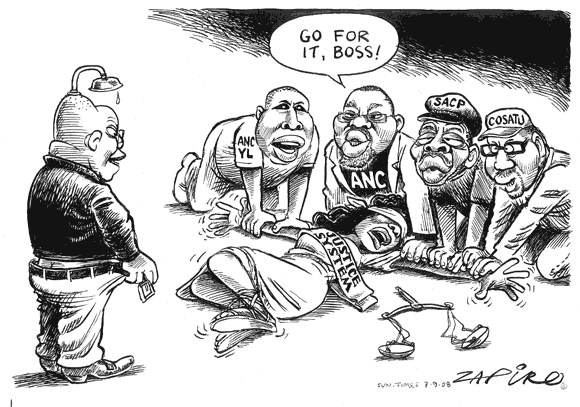 The cartoon, first published in the Sunday Times, shows African National Congress (ANC) leader Zuma unbuckling his belt -- his buttocks partially exposed -- in front of a woman who is being held down by leaders of the ANC, the South African Communist Party (SACP), the ANC Youth League and the Congress of South African Trade Unions (Cosatu). Gwede Mantashe, ANC secretary general, says: “Go for it, boss!”
The woman in the cartoon represents the justice system, so identified by a banner across her body -- implying that Zuma, together with the ANC and its alliance partners, is "raping" the judicial system. The press ombudsman's Khanye Mndaweni said on Tuesday that although the office had received two calls about the matter on Monday, no formal complaint had been laid yet.
Zapiro -- whose real name is Jonathan Shapiro -- told the Mail & Guardian Online on Monday that "there are layers in this cartoon. The primary point is that Zuma is violating the justice system and the spirit of the Constitution. That violation is depicted as a rape." On Tuesday, he said he had thought "very, very carefully" before putting pen to paper, and that he had also asked female friends for their opinion. "There is a very, very pronounced tendency in this country towards exceptionalism, as if our politicians are more sacrosanct than politicians worldwide. That I take issue with," he said. "I really feel strongly that they have to take a hard look at what they are doing and not use the red herring of racism."
His women friends, though shocked, felt that the cartoon not only showed graphically what was happening to the justice system and constitutional principles, but that it also contained a second level of criticism on violence against women in a very patriarchal society.
Zapiro said the blindfolded figure of justice was an allegorical figure going back centuries. "The fact that Jacob Zuma has this personal history is his problem," he said.
The ANC is expecting at least 5 000 supporters to converge on the Pietermaritzburg High Court on Thursday night before Friday's ruling on whether the decision to charge Zuma was lawful. Zuma faces a charge of racketeering, four charges of corruption, a charge of money laundering and 12 charges of fraud related to the multibillion-rand government arms deal.
Speaking at the University of Johannesburg on Tuesday, Zuma said although the judiciary was the final arbiter of disputes, it was not above criticism. ”It can't be said you can't criticise the judiciary. That is what is being said in South Africa. That is not right. But, the criticism should be fair and should be informed. That is very important," he said, addressing students on "access to justice". It was "only in dictatorships and autocracies that criticism is viewed with contempt". He said South Africa, as a 14-year-old democracy, was going through a learning curve and still internalising fundamental principles of democracy. Debates would help this process.
He said ANC deputy president Kgalema Motlanthe and secretary general Gwede Mantashe would never undermine the judiciary, nor the rule of law. "As the ANC we reiterate and affirm our belief in the rule of law, the independence of the judiciary to be the final arbitrator of disputes. "Motlanthe, Mantashe will never undermine these institutions. We seek to protect and strengthen them as the ANC has always done since 1912. "I believe in a free and independent judiciary that should operate without fear or favour. I believe in the right of equal access to the courts for all South Africans," he said.
Hundreds of readers of the M&G Online and its invitation-only blogging platform Thought Leader have been moved to comment on the furore, some using their real names and some using pseudonyms. Reader Tsiliso Tamasane said: “Zapiro has an insatiable hatred for Mr Zuma and will use any event to publicly humiliate him. It's no longer funny." Another reader, Joseph Sifundza, said while he has always enjoyed Zapiro's cartoons, he thought the cartoonist had gone “a bit far with this one”. “In fact, the NPA is the one raping Mr Zuma's rights with the help of the media and the opposition parties,” said Sifundza. Others thought it was fair comment. “It's called political satire and is required in any healthy democracy,” said a reader using the name Meren Gue. A reader under the name Garg Unzola said Zapiro is not a journalist. “Cartoons are not examples of investigative or informative journalism. You should view his cartoons with the same apprehension that you should read a columnist's column. Take it with a pinch of salt, accept that it is Zapiro's opinion and move on.”
Reader Rose Morrow said the cartoon, converted to text and abbreviated in journalistic speak, would probably go something like this: “Jacob Zuma, the president of the once highly respected and admired ANC, stands accused of attempting to rape the justice system of South Africa. His wholly self-serving, entirely unethical 'struggle' tactics to avoid at all costs his corruption trial are blindly supported by certain prominent leaders within that party, the ANCYL and the tripartite alliance. As one, they have launched a scathing, unabated, unfounded attack on the credentials and motive of our judges, including those from the Constitutional Court, many, if not all of whom, featured strongly in South Africa's struggle history. Added Morrow: “Printed in words, the comment would cause hardly a ripple!”
Jane Duncan, the executive director of the Freedom of Expression Institute in Johannesburg, said on Tuesday she had initially thought the cartoon to be "quite risky”. Duncan also believes that Zuma may have a case against Zapiro. “Yes, Zuma can sue Zapiro for defamation because it could evoke an association with the rape trial and depicting him as a rapist while he was not found guilty," she said. "A cartoon is a creative form of expression and it can be read in different ways. So I think the cartoonist should be given the benefit of the doubt." She added: “A cartoonist is a lot freer than a journalist”.
Fellow cartoonist and author Andy Mason told the M&G Online on Tuesday that freedom of expression is not an unlimited right, and these limits need to debated by the public. "It’s not the cartoonist who published it. The editor makes the considered decision to publish it. It’s a carefully considered risk taken in the context of the role of the newspaper. It’s not an issue of rights, it’s about responsibility," said Mason. "A cartoonist is given licence to go further than others and to push the boundaries. One of the tasks is to create public debate."
Anton Harber, journalism professor at the University of Witwatersrand, told the M&G Online: “South Africans are over-sensitive." He said he thinks it’s a powerful cartoon that “very clearly pushes the boundaries, but cartoons are satire. We give them [cartoonists] more space as journalists. You can even say this cartoon is outrageous, but that’s the function of a cartoon." He added: “Press freedom allows you to be tough and provocative." However, where to draw the line is hard to define, according to Harber. “It’s a question of judgement and taste.”
There are different possible objections to this cartoon, he said. Firstly, it could harm Zuma's dignity, and any cartoonist should be conscious of that. But, he said, “when you are a public persona you are open to more satire than normal citizens”. Another possible objection is gender violence. “But, in my opinion, the cartoon does not glorify violence against women." Thirdly, the ANC and its partners say the cartoon is referring to Zuma’s rape case, but Harber feels “those people are reading it far too literally”, saying: "It doesn’t directly refer to the rape trial.”
At a lecture at Wits in April this year, Harber said that cartoonists find themselves increasingly the target of criticism and attacks. On Tuesday he said this is because South Africans are “over-sensitive”. An important reason for this is that South Africa is still a young democracy. “In a lot of other countries this cartoon would be not that controversial," he said. “Zapiro is really pushing the boundaries and he takes it further than others. But that’s what you do as a cartoonist ... And [as a young democracy] we need it."
Source: Mail & Guardian
The woman in the cartoon represents the justice system, so identified by a banner across her body -- implying that Zuma, together with the ANC and its alliance partners, is "raping" the judicial system. The press ombudsman's Khanye Mndaweni said on Tuesday that although the office had received two calls about the matter on Monday, no formal complaint had been laid yet.
Zapiro -- whose real name is Jonathan Shapiro -- told the Mail & Guardian Online on Monday that "there are layers in this cartoon. The primary point is that Zuma is violating the justice system and the spirit of the Constitution. That violation is depicted as a rape." On Tuesday, he said he had thought "very, very carefully" before putting pen to paper, and that he had also asked female friends for their opinion. "There is a very, very pronounced tendency in this country towards exceptionalism, as if our politicians are more sacrosanct than politicians worldwide. That I take issue with," he said. "I really feel strongly that they have to take a hard look at what they are doing and not use the red herring of racism."
His women friends, though shocked, felt that the cartoon not only showed graphically what was happening to the justice system and constitutional principles, but that it also contained a second level of criticism on violence against women in a very patriarchal society.
Zapiro said the blindfolded figure of justice was an allegorical figure going back centuries. "The fact that Jacob Zuma has this personal history is his problem," he said.
The ANC is expecting at least 5 000 supporters to converge on the Pietermaritzburg High Court on Thursday night before Friday's ruling on whether the decision to charge Zuma was lawful. Zuma faces a charge of racketeering, four charges of corruption, a charge of money laundering and 12 charges of fraud related to the multibillion-rand government arms deal.
Speaking at the University of Johannesburg on Tuesday, Zuma said although the judiciary was the final arbiter of disputes, it was not above criticism. ”It can't be said you can't criticise the judiciary. That is what is being said in South Africa. That is not right. But, the criticism should be fair and should be informed. That is very important," he said, addressing students on "access to justice". It was "only in dictatorships and autocracies that criticism is viewed with contempt". He said South Africa, as a 14-year-old democracy, was going through a learning curve and still internalising fundamental principles of democracy. Debates would help this process.
He said ANC deputy president Kgalema Motlanthe and secretary general Gwede Mantashe would never undermine the judiciary, nor the rule of law. "As the ANC we reiterate and affirm our belief in the rule of law, the independence of the judiciary to be the final arbitrator of disputes. "Motlanthe, Mantashe will never undermine these institutions. We seek to protect and strengthen them as the ANC has always done since 1912. "I believe in a free and independent judiciary that should operate without fear or favour. I believe in the right of equal access to the courts for all South Africans," he said.
Hundreds of readers of the M&G Online and its invitation-only blogging platform Thought Leader have been moved to comment on the furore, some using their real names and some using pseudonyms. Reader Tsiliso Tamasane said: “Zapiro has an insatiable hatred for Mr Zuma and will use any event to publicly humiliate him. It's no longer funny." Another reader, Joseph Sifundza, said while he has always enjoyed Zapiro's cartoons, he thought the cartoonist had gone “a bit far with this one”. “In fact, the NPA is the one raping Mr Zuma's rights with the help of the media and the opposition parties,” said Sifundza. Others thought it was fair comment. “It's called political satire and is required in any healthy democracy,” said a reader using the name Meren Gue. A reader under the name Garg Unzola said Zapiro is not a journalist. “Cartoons are not examples of investigative or informative journalism. You should view his cartoons with the same apprehension that you should read a columnist's column. Take it with a pinch of salt, accept that it is Zapiro's opinion and move on.”
Reader Rose Morrow said the cartoon, converted to text and abbreviated in journalistic speak, would probably go something like this: “Jacob Zuma, the president of the once highly respected and admired ANC, stands accused of attempting to rape the justice system of South Africa. His wholly self-serving, entirely unethical 'struggle' tactics to avoid at all costs his corruption trial are blindly supported by certain prominent leaders within that party, the ANCYL and the tripartite alliance. As one, they have launched a scathing, unabated, unfounded attack on the credentials and motive of our judges, including those from the Constitutional Court, many, if not all of whom, featured strongly in South Africa's struggle history. Added Morrow: “Printed in words, the comment would cause hardly a ripple!”
Jane Duncan, the executive director of the Freedom of Expression Institute in Johannesburg, said on Tuesday she had initially thought the cartoon to be "quite risky”. Duncan also believes that Zuma may have a case against Zapiro. “Yes, Zuma can sue Zapiro for defamation because it could evoke an association with the rape trial and depicting him as a rapist while he was not found guilty," she said. "A cartoon is a creative form of expression and it can be read in different ways. So I think the cartoonist should be given the benefit of the doubt." She added: “A cartoonist is a lot freer than a journalist”.
Fellow cartoonist and author Andy Mason told the M&G Online on Tuesday that freedom of expression is not an unlimited right, and these limits need to debated by the public. "It’s not the cartoonist who published it. The editor makes the considered decision to publish it. It’s a carefully considered risk taken in the context of the role of the newspaper. It’s not an issue of rights, it’s about responsibility," said Mason. "A cartoonist is given licence to go further than others and to push the boundaries. One of the tasks is to create public debate."
Anton Harber, journalism professor at the University of Witwatersrand, told the M&G Online: “South Africans are over-sensitive." He said he thinks it’s a powerful cartoon that “very clearly pushes the boundaries, but cartoons are satire. We give them [cartoonists] more space as journalists. You can even say this cartoon is outrageous, but that’s the function of a cartoon." He added: “Press freedom allows you to be tough and provocative." However, where to draw the line is hard to define, according to Harber. “It’s a question of judgement and taste.”
There are different possible objections to this cartoon, he said. Firstly, it could harm Zuma's dignity, and any cartoonist should be conscious of that. But, he said, “when you are a public persona you are open to more satire than normal citizens”. Another possible objection is gender violence. “But, in my opinion, the cartoon does not glorify violence against women." Thirdly, the ANC and its partners say the cartoon is referring to Zuma’s rape case, but Harber feels “those people are reading it far too literally”, saying: "It doesn’t directly refer to the rape trial.”
At a lecture at Wits in April this year, Harber said that cartoonists find themselves increasingly the target of criticism and attacks. On Tuesday he said this is because South Africans are “over-sensitive”. An important reason for this is that South Africa is still a young democracy. “In a lot of other countries this cartoon would be not that controversial," he said. “Zapiro is really pushing the boundaries and he takes it further than others. But that’s what you do as a cartoonist ... And [as a young democracy] we need it."
Source: Mail & Guardian
The blindfolding of justice; allegorical going back centuries.
It seems a picture really is worth a thousand words after cartoonist Zapiro unleashed a storm of controversy this week for depicting Jacob Zuma and other leaders riding roughshod over the country’s justice system.
Source: Mail & Guardian
Zapiro
Source: Mail & Guardian
Monday, September 8, 2008
Tito gone fishing
Tito Mboweni was in the news this week because he was quitting to go fishing. Then, after chatting to ANC boss Gwede Mantashe, it seemed that Mboweni was prepared to keep his fishing part time. He would stay, if asked.
Source Mail & Guardian
Source Mail & Guardian
On Zuma, Zapiro and that cartoon….
I have always been a great fan of the cartoonist, Zapiro. He is intelligent, moral and brave – something one cannot say about too many people in South Africa. I am also not easily shocked and believe politicians generally deserve to be ridiculed and mocked. It is when people – especially politicians – start thinking they are beyond mocking and take themselves too seriously that trouble usually starts.
But when I saw his cartoon in the Sunday Times yesterday, I found myself wondering whether Zapiro had not gone too far and had perhaps not done something immoral and ethically deeply problematic.
Of course I agree with Zapiro that some of those ANC leaders who have been championing Zuma’s cause, have acted in a scandalous and despicable manner. I also agree that Zuma – through his silence – has aided and abetted some in the ANC in their very dangerous and immoral behaviour.
Perhaps one could still argue that a cartoonist may use the metaphor of rape in his cartoons to address a situation that he sees as dangerous and immoral – although I am not a woman and have never been raped, so maybe I am not the best one to judge this point. The metaphor of rape is definitely a powerful one – especially in a country like South Africa where so many woman have been and continue to be raped.
But I do wonder whether by using the metaphor of rape, Zapiro is not cheapening the horror of rape and – given our deeply patriarchal and sexist society – is not helping to desensitize us to this scourge. In a society where many men still see woman as something to be owned, I worry that this kind of cartoon might somehow send a signal to some men that rape is not such a bad thing.
In this cartoon Zapiro uses rape as a metaphor, of course, and he is using the horror that most ordinary decent people have of rape to make a very powerful point about the immorality of Zuma and his backers. But human beings are strange creatures – do we not become desensitized to a horror if we are exposed to it for long enough?
And what about the horrid sexists who might also be fans of Jacob Zuma? Is there not a danger that they will leer over this cartoon and somehow find it exciting or funny?
Lastly, the cartoon will be read in the context of Mr Zuma’s rape trial. Every single person who sees it will remember that Zuma was charged with rape and will make some connection between that charge and this cartoon.
But Zuma was acquitted in his rape trial. Although he said some very sexists and stupid things during his trial and although his supporters behaved appallingly outside the court, we have to respect the fact that he was acquitted because it shows our respect for the judiciary which, Zapiro suggests, Zuma’s supporters do not always show.
By depicting Zuma as a rapist – even in metaphoric terms – is Zapiro not disrespecting the decision by the court and planting the thought in our heads that maybe Zuma is a rapist after all? Is Zapiro in that way not undermining respect for the very judiciary he is purportedly defending by suggesting subliminally that Zuma should have been convicted?
I do not think there are easy answers to these questions. Maybe I am being prudish or overtly sensitive? I remain in two minds myself.
But perhaps we all have a duty when we engage in the public discourse to do so in a way that is not going to fan the flames of sexism, hate and violence. Maybe, just maybe, Zapiro overstepped the boundary in this case.
Source: Pierre de Vos: Constitutionally Speaking
But when I saw his cartoon in the Sunday Times yesterday, I found myself wondering whether Zapiro had not gone too far and had perhaps not done something immoral and ethically deeply problematic.
Of course I agree with Zapiro that some of those ANC leaders who have been championing Zuma’s cause, have acted in a scandalous and despicable manner. I also agree that Zuma – through his silence – has aided and abetted some in the ANC in their very dangerous and immoral behaviour.
Perhaps one could still argue that a cartoonist may use the metaphor of rape in his cartoons to address a situation that he sees as dangerous and immoral – although I am not a woman and have never been raped, so maybe I am not the best one to judge this point. The metaphor of rape is definitely a powerful one – especially in a country like South Africa where so many woman have been and continue to be raped.
But I do wonder whether by using the metaphor of rape, Zapiro is not cheapening the horror of rape and – given our deeply patriarchal and sexist society – is not helping to desensitize us to this scourge. In a society where many men still see woman as something to be owned, I worry that this kind of cartoon might somehow send a signal to some men that rape is not such a bad thing.
In this cartoon Zapiro uses rape as a metaphor, of course, and he is using the horror that most ordinary decent people have of rape to make a very powerful point about the immorality of Zuma and his backers. But human beings are strange creatures – do we not become desensitized to a horror if we are exposed to it for long enough?
And what about the horrid sexists who might also be fans of Jacob Zuma? Is there not a danger that they will leer over this cartoon and somehow find it exciting or funny?
Lastly, the cartoon will be read in the context of Mr Zuma’s rape trial. Every single person who sees it will remember that Zuma was charged with rape and will make some connection between that charge and this cartoon.
But Zuma was acquitted in his rape trial. Although he said some very sexists and stupid things during his trial and although his supporters behaved appallingly outside the court, we have to respect the fact that he was acquitted because it shows our respect for the judiciary which, Zapiro suggests, Zuma’s supporters do not always show.
By depicting Zuma as a rapist – even in metaphoric terms – is Zapiro not disrespecting the decision by the court and planting the thought in our heads that maybe Zuma is a rapist after all? Is Zapiro in that way not undermining respect for the very judiciary he is purportedly defending by suggesting subliminally that Zuma should have been convicted?
I do not think there are easy answers to these questions. Maybe I am being prudish or overtly sensitive? I remain in two minds myself.
But perhaps we all have a duty when we engage in the public discourse to do so in a way that is not going to fan the flames of sexism, hate and violence. Maybe, just maybe, Zapiro overstepped the boundary in this case.
Source: Pierre de Vos: Constitutionally Speaking
Zapiro speaks out
Cartoonist Jonathan Shapiro on Monday defended his controversial cartoon of Jacob Zuma preparing to rape justice, saying he thought "very, very carefully" before doing it. The African National Congress and its tripartite alliance partners have condemned the cartoon as disgusting, while ANC secretary general Gwede Mantashe labelled it racist.
The cartoon, published in the Sunday Times under Shapiro's pen-name Zapiro, shows a blindfolded female figure labelled "justice system", being pinned down by Zuma's political allies. The ANC president is depicted in the cartoon unzipping his pants, while Mantashe urges him: "Go for it, boss!"
Shapiro said he "absolutely" refuted the racism charge, and that his record in the struggle years spoke for itself. "There is a very, very pronounced tendency in this country towards exceptionalism, as if our politicians are more sacrosanct than politicians worldwide. That I take issue with," he said. "I really feel strongly that they have to take a hard look at what they are doing and not use the red herring of racism." He said he was not surprised that the cartoon had provoked strong reaction, as the image was "outrageous", and a "very explosive thing". He had thought "very, very carefully" about how women would view it, and before publication sent it to several women friends whose opinion he trusted. Their immediate reaction was one of shock. However they all then said that the cartoon not only showed graphically what was actually happening to the justice system and constitutional principles, but that it contained a second level of criticism on violence against women in a very patriarchal society.
Shapiro said the blindfolded figure of justice was an allegorical figure going back centuries. "The fact that Jacob Zuma has this personal history is his problem," he said.
Zuma, who is president of the ANC, was charged with raping a young woman in 2006, but was found not guilty. Earlier on Monday the ANC, its youth league and the SA Communist Party said in a joint statement that the cartoon was distasteful and "borders on defamation of character". The organisations said the Sunday Times had disguised abuse as press freedom in publishing it. "The cartoon rubbishes the collective integrity of the alliance and constitutes yet another continued violation of the rights and dignity of the ANC president," they said. The organisations said they had never attacked the judiciary, but criticised unfair treatment of Zuma in the normal public discourse of a democracy. "There can, therefore, be no justification for such unwarranted insult on our leadership by the Sunday Times."
Zapiro, they said, had been "consistent in unwarranted attacks on the movement and its leadership". "In a country where we have a serious scourge of fighting violence against women and in particular rape, we need to be very careful how we use the notion and the concept of rape loosely to demonstrate any form of perceived abuse."
Cosatu also expressed disgust at the cartoon, saying it was in extremely bad taste. In his online blog Constitutionally Speaking, University of the Western Cape constitutional law academic Prof Pierre de Vos said on Monday that though he had always been a great fan of Zapiro, he wondered whether the cartoonist had now gone too far and done something "immoral and ethically deeply problematic". He said he agreed with Zapiro that some of the leaders who had been championing Zuma's cause had acted despicably, and that Zuma, through his silence, had abetted them. However he wondered whether by using the metaphor of rape, Zapiro was not "cheapening" the horror of the act and helping to desensitise people.
De Vos also asked whether Shapiro was undermining respect for the judiciary he was purportedly defending, by suggesting subliminally that Zuma should have been convicted in the rape trial. His piece drew a flood of comments from his readers, most of them disagreeing with him. "It is time someone drew attention to the shocking behaviour of these political figureheads and their most avid supporters," wrote Thea Beckman. "We cannot allow a man who believes loyalty to be above the Constitution to take the reins of our country. Well done Zapiro."
Source: IoL
The cartoon, published in the Sunday Times under Shapiro's pen-name Zapiro, shows a blindfolded female figure labelled "justice system", being pinned down by Zuma's political allies. The ANC president is depicted in the cartoon unzipping his pants, while Mantashe urges him: "Go for it, boss!"
Shapiro said he "absolutely" refuted the racism charge, and that his record in the struggle years spoke for itself. "There is a very, very pronounced tendency in this country towards exceptionalism, as if our politicians are more sacrosanct than politicians worldwide. That I take issue with," he said. "I really feel strongly that they have to take a hard look at what they are doing and not use the red herring of racism." He said he was not surprised that the cartoon had provoked strong reaction, as the image was "outrageous", and a "very explosive thing". He had thought "very, very carefully" about how women would view it, and before publication sent it to several women friends whose opinion he trusted. Their immediate reaction was one of shock. However they all then said that the cartoon not only showed graphically what was actually happening to the justice system and constitutional principles, but that it contained a second level of criticism on violence against women in a very patriarchal society.
Shapiro said the blindfolded figure of justice was an allegorical figure going back centuries. "The fact that Jacob Zuma has this personal history is his problem," he said.
Zuma, who is president of the ANC, was charged with raping a young woman in 2006, but was found not guilty. Earlier on Monday the ANC, its youth league and the SA Communist Party said in a joint statement that the cartoon was distasteful and "borders on defamation of character". The organisations said the Sunday Times had disguised abuse as press freedom in publishing it. "The cartoon rubbishes the collective integrity of the alliance and constitutes yet another continued violation of the rights and dignity of the ANC president," they said. The organisations said they had never attacked the judiciary, but criticised unfair treatment of Zuma in the normal public discourse of a democracy. "There can, therefore, be no justification for such unwarranted insult on our leadership by the Sunday Times."
Zapiro, they said, had been "consistent in unwarranted attacks on the movement and its leadership". "In a country where we have a serious scourge of fighting violence against women and in particular rape, we need to be very careful how we use the notion and the concept of rape loosely to demonstrate any form of perceived abuse."
Cosatu also expressed disgust at the cartoon, saying it was in extremely bad taste. In his online blog Constitutionally Speaking, University of the Western Cape constitutional law academic Prof Pierre de Vos said on Monday that though he had always been a great fan of Zapiro, he wondered whether the cartoonist had now gone too far and done something "immoral and ethically deeply problematic". He said he agreed with Zapiro that some of the leaders who had been championing Zuma's cause had acted despicably, and that Zuma, through his silence, had abetted them. However he wondered whether by using the metaphor of rape, Zapiro was not "cheapening" the horror of the act and helping to desensitise people.
De Vos also asked whether Shapiro was undermining respect for the judiciary he was purportedly defending, by suggesting subliminally that Zuma should have been convicted in the rape trial. His piece drew a flood of comments from his readers, most of them disagreeing with him. "It is time someone drew attention to the shocking behaviour of these political figureheads and their most avid supporters," wrote Thea Beckman. "We cannot allow a man who believes loyalty to be above the Constitution to take the reins of our country. Well done Zapiro."
Source: IoL
Sunday, September 7, 2008
South Africa's Human Rights Reputation Tarnished
As a member of the United Nations security council for two years, South Africa has had many opportunities to speak out forcefully for human rights - or to join those speaking out against them. Again and again, it has chosen the latter course. The South African government's unwillingness to confront President Robert Mugabe on his extremely abusive governance of Zimbabwe is well known to South Africans, and justly controversial. Less well known are the many other important international issues on which the South African government has sided with reactionary rather than progressive forces.
Burma is the best-known case. With Russia and China, South Africa has blocked efforts to condemn the military government's lethal crackdown on peaceful protesters last year. Perhaps the department of foreign affairs has forgotten that, when Burma was still democratic, it demanded that the evils of apartheid, including the Sharpeville massacre of 1960, should be brought before the security council.
The international solidarity movement against apartheid constantly confronted the argument that what happened inside a country's borders was none of the rest of the world's business. That is precisely the argument that the South African government now makes frequently at the security council. It narrowly defines what constitutes a "threat to international peace and security", and insists that all other matters be taken up at the UN Human Rights Council in Geneva. Meanwhile, in Geneva, outside the limelight, South Africa has demonstrated a similar pattern - failing to support key resolutions condemning human rights abuses in countries from Iran to Uzbekistan, and aligning itself with countries whose human rights records are, by anyone's standard, abysmal.
At the UN this month, a diplomatic struggle is shaping up to be South Africa's lowest moment yet. The issue is Darfur, and more specifically the request by the prosecutor of the International Criminal Court (ICC) for an arrest warrant for Omar al-Bashir, the Sudanese president. The accusation: genocide and crimes against humanity, the world's most serious crimes. News of the warrant request was greeted with joy among the millions of Darfuris who have been driven from their homes by government forces acting in concert with janjaweed militias. Tens of thousands of Africans have died in this civil war, most of them civilians, and most of them as a result of Sudanese government actions.
The Sudanese government has begun a concerted campaign to evade justice for these crimes and the South African government has become its accomplice. Together with Libya, also on the security council, South Africa has been leading an effort to suspend the International Criminal Court's request for the next 12 months. Suspending the request for an arrest warrant would send a clear signal, not only to the Sudanese government, but also to tyrants everywhere that they can continue to cheat justice through international political machination. I was present at the negotiations on the treaty for the International Criminal Court 10 years ago in Rome, and listened with admiration to the speech of Dullah Omar, the South African justice minister, in ringing support of this important new human rights institution. Achieving a strong treaty at those talks was an uphill battle, but we won. Only the steadfast leadership of South Africa, along with a handful of others, overcame the opposition of major powers such as the United States, China and Israel.
The International Criminal Court is not an anti-African institution, as some have alleged. It is a pro-African institution: pro-civilians in Darfur whose villages have been burned to the ground, pro-women in the Democratic Republic of Congo who have been raped in wartime, pro-children in northern Uganda who have been abducted as child soldiers. It is opposed to government and rebel leaders responsible for such crimes, no matter where they live.
The prosecutor has also been looking into situations in Colombia and Afghanistan, as well as crimes committed in the Russian-Georgian armed conflict. It is truly heartbreaking to see South Africa preparing to abandon the court at a critical juncture in its history. Sadly, it appears to be part of a trend that is putting Pretoria's foreign policy on the wrong side of history. Perhaps only a fervent and sustained outcry from South African society can restore the country to its rightful path and begin to repair the damage that has already been done to its reputation.
Source: Human Rights Watch
Burma is the best-known case. With Russia and China, South Africa has blocked efforts to condemn the military government's lethal crackdown on peaceful protesters last year. Perhaps the department of foreign affairs has forgotten that, when Burma was still democratic, it demanded that the evils of apartheid, including the Sharpeville massacre of 1960, should be brought before the security council.
The international solidarity movement against apartheid constantly confronted the argument that what happened inside a country's borders was none of the rest of the world's business. That is precisely the argument that the South African government now makes frequently at the security council. It narrowly defines what constitutes a "threat to international peace and security", and insists that all other matters be taken up at the UN Human Rights Council in Geneva. Meanwhile, in Geneva, outside the limelight, South Africa has demonstrated a similar pattern - failing to support key resolutions condemning human rights abuses in countries from Iran to Uzbekistan, and aligning itself with countries whose human rights records are, by anyone's standard, abysmal.
At the UN this month, a diplomatic struggle is shaping up to be South Africa's lowest moment yet. The issue is Darfur, and more specifically the request by the prosecutor of the International Criminal Court (ICC) for an arrest warrant for Omar al-Bashir, the Sudanese president. The accusation: genocide and crimes against humanity, the world's most serious crimes. News of the warrant request was greeted with joy among the millions of Darfuris who have been driven from their homes by government forces acting in concert with janjaweed militias. Tens of thousands of Africans have died in this civil war, most of them civilians, and most of them as a result of Sudanese government actions.
The Sudanese government has begun a concerted campaign to evade justice for these crimes and the South African government has become its accomplice. Together with Libya, also on the security council, South Africa has been leading an effort to suspend the International Criminal Court's request for the next 12 months. Suspending the request for an arrest warrant would send a clear signal, not only to the Sudanese government, but also to tyrants everywhere that they can continue to cheat justice through international political machination. I was present at the negotiations on the treaty for the International Criminal Court 10 years ago in Rome, and listened with admiration to the speech of Dullah Omar, the South African justice minister, in ringing support of this important new human rights institution. Achieving a strong treaty at those talks was an uphill battle, but we won. Only the steadfast leadership of South Africa, along with a handful of others, overcame the opposition of major powers such as the United States, China and Israel.
The International Criminal Court is not an anti-African institution, as some have alleged. It is a pro-African institution: pro-civilians in Darfur whose villages have been burned to the ground, pro-women in the Democratic Republic of Congo who have been raped in wartime, pro-children in northern Uganda who have been abducted as child soldiers. It is opposed to government and rebel leaders responsible for such crimes, no matter where they live.
The prosecutor has also been looking into situations in Colombia and Afghanistan, as well as crimes committed in the Russian-Georgian armed conflict. It is truly heartbreaking to see South Africa preparing to abandon the court at a critical juncture in its history. Sadly, it appears to be part of a trend that is putting Pretoria's foreign policy on the wrong side of history. Perhaps only a fervent and sustained outcry from South African society can restore the country to its rightful path and begin to repair the damage that has already been done to its reputation.
Source: Human Rights Watch
Friday, September 5, 2008
Zuma supporters mobilise against court case
Supporters of African National Congress (ANC) president Jacob Zuma attempted to force their way into the Pinetown Magistrate's Court on Friday, as colleagues chanted slogans and picketed outside various other courts across the greater Durban area. The protests, arranged by the ANC's eThekwini region, were to be followed by the handing over of memorandums detailing the party's demands, including that the National Prosecuting Authority (NPA) drop charges against Zuma.
Pinetown police spokesperson Inspector Solomon Mbhele said a crowd of about 1 000 converged outside the court. Some, he said, were armed with sticks. "The protestors were trying to get into the court, but police with riot shields managed to stop them. Some protestors were also throwing the orange cones that were demarcating the surrounding roads," Mbhele said. "There was not too much violence," he said.
John Mchunu, ANC eThekwini general secretary, said that officials closed the door to the court building, preventing the protestors from entering. He said: "We are members of the public, and like them we have a right to enter the building." Meanwhile, a crowd of about 100 were seen picketing outside the Durban Magistrate's Court. Protestors held a big banner that read: "We shall take arms if need be to support ANC president Jacob Gedleyihlekisa Zuma."
In KwaMashu, police spokesperson Constable Siwe Nxumalo reported that at least 300 supporters were protesting outside the Ntuzuma Magistrate's Court. At the Umlazi court, police spokesperson Superintendent Danelia Veldhuizen said there were about 100 protesters. There were unconfirmed reports of cases at the court being rolled over due to high noise levels. Captain Edmund Singh said a small group of about 50 protesters had gathered at the Chatsworth Magistrate's Court. Overall, Mchunu declared Friday's protests successful. Another protest is planned for September 10 outside the NPA's offices in Durban.
On the eve of September 12, when Zuma finds out whether Judge Chris Nicholson has ruled in his favour to have the decision to charge him declared unlawful, protesters will converge on Pietermaritzburg's Freedom Square for a night vigil. Zuma faces charges that include corruption and fraud. He was charged in 2005 but that case was struck from the roll in 2006. He was re-charged in December 2007.
Two Thint companies -- Thint Holding (Southern Africa) Pty Ltd and Thint (Pty) Ltd -- are South African subsidiaries of the French arms manufacturing giant Thales International (formerly Thomson-CFS) and they also face similar charges for allegedly paying him bribes.
Source: Mail & Guardian
Pinetown police spokesperson Inspector Solomon Mbhele said a crowd of about 1 000 converged outside the court. Some, he said, were armed with sticks. "The protestors were trying to get into the court, but police with riot shields managed to stop them. Some protestors were also throwing the orange cones that were demarcating the surrounding roads," Mbhele said. "There was not too much violence," he said.
John Mchunu, ANC eThekwini general secretary, said that officials closed the door to the court building, preventing the protestors from entering. He said: "We are members of the public, and like them we have a right to enter the building." Meanwhile, a crowd of about 100 were seen picketing outside the Durban Magistrate's Court. Protestors held a big banner that read: "We shall take arms if need be to support ANC president Jacob Gedleyihlekisa Zuma."
In KwaMashu, police spokesperson Constable Siwe Nxumalo reported that at least 300 supporters were protesting outside the Ntuzuma Magistrate's Court. At the Umlazi court, police spokesperson Superintendent Danelia Veldhuizen said there were about 100 protesters. There were unconfirmed reports of cases at the court being rolled over due to high noise levels. Captain Edmund Singh said a small group of about 50 protesters had gathered at the Chatsworth Magistrate's Court. Overall, Mchunu declared Friday's protests successful. Another protest is planned for September 10 outside the NPA's offices in Durban.
On the eve of September 12, when Zuma finds out whether Judge Chris Nicholson has ruled in his favour to have the decision to charge him declared unlawful, protesters will converge on Pietermaritzburg's Freedom Square for a night vigil. Zuma faces charges that include corruption and fraud. He was charged in 2005 but that case was struck from the roll in 2006. He was re-charged in December 2007.
Two Thint companies -- Thint Holding (Southern Africa) Pty Ltd and Thint (Pty) Ltd -- are South African subsidiaries of the French arms manufacturing giant Thales International (formerly Thomson-CFS) and they also face similar charges for allegedly paying him bribes.
Source: Mail & Guardian
Wednesday, September 3, 2008
ANCYL takes aim at Scorpions
The “grandiose” media tactics employed by the Scorpions may have influenced the judiciary into believing offences had been committed, the ANC Youth League said on Tuesday.
Source: Mail & Guardian
Source: Mail & Guardian
Tuesday, September 2, 2008
Fasting not fighting as Muslims mark Ramadan
Muslims around the world this week begin the fasting and feasting month of Ramadan amid hopes of violence easing in some of the Islamic world's conflict hotspots.
Source: Mail & Guardian
Source: Mail & Guardian
Monday, September 1, 2008
Holomisa asks who is in charge of South Africa
Corruption emerged after the ruling African National Congress invested billions on arms and weaponry, said Bantu Holomisa, leader of the United Democratic Movement (UDM), on Saturday.
Holomisa said it was unclear who was in charge of the country.
"Is it the party in government or their head office outside government?" he asked.
"There have been attacks and manipulation of the Scorpions, the public broadcaster and the judiciary," he said.
Source: Mail & Guardian
Holomisa said it was unclear who was in charge of the country.
"Is it the party in government or their head office outside government?" he asked.
"There have been attacks and manipulation of the Scorpions, the public broadcaster and the judiciary," he said.
Source: Mail & Guardian
Friday, August 29, 2008
M&G Media buys back M&G Online
In a major strike for our independence, M&G Media has bought back the Mail & Guardian Online from MWeb, which has owned a stake since 1995.
Source: Mail & Guardian
Source: Mail & Guardian
A welcome voice of reason
ANC deputy president Kgalema Motlanthe stands at the Motlanthe's moderate centre, and he has the guts and integrity to stand up for what he thinks is right, even if that makes him unpopular. And although he almost certainly has his eye on high government office -- what politician doesn't -- he is not unhinged by ambition.
In this edition we publish an interview with Motlanthe in which he frankly takes on the mindless militancy of the hardliners in his party, particularly its youth wing, and among its communist and trade union allies. He defends the judiciary, pointing out that it has a decisive long-term role to play in our democracy, independently of the personalities who may happen to occupy the Bench. He has consistently claimed that Jacob Zuma is the victim of political persecution, but significantly, has not added his voice to the chorus of demands for the dropping of charges against the ANC president.
Source: Mail & Guardian
In this edition we publish an interview with Motlanthe in which he frankly takes on the mindless militancy of the hardliners in his party, particularly its youth wing, and among its communist and trade union allies. He defends the judiciary, pointing out that it has a decisive long-term role to play in our democracy, independently of the personalities who may happen to occupy the Bench. He has consistently claimed that Jacob Zuma is the victim of political persecution, but significantly, has not added his voice to the chorus of demands for the dropping of charges against the ANC president.
Source: Mail & Guardian
Sunday, August 24, 2008
Court slams the incredible Mr Simelane
Justice Department Director General Menzi Simelane received a harsh rebuke from Constitutional Court judges this week for not taking seriously a challenge to the dissolution of the Scorpions by businessman Bob Glenister.
Yacoob started his questioning of government's senior counsel Tshepo Sibeko by asking him why Simelane said nothing in his affidavit about the Bills when he knew "the decision was in the pipeline".
Government must account fully in court papers and look beyond technical positions, Yacoob said.
"Government must respond fully, frankly and openly to affidavits. This is a very serious matter."
Source: Mail & Guardian
Yacoob started his questioning of government's senior counsel Tshepo Sibeko by asking him why Simelane said nothing in his affidavit about the Bills when he knew "the decision was in the pipeline".
Government must account fully in court papers and look beyond technical positions, Yacoob said.
"Government must respond fully, frankly and openly to affidavits. This is a very serious matter."
Source: Mail & Guardian
Friday, August 22, 2008
Key affidavit used to smear Scorpions
As the fate of the Scorpions hangs in the balance, an investigation by the Mail & Guardian has uncovered a key document used to discredit the unit.
Source: Mail & Guardian
Source: Mail & Guardian
Thursday, August 21, 2008
'Cabinet acted unlawfully'?
Businessman Hugh Glenister's lawyer argued hard in the Constitutional Court on Wednesday to stop the legislation that would move the Scorpions to the police.
But, the judges of the court kept expressing concerns over the ramifications of the intervention in the parliamentary processes. "This is a case where initiating the legislation gives rise to the destruction of an institution," argued Glenister's lawyer, David Unterhalter. He submitted that by initiating legislation made on a resolution made by the ruling African National Congress, Cabinet was subordinating the law so that certain ANC national executive committee members could avoid scrutiny.
Unterhalter said the separation of powers was just a doctrine of prudence and there could be cases which justified judicial intervention in parliamentary process.He said the Cabinet had acted unconstitutionally by initiating the legislation and this gave the Constitutional Court the power to intervene.
But the judges remained sceptical. Judge Sandile Ngcobo said: "These considerations should be placed before parliament. Presently there are hearings which are hearing these issues. "And, presently we are sitting as the court looking at these issues. That just can't be right... That just can't be right." Judge Kate O'Regan said it was speculative to argue that the Scorpions would be ineffective until the process was complete. She was also not convinced that staff departures during the legislative process were cataclysmic. She calculated that only about 10% of the Scorpions? staff had left. "I am not sure that is the cataclysmic kind of effect that requires interfering with parliament," she said
Source: News 24
But, the judges of the court kept expressing concerns over the ramifications of the intervention in the parliamentary processes. "This is a case where initiating the legislation gives rise to the destruction of an institution," argued Glenister's lawyer, David Unterhalter. He submitted that by initiating legislation made on a resolution made by the ruling African National Congress, Cabinet was subordinating the law so that certain ANC national executive committee members could avoid scrutiny.
Unterhalter said the separation of powers was just a doctrine of prudence and there could be cases which justified judicial intervention in parliamentary process.He said the Cabinet had acted unconstitutionally by initiating the legislation and this gave the Constitutional Court the power to intervene.
But the judges remained sceptical. Judge Sandile Ngcobo said: "These considerations should be placed before parliament. Presently there are hearings which are hearing these issues. "And, presently we are sitting as the court looking at these issues. That just can't be right... That just can't be right." Judge Kate O'Regan said it was speculative to argue that the Scorpions would be ineffective until the process was complete. She was also not convinced that staff departures during the legislative process were cataclysmic. She calculated that only about 10% of the Scorpions? staff had left. "I am not sure that is the cataclysmic kind of effect that requires interfering with parliament," she said
Source: News 24
Wednesday, August 20, 2008
Scorpions battle: Concern over separation of powers
The justices of the Constitutional Court on Wednesday repeatedly expressed concern that they might be usurping the role of Parliament by deciding on the constitutionality of legislation currently under way that is aimed at disbanding the Scorpions.
Source; Mail & Guardian
Source; Mail & Guardian
Saturday, August 16, 2008
Guerrilla chief to head government in Nepal
The leader of the decade-long Maoist rebellion in Nepal was finally elected prime minister on Friday, after four months of political wrangling. His victory sets the stage for the former rebels' toughest challenge: how to uplift the lives of 27 million people in one of the poorest countries in the world, at a time of soaring food and fuel prices.
Pushpa Kamal Dahal, who goes by the nom de guerre Prachanda, or "the fierce one" in Nepali, won more than two-thirds of 577 votes cast in the Constituent Assembly. His election had been expected since April, when the Maoists won a majority in a special assembly elected both to draft a new constitution and to form a government. For four months, however, the nation's oldest party, Nepali Congress, with a long list of grievances against the Maoists, blocked their bid to lead a government of national consensus. The election of the prime minister opens the way to establish a democratically elected government in Nepal. That will be a milestone in resolving the decade-long civil war, a conflict that claimed the lives of an estimated 13,000 people before it ended with a peace accord in 2006.
The Maoists have already achieved their main goal, the ending of 239 years of Hindu monarchy. At its first session, in May, a constituent assembly declared Nepal a federal republic. The former king, Gyanendra, the world's last Hindu monarch, was forced to vacate the main palace here and live as a commoner. On Friday, Prachanda, 54, won with the support of three of four biggest parties in the 601-member assembly. Nepali Congress still refused to support his Communist Party of Nepal (Maoist), accusing its youth force of brutality. It also objected that the Maoists had not returned private property seized from political opponents during the war.
Prachanda defeated Sher Bahadur Deuba, a three-time former prime minister from Nepali Congress. A senior Maoist leader, Baburam Bhattarai, said Friday that political leaders of the party would no longer hold positions in its armed wing, the People's Liberation Army. He also pledged that the party would return seized property to its owners. Since shedding his fatigues and transforming himself into a politician, Prachanda has sought to cast his organization as a political party that merits the trust of the Nepalese people and foreign donors. As they form a government, the Maoists face their biggest challenge ever. Fuel is in short supply in the cities and hunger looms in the countryside. They will also press to integrate their former fighters into the Nepal army, a demand that the army will likely resist vigorously.
The Maoists remain on the U.S. list of banned terrorist organizations, although U.S. officials, apparently pragmatic, have established contact with their political leaders, including Prachanda.
Source: New York Times
Pushpa Kamal Dahal, who goes by the nom de guerre Prachanda, or "the fierce one" in Nepali, won more than two-thirds of 577 votes cast in the Constituent Assembly. His election had been expected since April, when the Maoists won a majority in a special assembly elected both to draft a new constitution and to form a government. For four months, however, the nation's oldest party, Nepali Congress, with a long list of grievances against the Maoists, blocked their bid to lead a government of national consensus. The election of the prime minister opens the way to establish a democratically elected government in Nepal. That will be a milestone in resolving the decade-long civil war, a conflict that claimed the lives of an estimated 13,000 people before it ended with a peace accord in 2006.
The Maoists have already achieved their main goal, the ending of 239 years of Hindu monarchy. At its first session, in May, a constituent assembly declared Nepal a federal republic. The former king, Gyanendra, the world's last Hindu monarch, was forced to vacate the main palace here and live as a commoner. On Friday, Prachanda, 54, won with the support of three of four biggest parties in the 601-member assembly. Nepali Congress still refused to support his Communist Party of Nepal (Maoist), accusing its youth force of brutality. It also objected that the Maoists had not returned private property seized from political opponents during the war.
Prachanda defeated Sher Bahadur Deuba, a three-time former prime minister from Nepali Congress. A senior Maoist leader, Baburam Bhattarai, said Friday that political leaders of the party would no longer hold positions in its armed wing, the People's Liberation Army. He also pledged that the party would return seized property to its owners. Since shedding his fatigues and transforming himself into a politician, Prachanda has sought to cast his organization as a political party that merits the trust of the Nepalese people and foreign donors. As they form a government, the Maoists face their biggest challenge ever. Fuel is in short supply in the cities and hunger looms in the countryside. They will also press to integrate their former fighters into the Nepal army, a demand that the army will likely resist vigorously.
The Maoists remain on the U.S. list of banned terrorist organizations, although U.S. officials, apparently pragmatic, have established contact with their political leaders, including Prachanda.
Source: New York Times
Wednesday, August 13, 2008
Scorpions controlled by CIA, MI5 - Kikine
British intelligence organisation MI5 and the United States' Central Intelligence Agency (CIA) are the masters of South Africa's elite crime fighting unit, the Scorpions, a public hearing into their dissolution heard in Durban on Tuesday.
Sam Kikine, the head of the International Traditional and Medicine Research Council, accused these two organisations of controlling the Scorpions. "Why have the Scorpions not investigated [chemical warfare expert]Wouter Basson and the CIA who have created this Aids? The Scorpions are working for MI5 and the CIA and not for South Africa," he told the hearing at the Umlazi Indoor Sports Complex. Kikine claimed that the Scorpions were loaded with apartheid era "special branch" operatives, who had also been responsible for the death of activist and lawyer Griffiths Mxenge, who was assassinated in 1981. Kikine said the council was supporting the proposed legislation to replace the Directorate of Special Operations, known as the Scorpions, with a new division within the South African Police Service, known as the Directorate for Priority Crime Investigation.
The hearings earlier kicked off amid singing and toyi-toying amid a heavy police presence. A crowd of about 80 Congress of South African Trade Unions (Cosatu) supporters had gathered outside the building before entering the complex singing. Many in the crowd wore shirts bearing logos of Cosatu's various member unions, while some wore shirts in support of African National Congress president Jacob Zuma. At one stage the crowd broke into Zuma's trademark "awulethu' mshini wami" song, taunting local Democratic Alliance supporters who had also turned up for the hearing. South African Communist Party (SACP) provincial secretary Themba Mthembu called for the inclusion of the Scorpions into the South African Police, because "integration would streamline and strengthen capacity in the fight against crime".
He said the SACP agreed with most of the findings of the Khampepe Commission, with the exception of keeping the unit separate from the police. The Democratic Alliance's KwaZulu-Natal safety and security spokesman Radley Keyes called for the retention of the unit, saying that it had achieved much. He said that one hearing in the province was insufficient and questioned whether the parliamentarians would take heed of the representations.
Keyes pointed to "the futility" of public representations of Matatiele where, despite residents' overwhelming support to remain in the province, the government had nevertheless supported the municipality's inclusion in the Eastern Cape. African Christian Democratic Party representative Cyril George described the Scorpions as "the sunlight that exposed crime". The South African Democratic Teachers Union secretary general Sipho "KK" Nkosi claimed that the Scorpions had been created by a political decision. "Disbanding it requires a political decision. The Scorpions chose some prime cases because they were serving the interests of their own political masters," he said. He criticised the Scorpions for highlighting their successes in the media. "Where they have not succeeded they have been mum to the media," he said.
Parliament's portfolio committees on justice and constitutional development, and safety and security were holding the hearings, which started on Monday and were expected to finish on Friday. Members of the public have until August 20 to hand in their written submissions against the disbanding.
Source: Polity
Sam Kikine, the head of the International Traditional and Medicine Research Council, accused these two organisations of controlling the Scorpions. "Why have the Scorpions not investigated [chemical warfare expert]Wouter Basson and the CIA who have created this Aids? The Scorpions are working for MI5 and the CIA and not for South Africa," he told the hearing at the Umlazi Indoor Sports Complex. Kikine claimed that the Scorpions were loaded with apartheid era "special branch" operatives, who had also been responsible for the death of activist and lawyer Griffiths Mxenge, who was assassinated in 1981. Kikine said the council was supporting the proposed legislation to replace the Directorate of Special Operations, known as the Scorpions, with a new division within the South African Police Service, known as the Directorate for Priority Crime Investigation.
The hearings earlier kicked off amid singing and toyi-toying amid a heavy police presence. A crowd of about 80 Congress of South African Trade Unions (Cosatu) supporters had gathered outside the building before entering the complex singing. Many in the crowd wore shirts bearing logos of Cosatu's various member unions, while some wore shirts in support of African National Congress president Jacob Zuma. At one stage the crowd broke into Zuma's trademark "awulethu' mshini wami" song, taunting local Democratic Alliance supporters who had also turned up for the hearing. South African Communist Party (SACP) provincial secretary Themba Mthembu called for the inclusion of the Scorpions into the South African Police, because "integration would streamline and strengthen capacity in the fight against crime".
He said the SACP agreed with most of the findings of the Khampepe Commission, with the exception of keeping the unit separate from the police. The Democratic Alliance's KwaZulu-Natal safety and security spokesman Radley Keyes called for the retention of the unit, saying that it had achieved much. He said that one hearing in the province was insufficient and questioned whether the parliamentarians would take heed of the representations.
Keyes pointed to "the futility" of public representations of Matatiele where, despite residents' overwhelming support to remain in the province, the government had nevertheless supported the municipality's inclusion in the Eastern Cape. African Christian Democratic Party representative Cyril George described the Scorpions as "the sunlight that exposed crime". The South African Democratic Teachers Union secretary general Sipho "KK" Nkosi claimed that the Scorpions had been created by a political decision. "Disbanding it requires a political decision. The Scorpions chose some prime cases because they were serving the interests of their own political masters," he said. He criticised the Scorpions for highlighting their successes in the media. "Where they have not succeeded they have been mum to the media," he said.
Parliament's portfolio committees on justice and constitutional development, and safety and security were holding the hearings, which started on Monday and were expected to finish on Friday. Members of the public have until August 20 to hand in their written submissions against the disbanding.
Source: Polity
Govt eyes improved criminal justice system
The flaws in South Africa's criminal justice system need to be fixed "yesterday", Deputy Minister of Justice and Constitutional Development Johnny de Lange said on Wednesday. "We need to do this in the shortest possible time. In fact, yesterday," he told reporters in Pretoria.
De Lange said such a review will reward the country with swift, equitable and fair justice in criminal matters. A key shortcoming at the moment is that the system is being managed by different departments what have no authority over each other. "Police, driven by targets, send dockets to court; prosecutors, also driven by targets, bargain with the perpetrators when they see that the case will take them longer," he said. This is counter-productive and no one, including opposition parties, has picked it up. In the reviewed system a top detective and a prosecutor will work together to screen dockets to ensure that only trial-ready dockets are put on court rolls.
In November last year, Cabinet approved a target of seven fundamental changes aimed at achieving a dynamic and coordinated criminal justice system. The seven-point plan envisages a criminal justice system with a single set of objectives, priorities and performance measurement targets. He said the new process will ensure that courts are focused on trials, rather than administrative functions. "The outcome of these changes will be a reduction of case cycle and the number of hearings per case," he said.
A major change will be that witnesses will only be subpoenaed to appear in court once a trial has started. In the current system they have to be in court even though the case is not ready for trial. He said a number of initiatives have been identified and some of these are being tested in pilot sites or are awaiting infrastructure before they can be fully implemented. "The outcome of these will be seen over a period of time," he said.
De Lange pointed out that the review of the criminal justice system started before the discussion on the future of the Scorpions. "The Scorpion issue is a parliamentary matter, which I can not comment on," he said.
De Lange said such a review will reward the country with swift, equitable and fair justice in criminal matters. A key shortcoming at the moment is that the system is being managed by different departments what have no authority over each other. "Police, driven by targets, send dockets to court; prosecutors, also driven by targets, bargain with the perpetrators when they see that the case will take them longer," he said. This is counter-productive and no one, including opposition parties, has picked it up. In the reviewed system a top detective and a prosecutor will work together to screen dockets to ensure that only trial-ready dockets are put on court rolls.
In November last year, Cabinet approved a target of seven fundamental changes aimed at achieving a dynamic and coordinated criminal justice system. The seven-point plan envisages a criminal justice system with a single set of objectives, priorities and performance measurement targets. He said the new process will ensure that courts are focused on trials, rather than administrative functions. "The outcome of these changes will be a reduction of case cycle and the number of hearings per case," he said.
A major change will be that witnesses will only be subpoenaed to appear in court once a trial has started. In the current system they have to be in court even though the case is not ready for trial. He said a number of initiatives have been identified and some of these are being tested in pilot sites or are awaiting infrastructure before they can be fully implemented. "The outcome of these will be seen over a period of time," he said.
De Lange pointed out that the review of the criminal justice system started before the discussion on the future of the Scorpions. "The Scorpion issue is a parliamentary matter, which I can not comment on," he said.
Saturday, August 9, 2008
Irene Grootboom dies homeless and penniless
Irene Grootboom was the woman whose name became known around the world for enforcing the state's obligation to respect socio-economic rights, especially of the homeless.
Yet, when she died this week in her forties, she was still homeless and penniless.
Eight years ago the Constitutional Court ruled in Grootboom's favour, saying that she and others living in an informal settlement on Wallacedene sports ground near Kraaifontein could not be evicted without being given alternative accommodation.
Crucially, the court found that the primary failure by the state was the inadequate housing programme, which didn't make sufficient provision for people in urgent need.
"She was a true hero, a genuine leader of her people, a hero of the working class, a symbol of hope to the poor, homeless and marginalised. Her courage and commitment to the creation of a society in which all enjoy a better life will be sorely missed," Skwatsha said.
Source: Mail and Guardian
Yet, when she died this week in her forties, she was still homeless and penniless.
Eight years ago the Constitutional Court ruled in Grootboom's favour, saying that she and others living in an informal settlement on Wallacedene sports ground near Kraaifontein could not be evicted without being given alternative accommodation.
Crucially, the court found that the primary failure by the state was the inadequate housing programme, which didn't make sufficient provision for people in urgent need.
"She was a true hero, a genuine leader of her people, a hero of the working class, a symbol of hope to the poor, homeless and marginalised. Her courage and commitment to the creation of a society in which all enjoy a better life will be sorely missed," Skwatsha said.
Source: Mail and Guardian
Thursday, August 7, 2008
President detained in Mauritania coup
 Troops overthrew Mauritania's president in a military coup on Wednesday after he tried to sack senior army officers accused of being behind a political crisis destabilising the country. President Sidi Ould Cheikh Abdallahi was arrested as troops rolled through the capital Nouakchott and took over the presidential palace and the prime minister's office. They chased staff from the headquarters of state radio and television, though there was no sign of fighting in the city. A statement read on public radio said the coup was led by the head of the presidential guard, General Ould Abdel Aziz, who had been sacked earlier in the morning.
The coup leaders formed a Military State Council and immediately annulled the army appointments made by the president, according to an information ministry statement broadcast on the radio. "The president has just been arrested by a commando, who came to fetch him, arrested him here and took him away," the president's daughter, Amal Mint Cheikh Abdallahi, told Radio France International from the presidential palace in Nouakchott. "This is a real coup d'etat," she said.
Abdallahi said armed men had occupied the presidency and that she was being prevented from leaving the building, but that she had not heard shots fired. The president's whereabouts were unknown, while Prime Minister Yahya Ould Ahmed Waghf was taken to an army barracks near the presidency, security sources said. A spokesman for the ousted president told AFP that the coup was in response to a presidential decree several high ranking army leaders including General Abdel Aziz. The president "issued a decree naming several new officers as the head of the presidential guard, the head of the armed forces and the head of the national guard. "These officers, three generals, refused to accept the presidential decree and are rebelling against the constitutional order," the spokesman Abdoulaye Mahmadou Ba said.
The capital of the nation of 3.1 million people was reported to be calm, with little evidence of the turmoil, witnesses said. The coup came less than six months after Abdallahi came to power in elections hailed as a model of democracy for Africa, following a three-year transition after a bloodless coup in August 2005.
 Mauritania has been facing a political crisis and on Monday 48 MPs walked out on the ruling party less than two weeks after a vote of no confidence in the government prompted a cabinet reshuffle. Renegade lawmakers criticised Abdallahi's exercise of "personal power", adding that he had "disappointed the hopes of Mauritanians," a spokesman for the group said on Monday. A decree read out on national radio early Wednesday replaced General Ould Cheikh Mohamed Ahmed as chief of the army, as well as sacking Abdel Aziz as head of the presidential guard. Both generals were members of the transition council which ushered in the elections which Abdallahi won in 2007. Political observers in Nouakchott said the two generals were accused of being behind the mass walkout of ruling party MPs on Monday. The breakaway MPs said they will form a new party to seek a change of direction in the country, which imports more than 70 percent of its food and has been hard hit by the global food crisis.
The Mauritanian president last month threatened to dissolve parliament after MPs filed a motion of no confidence in his new government, which then resigned. A spokesman for the MPs who walked out said the president was "reaping the fruits of his bad decisions". "By his decision to oust the generals he attacked the army head on, who reacted by deposing him" deputy Sidi Mohamed Ould Maham told AFP. The largely desertified country has a history of coups since its independence from France in 1960.
Mauritania was shaken between December 2007 and February 2008 by three attacks by extremists linked to Al-Qaeda which left seven people dead including four French tourists. The attacks caused the organisers of the 2008 Dakar rally to cancel the race, which usually crosses the Mauritanian deserts.
Source: AFP
Wednesday, August 6, 2008
Molewa: Poor struggle to access benefits
Weaknesses in the social security system have resulted in many children continuing to live in dire poverty, Social Development Minister Edna Molewa said on Thursday. Releasing a review of orphans' benefits in Pretoria, Molewa said the problem had become even more serious because of the recession. "The report has found that many children and families struggle to access pension funds to which they are legally entitled to, resulting in many continuing to live in poverty."
The study highlighted that communication between funds and beneficiaries had been poor, resulting in claimants failing to access their funds after the death of parents. Some claimants or their new caregivers were often not even aware that a parent had funds available for them.
Failure to investigate claims also caused frustration and lack of understanding. Hidden costs, inappropriate management, payments to foreign workers and payments to minors were also major obstacles. "It is a national disgrace that today there are hundreds of millions of rands still lying unclaimed in funds while intended beneficiaries live in dire poverty," said Molewa. She said the experience had shown that the current system was unsustainable and should not be allowed to continue.
The study showed where particular emphasis needed to be placed and where certain laws were left wanting. "We can be able to look at the laws and go to Parliament if need be." For the purpose of the study three statutory social insurance schemes and eight major pension funds were selected. This was augmented by individual case studies of claimants.
Source: Mail & Guardian
The study highlighted that communication between funds and beneficiaries had been poor, resulting in claimants failing to access their funds after the death of parents. Some claimants or their new caregivers were often not even aware that a parent had funds available for them.
Failure to investigate claims also caused frustration and lack of understanding. Hidden costs, inappropriate management, payments to foreign workers and payments to minors were also major obstacles. "It is a national disgrace that today there are hundreds of millions of rands still lying unclaimed in funds while intended beneficiaries live in dire poverty," said Molewa. She said the experience had shown that the current system was unsustainable and should not be allowed to continue.
The study showed where particular emphasis needed to be placed and where certain laws were left wanting. "We can be able to look at the laws and go to Parliament if need be." For the purpose of the study three statutory social insurance schemes and eight major pension funds were selected. This was augmented by individual case studies of claimants.
Source: Mail & Guardian
Tuesday, August 5, 2008
Why is Zuma's trial 'political'?
The claim that criminal prosecutions involving ANC president Jacob Zuma amount to political trials is nothing new.
Monday, August 4, 2008
The questionable company Jacob Zuma keeps
We are currently witnessing a series of reckless assaults on the Constitution, the independence of the judiciary, and the basic rule of law by members of the tripartite alliance leadership - namely, ANC Secretary-General, Gwede Mantashe, his COSATU counterpart, Zwelinzima Vavi, and ANCYL president, Julius Malema - in their frenzied rush to pledge allegiance to corruption-accused ANC president, Jacob Zuma.
Many have rightly questioned Zuma's silence on the matter; why, they ask, does he not publicly repudiate these remarks? If, according to the old adage, a man may be known by the company he keeps, then Zuma's refusal to censure Mantashe, Vavi, and Malema's remarks is an indication not only of the lengths to which his loyalty towards his political benefactors will drive him, but - coupled with his infamous declaration that he believes the ANC is more important than the Constitution - also indicates that he is in complete agreement with their sentiments.
As a would-be head of state, Jacob Zuma should be eager to represent all that is best about South Africa; he should surround himself with people who are committed to seeing this country succeed. As an aspirant leader of the executive and principal driver of policy, he should demonstrate impeccable judgement, which should manifest itself in the calibre of the friends and backers with whom he associates.
Yet an alarming number of Zuma's political benefactors are dubious to say the least, and, for the coterie of a presidential hopeful, point to a problematic trend towards the questionable in the company that Jacob Zuma keeps. The more vociferous of Zuma's friends are well known; but there remains a relatively unknown set of people amongst the ANC president's associates, who may arguably hold more sway in his political decision-making - particularly because of the material debt which he owes them for helping to facilitate his path to high office.
Jacob Zuma's benefactors - like those of most politicians - fall into two neat categories: the first comprises local and international businesspeople who have provided him with crucial financial support, chiefly through the Friends of Jacob Zuma Trust. His so-called "investment facilitator", Don Mkhwanazi, for example, is chairperson of the Trust, and a key driver in the process of selling the business community on Zuma. Their friendship dates back to Zuma's return from exile, when he stayed at Mkhwanazi's home in Umlazi.
As Zuma's apparent point-man in amassing financial favours from businesspeople (such as the fraud trial-implicated Vivian Reddy, who allegedly acted as Schaik's middle-man by delivering bribes to Zuma through the Development Africa Trust; and South African-born but London-based entrepreneur, Paul Ekon, who left the country in the mid-1990s under a cloud of speculation about his alleged involvement in the smuggling of a R4.8 million consignment of unwrought gold, and who facilitated Zuma's recent trip to the UK to meet with investors and company executives), Mkhwanazi arranges meetings between Zuma and potential donors, and fundraises for him. Almost every cent that is donated to Zuma reportedly passes through his hands.
Mkhwanazi is himself no stranger to scandal; he resigned from the Central Energy Fund when a commission of inquiry revealed that he had appointed corrupt Liberian businessman Emmanuel Shaw, who was on the UN Security Council Travel Ban List, as a consultant, without following the correct employment procedures. The enquiry also exposed the fact that Mkwanazi had failed to disclose his friendship with Shaw when the appointment was made.
The Schabir Schaik fraud trial exposed the chaotic state of Zuma's personal finances, hence the need for large amounts of money to help finance his lifestyle. It is unlikely, given Zuma's political ambitions, that his financial backers have chosen to fund this lifestyle charitably - a theory which was also rejected by Judge Hilary Squires during the trial.
If, as compensation for their generosity, Jacob Zuma's financial backers are able to exert even a small amount of influence on a Zuma-led administration, his possible presidency could well set in motion South Africa's descent into what Robert Guest calls the "vampire state".
The second group in Zuma's coterie are the kingmakers, who have rallied behind Zuma ever since his dismissal from the cabinet by President Mbeki. They are one of the major factors behind his ascent to the ANC presidency; they have stood by Zuma's side throughout both his rape and corruption trials, and mobilised supporters to fill the courtrooms every time he made a trial appearance. Several members of this group however, have questionable public records which suggest that they may be prepared to hijack state processes to further their own aims - be they financial or political:
KZN Transport MEC Bheki Cele, for example, is likely to be a key member of Zuma's inner circle in government. He is widely regarded as driving the campaign to have Zuma's pending corruption trial scrapped and all the charges dropped. In April 2007, Cele was named alongside Nathi Mthethwa, and brothers, John Mchunu - the ANC's eThekwini Regional Secretary, and Senzo Mchunu - ANC KwaZulu-Natal Provincial Secretary, as part of the group behind a campaign to make KwaZulu-Natal a no-go zone for Thabo Mbeki.
The same group is alleged to have lobbied the crowd to boo President Mbeki in front of Indian Prime Minister Manmohan Singh at a government event to celebrate the reburial of ANC struggle icon Moses Mabhida in KwaZulu-Natal in 2006. Together with the Mchunu brothers and Zet Luzipho, the secretary-general of COSATU in KwaZulu-Natal, Cele also organised the chaotic demonstrations by Jacob Zuma's supporters outside the courts whenever he appeared for trial. Their failure to repudiate the irresponsible behaviour of Zuma's supporters during these demonstrations suggests a readiness to tolerate such behaviour in order to further their political interests, which is unsettling at best. Who can forget the chanting of the slogan "burn the bitch" outside the courts during Zuma's rape trial?
Powerful politicians will always be surrounded by those who seek to capitalise on their influence for their own ends; indeed, this is part and parcel of politics. Jacob Zuma, however, appears to be amassing favour from a range of supporters who have made careers out of, or developed reputations for involvement in alleged corrupt activities, a willingness to skirt the edges of the law, and an alarming readiness to threaten violence. The implications of these favours being called in under a Zuma presidency are potentially dire. We could see the emergence of a state driven by special interests, with little respect for the due processes of democratic governance or public accountability; and one in which the rule of law is rapidly supplanted by the rule of force. Zuma's backers could also demand special treatment in the allocation of government business, in terms of tenders and contracts. This would have serious implications for service delivery, as priorities other than the meeting of performance criteria begin to dominate the processes for conducting state business.
In the DA's vision of an Open Opportunity Society for ALL, there is no space for back-room deals and political quid pro quo, because transparency and accountability are keystones of such a society. Every government transaction would be subject to public scrutiny, and there would be no escaping the consequences for anyone guilty of manipulating the process in favour of themselves or their connections.
The upshot: first, leaders chosen purely on the basis of their ability to lead and not on the basis of what they might be able to do for the well-connected; and, second, service providers and suppliers would be chosen purely on the basis of their merits, and not on the basis of who they know. This opens up opportunities for a much broader group to compete for state contracts, and taxpayers and citizens benefit from better service and a more efficient state.
Source: Politicsweb
Many have rightly questioned Zuma's silence on the matter; why, they ask, does he not publicly repudiate these remarks? If, according to the old adage, a man may be known by the company he keeps, then Zuma's refusal to censure Mantashe, Vavi, and Malema's remarks is an indication not only of the lengths to which his loyalty towards his political benefactors will drive him, but - coupled with his infamous declaration that he believes the ANC is more important than the Constitution - also indicates that he is in complete agreement with their sentiments.
As a would-be head of state, Jacob Zuma should be eager to represent all that is best about South Africa; he should surround himself with people who are committed to seeing this country succeed. As an aspirant leader of the executive and principal driver of policy, he should demonstrate impeccable judgement, which should manifest itself in the calibre of the friends and backers with whom he associates.
Yet an alarming number of Zuma's political benefactors are dubious to say the least, and, for the coterie of a presidential hopeful, point to a problematic trend towards the questionable in the company that Jacob Zuma keeps. The more vociferous of Zuma's friends are well known; but there remains a relatively unknown set of people amongst the ANC president's associates, who may arguably hold more sway in his political decision-making - particularly because of the material debt which he owes them for helping to facilitate his path to high office.
Jacob Zuma's benefactors - like those of most politicians - fall into two neat categories: the first comprises local and international businesspeople who have provided him with crucial financial support, chiefly through the Friends of Jacob Zuma Trust. His so-called "investment facilitator", Don Mkhwanazi, for example, is chairperson of the Trust, and a key driver in the process of selling the business community on Zuma. Their friendship dates back to Zuma's return from exile, when he stayed at Mkhwanazi's home in Umlazi.
As Zuma's apparent point-man in amassing financial favours from businesspeople (such as the fraud trial-implicated Vivian Reddy, who allegedly acted as Schaik's middle-man by delivering bribes to Zuma through the Development Africa Trust; and South African-born but London-based entrepreneur, Paul Ekon, who left the country in the mid-1990s under a cloud of speculation about his alleged involvement in the smuggling of a R4.8 million consignment of unwrought gold, and who facilitated Zuma's recent trip to the UK to meet with investors and company executives), Mkhwanazi arranges meetings between Zuma and potential donors, and fundraises for him. Almost every cent that is donated to Zuma reportedly passes through his hands.
Mkhwanazi is himself no stranger to scandal; he resigned from the Central Energy Fund when a commission of inquiry revealed that he had appointed corrupt Liberian businessman Emmanuel Shaw, who was on the UN Security Council Travel Ban List, as a consultant, without following the correct employment procedures. The enquiry also exposed the fact that Mkwanazi had failed to disclose his friendship with Shaw when the appointment was made.
The Schabir Schaik fraud trial exposed the chaotic state of Zuma's personal finances, hence the need for large amounts of money to help finance his lifestyle. It is unlikely, given Zuma's political ambitions, that his financial backers have chosen to fund this lifestyle charitably - a theory which was also rejected by Judge Hilary Squires during the trial.
If, as compensation for their generosity, Jacob Zuma's financial backers are able to exert even a small amount of influence on a Zuma-led administration, his possible presidency could well set in motion South Africa's descent into what Robert Guest calls the "vampire state".
The second group in Zuma's coterie are the kingmakers, who have rallied behind Zuma ever since his dismissal from the cabinet by President Mbeki. They are one of the major factors behind his ascent to the ANC presidency; they have stood by Zuma's side throughout both his rape and corruption trials, and mobilised supporters to fill the courtrooms every time he made a trial appearance. Several members of this group however, have questionable public records which suggest that they may be prepared to hijack state processes to further their own aims - be they financial or political:
KZN Transport MEC Bheki Cele, for example, is likely to be a key member of Zuma's inner circle in government. He is widely regarded as driving the campaign to have Zuma's pending corruption trial scrapped and all the charges dropped. In April 2007, Cele was named alongside Nathi Mthethwa, and brothers, John Mchunu - the ANC's eThekwini Regional Secretary, and Senzo Mchunu - ANC KwaZulu-Natal Provincial Secretary, as part of the group behind a campaign to make KwaZulu-Natal a no-go zone for Thabo Mbeki.
The same group is alleged to have lobbied the crowd to boo President Mbeki in front of Indian Prime Minister Manmohan Singh at a government event to celebrate the reburial of ANC struggle icon Moses Mabhida in KwaZulu-Natal in 2006. Together with the Mchunu brothers and Zet Luzipho, the secretary-general of COSATU in KwaZulu-Natal, Cele also organised the chaotic demonstrations by Jacob Zuma's supporters outside the courts whenever he appeared for trial. Their failure to repudiate the irresponsible behaviour of Zuma's supporters during these demonstrations suggests a readiness to tolerate such behaviour in order to further their political interests, which is unsettling at best. Who can forget the chanting of the slogan "burn the bitch" outside the courts during Zuma's rape trial?
Powerful politicians will always be surrounded by those who seek to capitalise on their influence for their own ends; indeed, this is part and parcel of politics. Jacob Zuma, however, appears to be amassing favour from a range of supporters who have made careers out of, or developed reputations for involvement in alleged corrupt activities, a willingness to skirt the edges of the law, and an alarming readiness to threaten violence. The implications of these favours being called in under a Zuma presidency are potentially dire. We could see the emergence of a state driven by special interests, with little respect for the due processes of democratic governance or public accountability; and one in which the rule of law is rapidly supplanted by the rule of force. Zuma's backers could also demand special treatment in the allocation of government business, in terms of tenders and contracts. This would have serious implications for service delivery, as priorities other than the meeting of performance criteria begin to dominate the processes for conducting state business.
In the DA's vision of an Open Opportunity Society for ALL, there is no space for back-room deals and political quid pro quo, because transparency and accountability are keystones of such a society. Every government transaction would be subject to public scrutiny, and there would be no escaping the consequences for anyone guilty of manipulating the process in favour of themselves or their connections.
The upshot: first, leaders chosen purely on the basis of their ability to lead and not on the basis of what they might be able to do for the well-connected; and, second, service providers and suppliers would be chosen purely on the basis of their merits, and not on the basis of who they know. This opens up opportunities for a much broader group to compete for state contracts, and taxpayers and citizens benefit from better service and a more efficient state.
Source: Politicsweb
Attempts to control media mount - Sanef
There are increasing attempts to control media via legislation, said Durban-based journalist Mary Papayya, who was recently re-elected secretary-general of the South African National Editors Forum (Sanef). Papayya, who will serve her third term in the position at Sanef, said the press needed to be more wary about developments such as the media tribunal. "We need to be wary of how political control encroaches on reporting," she said.
Papayya said if there was to be control, the first thing to come under pressure would be the press. "We are worried about political pressure by any party," she said. Here she referred to the media appeals tribunal touted by the government.
The tribunal has been proposed by the ANC, under which print media would be held accountable to parliament. Media institutions said the tribunal threatened the right to press freedom as well as the individual's rights to free expression. "The tribunal is not necessary, as we have an appeals panel and are self regulated. It threatens press freedom and contradicts the Constitution," she said. Papayya said Sanef had noted with concern the arrests of journalists and photographers, but attributed this to "lack of knowledge" by police.
In February, Durban journalist Mhlaba Memela, of the Sowetan newspaper, was arrested by a Metro police officer while taking pictures at an accident scene. Although his case was later dropped, Memela was charged with failing to comply with police instructions, resisting arrest and inciting a crowd.
In September last year, Daily News photographer Puri Devjee, who was at a crime scene, was arrested by a police officer from the collision unit. Devjee was handcuffed and taken to Berea Police Station, but later released on a warning. "Journalists have been unlawfully arrested and Sanef has called for a meeting with the SAPS as a joint initiative to resolve the problems," Papayya said. "We have the systems in place and it just needs to be made use of, because if there are contraventions there will be dire consequences," she said.
Papayya is a former editor, news editor, executive producer and bureau chief. Since 1987, she has worked across a range of media and is also a news trainer and consultant. She is the longest serving secretary-general in Sanef to date. She has served on the Sanef council since its inception in 1996.
Source: IoL
Papayya said if there was to be control, the first thing to come under pressure would be the press. "We are worried about political pressure by any party," she said. Here she referred to the media appeals tribunal touted by the government.
The tribunal has been proposed by the ANC, under which print media would be held accountable to parliament. Media institutions said the tribunal threatened the right to press freedom as well as the individual's rights to free expression. "The tribunal is not necessary, as we have an appeals panel and are self regulated. It threatens press freedom and contradicts the Constitution," she said. Papayya said Sanef had noted with concern the arrests of journalists and photographers, but attributed this to "lack of knowledge" by police.
In February, Durban journalist Mhlaba Memela, of the Sowetan newspaper, was arrested by a Metro police officer while taking pictures at an accident scene. Although his case was later dropped, Memela was charged with failing to comply with police instructions, resisting arrest and inciting a crowd.
In September last year, Daily News photographer Puri Devjee, who was at a crime scene, was arrested by a police officer from the collision unit. Devjee was handcuffed and taken to Berea Police Station, but later released on a warning. "Journalists have been unlawfully arrested and Sanef has called for a meeting with the SAPS as a joint initiative to resolve the problems," Papayya said. "We have the systems in place and it just needs to be made use of, because if there are contraventions there will be dire consequences," she said.
Papayya is a former editor, news editor, executive producer and bureau chief. Since 1987, she has worked across a range of media and is also a news trainer and consultant. She is the longest serving secretary-general in Sanef to date. She has served on the Sanef council since its inception in 1996.
Source: IoL
Friday, August 1, 2008
Mabandla instruction 'unlawful'
Justice Minister Brigitte Mabandla's order that prosecutions boss Vusi Pikoli not proceed with the prosecution of National Police Commissioner Jackie Selebi so that she can get more information on the matter was a criminal instruction, Pikoli's lawyer Wim Trengove said on Friday.
"That is an unexplained event. It is unconstitutional and unlawful. It is in fact a criminal instruction in terms of the NPA (National Prosecuting Authority) Act," said Trengove.
In the closing argument of the hearing into Pikoli's fitness to hold office, Trengove said there had never been a complaint against Pikoli since he took office in early 2005.
Trengove said that after Pikoli informed President Thabo Mbeki that he had secured a search and arrest warrant against Selebi, the two parted without any discord, except they had not agreed on when Pikoli would execute the warrant.
Mbeki then wrote to Mabandla asking for further details of the plans to arrest and prosecute so that he could create an enabling national security environment, given Selebi's position.
Mabandla asked for all the evidence against Selebi over the last 18 months and told Pikoli not to proceed with the prosecution of Selebi, he said, recapping on information presented at the inquiry. Pikoli wrote back to her saying this would be in breach of the NPA Act and, argued Trengove, this is when a "rupture" occurred.
In a subsequent letter to Pikoli, she did not clarify or retract any of those requests, said Trengove. "We simply don't know how this came about because the minister has never explained it to us, only she can," he said. "What we do know is that this was the beginning of the end."
Trengove said it was clear from the timeline of events that the Selebi investigation was why Pikoli was suspended. He said the government then went on to put out a "false" statement on Pikoli's suspension, saying it was due to an irretrievable breakdown in their relationship.
On his suspension, Pikoli told Mabandla this it was not true that there was no trust between them and she did not contradict him, Trengove submitted. Firing Pikoli would create "a great injustice and incalculable damage," he argued.
The complaint that he did not consider national security by disagreeing about the two weeks Mbeki needed before the planned Selebi action was mentioned for the first time at the start of hearing, he said. He submitted that the charges were unfounded and said the only person who could clarify matters and prove that there was a case was Mabandla. "Where is she?" he asked.
Source: News 24.com
"That is an unexplained event. It is unconstitutional and unlawful. It is in fact a criminal instruction in terms of the NPA (National Prosecuting Authority) Act," said Trengove.
In the closing argument of the hearing into Pikoli's fitness to hold office, Trengove said there had never been a complaint against Pikoli since he took office in early 2005.
Trengove said that after Pikoli informed President Thabo Mbeki that he had secured a search and arrest warrant against Selebi, the two parted without any discord, except they had not agreed on when Pikoli would execute the warrant.
Mbeki then wrote to Mabandla asking for further details of the plans to arrest and prosecute so that he could create an enabling national security environment, given Selebi's position.
Mabandla asked for all the evidence against Selebi over the last 18 months and told Pikoli not to proceed with the prosecution of Selebi, he said, recapping on information presented at the inquiry. Pikoli wrote back to her saying this would be in breach of the NPA Act and, argued Trengove, this is when a "rupture" occurred.
In a subsequent letter to Pikoli, she did not clarify or retract any of those requests, said Trengove. "We simply don't know how this came about because the minister has never explained it to us, only she can," he said. "What we do know is that this was the beginning of the end."
Trengove said it was clear from the timeline of events that the Selebi investigation was why Pikoli was suspended. He said the government then went on to put out a "false" statement on Pikoli's suspension, saying it was due to an irretrievable breakdown in their relationship.
On his suspension, Pikoli told Mabandla this it was not true that there was no trust between them and she did not contradict him, Trengove submitted. Firing Pikoli would create "a great injustice and incalculable damage," he argued.
The complaint that he did not consider national security by disagreeing about the two weeks Mbeki needed before the planned Selebi action was mentioned for the first time at the start of hearing, he said. He submitted that the charges were unfounded and said the only person who could clarify matters and prove that there was a case was Mabandla. "Where is she?" he asked.
Source: News 24.com
Thursday, July 31, 2008
Erosion Of Public Trust In Leaders Set To Undermine 2009 Elections In South Afric
As South Africa prepares for its fourth national and provincial elections in 2009 it is vital that leaders embrace the ‘politics of principle’ that underpin South Africa’s constitutional democracy. Without clear commitments by the new ANC leadership towards ethical conduct in public office, levels of trust in politicians are likely to decrease, further alienating voters.
Source: Institute for Security Studies
Source: Institute for Security Studies
Tuesday, July 29, 2008
Families out in the cold after farm eviction
Barely two metres from the busy R512 road leading to Lanseria Airport and Hartbeespoort dam, eight families have braved the inclement weather after they were evicted from the farm on which some had lived for more than 60 years.
The group ranges from the elderly to small children.
On Sunday night when the Pretoria News visited the evictees,65-year-old Priscilla Masilo and Jeremiah Mokoena, 73, sat on plastic chairs with the others, huddled around a fire to keep warm.
Scattered around them were their only belongings - blankets, mattresses and a few pots and pans. They remembered the many years they worked on the nearby Botesdal from early morning until late. Masilo was born on the farm in 1943. Her father worked there until he died in 1954 and Masilo and her grand-daughter had lived in a house their father built shortly before he died. Mokoena, who was born in 1935 took over from Masilo's father and took care of the pigs on the farm.
The group includes 63-year-old Louisa Sibeko, who is now confined to a wheelchair and who worked on the farm as a tomato picker. She had to stop work 10 years ago following a stroke. The families were evicted from the farm about a week ago and the City of Johannesburg wanted to relocate them to Adelaide Tambo Emergency settlement next to sewerage works.
But Masilo and her group refused to be relocated to a place where the stench is so pungent that they can barely eat their meals. "We will stay here until they say we can go back to the farm. That is our home and we worked on the farm for most of our lives,"Masilo said. An eviction order was sought against Masilo and the group as thefarm is earmarked for further development. The issue went to court in 2007 and the lawyer representing the group agreed to the eviction order without their consent .
Masilo said nobody would listen to their objections and their lawyer at the time merely told them to keep quiet. Masilo said they were told afterwards that they had to vacate the farm, but were able to remain there until when they were evicted with the help of Jumbo Security. Lawyers for Human Rights turned to the Land Claims Court in Randburg on Monday where they sought an urgent order to allow the people to return to the farm until the matter was resolved. The matter was however postponed for a week.
Louise du Plessis, the lawyer acting on their behalf, said these people have been living on the farm for years - some even for decades - and qualified as long-term occupiers under the Extension of Security of Tenure Act. The act gives occupiers a number of rights, including that if a tenant is older than 60 years and had been living on the particular property for longer than 10 years, he or she cannot be evicted, or in the alternative, must be suitably compensated. Du Plessis said the situation whereby the people were now living next to the road,was a disaster waiting to happen.
Source: Pretoria News
Scattered around them were their only belongings - blankets, mattresses and a few pots and pans. They remembered the many years they worked on the nearby Botesdal from early morning until late. Masilo was born on the farm in 1943. Her father worked there until he died in 1954 and Masilo and her grand-daughter had lived in a house their father built shortly before he died. Mokoena, who was born in 1935 took over from Masilo's father and took care of the pigs on the farm.
The group includes 63-year-old Louisa Sibeko, who is now confined to a wheelchair and who worked on the farm as a tomato picker. She had to stop work 10 years ago following a stroke. The families were evicted from the farm about a week ago and the City of Johannesburg wanted to relocate them to Adelaide Tambo Emergency settlement next to sewerage works.
But Masilo and her group refused to be relocated to a place where the stench is so pungent that they can barely eat their meals. "We will stay here until they say we can go back to the farm. That is our home and we worked on the farm for most of our lives,"Masilo said. An eviction order was sought against Masilo and the group as thefarm is earmarked for further development. The issue went to court in 2007 and the lawyer representing the group agreed to the eviction order without their consent .
Masilo said nobody would listen to their objections and their lawyer at the time merely told them to keep quiet. Masilo said they were told afterwards that they had to vacate the farm, but were able to remain there until when they were evicted with the help of Jumbo Security. Lawyers for Human Rights turned to the Land Claims Court in Randburg on Monday where they sought an urgent order to allow the people to return to the farm until the matter was resolved. The matter was however postponed for a week.
Louise du Plessis, the lawyer acting on their behalf, said these people have been living on the farm for years - some even for decades - and qualified as long-term occupiers under the Extension of Security of Tenure Act. The act gives occupiers a number of rights, including that if a tenant is older than 60 years and had been living on the particular property for longer than 10 years, he or she cannot be evicted, or in the alternative, must be suitably compensated. Du Plessis said the situation whereby the people were now living next to the road,was a disaster waiting to happen.
Source: Pretoria News
Monday, July 28, 2008
Al-Qaeda chemical expert 'killed'
Reports from Pakistan say a leading al-Qaeda chemical weapons expert, Midhat Mursi al-Sayid Umar, has been killed in a missile strike. Taleban officials in the tribal area of South Waziristan confirmed to the BBC that he was killed in a missile strike that left at least six people dead. The US, which has a reward of $5m on his head, said it had no information. He was wrongly reported to have been killed in 2006 in a strike aimed at al-Qaeda deputy head Ayman al-Zawahiri. The pre-dawn strike targeted a house near a mosque in the village of Azam Warsak, 20km (12 miles) west of the main town in South Waziristan, Wana. It was suspected to be a strike by US forces, with residents saying they had heard US drones, but this has not been confirmed. Pakistani military spokesman Maj Gen Athar Abbas told the AFP news agency it was still awaiting "authentic information" from the area.
Midhat Mursi al-Sayid Umar, 55, also known as Abu Khabab al-Masri, is an Egyptian national. The US government's Rewards for Justice website says he is "an explosives expert and poisons trainer working on behalf of al-Qaeda". It says he trained hundreds of militants in chemical and explosives operations at a camp at Derunta in Afghanistan.
The BBC's Syed Shoaib Hasan in Islamabad says the militant was considered part of Osama Bin Laden's inner circle and was said to be in charge of efforts to gain access to, or develop, weapons of mass destruction. Local residents said the house targeted belonged to a local tribesman and suspected militants used to stay there. The US is reported to have carried out a number of drone missile attacks in the tribal regions. Pakistan has complained the attacks could damage bilateral relations. The latest strike came shortly before Pakistani Prime Minister Yousuf Raza Gilani was due to meet US President George W Bush in Washington.
White House spokeswoman Dana Perino said she had no information about the incident. In recent months the US and its allies have pledged hundreds of millions of dollars in military and other forms of assistance to help Pakistan's new government tackle militancy in border tribal areas.
Source: BBC
Midhat Mursi al-Sayid Umar, 55, also known as Abu Khabab al-Masri, is an Egyptian national. The US government's Rewards for Justice website says he is "an explosives expert and poisons trainer working on behalf of al-Qaeda". It says he trained hundreds of militants in chemical and explosives operations at a camp at Derunta in Afghanistan.
The BBC's Syed Shoaib Hasan in Islamabad says the militant was considered part of Osama Bin Laden's inner circle and was said to be in charge of efforts to gain access to, or develop, weapons of mass destruction. Local residents said the house targeted belonged to a local tribesman and suspected militants used to stay there. The US is reported to have carried out a number of drone missile attacks in the tribal regions. Pakistan has complained the attacks could damage bilateral relations. The latest strike came shortly before Pakistani Prime Minister Yousuf Raza Gilani was due to meet US President George W Bush in Washington.
White House spokeswoman Dana Perino said she had no information about the incident. In recent months the US and its allies have pledged hundreds of millions of dollars in military and other forms of assistance to help Pakistan's new government tackle militancy in border tribal areas.
Source: BBC
Editors decide to fight moves to muzzle media
Any attempt by the government to control the media would be opposed, the SA National Editors' Forum has said. In a statement on Sunday, Sanef reiterated its firm opposition to any attempt by the government to control the media, such as the statutory media tribunal proposed by the ANC. The decision was taken at Sanef's annual general meeting in Joburg. "The industry's editorial self-regulatory system, the Press Council with its Press Ombudsman and Appeals Panel, dealt effectively with public complaints in the way similar institutions acted in 60 democracies throughout the world," Sanef said.
Any control would restrict media freedom and contravene the freedom of expression rights in the constitution. The forum also expressed concerns about unsubstantiated complaints by senior ANC members about the Press Council, as well as attempts to discredit the judiciary.
It deplored the increasing attempts by the government to exercise control over the media through legislation such as the Films and Publications Amendment Bill, the Protection of Information Bill and the National Key Points Act.
Source: IoL
Any control would restrict media freedom and contravene the freedom of expression rights in the constitution. The forum also expressed concerns about unsubstantiated complaints by senior ANC members about the Press Council, as well as attempts to discredit the judiciary.
It deplored the increasing attempts by the government to exercise control over the media through legislation such as the Films and Publications Amendment Bill, the Protection of Information Bill and the National Key Points Act.
Source: IoL
Saturday, July 26, 2008
Fear the wrath of the poor -- Cosatu
Cosatu leaders who spearheaded protest marches against rising food, fuel and electricity prices have sent a clear message to the new ANC leadership that they will not be spared the workers' wrath if they do not implement "pro-poor" policies.
"ANC must be on the forefront when the masses are rising. We expect the ANC to sit down and talk to us. We expect the leadership we have campaigned for in Polokwane to sit down with us.
"This is why Cosatu worked so hard to ensure [that] the leadership of the ANC is strongly biased towards the workers."
Source: Mail & Guardian
"ANC must be on the forefront when the masses are rising. We expect the ANC to sit down and talk to us. We expect the leadership we have campaigned for in Polokwane to sit down with us.
"This is why Cosatu worked so hard to ensure [that] the leadership of the ANC is strongly biased towards the workers."
Source: Mail & Guardian
Subscribe to:
Posts (Atom)