As a member of the United Nations security council for two years, South Africa has had many opportunities to speak out forcefully for human rights - or to join those speaking out against them. Again and again, it has chosen the latter course. The South African government's unwillingness to confront President Robert Mugabe on his extremely abusive governance of Zimbabwe is well known to South Africans, and justly controversial. Less well known are the many other important international issues on which the South African government has sided with reactionary rather than progressive forces.
Burma is the best-known case. With Russia and China, South Africa has blocked efforts to condemn the military government's lethal crackdown on peaceful protesters last year. Perhaps the department of foreign affairs has forgotten that, when Burma was still democratic, it demanded that the evils of apartheid, including the Sharpeville massacre of 1960, should be brought before the security council.
The international solidarity movement against apartheid constantly confronted the argument that what happened inside a country's borders was none of the rest of the world's business. That is precisely the argument that the South African government now makes frequently at the security council. It narrowly defines what constitutes a "threat to international peace and security", and insists that all other matters be taken up at the UN Human Rights Council in Geneva. Meanwhile, in Geneva, outside the limelight, South Africa has demonstrated a similar pattern - failing to support key resolutions condemning human rights abuses in countries from Iran to Uzbekistan, and aligning itself with countries whose human rights records are, by anyone's standard, abysmal.
At the UN this month, a diplomatic struggle is shaping up to be South Africa's lowest moment yet. The issue is Darfur, and more specifically the request by the prosecutor of the International Criminal Court (ICC) for an arrest warrant for Omar al-Bashir, the Sudanese president. The accusation: genocide and crimes against humanity, the world's most serious crimes. News of the warrant request was greeted with joy among the millions of Darfuris who have been driven from their homes by government forces acting in concert with janjaweed militias. Tens of thousands of Africans have died in this civil war, most of them civilians, and most of them as a result of Sudanese government actions.
The Sudanese government has begun a concerted campaign to evade justice for these crimes and the South African government has become its accomplice. Together with Libya, also on the security council, South Africa has been leading an effort to suspend the International Criminal Court's request for the next 12 months. Suspending the request for an arrest warrant would send a clear signal, not only to the Sudanese government, but also to tyrants everywhere that they can continue to cheat justice through international political machination. I was present at the negotiations on the treaty for the International Criminal Court 10 years ago in Rome, and listened with admiration to the speech of Dullah Omar, the South African justice minister, in ringing support of this important new human rights institution. Achieving a strong treaty at those talks was an uphill battle, but we won. Only the steadfast leadership of South Africa, along with a handful of others, overcame the opposition of major powers such as the United States, China and Israel.
The International Criminal Court is not an anti-African institution, as some have alleged. It is a pro-African institution: pro-civilians in Darfur whose villages have been burned to the ground, pro-women in the Democratic Republic of Congo who have been raped in wartime, pro-children in northern Uganda who have been abducted as child soldiers. It is opposed to government and rebel leaders responsible for such crimes, no matter where they live.
The prosecutor has also been looking into situations in Colombia and Afghanistan, as well as crimes committed in the Russian-Georgian armed conflict. It is truly heartbreaking to see South Africa preparing to abandon the court at a critical juncture in its history. Sadly, it appears to be part of a trend that is putting Pretoria's foreign policy on the wrong side of history. Perhaps only a fervent and sustained outcry from South African society can restore the country to its rightful path and begin to repair the damage that has already been done to its reputation.
Source: Human Rights Watch
Showing posts with label Dullah Omar. Show all posts
Showing posts with label Dullah Omar. Show all posts
Sunday, September 7, 2008


Monday, August 17, 1998
DULLAH OMAR: JOBS FOR PALS
LONG, LONG AGO MR DULLAH OMAR was a humble and serious lawyer who espoused the cause of non-racialism and liberation. He is known never to have sued a client for non-payment of fees, believing that if they did not pay, they probably could not afford to pay. Twenty years ago, he was the senior partner of a leading law firm on the Cape Flats, known first as AM Omar & Co. and then as Omar & Vassen.
In the early eighties, he turned down an invitation to join the board of the new – privately owned – Gatesville Hospital, rudely denouncing the owners as “a bunch of capitalists”. In the eighties, he went to the Bar and, as a struggle lawyer, often accompanied his clients into detention. Not that long ago when, somewhat misguidedly, corporate lawyers Sonnenbergs invited him, in his capacity as the new Minister of Justice, to open their luxurious new offices in Cape Town, he soured the occasion by observing in his speech: “The poor definitely can’t come in here.”
But now, established as Minister of Justice and a senior leader of the ANC in the Cape, things appear to have changed. The minister’s children are major beneficiaries of “empowerment” shares worth many millions, in a variety of companies. Today, the Omar family owns a R650 000 holiday house in Betty’s Bay (Dr Verwoerd’s favourite resort) and recently Omar’s wife, Hadji Farieda, was pictured at the auction of a Constantia mansion that belonged to Bulgarian mass murderer, Goran Bojovic. It was knocked down to her on a bid of R1.2m. (For advice on their big business dealings do they consult Sonnenbergs, or is it Herbsteins, where daughter Fazlan is doing her articles?) And then there is the rapidly expanding network of friends and associates of the minister who have recently acquired jobs in the Public Service. Large numbers of lawyers once connected to Omar & Co, appear to have recreated Omar & Co in a new guise – on the State’s payroll. We have compiled a list of some of them:
Source: Nose Week: Issue # 24
In the early eighties, he turned down an invitation to join the board of the new – privately owned – Gatesville Hospital, rudely denouncing the owners as “a bunch of capitalists”. In the eighties, he went to the Bar and, as a struggle lawyer, often accompanied his clients into detention. Not that long ago when, somewhat misguidedly, corporate lawyers Sonnenbergs invited him, in his capacity as the new Minister of Justice, to open their luxurious new offices in Cape Town, he soured the occasion by observing in his speech: “The poor definitely can’t come in here.”
But now, established as Minister of Justice and a senior leader of the ANC in the Cape, things appear to have changed. The minister’s children are major beneficiaries of “empowerment” shares worth many millions, in a variety of companies. Today, the Omar family owns a R650 000 holiday house in Betty’s Bay (Dr Verwoerd’s favourite resort) and recently Omar’s wife, Hadji Farieda, was pictured at the auction of a Constantia mansion that belonged to Bulgarian mass murderer, Goran Bojovic. It was knocked down to her on a bid of R1.2m. (For advice on their big business dealings do they consult Sonnenbergs, or is it Herbsteins, where daughter Fazlan is doing her articles?) And then there is the rapidly expanding network of friends and associates of the minister who have recently acquired jobs in the Public Service. Large numbers of lawyers once connected to Omar & Co, appear to have recreated Omar & Co in a new guise – on the State’s payroll. We have compiled a list of some of them:
- Enver Daniels, once a professional assistant in Omar’s firm, was appointed first as special adviser to the minister, and is now Chief Government Law Adviser.
- Denzil Potgieter, another Omar PA, was appointed to the Truth and Reconciliation Commission. He has been elevated to the status of Senior Counsel at the Cape Town Bar, contrary to the Bar Council’s recommendation, and is tipped for judicial appointment.
- Mr Omar’s old law partner, Ramesh Vassen, was struck off the roll of attorneys when he was caught with a “short-fall” on his trust account. His appeal to have himself reinstated – after he repaid all the money he had stolen – was turned down by the Appeal Court in Bloemfontein in June. But, in the meantime, Vassen has been helped out with a job in the “service “ – as a Parliamentary liaison officer.
- Percy Sonn, once a professional assistant at Omars, is today Deputy Attorney General of the Cape.
- Shenaaz Meer, one-time articled clerk at Omars – and daughter of friend Dr Fatima Meer – first got a job at the Legal Resources Centre, and now sits on the Land Claims Court.
- David Mias, another attorney long associated with Mr Omar – he was also the escort of Dullah’s sister, Ragmat, for many years – was first appointed to run the Legal Reousrces Centre in Port Elizabeth. When it failed due to mismanagement, Mias was appointed State Attorney in Cape Town.
- Mias’s former partner, Ms Marcel Luter, was recently appointed Deputy State Attorney in Pretoria.
- Yusuf (Joey) Ebrahim, once a professional assistant in Dullah’s firm, never managed to get his law BA, but somehow UCT was persuaded to admit him to an affirmative MA course – which he never completed. In the meantime, Mr Ebrahim was made first an assessor to Judge President Friedman on the Cape Bench, and then, bless him, a judge in Bisho.
- Another prominent “Indian” attorney from the Cape Flats, Dines Gihwala, was recently made an acting judge of the Cape High Court. You may be surprised that we include him in our list of those in favour with Mr Omar. Gihwala was, after all, his arch-opponent for many years; one of those men of colour who was happy to serve on the ethnic “management” committees set up by the previous regime; the sort of “coloured” lawyer who did not want to get involved with defending “politicals”. In fact, just the sort of attorney of colour who would, in the new era, have his firm amalgamate with the ultimate in Broederbond firms, Hofmeyr Van der Merwe. So why should Mr Gihwala now have received the nod from the minister and have been appointed an acting judge? Speculation in informed circles is that the minister’s pride has been satisfied by Gihwala’s acknowledgement of his leadership. Gihwala has not only made a donation of R50 000 to ANC funds, but earlier this year persuaded the Hindu Association of Rylands Estate, of which he is a leading member, to throw a festive bash in honour of the minister. Great stuff in an election year. Not that everyone is that thrilled with the new-found affection between the two old enemies – unnamed “elements” in the Thornhill Residents’ Association – ANC stronghold of the Omar clan – expressed their disapproval by distributing a scurrilous pamphlet about Gihwala in their neighbourhood.
- Then there’s Omar’s political rival of the struggle years, Essa Moosa, who was first the UDF’s main attorney and then became ANC star Allan Boesak’s attorney. Sometimes described as a “dagga” lawyer from Athlone who made his first fortune out of International Defence and Aid Fund grants, Moose has rapidly ascended the social and Justice Department ladders from being appointed Co-ordinator of Lay Assessors. Early this year he was appointed an acting judge of the Free State High Court.
- The star in Omar’s firmament has to be Judge Siraj Desai, whose experience and undoubted ability made him a fit appointment to the Cape Bench. Judge Desai, too, started his career as a professional assistant in Dullah’s firm. Not that long before his appointment he pleased Mr Omar greatly by abandoning the more radical Unity Movement to join the ANC.
- Even old friends at the Mitchell’s Plain courts have not been forgotten. Nizaam Hendricks, long on the court staff and a frequent dinner guest of the Omars, was transferred to Pretoria as head of personnel in the department of Justice.
- Since Hendrick’s attorney wife, Gadija Behardien, also needed a job on their transfer north, the department’s head of personnel (Hendricks) was fortunately able to assist with a local post – that of deputy State Attorney in Pretoria. Hold your breath. Who is next in line for a job? Will it be Ebie Mohamed, Nita Hanmer or Dullah’s charming and attractive old friend, Nicky van Driel?
Source: Nose Week: Issue # 24
Thursday, June 15, 1995
Commission of Inquiry Into Alleged Arms Transactions Between Armscor and One Eli Wazan and Other Related Matters
On Sunday 18 September 1994, the Afrikaans Sunday newspaper,Rapport, reported that `a massive arsenal' of South African weapons - tens of thousands of AK 47 rifles and millions of rounds of ammunition - had been shipped from Port Elizabeth to the `terror-contaminated' Middle East. The weapons emanated from the South African National Defence Force (SANDF). The supplier was the Armaments Corporation of South Africa (Armscor), operating as the sales arm of the SANDF. The report quoted allegations that the weapons were destined for the Palestine Liberation Organisation (PLO), for use against Israel: the report's suggestion was that the new African National Congress-led government was seeking to bolster its old ally, the PLO. This was despite the official stand of Armscor that the arms shipment had occurred within government prescriptions, and that the export was in fact destined for the government of Lebanon.
Subsequent press reports revealed that the consignment had been headed for Yemen, but had been turned away at one of that country's ports. Armscor arranged for the return of the ship to South Africa, where its cargo was unloaded at Port Elizabeth and transferred to SANDF storage. (The ownership of the shipment, and related financial matters, are currently disputed in legal proceedings between various of the parties.)
Rapport's disclosure provoked a public storm in South Africa. World media attention focused on the activities of Armscor, and on South Africa's alleged role in supplying arms to dubious purchasers. The Minister of Defence, Mr J Modise, called on Armscor to furnish a report on the events. After receiving the report, and within twelve days of the original disclosure, he requested the Minister of Justice, Mr A M Omar, to appoint an independent commission to investigate the issue.
This Commission was the result.
Source: Polity
Subsequent press reports revealed that the consignment had been headed for Yemen, but had been turned away at one of that country's ports. Armscor arranged for the return of the ship to South Africa, where its cargo was unloaded at Port Elizabeth and transferred to SANDF storage. (The ownership of the shipment, and related financial matters, are currently disputed in legal proceedings between various of the parties.)
Rapport's disclosure provoked a public storm in South Africa. World media attention focused on the activities of Armscor, and on South Africa's alleged role in supplying arms to dubious purchasers. The Minister of Defence, Mr J Modise, called on Armscor to furnish a report on the events. After receiving the report, and within twelve days of the original disclosure, he requested the Minister of Justice, Mr A M Omar, to appoint an independent commission to investigate the issue.
This Commission was the result.
Source: Polity
Sunday, February 11, 1990
SOUTH AFRICA'S NEW ERA; MANDELA, FREED, URGES STEP-UP IN PRESSURE TO END WHITE RULE
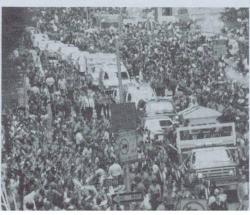 After 27 and a half years in prison, Nelson Mandela finally won his freedom today and promptly urged his supporters at home and abroad to increase their pressure against the white minority Goverment that had just released him. ''We have waited too long for our freedom,'' Mr. Mandela told a cheering crowd from a balcony of Cape Town's old City Hall. ''We can wait no longer.'' ''Now is the time to intensify the struggle on all fronts,'' he said. ''To relax our efforts now would be a mistake which generations to come will not able to forgive.''
 Mr. Mandela's 20-minute speech, which he prepared before leaving prison today, constituted his first remarks in public since before he was sentenced in June 1964 to life imprisonment for conspiracy to overthrow the Government and engage in sabotage. He asked the international community not to lift its sanctions against South Africa, despite the recent changes introduced by President F. W. de Klerk, which culminated in Mr. Mandela's release. ''To lift sanctions now would be to run the risk of aborting the process toward ending apartheid,'' he said.
Mr. Mandela's voice sounded firm and his words as eloquently militant as when he defended violence as the ultimate recourse at his political trial in 1964. Though he looked all of his 71 years and was grayer than artists' renditions over the years had depicted, he walked out of Victor Verster prison erect and vigorous. In Washington, President Bush rejoiced over the release of Mr. Mandela, spoke to him by telephone and invited the anti-apartheid leader to visit the White House. Mr. Mandela gave no evidence that his militant opposition to apartheid had been tempered by the more than 10,000 days he spent in confinement. But he also said nothing that would have surprised the Government had he said it during his years of incarceration. Indeed, there appeared to be nothing in Mr. Mandela's initial remarks after his release to give the Government much consolation or encouragement. Although he has been viewed as a potential leader for all South Africans, he stressed time and again that his loyalty lay with the African National Congress, for which he was working underground when he was jailed in August 1962 on charges of incitement and leaving the country illegally. He was serving time on that conviction when he was sentenced to life imprisonment in 1964.
Mr. Mandela told a crowd that he remained a ''loyal and disciplined member'' of the African National Congress and still endorsed its policies, including its use of armed struggle against the white minority Government. He said he saluted the congress's military wing, Spear of the Nation, and its ally, the South African Communist Party, ''for its steady contribution to the struggle for democracy.'' But he also thanked the Black Sash, an organization of white women working to end apartheid, and the predominantly white National Union of South African Students for being ''the conscience of white South Africans.'' And he held out an olive branch to all whites, asking them to join in shaping a new South Africa. ''The freedom movement is a political home for you, too,'' he said.
In his first speech after his release, Mr. Mandela may have taken an orthodox line with a mass audience sympathetic to the African National Congress and might in private discussions eshow greater flexibility on the question of discussions that the Government wants to have with blacks, who are 28 million of the population, compared with the 5 million whites of the ruling minority. He said he was only making some preliminary comments following his release, and would have more to say ''after I have had the opportunity to consult with my comrades.'' By this he meant the leaders of the African National Congress now in exile in Zambia as well as colleagues still based in South Africa. But he appeared to discourage any leading role for himself, such as the Government has in mind, saying, ''A leader of the movement is a person who has been democratically elected at a national conference.''
President de Klerk has invited black leaders to join talks leading to the formulation of a new constitution that would let black South Africans take part at last in their nation's politics.Mr. Mandela acknowledged to the crowd that he had conducted a dialogue with the Government during his last years in prison. But he added: ''My talks with the Government have been aimed at normalizing the political situation in the country. We have not yet begun discussing the basic demands of our struggle. I wish to stress that I myself have at no time entered into negotiations about the future of our country, except to insist on a meeting between the A.N.C. and the Government,'' he said. He described Mr. de Klerk, whom he has met twice since December, as ''a man of integrity. Mr. de Klerk has gone further than any other Nationalist President in taking real steps to normalize the situation,'' Mr. Mandela said. ''But as an organization we base our policy and strategy and tactics on the harsh reality we are faced with,'' he said. ''And this reality is that we are still suffering under the policies of the Nationalist Government.''
The National Party, which Mr. de Klerk now leads, instituted apartheid after taking power in 1948. Mr. Mandela said the Government had to take further steps before negotiations could begin. As a prerequisite for negotiations, he reiterated two demands that he had conveyed from prison through recent visitors. These are are the lifting of the state of emergency, which was imposed in June 1986, and the release of all political prisoners, including those accused of crimes committed in the struggle against apartheid. ''Only such a normalized situation which allows for free political activity can allow us to consult our people in order to obtain a mandate,'' Mr. Mandela said. He said the people had to be consulted about who would represent them in talks with the Government. ''Negotiations cannot take place above the heads or behind the backs of our people,'' he said. ''It is our belief that the future of our country can only be determined by a body which is democratically elected on a nonracial basis.''
Mr. Mandela appeared to allude to a formula under which a constituent assembly, in effect supplanting the existing Parliament, would draft a new constitution. Such a plan would mean the creation of an interim government in South Africa and has previously been rejected by Mr. de Klerk for the foreseeable future. Mr. Mandela walked out of Victor Verster Prison near Paarl at 4:15 P.M., 75 minutes later than the release time announced Saturday afternoon by Mr. de Klerk. Acquaintances of the Mandela family said his departure from the prison was delayed by family discussions. He was greeted by about 5,000 supporters lining the asphalt road outside the prison farm where he has been held since December 1988. Some waved the black, green and yellow flags of the African National Congress, from which Mr. de Klerk removed a ban on Feb. 2. Mr. Mandela was then driven 40 miles from Paarl to Cape Town, passing several hundred people who had parked by the roadside or waited on overpasses in hope of seeing him. They held homemade signs, some of which read simply, ''Welcome home.'' A huge crowd, which organizers said reached 250,000 people, assembled in the square in front of the old City Hall in Cape Town to greet Mr. Mandela. Reporters covering the rally put the crowd's size at only 50,000 people at its peak. They became impatient and sometimes unruly, waiting up to six hours in the hot sun and had dwindled to about 20,000 by sunset, when Mr. Mandela finally appeared.
In the 1950's it was Government policy to prevent blacks from settling in the Western Cape, so they are not in the clear majority in Cape Town, where Mr. Mandela was released. People of mixed race, known as ''coloreds,'' are the largest population group in Cape Town, where whites also outnumber blacks. Blacks, who account for nearly 75 percent of the population in the country as a whole, are in the overwhelming majority in the Johannesburg region, where Mr. Mandela can expect his most tumultuous welcome.
The festive occasion was marred by violence after some youths who had been drinking on the fringes of the rally started breaking windows and looting shops in downtown Cape Town. The police tried to disperse them by firing shotguns and tear gas, and some of the youths retaliated by throwing bottles and stones. At one point, drunken protesters invaded a Chinese restaurant, snatched up the liquor and wine and threw bottles at the police from the rooftop. One man in the crowd was also injured in a knife fight.
The South African Press Association reported tonight that 2 people had been killed and 13 wounded in the confrontations. A physician treating casualties on the scene estimated that 100 people had been wounded, mostly by buckshot. Most suffered only light injuries, including three journalists covering the rally. Cheryl Carolus, a spokeswoman for the United Democratic Front, which helped organize the rally, attributed the violence to outsiders who, she said, were ''beyond our usual crowds, or who supported the rival Pan-Africanist Movement.''' At times, some supporters at the rally had to scramble for cover as the police chased or fired at looters and stone-throwers. The Rev. Allan Boesak, a prominent figure in the anti-apartheid movement, pleaded for more than 45 minutes with the crowd to maintain discipline and move back.
Dullah Omar, a lawyer representing the Mandela family, said Mr. Mandela had been unaware of the violence. This evening, Mr. Mandela failed to appear at a news conference arranged by the reception committee that is handling his schedule. A representative said Mr. Mandela would meet the press later this week in Johannesburg. Mr. Mandela and his wife, Winnie, are expected to fly to Johannesburg on Monday and proceed to their home in the black township of Soweto. One of the organizers, Saki Mocozoma, said security considerations precluded him from revealing where the Mandelas were spending their first night.
Mr. Mandela also paid tribute to his wife, who has lived apart from him for more than 27 years, and their children. ''I am convinced that your pain and suffering was far greater than my own,'' he told them.
Source: New York Times
Thursday, December 14, 1989
De Klerk and Mandela Discuss Future

President F. W. de Klerk discussed South Africa's future with Nelson R. Mandela today, raising the expectation that the imprisoned anti-apartheid leader may be released early next year. Mr. de Klerk received Mr. Mandela, South Africa's most prominent political prisoner, at Tuynhuys, the President's office in Cape Town. Mr. Mandela, who has been in jail since 1963, is being held at a prison farm near Paarl, outside Cape Town.
Justice Minister Hendrick J. Coetsee, who attended the meeting, said that it was requested by Mr. Mandela and welcomed by Mr. de Klerk, who says he wants to create a climate for negotiations that would give the country's disenfranchised black majority a limited degree of political power. Taking Measure of Each Other In a cautiously worded statement, Mr. Coetsee said the meeting with Mr. Mandela ''fitted in with Mr. de Klerk's program to consult with the full spectrum of political opinion concerning the mutual future of all South Africans.'' The discussions between Mr. de Klerk and Mr. Mandela, he said, included ''ways and means to address current obstacles in the way of meaningful dialogue.'' Mr. Coetsee declined to give more details, saying further statements ''would serve no positive purpose.'' But Mr. Mandela's release has been a consistent precondition of black leaders across the political spectrum for talks with the white minority Government.
The state-run South African Broadcasting Corporation, in reporting news of the meeting on the television evening news, showed an old photograph of Mr. Mandela, indicating a departure from the official position that his photograph not be shown or published because South African law treats him as a banned person. Today's meeting created the opportunity for the most prominent white and black South Africans to take personal measure of each other. Mr. Coetsee did not say how long the meeting lasted. The Justice Minister said follow-up talks between Mr. de Klerk and Mr. Mandela were envisioned in the new year, a statement that indicated Mr. Mandela would not be freed this month. Criticism From the Right
During a visit to the Ivory Coast on Dec. 2, President de Klerk told reporters that the question was not whether Mr. Mandela would be released but when and under what circumstances. Today's meeting was criticized by Andries Treurnicht, the leader of the right-wing Conservative Party, who said that it amounted to an unbanning of the outlawed African National Congress, to which Mr. Mandela has belonged for 45 years. But the liberal Democratic Party welcomed the meeting. In a statement, its co-leader, Denis Worrall, said Mr. Mandela's request to see President de Klerk ''suggests Mr. Mandela understands what an important role he has to play and how deeply his initial approach will influence in particular white South African attitudes.''
There have been reports that Mr. Mandela was remaining in prison by his own choice in order to get more jailed comrades released and to work out details for negotiations with the Government. But Dullah Omar, a Cape Town attorney, discounted such suggestions after lunching yesterday with Walter and Albertina Sisulu. Mr. Sisulu, a comrade of Mr. Mandela in both the outlawed African National Congress and in prison, visited Mr. Mandela for three hours yesterday.
Mr. de Klerk freed Mr. Sisulu and seven other long-term political prisoners, six of whom belonged to the Congress, on Oct. 15 in a gesture seen as a rehearsal for Mr. Mandela's release. Mr. Omar said Mr. Sisulu told him that of the issues he and Mr. Mandela discussed, ''the most relevant one was Mr. Mandela's continued imprisonment. Mr. Mandela emphatically denies that he has chosen not to be released now.'' ''He says he does not know why he has not been released with the others,'' Mr. Omar continued, according to a report by the South African Press Association. ''He has the right to be released but is not prepared to beg for his release.''
New York Times
Subscribe to:
Posts (Atom)