Twenty former members of the disbanded Durban Organised Crime Unit face 71 charges, including 14 of murder, the Durban Regional Court has been told. One of the members, Captain Neville Eva, told the court he intended pleading not guilty to all the charges. Also on the provisional indictment are 14 counts of defeating the ends of justice, as well as 14 charges of unlawful possession of weapons and ammunition.
The court was packed for the bail hearings of the 20, who stand accused of being part of a hit squad.
Eva said that when the Sunday Times published an exposé alleging the existence of the hit squad, all members of the unit promised the then Independent Complaints Directorate – since renamed the Independent Police Investigative Directorate (IPID) – they would cooperate with the investigation. “Our attitude was to assist the investigation in any way possible.” Eva said the members were ordered to hand in their weapons, laptops and cellphones earlier this year.
They were also instructed not to take on any new cases, but to continue with pending cases. Eva, a veteran of 27 years, said if they had intended to tamper with evidence, they had had six months in which to do so.
IPID spokesperson Moses Dlamini confirmed the 20 were arrested on Wednesday in a joint operation by the Hawks and the IPID. Protesters supporting the 20 men stood outside the court building with placards.
People had to stand outside the court in the hallway, because there was insufficient space for supporters and families of the accused, while police monitored the crowds inside and outside the building.
Magistrate Sharon Marks threatened to have the people removed if they did not keep quiet.
Source: Mail & Guardian
Showing posts with label ICD. Show all posts
Showing posts with label ICD. Show all posts
Thursday, June 21, 2012


Sunday, June 17, 2012
Richard Mdluli has some explaining to do
Suspended crime intellience head Lieutenant-General Richard Mdluli will have to explain why R150 000 of police funds was used to upgrade security at his house when he appears before a disciplinary hearing in July, City Press reported on Sunday.
The 10 charges Mdluli faces were revealed in court papers filed by former acting police chief Nhlanhla Mkhwanazi in the Johannesburg Labour Court this week. The charges against him relate to his alleged abuse of a crime intelligence “slush fund”, that he misled investigations into 250 covert appointments of crime intelligence operatives, and appointed family members and friends to police positions. The charge sheet states that Mdluli allegedly spent R150 209 on security upgrades to his Boksburg home, authorised air travel for his wife and children to the value of R84 199, and spent R46 809 on business class tickets for his wife.
Mdluli remains suspended from the police service, pending various court actions. The Labour Court case in which Mdluli is challenging his suspension is due to be heard this week. Last year, Mdluli faced fraud and corruption charges for the misuse of the fund, and faced a murder charge for the death of his former lover’s husband. The charges led to his initial suspension. This year, all the charges were withdrawn and Mdluli was reinstated in March. This was widely criticised by, among others, the Democratic Alliance and lobby group Freedom Under Law. Police Minister Nathi Mthethwa later moved him to a different division but Mkhwanazi opted to suspend him. The suspension was lifted by the Labour Court on June 1 but subsequently overturned by the same court.
New top cop Mangwashi Phiyega said she will comment on the investigation into Mdluli after she has read the files on him, the paper reported. “I will be dealing with it.”
Phiyega said documents seen in newspapers were “adulterated”. “Now that I’m here, they will show me the real files and maybe when you talk to me 12 months down the line, I will be able to say I did see the real files and what we were seeing wasn’t the real thing,” she told the publication.
Phiyega also commended the Independent Police Investigative Directorate.
“No doctor can doctor herself. It’s critical and important to have the directorate to police us and to regulate us. I really appreciate its existence.”
Source: Mail & Guardian
The 10 charges Mdluli faces were revealed in court papers filed by former acting police chief Nhlanhla Mkhwanazi in the Johannesburg Labour Court this week. The charges against him relate to his alleged abuse of a crime intelligence “slush fund”, that he misled investigations into 250 covert appointments of crime intelligence operatives, and appointed family members and friends to police positions. The charge sheet states that Mdluli allegedly spent R150 209 on security upgrades to his Boksburg home, authorised air travel for his wife and children to the value of R84 199, and spent R46 809 on business class tickets for his wife.
Mdluli remains suspended from the police service, pending various court actions. The Labour Court case in which Mdluli is challenging his suspension is due to be heard this week. Last year, Mdluli faced fraud and corruption charges for the misuse of the fund, and faced a murder charge for the death of his former lover’s husband. The charges led to his initial suspension. This year, all the charges were withdrawn and Mdluli was reinstated in March. This was widely criticised by, among others, the Democratic Alliance and lobby group Freedom Under Law. Police Minister Nathi Mthethwa later moved him to a different division but Mkhwanazi opted to suspend him. The suspension was lifted by the Labour Court on June 1 but subsequently overturned by the same court.
New top cop Mangwashi Phiyega said she will comment on the investigation into Mdluli after she has read the files on him, the paper reported. “I will be dealing with it.”
Phiyega said documents seen in newspapers were “adulterated”. “Now that I’m here, they will show me the real files and maybe when you talk to me 12 months down the line, I will be able to say I did see the real files and what we were seeing wasn’t the real thing,” she told the publication.
Phiyega also commended the Independent Police Investigative Directorate.
“No doctor can doctor herself. It’s critical and important to have the directorate to police us and to regulate us. I really appreciate its existence.”
Source: Mail & Guardian
Monday, February 6, 2012
The South African Constitutional Court Extends Police Accountability
Should the police be more trustworthy than any other citizen? And if they are not, can you hold the Minister of Police to account? In an important unanimous judgement penned by South African Chief Justice Mogoeng Mogoeng and handed down on 15 December 2011, the answer to these questions was a resounding “yes.” This judgement has effectively set new legal precedent by extending the basis for civil claims against police officers who break the law and cause injury or damage to citizens. Most importantly, this judgement holds that even when off-duty, if there is enough of a connection between their employment as police officers and their illegal acts, the Minister of Police may be held liable.
This ground-breaking case began 14 years ago in 1998 when Allister van Wyk, a police officer, raped a thirteen year old girl outside the town of George in the Western Cape. The incident started in the early hours of the morning when the girl had needed a lift home from a night-club. Mr van Vyk offered to give her a lift home as he was doing the same for two of his friends. He was driving an unmarked police vehicle at the time that had been allocated to him as he was on standby duty and would need to be able to respond quickly if he was called to pace himself on duty. Knowing he was a police officer and was driving a police vehicle, the girl felt that it would be safe to accept a lift from him. After leaving the night club, van Wyk first dropped off his friends, but then, instead of driving her home, he drove out of town towards an area known as ‘the Wilderness’, stopping in the Kaaimans pass at a dark and secluded picnic spot alongside the estuary.
The girl, realising that he wasn’t driving her straight home as promised, became afraid and jumped from the car as soon as it stopped. She managed to get away and hide amongst the trees and bush until he left. Then she made her way back to the main road with the intention of hitchhiking back into George. She didn’t wait long before a vehicle stopped for her. To her surprise it was the same car she had just escaped from, driven by van Wyk. Although reluctant to climb back in, van Wyk assured her that he would take her home unharmed. Given that there were very few vehicles on this road at that time of the morning, she felt she had little choice but to accept. Van Wyk drove a short way up the road before stopping, assaulting and then raping her. He then drove her home and threatened to hurt or kill her if she told anyone what he had done.
She bravely defied his threats and reported the incident to the police who arrested van Wyk and charged him with rape. He was later convicted of the crime and was sent to prison. Shockingly, at the time of the rape van Wyk was head of the George detective unit, this was in spite of having four previous criminal convictions against him.
In 2005 the girl, now a young woman, brought a civil claim for damages against van Wyk and the Minister of Police. She held the Minister liable for van Wyk’s action and sought to claim damages from the police. Although the High Court ruled in her favour, the police appealed the decision which was subsequently overturned in a majority judgement by the Supreme Court of Appeal on the basis that van Wyk was off-duty at the time of the incident and that the Minister could therefore not be held liable. She then appealed that ruling in the Constitutional Court.
The question the Constitutional Court was called on to answer, was whether the Minister of Police could be held accountable for the actions of police officers, who were not on active duty; and whether police officers should be more worthy of our trust than any other citizen. The Institute for Security Studies was the first of three civil-society organisations to apply to act as amicus curie (friends of the court) by bringing expert testimony in the matter. We did so because this case offered an opportunity to strengthen police accountability by putting in place additional legal measures that citizens could use to hold the state liable for criminal and abusive behaviour by police officials.
The Court’s finding, that the Minister of Police, is indeed accountable for the actions of officers, represents an important milestone in the effort to ensure that the police act to project, rather than harm citizen’s even when they are not on active duty. It means that the Minister of Police has a responsibility to ensure that the officers who are recruited, appointed and employed by the police are not criminals themselves. Fortunately, the current Minister of Police, Nathi Mthethwa has already publicly committed himself to professionalising the South African Police Service (SAPS). This finding is particularly important in the light of the increase in recent years of cases of human rights violations committed by the police. For instance, the Independent Complaints Directorate (ICD) reported 45 allegations of torture in its 2010-2011 report, the highest number reported since 1999.
Towards the end of 2011, the Parliamentary Portfolio Committee on Police heard that during the 2010-11 financial year, contingent civil claims against the SAPS, mostly arising out of police criminality and misconduct, had increased to the substantial amount of R11bn or about 20% of the total police budget. In the short-term the Constitutional Courts ruling is likely to mean that the police will face additional civil claims and will therefore have to allocate even more of their budget to cover the potential cost of these claims.
To prevent this, it is going to be necessary for the Minister to ensure that SAPS management put proper measures in place to ensure that the people they recruit, train and employ understand, accept and are held accountable to the burden of professional service that being a member of the police requires. If SAPS management is able to do this, it will result in better policing while costing the state less in civil claims in the long run.
Source: ISS
This ground-breaking case began 14 years ago in 1998 when Allister van Wyk, a police officer, raped a thirteen year old girl outside the town of George in the Western Cape. The incident started in the early hours of the morning when the girl had needed a lift home from a night-club. Mr van Vyk offered to give her a lift home as he was doing the same for two of his friends. He was driving an unmarked police vehicle at the time that had been allocated to him as he was on standby duty and would need to be able to respond quickly if he was called to pace himself on duty. Knowing he was a police officer and was driving a police vehicle, the girl felt that it would be safe to accept a lift from him. After leaving the night club, van Wyk first dropped off his friends, but then, instead of driving her home, he drove out of town towards an area known as ‘the Wilderness’, stopping in the Kaaimans pass at a dark and secluded picnic spot alongside the estuary.
The girl, realising that he wasn’t driving her straight home as promised, became afraid and jumped from the car as soon as it stopped. She managed to get away and hide amongst the trees and bush until he left. Then she made her way back to the main road with the intention of hitchhiking back into George. She didn’t wait long before a vehicle stopped for her. To her surprise it was the same car she had just escaped from, driven by van Wyk. Although reluctant to climb back in, van Wyk assured her that he would take her home unharmed. Given that there were very few vehicles on this road at that time of the morning, she felt she had little choice but to accept. Van Wyk drove a short way up the road before stopping, assaulting and then raping her. He then drove her home and threatened to hurt or kill her if she told anyone what he had done.
She bravely defied his threats and reported the incident to the police who arrested van Wyk and charged him with rape. He was later convicted of the crime and was sent to prison. Shockingly, at the time of the rape van Wyk was head of the George detective unit, this was in spite of having four previous criminal convictions against him.
In 2005 the girl, now a young woman, brought a civil claim for damages against van Wyk and the Minister of Police. She held the Minister liable for van Wyk’s action and sought to claim damages from the police. Although the High Court ruled in her favour, the police appealed the decision which was subsequently overturned in a majority judgement by the Supreme Court of Appeal on the basis that van Wyk was off-duty at the time of the incident and that the Minister could therefore not be held liable. She then appealed that ruling in the Constitutional Court.
The question the Constitutional Court was called on to answer, was whether the Minister of Police could be held accountable for the actions of police officers, who were not on active duty; and whether police officers should be more worthy of our trust than any other citizen. The Institute for Security Studies was the first of three civil-society organisations to apply to act as amicus curie (friends of the court) by bringing expert testimony in the matter. We did so because this case offered an opportunity to strengthen police accountability by putting in place additional legal measures that citizens could use to hold the state liable for criminal and abusive behaviour by police officials.
The Court’s finding, that the Minister of Police, is indeed accountable for the actions of officers, represents an important milestone in the effort to ensure that the police act to project, rather than harm citizen’s even when they are not on active duty. It means that the Minister of Police has a responsibility to ensure that the officers who are recruited, appointed and employed by the police are not criminals themselves. Fortunately, the current Minister of Police, Nathi Mthethwa has already publicly committed himself to professionalising the South African Police Service (SAPS). This finding is particularly important in the light of the increase in recent years of cases of human rights violations committed by the police. For instance, the Independent Complaints Directorate (ICD) reported 45 allegations of torture in its 2010-2011 report, the highest number reported since 1999.
Towards the end of 2011, the Parliamentary Portfolio Committee on Police heard that during the 2010-11 financial year, contingent civil claims against the SAPS, mostly arising out of police criminality and misconduct, had increased to the substantial amount of R11bn or about 20% of the total police budget. In the short-term the Constitutional Courts ruling is likely to mean that the police will face additional civil claims and will therefore have to allocate even more of their budget to cover the potential cost of these claims.
To prevent this, it is going to be necessary for the Minister to ensure that SAPS management put proper measures in place to ensure that the people they recruit, train and employ understand, accept and are held accountable to the burden of professional service that being a member of the police requires. If SAPS management is able to do this, it will result in better policing while costing the state less in civil claims in the long run.
Source: ISS
Wednesday, April 20, 2011
South Africa Exults Abroad but Frets at Home
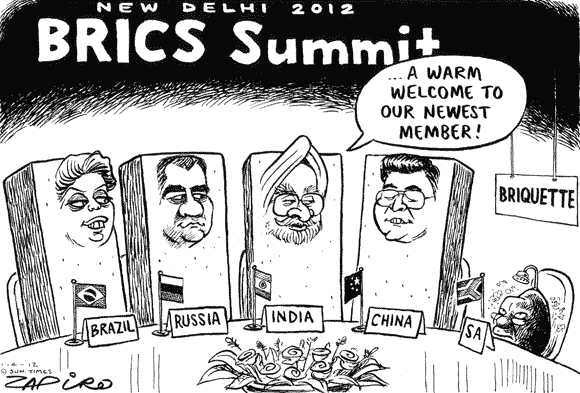
With the country preparing for local elections on May 18, the cabinet member Mr. Zuma chose to oversee local government, Sicelo Shiceka, is now embroiled in scandalous reports about his profligate living at public expense. Mr. Zuma announced Sunday that he was awaiting an explanation from Mr. Shiceka that has yet to come. “It’s this flaunting of inequality and conspicuous consumption that people get agitated about,” said Ben Roberts, a researcher at the Human Sciences Research Council, which recently conducted a survey of South Africans documenting widespread disillusionment with local government.
Parliamentary leaders of Mr. Zuma’s party, the African National Congress, have asked for independent investigators in the public protector’s office to find out whether Mr. Shiceka spent more than $50,000 of taxpayers’ money to fly to Switzerland and stay in five-star hotels while visiting his girlfriend, a flight attendant, who was jailed there on drug charges, as The Sunday Times of South Africa reported.
In a follow-up article on Sunday, the newspaper reported that municipal trucks were delivering water to the building site of Mr. Shiceka’s new home in the poorest district in the Eastern Cape. His home was also slated to be among the first to get electricity. “What a disgrace!” shouted the headline. “Minister builds emperor’s palace in South Africa’s poorest village.”
Corruption and great disparities in wealth are hardly uncommon among the other BRICS countries. But the lack of basic services has touched a particular nerve here. People in Mr. Shiceka’s home district had been protesting the poor quality of water and sewerage services. And it was precisely these issues that led poor people in Ficksburg, a town in the Free State, to take to the streets last week in a protest that ended in tragedy. SABC, the state broadcaster, showed police officers in Ficksburg assaulting an unarmed, shirtless protester named Andries Tatane, 33, and thwacking his torso with batons. Mr. Tatane then looked down at his chest, streaming with blood. A haunting photograph shows him lying wounded in the arms of a friend whose face is contorted in anguish. Mr. Tatane died minutes later. “The post-mortem showed he died of gunshot wounds,” said Moses Dlamini, spokesman for the Independent Complaints Directorate, which investigates police brutality. “And he had bruises which indicated he was assaulted.” Two police officers have been charged with the murder and four others with assault, but not before enraged residents of Mr. Tatane’s township set fire to two government buildings.
An African National Congress spokesman, Jackson Mthembu, described the attack on Mr. Tatane as reminiscent of “apartheid-era strong-arm tactics” — a remarkable statement considering that the A.N.C. itself led the struggle against apartheid and has governed the country, and overseen its police force, since 1994.
The so-called service delivery protests, a phenomenon across the country, provide signs of the simmering discontent among many South Africans about how long it is taking to translate the gains of freedom into material progress. Even as South Africa takes center stage with the world’s most prominent developing nations, a majority of young black South Africans are jobless. Poverty remains widespread. A nationwide survey of about 3,200 South Africans age 16 and older, sponsored by the country’s Independent Electoral Commission, found that South Africans were most dissatisfied with local government performance on job creation, crime and housing.
The survey, released last week, documented an erosion of trust at all levels of government, with the lowest approval level — 38 percent — reserved for local government, down from a high of 55 percent in 2004. Politicians rated even lower. Only 27 percent of South Africans trusted them when the survey was conducted in the final months of 2010. The main opposition party, the Democratic Alliance — widely perceived as dominated by whites — has sought to attract more black support by highlighting its strong record in running the city of Cape Town. Helen Zille, the former journalist who leads the party, has seized on the killing of Mr. Tatane as emblematic of how the A.N.C. has “become disconnected from the people it is supposed to serve.”
But the loyalty of voters to the A.N.C., the party of Nelson Mandela, remains deep, and the survey found that those who were most unhappy with government were also the ones who said they were least likely to vote. So the question of whether discontent leads to change in the ballot box remains open.
Source: New York Times
Tuesday, April 19, 2011
Arresting a Few Policemen will not Solve South Africa`s Violent Policing Problem
The brutal death of unarmed protestor and father of two, Andries Tatane, at the hands of the South African police in Ficksburg on 13 April would have gone largely unnoticed except that it was captured on film and shown as headline news on national television. South Africans and people around the world were rightly outraged at the senseless and disproportionate violence directed at Mr. Tatane by a mob of policemen. The harsh reality is that many police officials who watching the news would not have been shocked at seeing him beaten with batons and shot at from close range with rubber bullets. Because Tatane was fighting back at policemen attacking him, many police officials would have thought that he deserved the beating. The use of excessive violence as part of everyday policing has long been the norm in South Africa. What was different this time was not only that the victim died shortly thereafter, but that it was captured on film and broadcast on public television.
The warning signs that the police are becoming increasingly violent have been around for some time. The Independent Complaints Directorate (ICD) annually reports on police related deaths, assaults and other forms of serious misconduct to parliament. Statistics collected by the ICD reveal that the number of people shot dead by the police more than doubled (increasing by over 100%) between 2005/06 and 2008/09, when a record high of 568 people were killed. The number dropped slightly but remained high at 524 shot dead during 2009/10. Moreover, the ICD statistics reveal that complaints of police assault with intention to commit grievous bodily harm (GBH) increased from 825 incidents in 2008/10 to 920 in 2009/2010. Unfortunately however, these figures have not resulted in any recognition that there might be a fundamental problem in the SAPS and no steps have been taken by police leadership to obtain a better understanding as to the cause of the increase or to reduce the number of killings.
Given the national and international profile given to this incident however, the Minister of Police Nathi Mthethwa immediately released a media statement in which he expressed his “…full confidence that the Independent Complaints Directorate (ICD) will, without fear or favour investigate an alleged killing of a striking resident by police during a march in Ficksburg.” A few days later the Minister released another statement welcoming the arrest of six policemen implicated in the killing and highlighting that he has been consistent in his stance that, “those who break the law must be punished.” It is unusual for the ICD to act so quickly in response to complaints of police brutality, but given the widespread condemnation of this incident and the directive from the Minister, it is understandable.
Unfortunately however, this approach where incidents are referred to the ICD for investigation is not going to solve this deep and ongoing problem. The investigations may or may not reveal whether the police officials involved acted within the scope of the law and police regulations. If it is found that they broke the law then the ICD will give the docket to the National Prosecuting Authority who may decide to criminally prosecute the policemen. If SAPS regulations were broken then the ICD will make recommendations to the SAPS that disciplinary action is taken against the offending officials. The SAPS generally ignore these recommendations from the ICD but even when they do act on them, the only outcome will be that a few officials will be held accountable. This will not address the underlying management, structural and cultural problems that are contributing to this growing problem.
The ANC was correct to call for a commission of inquiry into Tatane’s death, as this is exactly what is needed at this time. Rather than only focusing on the individual officials as the ICD investigation will do, such an inquiry should look at the organisational context within which these police officials were operating. If it does so it is likely to find that inadequate command and control was generally exercised over the officials and that the SAPS standing operating procedures and the code of conduct were largely ignored. It is also likely to find that the training these officials received was sub-standard and that they were not properly assessed as to the extent to which they understand their role and responsibilities in handling public protests. Further still, such an inquiry could note that poor strategic decisions taken by SAPS leadership over the past decade resulted in the closure of specialised units including half of the Public Order Policing units, although these were belatedly re-established for the 2010 FIFA World Cup. Consequently, the SAPS does not possess adequate skills and capacity to professionally respond to a number of the challenges it faces including maintaining public order.
If such an inquiry correctly includes a focus on those who have the authority and responsibility to ensure that the police uphold the law, then the political context of this killing cannot be ignored. Since 2008 when Deputy Minister of Police, Susan Shabangu called for police to “shoot to kill”, the SAPS has been led down a dangerous path where political rhetoric urging police to “show no mercy” to whomever they choose to label as “criminals” has replaced a firm commitment to ensuring that the SAPS adheres to acceptable standards of police professionalism and the rule of law. The “police service” was rhetorically renamed a “police force”, military style ranks were introduced and a “war on crime” was announced. While the Minister of Police has implored the police to “…respect the principles of human dignity and rights” he also appears to justify police violence by warning civilians, “not to provoke or insult the police.” This suggests that at the most senior levels of government, police violence is not seen as a fundamental challenge that police leadership has a duty to contain as much as it is something that civilians should avoid in the way that they act towards police officials.
David Bruce from the Centre for the Study of Violence and Reconciliation who has been studying violence and policing in South Africa presented a paper at an ISS Conference on Crime and Crime Prevention in December 2010 in which he highlights the urgent need, “… for policing which is carried out fairly and respectfully.” He goes on to argue that, “There is some evidence ‘that the manner in which people are treated by agents of the criminal justice system contributes not only to respect for [the criminal] justice [system] but to respect for the law itself’. Essentially this means that people are more likely to voluntarily obey the law if they believe that agents of the criminal justice system will act towards them in a fair way.” This is an insight that the current leadership would do well to heed.
The Mail & Guardian recently quoted a government insider as stating that President Jacob Zuma had appointed General Cele to show South Africans that “police must be feared and respected”. However, fear does not necessarily bring respect. If one listens to the public outrage about this killing one would be hard pressed to find many people expressing respect for the police and far more likely to hear expressions of police disdain, even hate. However, state policing can be respected only if government changes its militant approach to policing and recognises it for the professional craft that it should be. Given that many of the problems currently facing the SAPS stem from decades of poor leadership and bad strategic decisions, effective change will need to be guided by an independent commission of inquiry that specifically focuses on the managerial, structural and cultural challenges that need to be addressed to professionalise the organisation. Until this happens, the tragic killing of Andries Tatane will not be the last such policing related incident to shock South Africa.
Source: Polity
The warning signs that the police are becoming increasingly violent have been around for some time. The Independent Complaints Directorate (ICD) annually reports on police related deaths, assaults and other forms of serious misconduct to parliament. Statistics collected by the ICD reveal that the number of people shot dead by the police more than doubled (increasing by over 100%) between 2005/06 and 2008/09, when a record high of 568 people were killed. The number dropped slightly but remained high at 524 shot dead during 2009/10. Moreover, the ICD statistics reveal that complaints of police assault with intention to commit grievous bodily harm (GBH) increased from 825 incidents in 2008/10 to 920 in 2009/2010. Unfortunately however, these figures have not resulted in any recognition that there might be a fundamental problem in the SAPS and no steps have been taken by police leadership to obtain a better understanding as to the cause of the increase or to reduce the number of killings.
Given the national and international profile given to this incident however, the Minister of Police Nathi Mthethwa immediately released a media statement in which he expressed his “…full confidence that the Independent Complaints Directorate (ICD) will, without fear or favour investigate an alleged killing of a striking resident by police during a march in Ficksburg.” A few days later the Minister released another statement welcoming the arrest of six policemen implicated in the killing and highlighting that he has been consistent in his stance that, “those who break the law must be punished.” It is unusual for the ICD to act so quickly in response to complaints of police brutality, but given the widespread condemnation of this incident and the directive from the Minister, it is understandable.
Unfortunately however, this approach where incidents are referred to the ICD for investigation is not going to solve this deep and ongoing problem. The investigations may or may not reveal whether the police officials involved acted within the scope of the law and police regulations. If it is found that they broke the law then the ICD will give the docket to the National Prosecuting Authority who may decide to criminally prosecute the policemen. If SAPS regulations were broken then the ICD will make recommendations to the SAPS that disciplinary action is taken against the offending officials. The SAPS generally ignore these recommendations from the ICD but even when they do act on them, the only outcome will be that a few officials will be held accountable. This will not address the underlying management, structural and cultural problems that are contributing to this growing problem.
The ANC was correct to call for a commission of inquiry into Tatane’s death, as this is exactly what is needed at this time. Rather than only focusing on the individual officials as the ICD investigation will do, such an inquiry should look at the organisational context within which these police officials were operating. If it does so it is likely to find that inadequate command and control was generally exercised over the officials and that the SAPS standing operating procedures and the code of conduct were largely ignored. It is also likely to find that the training these officials received was sub-standard and that they were not properly assessed as to the extent to which they understand their role and responsibilities in handling public protests. Further still, such an inquiry could note that poor strategic decisions taken by SAPS leadership over the past decade resulted in the closure of specialised units including half of the Public Order Policing units, although these were belatedly re-established for the 2010 FIFA World Cup. Consequently, the SAPS does not possess adequate skills and capacity to professionally respond to a number of the challenges it faces including maintaining public order.
If such an inquiry correctly includes a focus on those who have the authority and responsibility to ensure that the police uphold the law, then the political context of this killing cannot be ignored. Since 2008 when Deputy Minister of Police, Susan Shabangu called for police to “shoot to kill”, the SAPS has been led down a dangerous path where political rhetoric urging police to “show no mercy” to whomever they choose to label as “criminals” has replaced a firm commitment to ensuring that the SAPS adheres to acceptable standards of police professionalism and the rule of law. The “police service” was rhetorically renamed a “police force”, military style ranks were introduced and a “war on crime” was announced. While the Minister of Police has implored the police to “…respect the principles of human dignity and rights” he also appears to justify police violence by warning civilians, “not to provoke or insult the police.” This suggests that at the most senior levels of government, police violence is not seen as a fundamental challenge that police leadership has a duty to contain as much as it is something that civilians should avoid in the way that they act towards police officials.
David Bruce from the Centre for the Study of Violence and Reconciliation who has been studying violence and policing in South Africa presented a paper at an ISS Conference on Crime and Crime Prevention in December 2010 in which he highlights the urgent need, “… for policing which is carried out fairly and respectfully.” He goes on to argue that, “There is some evidence ‘that the manner in which people are treated by agents of the criminal justice system contributes not only to respect for [the criminal] justice [system] but to respect for the law itself’. Essentially this means that people are more likely to voluntarily obey the law if they believe that agents of the criminal justice system will act towards them in a fair way.” This is an insight that the current leadership would do well to heed.
The Mail & Guardian recently quoted a government insider as stating that President Jacob Zuma had appointed General Cele to show South Africans that “police must be feared and respected”. However, fear does not necessarily bring respect. If one listens to the public outrage about this killing one would be hard pressed to find many people expressing respect for the police and far more likely to hear expressions of police disdain, even hate. However, state policing can be respected only if government changes its militant approach to policing and recognises it for the professional craft that it should be. Given that many of the problems currently facing the SAPS stem from decades of poor leadership and bad strategic decisions, effective change will need to be guided by an independent commission of inquiry that specifically focuses on the managerial, structural and cultural challenges that need to be addressed to professionalise the organisation. Until this happens, the tragic killing of Andries Tatane will not be the last such policing related incident to shock South Africa.
Source: Polity
Friday, November 5, 2010
Cloud over murder statistics
A filing cabinet packed with about 100 postmortem reports of murders and other unnatural deaths, which were not referred to the police for investigation, has been discovered at the Salt River mortuary in Cape Town. The discovery was made last year and brought to the attention of Mzwandile Petros, the former Western Cape police commissioner, now the commissioner in Gauteng. It is understood that he did not act until health authorities confirmed the existence of the reports.
It has been reported that Petros is heading a task team that is conducting a countrywide investigation into the validity of crime statistics, particularly with regard to inquest and murder dockets. His latest appointment will raise eyebrows, given his lack of prompt action in solving the Salt River mortuary mystery and his failure to launch an inquiry into the alleged manipulation of crime statistics at police stations in the Western Cape.
The Salt River post-mortems are understood to date back three years. Although the bodies were removed for burial or cremation, the cases were not investigated as they were not registered on the police crime administration system. Police liaison officers were sent to the mortuary earlier this year to address the problem and by last month the final post-mortem reports were registered with the police, sources said.
Many of the names of the deceased were found recorded in the reports but some identities were unknown. A similar situation arose at Tygerberg mortuary, where a smaller cache of post-mortem reports was found, but these were later registered with the police. The issue of how to prevent a recurrence was raised at recent meetings of the health department (which runs the two mortuaries), the police and justice officials. Petros was handed a detailed report on the issue after the matter had been raised at previous meetings. However, the police have still not established who put the post-mortem reports in the cabinet, or why they were not referred to the police.
It is believed these cases could have fallen through the cracks, as bodies are sometimes removed from Groote Schuur and Tygerberg hospitals and taken to mortuaries without police obtaining particulars. The task team that Petros has been appointed to lead is reported to be analysing 31 253 inquest dockets opened in the nine provinces in the 2009-2010 financial year. The probe is intended to reveal whether police stations filed deaths incorrectly under "inquest" instead of "murder".
In September Nathi Mthethwa, the police minister, announced that violent crime had declined last year, with murders down 8,6%. But police say the nationwide probe could raise questions about the authenticity of these figures. Last year former Western Cape police commissioner Lennit Max accused Petros of ignoring a letter he had written to him and the former acting national commissioner, Tim Williams, calling for an inquiry into the information he had been given that crime statistics were being manipulated at police stations in Paarl, Paarl East, Mbekweni, Wellington and Oudtshoorn.
The Independent Complaints Directorate eventually investigated the matter, and said earlier this year that Petros had stalled the release of the long-awaited report. According to leaked internal police reports, Petros and one of his former assistants, Anwa Dramat, now head of the Hawks, were informed at least three years ago that police stations in the province were manipulating crime statistics.
Petros claimed that one of the reports was a fake and refused to discuss the others. Neither Petros nor the Western Cape police had responded to questions from the Mail & Guardian at the time of going to press.
Source: Mail & Guardian
It has been reported that Petros is heading a task team that is conducting a countrywide investigation into the validity of crime statistics, particularly with regard to inquest and murder dockets. His latest appointment will raise eyebrows, given his lack of prompt action in solving the Salt River mortuary mystery and his failure to launch an inquiry into the alleged manipulation of crime statistics at police stations in the Western Cape.
The Salt River post-mortems are understood to date back three years. Although the bodies were removed for burial or cremation, the cases were not investigated as they were not registered on the police crime administration system. Police liaison officers were sent to the mortuary earlier this year to address the problem and by last month the final post-mortem reports were registered with the police, sources said.
Many of the names of the deceased were found recorded in the reports but some identities were unknown. A similar situation arose at Tygerberg mortuary, where a smaller cache of post-mortem reports was found, but these were later registered with the police. The issue of how to prevent a recurrence was raised at recent meetings of the health department (which runs the two mortuaries), the police and justice officials. Petros was handed a detailed report on the issue after the matter had been raised at previous meetings. However, the police have still not established who put the post-mortem reports in the cabinet, or why they were not referred to the police.
It is believed these cases could have fallen through the cracks, as bodies are sometimes removed from Groote Schuur and Tygerberg hospitals and taken to mortuaries without police obtaining particulars. The task team that Petros has been appointed to lead is reported to be analysing 31 253 inquest dockets opened in the nine provinces in the 2009-2010 financial year. The probe is intended to reveal whether police stations filed deaths incorrectly under "inquest" instead of "murder".
In September Nathi Mthethwa, the police minister, announced that violent crime had declined last year, with murders down 8,6%. But police say the nationwide probe could raise questions about the authenticity of these figures. Last year former Western Cape police commissioner Lennit Max accused Petros of ignoring a letter he had written to him and the former acting national commissioner, Tim Williams, calling for an inquiry into the information he had been given that crime statistics were being manipulated at police stations in Paarl, Paarl East, Mbekweni, Wellington and Oudtshoorn.
The Independent Complaints Directorate eventually investigated the matter, and said earlier this year that Petros had stalled the release of the long-awaited report. According to leaked internal police reports, Petros and one of his former assistants, Anwa Dramat, now head of the Hawks, were informed at least three years ago that police stations in the province were manipulating crime statistics.
Petros claimed that one of the reports was a fake and refused to discuss the others. Neither Petros nor the Western Cape police had responded to questions from the Mail & Guardian at the time of going to press.
Source: Mail & Guardian
Thursday, August 6, 2009
Beukman appointed as ICD head
Cape Town - Parliament gave the police ministry the go-ahead on Thursday to appoint former ANC MP Francois Beukman as the head of the Independent Complaints Directorate (ICD). The appointment was approved by members of the ruling party and the opposition on Parliament's portfolio committee on police after Police Minister Nathi Mthethwa told them on Monday Beukman was his choice for the post.
Beukman is a former National Party politician who chaired the legislature's watchdog public accounts committee from 2002 to 2005 before defecting to the African National Congress.
All parties agreed to the appointment, but Congress of the People MP Mluleki George said though he had nothing against Beukman and new national police commissioner Bheki Cele, he believed it was wrong to appoint politicians to head important public bodies. "I have no problem with Mr Francois Beukman, but it is a question of principle. You need professional people do deal with them," he told the committee.
Opposition parties strongly objected to Cele's appointment as South Africa's new top cop last week, saying as a member of the ANC National Executive Committee he could not be trusted to be neutral in his new job. Cele who was present as George spoke, having just briefed the committee on planning in various departments of the police force, shrugged off the criticism. "Thanks for your Damascus moment, George," he said, referring to George's defection from the ANC to Cope last year.
Source: News 24
Beukman is a former National Party politician who chaired the legislature's watchdog public accounts committee from 2002 to 2005 before defecting to the African National Congress.
All parties agreed to the appointment, but Congress of the People MP Mluleki George said though he had nothing against Beukman and new national police commissioner Bheki Cele, he believed it was wrong to appoint politicians to head important public bodies. "I have no problem with Mr Francois Beukman, but it is a question of principle. You need professional people do deal with them," he told the committee.
Opposition parties strongly objected to Cele's appointment as South Africa's new top cop last week, saying as a member of the ANC National Executive Committee he could not be trusted to be neutral in his new job. Cele who was present as George spoke, having just briefed the committee on planning in various departments of the police force, shrugged off the criticism. "Thanks for your Damascus moment, George," he said, referring to George's defection from the ANC to Cope last year.
Source: News 24
Sunday, July 5, 2009
Crime stats scam exposed
A KwaZulu-Natal police whistleblower, who was suspended without pay because, he said, he exposed fraudulent crime statistics, has had his salary reinstated.
Constable Craig Josiah approached the KwaZulu-Natal High Court in Pietermaritzburg last month to set aside his suspension. He claimed he had been victimised and subjected to trumped-up charges after he exposed "fraudulent" activities in the capturing of crime statistics.
Judge Fikile Mokgohloa ordered that Josiah's salary be reinstated pending the state's filing of its papers and argument in court on Josiah's suspension.
Josiah's station commissioner, Director Hariram Badul, had discontinued his salary on March 9. This was after the Independent Complaints Directorate (ICD), acting on information provided by Josiah, raided the Mountain Rise Police Station in Pietermaritzburg and discovered 170 unregistered dockets stacked away in a room.
Source: Mail & Guardian
Constable Craig Josiah approached the KwaZulu-Natal High Court in Pietermaritzburg last month to set aside his suspension. He claimed he had been victimised and subjected to trumped-up charges after he exposed "fraudulent" activities in the capturing of crime statistics.
Judge Fikile Mokgohloa ordered that Josiah's salary be reinstated pending the state's filing of its papers and argument in court on Josiah's suspension.
Josiah's station commissioner, Director Hariram Badul, had discontinued his salary on March 9. This was after the Independent Complaints Directorate (ICD), acting on information provided by Josiah, raided the Mountain Rise Police Station in Pietermaritzburg and discovered 170 unregistered dockets stacked away in a room.
Source: Mail & Guardian
Wednesday, January 5, 2000
ICD to probe Selebi swearing claim
Charges of crimen injuria against National Police Commissioner Jackie Selebi would be probed by the Independent Complaints Directorate, Selebi's office said on Tuesday. Spokeswoman Director Sally de Beer said the ICD was perfectly placed to handle the investigation as it was independent from the SA Police Service. "This will help ensure a credible and objective finding," she said in Pretoria.
The Democratic Party earlier called on Selebi to go on leave pending the outcome of the probe into charges that he swore at a Pretoria policewoman on New Year's eve. "It is too much to expect that the inquiry can be concluded impartially with the new commissioner on duty," the party's safety and security spokesman Graham McIntosh said in a statement.He questioned Selebi's motives for declining to elaborate on the incident by "hiding behind" the sub judice rule. "If he really called the policewoman a 'f... gorilla' he should be man enough to admit it and apologise," McIntosh said. "Instead he is subjecting himself and the SAPS to a long process which is not in the interest of South Africa."
Selebi allegedly swore at a female sergeant on duty at Pretoria's Brooklyn police station after he demanded a driver but was not recognised. The woman, identified as Sergeant Jeanette Mothiba, has laid a charge of crimen injuria against her new boss.
On Sunday Selebi said the charge resulted from "an unfortunate incident of mistaken identity". He said it would be improper for him to elaborate as the case was sub judice. The DP's Gauteng branch said in a separate statement it was understandable that Selebi was not as "recognisable" as he would have liked. "I have sympathy with the sergeant who apparently failed to snap to attention upon his entrance. I for one would not know the face of Mr Selebi, who has now been in office for a mere four days," according to public safety spokeswoman Shelley Loe.
"If Mr Selebi felt that it was so important to be instantly recognised by police throughout the country, I suggest that he issue a clear head and shoulder photograph of himself to be displayed in all police stations."
Source: Mail & Guardian
The Democratic Party earlier called on Selebi to go on leave pending the outcome of the probe into charges that he swore at a Pretoria policewoman on New Year's eve. "It is too much to expect that the inquiry can be concluded impartially with the new commissioner on duty," the party's safety and security spokesman Graham McIntosh said in a statement.He questioned Selebi's motives for declining to elaborate on the incident by "hiding behind" the sub judice rule. "If he really called the policewoman a 'f... gorilla' he should be man enough to admit it and apologise," McIntosh said. "Instead he is subjecting himself and the SAPS to a long process which is not in the interest of South Africa."
Selebi allegedly swore at a female sergeant on duty at Pretoria's Brooklyn police station after he demanded a driver but was not recognised. The woman, identified as Sergeant Jeanette Mothiba, has laid a charge of crimen injuria against her new boss.
On Sunday Selebi said the charge resulted from "an unfortunate incident of mistaken identity". He said it would be improper for him to elaborate as the case was sub judice. The DP's Gauteng branch said in a separate statement it was understandable that Selebi was not as "recognisable" as he would have liked. "I have sympathy with the sergeant who apparently failed to snap to attention upon his entrance. I for one would not know the face of Mr Selebi, who has now been in office for a mere four days," according to public safety spokeswoman Shelley Loe.
"If Mr Selebi felt that it was so important to be instantly recognised by police throughout the country, I suggest that he issue a clear head and shoulder photograph of himself to be displayed in all police stations."
Source: Mail & Guardian
Subscribe to:
Posts (Atom)